
Distinguished Professor of Psychiatry and of Neuroscience and Physiology, Norton College of Medicine, SUNY bsky.app/profile/adhdevidenc…
Joined August 2010
- Tweets 1,348
- Following 336
- Followers 24,926
- Likes 270
241 Photos and videos


Pinned Tweet

10 Feb 2025
1
1
8
1,361
Small-scale studies matter! These are not the studies to draw hard conclusions from, but research that begets more and better research: adhdevidence.org/blog/how-re…
143
New Meta-Analysis: CBT helps adults with ADHD actually function better, not just score lower on symptom checklists. adhdevidence.org/blog/meta-a…
1
2
111
New meta-analysis on kids with both ADHD and epilepsy: These two conditions co-occur way more than chance (~25% of kids with epilepsy also have ADHD). So what happens cognitively when both are present? adhdevidence.org/blog/when-a…
115
Stephen Faraone (he/him/his) retweeted

Jun 3
Why do some people light up when chasing ambitious goals, while others find fulfillment through connection or stability? Your motivational profile could help explain what energizes you—and what’s missing when life feels out of sync. By @swhitbo psychologytoday.com/us/blog/…
1
5
10
2,250
We talk about exercise a lot, but this one’s different: New meta-analysis suggests that exercise may specifically improve social functioning in kids with ADHD adhdevidence.org/blog/exerci…
4
12
763
Could your ADHD benefit from a "Kinetic Prescription"...? adhdevidence.org/blog/exerci…
4
380
A new study highlights how chronic boredom in ADHD acts as a biological signal, urging us to redesign our schools and workplaces for better engagement: adhdevidence.org/blog/the-ne…
1
3
18
988
Your skull is made of separate plates at birth, which allows them to shift as your brain grows. When those plates fuse too early (craniosynostosis), pressure builds. A new study suggests that pressure may have lasting effects on brain development, including a significantly higher risk of ADHD. adhdevidence.org/blog/early-…
1
3
232
Children with ADHD are disproportionately likely to end up involved with child welfare services. Does medication change that? adhdevidence.org/blog/popula…
1
2
7
407
Stephen Faraone (he/him/his) retweeted

May 2
One of your best Steve
1
1
102
Stephen Faraone (he/him/his) retweeted

Apr 29
Imagine a 19-year-old scrolling TikTok. She watches a creator list five "signs you have undiagnosed anxiety." She recognizes three in herself. By the end of the week, she's describing herself as anxious to her friends. A month later, she's avoiding situations she used to handle fine.
What went wrong?
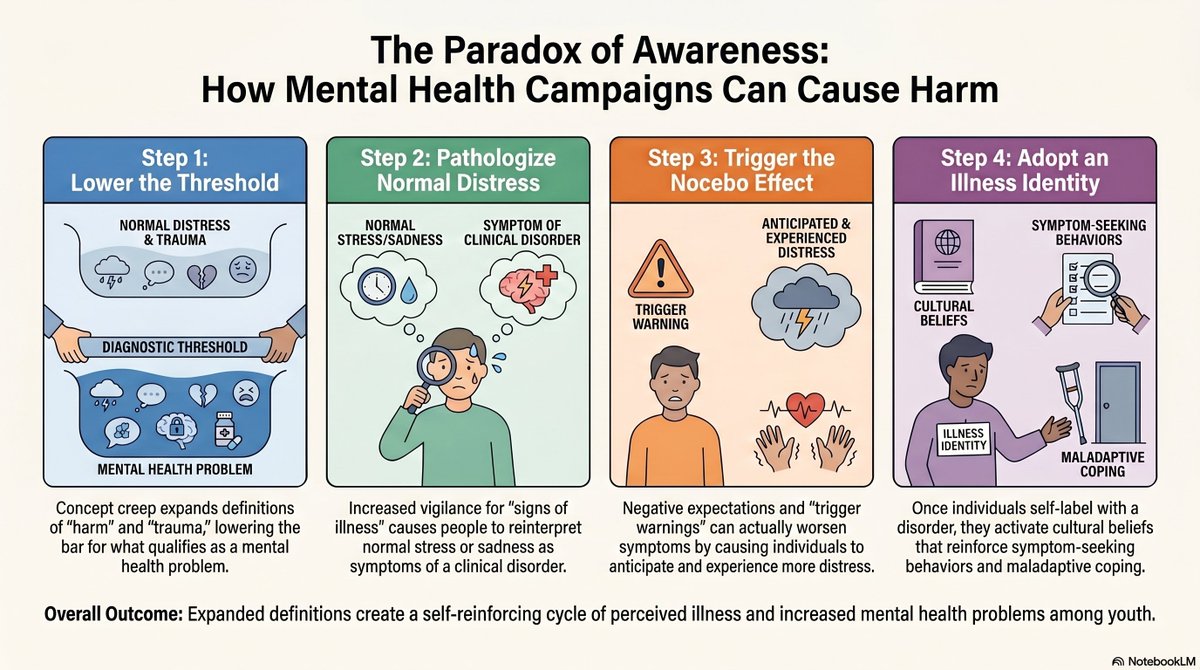
In a new paper by my PhD student Dasha Sandra, titled "Why mental health awareness can harm: Converging explanations for a societal problem", we argue that well-meaning mental health awareness can backfire, and we identify how. Four separate literatures (concept creep, nocebo effects, prevalence inflation, and illness self-labeling) have been circling the same problem from different angles. We show they converge on three mechanisms:
1.Awareness lowers the threshold for what counts as a disorder.
2. It trains people to scan their inner lives for symptoms and reinterpret normal distress as pathology.
3. Once someone adopts an illness identity, they behave in ways that confirm and deepen it.
The evidence is wide. Learning that loneliness is harmful makes solitude feel worse. Learning that stress is harmful worsens well-being and performance. Awareness videos about fake conditions like "wind turbine syndrome" produce real headaches. Trigger warnings raise anticipatory anxiety without reducing distress.
This does not mean awareness should stop. It means awareness can have unintended consequences, including manufacturing the suffering it tries to prevent. Inoculating people against these mechanisms works, and we already have evidence it does.
Link to paper: michael-inzlicht.squarespace…
234
1,813
7,491
537,665
1 in 3 stimulant users experience psychotic symptoms. 1 in 500 prescribed stimulant users do. That gap tells you almost everything about how context shapes risk. New post breaks down two major studies on ADHD meds and psychosis. adhdevidence.org/blog/psycho…
2
2
5
305
Can physical activity actually improve motor skills in kids with ADHD? And, if so, is there a certain type of exercise that works best? instagram.com/p/DXXPHAQDoCC/…
1
114
If your child has ADHD and struggles with handwriting or coordination, exercise may help. A new meta-analysis found meaningful improvements in motor skills when kids with ADHD followed structured exercise programs: adhdevidence.org/blog/can-ce…
1
1
4
181
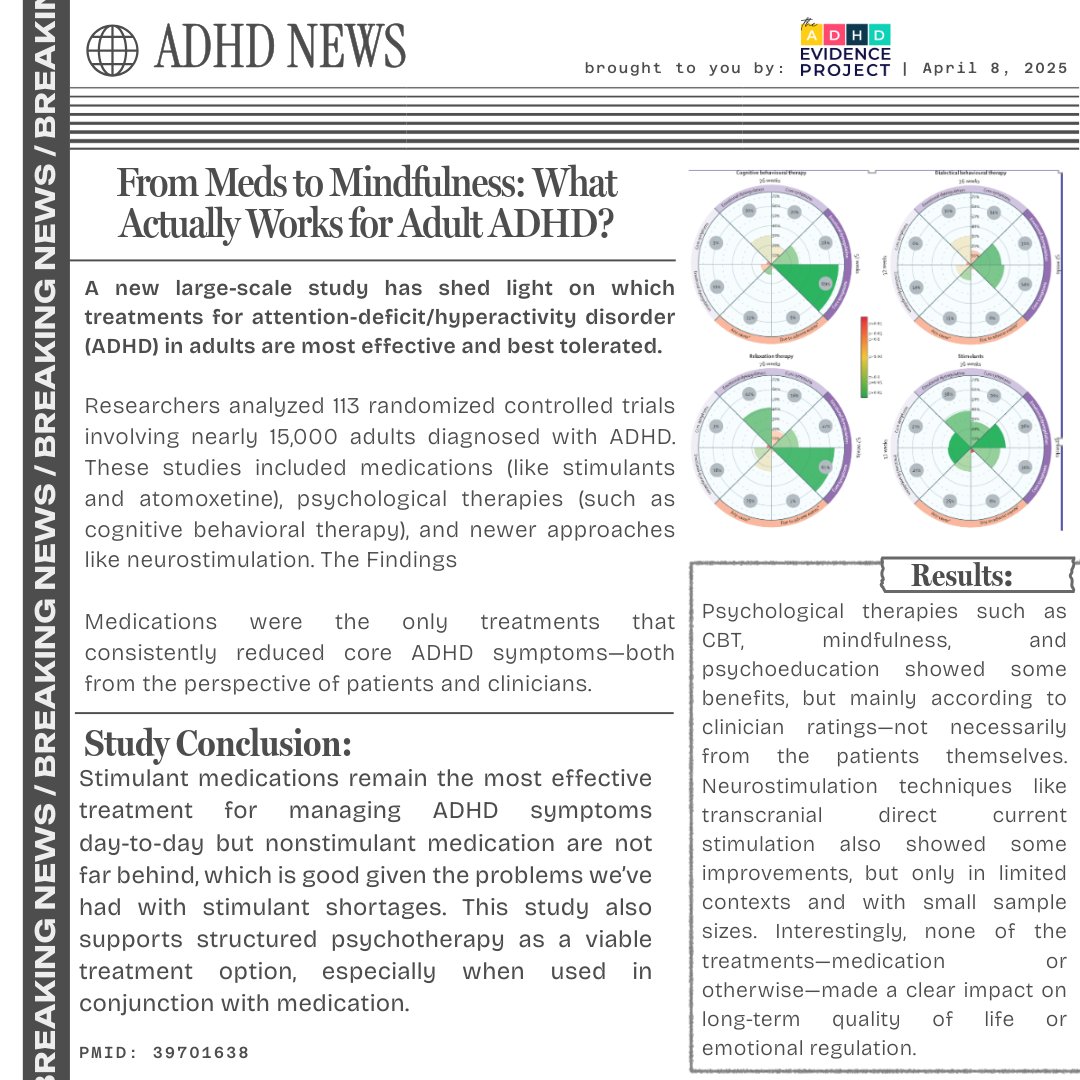
This study ranked ADHD treatment therapies with 92% statistical confidence. One of the top performers? Supported by exactly one previous trial. This is what happens when sophisticated methods meet a thin evidence base. Our new blog explains the gap. adhdevidence.org/blog/saudi-…
2
2
371
Anyone with lived experience can tell you that not all ADHD presents the same way, but now there's brain imaging data to back that up; A new study found 3 reproducible neurobiological subtypes with different symptom profiles, emotional regulation patterns, and neurotransmitter associations. Read more: adhdevidence.org/blog/findin…
7
26
84
6,093
For a more accessible read, check out our blog explaining this study: adhdevidence.org/blog/why-do…
Mar 26

Why do ~35–61% of people with #ADHD stop their medication within a year? 🛑💊🧠
Read the full paper here: 🔓 lnkd.in/dGBd9hmq
#pharmacogenomics
2
3
513
Our research found that genetics may influence whether patients continue their ADHD medication, but it's a complex relationship: adhdevidence.org/blog/why-do…
3
387