
Incoming CS PhD @uchicago | MechEng @waseda_univ
Joined October 2022
- Tweets 24
- Following 241
- Followers 113
- Likes 333
4 Photos and videos

Pinned Tweet

Jun 11
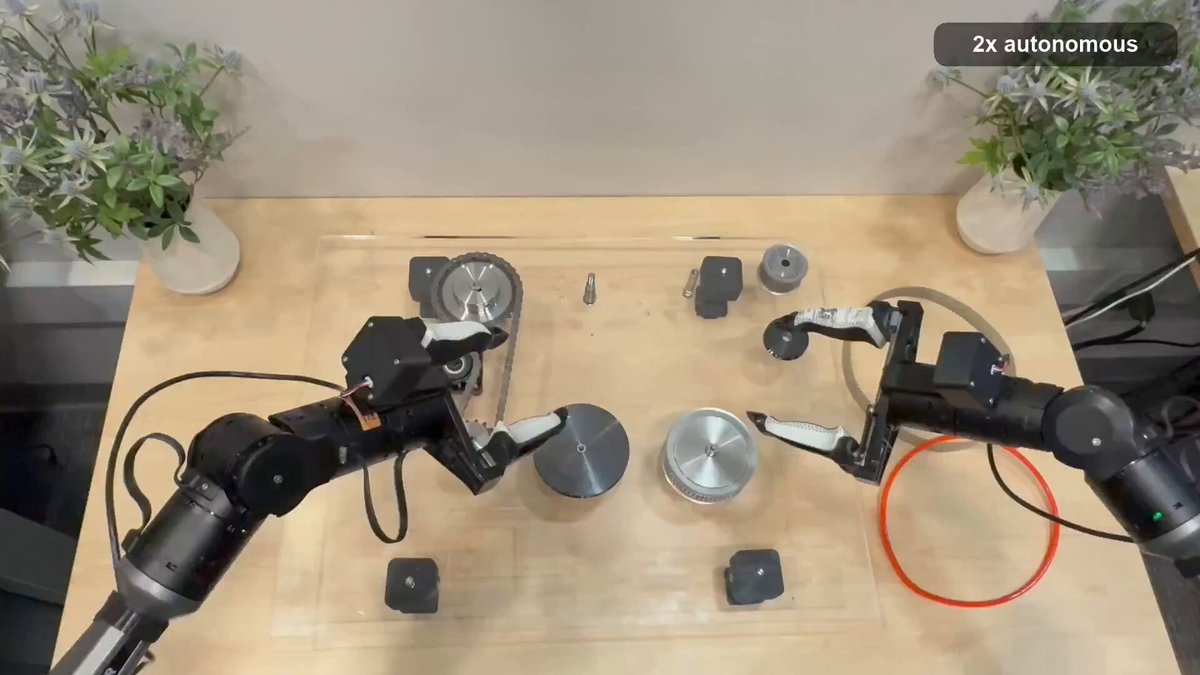
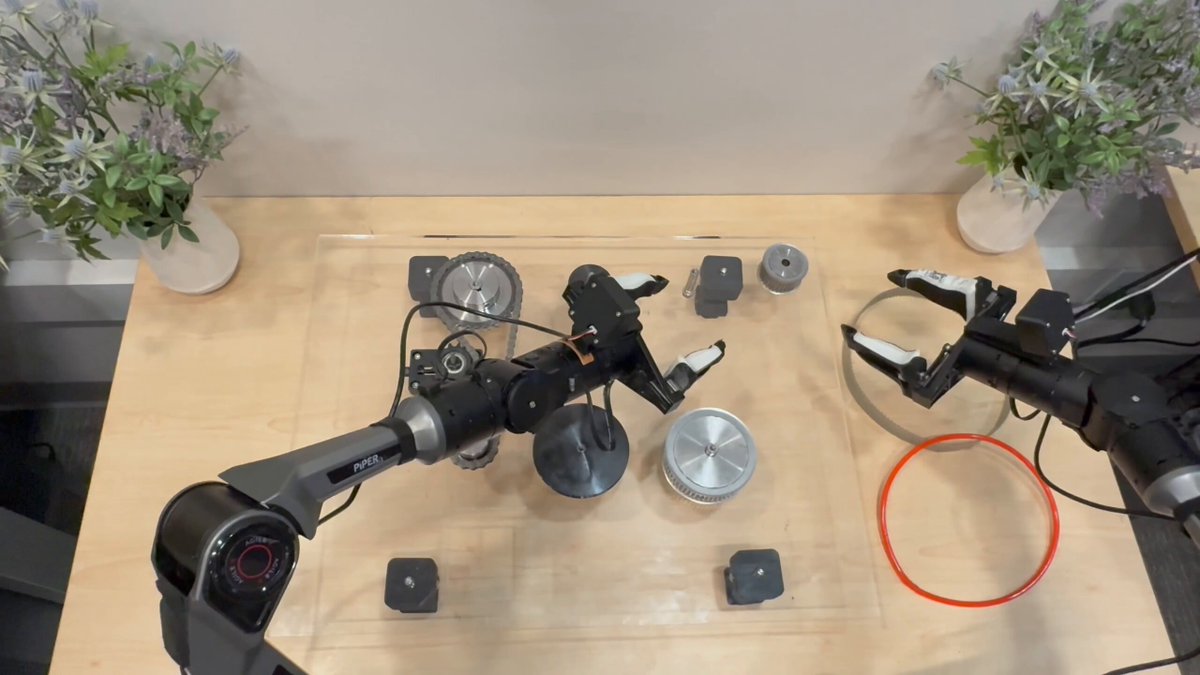
Force sensing for low-cost robot arms — without adding force sensors.
🚀 Excited to share FACTR 2! 🚀
FACTR 2 enables external torque sensing on low cost arms and uses it to improve policy learning.
w/ @JasonJZLiu @_tonytao_
🧵(1/6)
7
23
140
26,225
Steven Oh retweeted

Force sensing without expensive sensors? 🧠🦾
The team at @CMU_Robotics is pushing boundaries with FACTR 2, unlocking native force awareness on standard commodity hardware with <10 mins of training data.
Website: jasonjzliu.com/factr2/
Paper: arxiv.org/abs/2606.12406
Jun 11

Force is arguably the most overlooked ingredient in modern robot learning.
Introducing FACTR 2: it turns *any* commodity robot into a force-aware system with no force sensors required.
Train a tiny force network in <1min with <10mins of data and drop it into any existing teleop pipelines:
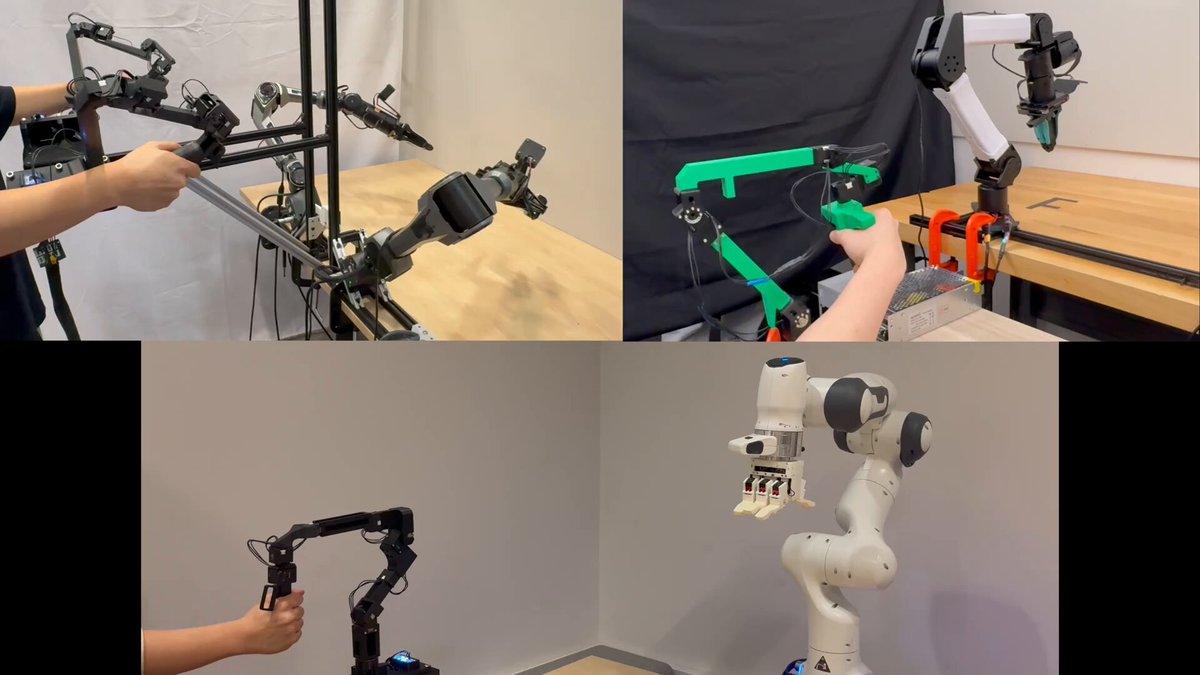
✅ Free force sensing for both the robot and the operator arm
✅ Makes demos higher-quality → fewer of them needed.
✅ A new force-aware learning algorithm (FIRST) uses those recovered forces to figure out which parts of a demo actually matter, making learning data-efficient.
✅ Strong performance on complex tasks with fewer demos and even no pretraining!
More details below.
3
13
1,052
Steven Oh retweeted

Jun 12
Great work by @StevenOh_ . A lightweight yet effective system introducing tactile information to manipulation.
Jun 11

Force sensing for low-cost robot arms — without adding force sensors.
🚀 Excited to share FACTR 2! 🚀
FACTR 2 enables external torque sensing on low cost arms and uses it to improve policy learning.
w/ @JasonJZLiu @_tonytao_
🧵(1/6)
2
8
1,449
Steven Oh retweeted

Jun 11
CMUとの共同研究論文が出ました。@StevenOh_ らが、力覚センサを用いないバイラテラル遠隔操作および、接触前の状態を考慮した模倣学習手法を提案しました。結果として、複数のContact-rich manipulationを実現しています。これらの手法は、多指ハンドのマニピュレーションにも応用していきたいと考えています。
2
10
735
Steven Oh retweeted
Jun 11
Excited to share the collaborative research paper with CMU. @StevenOh_ and colleagues worked on bi-lateral tele-operation without force sensors and pre-contact aware imitation learning. They achieved multiple contact-rich manipulation.
I believe the methods can be applied to multi-fingered manipulation.
Jun 11
Force sensing for low-cost robot arms — without adding force sensors.
🚀 Excited to share FACTR 2! 🚀
FACTR 2 enables external torque sensing on low cost arms and uses it to improve policy learning.
w/ @JasonJZLiu @_tonytao_
🧵(1/6)
1
5
21
2,506
Steven Oh retweeted

Jun 11
Here are a few more tasks we trained using the system
w/ @yangphiliphan
Jun 11

💥Introducing FACTR 2, learning external force sensing on commodity robot arms without needing dedicated sensors.
We show that learned force signals enable force-feedback teleop on low-cost arms and improve BC policies.
FACTR 2 consists of:
1. Neural External Torque (NEXT): learns external forces without needing dedicated force sensors.
2. Force-Informed Re-Sampling Training (FIRST): uses the learned force signal to identify task-critical regions and upsample them during training.
w/ @StevenOh_ @_tonytao_
🧵(1/N)
4
16
76
7,665
Steven Oh retweeted

Jun 11
Contact is the hard part
You can often tell who is faking it based on how much theyre avoiding making sustained contact with stuff
Cool work
Jun 11

What if some parts of a robot demonstration are more important than others?
Most of a trajectory is free-space motion. But success or failure is often determined by a few critical moments around contact.
In FACTR 2, we use force to find these moments and prioritize them for training. We find this helps policies learn better alignment and recovery behaviors, like the example below.
w/ @StevenOh_ @JasonJZLiu
🧵(1/N)
3
7
77
10,902
Steven Oh retweeted

Jun 11
Force is arguably the most overlooked ingredient in modern robot learning.
Introducing FACTR 2: it turns *any* commodity robot into a force-aware system with no force sensors required.
Train a tiny force network in <1min with <10mins of data and drop it into any existing teleop pipelines:
✅ Free force sensing for both the robot and the operator arm
✅ Makes demos higher-quality → fewer of them needed.
✅ A new force-aware learning algorithm (FIRST) uses those recovered forces to figure out which parts of a demo actually matter, making learning data-efficient.
✅ Strong performance on complex tasks with fewer demos and even no pretraining!
More details below.
Jun 11
💥Introducing FACTR 2, learning external force sensing on commodity robot arms without needing dedicated sensors.
We show that learned force signals enable force-feedback teleop on low-cost arms and improve BC policies.
FACTR 2 consists of:
1. Neural External Torque (NEXT): learns external forces without needing dedicated force sensors.
2. Force-Informed Re-Sampling Training (FIRST): uses the learned force signal to identify task-critical regions and upsample them during training.
w/ @StevenOh_ @_tonytao_
🧵(1/N)
6
52
392
36,492
Steven Oh retweeted

Jun 11
Manipulation policies should focus on contact!
FACTR 2 first learns force estimation for any robot arm without requiring any extra sensors.
It uses this to train BC policies that focus on the contact rich moments that matter most for success.
Jun 11
💥Introducing FACTR 2, learning external force sensing on commodity robot arms without needing dedicated sensors.
We show that learned force signals enable force-feedback teleop on low-cost arms and improve BC policies.
FACTR 2 consists of:
1. Neural External Torque (NEXT): learns external forces without needing dedicated force sensors.
2. Force-Informed Re-Sampling Training (FIRST): uses the learned force signal to identify task-critical regions and upsample them during training.
w/ @StevenOh_ @_tonytao_
🧵(1/N)
2
4
48
6,268
Steven Oh retweeted

Jun 11
New work on FACTR 2: Learning External Force Sensing for Commodity Robot Arms Improves Policy Learning:
Paper: arxiv.org/abs/2606.12406
Web: jasonjzliu.com/factr2/
FACTR 2 shows that learned force signals can both enable force-feedback teleoperation on low-cost manipulators and improve behavior cloning (BC) policies for contact-rich tasks. It consists of two components:
1. Neural External Torque Estimation (NEXT): A lightweight model that infers external joint torques without dedicated force sensors.
2. Force-Informed Re-Sampling Training (FIRST): A training strategy that uses the learned force signal to identify and upsample task-critical moments.
The key insight is simple: policy failures rarely occur in free space, they occur during brief pre-contact alignment and contact-rich interactions, where precise corrections matter most.
Together, NEXT and FIRST bring force-aware teleoperation and robust long-horizon contact-rich policy learning to off-the-shelf robot arms, without requiring additional sensing hardware.
See a more detailed thread by @JasonJZLiu.
Jun 11
💥Introducing FACTR 2, learning external force sensing on commodity robot arms without needing dedicated sensors.
We show that learned force signals enable force-feedback teleop on low-cost arms and improve BC policies.
FACTR 2 consists of:
1. Neural External Torque (NEXT): learns external forces without needing dedicated force sensors.
2. Force-Informed Re-Sampling Training (FIRST): uses the learned force signal to identify task-critical regions and upsample them during training.
w/ @StevenOh_ @_tonytao_
🧵(1/N)
3
15
63
19,423
Jun 11
Force sensing for low-cost robot arms — without adding force sensors.
🚀 Excited to share FACTR 2! 🚀
FACTR 2 enables external torque sensing on low cost arms and uses it to improve policy learning.
w/ @JasonJZLiu @_tonytao_
🧵(1/6)
7
23
140
26,225
Jun 11
Check out @JasonJZLiu's thread x.com/JasonJZLiu/status/2065…
Jun 11
💥Introducing FACTR 2, learning external force sensing on commodity robot arms without needing dedicated sensors.
We show that learned force signals enable force-feedback teleop on low-cost arms and improve BC policies.
FACTR 2 consists of:
1. Neural External Torque (NEXT): learns external forces without needing dedicated force sensors.
2. Force-Informed Re-Sampling Training (FIRST): uses the learned force signal to identify task-critical regions and upsample them during training.
w/ @StevenOh_ @_tonytao_
🧵(1/N)
1
4
760
Jun 11
Also check out @_tonytao_ 's thread! x.com/_tonytao_/status/20650…
Jun 11
What if some parts of a robot demonstration are more important than others?
Most of a trajectory is free-space motion. But success or failure is often determined by a few critical moments around contact.
In FACTR 2, we use force to find these moments and prioritize them for training. We find this helps policies learn better alignment and recovery behaviors, like the example below.
w/ @StevenOh_ @JasonJZLiu
🧵(1/N)
2
73