Joined August 2019
- Tweets 2,723
- Following 209
- Followers 233
- Likes 4,121
7 Photos and videos
Tal beeri retweeted
Weekly Report – Hezbollah Attacks Against Israel (8–14 June)
Key Trends This Week
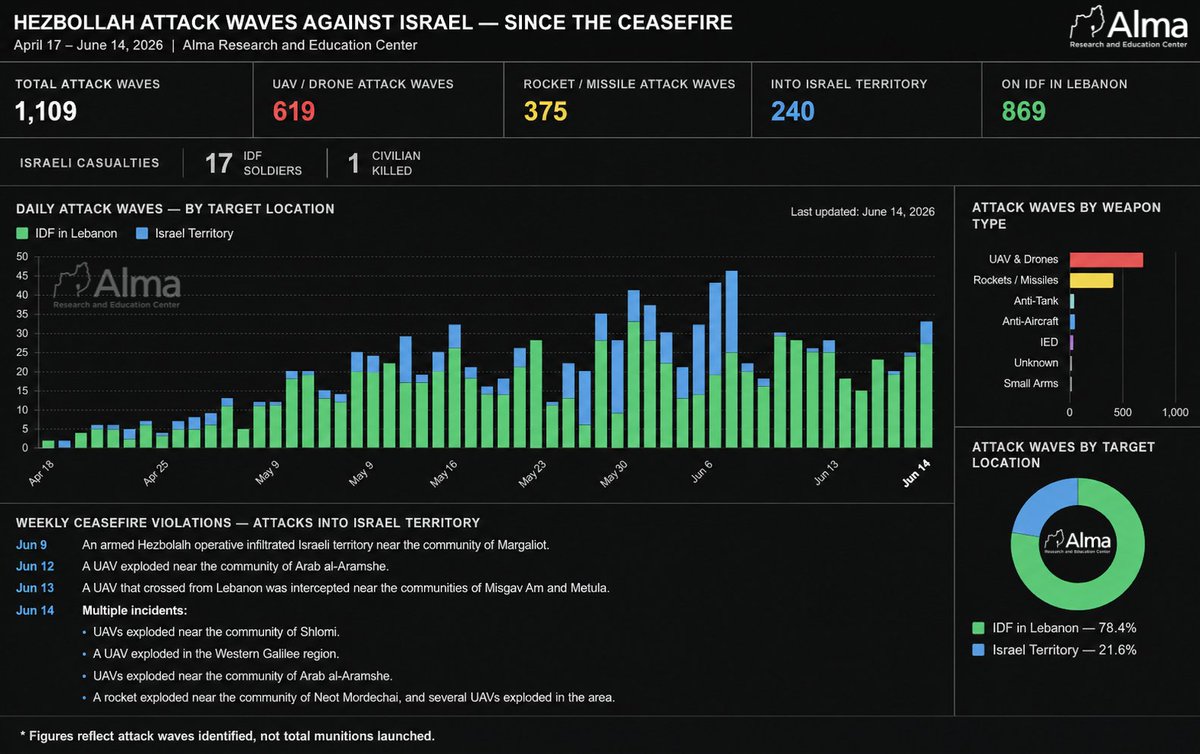
During the past week (8–14 June), Hezbollah carried out 134 attack waves against Israel and IDF forces, a decrease compared to the previous week (1–7 June), during which 198 attack waves were recorded. Of the total attacks, 127 were directed against IDF forces operating in southern Lebanon, while 7 were launched directly at Israeli territory (compared to 30 attacks during the previous week).
The significant decline in attacks directed at Israeli territory may have been the result of intensified Israeli offensive operations against Hezbollah during the past week.
Throughout the week, Hezbollah conducted several direct attacks against Israeli territory, which prompted extensive Israeli responses in Lebanon. These included: the infiltration of an armed Hezbollah operative into Israeli territory near Margaliot (9 June); a UAV detonation near Arab al-Aramshe (12 June); the interception of a UAV near the communities of Misgav Am and Metula (13 June); and, on 14 June, several additional incidents involving UAV infiltrations and explosions in the areas of Shlomi, the Western Galilee, and Arab al-Aramshe, alongside rocket fire targeting the area of Neot Mordechai.
In terms of weapon systems, UAVs and drones continued to constitute Hezbollah’s primary means of attack. Of the total weekly attacks, 67 were carried out using UAVs and drones, while 52 involved indirect fire (rockets and artillery). In addition, the organization conducted 9 anti-aircraft fire incidents, 3 anti-tank guided missile (ATGM) attacks, and 3 explosive device attacks.
The relatively high level of anti-aircraft fire continues to indicate Hezbollah’s efforts to challenge the IDF’s freedom of aerial operations in southern Lebanon.
Cumulative Data Since the Ceasefire
Since the beginning of the ceasefire (17 April – 14 June 2026), Hezbollah has conducted 1,109 attack waves against Israel and IDF forces.
Of all attacks, 869 attack waves (78.4%) were directed against IDF forces operating in southern Lebanon, while 240 attack waves (21.6%) targeted Israeli territory.
The distribution of attacks by weapon type highlights the continued centrality of UAVs and drones within Hezbollah’s offensive arsenal. Since the start of the ceasefire, Hezbollah has carried out 619 attack waves using UAVs and drones, accounting for more than half of all attacks. In addition, the organization conducted 375 attack waves using rockets and missiles. The remaining attacks included ATGM fire, anti-aircraft fire, explosive device attacks, small-arms fire, and incidents in which the type of weapon employed could not be identified.
13
24
1,279
Tal beeri retweeted
On June 14, it was reported that senior Hezbollah figure Ali Musa Abbas Daqduq was eliminated on June 12 in an area south of the Litani River. Daqduq was also known by his jihadist alias Abu Hussein Sajed. In the most recent senior position known to us, he served as commander of the Golan File Unit, which operated in southern Syria near the Israeli border during the Assad regime. (This position is equivalent to the rank of brigadier general and corresponds to the commander of one of Hezbollah’s geographic units, such as Badr, Nasr, and others.)
At this stage, we do not know what his most recent position was. However, given his senior operational status and his physical presence south of the Litani River, it is clear that he was heavily involved in directing Hezbollah’s operations against communities in Israeli territory and against IDF activities in southern Lebanon.
In our assessment, the presence of a senior figure such as Daqduq in the area south of the Litani River, may indicate one of two possible roles he held prior to his death. First, he may have been promoted and appointed commander of Hezbollah’s Southern Front, replacing Hajj Youssef Ismail Hashem, who had himself succeeded Ali Karaki. Hashem was eliminated on April 1, 2026. Alternatively, Daqduq may have been appointed commander of the Nasr Unit, replacing Hassan Salameh, who was eliminated on March 9, 2026.
For additional details and information regarding his direct involvement in the killing of American soldiers, see the attached article.
israel-alma.org/assassinatio…
5
13
38
1,815
Tal beeri retweeted
Weekly Report – Israeli Air Force Airstrikes in Lebanon (8–14 June)
Key Trends This Week
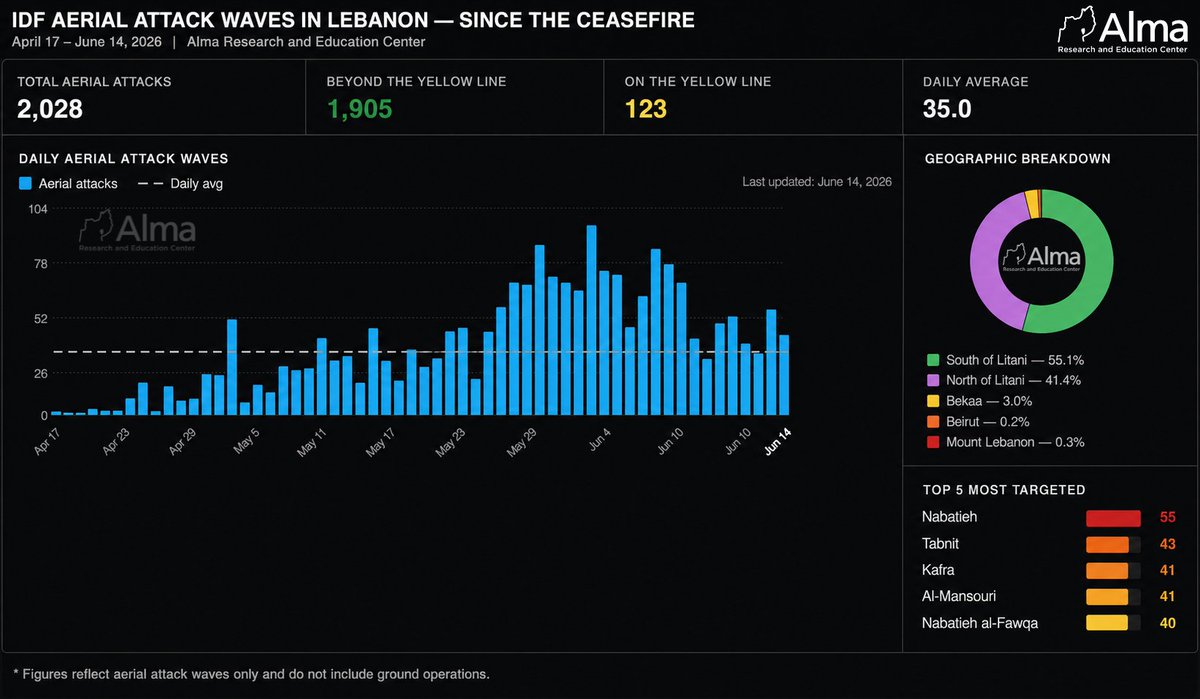
During the past week (8–14 June), the IDF conducted 281 waves of airstrikes across Lebanon. This represents a significant decrease compared to the previous week, during which 436 waves of airstrikes were carried out—a decline of approximately 36% in the scope of aerial operations.
Geographically, 144 strikes were conducted south of the Litani River, accounting for 51.2% of all strikes during the week, while 124 strikes were carried out north of the Litani, representing 44.1% of total strikes. In addition, 11 strikes were conducted in the Beqaa Valley (3.9% of all strikes), and one strike was carried out in Beirut (0.4%).
The vast majority of strikes were conducted outside the Yellow Line, with 271 out of 281 strike waves (96.4%) occurring in these areas. Only 10 strikes (3.6%) were carried out within the Yellow Line.
The strike in Beirut on 14 June was conducted in response to Hezbollah violations of the ceasefire understandings and its continued launches of UAVs and rockets toward Israeli communities.
Cumulative Data Since the Ceasefire
Since the beginning of the ceasefire, between 17 April and 14 June 2026, the IDF has conducted 2,028 waves of airstrikes in Lebanon, averaging 35 strike waves per day.
Most strikes were carried out south of the Litani River—1,117 strike waves, representing 55.1% of all strikes. An additional 840 strikes were conducted north of the Litani (41.4%), 61 strikes in the Beqaa Valley (3.0%), six strikes in Mount Lebanon (0.3%), and only four strikes in Beirut (0.2%).
The geographic areas that have sustained the highest number of strikes since the beginning of the ceasefire are Nabatieh (55 strikes), Tebnine (43), Kafra (41), Al-Mansouri (41), and Nabatieh al-Fawqa (40).
Note: The data presented in the charts refer exclusively to IDF airstrikes and do not include ground operations, artillery fire, or other military activities conducted during the period under review.
1
6
13
1,110
Tal beeri retweeted

פרסמנו במהדורה: ארה״ב רוצה שצבא לבנון יפרק את חיזבאללה מנשקו. אלא שלפי שורת עדויות ארוכה, חיזבאללה כבר נטוע עמוק בתוך צבא לבנון, ויש גם קצינים וחיילים בצבא שנאמנים לארגון.
תודה ל @TalBeeri72 @Israel_Alma_org על התרומה לכתבה

חדשות 14 | חדירת חיזבאללה לצבא לבנון: עומק הקשרים נחשף | אחיקם הימלפרב
#החדשות
@MaggieTabibi @Ahikam20
6
36
166
5,759
Tal beeri retweeted

Jun 14
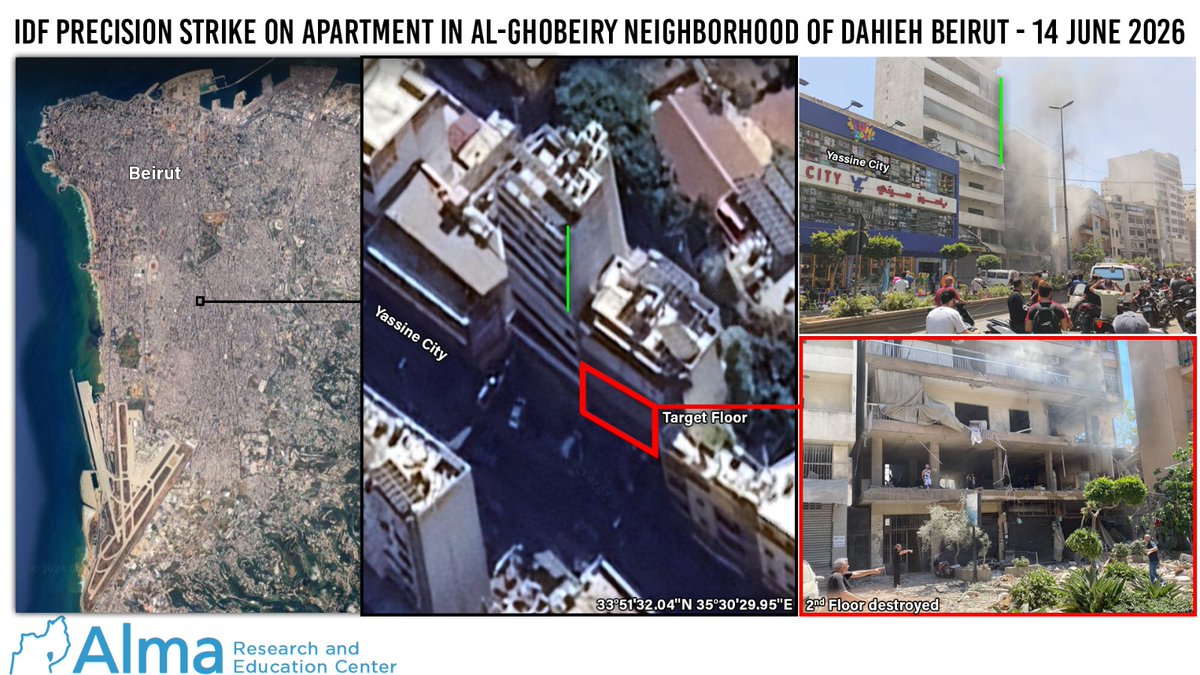
A short time ago (June 14), Israel carried out a targeted strike on a Hezbollah command center located on the second floor of a civilian building in the Al-Ghobeiry area of Dahieh. According to local reports, there were casualties.
The strike was conducted following a series of UAV incursions into Israeli territory over the past three days (Arab al-Aramsheh, Metula, and Shlomi), as well as a ground infiltration by a Hezbollah operative near Margaliot on June 9.
The previous strike in Dahieh took place on June 7 against a Hezbollah command center operating from a civilian apartment in the Tahwitat al-Ghadir area, after Hezbollah launched two rockets that crossed into Israeli territory. Following that strike, Iran launched several barrages of ballistic missiles toward Israel.
Hezbollah is acting on Iran’s behalf to challenge Israel’s response policy while negotiations between the United States and Iran are taking place simultaneously.
From Iran’s perspective, the optimal scenario would be a significant escalation in the Lebanese arena that would lead to the collapse of the ongoing negotiations between the United States and Iran (buying Iran more time) and also the collapse of the negotiations between Israel and Lebanon (under U.S. auspices).
All of this would, in their view, create a wedge and increased tension between Israel and the United States. In that way, Iran would benefit regardless of the outcome.
1
15
32
3,861
Tal beeri retweeted

Jun 12
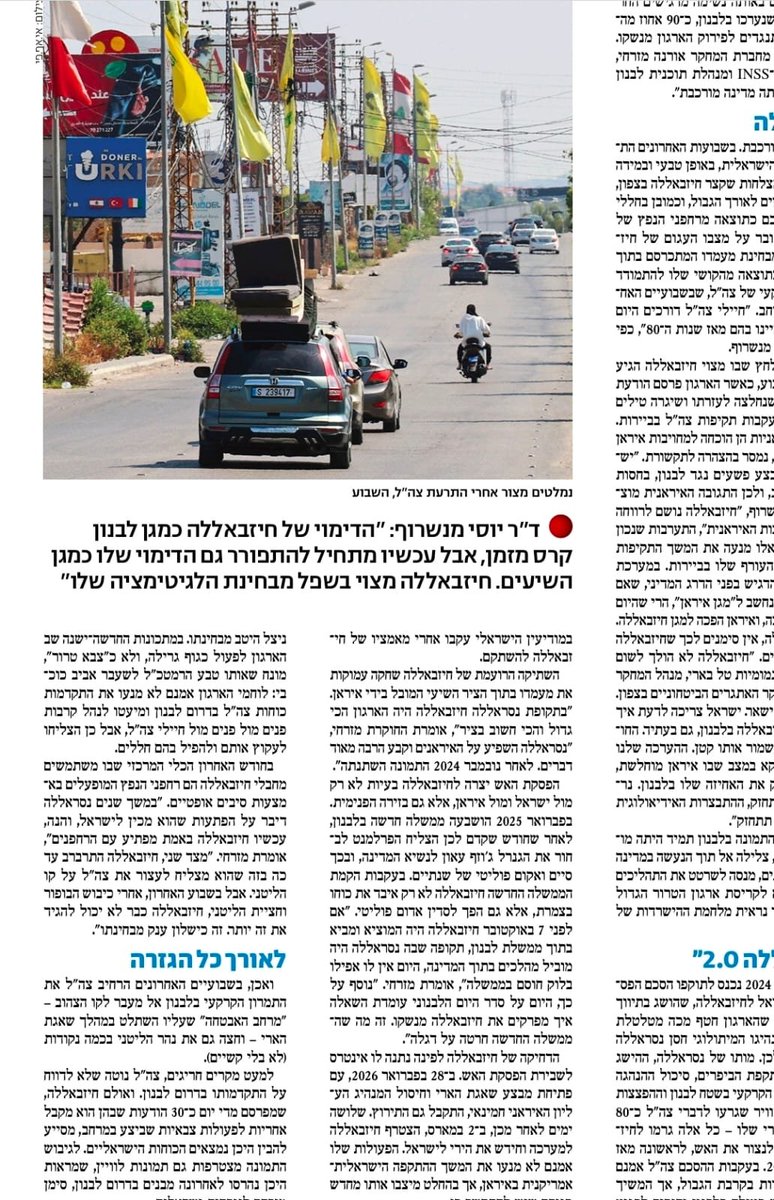
התראיינתי, לצד טל בארי ממכון עלמא ואורנה מזרחי מה-inss, לכתבת תחקיר של @itay_il שפורסמה היום במוסף "ישראל השבוע" ב-@IsraelHayomHeb. התחקיר עסק במצבו של חזבאללה מול הבסיס החברתית שלו, מול מדינת לבנון ובלחימה מול צה"ל. בין היתר הסברתי שהדימוי של חזבאללה כמגן לבנון קרס מזמן, אבל עכשיו מתחיל להתפורר גם הדימוי שלו כמגן השיעים במדינה. חזבאללה מצוי בשפל מבחינת הלגיטימציה שלו. עם זאת, הוא עדיין הגורם החזק בלבנון, ולכן במקביל למערכה הצבאית נגדו יש לפעול גם נגד מערך הדעווה שלו.
israelhayom.co.il/magazine/h…
3
2
285
Tal beeri retweeted
Jun 12
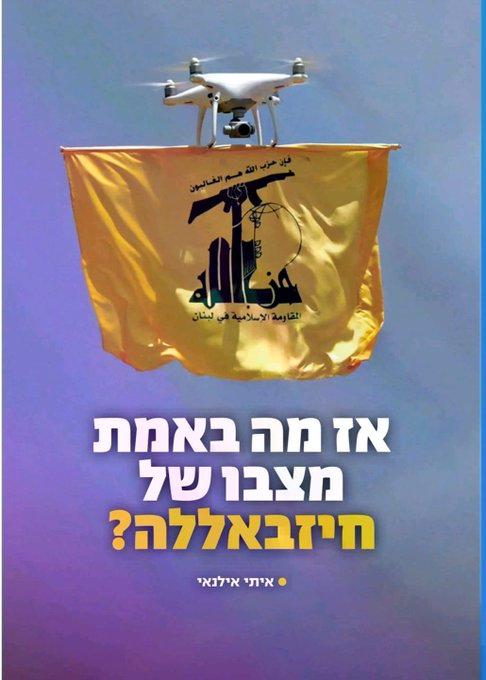
Told @itay_il for his in-depth investigative piece published today in @IsraelHayomEng (alongside Tal Beeri from @Israel_Alma_org and Orna Mizrahi from the @INSSIsrael):
While Hezbollah’s image as the "defender of Lebanon" collapsed long ago, its image as the "defender of the Shiites" in the country is now starting to crumble as well. Hezbollah is currently at an all-time low in terms of its legitimacy.
However, it remains the strongest actor in Lebanon. Therefore, alongside the military campaign against it, we must also take decisive action against its Dawa (social-civilian) network.
The investigation examines Hezbollah’s current predicament vis-à-vis its social base, the Lebanese state, and the IDF.
Read the full piece here israelhayom.com/2026/06/12/h…
3
4
322
Tal beeri retweeted
Jun 11
Heat Map of Airstrikes in Lebanon During the “Ceasefire” (April 17 – June 10, 2026)
The geographic analysis of airstrikes in Lebanon between April 17 and June 10, 2026, as reflected in the attached heat map, highlights the IDF’s operational focus in southern Lebanon, both south and north of the Litani River. Additional, relatively limited strikes were conducted elsewhere in Lebanon, including the Beqaa Valley, Mount Lebanon, and Beirut.
The most prominent geographic concentrations of strikes in southern Lebanon are located north of the Litani in the Nabatieh area, and south of the Litani in the Tebnine and Tyre areas, as well as east of Tyre in Wadi Jilu. These areas currently constitute key centers of gravity in Hezbollah’s operational deployment along the southern front.
The heat map serves as a geographic indicator of Hezbollah’s activity hubs in southern Lebanon, where Hezbollah infrastructure, capabilities, and threats have been identified. In other words, it reflects significant operational presence by the organization within a given geographic area, whether through weapons storage, militant movement, attempts to rehabilitate infrastructure, observation posts, launch arrays, or other military activities.
Within this context, the activity of Radwan Force operatives is also noteworthy, as they have resumed operations in areas south of the Litani River and, at times, even south of the “Yellow Line.”
The current strike pattern clearly indicates that Hezbollah has been working to restore its military infrastructure south of the Litani River. Analysis of the geographic concentrations suggests that the organization has continued to operate, rehabilitate, and adapt its operational systems in southern Lebanon, while gradually reestablishing its presence in forward areas facing Israel.

1
10
31
2,536
Tal beeri retweeted
Jun 11
Weapons Next to a Baby Crib: This Is What Hezbollah’s Human Shield Strategy Looks Like
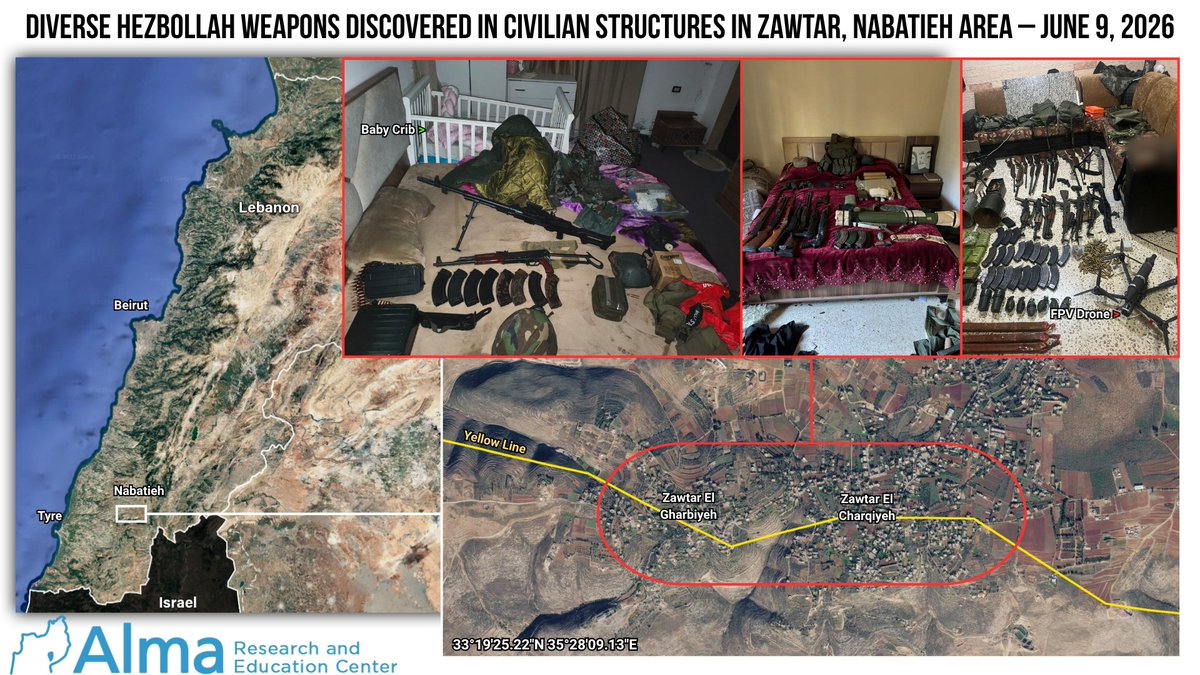
During IDF operations in the villages of Zawtar al-Gharbiya and Zawtar al-Sharqiya in southern Lebanon, several Hezbollah weapons depots were discovered inside civilian buildings. In one of the structures, which had been used by Hezbollah’s Radwan Force, dozens of weapons were found next to a baby crib, in a bedroom, and in the living room of a civilian home.
Significant weapons seized include at least one Claymore anti-personnel mine, one PKM light machine gun, one RPG-30, one fire optic cabled FPV drone with an RPG attached, an Iranian copy of a Steyr HS .50 anti-material rifle, and several explosive formed penetrators.
This is not an isolated incident, but rather a well-established pattern. For years, Hezbollah has embedded military infrastructure within private homes, residential neighborhoods, and civilian buildings throughout southern Lebanon. In doing so, it deliberately blurs the line between civilian and military spaces, turning the local population into part of its military infrastructure.
The image of weapons stored next to a baby crib starkly illustrates the true meaning of using human shields: exploiting civilian environments for military purposes while knowingly placing the very civilians Hezbollah claims to defend at risk.
The Alma Research and Education Center continuously documents and maps incidents and findings related to Hezbollah’s use of human shields in southern Lebanon through an interactive, regularly updated map:
israel-alma.org/hezbollahs-h…
1
12
42
2,053
Tal beeri retweeted
Jun 10
Listen to the remarks of Mahmoud Shuaib (محمود شعيب), a Shiite political activist from southern Lebanon.
Shuaib is highly critical of Hezbollah, arguing that the organization embeds its military activities within civilian areas, private homes, and near civilian populations, effectively turning the residents of southern Lebanon into "human shields." According to him, this policy is a major factor behind the harm suffered by civilians and the widespread destruction of their property during conflicts.
Mahmoud Shuaib is one of the most prominent Shiite voices opposing Hezbollah and Amal, advocating for a stronger Lebanese state, reduced Iranian influence, and the transfer of security responsibilities to the Lebanese Army.
Shuaib has long argued that Hezbollah undermines Lebanon’s sovereignty, draws the Shiite community into regional conflicts, and contributes to the country’s economic, social, and security deterioration. Due to his activism and public statements, he has been involved in several public and legal disputes with Hezbollah-affiliated figures and has claimed to have faced threats and intimidation because of his views.
Shuaib represents an authentic voice of internal opposition in Lebanon – a voice that persists despite years of pressure, intimidation, and efforts to silence dissent. However, as of today, this opposition remains insufficiently organized to pose a significant challenge to Hezbollah’s position or influence within Lebanon.
1
11
28
1,920
Tal beeri retweeted
Jun 10
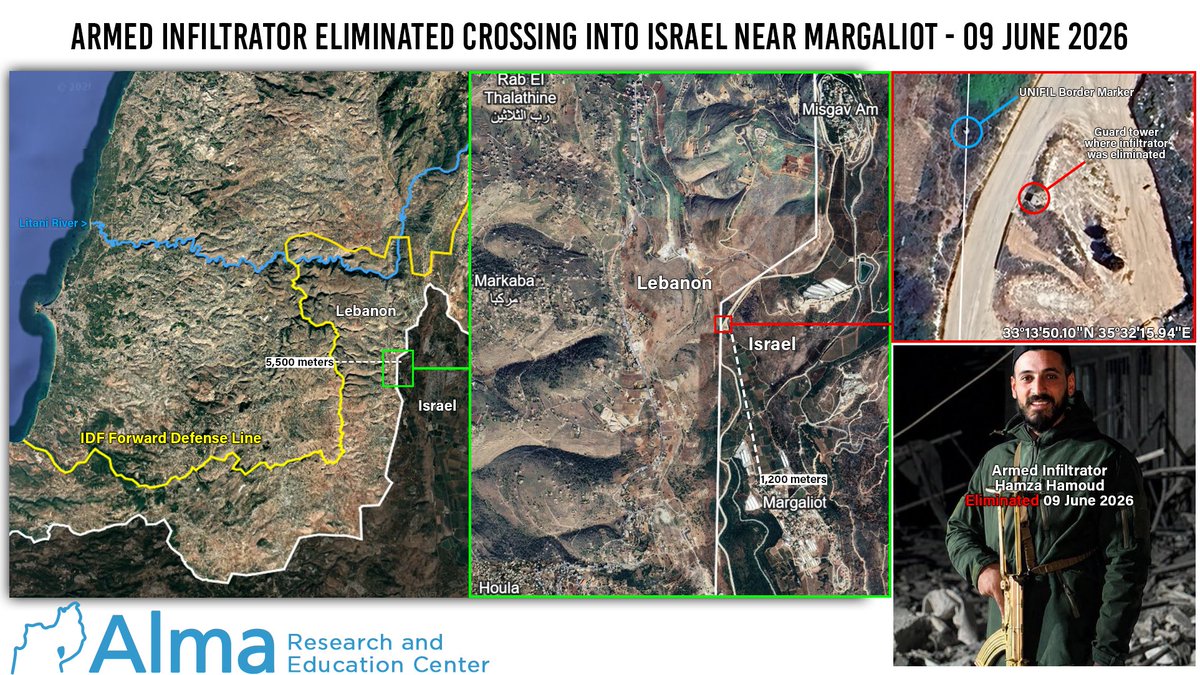
Yesterday, an armed infiltrator crossed from Lebanon into Israel and reached a point only a few hundred meters from the community of Margaliot after hiding inside an abandoned IDF guard post. The infiltrator was eliminated, and the incident ended without casualties.
The incident demonstrates that despite the extensive IDF operations in Lebanon and the significant degradation of Hezbollah’s capabilities and the Radwan Force, the threat of infiltrations into Israeli territory has not disappeared. While Hezbollah’s large-scale plan to infiltrate the Galilee has lost most of its operational viability, infiltrations by individual operatives or small cells continue to pose a threat along the border.
Was this the independent initiative of a lone operative, or an operation carried out under the direction of an organized actor? And what does this incident reveal about the ongoing infiltration threat along Israel’s northern border following the degradation of the Radwan Force?
Read the full analysis >>
israel-alma.org/terrorist-in…
8
20
2,124
Tal beeri retweeted
Jun 8
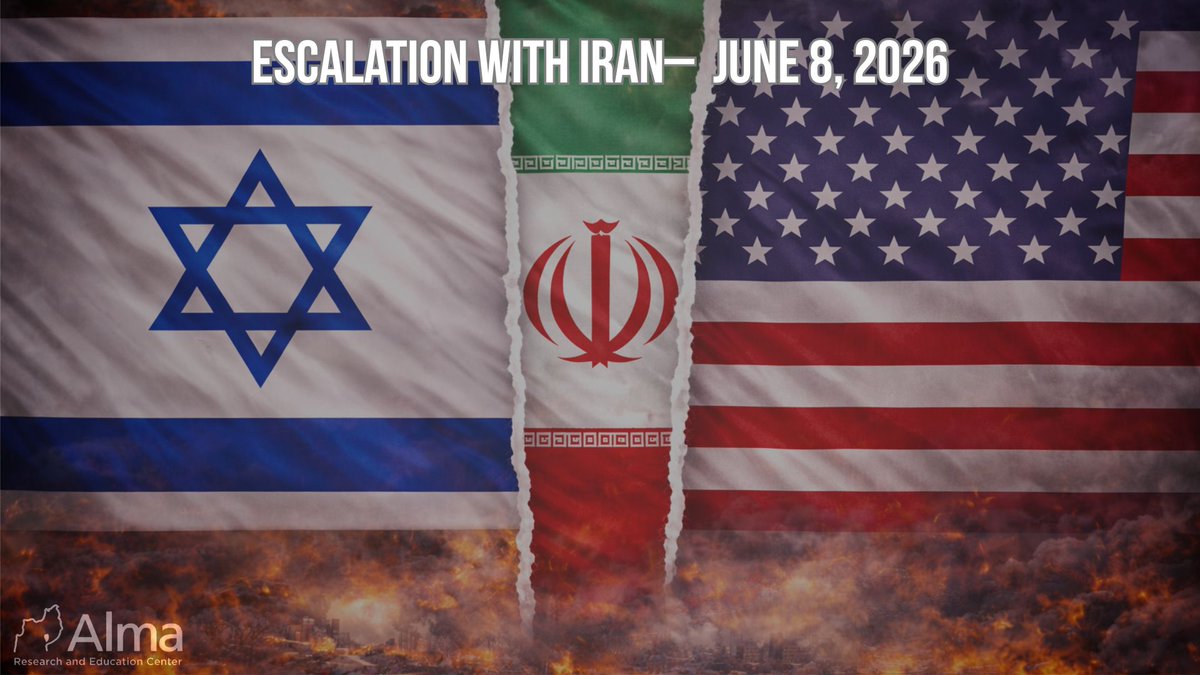
On June 7, Hezbollah launched rockets toward Israel. In response, the IDF struck a Hezbollah headquarters in the Dahiyeh district of Beirut, killing two operatives. Following the strike, Iran launched more than 20 ballistic missiles at Israel in several barrages.
The following day, June 8, Israel carried out strikes in Iran targeting air defense systems, military infrastructure, and strategically significant facilities, while continuing its attacks against Hezbollah targets in southern Lebanon.
In the afternoon, Iran announced a ceasefire, but conditioned it on the cessation of Israeli strikes in Lebanon. Israel stated that it would halt its strikes in Iran but would continue operations against Hezbollah in southern Lebanon.
Read Alma Center’s full report on the 24-hour escalation between Israel, Iran, and Hezbollah.
israel-alma.org/daily-report…
9
19
1,170
Tal beeri retweeted
Jun 8
Weekly Report – Hezbollah Attacks Against Israel (June 1–7, 2026)
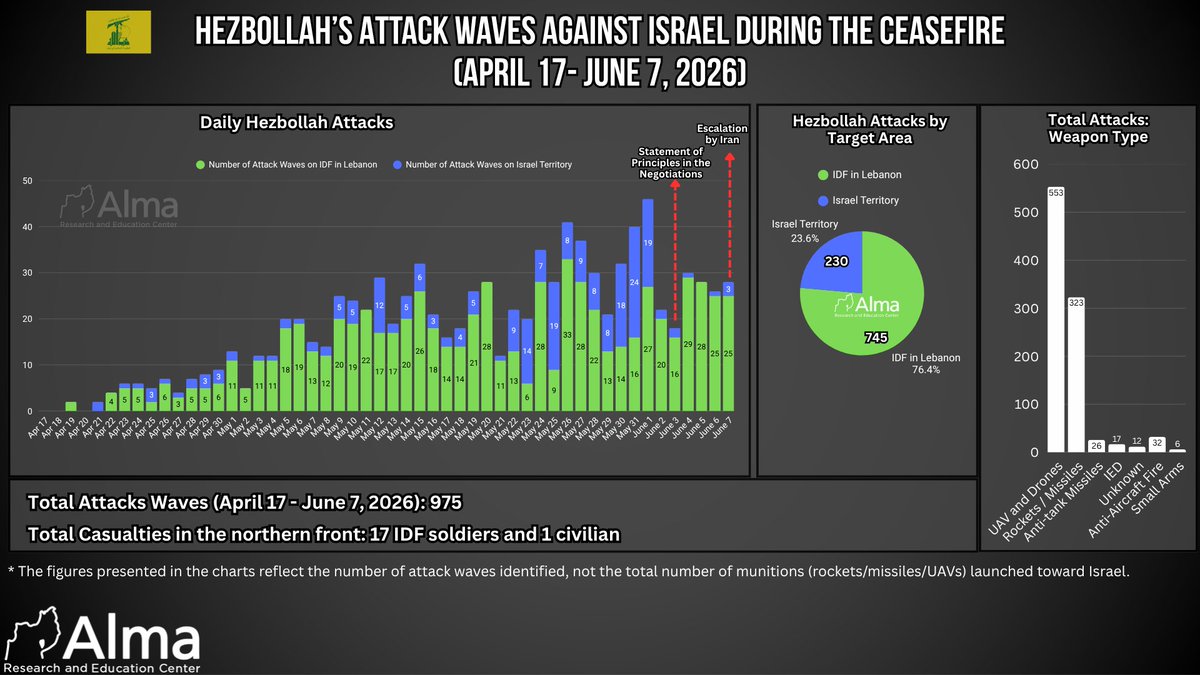
During the week, Hezbollah carried out 198 attack waves against Israel and IDF forces operating in Lebanon.
Most of the attacks (168) targeted IDF forces in southern Lebanon, while 30 attack waves were directed at Israeli territory.
The attacks against Israel were evenly divided between UAVs and explosive drones (15 attack waves) and rocket and missile fire (15 attack waves).
At the same time, Hezbollah launched 93 attack waves using rockets and missiles against IDF forces operating in southern Lebanon and 76 attack waves using UAVs and explosive drones, alongside additional attacks involving anti-tank guided missiles (ATGMs), anti-aircraft fire, improvised explosive devices (IEDs), and other weapon systems.
This week's data indicate a noticeable shift in Hezbollah's operational patterns, with an increase in the use of indirect fire systems (rockets and artillery) compared to previous weeks, during which the organization relied more heavily on UAVs and explosive drones. This trend may reflect an effort to increase both the volume of fire and the pace of attacks.
During the week, four IDF soldiers were killed in southern Lebanon. Two were killed by Hezbollah explosive drone strikes, one was killed by an anti-tank missile strike, and another was killed in an accidental discharge incident.
The week began with a peak in activity, as June 1 recorded the highest daily number of attacks since the beginning of the ceasefire (April 17). Although attack levels declined somewhat afterward, Hezbollah maintained a consistently high operational tempo throughout the week.
The decline in Hezbollah's attacks later in the week was likely linked to the organization's effort to confine the confrontation to southern Lebanon and to Israel's declared policy that attacks on Israeli territory would trigger strikes against Hezbollah assets in Beirut's Dahieh district. This dynamic emerged following the publication of the Statement of Principles on June 3 as part of the negotiations between Israel and Lebanon.
On June 7, Hezbollah launched rockets toward Israeli territory. In response, the IDF struck a Hezbollah command center in Dahieh, Beirut, killing two Hezbollah operatives. The incident led to further escalation and direct Iranian involvement, including several waves of ballistic missile attacks against Israel.
Cumulative Data Since the Ceasefire (April 17 – June 7)
Since the beginning of the ceasefire, 975 Hezbollah attack waves have been identified. Of these, 745 attack waves (76.4%) targeted IDF forces operating in Lebanon, while 230 attack waves (23.6%) were directed at Israeli territory.
In terms of weapon systems, Hezbollah's attacks relied primarily on UAVs and explosive drones (553 attack waves) and rockets and missiles (323 attack waves). Additional attacks involved anti-aircraft fire (32), anti-tank guided missiles (26), IEDs (17), incidents in which the weapon type could not be identified (12), and small arms fire (6).
During the ceasefire period, 17 IDF soldiers and one Israeli civilian were killed on the northern front as a result of Hezbollah activity.
Neither the ceasefire agreement (April 17) nor the Statement of Principles (June 3) prevented Hezbollah from continuing to conduct high-intensity attacks against Israeli territory and IDF forces operating in southern Lebanon.
12
20
2,332
Tal beeri retweeted
Jun 8
Weekly Report – Israeli Air Force Airstrikes in Lebanon (June 1–7, 2026)
Between June 1 and June 7, the Israel Defense Forces (IDF) conducted 436 airstrike waves across Lebanon. Operations were concentrated primarily in southern Lebanon and in areas both south and north of the Litani River:
•230 strikes south of the Litani River
•197 strikes north of the Litani River
•7 strikes in the Beqaa Valley
•1 strike in Beirut
•1 strike in the Mount Lebanon area
The overwhelming majority of strikes (429 out of 436) were conducted beyond the Yellow Line, while only 7 strikes were carried out within the Yellow Line.
The IDF continued to issue evacuation warnings to residents of southern Lebanon prior to conducting strikes, using various communication channels in an effort to minimize civilian casualties.
On June 3, the U.S. Department of State published a Statement of Principles as part of the direct negotiations between Israel and Lebanon.
At the same time, Israel reiterated that any Hezbollah attack against Israeli communities would result in strikes against Hezbollah assets in Beirut’s Dahieh district. After Hezbollah launched two rockets toward northern Israeli communities on June 7, the IDF struck a Hezbollah command center in Dahieh. Two Hezbollah operatives present at the site were killed. Following the strike, Iran intervened directly and carried out several waves of ballistic missile attacks against Israel, significantly escalating regional tensions.
Cumulative Data Since the Ceasefire (April 17 – June 7)
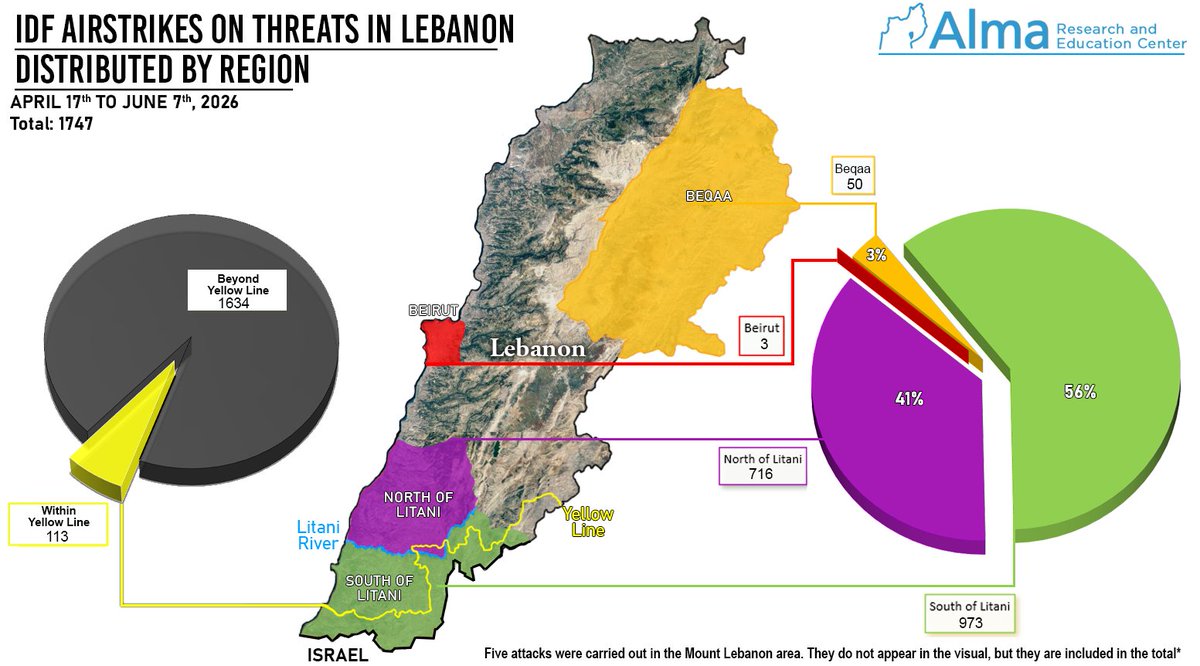
Since the beginning of the ceasefire on April 17, the IDF has conducted 1,747 airstrike waves across Lebanon.
Most strikes were concentrated in southern Lebanon (973 strikes) and areas north of the Litani River (716 strikes), alongside 50 strikes in the Beqaa Valley, 3 strikes in Beirut, and 5 strikes in the Mount Lebanon area.
In addition, 1,634 strikes (93.5%) were conducted beyond the Yellow Line, while 113 strikes (6.5%) were carried out within the Yellow Line.
Note: The data presented in the graphs refer only to IDF airstrikes and do not include ground activity, artillery fire, or additional weapons systems used during the period under review.
9
17
1,612
Tal beeri retweeted
Jun 7
Iran is launching waves of ballistic missile attacks toward Israel.
The Iranians are "responding" to a targeted Israeli strike carried out this afternoon in the Dahiyeh district of Beirut.
The Israeli strike came in response to the launch of two Hezbollah rockets toward Israeli territory earlier this morning.
The Iranians are attempting to establish a response equation.
3
7
14
1,554
Tal beeri retweeted
Jun 7
On June 3, we wrote about the IDF’s takeover of the Beaufort area and noted that this is not just another hill in southern Lebanon…
The important part of the story lies in what Hezbollah built— with direct Iranian assistance—inside the ridge, beneath the Beaufort fortress.
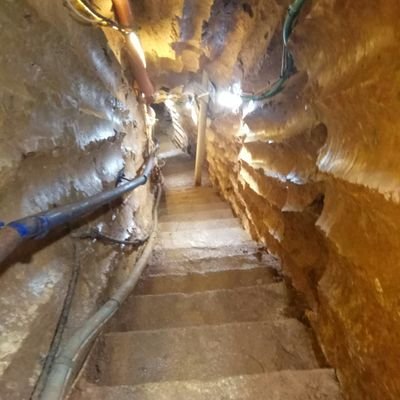
This is one of Hezbollah’s most strategic and significant tunneling assets in southern Lebanon: a vast underground complex that for years served as a command center, weapons storage facility, and fire control hub.
The tunnel infrastructure within the Beaufort Ridge was constructed in a location that enables operational control over Israeli territory near the border.
The tunnel network was designed to accommodate hundreds of Hezbollah operatives simultaneously. Inside, rooms were identified that are prepared for prolonged stay and extended combat.
Infrastructure for water and electricity was found within the tunnels, along with medical facilities and kitchens, in addition to extensive anti-tank and air defense systems.
One of the tunnels is approximately one kilometer long.
As part of efforts to enforce the agreement between Israel and Lebanon, a request was submitted to the Lebanese Army to address the tunnel network beneath Beaufort. However, Hezbollah prevented the Lebanese Army from doing so.
10
34
3,377
Tal beeri retweeted
Jun 4
In a video filmed in February 2025 by a Lebanese resident from Beaufort Castle, the strategic significance of the ridge is clearly visible. From this elevated vantage point, one can observe Israeli territory, including the town of Metula and the Mount Hermon area.
The video is more than a simple landscape recording. The Lebanese narrator proudly highlights Hezbollah’s control of the area and its commanding observation capabilities over Israel. This is particularly noteworthy given that during Operation Northern Arrows, IDF forces reached the foothills of the Beaufort Ridge but did not capture it.
In his view, Hezbollah’s continued control of the ridge following the operation served as proof of the organization’s resilience and its ability to retain one of its most important strategic assets in southern Lebanon.
Precisely for this reason, the current Israeli takeover of the Beaufort carries broader significance. Beyond territorial control, it deprives Hezbollah of a key observation post and a major hub of military activity that the organization had long used for intelligence collection, surveillance, and the direction of operational activities against Israel. It also represents a blow to a symbol that many of Hezbollah’s supporters viewed as evidence of the organization’s ability to maintain its grip on the area despite ongoing hostilities.
The video vividly illustrates how a topographical advantage can become a psychological asset—and how the loss of control over such a position constitutes not only an operational setback for Hezbollah, but also a symbolic and psychological blow.
3
27
96
8,975
Tal beeri retweeted
Jun 4
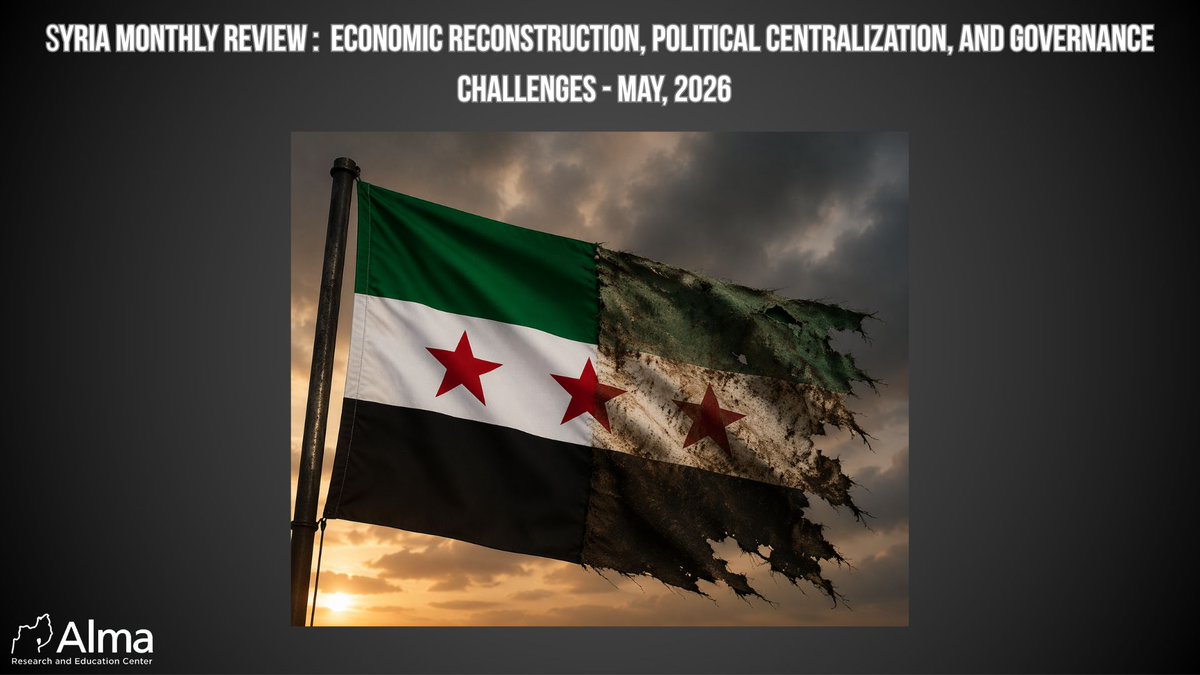
Syria – Monthly Review (May 2026): Is the New Syria Really Stabilizing?
Despite sanctions relief, growing interest from foreign investors, and improving international relations, Syria continues to grapple with weak institutions, centralized governance, persistent terrorism, sectarian tensions, and a deep social crisis. Millions of displaced people still live in camps, parliament has yet to convene, and the benefits of economic reconstruction remain out of reach for the average Syrian citizen. At the same time, Turkey and Russia continue to deepen their influence over Damascus.
The key question today is not whether Syria has entered a phase of reconstruction, but whether it is capable of building a functioning and stable state. For now, it appears that the road to achieving that goal remains a long one.
Read the full analysis>> israel-alma.org/monthly-revi…
9
18
1,776
Tal beeri retweeted
Jun 3
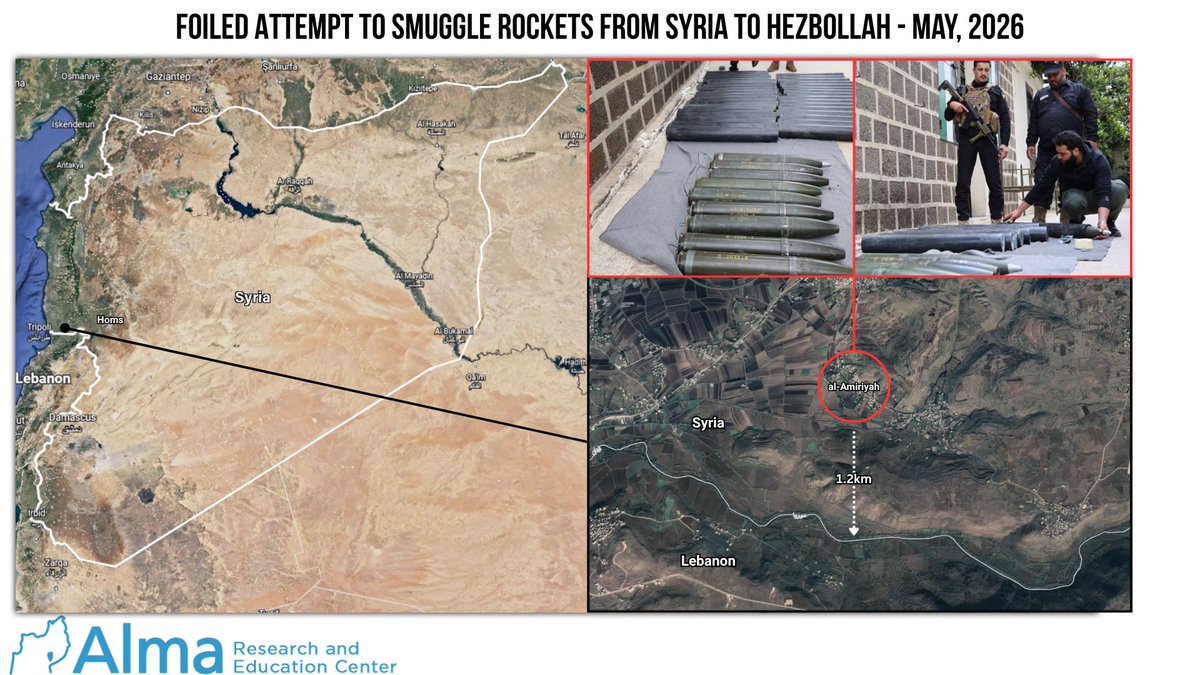
The smuggling of weapons from Syrian territory into Lebanon for Hezbollah continues. Some of these smuggling attempts are being thwarted by Syrian security forces. Recently, an attempt was made to smuggle rockets through the village of al-Ameriyah (العامرية) in the Talkalakh (تلكلخ) area of Homs Governorate, near the border with northern Lebanon. The village is located approximately 1.2 kilometers from the Lebanese border.
Since the fall of the Assad regime in December 2024, most of the weapons smuggling attempts that we have identified so far through open-source material have been carried out through the geographic area of al-Qusayr, which borders northeastern Lebanon’s Beqaa Valley and serves as a central hub for smuggling routes from Syria into Lebanon.
The current smuggling attempt took place in a different area, along Lebanon’s northern border. The Lebanon–Syria border stretches for approximately 400 kilometers, the vast majority of which remains completely porous. Hezbollah has exploited, continues to exploit, and will continue to exploit this reality. In addition to exploiting the porous border, Hezbollah also smuggles weapons and equipment through the formal border crossings between Syria and Lebanon (see our April 2026 publication on Hezbollah smuggling activities through the al-Masnaa border crossing). Hezbollah’s smuggling networks remain active through both land and maritime routes. Replenishing its weapons arsenal is a fundamental and critical component of Hezbollah’s rehabilitation and recovery efforts.
1
20
58
4,390
Tal beeri retweeted
Jun 3
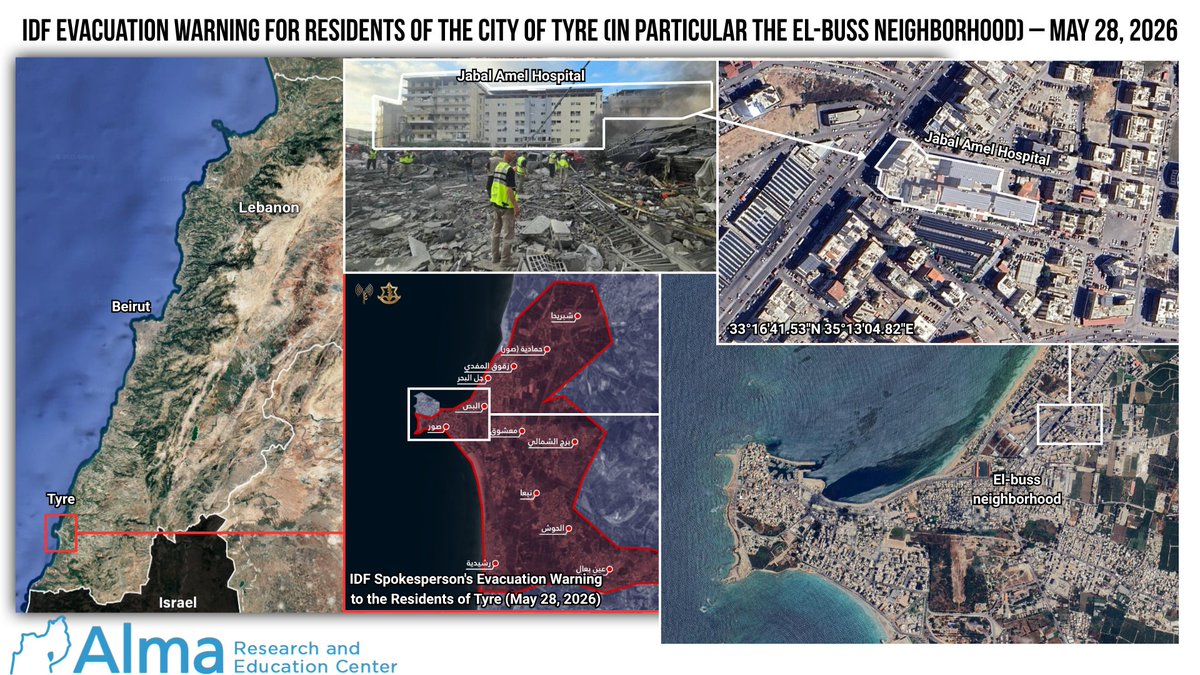
In recent days, reports have been published claiming that the IDF directly struck Jabal Amel Hospital, located in the El-Buss neighborhood (البص) in the city of Tyre. However, these reports are, to say the least, inaccurate and do not reflect the reality of the incident.
On June 1, 2026, footage began circulating from inside the hospital corridors, showing damage caused as a result of an IDF strike. However, the airstrike was not directed at the hospital itself, but rather at a target located in close proximity to the hospital.
The extensive documentation indicates that the damage sustained by the hospital was indirect and resulted from the blast wave generated by the strike, rather than from a direct hit on the building. The footage clearly shows that the hospital structure remained intact, was not directly targeted, and was not destroyed as a result of the strike. This stands in contrast to reports published by various media outlets, including Western media.
It is important to note that several days prior to the strike, on May 28, 2026, the IDF Arabic-language spokesperson issued an urgent evacuation warning to residents of the city of Tyre and the surrounding camps and neighborhoods, in accordance with international law. The warning was accompanied by a map identifying the areas designated for evacuation. One of the neighborhoods explicitly included in the warning was El-Buss, where Jabal Amel Hospital is located.
Residents of the area received a clear and advance warning regarding the need to evacuate the area, including the El-Buss neighborhood where the hospital is located. Despite this, some members of the population remained in the area, thereby exposing themselves to risk.
It should also be noted that following the IDF evacuation warning, medical teams and ambulances were observed evacuating from some of the areas included in the warning zone.
Hezbollah systematically operates from within civilian environments and conducts military activity both near and inside sensitive civilian infrastructure, including hospitals, schools, and similar facilities. At times, Hezbollah also prevents or hinders the evacuation of civilians from areas adjacent to its military assets. This conduct assists the organization both in protecting its assets and in advancing its propaganda narrative in cases where civilian surroundings and infrastructure are affected as a result of Hezbollah's own activities.
4
31
58
3,571