Joined April 2026
117 Photos and videos
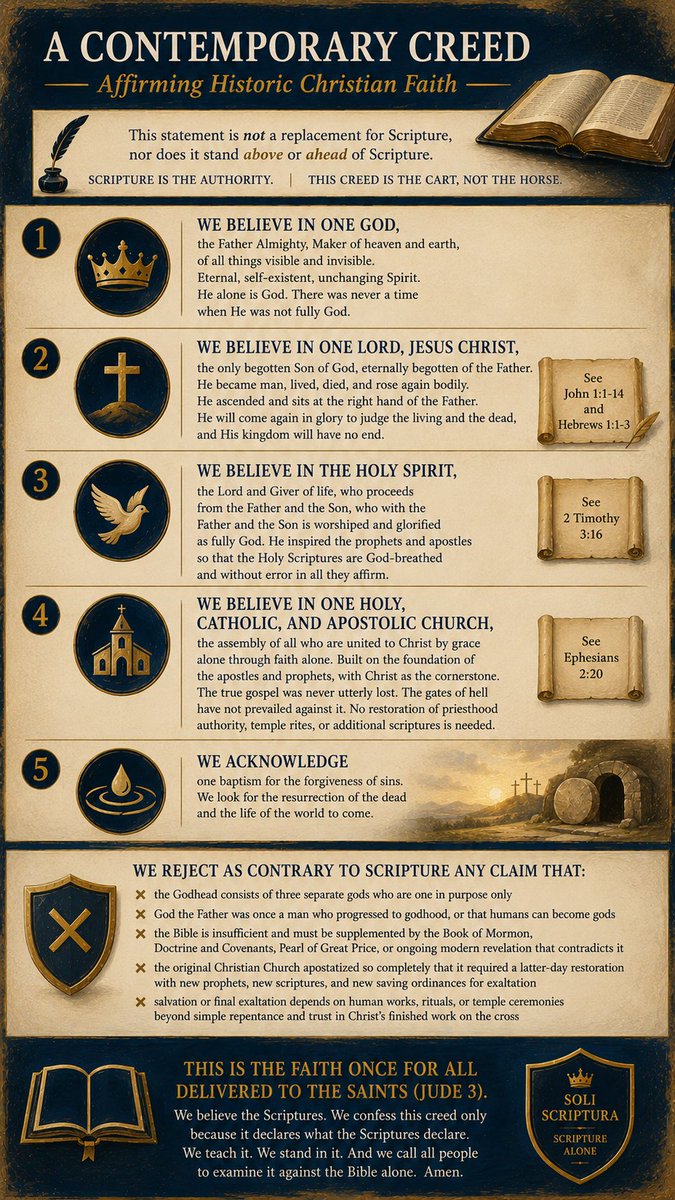
A speculation on what the Nicene Creed would look like if it were reproduced today: A Contemporary Creed Affirming Historic Christian Faith (This statement is not a replacement for Scripture, nor does it stand above or ahead of Scripture. We believe the Bible, the sixty‑six books of the Old and New Testaments, as the sole, sufficient, infallible, and final authority in all matters of faith and practice. This creed is simply a faithful summary and confession of what the Scriptures themselves teach. It is the cart, not the horse. We do not follow creeds instead of Scripture. We confess this creed because it echoes Scripture.) We believe in one God, the Father Almighty, Maker of heaven and earth, of all things visible and invisible. He is eternal, self‑existent, unchanging Spirit, without beginning, without progression, and without end. He alone is God. There was never a time when He was not fully God. We believe in one Lord, Jesus Christ, the only begotten Son of God, eternally begotten of the Father before all worlds, God of God, Light of Light, true God of true God, begotten and not made, of one substance with the Father. Through Him all things were made. For us and for our salvation He came down from heaven. By the Holy Spirit He was incarnate of the Virgin Mary and became man. He lived a sinless life, was crucified under Pontius Pilate, suffered, died, and was buried. On the third day He rose bodily according to the Scriptures. He ascended into heaven and sits at the right hand of the Father. He will come again in glory to judge the living and the dead, and His kingdom will have no end. See John 1:1-14 and Hebrews 1:1-3. We believe in the Holy Spirit, the Lord and Giver of life, who proceeds from the Father and the Son, who with the Father and the Son is worshiped and glorified as fully God. He inspired the prophets and apostles so that the Holy Scriptures are God‑breathed and without error in all they affirm. See 2 Timothy 3:16. We believe in one holy, catholic, and apostolic Church, the assembly of all who are united to Christ by grace alone through faith alone. This Church is built on the foundation of the apostles and prophets, with Christ Jesus Himself as the cornerstone. The true gospel was never utterly lost. The gates of hell have not prevailed against it. No nineteenth‑century restoration of priesthood authority, temple rites, or additional scriptures is needed. See Ephesians 2:20. We acknowledge one baptism for the forgiveness of sins. We look for the resurrection of the dead and the life of the world to come. We reject as contrary to the clear teaching of Scripture any claim that: • the Godhead consists of three separate gods who are one in purpose only • God the Father was once a man who progressed to godhood, or that humans can become gods • the Bible is insufficient and must be supplemented by the Book of Mormon, Doctrine and Covenants, Pearl of Great Price, or ongoing modern revelation that contradicts it • the original Christian Church apostatized so completely that it required a latter‑day restoration with new prophets, new scriptures, and new saving ordinances for exaltation • salvation or final exaltation depends on human works, rituals, or temple ceremonies beyond simple repentance and trust in Christ’s finished work on the cross This is the faith once for all delivered to the saints (see Jude 3). We believe the Scriptures. We confess this creed only because it declares what the Scriptures declare. We teach it. We stand in it. And we call all people to examine it against the Bible alone. Amen.
1
117
Fellow believers, @RandomLDS argues that the Bible cannot be trusted in its current form because it was copied by fallible scribes over centuries, allowing errors and changes to creep in. Therefore we need Joseph Smith and the Book of Mormon to correct what was supposedly lost. This claim does not match the actual evidence of how the Bible was transmitted. The New Testament is the best attested document from the ancient world. We possess over 5800 Greek manuscripts, plus early translations and quotations from the church fathers. These come from multiple independent lines of transmission. While minor variants exist, the vast majority are trivial (spelling, word order, small omissions) and none affect any core doctrine. The essential text is stable and well established. Scripture itself testifies that God has preserved His Word. “The grass withers, the flower fades, but the word of our God will stand forever” (Isaiah 40:8). Jesus declared that not one jot or tittle would pass from the Law until all is accomplished (Matthew 5:18). The 1689 London Baptist Confession confesses that Holy Scripture has been kept pure in all ages by God’s providence and is sufficient for faith and life. The same standard is rarely applied to the Book of Mormon, which also passed through human hands and has its own textual history. The argument is selectively used against the Bible alone. The real issue is not whether minor copying variants exist. The real issue is whether we will receive the God who has preserved His Word across centuries or insist that we need later revelation to correct what He supposedly failed to keep pure. Stay anchored in the whole counsel of God. The Bible we have today is not a damaged, uncertain document requiring modern correction. It is the preserved and sufficient Word of the living God. We do not need later prophets to rescue what He has already given and protected.
Some faiths treat the Bible as if it’s perfect in its current state; however, the more you look at the history of the Bible, the harder it is to pretend it reached us unscathed from error. These texts were copied long after the originals disappeared, often by people working with damaged pages, missing lines, or handwriting they could barely read. Every time a scribe had to guess at a word or reconstruct a sentence, the meaning potentially shifted a little. I common children’s game illustrates this perfectly where they whisper a sentence to one another and see how it changed along the way. Sometimes the changes to the Bible were accidental. Sometimes they were intentional. Either way, the idea that this process produced a perfect final result is impossible to defend. If the Bible passed through that many hands, across that many centuries, with that many opportunities for human error, then of course mistakes and errors crept in. Of course some meanings were lost. Of course some passages were altered. It would be strange if that had not happened. Therefore, we cannot act like the text we have today is guaranteed to match what God originally revealed to His prophets. That is why Joseph Smith’s statement matters. When he said, “We believe the Bible to be the word of God as far as it is translated correctly,” he was stating the only position that makes sense once you understand how the Bible actually came down to us. If the transmission was imperfect, then we need God to clarify what is true. We need Him to correct what was lost. We need Him to speak again. This is where a living prophet becomes essential. If God spoke anciently but the record of those revelations has been altered, damaged, or misunderstood over time, then the only way to recover the original meaning is for God to speak now. A prophet is not a luxury. A prophet is the only safeguard against the accumulated errors of centuries. Without one, we are left guessing which parts of the text reflect God’s voice and which parts reflect the limitations of the people who copied it. Thankfully we have the Book of Mormon - Another Testament of Jesus Christ that stands as a second witness and helps clarify Christs simple doctrine.
14
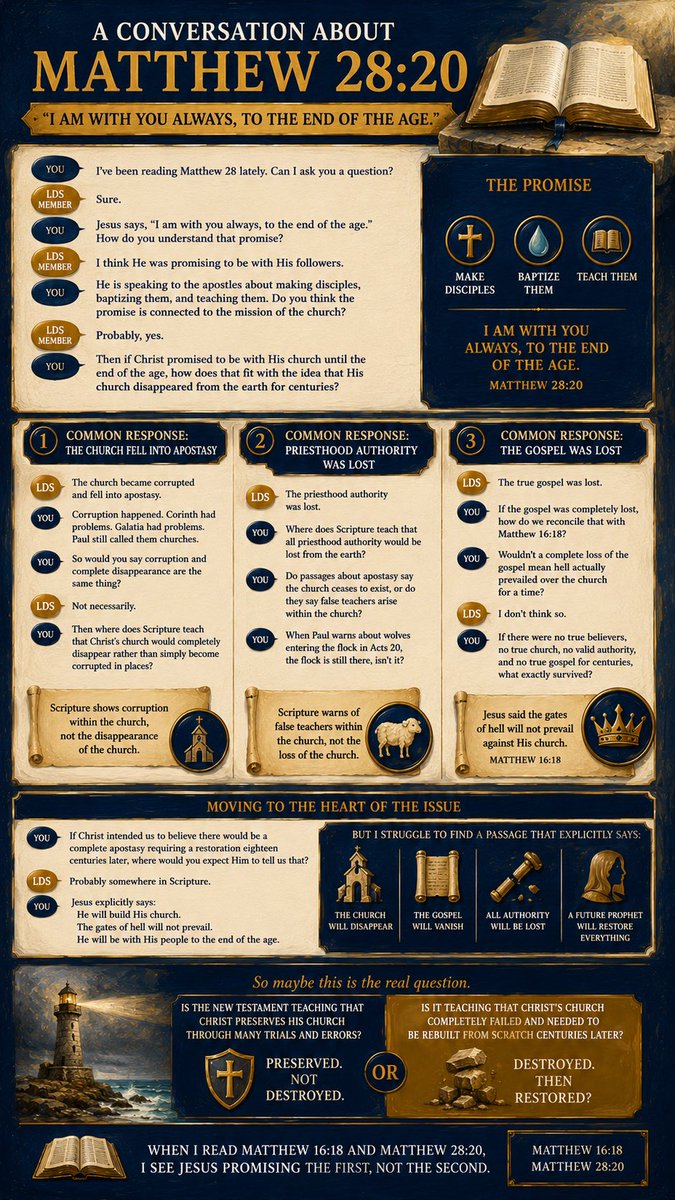
You to an LDS friend/member: I’ve been reading Matthew 28 lately, and something has been on my mind. Can I ask you a question? LDS Member: Sure. You: Jesus says, “I am with you always, to the end of the age.” How do you understand that promise? LDS Member: I think He was promising to be with His followers. You: That makes sense. In the context, though, He is speaking to the apostles about making disciples, baptizing them, and teaching them. Do you think the promise is connected to the mission of the church? LDS Member: Probably, yes. You: Then help me understand something. If Christ promised to be with His church until the end of the age, how does that fit with the idea that His church disappeared from the earth for centuries? First Common Response LDS Member: The church became corrupted and fell into apostasy. You: I agree corruption happened. We see corruption even in the New Testament churches. Corinth had serious problems. Galatia had serious problems. Yet Paul still called them churches. So would you say corruption and complete disappearance are the same thing? LDS Member: Not necessarily. You: Then where does Scripture teach that Christ’s church would completely disappear rather than simply become corrupted in places? Second Common Response LDS Member: The priesthood authority was lost. You: I understand that’s the LDS position. What I’m trying to find is where Scripture teaches that all priesthood authority would be lost from the earth. Can you think of a passage that explicitly says that? LDS Member: There are passages about apostasy. You: Yes, and I take those seriously. But do those passages say the church ceases to exist, or do they say false teachers will arise within the church? For example, when Paul warns about wolves entering the flock in Acts 20, the flock is still there, isn’t it? Third Common Response LDS Member: The true gospel was lost. You: That’s another thing I’ve been thinking about. If the gospel was completely lost, how do we reconcile that with passages like Matthew 16:18 where Jesus says the gates of hell will not prevail against His church? Wouldn’t a complete loss of the gospel mean hell actually prevailed over the church for a time? LDS Member: I don’t think so. You: How not? Because if there were no true believers, no true church, no valid authority, and no true gospel for centuries, what exactly survived? Moving to the Heart of the Issue You: Can I ask the question a different way? LDS Member: Sure. You: If Christ intended us to believe there would be a complete apostasy requiring a restoration eighteen centuries later, where would you expect Him to tell us that? LDS Member: Probably somewhere in Scripture. You: That’s what I keep coming back to. Because Jesus explicitly says: He will build His church. The gates of hell will not prevail. He will be with His people to the end of the age. But I struggle to find a passage that explicitly says: the church will disappear, the gospel will vanish, all authority will be lost, and a future prophet will restore everything. You: So maybe this is the real question. Is the New Testament teaching that Christ preserves His church through many trials and errors? Or is it teaching that Christ’s church completely failed and needed to be rebuilt from scratch centuries later? Because those seem like two very different stories. And when I read Matthew 16:18 and Matthew 28:20, I honestly see Jesus promising the first, not the second.
18
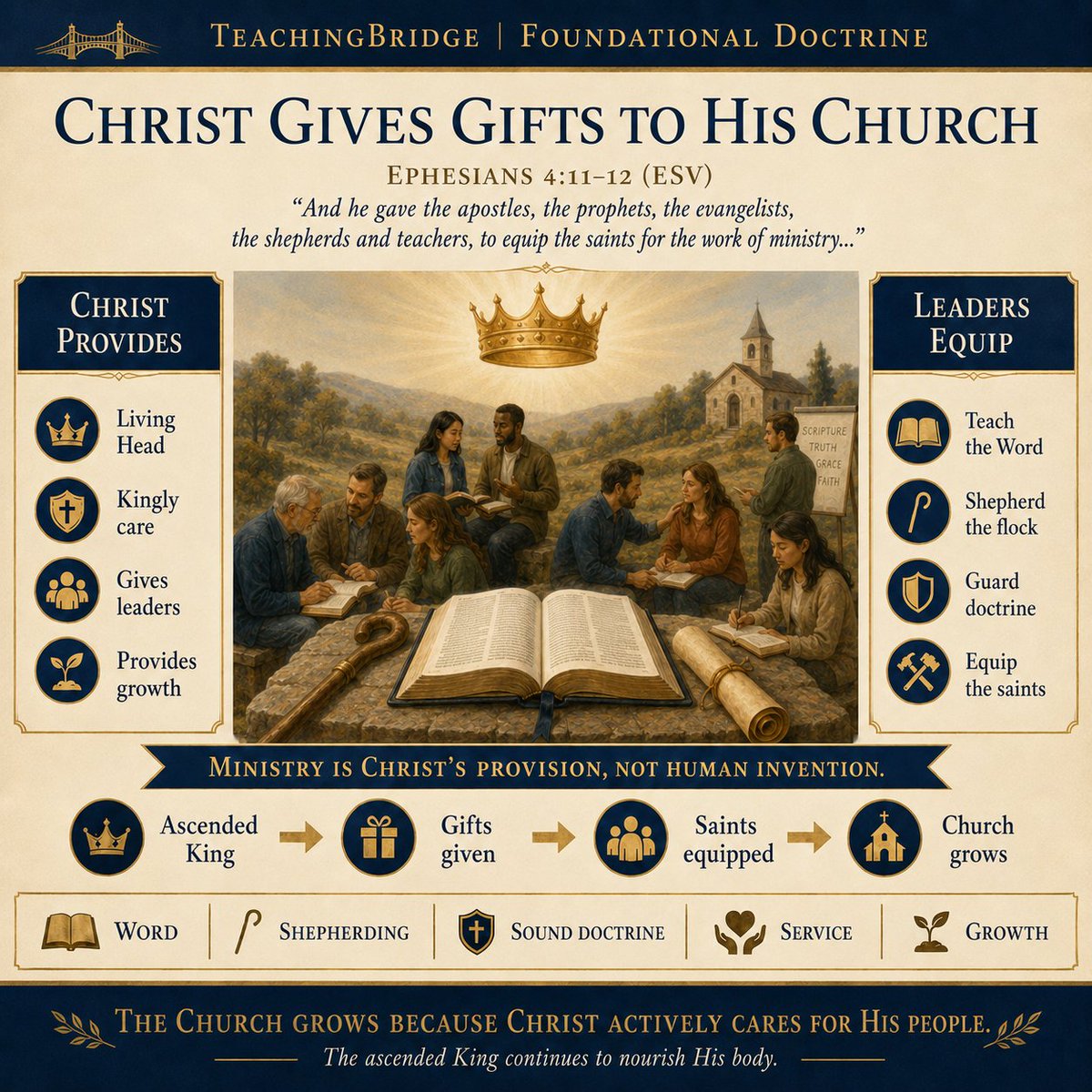
🌉 TeachingBridge | Foundational Doctrine Christ Gives Gifts to His Church 📖 Ephesians 4:11–12 (ESV) “And he gave the apostles, the prophets, the evangelists, the shepherds and teachers, to equip the saints for the work of ministry…” The ascended Christ has not abandoned His Church. Having conquered sin, death, and the grave, He now rules His people as their living Head. One of the ways Christ exercises His kingly care is through the gifts He gives to His Church. Ephesians 4 reminds us that ministry is not ultimately a human invention. It is Christ's provision. The Lord who purchased His people also provides for their growth. He gives leaders to teach His Word, shepherd His flock, guard sound doctrine, and equip believers for faithful service. This means that the ministry of the Church is not built upon charisma, personality, or innovation. It is built upon Christ's gracious provision. The Church grows because Christ actively cares for His people. The ascended King continues to nourish His body. #Ephesians4 #Church #ChristTheKing #MeansOfGrace #TeachingBridge
1
1
11
TeachingBridge Ministries retweeted
Libertarian Free Will.
What is the #1 lie of modern Christianity?
9
1
31
2,050
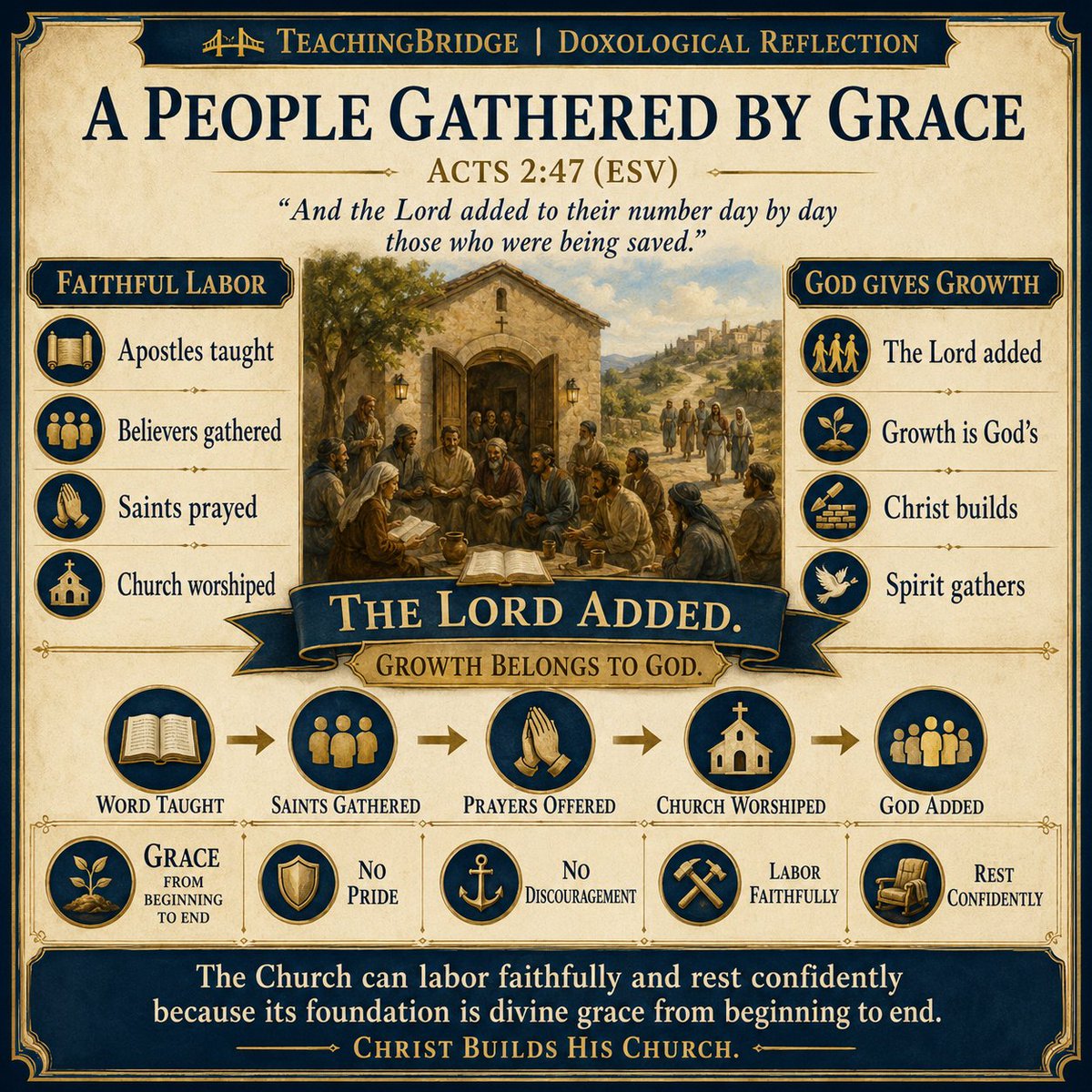
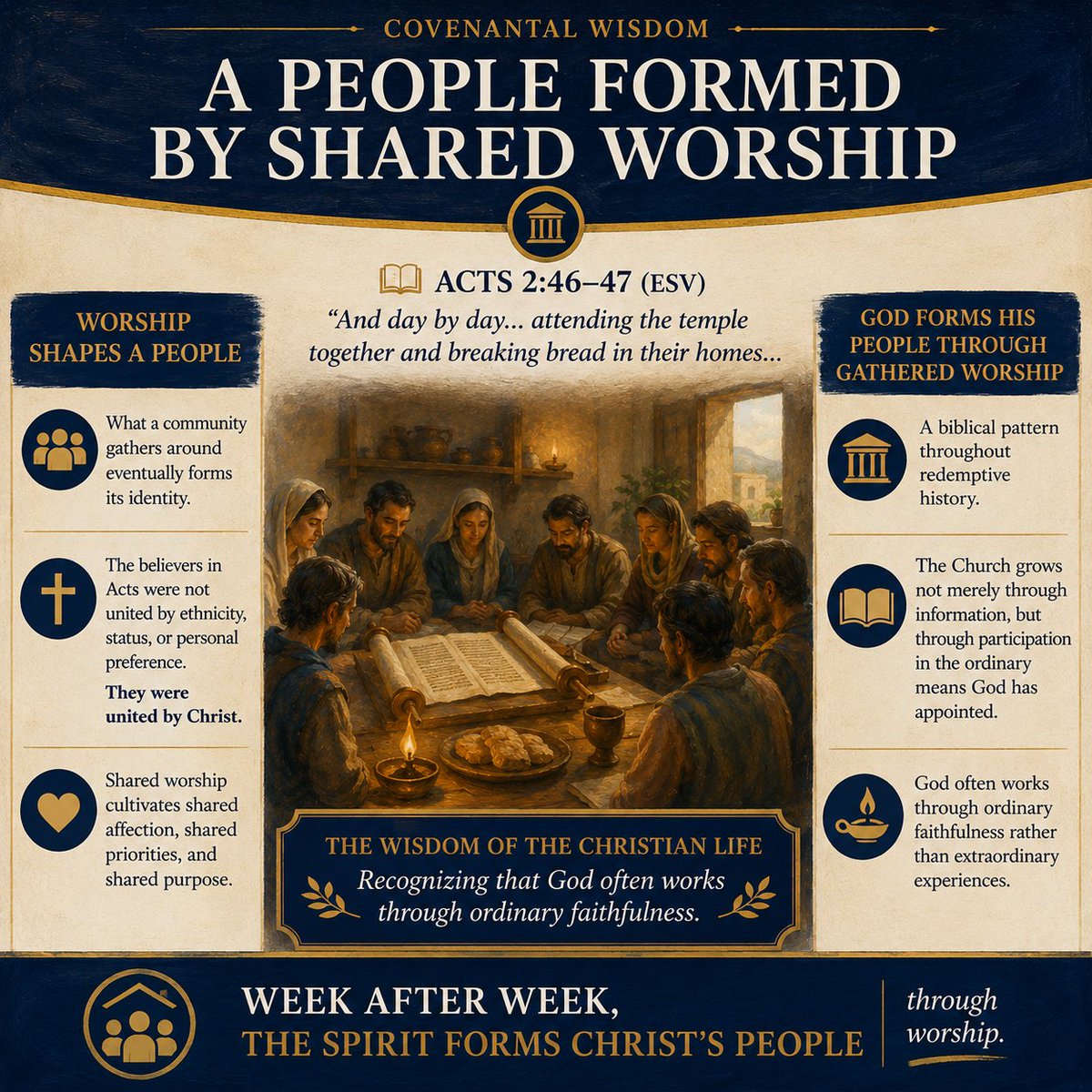
🌉 TeachingBridge | Doxological Reflection A People Gathered by Grace 📖 Acts 2:47 (ESV) “And the Lord added to their number day by day those who were being saved.” The closing note of Acts 2 directs attention to the true builder of the Church. The apostles taught. The believers gathered. The saints prayed. The church worshiped. But the Lord added. Growth ultimately belongs to God. This truth guards against pride and discouragement alike. The Church does not exist because of human ingenuity. Nor is its future dependent upon human strength. Christ builds His Church. The Spirit gathers His people. The Father receives glory through a redeemed community purchased by the blood of His Son. Therefore the Church can labor faithfully and rest confidently. Its foundation is divine grace from beginning to end. #Acts2 #ChurchGrowth #Grace #Doxology #TeachingBridge
9
TeachingBridge Ministries retweeted
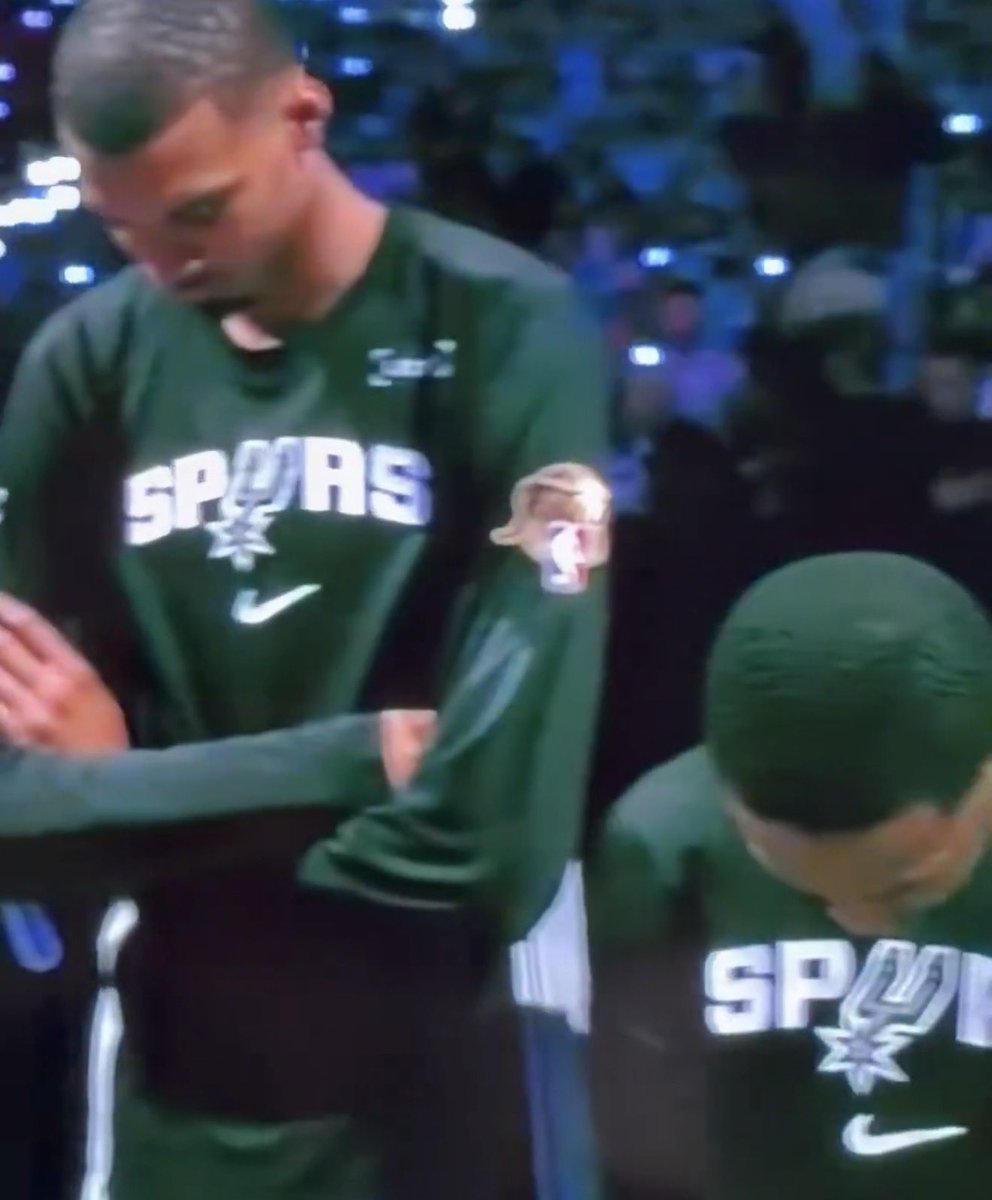
Notice how, unlike the NBA, all of the Team USA soccer players have their hands over their hearts for the national anthem! This isn’t about black or white. This is about the NBA being full of ungrateful bitches who hate the country!
Community note
Wemby is French not American. en.wikipedia.org/wiki/Victor_We…
2,527
11,544
86,336
6,863,149
TeachingBridge Ministries retweeted
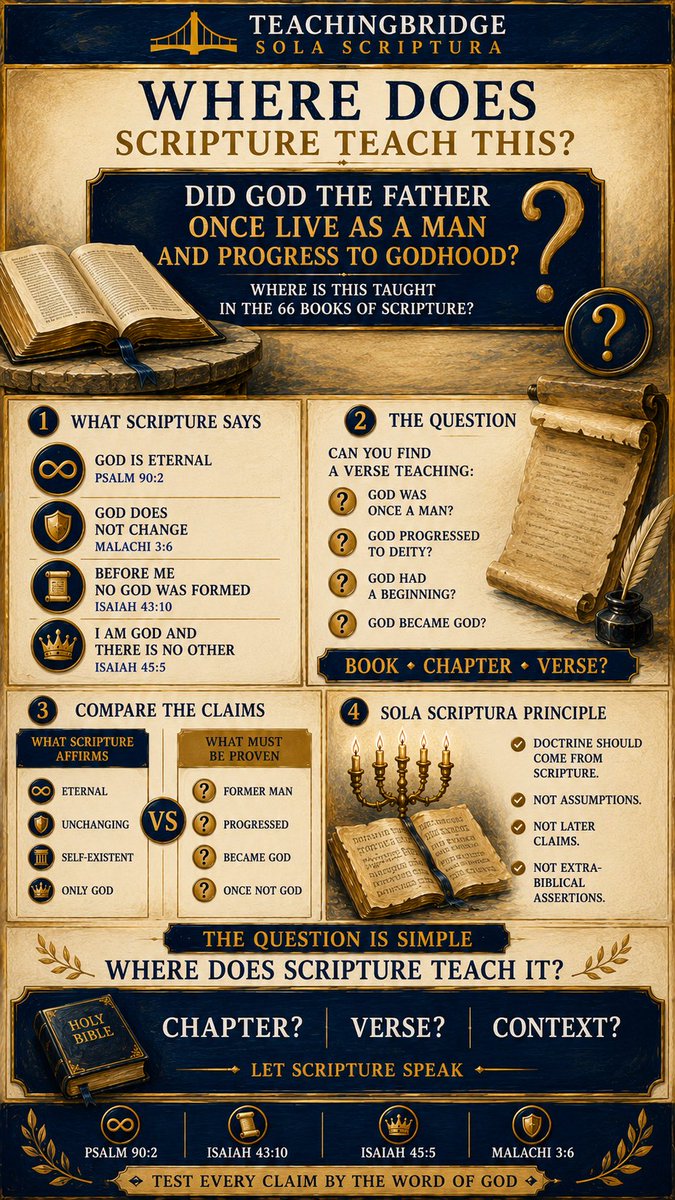
Honest Question: Where does Scripture teach that God the Father was once a man who progressed to godhood? 🤷
1
1
10
TeachingBridge Ministries retweeted
BREAKING: Sec Marco Rubio just met with Right Wing Paraguay President at the FIFA World Cup TEAM USA JUST WON BY A LANDSLIDE WE ARE SO BACK
375
5,031
52,030
1,418,307
TeachingBridge Ministries retweeted
The entire USMNT squad joined in for the postgame prayer after their World Cup victory over Paraguay. 🙏🇺🇸 Mark McKenzie led the prayer.
146
1,699
19,876
1,055,940
TeachingBridge Ministries retweeted
Dan Shay version of the Star Spangled Banner takes over Whitney Houston's rendition at Super Bowl XXV, for the top spot Reasoning → world stage → performed beautifully a cappella (no music) → no bullshit politics → Tom Cruise > Beckham

2
1
18
1,295
TeachingBridge Ministries retweeted
Dan Shay sing The Star-Spangled Banner on home soil at the FIFA World Cup. Watch for Tom Cruise showing his patriotic side! 🇺🇸
3
5
106
11,061
TeachingBridge Ministries retweeted
Being that it's Almost the 4th of July, America's Birthday, I thought it might be good to have a little History Lesson... Who Knows, you might even Learn something... Star Spangled Banner As You've Never Heard It youtu.be/YaxGNQE5ZLA?si=0neE… #BuildAmericanBuyAmerican #GodBlessAmerica #GodBlessPresidentTrump #EndGlobalism #RemoveMLG #RemoveStansbury #RemoveHaaland #FireTim #RemoveBenRayLujan #RemoveHeinrich #EnforceTheLaw I would rather be optimistic and wrong, rather than pessimistic and right... -- Elon Musk
1
23
TeachingBridge Ministries retweeted
Amazing Rendition of The Star Bangled Banner!! 🇺🇸 🫡

1
1
4
126
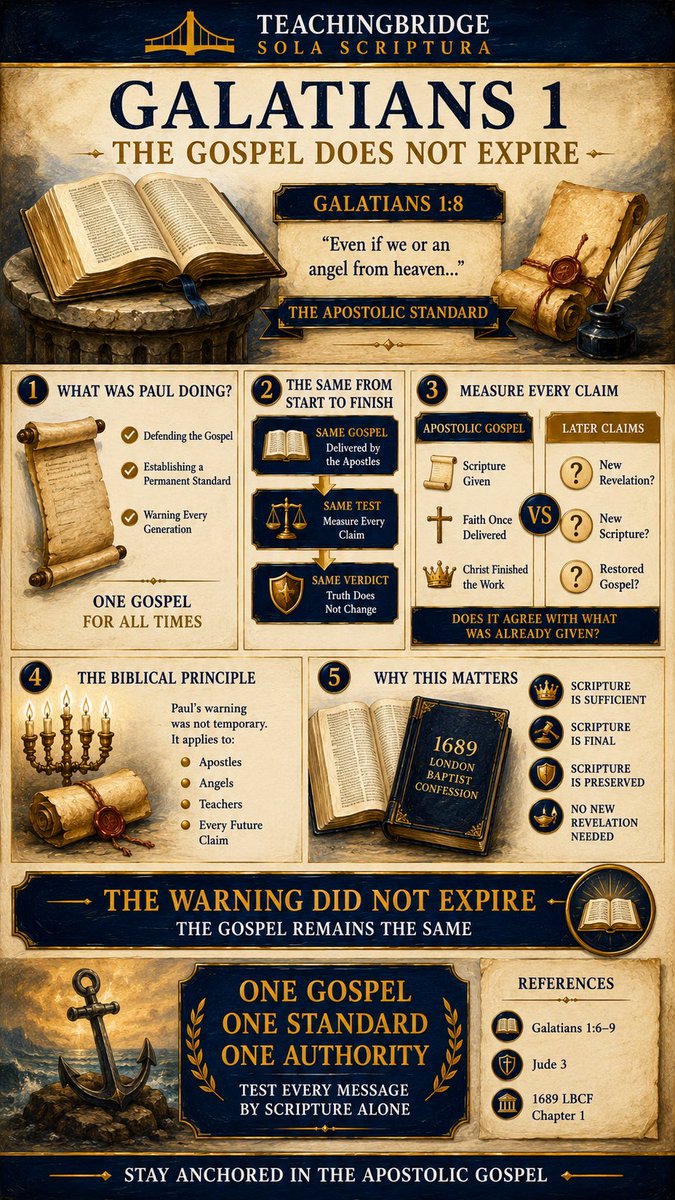
Fellow believers, this is a common rhetorical move in these conversations, but it rests on a misunderstanding of what Paul is actually doing in Galatians 1. Paul is not simply addressing a local dispute in Galatia. He is establishing a permanent and universal standard for the gospel itself. In Galatians 1:6 through 9, Paul expresses astonishment that the Galatians are turning to a different gospel. He then pronounces a curse on anyone, even an apostle or an angel from heaven, who preaches a gospel that differs from the one he had already delivered to them. The force of his language is intentional and sweeping. He is not limiting the warning to the specific issue of circumcision or the Judaizers. He is declaring that the gospel he preached is the only gospel, and that any addition, alteration, or replacement stands under God’s judgment. See Galatians 1:8. The principle is timeless. The gospel is not negotiable. It was delivered once for all through the apostles. Anything that comes later claiming new revelation, new scripture, or a restored gospel must be tested against what was already given. If it contradicts or adds to the apostolic message, it falls under the same apostolic warning. This is why Galatians 1:8 remains directly relevant. When a later movement claims that an angel brought new revelation and a restored gospel that changes core doctrines such as the nature of God, the person of Christ, the way of salvation, and the sufficiency of Scripture, the biblical test is not whether the movement existed in the first century. The test is whether it aligns with the gospel the apostles already preached. The 1689 London Baptist Confession affirms that Holy Scripture is the supreme and final authority because God has given and preserved it as the sufficient rule for faith and life. We do not need later prophets or new scripture to complete or correct what the apostles delivered. The gospel remains the same yesterday, today, and forever because it rests on the finished work of Christ, not on ongoing additions. See 1689 LBCF on Scripture. When someone tries to limit Galatians 1 to the problem in Galatia, they are not doing careful exegesis. They are attempting to make the apostolic warning expire after the first century so that later claims can escape examination. Stay anchored in the whole counsel of God. The gospel Paul preached is not one option among many. It is the only gospel. Any message that requires us to accept new revelation alongside or above what the apostles gave stands under the very warning Paul pronounced.
Evangelical: Galatians 1:8 proves Mormonism is false. Mormon: What was the problem in Galatia? Evangelical: Mormonism. Mormon: Mormonism didn't exist. Evangelical: Exactly. Mormon: What was Paul actually talking about? Evangelical: That's not important. Mormon: Then why did you quote the chapter?
1
1
24
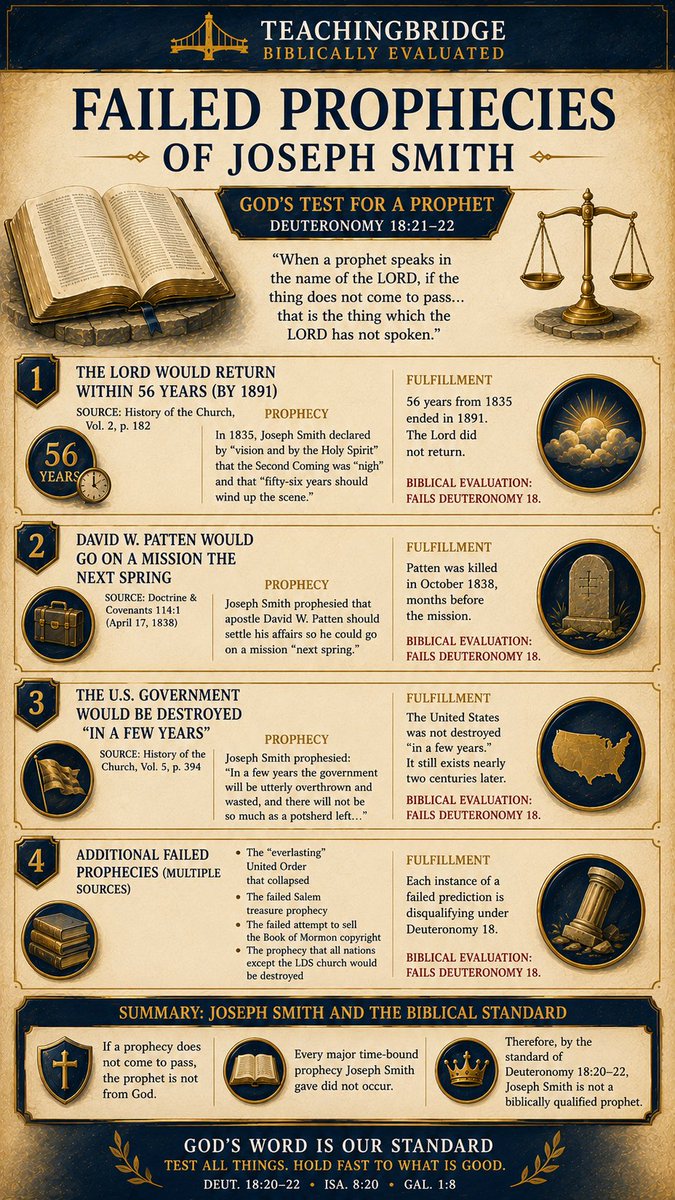
Failed Prophecies of Joseph Smith (Biblically Evaluated) Deuteronomy 18:21‑22 gives God’s own test for a prophet: “When a prophet speaks in the name of the LORD, if the thing does not come to pass… that is the thing which the LORD has not spoken.” The historical record shows multiple specific, time‑bound prophecies by Joseph Smith that did not occur. These are drawn directly from LDS sources such as the Doctrine & Covenants and History of the Church. --- 1. Prophecy: The Lord would return within 56 years (by 1891) Source: History of the Church, Vol. 2, p. 182 In 1835, Joseph Smith declared by “vision and by the Holy Spirit” that the Second Coming was “nigh” and that “fifty‑six years should wind up the scene.” Fulfillment: 56 years from 1835 ended in 1891. The Lord did not return. Biblical evaluation: Fails Deuteronomy 18. --- 2. Prophecy: David W. Patten would go on a mission the next spring Source: Doctrine & Covenants 114:1 (April 17, 1838) Joseph Smith prophesied that apostle David W. Patten should settle his affairs so he could go on a mission “next spring.” Fulfillment: Patten was killed in October 1838, months before the mission. Biblical evaluation: Fails Deuteronomy 18. --- 3. Prophecy: The U.S. government would be destroyed “in a few years” Source: History of the Church, Vol. 5, p. 394 Joseph Smith prophesied: “In a few years the government will be utterly overthrown and wasted, and there will not be so much as a potsherd left…” Fulfillment: The United States was not destroyed “in a few years.” It still exists nearly two centuries later. Biblical evaluation: Fails Deuteronomy 18. --- 4. Additional failed prophecies (corroborated by multiple sources) The search results also reference other failed prophecies commonly discussed by historians and LDS scholars, including: • The “everlasting” United Order that collapsed • The failed Salem treasure prophecy • The failed attempt to sell the Book of Mormon copyright • The prophecy that all nations except the LDS church would be destroyed These are discussed in modern analyses of Joseph Smith’s prophetic record. Biblical evaluation: Each instance of a failed prediction is disqualifying under Deuteronomy 18. --- Summary: Joseph Smith and the Biblical Standard Using only the biblical test God Himself gave: If a prophecy does not come to pass, the prophet is not from God. Every major time‑bound prophecy Joseph Smith gave … including the Second Coming, the U.S. government’s destruction, and David Patten’s mission (did not occur) Therefore, by the standard of Deuteronomy 18:20‑22, Joseph Smith does not meet the biblical criteria for a true prophet.
Replying to @TeachingbridgeM
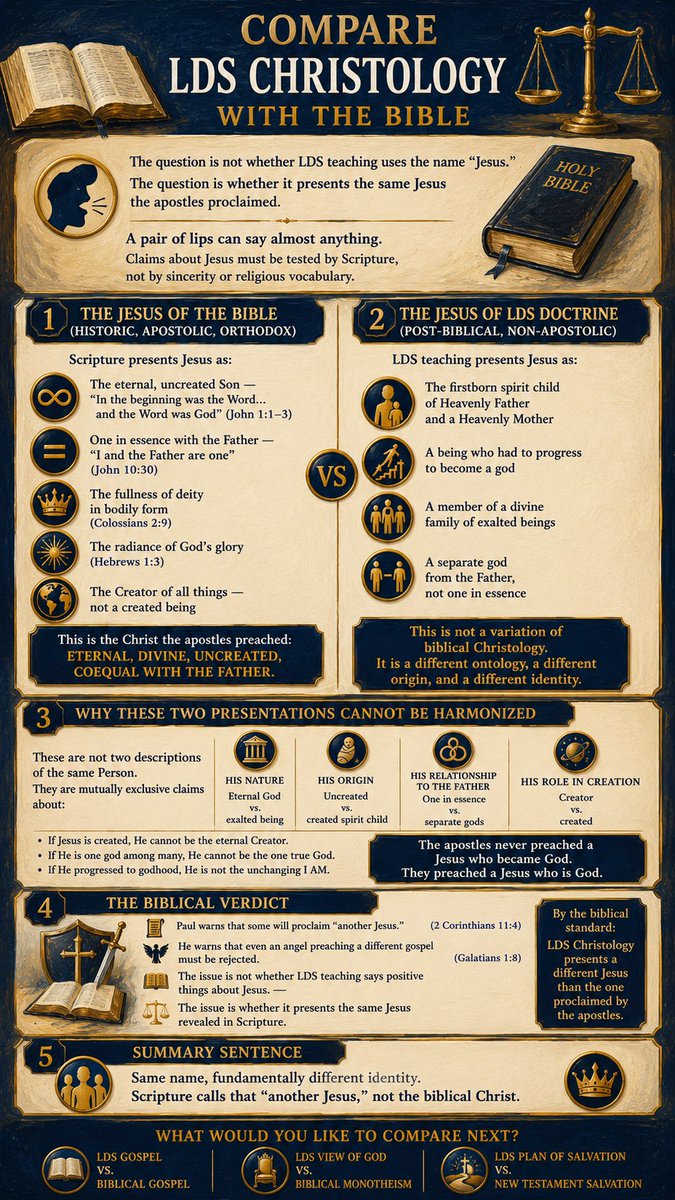
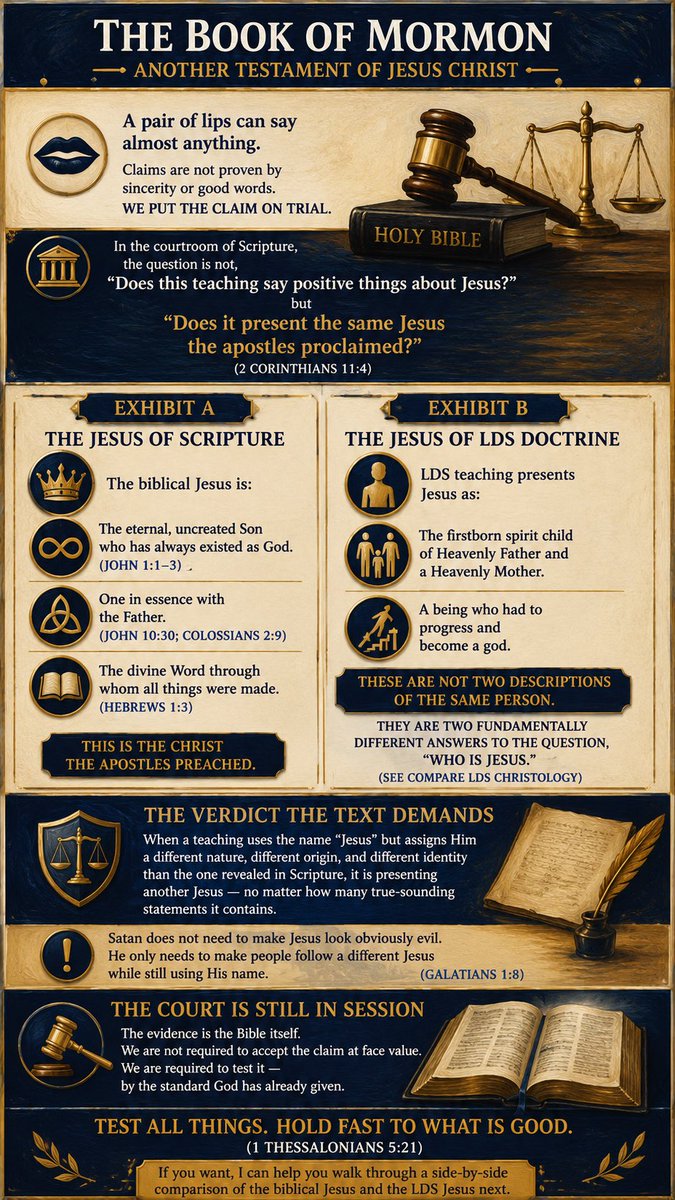
Applying the Biblical Tests of Revelation to Joseph Smith (If the prophecy fails, the prophet is false) The Bible gives four objective tests for evaluating anyone who claims to speak for God. When we apply those tests to Joseph Smith, the results are consistent and decisive. --- 1. The Continuity Test Does the message align with prior revelation (Isaiah 8:20; Deuteronomy 13:1‑5) Joseph Smith’s teachings introduce doctrines that contradict the already‑revealed Scriptures, including: • A different God (God the Father once a man who progressed to godhood) • A different Jesus (a created spirit‑child who became a god) • A different gospel (salvation by ordinances, temple rituals, and exaltation) • A plurality of gods (in direct conflict with biblical monotheism) These are not developments of biblical teaching. They are replacements of it. Result: Joseph Smith’s teachings fail the continuity test. --- 2. The Verification Test Did his predictions come to pass (Deuteronomy 18:20‑22) Joseph Smith made specific, time‑bound prophecies that did not occur, including: • The Civil War prophecy expanding to all nations (did not happen) • The Second Coming before 1891 (did not happen) • A temple in Independence, Missouri “in this generation” (never happened) • The destruction of all nations except the LDS church —(did not happen) Deuteronomy 18 does not allow reinterpretation or spiritualizing after the fact. If the prophecy fails, the prophet is false. Result: Joseph Smith fails the verification test. --- 3. The Christological & Gospel Test Does the message proclaim the same Jesus and the same gospel (2 Corinthians 11:4; Galatians 1:8) Joseph Smith’s revelations teach: • A different Jesus (created being, spirit‑child, progressed to godhood) • A different gospel (exaltation through works, ordinances, and temple rituals) • A different God (one god among many, not the eternal Creator) Paul’s warning is direct: If someone preaches another Jesus or another gospel, even if it comes from “an angel,” it is not from God. Result: Joseph Smith fails the Christological and gospel test. --- 4. The Transparency & Preservation Test Is the revelation public, verifiable, and preserved Biblical revelation is: • Public • Witnessed • Open to examination • Preserved for the people of God Joseph Smith’s claims involve: • Gold plates never publicly examined • Witnesses describing visionary experiences (“spiritual eyes”) • No surviving plates • No independent verification • A translation process involving a seer stone in a hat • Revisions to the Book of Mormon and Doctrine & Covenants This is not how biblical revelation operates. Result: Joseph Smith fails the transparency and preservation test. --- Conclusion: All Four Biblical Tests Point to the Same Result By the standards God Himself gave, Joseph Smith does not meet the criteria of a true prophet. This is not based on emotion, tradition, or denominational loyalty. It is based on the objective tests of Scripture.
1
37
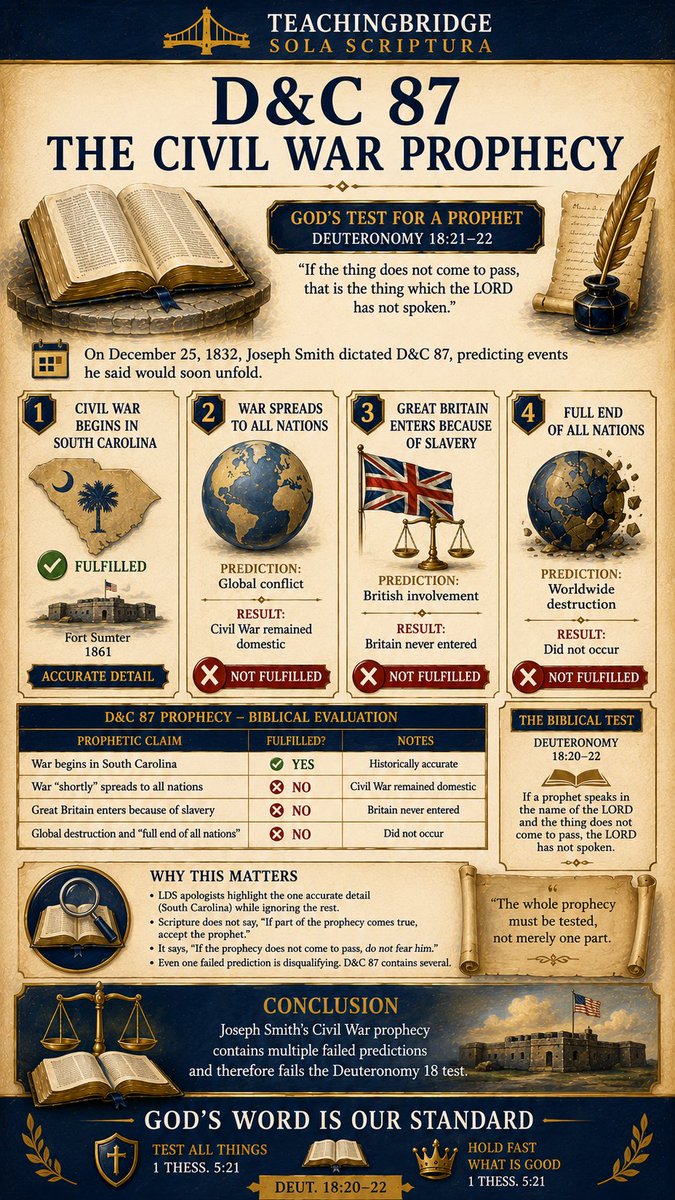
Joseph Smith’s Civil War Prophecy (D&C 87) — What He Said and What Happened On December 25, 1832, Joseph Smith dictated a revelation now known as Doctrine & Covenants 87, predicting a series of events he said would soon unfold. The historical background and content are documented in the Joseph Smith Papers and LDS historical scholarship. The prophecy includes three major claims: --- 1. The Civil War would begin in South Carolina This part did happen … the Civil War began at Fort Sumter, South Carolina, in April 1861. Even LDS historians note that early newspapers recognized this partial correspondence. However, the prophecy does not stop there. --- 2. The war would “shortly” spread to all nations Joseph Smith prophesied that the conflict would escalate into global war, involving: • “all nations” • slave uprisings • widespread famine • plagues • the “full end of all nations” This escalation did not occur. The American Civil War remained a domestic conflict, not a global one. LDS scholars acknowledge that the prophecy has been repeatedly reinterpreted over time because its global predictions did not materialize. --- 3. Great Britain and other nations would be drawn into the war because of slavery Joseph Smith predicted that Great Britain would be forced into the conflict due to “the slave question.” This did not happen. • Britain did not enter the Civil War. • Britain had already abolished slavery in 1833. • No European nation joined the conflict. LDS historians note that later generations tried to apply this part of the prophecy to World War I or other conflicts because it did not fit the Civil War itself. --- How the Prophecy Fails the Biblical Test (Deuteronomy 18:20–22) Deuteronomy 18 gives a simple, non-negotiable standard: If a prophet speaks in the name of the Lord and the thing does not come to pass, the Lord has not spoken. Applying that standard: *Prophetic Claim-Fulfilled?-(Notes) *War begins in South Carolina-Yes-(Historically accurate) *War “shortly” spreads to all nations-No-(Civil War remained domestic) *Great Britain enters because of slavery-No-(Britain never entered) *Global destruction and “full end of all nations”-No-(Did not occur) Conclusion: Joseph Smith’s Civil War prophecy contains multiple failed predictions, and therefore fails the Deuteronomy 18 test. --- Why This Matters LDS apologists often highlight the one accurate detail (South Carolina) while ignoring the rest of the prophecy, which is where the biblical test is actually applied. But Scripture does not say: “If part of the prophecy comes true, accept the prophet.” It says: If the prophecy does not come to pass, do not fear him. Even one failed prediction is disqualifying. D&C 87 contains several.
1
1
78
Fellow believers, here is another common attempt to create a false equivalence. The claim is that Christians are inconsistent for accepting a talking donkey in Scripture while rejecting the gold plates, which supposedly rest on stronger first‑hand, historically verifiable testimony. It sounds clever on the surface, but it collapses two completely different categories. --- 1. The Talking Donkey Is Not an Isolated Anecdote The account in Numbers 22 appears within: • Inspired Scripture • Written by Moses • Preserved in the canon • Embedded in the unified biblical storyline • Consistent with God’s sovereign power over creation The event serves a clear theological purpose: God can use even a donkey to rebuke a prophet acting against His will. Christians do not accept it because it feels normal. We accept it because it is part of the Spirit‑breathed testimony preserved, tested, and affirmed across centuries. --- 2. The Gold Plates Are a Completely Different Category The gold plates rest on the testimony of eleven men: • The Three Witnesses described a visionary experience (“spiritual eyes”). • The Eight Witnesses claimed to handle plates but were all close associates or relatives. • Several later distanced themselves from Joseph Smith or the movement. • The plates were never subjected to public, neutral examination. • They disappeared and have never been recovered. This is not comparable to the resurrection of Jesus, which rests on: • Early • Multiple • Independent • Public • Falsifiable • Historically anchored lines of testimony, including a creed within a few years of the events (1 Corinthians 15:3‑8). The gold plates do not meet the biblical or historical standard for new revelation. --- 3. Scripture Gives Us the Standard for Testing New Claims The issue is not whether something sounds “crazy” to modern ears. The issue is whether it meets the biblical tests God Himself gave. Those tests include: • Alignment with prior revelation (Isaiah 8:20; Deuteronomy 13:1‑5) • Accuracy of predictions (Deuteronomy 18:20‑22) • Fidelity to the apostolic gospel (Galatians 1:8) Deuteronomy 18 is especially clear: If someone speaks in the name of the Lord and the thing does not come to pass, that is not a word the Lord has spoken. Later explanations do not erase earlier failed predictions. --- 4. Why Christians Are Not Being Inconsistent The 1689 London Baptist Confession affirms that Scripture is the supreme and final authority because God has given and preserved it. We do not lower the bar for one set of claims while holding others to a normal historical standard. Clarity on this point is not cruelty. It is fidelity to the standard God Himself provided. --- Summary Sentence The Bible does not ask us to believe every supernatural story on equal terms. It gives us a consistent, preserved, testable testimony centered on Christ … and it gives us the standard for evaluating every later claim.
1
1
41
The biblical standard for revelation is not vague, mystical, or subjective. It is clear, testable, and rooted in God’s own character. Scripture never asks God’s people to accept new revelation on the basis of sincerity, spiritual language, or impressive claims. It gives objective criteria so that believers can discern truth from deception. Below is the full framework, organized around the actual tests God provides. --- The Biblical Standard for Revelation 1. Revelation must align with what God has already spoken God never contradicts Himself. Any message claiming divine authority must match the prior revelation He has given. • “To the teaching and to the testimony. If they will not speak according to this word, it is because they have no light” (Isaiah 8:20). • Deuteronomy 13:1‑5 warns that even if a sign or wonder occurs, if the message leads people away from the true God, it is not from Him. This is the continuity test. A new message must harmonize with the established Word of God. --- 2. Revelation must be accompanied by fulfilled predictions When someone claims to speak for God, the test is not how spiritual they sound. The test is accuracy. • “When a prophet speaks in the name of the Lord, if the word does not come to pass or come true, that is a word the Lord has not spoken” (Deuteronomy 18:20‑22). This is the verification test. God does not give failed prophecies. --- 3. Revelation must present the same Jesus and the same gospel The New Testament warns that deception often comes in the form of another Jesus or another gospel that uses biblical language but changes the substance. • “If someone comes and proclaims another Jesus… you put up with it readily enough” (2 Corinthians 11:4). • “Even if we or an angel from heaven should preach to you a gospel contrary to the one we preached… let him be accursed” (Galatians 1:8). This is the Christological and gospel test. A message that changes who Jesus is or how He saves is not from God. --- 4. Revelation must be publicly verifiable, not hidden or inaccessible Biblical revelation is: • public • witnessed • preserved • testable • open to examination The resurrection, for example, was seen by many witnesses, including hostile ones. Biblical prophets spoke publicly, not in secret. Scripture was copied, circulated, and scrutinized. This is the transparency test. True revelation is not dependent on secret objects, private visions, or unverifiable claims. --- 5. Revelation must be preserved and recognized by the people of God God does not give Scripture that disappears, cannot be examined, or is lost to history. • The Old Testament was preserved by Israel. • The New Testament was preserved by the early church. • The canon was recognized, not invented. This is the preservation test. God preserves His Word because He intends His people to know it. --- Summary: The Four Tests in One Sentence True revelation aligns with prior Scripture, proves itself through fulfilled prophecy, proclaims the same Christ and gospel, and stands open to public verification and preservation.
1
19
Applying the Biblical Tests of Revelation to Joseph Smith (If the prophecy fails, the prophet is false) The Bible gives four objective tests for evaluating anyone who claims to speak for God. When we apply those tests to Joseph Smith, the results are consistent and decisive. --- 1. The Continuity Test Does the message align with prior revelation (Isaiah 8:20; Deuteronomy 13:1‑5) Joseph Smith’s teachings introduce doctrines that contradict the already‑revealed Scriptures, including: • A different God (God the Father once a man who progressed to godhood) • A different Jesus (a created spirit‑child who became a god) • A different gospel (salvation by ordinances, temple rituals, and exaltation) • A plurality of gods (in direct conflict with biblical monotheism) These are not developments of biblical teaching. They are replacements of it. Result: Joseph Smith’s teachings fail the continuity test. --- 2. The Verification Test Did his predictions come to pass (Deuteronomy 18:20‑22) Joseph Smith made specific, time‑bound prophecies that did not occur, including: • The Civil War prophecy expanding to all nations (did not happen) • The Second Coming before 1891 (did not happen) • A temple in Independence, Missouri “in this generation” (never happened) • The destruction of all nations except the LDS church —(did not happen) Deuteronomy 18 does not allow reinterpretation or spiritualizing after the fact. If the prophecy fails, the prophet is false. Result: Joseph Smith fails the verification test. --- 3. The Christological & Gospel Test Does the message proclaim the same Jesus and the same gospel (2 Corinthians 11:4; Galatians 1:8) Joseph Smith’s revelations teach: • A different Jesus (created being, spirit‑child, progressed to godhood) • A different gospel (exaltation through works, ordinances, and temple rituals) • A different God (one god among many, not the eternal Creator) Paul’s warning is direct: If someone preaches another Jesus or another gospel, even if it comes from “an angel,” it is not from God. Result: Joseph Smith fails the Christological and gospel test. --- 4. The Transparency & Preservation Test Is the revelation public, verifiable, and preserved Biblical revelation is: • Public • Witnessed • Open to examination • Preserved for the people of God Joseph Smith’s claims involve: • Gold plates never publicly examined • Witnesses describing visionary experiences (“spiritual eyes”) • No surviving plates • No independent verification • A translation process involving a seer stone in a hat • Revisions to the Book of Mormon and Doctrine & Covenants This is not how biblical revelation operates. Result: Joseph Smith fails the transparency and preservation test. --- Conclusion: All Four Biblical Tests Point to the Same Result By the standards God Himself gave, Joseph Smith does not meet the criteria of a true prophet. This is not based on emotion, tradition, or denominational loyalty. It is based on the objective tests of Scripture.
60
Fellow believers, here is the classic move that keeps resurfacing in these conversations. The post tries to shift the discussion toward translations and creeds while implying that the real problem is the Bible’s transmission. It is the old question dressed in new clothes: “Did God really say… and can we actually trust what He said” Scripture answers that question with clarity and confidence. God has preserved His Word across generations, languages, and manuscript traditions. We are not dealing with one or two fragile copies that could have been easily corrupted. We have thousands of Greek manuscripts, early translations, and citations from the early church fathers … far more than for any other ancient document. The overwhelming majority of the text is settled and stable. Where minor variants exist, they are known, cataloged, and none affect any major doctrine. This is not a defense of creeds over Scripture. It is the opposite. The 1689 London Baptist Confession affirms that Holy Scripture is the supreme and final authority precisely because God has given and preserved it as the sufficient rule for faith and life. We do not need later prophets to correct or complete what He has already spoken. When a new revelation or testimony is offered, the biblical test is straightforward: • Does it align with prior revelation (Isaiah 8:20; Deuteronomy 13:1‑5) • Do its predictions come to pass (Deuteronomy 18:20‑22) • Does it proclaim the same Christ and the same gospel (Galatians 1:8; 2 Corinthians 11:4) God does not contradict Himself. If something new requires us to reinterpret or set aside large portions of the established text, the problem is not with the preservation of Scripture. The problem is with the new claim. The real issue is not whether we have enough old manuscripts. We do. The issue is whether we will receive what those manuscripts consistently say about who God is, who Christ is, and how He saves sinners — or whether we will accept a later system that must revise or correct the text to make room for itself. Stay anchored in the whole counsel of God. The Bible does not need to be rescued from obscurity or corruption. It has been preserved by the very God who breathed it out, and it remains clear enough for faith, life, and the salvation of sinners in every generation.
26
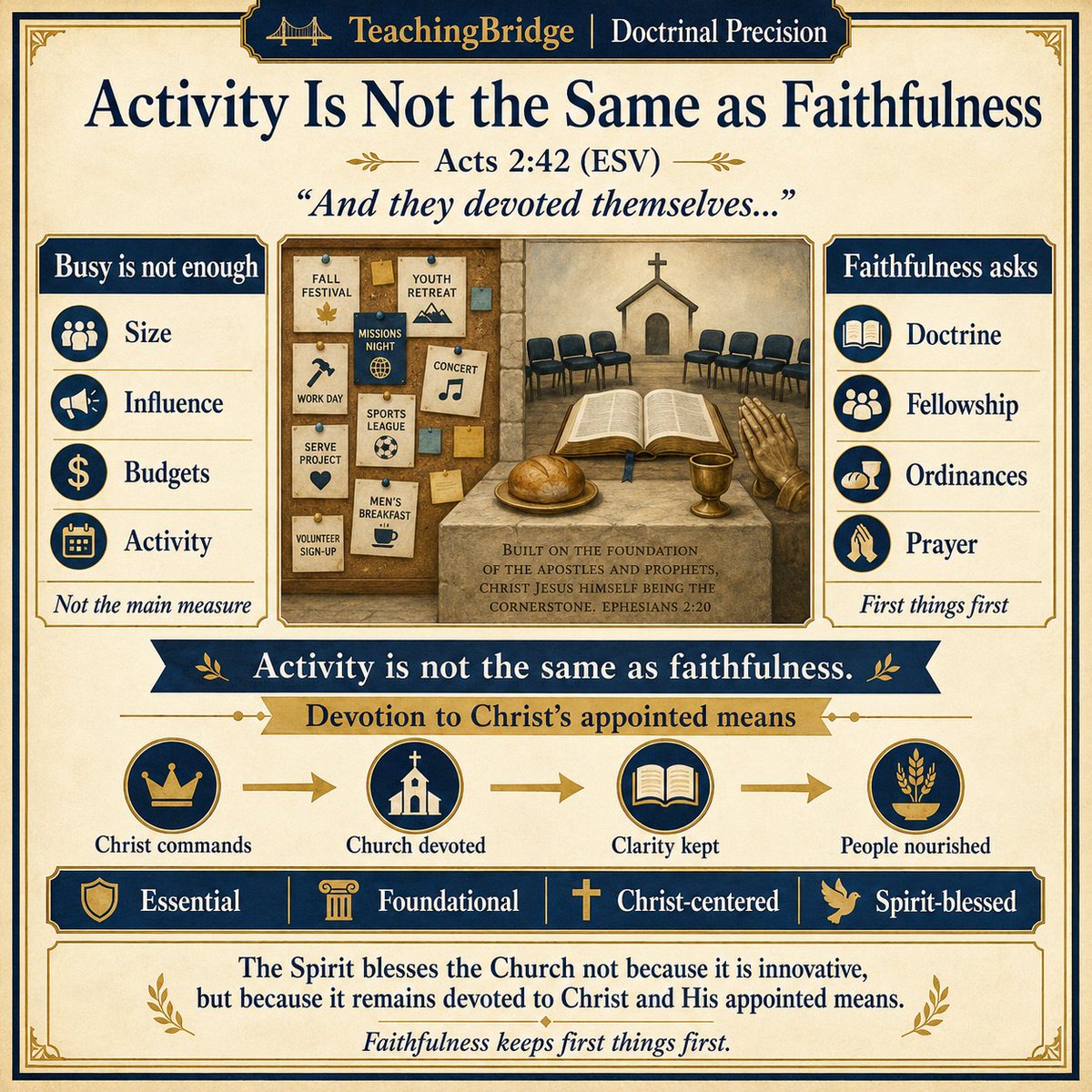
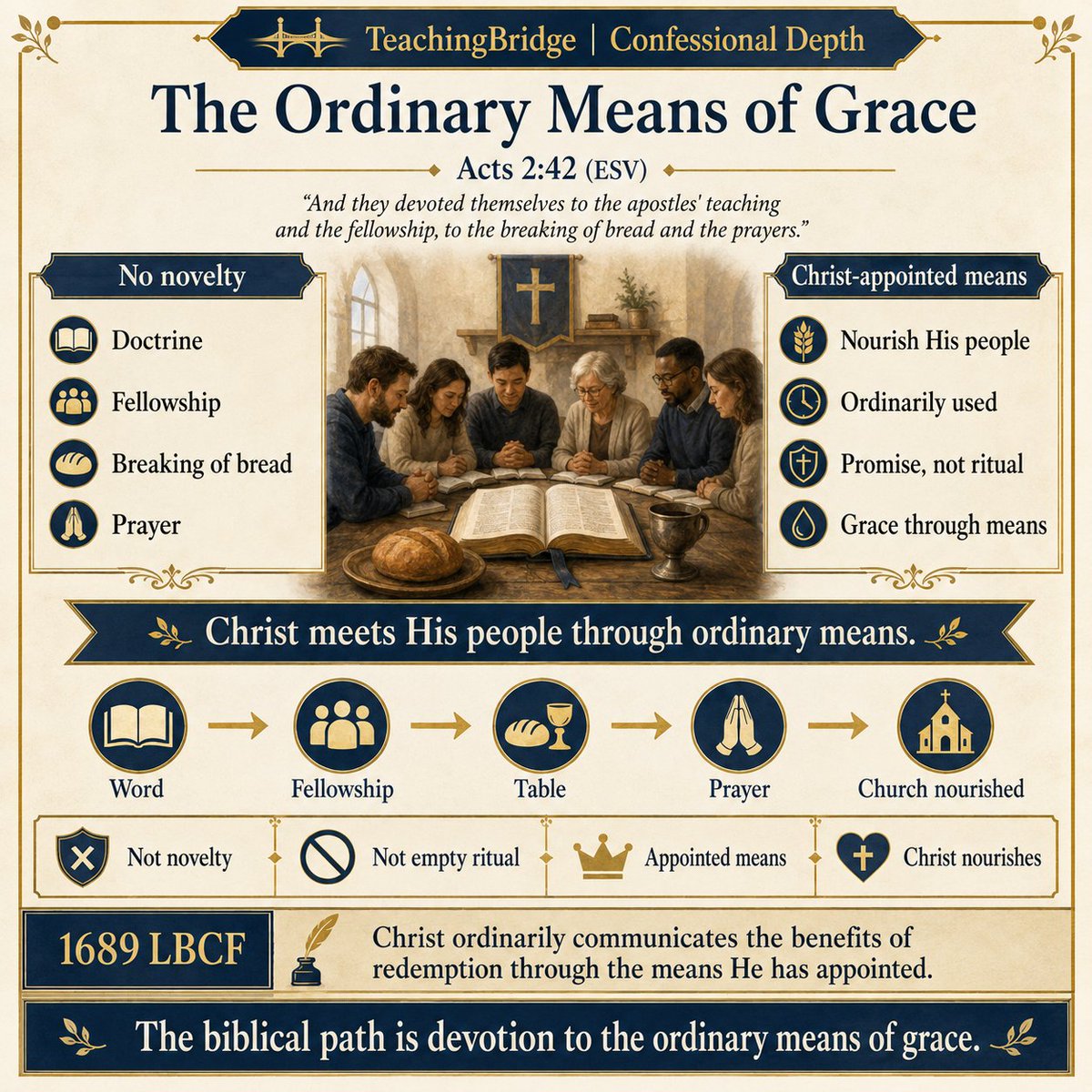
🌉 TeachingBridge | Doctrinal Precision Activity Is Not the Same as Faithfulness 📖 Acts 2:42 (ESV) “And they devoted themselves…” Churches can be busy without being healthy. Scripture does not measure faithfulness primarily by size, influence, budgets, or activity. Acts 2 directs attention elsewhere. The question is not whether a church is active. The question is whether it is devoted to the things Christ has commanded. Many activities may be useful. Only some are essential. Doctrine, fellowship, the ordinances, and prayer are not optional additions to church life. They are foundational commitments. When secondary matters become central, the Church gradually loses clarity. Faithfulness requires keeping first things first. The Spirit blesses the Church not because it is innovative, but because it remains devoted to Christ and His appointed means. #Acts2 #ChurchHealth #Doctrine #MeansOfGrace #TeachingBridge
10