
Joined January 2025
- Tweets 2,027
- Following 35
- Followers 38
- Likes 188
34 Photos and videos




Pinned Tweet

Jun 4
“Blessed are the meek, for they shall inherit the Earth.”
Matthew 5:5
1
53
Jun 10
Sola Scriptura has been abused.
Many use it as a blank check to insert their personal ideologies into the text, and critics are right to call out that misuse of Scripture.
But Sola Scriptura was never meant to be the mechanism by which every interpreter automatically knows the truth.
It was meant to be the standard by which every interpreter is tested.
Jun 10

Texts don’t read themselves. People interpret them.
Scripture corrects false teaching, forms doctrine, and guides God’s people. But the Bible itself does not perform interpretation. It provides the inspired text and the necessary context.
That context still has to be understood, and understanding requires faithful method, humility, and guidance from the Holy Spirit.
Jesus taught plainly at times, but He also taught in parables, and even His disciples needed Him to explain what He meant.
So the issue isn’t “simple Bible vs big words.” The issue is whether our interpretation is being submitted to the whole counsel of God by the Spirit.
40
Jun 8
Good works aren’t the reason I am saved.
My salvation is the reason I am glad to do good works.
Without them, there would be no evidence my heart has been changed.
Jun 8

Just because we aren’t saved by our works, doesn’t mean we “sit back and do nothing”.
We work out of love and gratitude to God, while resting in His finished work to save us.
2
37
Jun 5

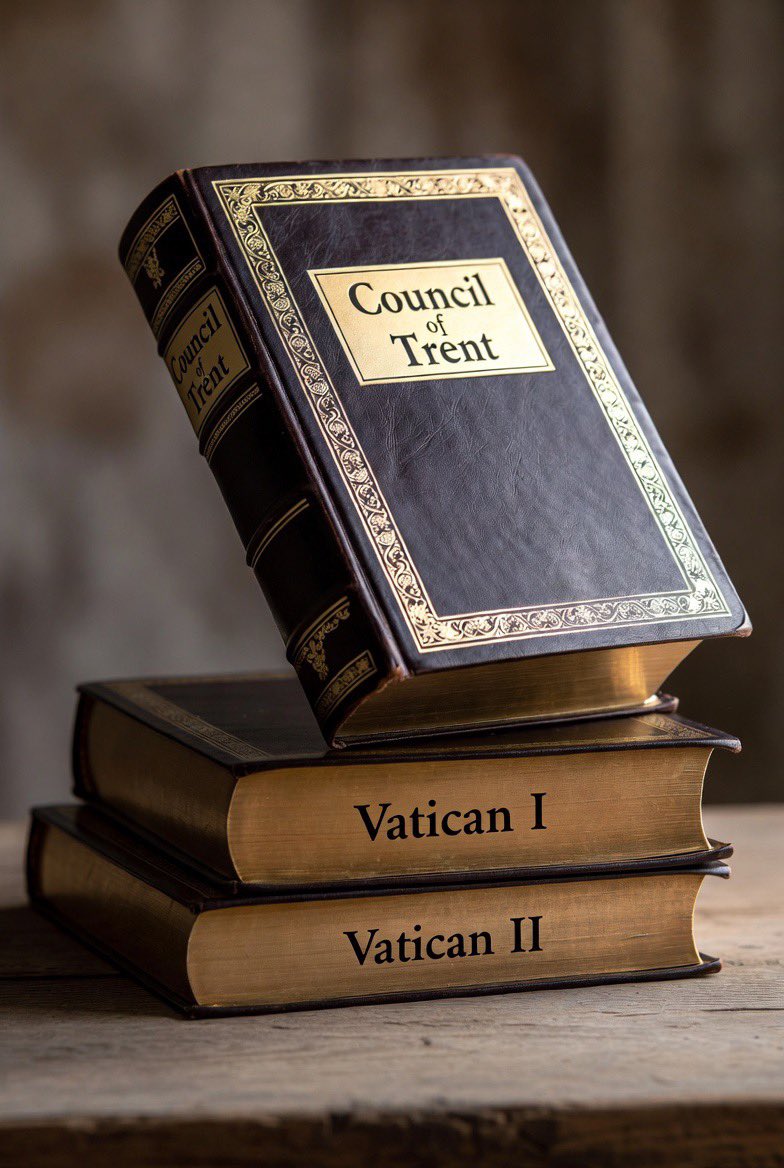
Unlike some traditional Catholics, I fully accept Vatican II, but I insist on interpreting it as an inferior (pastoral) council, beneath Vatican I and Trent. This is how I am able to easily keep a traditional composure within the mainstream Church.
Every Catholic should use the Council of Trent as their PRIMARY source of Catholic doctrine. Then look at Vatican I and Vatican II as supplemental texts, putting greater emphasis on Vatican I.
Another way to look at it is this. Think of the Council of Trent as the main text, and the two Vatican councils as footnotes.
24
Jun 3
A reality that many Protestants, Catholics, and Orthodox fail to recognize is that any institution can drift from its purpose when preserving itself becomes more important than serving Christ.
It’s true of the papacy. It’s true of Calvinism. It’s true of Constantinople. Human beings are tribal by nature, but Christ calls us into communion with Him and one another.
So whichever tradition we find ourselves adhering to, we certainly share more in common through Christ. And when we remember that, the walls we build around ourselves begin to matter less. We remember that we are not called to be bouncers, but gracious hosts extending an invitation.
18
Jun 1
Protestants:
God gave us an authoritative word written by the people He inspired so that we can test tradition and teaching against the truth.
Catholics:
Yea, well we named the books and put numbers in them, and compiled them, so now what?
1
20
Ryan Rhodes retweeted

May 30
Too many people come to the conclusion that, essentially, if you’re theology isn’t perfect, you are not saved
What is the GOSPEL of our salvation???
10
1
13
881
May 28
The Catholic Church began losing the plot when it stopped functioning as a persecuted witness to Christ and became comfortable as a mainstream institution of power.
The Church was never designed to control society from the top down. It was called to testify, suffer, serve, preach, disciple, and make Christ known.
But once Christianity became socially advantageous, the temptation changed. Instead of asking, “How do we follow Jesus faithfully?” the institutional question increasingly became, “How do we preserve influence, authority, and control?”
26
May 26
One side reduces preaching to gender. The other reduces it to institutional membership.
The New Testament seems far more concerned with faithfulness, wisdom, sound doctrine, and building up the body.
May 26

Neither can Protestants.
1
50
May 22
That there was a group of people who canonized scripture does not negate that scripture is uniquely authoritative, neither does it diminish its role as the measure by which all other earthly authorities are tested.
Infallibility of people or institutions is not required to recognize authority.
47
Ryan Rhodes retweeted

May 22
Hi @grok
Is infallibility a necessary condition for correct recognition of truth?
If not, then why would infallibility be required for recognition of divinely inspired writings specifically, rather than for recognition in any other domain of knowledge?
Answer directly.
3
1
8
835
May 21
I think a lot of confusion in Christianity comes from people trying to force themselves to believe what they’re “supposed” to believe instead of pursuing the Lord sincerely and letting conviction grow from that relationship.
33
Ryan Rhodes retweeted
May 12
Is God not in control of His church? Do you think He’d forego his promise simply because Peter’s role wasn’t continuous? Oh ye of little faith.
The church that grew into the Catholic church served a significant role through the middle ages, but that role wasn’t never meant to be permanent. It started with Jerusalem, then Judea, then Samaria, then the ends of the Earth. It was never meant to fuse inward toward Rome, but outward. People are who Jesus expects us to bind in Heaven and Earth, not institutions for institutional sake. Organization matter. Leaders are essential. Claiming to be to only church that matters is antithetical to the purpose of the church itself.
1
122
Ryan Rhodes retweeted

May 10
As a non-Catholic, I have a higher view of the Church than fire insurance. Weird.

One reason that I am Catholic:
I believe that outside the Catholic Church, I'd go to everlasting hell.
9
2
33
3,615
May 4
Any tradition or authority that becomes a prerequisite for access to Christ, rather than a witness to Him, needs to be questioned.
1
80
Apr 30
Our deepest theological disagreements aren’t about what is true, but how truth is recognized, validated, and defined.
The real challenge?
How do you evaluate a system of knowing when it defines its own criteria?
Revelation → God speaks
Reason → logic coheres
Tradition → history confirms
This is the plight of epistemology.
1
106
Apr 23
In the last decade, social media has pushed meaningful discourse down a rough and winding road, one that increasingly ignores every sign to turn back. What was once healthy debate over real ideas has been replaced by an action-reaction cycle of “gotcha” moments, where people retreat to their echo chambers not to reflect, but to reinforce the belief that “we were right all along.”
But these exchanges don’t uncover truth, they obscure it. They trade clarity for validation, and humility for pride.
The more people engage in them, the more they are affirmed in their actions, because the cycle doesn’t correct itself, it rewards itself.
The Cycle of Gotcha Culture
Gotcha culture follows a predictable pattern:
Certainty – “I—and I alone—possess the truth.”
Truth is no longer something to aspire toward, but an identity that must be defended.
Suspicion – “Why don’t others see it?”
Disagreement is no longer a difference of perspective, but a failure to see me.
Strategy – “How can I expose that?”
The goal shifts from understanding to revealing the error in others.
Simplification – Complexity is reduced into an impossible choice.
Nuance is stripped away so that only one answer appears reasonable.
Provocation – The issue is framed to elicit reaction, not reflection.
The wording is designed to snare, not to clarify.
Validation – The reaction becomes the proof. Not proof of truth, but proof that the method “worked.” The “others” are clearly wrong, and MY truth is validated by those cheering me on.
What begins as an identity crisis pretending to be truth-seeking, ends as an identity crisis performing as success, and the truth itself is left buried beneath the applause.
122
Apr 20
The early Church’s response to movements like Gnosticism established a pattern of defining doctrinal boundaries. Over time, the Church continued to develop and formalize additional doctrines, and the debate today is whether those later definitions faithfully preserved the original apostolic teaching or extended beyond it.
The early Church played a crucial role in preserving and defining core Christian teachings. But as it grew in influence—especially after gaining political power—it became increasingly susceptible to corruption and abuses of authority, which eventually led to calls for reform.
The earliest Reformers initially sought to correct corruption and call the Church back to what they believed were its original teachings, rather than to create a separate movement. However, as deeper theological disagreements emerged and reconciliation failed, those reform efforts eventually led to a lasting division.
The Reformation gained momentum in part because many believed the Church was too slow or unwilling to address real corruption. However, the resulting division was not caused by that alone, but also by deeper theological disagreements that neither side was willing to compromise on.
Since Christ did not visibly prevent the Church from developing or dividing over time, it raises the question of how He preserves truth—whether primarily through a continuous institution, or through ongoing correction and reform within the broader body of believers.
The development of the Church over time—including the contributions of Reformation movements—has led to significant positive impacts on the world, such as increased access to Scripture, global evangelism, and cultural transformation. That raises the question of whether these developments reflect, at least in part, a legitimate unfolding of the Church’s mission.
The Catholic Church as well has demonstrably reformed and improved in certain areas since the Reformation, which suggests that at least some criticisms raised by early Reformers were valid. This raises important questions about how the Church discerns between faithful development and necessary correction.
The diversity of Christian traditions often reflects different emphases within the body of Christ—some focusing more on teaching, others on service, worship, or evangelism. While these differences can be enriching, the challenge is discerning where diversity reflects complementary roles and where it reflects deeper doctrinal divisions.
Because both institutional continuity and reform movements have demonstrated the capacity for both preserving and distorting aspects of the faith, the only stable and universally accessible standard must be something outside any single institutional expression of the Church—namely, the recorded apostolic witness in the New Testament.
The recorded teachings of the apostles in the New Testament provide the only universally binding standard for Christian doctrine. Any development within the Church must remain consistent with—and be testable against—that apostolic witness.
Scripture serves as the shared apostolic foundation that all Christian teaching must remain accountable to. While interpretation is unavoidable and traditions develop, those developments should ultimately be measured against the New Testament for the sake of building up the Church as a whole.
2
154
Apr 17
This is Caesarea Philippi.
It was the center of pagan worship in the first century, especially to the god Pan.
Those niches carved into the rock face were for idols of pagan gods to be placed. And that large grotto at the base was called “the gates of Hades.”
More importantly, this was also the backdrop of one of Jesus’ teachings to his disciples. He stopped here, in the midst of hell itself and asked his disciples, “ Who do people say the Son of Man is?” And then He presses further, “But who do you say that I am?”
It’s here in front of the rock face of pagan idols and next to the gates of hell that Jesus calls Simon a rock, and says, “upon this rock I will build my church, and the gates of hell will not overcome it.”
Jesus established His kingdom forever, and his church was designed to break down the barriers of hell itself.
1
133