
Disciple of Christ nothing i share is advice
Joined July 2017
- Tweets 25,400
- Following 1,636
- Followers 9,111
- Likes 15,731
3,570 Photos and videos












Jun 11
The TRUTH carries a weight that no lie can counterfeit.
Jesus Christ is that Truth
1
7
180
Jun 10
Did anything you are holding in your wallet generate $173,000 in pure revenue for its holders the last 90 days on #PulseChain?
We already know the answer to that.
#PTGC

I’m excited to see the impact that the generation of these tokens at such cheap prices will have on the way back up. Most people aren’t seeing it because 10 billion $PLS tokens aren’t worth nearly as much as they used to be. Back at sacrifice prices, these tokens were worth $1 million. That’s just 90 days’ worth of tokens in the DAO.

5
11
54
1,196
Jun 10
The more intense the hate toward Jesus Christ the more excited we disciples become.
4
16
426
Jun 10
My favourite moment from the Godlogic vs. Dr. Nasser debate.
Godlogic: Prove Jesus was a Muslim.
Dr. Nasser: Jesus was a Muslim because He submitted Himself to one God.
Godlogic: Which God?
Dr. Nasser: The Creator of the universe.
Godlogic: And what did Jesus call Him?
Dr. Nasser: Umm… Adonai?
Godlogic: Nope.
Dr. Nasser: What term did they use in the Bible again?
Godlogic: Abba.
Dr. Nasser: Not always.
Godlogic: Did Jesus use the term “Abba”?
Dr. Nasser: Yes.
Godlogic: What does “Abba” mean?
Dr. Nasser: Father.
Godlogic: Is that a good Muslim?
Dr. Nasser: Are we really going back to this?
Godlogic: Stop stalling.
Dr. Nasser: You’re really good at this, huh?
Godlogic: I am. 😎
Dr. Nasser: Listen! Jesus was speaking to Israelites, and Jews today also call God Father!
Godlogic: Are they Muslims?
Dr. Nasser: NO, THEY ARE JEWS!
Godlogic: Thank you. It’s over.
@GodLogic_GL destroyed Dr. Nasser with Logic.
Jesus was never a Muslim.
1
7
291
Jun 10
“Cowards die many times before their death. The valiant only taste death but once.”
Shakespeare
1
8
240
Jun 6
I’m amazed that anyone would deny the greatness and glory of God the creator engineer.
To Jesus Christ be the glory for all he has made.
Jun 6

i honestly can’t wrap my head around it. if God put this much order into the smallest parts of creation, what makes you think He would leave you completely on your own?
7
385
Mando retweeted

Jun 4
Never forget, Muhammad got one thing right.
If he was a false prophet, his aorta would be severed (Surah 69:44-47). Later, Muhammad dies after saying his aorta was severed (Dawud 4512 / Bukhari 4428), proving he's a false prophet.
236
615
3,987
128,665
Jun 3
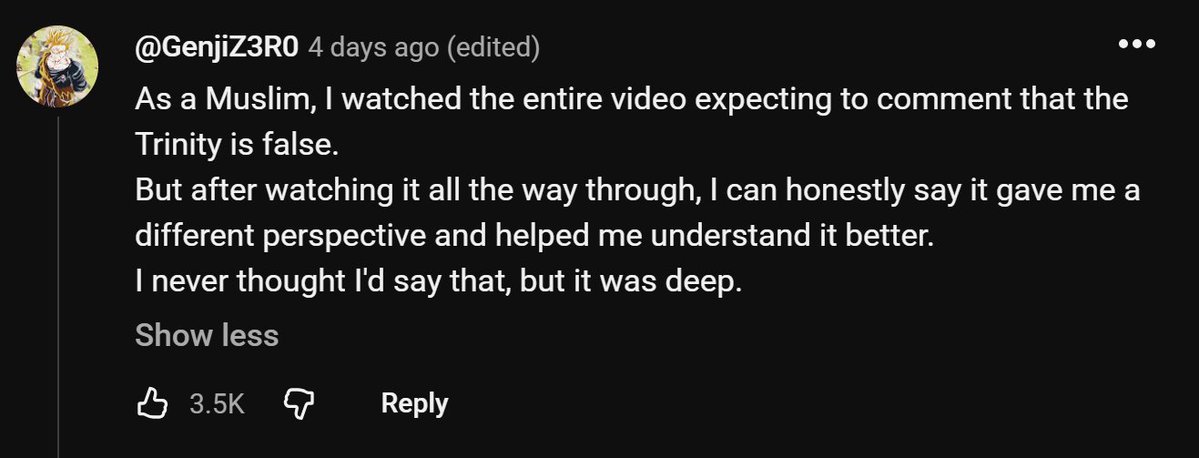
Great job GodLogic my peer @stridentcitizen was just speaking with me about the Trinity today and he is a “Logic” guy himself but is struggling with the concept of God being a triune being. Great to see the comments of Muslims realizing this.
Jun 3

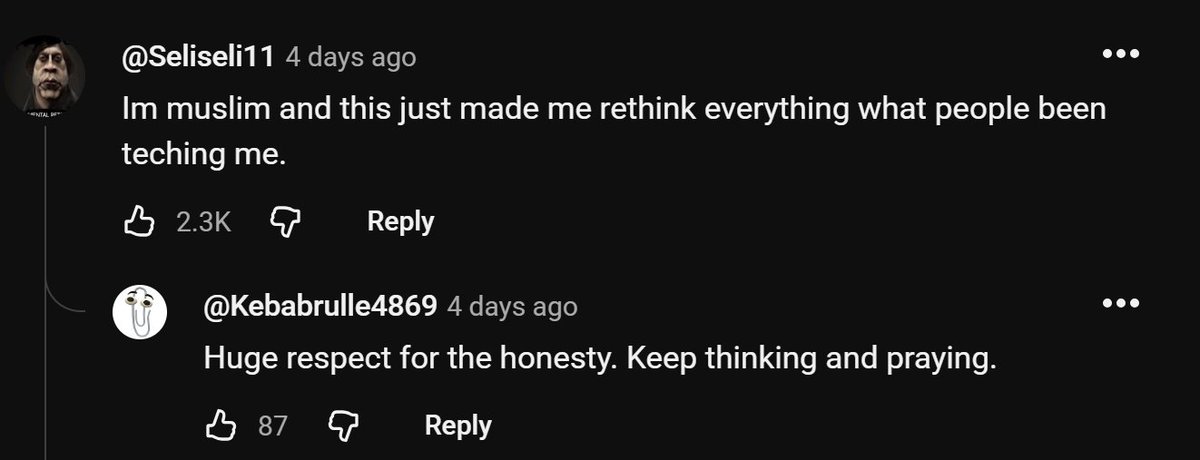
Just want to say shoutout to the 3 Muslims that @InspiringPhilos , Belle, and I debated. Because of them, Muslims are leaving Islam and doubting their faith. This is just after a scroll or two in the comments, by the way. 🙏🙏🙏

1
3
338
Jun 3
Here's a solid overview of the Trinity as understood in orthodox Christian theology:
The Core Doctrine There is one God who exists eternally as three distinct Persons Father, Son, and Holy Spirit. Not three gods, not one God wearing three masks, but one divine Being in three Persons.
The Key Distinctions
•One in essence (substance) All three share the same divine nature fully and equally. The Father isn't more God than the Son.
•Three in Person — Each Person is genuinely distinct, not just a different mode or role God plays.
•Co-equal and Co-eternal — None of the three preceded the others. There was never a time when any Person did not exist.
Each Person's Role
•The Father — The source and fountainhead; unbegotten
•The Son — Eternally begotten of the Father (not created); became incarnate as Jesus Christ
•The Holy Spirit — Eternally proceeds from the Father (and in Western Christianity, also from the Son — the filioque)
What Orthodox Christianity Explicitly Rejects
•Modalism — The idea that Father, Son, and Spirit are just different modes or masks of one Person (like water, ice, steam). This was condemned as heresy.
•Arianism — The belief that the Son is a created being, subordinate to and less than the Father. Also condemned.
•Tritheism — Treating the three Persons as three separate gods.
•Unitarianism — Denying the Trinity altogether, reducing God to one Person only.
The Classic Formulation The doctrine was formally defined at the Council of Nicaea (325 AD) and further clarified at the Council of Constantinople (381 AD), producing the Nicene Creed, which remains the standard of Trinitarian orthodoxy across Catholic, Eastern Orthodox, and most Protestant traditions.
The key phrase from Nicaea regarding the Son: homoousios — meaning the Son is of the same substance as the Father, not merely similar.
1
181
May 31
This Ortho Muslim thinks he can invent a “Christian Dilemma” by creating false arguments that do not exist. It’s actually a very low IQ theological argument.
Jesus Christ did die under Pontius Pilot. History clearly communicates this.
And why Jesus Christ the “Man” can die is because he was fully God as well as Fully man in the hypostatic union. When Jesus’s body died the “person” of Christ remained alive and he was fully conscious and in complete control at all times. Taking the keys from of death and hades from the underworld and proclaiming liberty to those in Paradise. He was also the one that Resurrected his own body on the third day.
“Destroy this temple and in three days I will raise it up” John 2:19
In addition Jesus the Word/Logos is the second person of the Trinity. There was never a time the Godhead was dead in that sense. The father was alive, the Son was alive, the Spirit was alive. It was only the Sons “flesh” that died. But even his flesh did not see corruption or decay.
Islam fundamentally and on purpose lies about the reality of the Triune nature of God. While they claim that Allah is uncreated and the Koran is also uncreated. So they have two uncreated things yet claim there is only one God. Hmmm.
His second point If Jesus is God then he didn’t die and Christianity is false is so silly an argument that he would be laughed out of any academic setting.
If Yahweh is One being and three persons. And Jesus is the second person in that Godhead then yes he can take on Flesh as he did and willingly die on a cross a physical death as he did and yes he can then take back up his life again as he did. And there is ZERO that could stop him.
We are supposed to just take ortho-Muslim guys works for it that his argument is valid and coherent when it’s laughable according to his own Koran.
Now the Islamic Dilemma is very real. And logically is consistent and is turning many way from this fake false anti-Christ system. Good luck with that low IQ trash only the unlearned fall for this garbage.

The Christian Dilemma
If Jesus died, he’s not God and Christianity is false
If Jesus Is God, then he didn’t die and Christianity is false
Either-way, Christianity is false.
2
9
541
May 30
This is complete nonsense and it’s never something Christ or the Apostles would do. “Tradition” of men are not binding or authoritative whatsoever.
God is the God of the living not the dead.
May 30

Orthodox foot relic fetish. 🤦♂️aka "Sacred Tradition" 🤣🤣🤣 This is what happens when you are not sola scriptura. lol
1
248
May 30
The Grays Currency live now on spaces with founder @TheGray369. The Killer Dapp of the chain.
Come ask why this first in class first of a kind system is different.

1
4
26
482
May 29
Hey @elonmusk Richard has a pretty large IQ. He’s the guy that crushed the SEC in court and system state forked Ethereum called PulseChain @PulsechainCom. I’m wondering why Billionaires don’t care as much about longevity research to save their own lives and their families lives as much as things like going to mars, the moon or other endeavors? Genuine question?
May 29

Shoutout fellow rumored billionaires. I hate to break it to you, but you are all going to feel really retarded you didn't invest in the medical research needed to save you, as you progress to worm food. Stop being retarded and do what is in your own best interest. Save humanity!
1
12
634
May 28
In Telegram now live talking about the @PulseTGC ecosystem.
May 28
Holders continue to take advantage of these opportunities to take positions at the lows.
The machine is getting much stronger. Are you positioned yet?
(Live now) in Telegram with the founder @TheGray369 for questions and updates.
t.me/thegrayscurrency

1
130
May 25
The Roman Catholic nor Orthodox “gave us scripture”.
The claim that the Catholic or Orthodox Church "gave us the Bible" by choosing which books went in it is one of the most repeated and easily dismantled arguments in all of Christian history.
The argument goes like this: "Without our councils you wouldn't know what Scripture is. We decided what went in and what stayed out. You are therefore dependent on our authority to have a Bible at all."
Let's take that apart piece by piece.
THE CLAIM ASSUMES THE CONCLUSION
The argument is circular at its foundation. It goes like this:
"The Church has authority. Therefore when the Church selected the canon that selection is authoritative. Therefore you must trust the Church's authority to trust the Bible."
You cannot use the Bible to prove the Church's authority and then use the Church's authority to validate the Bible. That is a logical circle, not a foundation.
The question is not whether a council listed the books. The question is, on what BASIS did they recognize them? And the answer to that question completely undermines the authority claim.
THE CRITERIA FOR CANONICITY WERE NEVER INSTITUTIONAL
When the early church evaluated which books belonged in the New Testament they used specific criteria and none of those criteria were "Rome approves it" or "the institutional church endorses it."
The criteria were:
Apostolicity: was it written by an apostle or a direct companion of an apostle? This is a Christological standard, it traces authority back to Christ who appointed the apostles.
John 14:26: Jesus told the apostles: "The Holy Spirit will teach you all things and will remind you of everything I have said to you."
The inspiration promise was given to the apostles, not to future councils.
Consistency, did the book align with the teaching already established by the apostles? Paul set this standard himself:
Galatians 1:8 "Even if we or an angel from heaven should preach a gospel other than the one we preached to you let them be under God's curse."
The measuring stick was the apostolic gospel, not institutional approval. A council couldn't make a book canonical by voting for it. It could only recognize whether a book met the standard Christ and the apostles had already established.
Catholic Reception: This is the ironic one. The criterion called "catholic reception" meant, is this book already being widely used and accepted by churches everywhere across the world? This means the books were already recognized as authoritative by the broader church body BEFORE the councils met. The councils were documenting existing consensus, not creating new authority.
THE CHURCH RECOGNIZED IT DID NOT DETERMINE
This is the critical distinction and it matters enormously.
When a scientist discovers a law of nature he doesn't create that law. Gravity existed before Newton described it. Newton's description didn't give gravity its power, it simply acknowledged what was already operating.
The same principle applies here. The books of the New Testament carried inherent authority because of their apostolic origin and divine inspiration, not because a council voted on them. The councils recognized what was already true.
2 Timothy 3:16 says Scripture is God-breathed. It doesn't say Scripture becomes authoritative when a council approves it. The God-breathed quality is intrinsic, it exists in the text itself independent of any institutional recognition.
Think of it this way, if the Council of Carthage had voted differently would that have changed what God inspired? Would Paul's letter to the Romans suddenly lose its divine authority because bishops in North Africa voted against it? The absurdity of that question reveals the weakness of the institutional authority claim.
8
1
4
407
May 25
THE BOOKS THAT WERE DISPUTED PROVE THE POINT
There were books that took longer to reach universal consensus — Hebrews, James, 2 Peter, 2 and 3 John, Jude, Revelation. Why? Because the early church was applying rigorous apostolic criteria, not institutional preference.
And critically, there were books some wanted to include that were rejected, the Shepherd of Hermas, the Epistle of Barnabas, the Didache. Why were they rejected? Not because Rome said no. But because they failed the apostolicity test, they couldn't be traced to an apostle or apostolic companion with sufficient confidence.
The process was theological and historical, not institutional. The church was asking "did God inspire this?" not "does our institution approve this?"
THE NEW TESTAMENT ITSELF CLAIMS SELF-AUTHENTICATION
The New Testament books claim their own authority internally, they don't appeal to any future council for validation.
Paul opens nearly every letter by establishing his authority directly from Christ:
Galatians 1:1 "Paul, an apostle sent not from men nor by a man, but by Jesus Christ and God the Father."
He explicitly says his authority is NOT from men or human institutions. It comes directly from Christ. A council recognizing that letter centuries later added nothing to its authority, the authority was already established at its origin.
Peter confirmed this principle when he called Paul's letters Scripture in real time, in the first century, without waiting for any council:
2 Peter 3:15-16 "Our dear brother Paul also wrote to you...His letters contain some things that are hard to understand which ignorant and unstable people distort as they do the other Scriptures."
Peter called them Scripture. In the first century. Before any canon council existed. This single verse obliterates the claim that the church gave us the New Testament by selecting its books, because the apostles themselves were already identifying which writings carried scriptural authority.
THE HOLY SPIRIT, NOT THE INSTITUTION, AUTHENTICATED THE CANON
The Holy Spirit who inspired the books is the same Holy Spirit who bears witness to their authority in the hearts of believers.
John 10:27 "My sheep hear my voice."
John 16:13 "When he the Spirit of truth comes he will guide you into all truth."
1 John 2:27 "The anointing you received from him remains in you and you do not need anyone to teach you. But as his anointing teaches you about all things...remain in him."
The early church recognized the canonical books because the Holy Spirit bore witness to their divine origin in the hearts and communities of believers. That recognition happened organically across geographically separated churches who had no institutional connection to Rome, churches in Syria, Egypt, Asia Minor, North Africa, and Gaul were all reading the same books and treating them as authoritative independently.
If the Catholic Church gave us the canon, why did churches with no connection to Rome arrive at essentially the same canon before Rome formally declared it?
1
156
May 25
THE ARGUMENT UNDERMINES ITSELF HISTORICALLY
Here is where the institutional authority claim collapses under its own weight:
The Eastern Orthodox Church and the Roman Catholic Church have different canons. The Catholic Bible includes the deuterocanonical books, Tobit, Judith, 1 and 2 Maccabees, Wisdom, Sirach, Baruch. The Eastern Orthodox canon includes additional books beyond even the Catholic canon. The Protestant canon follows the Hebrew Old Testament canon that Christ and the apostles used.
If an infallible institution gave us the Bible, which institution? They disagree with each other. You cannot appeal to institutional authority to settle the canon question when the institutions themselves haven't settled it.
Furthermore, Jesus and the apostles consistently quoted from the Hebrew Old Testament canon, the Tanakh, which did not include the deuterocanonical books. Jesus never once quoted from 1 Maccabees or Sirach. Paul never appealed to Tobit. The New Testament has approximately 300 direct quotes and hundreds of allusions to the Old Testament, and they overwhelmingly align with the Hebrew canon.
If you're going to argue that the church's canon selection is authoritative, you have to explain why Jesus himself used a different canon than the one Rome eventually endorsed.
THE REAL HISTORICAL TIMELINE
The canon didn't drop out of the sky at Carthage in 397 AD. Here is what actually happened:
50-100 AD — The New Testament books are written and immediately begin circulating among churches.
95-107 AD — Clement of Rome and Ignatius of Antioch quote extensively from New Testament books treating them as authoritative — 290 years before Carthage.
155-170 AD — Justin Martyr describes the four Gospels being read in Sunday worship. The Muratorian Fragment lists most of the New Testament canon.
180 AD — Irenaeus cites 21 of 27 New Testament books as Scripture.
367 AD — Athanasius lists all 27 New Testament books exactly as we have them — 30 years before Carthage. He was Bishop of Alexandria — not Rome.
397 AD — The Council of Carthage formally lists the 27 books.
What this timeline shows is that the canon was not the product of an institution making a decision. It was the product of the Holy Spirit bearing witness to apostolic writings across generations and geographies until the consensus was so overwhelming that a council simply recorded what the church already knew.
The council at the end of that process no more gave us the Bible than a graduation ceremony gives a student their education. The work was already done. The ceremony just marked it.
(FINAL WORD)
To the claim that: "we gave you your Bible by choosing what went in it".
You did not choose. You recognized. And you recognized based on criteria, apostolicity, consistency, and widespread reception, that were never yours to invent. Those criteria came from the apostles themselves who got them from Christ.
The Bible's authority does not flow downward from institutional decisions. It flows outward from its divine origin. God inspired it. The Holy Spirit authenticated it. The apostles established the standard for recognizing it. Believers across centuries confirmed it. Councils recorded it.
You were last in that chain, not first.
Hebrews 1:1-2 "In the past God spoke to our ancestors through the prophets at many times and in various ways but in these last days he has spoken to us by his Son."
God spoke. Through His Son. Recorded by His apostles. Confirmed by His Spirit. The institution didn't speak first and it doesn't speak loudest. God does. Through His word. Which stands forever, completely independent of any human authority that thinks it owns it.
Isaiah 40:8 - "The grass withers and the flowers fall but the word of our God endures forever."
Not the word of the church. The word of God.
2
107