
A Muslim who has taken an interest in comparative religion & theology
Joined October 2024
- Tweets 797
- Following 31
- Followers 10,376
- Likes 315
135 Photos and videos

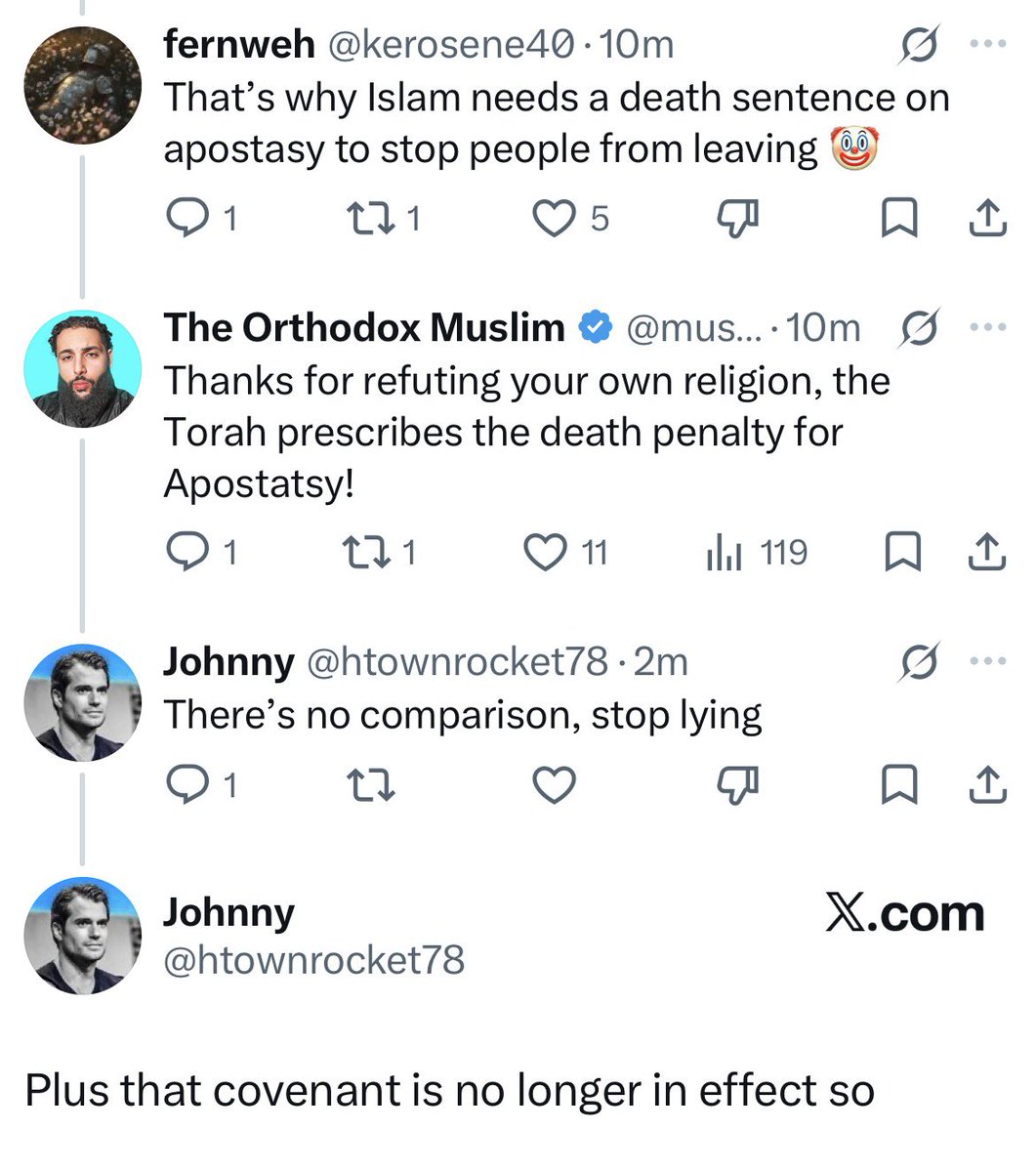
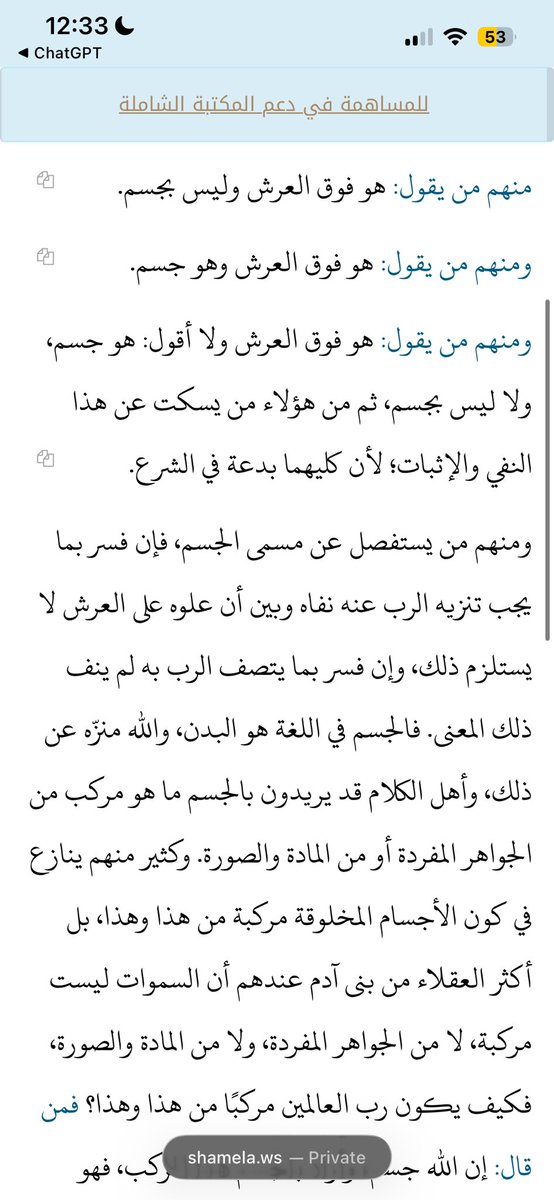



Homeboy, you didn’t even know what a sufficient cause is and you are meant to be a philosopher

It was clear @dawahxdialogues didn't know what she was talking about. At first she said a sufficient cause means it's the only thing that is necessary, but then she said sufficient doesn't mean "only." They just make things up as they go along.
34
13
345
11,418
Yassine Bounou was the man of the match, excellent performance to the Moroccan national team.
27
6
281
6,574
Just finished watching 1 Christian VS 4 Muslims, Inspiring Philosophy (Michael Jones) was genuinely CRUSHED.
Christian Apologetics is getting destroyed by us new-Gen Muslims.
Love to see it!
80
26
644
12,029
1 Christian VS 4 Muslims *LIVE DEBATE REVIEW* youtube.com/live/_Wtv06bRgxk… via @YouTube
1:30PM EST!
7
6
99
5,269
The Orthodox Muslim retweeted
🤣🤣🤣🤣😭😭😭😭😭😭 thanks for conceding you argument!
Your argument was you can conceive of a different limit, therefore contingent and could be otherwise because it’s logically possible to be otherwise.
But now, you have agreed that something can be logically possible but metaphysically impossible.
Since that is my doxastic commitment and you are doing an internal critique, you have admitted that there is no metaphysical incoherence in my position
YOU
JUST
LOST 😭😭🫵🏼🫵🏼🫵🏼
16
7
266
7,117
The Orthodox Muslim retweeted

Zakir Hussain vs Dr Michael Brown debate
youtu.be/j8Tt6GcN_e0?si=fmX4…
3
15
56
5,061
Live Reaction To This Debate Tomorrow!
2:30PM EST Insha’Allah
youtu.be/j8Tt6GcN_e0?si=BPGt…
8
7
122
8,173
This is proof Christians have mental issues 😭😭😭😭 who’s going to tell him guys ?

Blacklisting because he cooked you guys is crazy work.
27
7
427
13,424
Why is GodLogic BEGGING to talk to Sneako? You are blacklisted dude. Stop begging for debates!
175
68
1,337
45,474
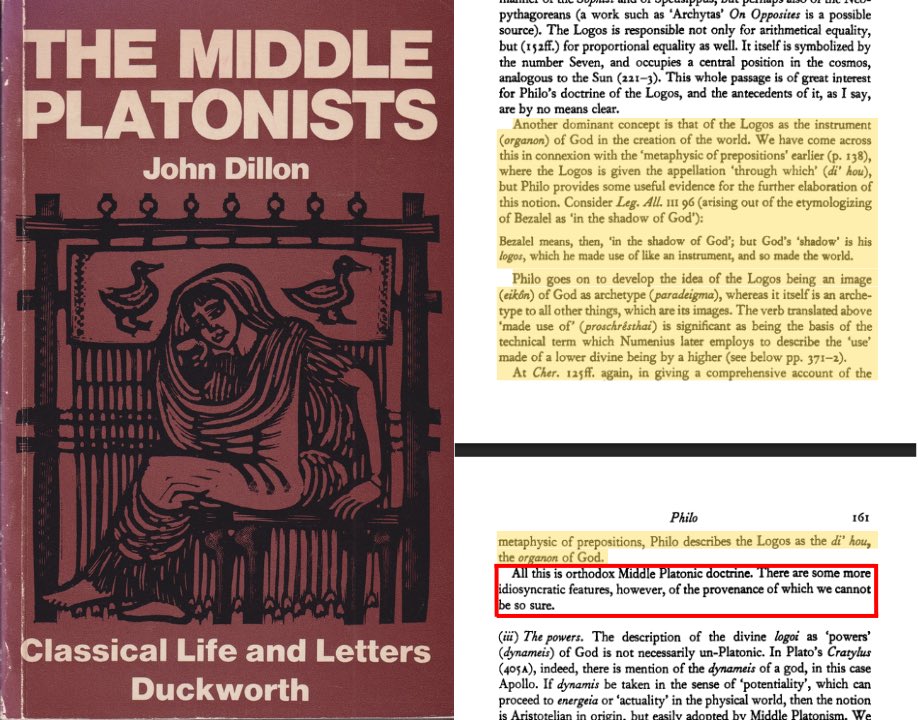
Christians genuinely get flabbergasted when they realize that John’s gospel teaches a middle-platonic view of multiple deities! The One, highest ineffable God, and the divine intermediary “The Logos” or “The Intellect”
John 1:1 “In the beginning was the Word, and the Word was with God, and the Word was god”
83
44
431
22,291
The Orthodox Muslim retweeted

Look at @InspiringPhilos fail to answer how many gods died on the cross 😂
163
115
1,158
91,682

This is THE LAST reply I send to you, you are not responding to anything you are welcome to join my panel.
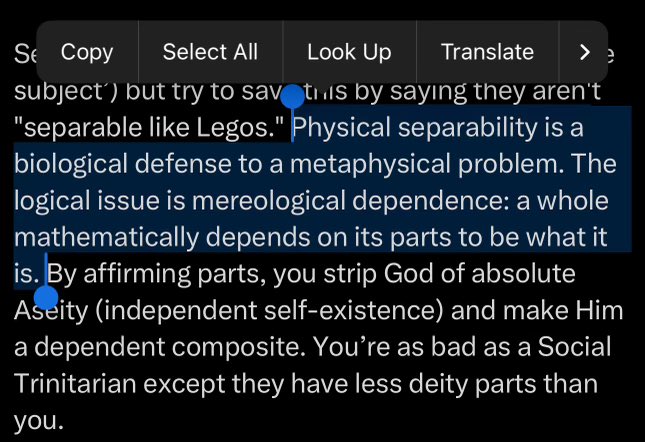
Mr. “Physical separability is a biological defense to a metaphysical problem, and this isn’t AI but rather my sophisticated rhetoric”, has (kinda?) responded.
First off, I DO NOT HOLD to God being a 3D object, however, I do believe that it’s metaphysically coherent to commit to that yet simultaneously attribute it with aseity. Your argument in (1) hasn’t provided a defeater, why? Because as you said here; “This already is a problem because a 3D deity is arbitrarily limited in having 3 dimensions as to any other number. Therefore, your deity is modally contingent in His dimensionality. Furthermore, there must be an external cause or specifier that makes your deity 3 dimension as opposed to another number.”, you made two assumptions, and for the third time, PLEASE justify them! Why is it metaphysically incoherent for that “arbitrary limit” to be brute? How does that entail being “modally contingent”? It’s metaphysically coherent to assume that there exists x such that x is 3D, exists without a cause, and it’s a brute necessity, that “why” it’s the case is therefore brute. What’s the METAPHYSICAL problem here? Those aren’t even related. Also, another point, why “must there be an external specifier”? Why? What motivates that? Why can’t I say that for every object x, if x is simple, x needs an external simplifier? Are you arguing for epistemic inconsistency or metaphysical incoherency? Do you even know the difference, or did “biological defense” reading not suffice? If it’s epistemic inconsistency, then ontological dependency nor modal contingency are logically entailed. Do better. What’s funnier is that in (2), you basically make the same argument in a different way; “it is logically possible for that number to be different - thereby making His extent and boundaries an arbitrarily limit and rendering your God modally contingent. Again, there must be an external specifier for your God's finite spatial extent on the up-down axis.” First, logical possibility doesn’t entail metaphysical possibility. This is basic stuff dude. It’s demonstrably formally consistent that your “exists and not exists” outdated conception of God to not exist. Is that a serious defeater? No. Metaphysical possibility is motivated by commitments far beyond just mere formal consistency. Also again, “external specifier” and “arbitrary limits” are non-sequiturs as you haven’t demonstrated that they logically entail that, when I told you that such “issues” can be resolved by simply saying that such object is a brute necessity, and brute necessity isn’t ad-hoc because that’s what aseity is. Read up man. Third, speaking of aseity, you don’t even know what it means, it’s actually you who’s as clueless as a social Trinitarian. Aseity means there is x such that x obtains in all metaphysically possible worlds AND x lacks any external metaphysical explanation. In your ancient wizard of oz theology terms, aseity means something exists without a cause and always exists. That’s the mainstream definition within contemporary philosophy of religion. I told you, on the issue of composition, you low-tier, within my last tweet, which I told to not run away from and you did exactly that, to do three things, in order for the argument to follow; 1. Flesh out what ontic-priority is, 2. demonstrate why we ought to commit to that hermeneutic, and 3. prove how an object bearing properties necessarily entails ontological priority relations. Don’t run again and again from this. How is causal dependency even entailed? Is God under your view thereby causally dependent because of necessitarianism, really? Do you see how pathetic and self-defeating your argument is? I will reply to (4) of your tweet later under this post.
Jun 10

Let us round up and consolidate your hydra of heresies into one rebuttal @muslimorthodoxy:
PS. I wrote this myself, not with AI. You confuse my posts with AI because I am a professional author and I was writing essay-length Facebook comments before you knew how to use a computer.
My main argument is that your Salafi Deity is a contingent being - both ontologically (where contingency = dependence) and modally (modern analytic possible worlds framework). Here is why:
1. Contingent Dimensional Limits: Your deity is spatial and can be pointed at. Since space is 3 dimensional with 6 directions, God being spatial means God is spatially extended (as @jhoover04 has rightly observed). This logically entails that your deity is a 3-dimesional entity (a body even though you won't admit that). This already is a problem because a 3D deity is arbitrarily limited in having 3 dimensions as to any other number. Therefore, your deity is modally contingent in His dimensionality. Furthermore, there must be an external cause or specifier that makes your deity 3 dimension as opposed to another number. This means your deity is dependent and ontologically contingent.
2. Contingent Spatial Boundaries: You already conceded that your deity has boundary conditions (hadd) in the upward and downward directions. That means your deity has a finite spatial extent in terms of the up-down axis. That is an arbitrary limit and means your God is modally contingent. Your reply to this was -- the lower boundary of your God is just relational to the existence of creatures - because creaturely existence spatially begins when your God's downward extension ends. That does not solve the issue -- rather, it means that your God arbitrarily limited Himself in the downward direction when he created the Throne below him. You have not replied to my claim that your God's spatial extent is a finite number and it is logically possible for that number to be different - thereby making His extent and boundaries an arbitrarily limit and rendering your God modally contingent. Again, there must be an external specifier for your God's finite spatial extent on the up-down axis. That makes your God dependent as well.
3. Composition: You already admitted your God has parts - Hands, Feet, Eyes, Fingers, etc. Your claim that God is spatial entails that His parts are also spatial and non-overlapping. This means your deity is like Megazord - he is literally composed and comprised of other entities that are ontologically discernable and distinct from the whole of God and from each other. How is this NOT composition? Once you conceded the existence of real and ontologically distinct parts within your deity, you brought the problem on yourself that your God is DEPENDENT upon these spatially and ontologically distinct items that comprise Him. This is NOT aseity; aseity means "from one-self". There is no such thing as "external aseity" or "internal aseity" - you sound like a Social Trinitarian like Chad McIntosh when you claim such a thing.
In your account, each part of God is NOT identical to God and spatially "lesser" than God. So your God is literally NOT "from one-self" (a se); your God is derived from genuine "others", i.e. spatially and ontologically distinct parts or constituents. The only other move you can make here is to say -- no, the parts of God - His Hands/Feet/Eyes/Fingers - are distinct from God and dependent upon God to exist. This would not help you because it would mean God considered without His dependent parts IS simple and His so-called parts are just emanations or creations of the simple God. So once you assert God has ontologically and spatially distinct parts and once you claim God is independent (a se), you have to disclose whether God depends upon His parts (contradiction) or whether the parts of God depend upon God (which negates them being parts and affirms God being simple). So which one is it? And if you say they are ontologically co-dependent, then this is a vicious circular dependence in which there is no real a se reality at all and everything is interdependent. Sounds like you should become a Buddhist if you hold to that.
4. You accepted brute facts. Big problem here. If you have brute facts in the creation, then God cannot be the cause or explanation of such brute facts - they are unexplained and uncaused and this is polytheism. If you claim God is still the causal explanation of the brute facts, then you have brute facts internal to God. This would like, inter alia:
a) God's contingent intention to create this particular creation must differ across possible worlds - this is rendered a brute contingent because you reject necessitarianism and nothing in God necessitates the contingent choice of His will;
b) God's foreknowledge of the brute contingent or libertarian choices that creatures make - this will be a contingent brute fact inside God;
c) God's foreknowledge of God's contingent choices - since the divine choices differ across possible worlds, God's knowledge of His choices will be contingent and brute.
The upshot of the above is that your God contains brutely contingent will and brutely contingent knowledge. This makes your God a brutely contingent being.
5. Just one of the above problems with your theology seriously weakens your credibility and effectiveness in debating Christians and atheists. Here is why:
- You can no longer attack Monarchic Trinitarian views of the Son being eternally dependent on the Father since your God is dependent upon His internal parts and technically lacks aseity and is, at best, as a se as the Son of God.
- You cannot refute Social Trinitarians like Chad McIntosh or WL Craig @RFupdates because their Social Trinity in which the 3 divine persons are inseparable parts of the whole of God is ontologically on par with your God who has multiple parts lesser than the whole. In fact, Social Trinitarians are better than you because their God is not spatially located and 3 dimensional and made up of spatial parts whereas your God is spatially composed.
- You cannot against the atheist or pantheist or monist who says the material Universe is a necessary being and self-sufficient. You can no longer just assert that the Universe has contingent parts, spatial boundaries, and be done with it. Your God ALSO has contingent features that are arbitrarily limited spatial dimensions and boundaries and you have no explanation for these. You cannot even appeal to the temporality of the Cosmos as proof of its contingency since your deity is temporal and changing within time and space. You cannot use to KCA because your God is perpetually creating the Universe.
- You cannot argue the contingency argument anymore (the modal version or the medieval Avicennian version) because your God has brute contingent features (His will, His knowledge) and your allow the Cosmos to have brute features.
39
12
306
41,623
Andani, you are using AI, atleast subscribe to ChatGPT , cmon man. “Biological defense”, really dude?😂
Anyways, you seem to be confused on what it means to be a se. All that aseity is trying to unpack is mere brute necessity. I believe God, as an object, lacks any external metaphysical explanation and obtains in all metaphysically possible worlds. God is the only object in my view that satisfies that thus only God is a se, and this is wholly consistent. Any other creature can’t satisfy those conditions. Within medieval-dated composition arguments, you are trying to prove ontic-priority for what you deem as God’s “parts”, so go ahead. Flesh out what ontic-priority is, demonstrate why we ought to commit to that hermeneutic, and prove how an object bearing properties necessarily entails ontic-priority relations. Don’t run again.
Jun 10
FYI - I don’t use chat gpt or AI to tweet. I write them myself — including these dashes — which I produce manually.
28
10
223
18,931
Sincere Christian Comes Back To Solve THIS PUZZLING Question *MUST WATCH*
youtu.be/-Np5LC-o70k
7
7
75
6,206
Poor Jai, the LXX renders it the same way!!!!!!! 😭😭😭😭😭😭😭😭😭🫵🏼🫵🏼🫵🏼 YOU LOST SIR.
Hey how about you stop being a sissy and come talk about it live instead of replying back and fourth?
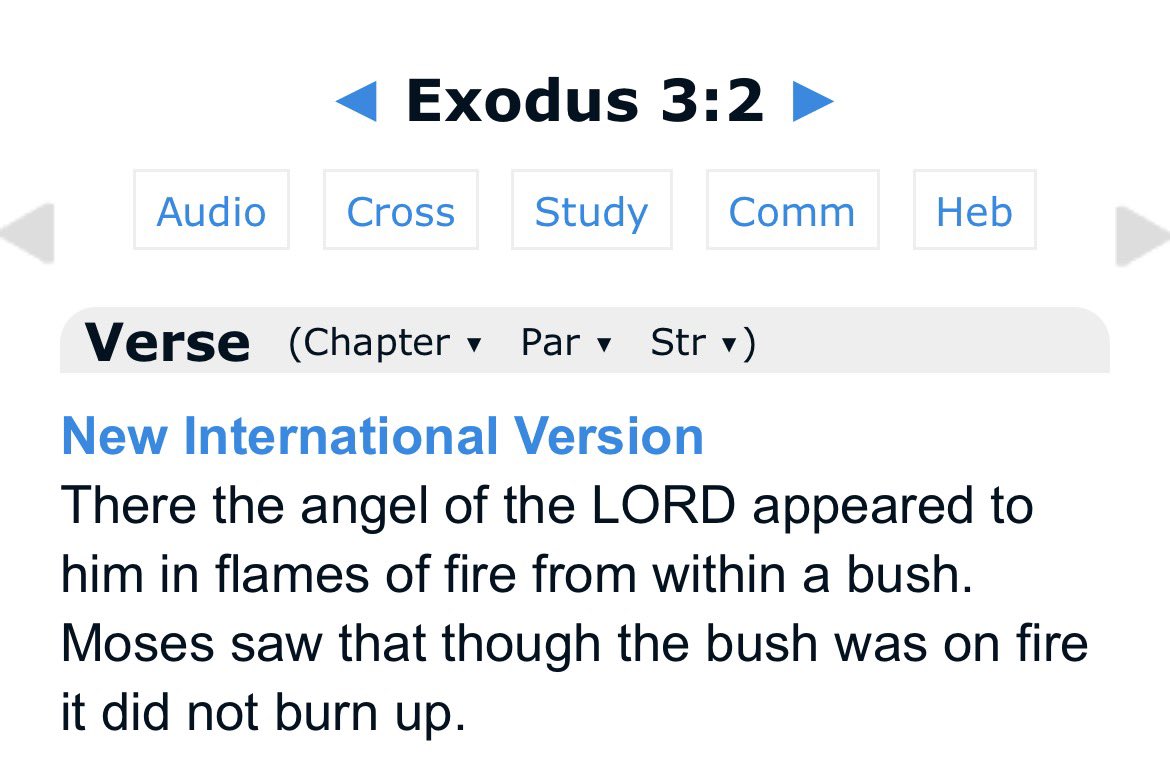
Jun 9

A little knowledge is a dangerous thing.
The Hebrew construction is סמיכות (smikhut), equivalent to Arabic الإضافة (al-idaafa).
So if you know even some basic Arabic, this should be obvious.
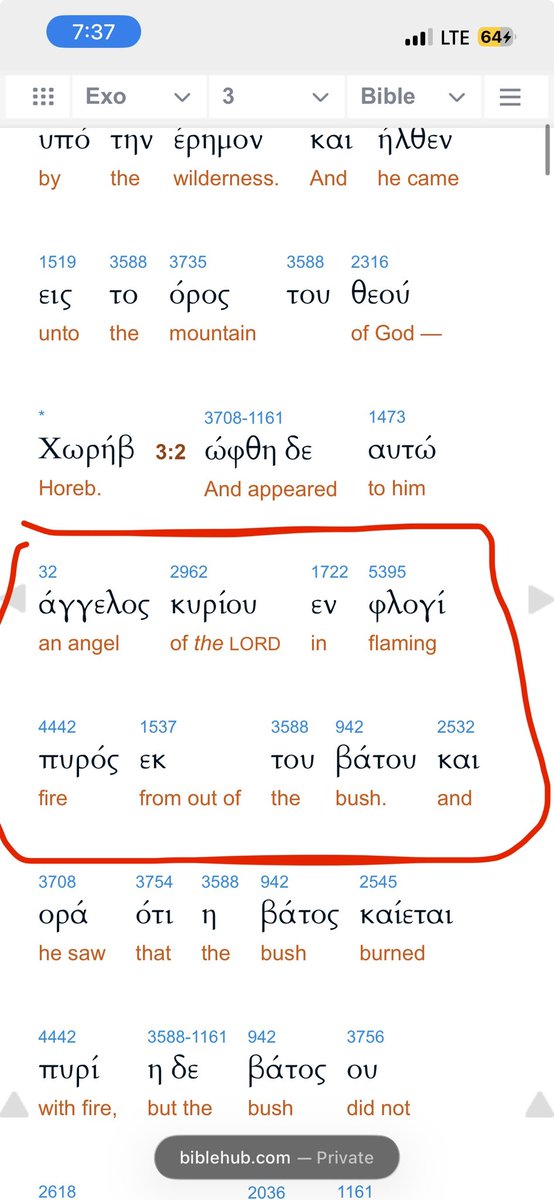
In Hebrew, מַלְאַךְ יְהוָה (malaakh YHWH) does not need הַ (ha-) on מַלְאַךְ (malaakh) to be definite. Since YHWH is definite, the whole phrase is definite: “the angel/messenger of YHWH.”
Same construct in Arabic:
You do not say الرسول الله (al-rasoul Allah).
You say رسول الله (rasoul Allah).
Even without الـ (al-) on رسول (rasoul), it means “the messenger of God,” not “a messenger of God,” because الله (Allah) is definite.
Greek, however, works differently. A genitive phrase like ἄγγελος Κυρίου (angelos Kiriou) does not automatically become definite just because Κυρίου (Kiriou) is definite.
That is why Matthew 1:20 is translated “an angel of the Lord.” There is no definite article before ἄγγελος (angelos) there.
But Matthew 1:24 says ὁ ἄγγελος Κυρίου (o angelos Kiriou), “the angel of the Lord.” That article is called an anaphoric article, meaning it points back to the angel already introduced in 1:20.
So no, this is not Christians “arbitrarily choosing.”
This is “you are ignorant of the grammar you’re discussing,” and then declared victory with emojis.
62
27
517
32,125
lol, this proves that Christians including Sam Shamoun are BOTS.
I expected Sam Shamoun to know better than this, clearly not
The whole point is, the Greek & Hebrew don’t have the definite article for “The Angel of The Lord” appearance In Exodus! It merely reads “Malakh ״יהוה or “Angelos Kyriou” in Greek.
It reads the SAME EXACT way in the Matthew, regardless of it being rendered as “an Angel of The Lord”
So Christians will arbitrarily choose when this is the same Angel and when not.
😂😂😂😂🫵🏼🫵🏼🫵🏼🫵🏼🫵🏼🫵🏼
YOU LOST
Jun 9

And this is the guy who thinks he can debate me.
61
41
634
63,821
7 Catholics PRESS Me On GodLogic's Wife & LOSE THEIR MINDS! Watch Now!
youtu.be/WYy9XKVrZVs
14
12
133
10,523
I INVADED A Christian Panel & Made 3 Christians PANIC Over Simple Question! (HILARIOUS)
youtu.be/UqvYHYVvhYA
18
15
189
13,249