
A think tank focused on nuclear nonproliferation. Employing science in pursuit of peace since 1993. contact us: isis@isis-online.org
Joined June 2009
- Tweets 21,224
- Following 597
- Followers 21,106
- Likes 485
639 Photos and videos
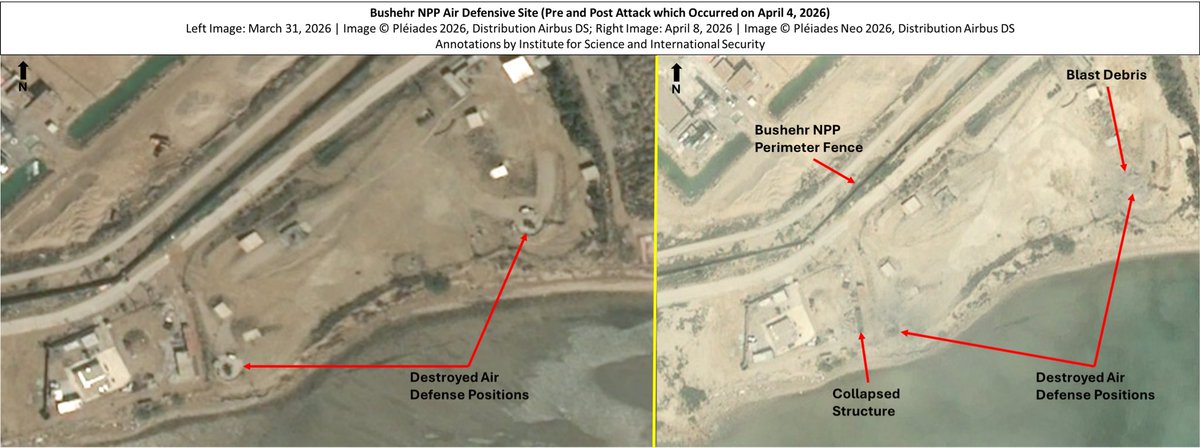
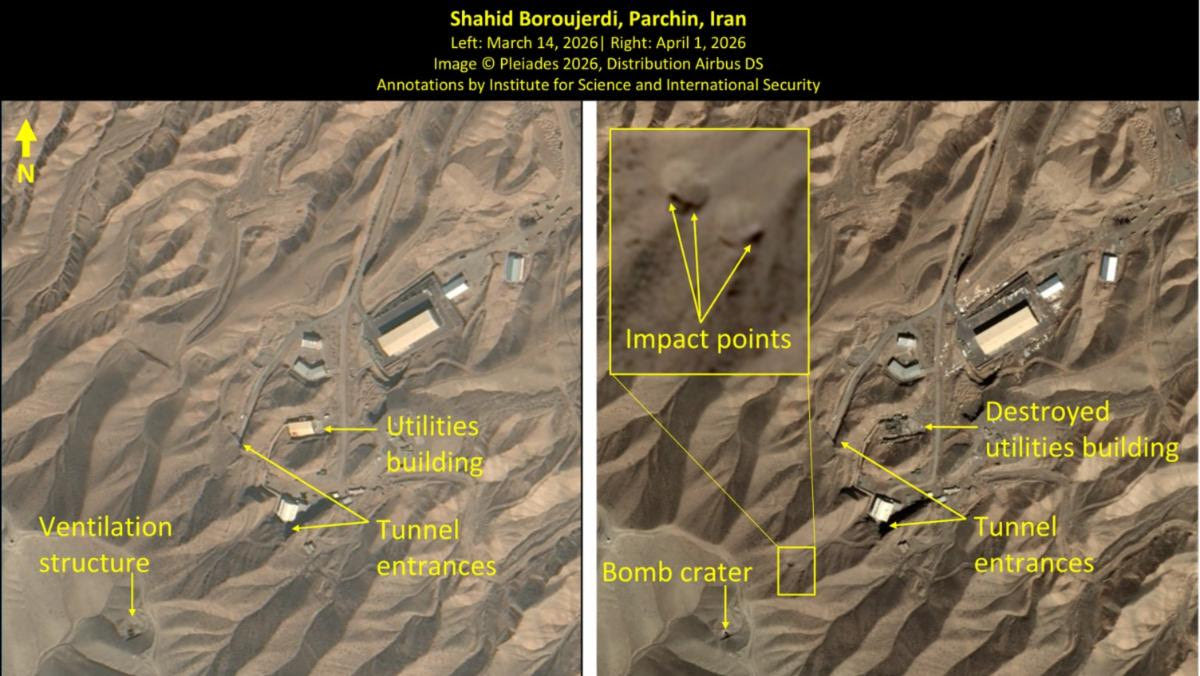
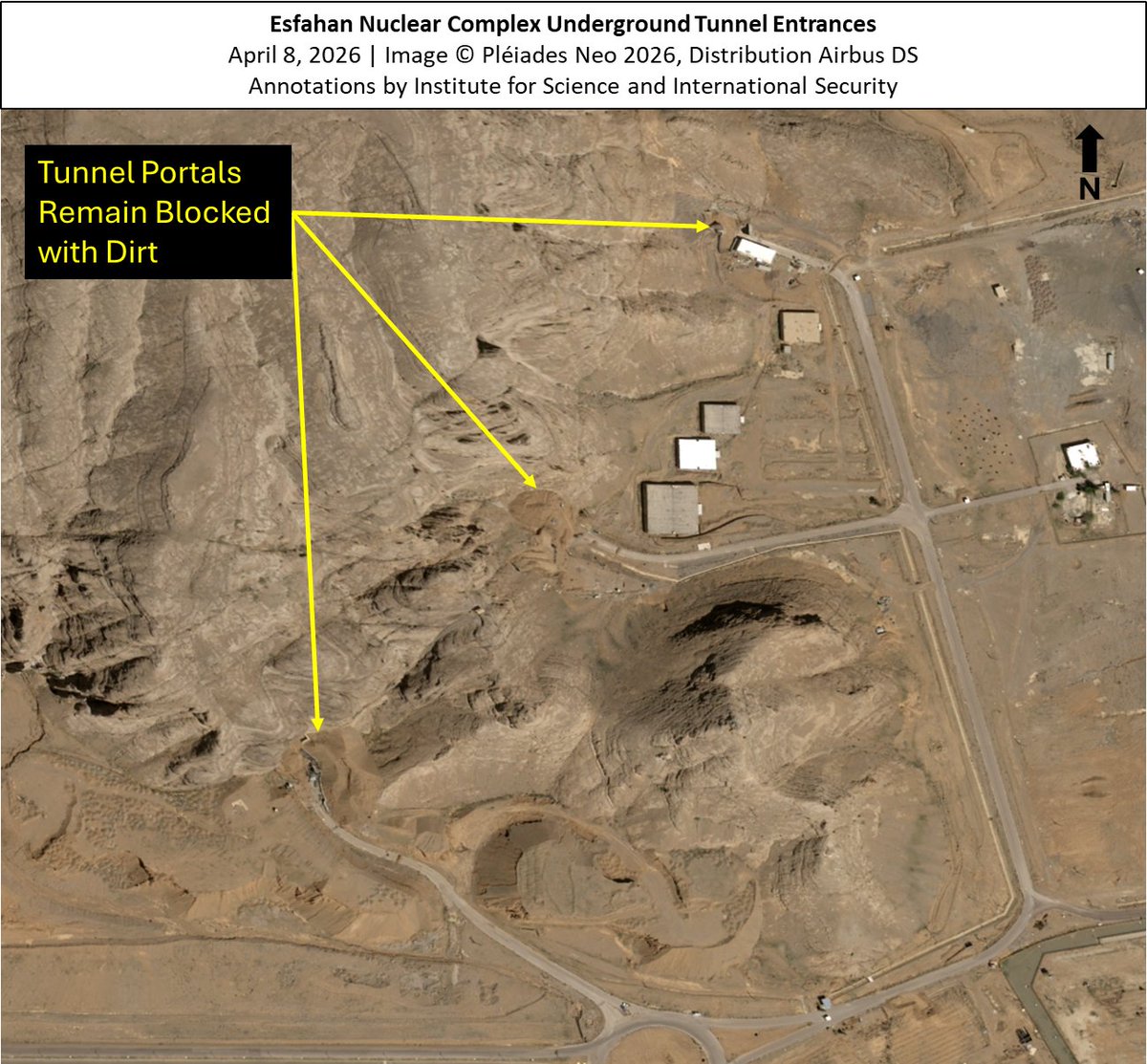
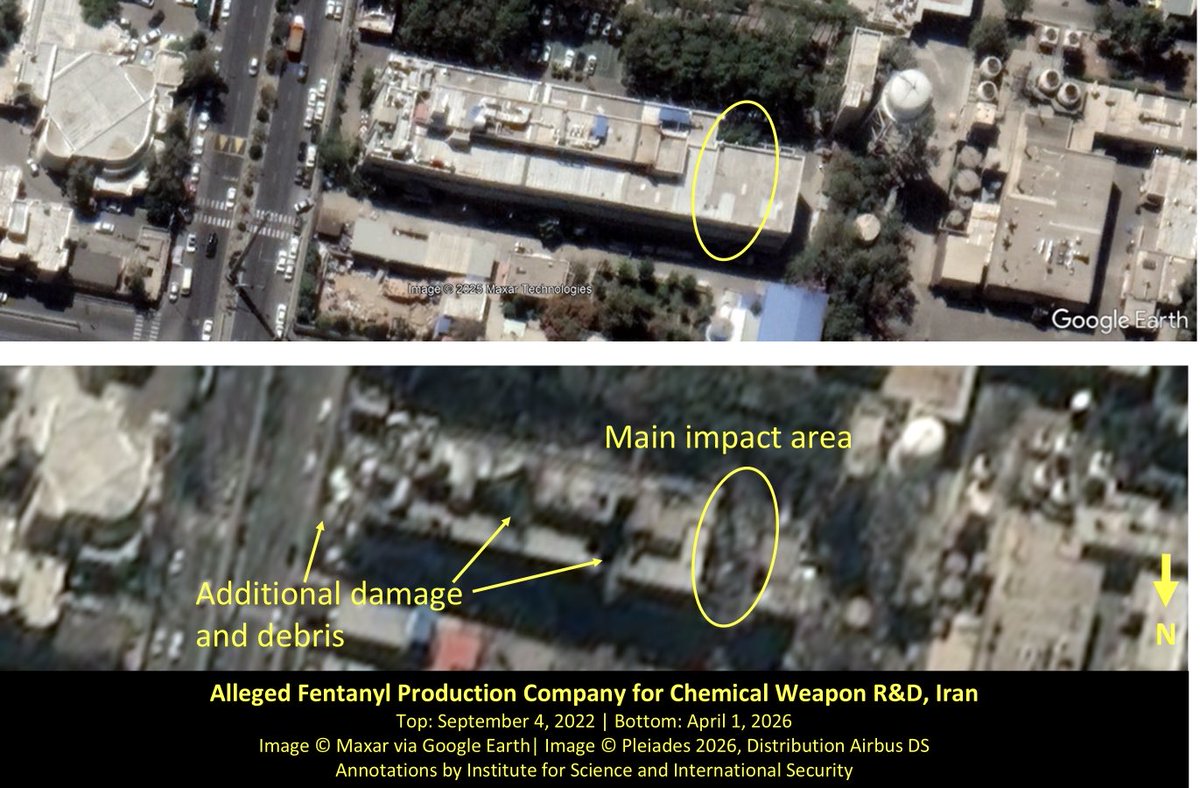

Jun 11
NEW ANALYSIS on Countries with Rare Earth Element Reserves: A Peddling Peril Index 2025/2026 Teaser
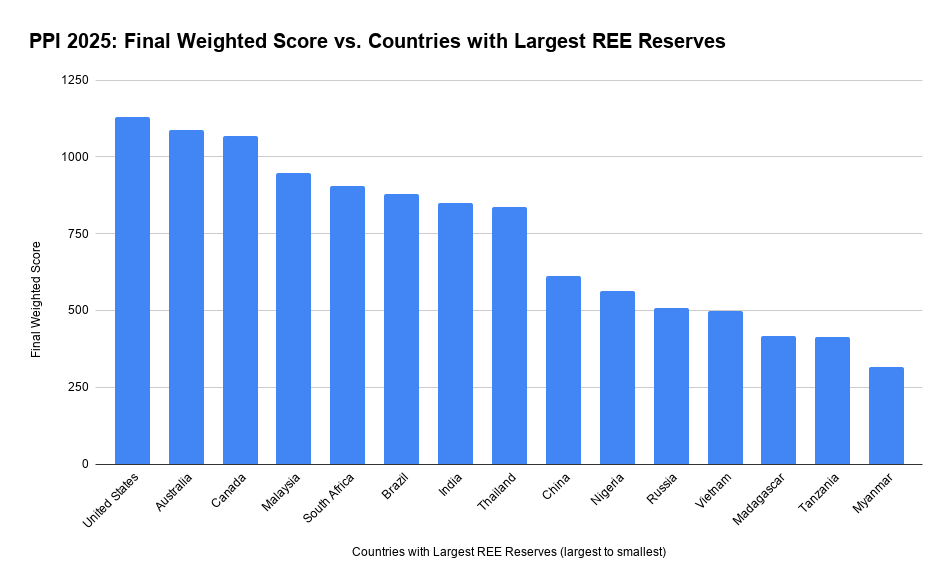
The PPI 2025/2026 is the forthcoming, fifth edition in a biennial series collecting qualitative and quantitative data in five areas of strategic trade controls. The underlying data contain information on 200 countries across 106 indicators, and different methods of presenting and analyzing the data are discussed, including statistical analysis and case studies. In addition to a final ranking of the 200 countries, territories and entities evaluated in the PPI, examples of evaluating the countries in groups are included, such as grouping countries by supply potential of WMD-related items and technology, to acknowledge and draw out different needs for—and challenges posed to—strategic trade control systems across countries. A subset of evaluated countries is presented here, namely those that have rare earth element deposits or reserves.
The PPI team evaluated 16 countries that have the largest rare earth elements (REEs or rare earths) deposits. Rare earth elements are a group of 17 metallic elements recognized for their importance in the modern production of advanced technologies, military weapon systems, and industrial goods; they are therefore dual-use goods. The 16 countries are (listed alphabetically): Australia, Brazil, Canada, China, Greenland*, India, Madagascar, Malaysia, Myanmar, Nigeria, Russia, South Africa, Tanzania, Thailand, United States, and Vietnam. These countries should prioritize their ability to control the entire REE process, from separation, refining, to alloying and end-product manufacturing.
China’s control of the REE supply chain poses unique challenges. Countries effectively need to build their own domestic industries to insulate themselves from coercive trade practices, but this is difficult in a market dominated by price pressures and dictated by supply and demand. For new supply chains to be profitable and sustainable, governments can help by providing financing to alleviate concerns and provide incentives to develop the projects in the first place. But as the PPI demonstrates, simply funding new supply chain elements alone is not enough to prevent China’s aggressive expansion. Countries will need to leverage export controls and inbound foreign direct investment controls to prevent the exploitation of their domestic resources. This can be done by strictly monitoring and evaluating the companies seeking access to domestic natural resources, and determining the level of ownership these companies would have, and who are the true beneficial owners of the companies themselves.
Applying the results of the PPI to the group of 15 countries (no PPI results are available for Greenland, see footnote 1) with the largest deposits of REE’s can reveal some interesting insights into the strengths and vulnerabilities facing these countries as they develop their domestic resources.
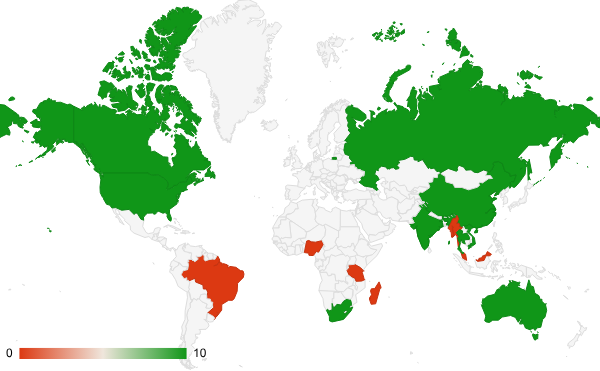
As a group, the countries on average scored 735 points, or 56 percent of the total 1,300 points available in the PPI. The points varied widely from some of the best scoring countries, including the United States, to some of the worst scoring countries, including Myanmar (see Figure 1).
Inbound Foreign direct investment (FDI) controls play a vital role in how countries can protect investments in their domestic REE resources. Countries with poor inbound FDI controls are less able to assess and vet the risks posed by foreign companies or governments making investments into domestic REE operations, increasing the possibility that domestic resources can be fully purchased and owned by a foreign entity. Nine of the 15 countries received full points in the FDI sub-criterion, meaning these countries have a dedicated mechanism to screen inbound investments which allows screening for national security purposes (see Figure 6). Six of the countries have neither dedicated FDI screening mechanisms nor screen FDI in sectors relevant to national security and did not earn any points. These six countries are highly vulnerable to foreign exploitation.
Internal stability and corruption are major considerations in how well a country can manage and protect its REE resources. Poor internal stability limits the ability of the government to effectively govern its territory and maintain stable long-term policies that enable businesses to form long-term plans and investments. Of the 15 countries assessed here, eight of them are listed in the bottom half of the Global Corruption Index (GCI) for 2023, ranking them amongst some of the most corrupt countries in the world. This includes Myanmar, Madagascar, Nigeria, Viet Nam, Tanzania, Russia, China, and Thailand. As seen above, four of those countries, Myanmar, Madagascar Tanzania, and Nigeria, lack inbound FDI controls, meaning they are especially vulnerable to exploitation.
Read the full report with additional findings and recommendations here: isis-online.org/isis-reports… and read more about the Peddling Peril Index series here: isis-online.org/peddling-per…
7
20
188,865
Jun 10
NEW: Comprehensive Imagery Report on Nuclear Enrichment Related Sites, Post-April Ceasefire
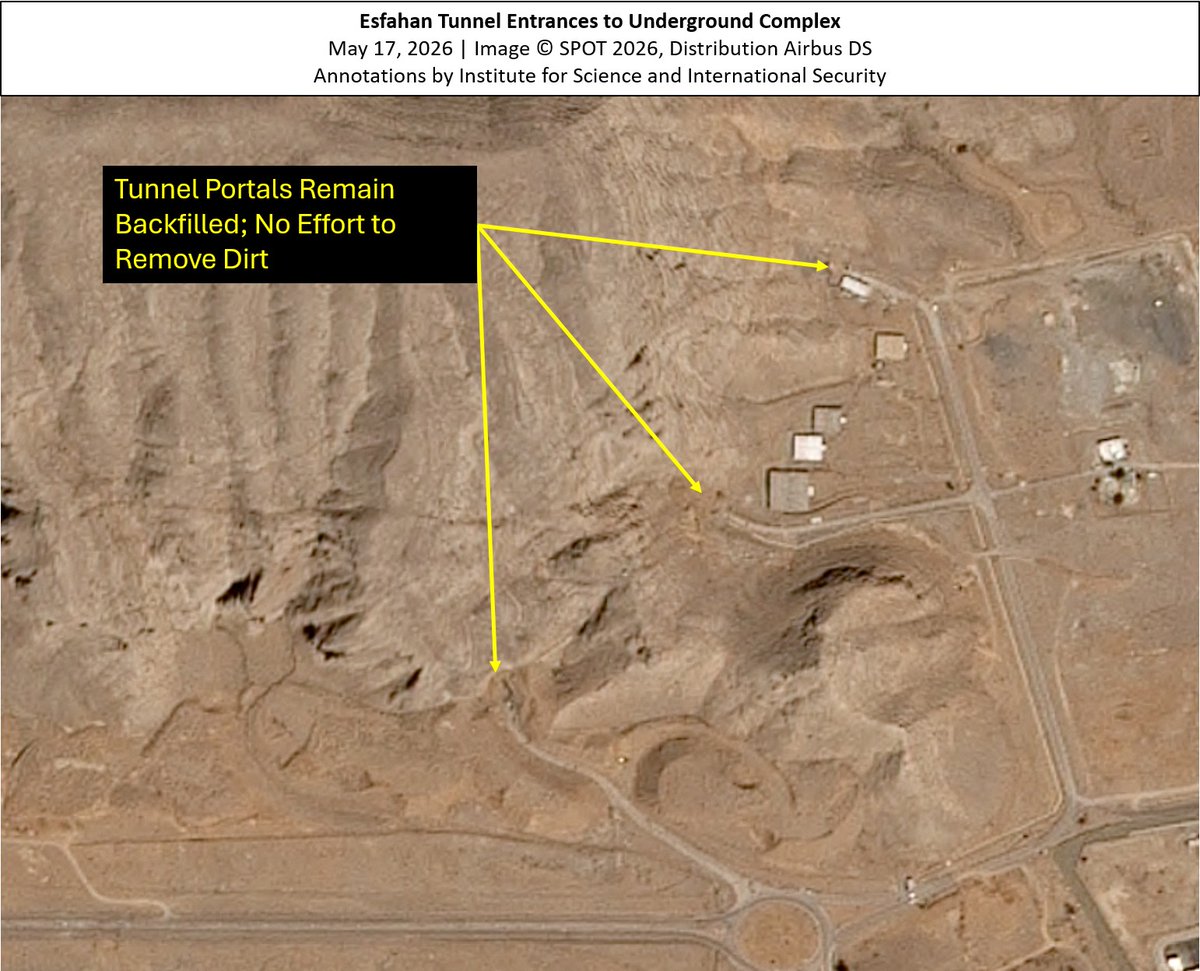
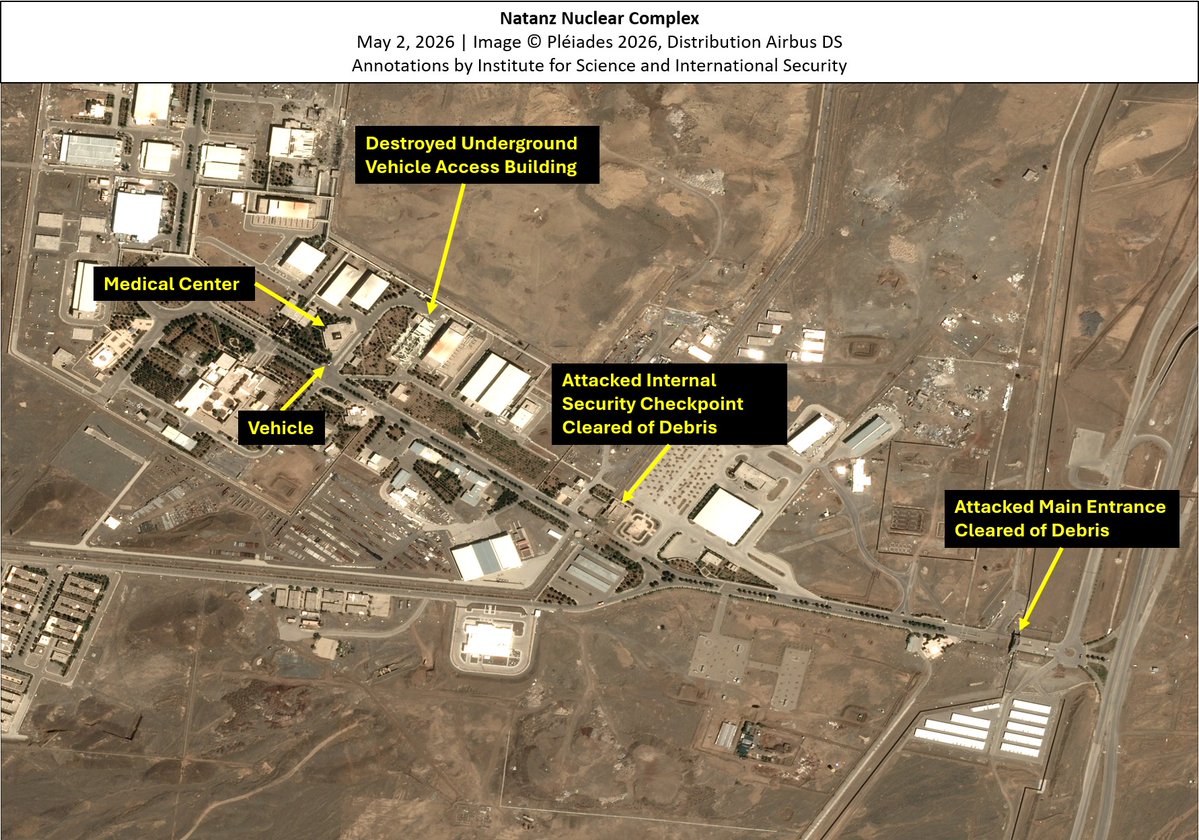
Following the ceasefire between Iran, the United States and Israel established in early April 2026, we have continued to monitor key sites related to Iran’s nuclear program. In this report, we take a close look at key sites related to uranium enrichment, which include Esfahan, Fordow, and Natanz, the two separate mountain tunnel facilities south of the Natanz site, as well as centrifuge production sites. Several of these sites have shown signs of activity. While the activity visible in imagery is not conclusive, collectively, they indicate the following:
- There is no evidence of any uranium enrichment, and the centrifuge program remains destroyed. Nonetheless, the need remains to verifiably dismantle or further disable Iran’s remaining enrichment facilities, close Pickaxe mountain and other underground sites, and remove or downblend the ten tonnes of enriched uranium, including about 440 kilograms of 60 percent enriched uranium.
- Iran has not given up on its enrichment program altogether;
- The underground Natanz Fuel Enrichment Plant (FEP) is believed to hold enriched uranium, and may hold intact centrifuges, components, and equipment, but is currently inaccessible due to March 2026 strikes on the entrances.
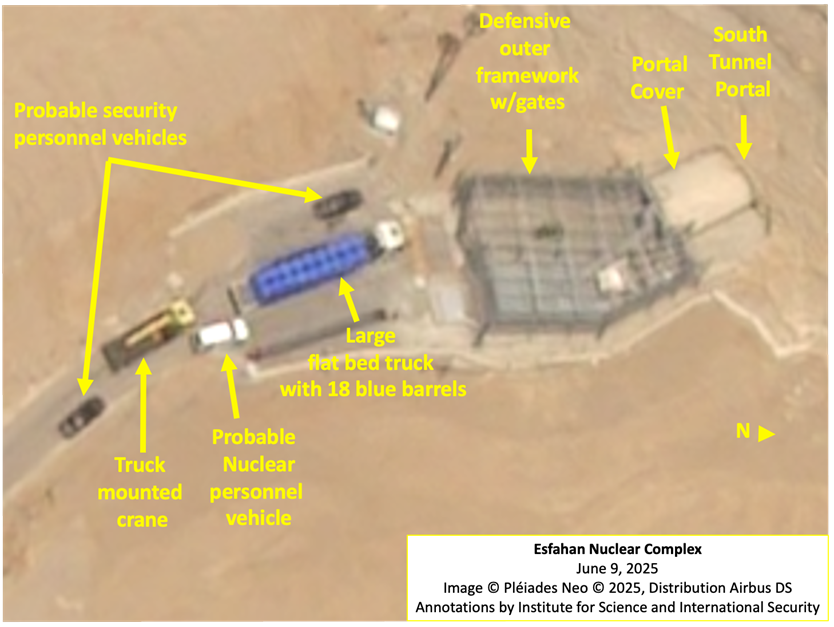
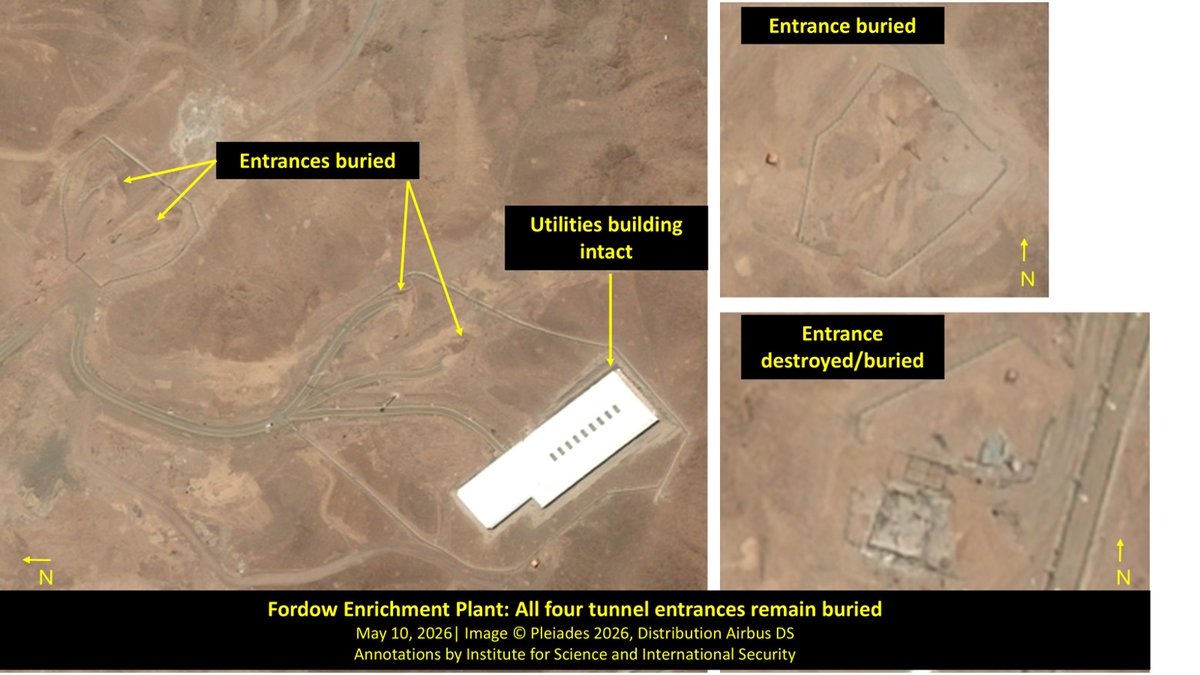
-Stocks of enriched uranium, including the 60 percent highly enriched uranium, appear to remain bottled up in underground facilities at Esfahan, Natanz, and Fordow. All tunnel entrances at Esfahan, Fordow, and Natanz that were sealed prior to March 2026 remain sealed. The latter tunnel was built in 2007 and was sealed early in the months following the June strikes, raising concern about its current content.
-The large tunnel complex known as Pickaxe mountain remains largely accessible and open and under ongoing construction; it is not assessed to hold facilities ready to operate. It is not believed to hold enriched uranium stocks.
-Above-ground centrifuge production sites remain destroyed with no evidence of reconstruction.
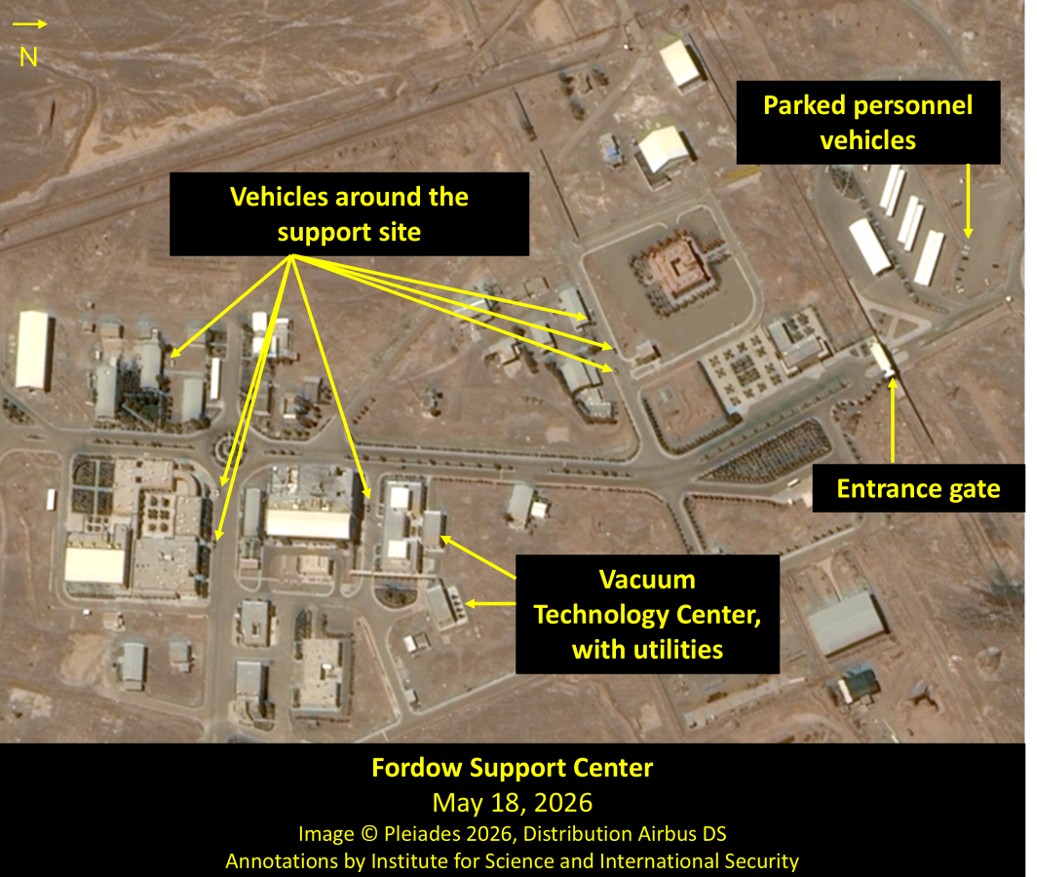
-Other enrichment-related assets may be more accessible; the limited damage inflicted on the Fordow support site appears disproportionate to its importance and current activity around the support site seems high. The status remains unclear of a planned enrichment building at the site estimated to hold two cascades, albeit one planned to separate mainly iridium or tellurium. But if iridium hexafluoride and tellurium hexafluoride have not yet been introduced into the centrifuge cascades, the cascades could be used for uranium enrichment.
- Given Iran’s ongoing refusal to provide required information on its enriched uranium stocks or allow the International Atomic Energy Agency (IAEA) access to enrichment related sites, including the location of enriched uranium, centrifuge inventory, and related equipment, the IAEA relies heavily on satellite imagery. However, with respect to Iran, unlike with North Korea, the IAEA rarely reports on its assessments from imagery, as evidenced in the short NPT safeguards and JCPOA Verification reports presented to the Board this week. Our recommendation is that the Board of Governors instruct the IAEA to report more information to its member states regarding Iranian activities observed at nuclear sites, especially with regard to the recovery of equipment and enriched uranium from the destroyed sites, the possible current locations of enriched uranium or diversion of that material, and the status of nuclear weaponization sites and other key assets. Here, it should be remembered that the benchmark set for Iran by current UN Security Council sanctions resolutions is a suspension of all enrichment activities, including research and development.
It is important to remember that an enrichment capability requires significantly more than the existence of UF6 and centrifuges or centrifuge parts. Thus, the existence of the enriched uranium or centrifuge-related items should not be confused with Iran’s ability to enrich uranium, a capability not now existing in Iran. Another common misinterpretation is to confuse the HEU stock with building nuclear weapons, a process that has been significantly lengthened by the damage wrought by the two wars. Removing or downblending the HEU may be necessary for a nuclear deal, but the HEU’s presence in Iran does not mean that Iran is enriching uranium or building nuclear weapons. This HEU was there before the June war, coupled with a nuclear weapons program that could produce a weapon in months. Today, that timeline is at least a year. Moreover, moving technically to build that weapon is now fraught with risks and potential technical hurdles that could result in failure.
Read the full analysis here: isis-online.org/isis-reports…
1
44
103
56,399
Inst for Science retweeted

Jun 10
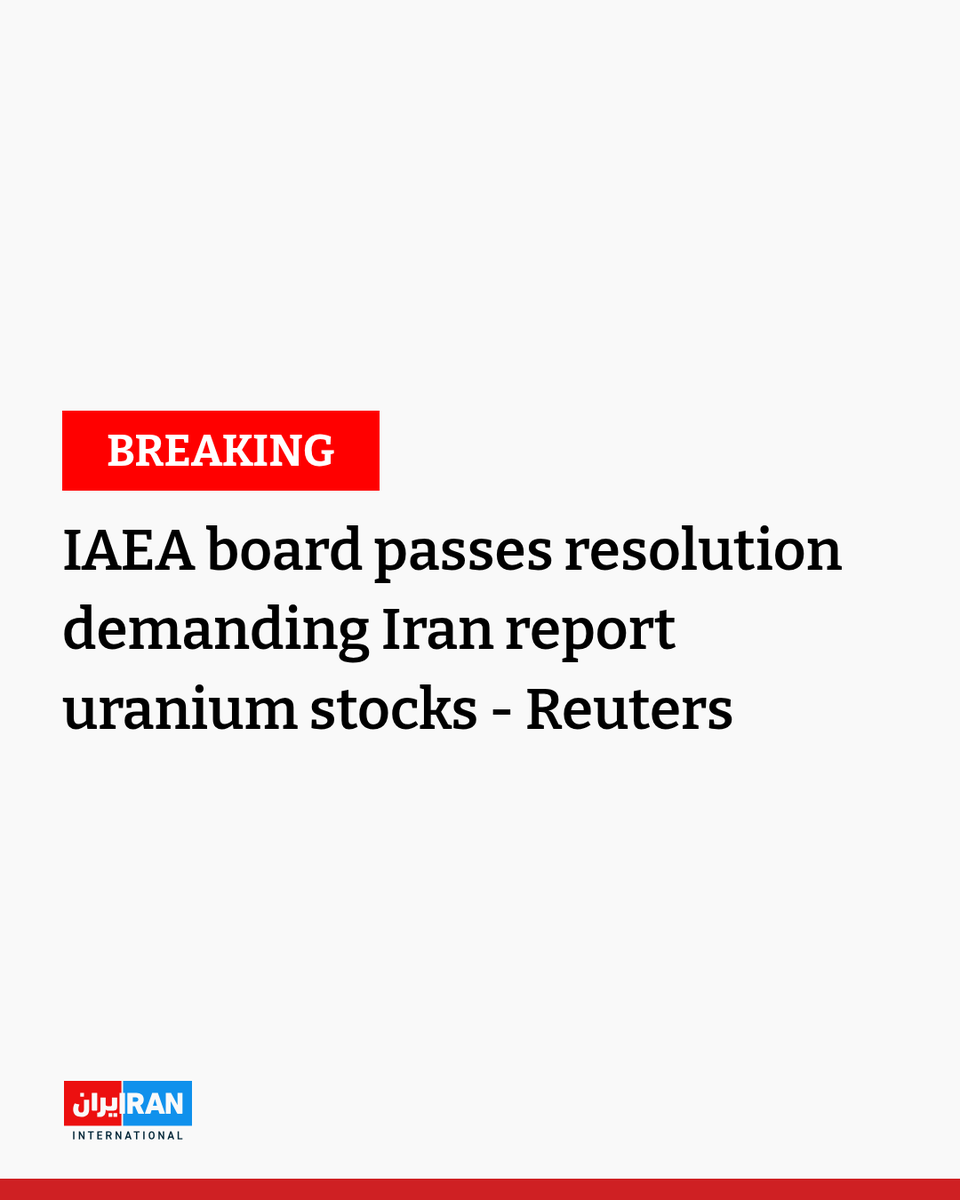
21 votes in favour, 3 against, ten abstentions.

The UN nuclear watchdog’s 35-nation Board of Governors passed a US-backed resolution requiring Iran to declare its remaining enriched uranium stocks and allow inspectors to verify them, Reuters reported on Wednesday, citing diplomats.
The resolution, submitted by the United States, Britain, France and Germany, passed with 21 votes in favor, three against and 10 abstentions, diplomats at the closed-door meeting said.
Russia, China and Niger voted against the resolution, while Venezuela was not allowed to take part, the diplomats said.
iranintl.com/en/202606107755
1
3
32
5,909
Inst for Science retweeted

Jun 10
Undisclosed Small Centrifuge Facility at Fordow Support Site?
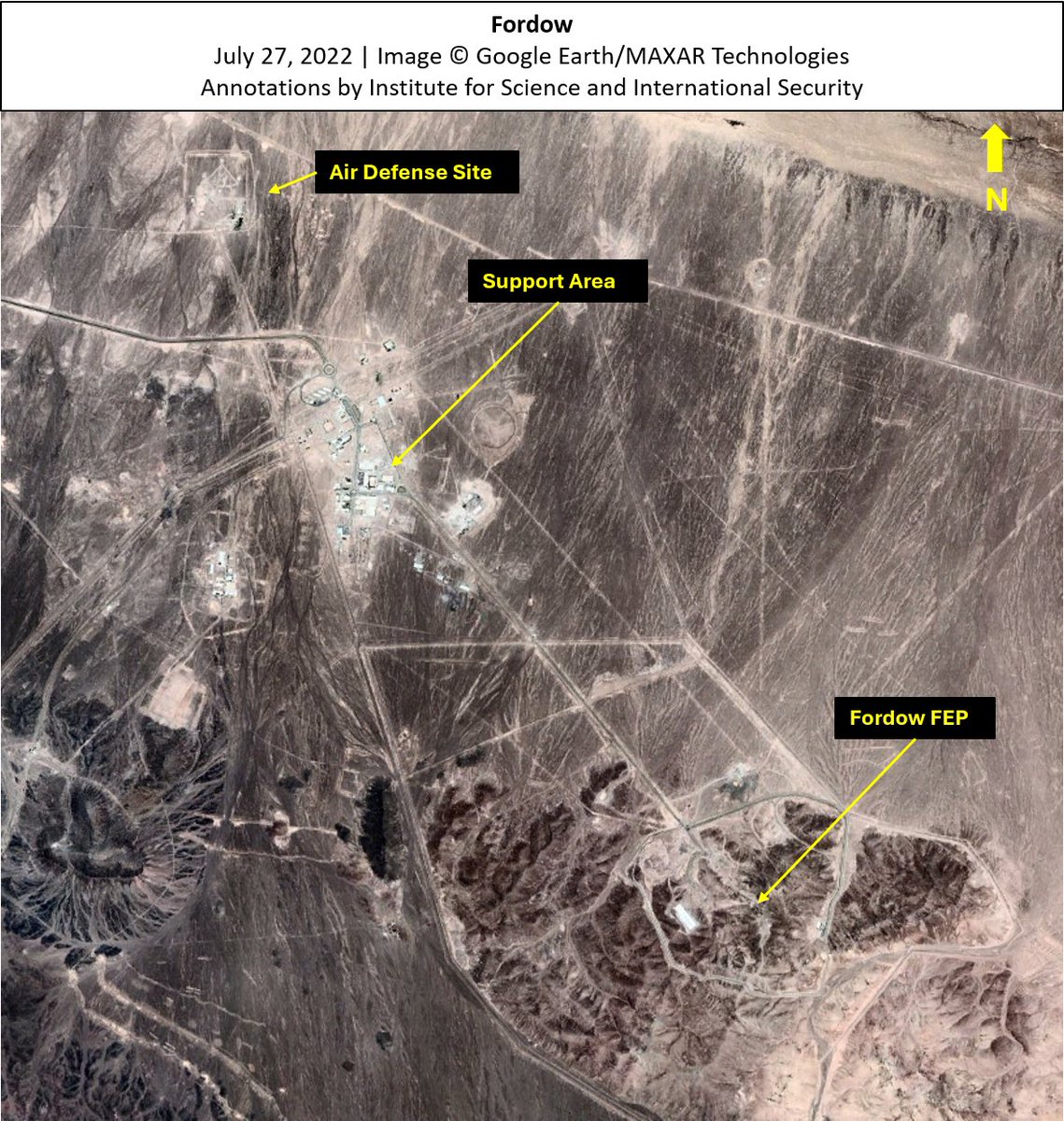
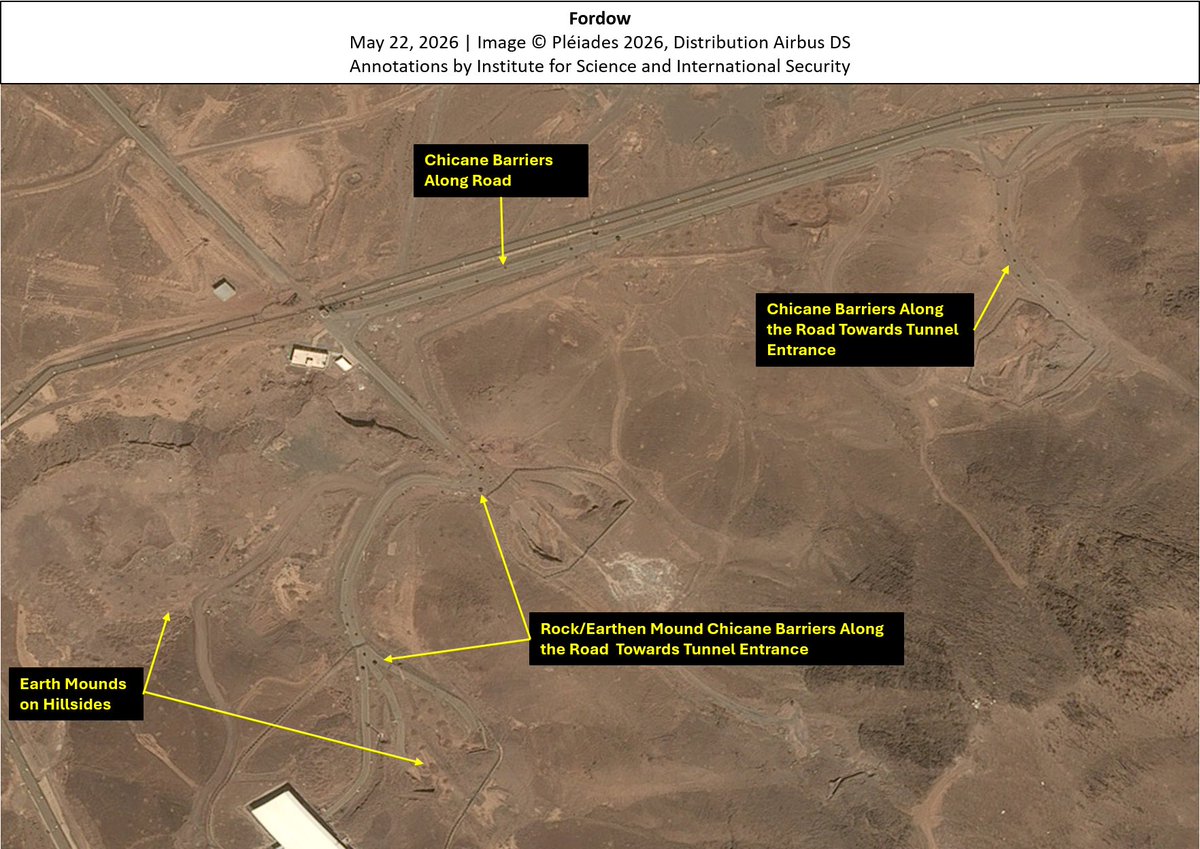
We recently learned from a trusted colleague about reporting about enrichment related reconstruction activities at the Fordow enrichment site, information we were unable to confirm. This led us to look more broadly at the site, which includes the well-known underground enrichment plant (bombed by the United States in June 2025) and the less-known above-ground support area north of the underground site (see first image below). As of mid-May 2026, available satellite imagery does not provide evidence of renewed access to, or reconstruction activity at, the underground Fordow enrichment plant itself. However, Iran appears to have recently increased passive defense measures at the site (see second image below). Perhaps, there is some secret human intelligence-based information showing secret activity immune from satellite surveillance, but if it is occurring, it may be small-scale activity, perhaps tied to recovering HEU still inside the plant, which is reported to be about 80 kgs, or two significant quantities.
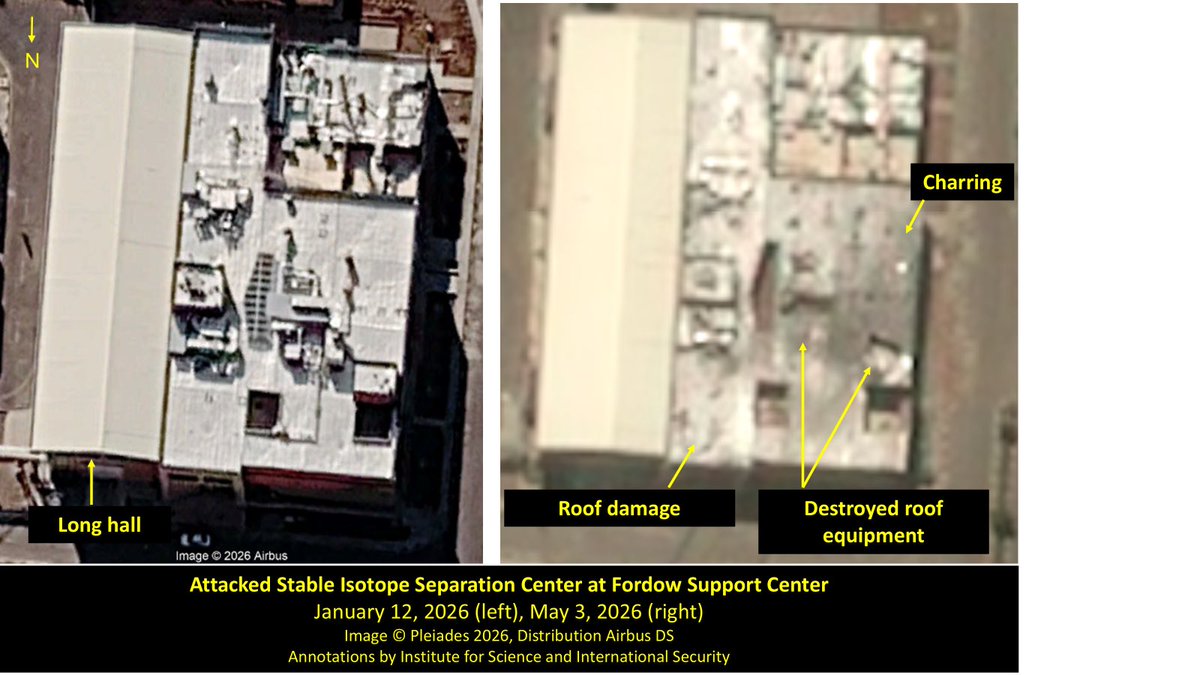
While we did not find any concerning activity at the main site, we did identify something worrisome at the support site. This site was barely damaged in attacks during either 2025 or 2026 attacks. Our results are described in a report we published on Monday on our website, titled "Recent Activity at the Fordow Enrichment Plant and its Associated Support Site."
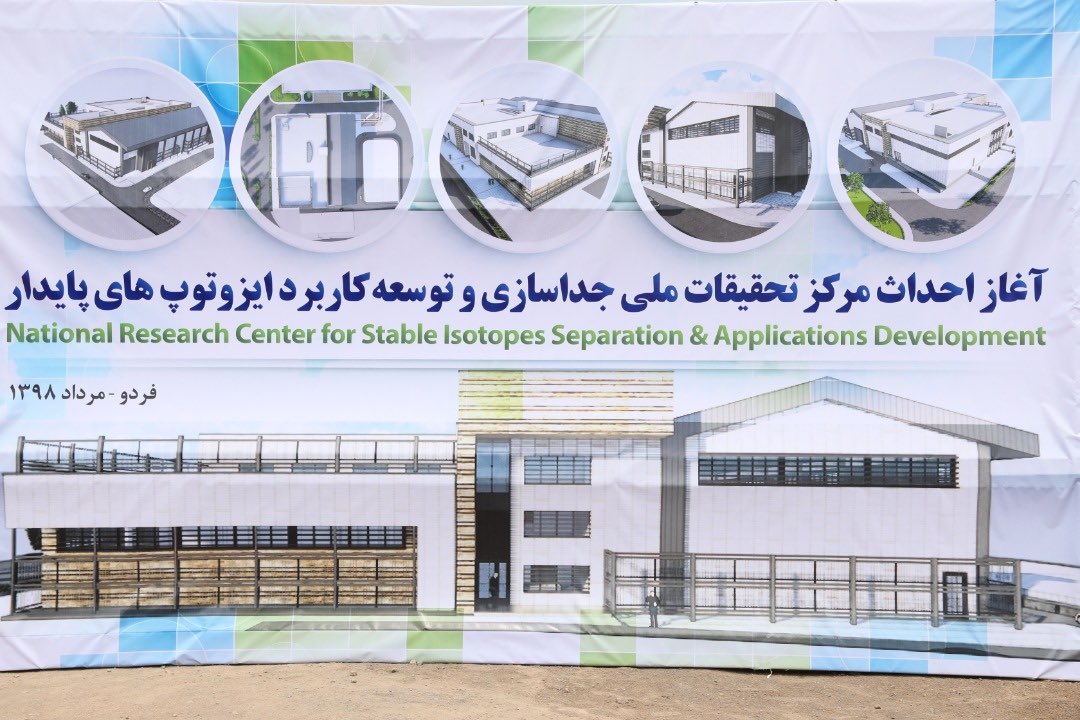
We were drawn to a lightly damaged building next to and connected to the Vacuum Technology Center, which several years ago we could determine was involved in manufacturing difficult-to-make equipment needed to operate centrifuge cascades. (See images below of the attacked but lightly damaged building) The activities at this building were not secret. Open-source information suggests that it may house a relatively small hall containing up to two-cascades of gas centrifuges, installed for stable isotope enrichment, which Iran was pursuing under the JCPOA in cooperation with Russia. However, if Iran installed the centrifuges, as planned, and did not use them for stable isotope separation, they would be usable for uranium enrichment.
The IAEA quarterly reports have been silent on the issue of stable isotope separation for quite a while, despite Iran announcing in early 2025 its intention to install centrifuges in this hall. In particular, the IAEA has not discussed this building or its contents. Likewise, Israel has been silent on why it attacked this building.
We are actively seeking answers to (1) why was the building attacked; (2) whether Iran installed a few hundred centrifuges at the support site before the June 2025; and if so, (3) were the centrifuges contaminated by iridium or tellurium hexafluoride, making them practically unusable for uranium enrichment.
This is another reason for the Board of Governors to pass a resolution supporting the IAEA to resume inspections in Iran and to be able to report on the status of centrifuges in Iran.
Our results on Fordow will also be repeated in our report, "Comprehensive Imagery Report on Nuclear Enrichment Related Sites, Post-April Ceasefire” that we will publish today.
19
130
369
92,907
Jun 9
OUT NOW: Analysis of IAEA Iran Verification and Monitoring and NPT Safeguards Reports — June 2026
Findings At a Glance 👇
● In its latest safeguards report, the IAEA continues to declare Iran in violation of its Nuclear Non-Proliferation Treaty (NPT) safeguards agreement.
● The IAEA is unable to verify the suspension of Iran’s uranium enrichment, plutonium reprocessing, and heavy water production programs, as required under UN Security Council (UNSC) resolutions reimposed in October 2025, and Iran is denying the IAEA access, information, and cooperation.
● The IAEA is unable to report on Iran’s stocks of enriched uranium and their size, location and chemical composition, and the status of centrifuges and related equipment.
● The IAEA clearly identifies the Esfahan, aka Isfahan, tunnel complex as a storage location for 20 and 60 percent enriched uranium and reports its concern about activity at the site in early February 2026.
● According to the Verification report, after February 28, 2026, the IAEA “stopped conducting verification activities in Iran in accordance with the NPT safeguards agreement.
● Overall, the report lacks sufficient information. It provides much less detail on the location of enriched uranium than Director General Rafael Grossi has reported in media interviews, and no information on the other candidate sites where the material may be entombed, including Fordow, a tunnel site built in 2007 at Natanz, and Pickaxe Mountain near Natanz.
● The report does not address Iranian nuclear weapons related sites that were struck by the United States and Israel during the June 2025 and February to April 2026 conflicts, despite publicly available information on the nuclear weapons relevance of the sites and the fact that some of them had capabilities the IAEA was mandated to monitor under Section T of the Joint Comprehensive Plan of Action (JCPOA).
● Despite publicly available information on the extent of damage inflicted on nuclear sites, the IAEA continues to report nothing more than a list of declared sites "affected by the attacks."
● The IAEA does not report its observations of the status of known centrifuge manufacturing sites, such as TESA Karaj and Kalaye Electric; both were attacked in June 2025. The IAEA does report an additional attack on the former in the recent phase of the conflict. The IAEA Verification report states in a footnote that the Karaj site was struck again during the 2026 phase.
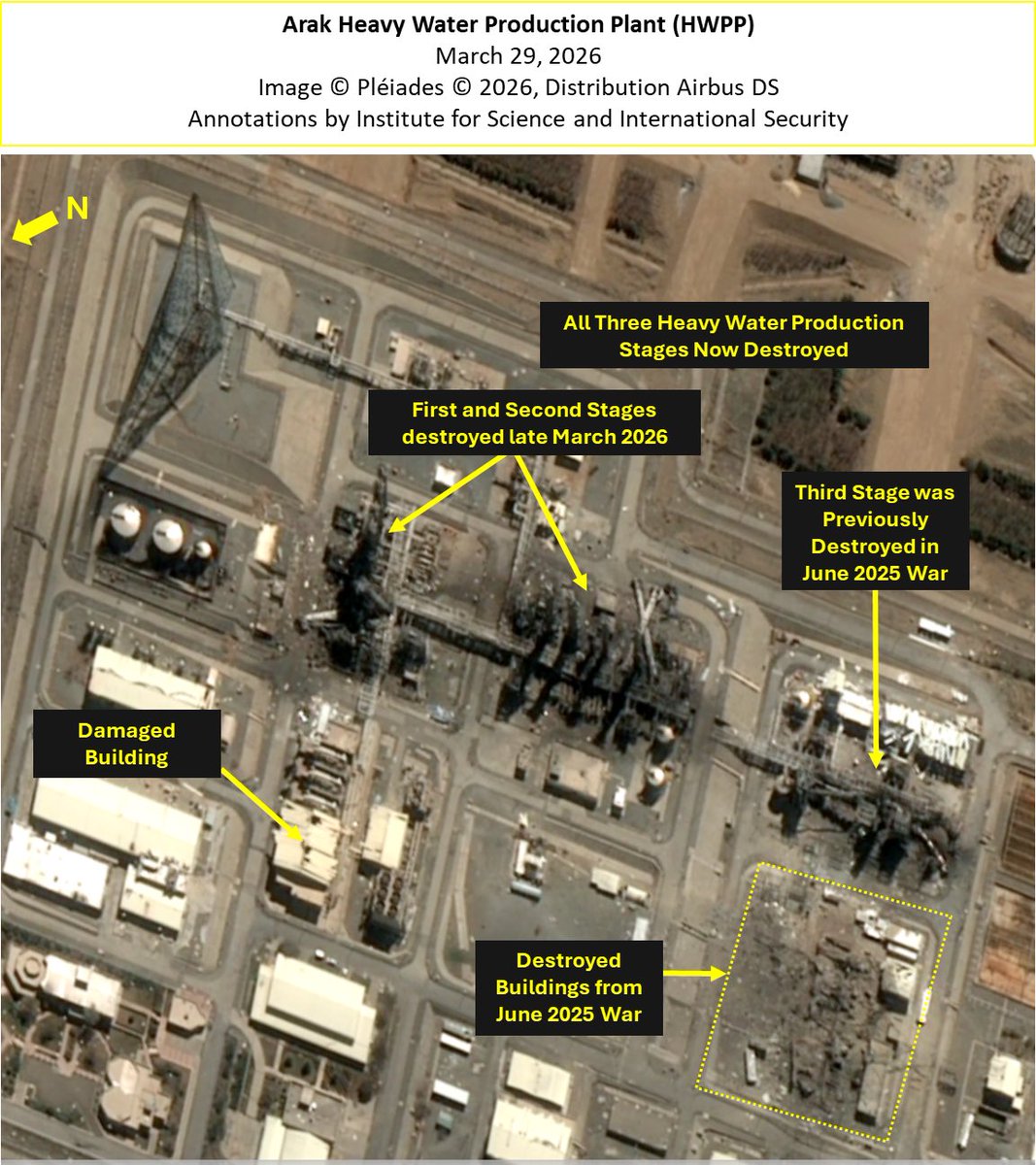
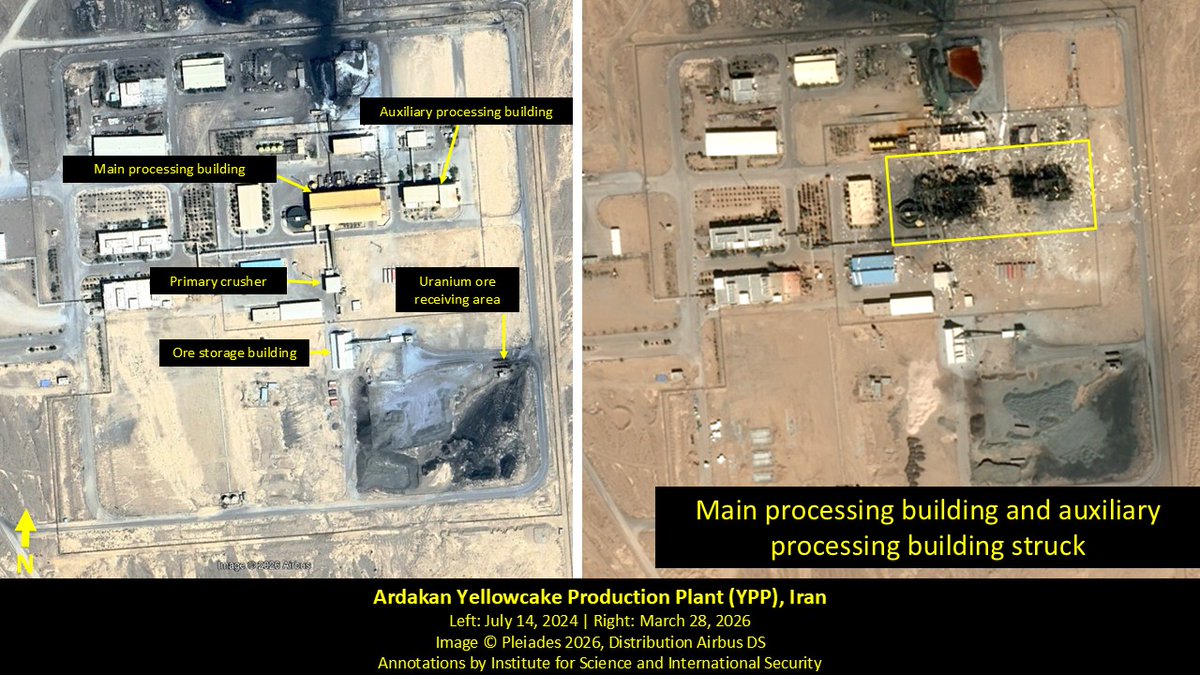
● The Verification report does list the Heavy Water Production Plant and the Ardakan Yellowcake Production Plant as attacked in phase two of the conflict.
● The Board of Governors should instruct the IAEA to increase reporting to the member states in its safeguards report regarding Iranian activities observed at nuclear sites, especially with regard to the recovery of equipment and enriched uranium from the destroyed sites, the possible current locations of enriched uranium or diversion of that material, and the status of nuclear weaponization sites and other key assets.
● A draft resolution reportedly sponsored by the United States and the European Union, demands Iran provide the IAEA with "precise information on nuclear material accountancy and safeguarded nuclear facilities" and grant inspectors full access to verify that information "without delay."
Our full analysis, written jointly with @StrickerNonpro, is available here: isis-online.org/isis-reports…
7
14
2,219
Inst for Science retweeted
The just released quarterly IAEA safeguards report on Iran reminds us that under UNSC resolutions, Iran is required to suspend all its enrichment activities. Enrichment and reprocessing suspension is the IAEA’s new benchmark, not JCPOA limits, that is verified in this safeguards report. The report makes clear that without Iran allowing any meaningful access, it cannot verify that suspension.
The report also reiterates that Iran continues to refuse to address its undeclared nuclear material and activities, in violation of its comprehensive safeguards agreement.
The report shows that Iran has no legal right to deny the IAEA access or to fail to cooperate.
Discussions about a right to enrich by those in Iran and elsewhere are merely a dishonest diversion from the issues of Iran’s violations of internationally binding UNSC resolutions and the NPT. These binding obligations are not reduced or eliminated by the wars. In fact, the war can be seen in part as a bilateral step to enforce these obligations.
We will release a longer analysis of the report next week.
18
70
139
73,928
Inst for Science retweeted
That was last seriously considered in 1994, by the Clinton administration, but Jimmy Carter’s private visit quickly shifted the effort to diplomacy, resulting in the Agreed Framework. Relevant to today, major nuclear incentives in the Agreed Framework, nuclear components of a LWR, were conditional on North Korea satisfying the IAEA, a condition absent in the JCPOA and one absolutely necessary in a new nuclear deal with Iran.
1
2
7
1,623
Inst for Science retweeted
New North Korean Enrichment Plant: Initial Look
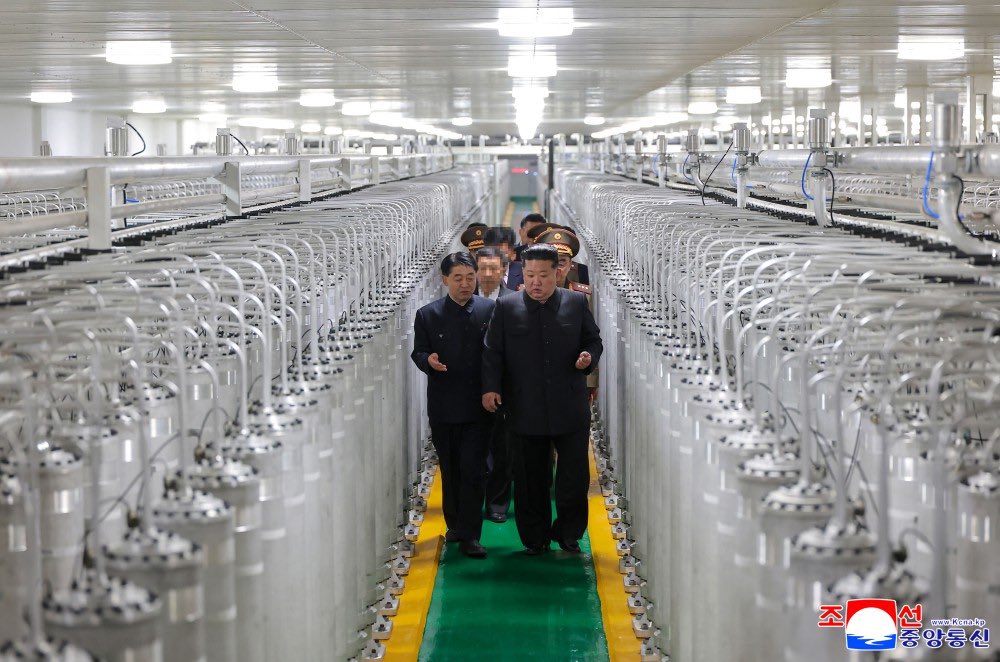
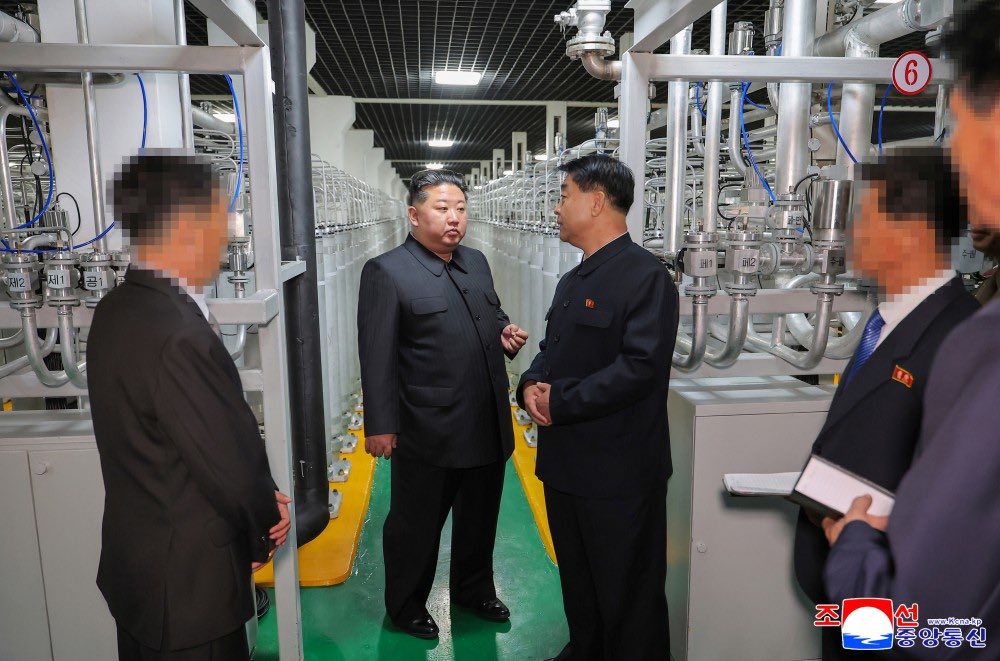
Kim Jong Un toured a new uranium enrichment plant on June 3, 2026. KCNA released a statement claiming that the plant had "new production lines based on more sophisticated technology," along with nine images (see two of the KCNA images below).
The centrifuges in the images look similar in shape and size to the ones installed in Kangsong and the Yongbyon centrifuge plants, the latter first revealed in 2010. The cascades shown appear to be for making low enriched uranium. The ones for enriching in stages to weapon-grade uranium (WGU) could be in other parts of the building.
At first glance the ceilings in these cascade halls appear different from available images of those in Kangsong and the 2010 Yongbyon enrichment plants. The relatively low, quite different ceilings could imply that this new centrifuge plant has two floors, each containing centrifuges.
The plant’s purpose appears to be to make weapon-grade uranium or at least contribute low enriched uranium to its production elsewhere. It represents a significant increase in North Korea’s ability to make WGU. An initial crude estimate, to be refined later, is that the site could produce 100 to 200 kilograms of WGU per year. Assuming 20 kilograms per weapon, that is enough for 5-10 nuclear weapons per year.
The site may be the multi-storied one recently completed at the Yongbyon site near the Radiochemical Laboratory that is suspected to be an enrichment site (see satellite images below from May 31st and June 1). These two images do not show any activity.
More analysis and imagery will follow


7
53
160
300,230
Jun 2
NEW: May 2026 Updated Analysis of Russian Shahed-type Drones Deployed Against Ukraine
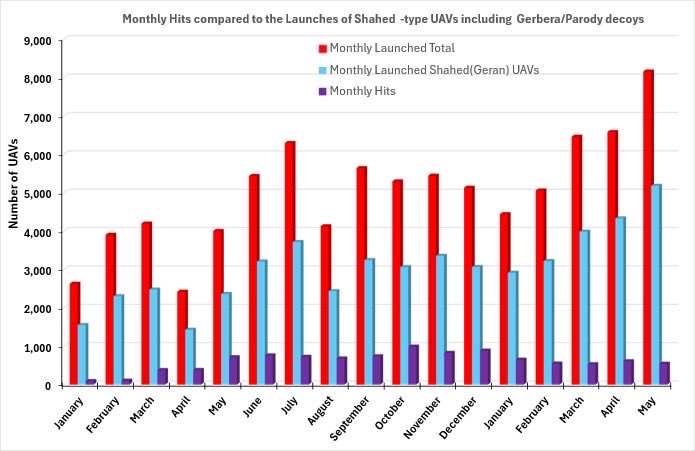
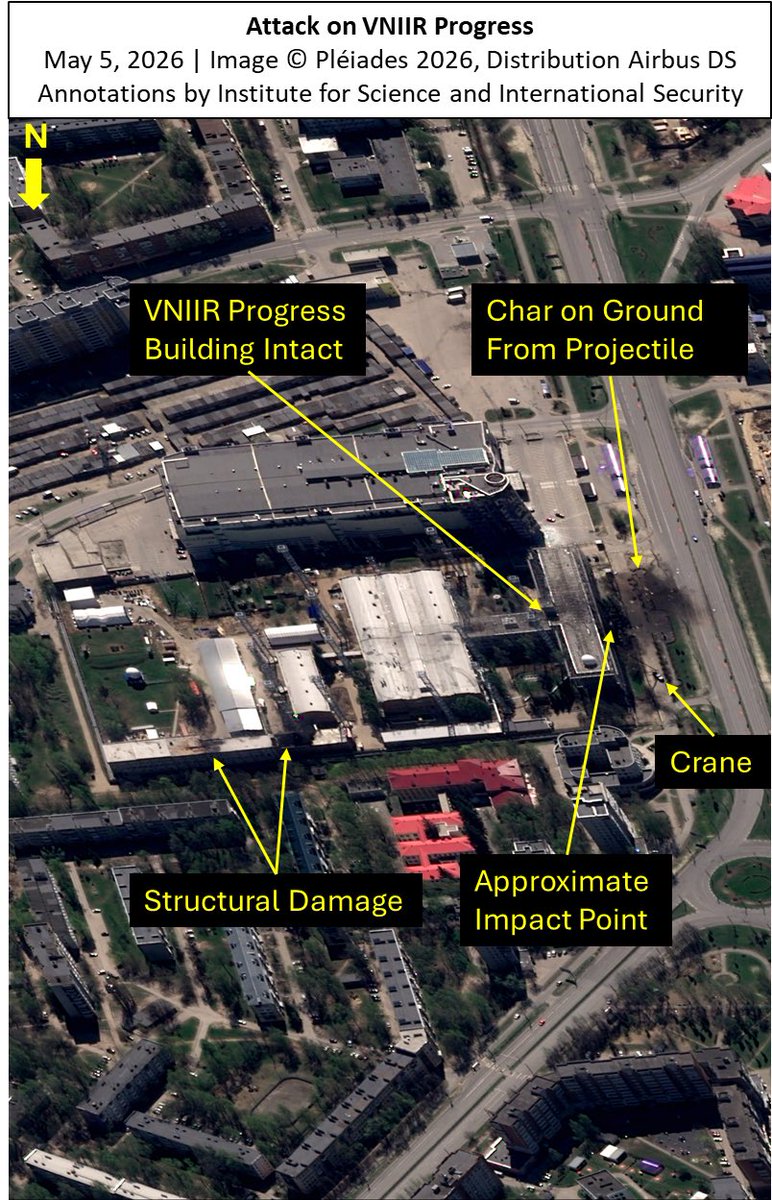
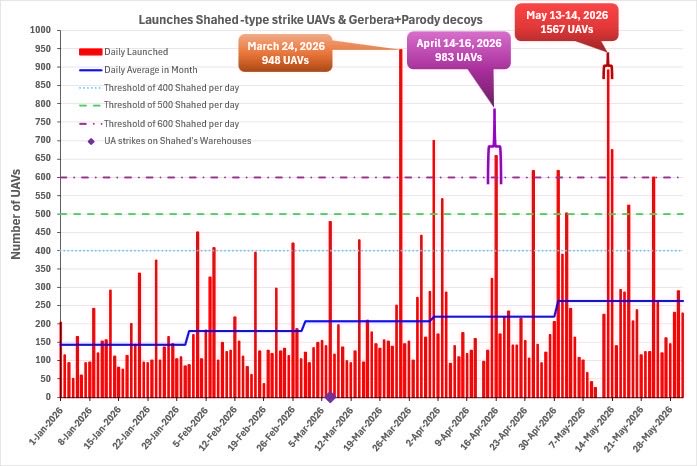
May 2026 marked a new peak in the scale of Russian Shahed-type UAV operations against Ukraine. According to Ukrainian Air Force reporting, over the course of the month, Russia launched a total of 8,161 Shahed-type UAVs (including decoys), of which an estimated 5,181 were Shahed/Geran strike UAVs produced at the Alabuga facility. The average launch rate reached 263 total UAVs (167 Shahed/Geran) daily, exceeding the previous records established in March and April 2026.
The most significant development was not simply the increase in launch volume. Despite record numbers of UAVs being employed, the effectiveness of the attacks continued to decline. The overall hit rate fell to approximately 6.65 percent of total Shahed-type launches and roughly 10.48 percent of estimated Shahed/Geran launches. These were among the lowest effectiveness levels observed since the large-scale expansion of Russian UAV operations began.
The growing role of interceptor UAVs helps explain the declining effectiveness of Russian attacks despite increasing launch volumes. The emergence of this capability represents one of the most important defensive adaptations of 2026. Ukrainian military observers reported that interceptor drones accounted for more than 40 percent of Shahed-type UAVs destroyed during some of the largest attacks late in the month.
The data suggest that Russia is increasingly compensating for declining strike efficiency through larger attack packages. This trend indicates that the campaign is designed not only to damage specific targets but also to impose sustained psychological pressure on the civilian population, disrupt economic activity, exhaust Ukrainian air-defense resources, and create favorable conditions for missile strikes.
Read the full analysis by @anokhin_i here: isis-online.org/isis-reports…
1
4
12
272,881
Jun 1
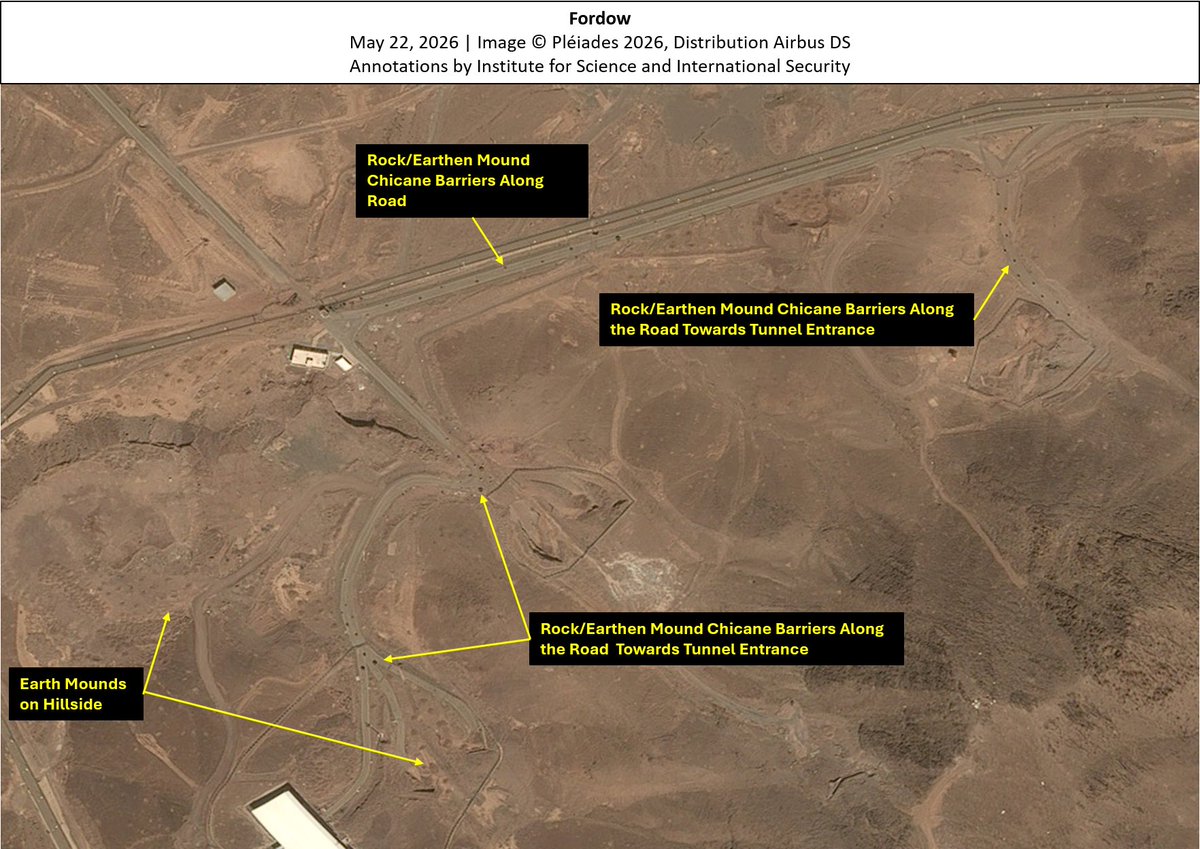
NEW passive defense measures taken at Fordow: Between May 10 and May 18th, Iran added passive defensive measures in the shape of earthen/rocky mounds and other objects on the roads leading to the tunnel entrances of the destroyed Fordow underground enrichment plant. The alternate placings of the piles/objects are very precise, which creates a series of chicanes, indicating they are not intended as obstruction, but a means to prevent rapid ingress and egress by any vehicles (i.e. hindering offensive forces once onsite). The placement indicates that Iranians still want access onsite for themselves, otherwise we would likely see berms all the way across the roads, as previously seen on the roads leading to the Esfahan tunnel entrances. The chicanes leading to the single eastern tunnel entrance may have only been temporary and removed again by May 26, although this needs to be confirmed with higher resolution imagery. This entrance was backfilled by Iran and hit by Israel in June 2025, with a crater, but no penetration hole visible above the tunnel entrance. All tunnel entrances appear to remain buried as of May 26.
24
60
6,901
Inst for Science retweeted

May 21
Thank you @DAVIDHALBRIGHT1 (@TheGoodISIS), Alexandra Bell (@BulletinAtomic) & @StaciePettyjohn (@CNASdc) for a conversation on the implications of the #NewSTART expiration and the state of rising global #proliferation☢️
📺Watch the full discussion: youtu.be/fjdgFrwpACI
1
1
1,701
Inst for Science retweeted
May 19
I wanted to share Igor Anokhin’s answers to questions from Business Insider about Russia’s Shahed drone attacks against Ukraine that point to the need for more work to defend against Shahded drones not only in Ukraine but the Gulf States as well.
The Business Insider report is here businessinsider.com/russia-d…
Igor‘s latest monthly Shahed drone tabulation is here isis-online.org/isis-reports…
1) What does the Shahed drone (UAV) data say about how Russia is changing the cadence of its drone strikes?
The main change is that Russia no longer relies exclusively on evening and nighttime waves of “Shahed”/“Gheran” drone attacks.
Since March–April 2026, Russia has increasingly employed repeated waves of attacks during nighttime, morning, daytime, and evening periods. This means the window for attacks is expanding from a few hours at night to prolonged cycles lasting about 24 hours or more.
The massive Shahed attack on May 13–14 is a prime example: Ukraine recorded 753 UAVs during the daytime attack on May 13 (over 892 UAVs in the previous 24 hours), followed by another combined nighttime strike involving 675 UAVs and 56 missiles on the night of May 14.
2) How many times has Russia engaged in prolonged windows for long-range drone strikes?
Based on my observations, all massive attacks typically include strikes over long distances. The most significant sustained periods of strikes in 2026 include:
March 24 — nearly 1,000 UAVs over 24 hours, including a nighttime combined strike and a large daytime wave of UAVs.
April 1 — over 700 UAVs over a 24-hour night-day cycle.
April 15–16 — an approximately 32-hour sustained cycle of combined attacks.
May 1–2 — repeated night and day waves of UAVs.
May 13–14 — the very large-scale example, when, according to reports, approximately 1,570 UAVs were deployed over two days, with the first attack cycle targeting exclusively western regions of Ukraine, and the main nighttime cycle targeting exclusively Kyiv and Kremenchuk.
Therefore, I would identify at least five major sustained windows for strikes in 2026.
3) What do you think is the purpose behind this shift?
The main goal is psychological pressure and economic terror: keeping Ukrainian cities on high alert for many hours, disrupting civilian life, and targeting energy and critical infrastructure.
To achieve this goal, Russia is attempting to overwhelm Ukraine’s multi-layered defense by combining strike UAVs of the “Shahed”/“Geran” type with UAVs of the “Gerbera,” “Italmas,” and “Harpy” types, as well as decoys.
It is also testing the coverage of Ukraine’s electronic warfare systems, the tactics of interceptor drones, and the response times of mobile fire groups.
Sustained pressure from UAVs, in turn, sets the stage for missile strikes, forcing Ukraine to expose its air defense positions or expend its interceptors.
4) Do you think we are going to see such prolonged windows become a more permanent fixture in the war? How can or should Ukraine respond?
I wouldn’t call this a fully established pattern yet, but it is clearly becoming a new operational model. At the same time, Russia’s expansion of Shahed/Geran drone production in Alabuga, combined with the wider use of decoys and other Shahed-type drones, makes such sustained attacks increasingly likely.
Ukraine must respond by further developing a multi-layered, cost-effective air defense system. This means more interceptor drones (Currently, about 45% of all downed UAVs are accounted for by interceptors. Today, for example, over 300 UAVs were shot down by STING interceptors.This is 20% of the total number of UAVs launched, excluding other companies (P1SUN, Merops, etc.).), more mobile fire teams, distributed electronic warfare systems, acoustic and visual detection networks, as well as faster data exchange between monitoring units, air defense units, and local response units.
Ukraine should reserve expensive missile interceptors for missiles and the most dangerous aerial threats, while using cheaper systems against “Shahed”-type drones and decoys.
1
6
14
3,296
May 18
AVAILABLE NOW - Our analysis of the Fast 16 Malware: Fast 16 Malware Aimed at Undermining Proliferant State Nuclear Weapons Programs, Iran was a Credible Target
We performed this analysis in collaboration with Symantec’s Threat Hunter Team and Kim Zetter, with whom we had collaborated years ago on the Stuxnet malware.
Our collaboration with @symantec and @KimZetter
developed after Sentinel One publicly revealed the Fast16 malware, which is dated to about 2005 and was a multi-year sustained operation. The malware looks to be targeting a nuclear weapon program’s hydrodynamic calculation group working on implosion systems using weapon-grade uranium as the nuclear explosive material.
Fast 16 targets the LS DYNA and AUTODYN software and specifically manipulates the values during simulations of explosively driven compressions of very dense materials. These software packages are very useful and capable to model the whole hydrodynamic process starting with the detonation of the high explosives, the development of a shock wave accelerating a high density metal flyer plate that strikes the core with tremendous force, causing compression of a central dense core to very high pressures and temperatures, exactly the hydrodynamic process in an implosion-type, solid core, levitated design, common to many early nuclear weapons programs. The software packages enable the solution and characterization of a very difficult problem involving full transient physics of matter under extreme compression. It turns an extremely fast, and opaque physical process into a fully resolved, designable system, with an exact geometry, driver, and timing that produces the pressure, density, and uniformity desired.
Although the malware looks first for specific high explosive equation of state (EOS) packages in either LS DYNA or AUTODYN, that seems just to be a first step in locating a worthwhile target, or a way to narrow its search. The ultimate target is a material being compressed that is far denser than the high explosive materials and far denser than the metals commonly studied in commercial applications of LS DYNA and AUTODYN.
The target metal appears to be uranium. The software lists a value of 19, where 19 g/cc is the density of solid uranium at atmospheric pressure. The manipulation of the simulation output was to start when the density of the compressed material would reach 30, which again indicates uranium. The density of 30 g/cc is the point at which the lattice structure of solid uranium is soon to collapse, and the material starts to liquify under shock. A density of 30 g/cc is further assessed to be a compression within reach of an early nuclear implosion weapons program. This indicates that a core of uranium is the target and shows the malware starting to act in a particularly important region where the uranium is starting to undergo a phase change from solid to liquid. This region is particularly important to a nuclear weapons team that wants to understand how to increase the uranium’s density, and ultimately help achieve a higher explosive yield, but also a region that is very difficult to study experimentally. The accuracy of predicted pressures, densities, and phase states becomes increasingly uncertain at high compression because of limitations in available uranium equation-of-state data and the complexity of its phase behavior, leaving the designer more dependent on the model rather than experimental data.
Target Iran?
While we cannot exclude other target countries working on nuclear weapons in the early 2000s, such as North Korea or possibly Syria, the timing, the access required for creating the faulty driver memory, and the focus on uranium point to Iran’s nuclear weapons efforts being the target. It is also known from a variety of academic publications that both LS DYNA and AUTODYN were being used in Iran in this time period.
In the period of 2003 to 2005, Western intelligence agencies believed that Iran had an active nuclear weapons program concentrated on building warheads for ballistic missile delivery, with active calculation and simulation teams modeling the nuclear explosion. Although Western intelligence was unaware in 2005 that Iran had ended the program, codenamed the Amad Plan, dedicated to building five nuclear weapons as fast as possible, Iran instituted a new nuclear weapons program on a reduced scale which was likely more dependent on computer calculations and simulations. In either case, malware targeting the results of these complex calculations characterizing a region of high pressure and density posed a serious threat to the program.
Despite missing Amad’s shutdown, Western intelligence in 2005 had penetrated Iran’s nuclear weapons program in multiple ways, and within a few years afterwards learned that the Amad Plan had shut down. The penetration could have been sufficient that someone could have inserted the malware into the internal computer networks used by the nuclear weapons teams, a requirement since the malware does not transit via the internet.
Iran’s nuclear weapons program in 2003, at the end of Amad, was suffering problems in its nuclear weapons design. The 2018 seizure by Israel of the Nuclear Archive, a detailed library of the Amad Plan, contains discussions about the state of the nuclear weapons effort as of late 2003. In summing up the challenges that remained when the Amad Plan was ending, the leaders of the program met and noted difficulties in the design section, defined as calculations and analysis, production, and test. They cited the lack of scientific knowledge of design, where the main problem is the reduction in the scientific studies of the project. The head of the program concluded that the design team had to specify a set of questions so that these questions become the instructions for other teams such as production and test. These problems likely persisted into the time when the malware was active, and the reorganized nuclear weapons team was running computer codes.
One further indication of Iran’s on-going multi-year efforts to conduct satisfactory hydrodynamic simulations is that the IAEA reported that Iran in 2008 and 2009 was modeling spherical geometries consisting of a weapon-grade uranium core subject to shock compression.
If Iran was the target, Iran’s nuclear weapons program would have had a hard time doubling the core density in 2005, likely also today. Achieving such high densities in uranium poses several challenges in a single HE-flyer plate-solid core system. Moreover, in 2003, Iran was looking to achieve only an explosive yield of 10 kilotons, further suggesting that the nuclear weapons team was not working to achieve such high densities. This would suggest that the actual densities being achieved were less than double and closer to 31 or 33 grams per cc, close to the activation density of the malware and after the solid would undergo a phase change to a liquid.
Action of the Malware
The Symantec threat hunter team identified multiple mechanisms, called by them as A, B, and C, in the malware sample that was detected and analyzed. Mechanism A was judged as naive and not further assessed. B appears to target LS DYNA, and C targets AUTODYN.
Beyond the malware authors’ apparent confidence in the worthiness of the effort, thus far, it is not possible to fully establish the malware’s impact on a nuclear weapons program. Simply put, both mechanisms B and C manipulated Equation of State results for the compressed weapon-grade uranium, or its stand-in natural uranium, metal, and specifically lowered the calculated pressure experienced by the uranium by a factor determined by the actual pressure being calculated by the EOS program.
If this or these values are lowered too much, the inconsistencies in the resulting physics should be noticeable or discoverable by the user. But if the change is less, lowering the results artificially, it may not be noticed by the user of the software. If pressure is the output value lowered, the manipulated results would indicate to the user that the uranium is “softer” and more easily compressed than it is in reality. However, it would also indicate the shock wave propagating through the material, intended to sustain super criticality throughout the core as well as initiating the neutron source at the center, is weaker than expected and the phase change to melting may appear to onset earlier or later or the dense-fluid region look broader or narrower. The accuracy of predicted pressures, densities, and phase states becomes increasingly uncertain at high compression because of limitations in available uranium equation-of-state data and the complexity of its phase behavior. Thus, a misperceived result of this region may be more believed because of these uncertainties, particularly because of the difficulty of testing experimentally in this density region.
The impact of a malware’s change in the pressure in the region above 30 grams per cc can complicate efforts to improve the design and even send programs down wrong paths. The calculational team may recommend more force on the core or more efficient transfer of force to increase the compression. This may put pressure on manufacturing teams to make and test new components to enable these changes. This could complicate miniaturization efforts, a critical concern to ensure the warhead fits into a ballistic missile re-entry vehicle. The effect could be to waste time, resources, and lower the overall morale of the program. If “fixes” are made and the program runs again, unsatisfactory values will be generated anew.
If the results are accepted as valid and no further work is done, then the nuclear weapons program ends with a mistaken view of the performance of the imploding core, leading to potential distortions when the code is combined with neutronic codes. The sum total may result in a system that will not work, or will underperform, when detonated.
Thus, the results would undermine confidence in the overall workability of a simulated design, and if the scaling in the pressure went unnoticed, could potentially lead to structural design changes in the components of the weapon to rectify the perceived problems. In any case, the malware appears intended to disrupt the development and construction of a nuclear weapon.
Links to the analysis on our website, Symantec, and Kim Zetter's report here: isis-online.org/isis-reports…; security.com/blog-post/fast1…; zetter-zeroday.com/experts-c…
6
17
3,098
Inst for Science retweeted
May 16
I want to post our analysis first on X (later on our website) on the Fast 16 malware that was done in parallel to analysis by @KimZetter and @symantec
“Fast 16 Malware Aimed at Undermining Proliferant State Nuclear Weapons Programs, Iran was a Credible Target” by the Institute for Science and International Security
Highly interesting analysis that Kim Zetter and the Symantec’s Threat Hunter Team were able to develop after Sentinel One publicly revealed the Fast16 malware, which is dated to about 2005 and was a multi-year sustained operation. The malware looks to be targeting a nuclear weapon program’s hydrodynamic calculation group working on implosion systems using weapon-grade uranium as the nuclear explosive material.
Fast 16 targets the LS DYNA and AUTODYN software and specifically manipulates the values during simulations of explosively driven compressions of very dense materials. These software packages are very useful and capable to model the whole hydrodynamic process starting with the detonation of the high explosives, the development of a shock wave accelerating a high density metal flyer plate that strikes the core with tremendous force, causing compression of a central dense core to very high pressures and temperatures, exactly the hydrodynamic process in an implosion-type, solid core, levitated design, common to many early nuclear weapons programs. The software packages enable the solution and characterization of a very difficult problem involving full transient physics of matter under extreme compression. It turns an extremely fast, and opaque physical process into a fully resolved, designable system, with an exact geometry, driver, and timing that produces the pressure, density, and uniformity desired.
Although the malware looks first for specific high explosive equation of state (EOS) packages in either LS DYNA or AUTODYN, that seems just to be a first step in locating a worthwhile target, or a way to narrow its search. The ultimate target is a material being compressed that is far denser than the high explosive materials and far denser than the metals commonly studied in commercial applications of LS DYNA and AUTODYN.
The target metal appears to be uranium. The software lists a value of 19, where 19 g/cc is the density of solid uranium at atmospheric pressure. The manipulation of the simulation output was to start when the density of the compressed material would reach 30, which again indicates uranium. The density of 30 g/cc is the point at which the lattice structure of solid uranium is soon to collapse, and the material starts to liquify under shock. A density of 30 g/cc is further assessed to be a compression within reach of an early nuclear implosion weapons program. This indicates that a core of uranium is the target and shows the malware starting to act in a particularly important region where the uranium is starting to undergo a phase change from solid to liquid. This region is particularly important to a nuclear weapons team that wants to understand how to increase the uranium’s density, and ultimately help achieve a higher explosive yield, but also a region that is very difficult to study experimentally. The accuracy of predicted pressures, densities, and phase states becomes increasingly uncertain at high compression because of limitations in available uranium equation-of-state data and the complexity of its phase behavior, leaving the designer more dependent on the model rather than experimental data.
Target Iran?
While we cannot exclude other target countries working on nuclear weapons in the early 2000s, such as North Korea or possibly Syria, the timing, the access required for creating the faulty driver memory, and the focus on uranium point to Iran’s nuclear weapons efforts being the target. It is also known from a variety of academic publications that both LS DYNA and AUTODYN were being used in Iran in this time period.
In the period of 2003 to 2005, Western intelligence agencies believed that Iran had an active nuclear weapons program concentrated on building warheads for ballistic missile delivery, with active calculation and simulation teams modeling the nuclear explosion. Although Western intelligence was unaware in 2005 that Iran had ended the program, codenamed the Amad Plan, dedicated to building five nuclear weapons as fast as possible, Iran instituted a new nuclear weapons program on a reduced scale which was likely more dependent on computer calculations and simulations. In either case, malware targeting the results of these complex calculations characterizing a region of high pressure and density posed a serious threat to the program.
Despite missing Amad’s shutdown, Western intelligence in 2005 had penetrated Iran’s nuclear weapons program in multiple ways, and within a few years afterwards learned that the Amad Plan had shut down. The penetration could have been sufficient that someone could have inserted the malware into the internal computer networks used by the nuclear weapons teams, a requirement since the malware does not transit via the internet.
Iran’s nuclear weapons program in 2003, at the end of Amad, was suffering problems in its nuclear weapons design. The 2018 seizure by Israel of the Nuclear Archive, a detailed library of the Amad Plan, contains discussions about the state of the nuclear weapons effort as of late 2003. In summing up the challenges that remained when the Amad Plan was ending, the leaders of the program met and noted difficulties in the design section, defined as calculations and analysis, production, and test. They cited the lack of scientific knowledge of design, where the main problem is the reduction in the scientific studies of the project. The head of the program concluded that the design team had to specify a set of questions so that these questions become the instructions for other teams such as production and test. These problems likely persisted into the time when the malware was active, and the reorganized nuclear weapons team was running computer codes.
One further indication of Iran’s on-going multi-year efforts to conduct satisfactory hydrodynamic simulations is that the IAEA reported that Iran in 2008 and 2009 was modeling spherical geometries consisting of a weapon-grade uranium core subject to shock compression.
If Iran was the target, Iran’s nuclear weapons program would have had a hard time doubling the core density in 2005, likely also today. Achieving such high densities in uranium poses several challenges in a single HE-flyer plate-solid core system. Moreover, in 2003, Iran was looking to achieve only an explosive yield of 10 kilotons, further suggesting that the nuclear weapons team was not working to achieve such high densities. This would suggest that the actual densities being achieved were less than double and closer to 31 or 33 grams per cc, close to the activation density of the malware and after the solid would undergo a phase change to a liquid.
Action of the Malware
The Symantec threat hunter team identified multiple mechanisms, called by them as A, B, and C, in the malware sample that was detected and analyzed. Mechanism A was judged as naive and not further assessed. B appears to target LS DYNA, and C targets AUTODYN.
Beyond the malware authors’ apparent confidence in the worthiness of the effort, thus far, it is not possible to fully establish the malware’s impact on a nuclear weapons program. Simply put, both mechanisms B and C manipulated Equation of State results for the compressed weapon-grade uranium, or its stand-in natural uranium, metal, and specifically lowered the calculated pressure experienced by the uranium by a factor determined by the actual pressure being calculated by the EOS program.
If this or these values are lowered too much, the inconsistencies in the resulting physics should be noticeable or discoverable by the user. But if the change is less, lowering the results artificially, it may not be noticed by the user of the software. If pressure is the output value lowered, the manipulated results would indicate to the user that the uranium is “softer” and more easily compressed than it is in reality. However, it would also indicate the shock wave propagating through the material, intended to sustain super criticality throughout the core as well as initiating the neutron source at the center, is weaker than expected and the phase change to melting may appear to onset earlier or later or the dense-fluid region look broader or narrower. The accuracy of predicted pressures, densities, and phase states becomes increasingly uncertain at high compression because of limitations in available uranium equation-of-state data and the complexity of its phase behavior. Thus, a misperceived result of this region may be more believed because of these uncertainties, particularly because of the difficulty of testing experimentally in this density region.
The impact of a malware’s change in the pressure in the region above 30 grams per cc can complicate efforts to improve the design and even send programs down wrong paths. The calculational team may recommend more force on the core or more efficient transfer of force to increase the compression. This may put pressure on manufacturing teams to make and test new components to enable these changes. This could complicate miniaturization efforts, a critical concern to ensure the warhead fits into a ballistic missile re-entry vehicle. The effect could be to waste time, resources, and lower the overall morale of the program. If “fixes” are made and the program runs again, unsatisfactory values will be generated anew.
If the results are accepted as valid and no further work is done, then the nuclear weapons program ends with a mistaken view of the performance of the imploding core, leading to potential distortions when the code is combined with neutronic codes. The sum total may result in a system that will not work, or will underperform, when detonated.
Thus, the results would undermine confidence in the overall workability of a simulated design, and if the scaling in the pressure went unnoticed, could potentially lead to structural design changes in the components of the weapon to rectify the perceived problems. In any case, the malware appears intended to disrupt the development and construction of a nuclear weapon.
6
29
65
72,675
May 15
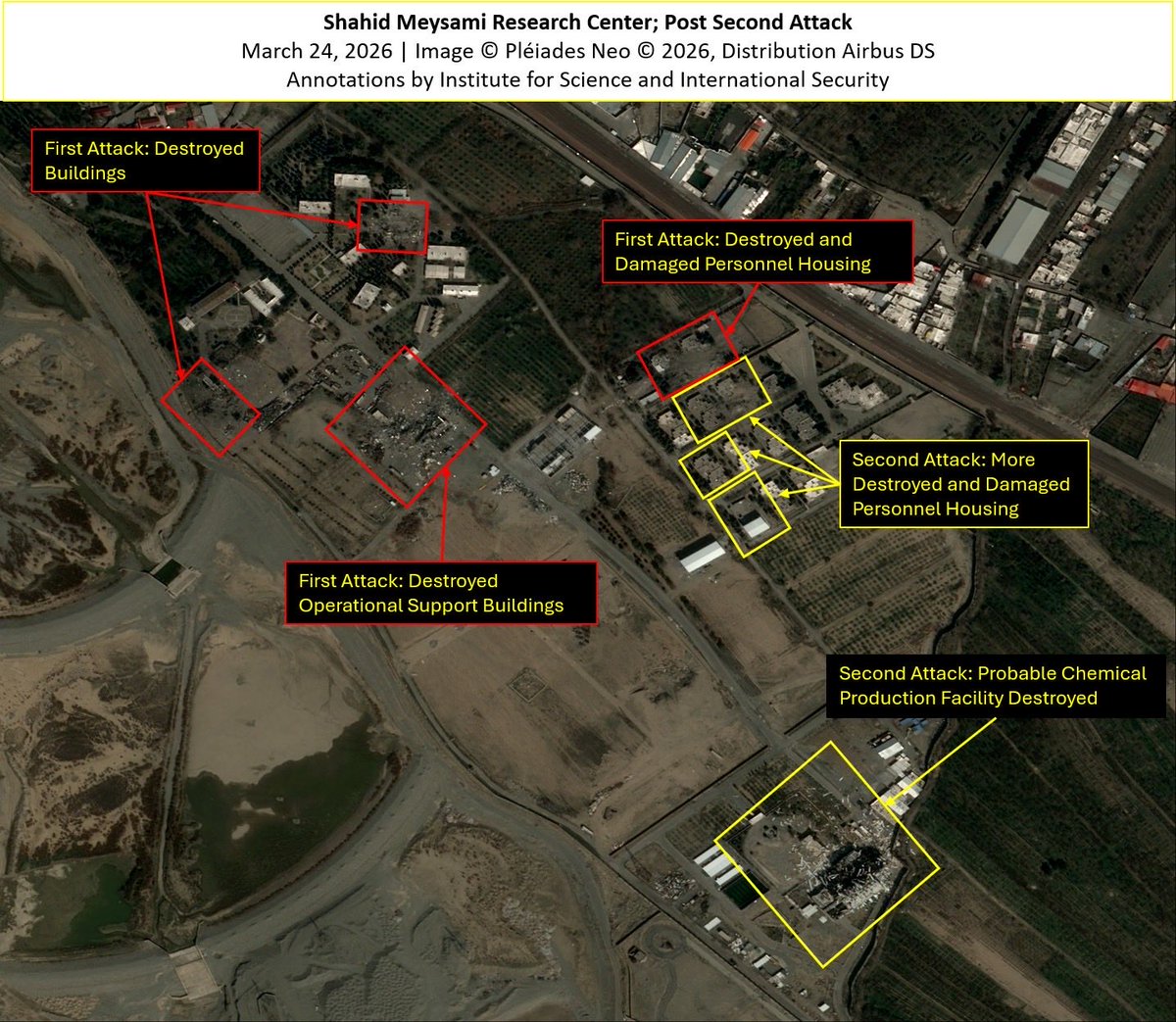
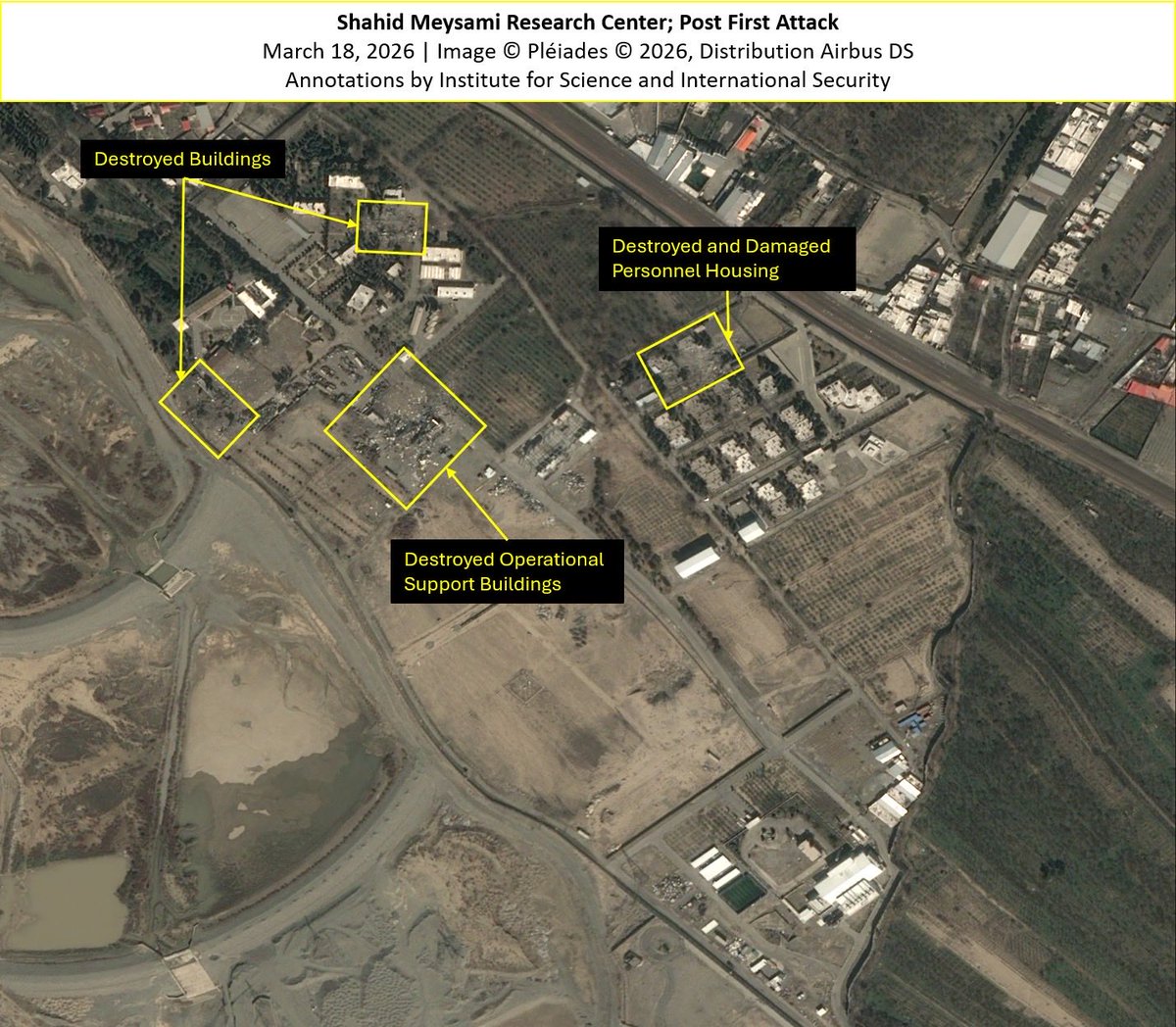
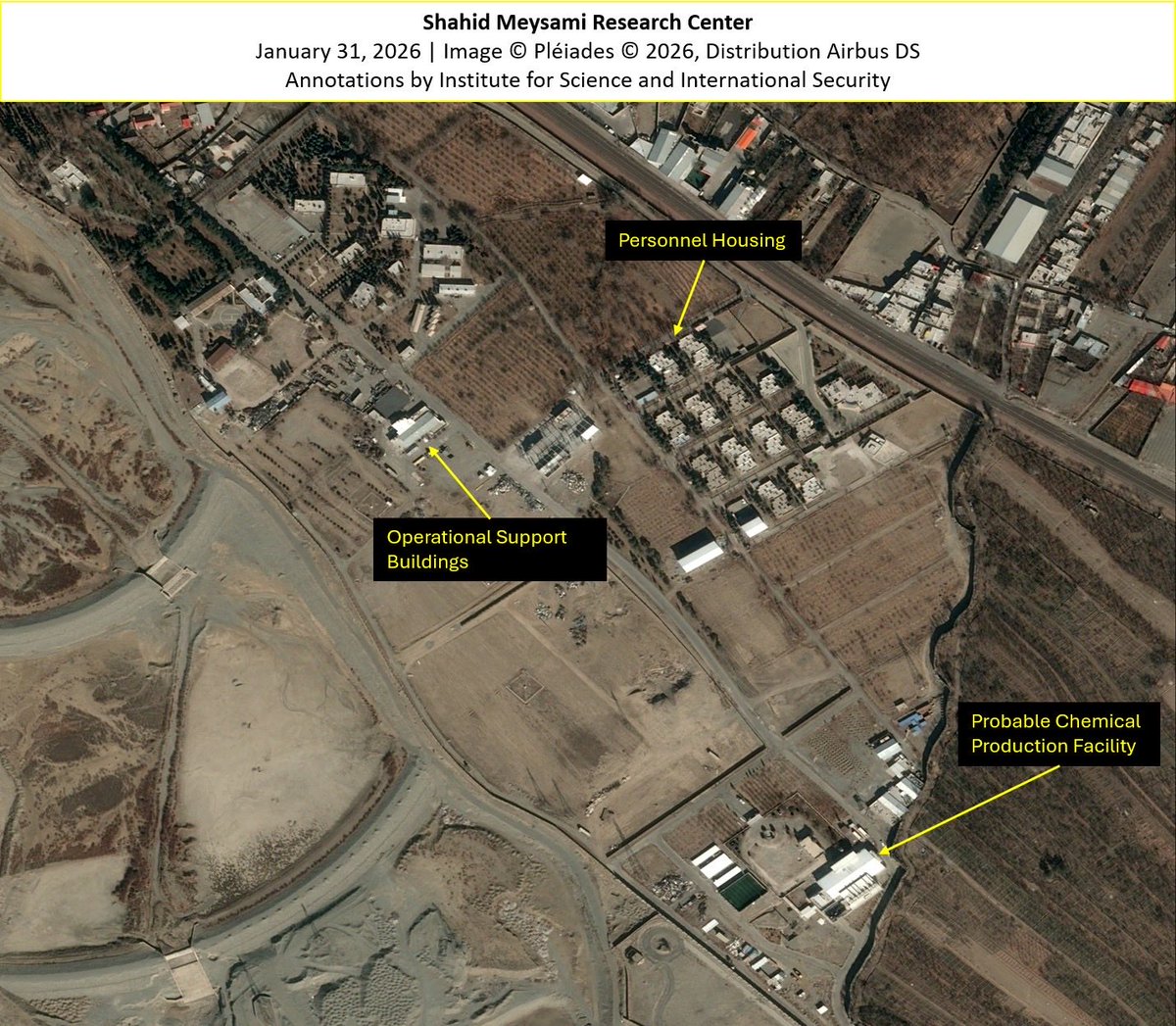
Satellite imagery shows that the Shahid Meysami (or Meisami) research center, located west of Tehran, near Karaj, was attacked twice in March 2026. The site was already heavily attacked in June 2025, tied by Israel to Iran’s chemical and biological weapons development, but also described as holding nuclear weapons related equipment. Imagery from March 14, 2026, shows that several operational support buildings and nearby high-level personnel housing were targeted in the first March 2026 attack. Then, on or before March 24, 2026, imagery shows that a second attack occurred, targeting and destroying a probable chemical production facility in the southern quadrant of the complex as well as several more personnel housing buildings.
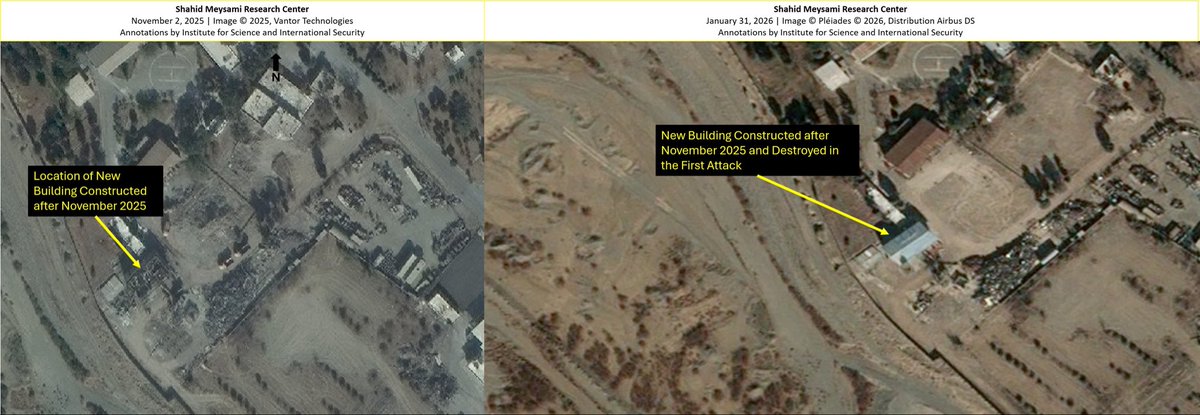
No new information on why the site was attacked was released by the IDF, however, recent activity at the site could be one reason. Following the June attacks, we identified significant cleanup and clearing operations at several of the destroyed or damaged buildings, constituting salvaging as a possible prelude to reconstruction. Indeed, a small building that was destroyed in March 2026 was only constructed in recent months, after November 2025, at a location of a building destroyed in June.
In a September 2025 report to the UN Security Council, Israel stated, “The site contained a large amount of metallurgical equipment that served the Advanced Materials Centre, under the Shahid Meithami group, the chemistry group of SPND. This equipment can be used, with modifications, for the metallurgy process for fissile core fabrication.” Additionally, the report states, that the Shahid Meysami site "was one of the central sites in the Iranian Chemical and Biological Weapons program, used for the research and development of chemical materials based on pharmaceuticals."
Link to report: isis-online.org/isis-reports…
1
33
69
12,029
May 14
NEW Policy Brief: The Iran Nuclear Deal the World Deserves Takes Us Back to the Basics
The current nuclear negotiations on Iran need to reflect Iran’s requirement to demonstrate it does not have a nuclear weapons program and secondarily on eliminating the means to enrich uranium and the existing stocks of enriched uranium. The goal should be reestablishing the norms and obligations of nuclear nonproliferation on Iran, not further perpetuating additional exemptions to them or creating new ones.
Too often, nuclear negotiations with Iran have become too bogged down and, in essence, lose the forest for the trees. That focus on individual details overwhelmingly favors Iran. Detailed proposals about nuclear limits and step by step plans are intended to wear U.S. negotiators down and have them get lost in the details of what sanctions are removed when and what nuclear capability limits are sufficient. Reinventing the wheel of nonproliferation limits and monitoring and carving a special, unusual nonproliferation status for Iran is what led us here in the first place. Focusing on limits on nuclear capabilities, while largely deemphasizing the main cause of concern, has got us into the present debacle.
Instead, the United States should focus first on obtaining and verifying Iranian commitments not to build nuclear weapons. That includes Iran providing the IAEA an accurate and complete nuclear declaration and allowing full access to all relevant sites and persons. Iran has never taken the steps necessary to determine compliance with its obligations under the Nuclear Non-Proliferation Treaty (NPT). This effort was essentially abandoned in the Joint Comprehensive Plan of Action (JCPOA). Iran must acknowledge and end upfront its work on nuclear weapons prior to any sanction’s relief. Both Iraq and South Africa did so, the former through a tough cease fire agreement in 1991 and the latter voluntarily. Iran should choose the latter to avoid the former. And that should be the choice offered to Iran.
The status quo favors the United States, with Iran’s ability to make nuclear weapons severely degraded by the war, and its stocks of enriched uranium bottled up in sealed tunnel complexes, easy to monitor from above.
This process will also satisfy current UN Security Council demands and IAEA Board of Governors resolutions on Iran, opening the door for sanctions relief, conditional on the final outcome rather than negotiated to be a step-for-step reward to keep Iran engaged in the process. After all, the Islamic regime is still in power, and it neither wants nor needs all sanctions removed, it needs a lifeline, and it otherwise could decide it got enough at any point. Preserving its nuclear weaponization infrastructure and personnel and its ability to make gas centrifuges has been key to that strategy. The stocks of enriched uranium have taken on special meaning in the present context but in the end, Iran will move to protect the former capabilities rather than the mere products of those capabilities.
To start, Iran would have to provide a complete declaration and access, and dismantle, destroy or render harmless key nuclear weaponization equipment and materials, followed by the IAEA conducting an initial verification of the declaration and dismantlement. The initial verification can be accomplished relatively quickly, and the following verification would be more thorough to ensure the absence of undeclared materials or activities.
The first phase can occur in a matter of months, if Iran cooperates, as South Africa showed. If Iran refuses to cooperate or only partially cooperates, an infinite amount of time is not enough, and no rewards would be given.
The targets Israel and the United States destroyed demonstrate considerable knowledge about Iran’s nuclear weaponization program, which if shared can help the IAEA’s effort and speed it up. In the two wars, Israel attacked and destroyed nine to twelve sites involved in developing and building nuclear weapons. Many of these sites contained elements added only in recent months or years. At least one site held a post-June reconstituted nuclear weaponization capability that Israel somehow discovered. In addition, Israel killed over 20 “oppenheimers” and “groves” essential to a functioning nuclear weaponization effort, eliminating important know-how in the process.
The initial phase of coming into compliance with the NPT would include a full declaration of the locations of the stocks of enriched uranium and go further, mandating their removal or down blending. Stocks of natural uranium should be sold internationally, as unneeded.
In parallel, specific limits on the fuel cycle should be negotiated. The soundest position is that Iran commits to a pledge of no enrichment and no reprocessing for an extended period of time. Iran has no reason beyond building nuclear weapons to do either. Iran has not adhered to the NPT and thus cannot claim NPT privileges. Since Iran has not met the basic demands of the NPT, it does not deserve enrichment or reprocessing. Iranian enrichment and its means of production have been destroyed. The war ended enrichment in Iran, something that no nuclear agreement had accomplished. The end to enrichment is therefore a given, and its continuation does not deserve sanctions relief. It has no ability to reprocess and all its plutonium is in irradiated fuel under international monitoring at the Bushehr nuclear power reactor and unlikely to be diverted.
A compromise on enrichment is possible, if Iran demonstrates, concretely and verifiably, it has exclusively a peaceful nuclear program. But that compromise needs to contain a suspension long enough to matter, and any restart of Iran’s centrifuge program would require the satisfaction of a set of criteria. The most fundamental one is a determination that the program would be economically and commercially viable.
How long is enough? A 20-year time period is often discussed. It is critical that a 20-year suspension does not mean a 20-year preparation for rebuilding; the condition of a spring back was a deep flaw at the heart of the JCPOA. There must be a halt to the current centrifuge program for its entire duration. It must mean, at the beginning of the 20 years, redirecting all employees in the centrifuge program to other areas of work, and dismantling key components and equipment of the centrifuge program under international supervision. This is critical because without any halt, it would likely take Iran more than a decade to rebuild its enrichment capacity anyway, if not longer, given the current sanctions regime and the immense amount of imported, sensitive equipment and materials at the heart of its enrichment industry. A new agreement should not legitimize the reconstruction of a centrifuge program during this suspension, one making no economic sense while posing a grave proliferation risk. When the risk is gone and the economics makes sense, then Iran can recreate a centrifuge program.
Significant sanctions relief would follow the successful completion of the initial verification of the end of Iran’s nuclear weaponization program, the verified dismantlement of its centrifuge program, and removal or downblending of enriched uranium stocks to natural uranium. More sanctions relief would follow the successful completion of the second, more thorough IAEA verification.
Unfortunately, many are willing to make Iran’s case. U.S. negotiators unable and unwilling to discuss details are dismissed as incompetent, although they are correct to hold the line on the latter, and the former helps them with it. Many others continue to say that asking Iran to give up enrichment is a lot, and asking for a lot means the war will continue, when in fact, the war has destroyed so much. What used to be a lot is now a little.
And if Iran moves to rebuild a small enrichment plant sufficient to further enrich its 60 percent to 90 percent enriched uranium, then it is clearly moving to build nuclear weapons and inviting a resumption of military conflict, while likely still needing well over a year to build a nuclear weapon out of the weapon-grade uranium.
So, there is time to accomplish a more fundamental and pressing goal, a simple and straightforward one, with no complicated sequencing, establishing verifiably that Iran is committed to a peaceful nuclear program and, in parallel, to establish a cooling off period of at least 20 years where Iran continues its halt across its entire enrichment program. This approach, focused fundamentally on NPT compliance, is more amenable to gathering international support and justifying further U.S. actions.
isis-online.org/isis-reports…
2
8
15
158,178
May 7
NEW: Comprehensive Analysis of Iranian Nuclear Facilities Targeted During the Recent War, the Second Phase of the Iran War
Today we released a comprehensive report detailing and providing high-resolution satellite imagery of the nuclear related facilities that Israel and the United States targeted and destroyed during the Iran war that lasted from February 28 to a ceasefire on April 7/8, 2026. The Institute could identify at least six nuclear sites that were attacked. Three other sites that were attacked could be nuclear-related, but there is not enough information to be certain. In total, six to nine sites were recently attacked that were nuclear related.
The Israeli priority in the second phase of the war appears to have been more on further degrading Iran’s ability to make the nuclear weapon itself, a process called nuclear weaponization. Some of these targeted weaponization sites were revealed publicly for the first time, shedding new light onto the extent of Iran's nuclear weapons related work. Of the six to nine sites mentioned above, four to seven of them, or almost all of them, were directly related to making the nuclear weapon itself or possibly related in that way. A total of five nuclear weaponization-related sites were attacked in June 2025. In both phases of the war, a grand total of nine to twelve sites involved in developing and building nuclear weapons were targeted.
Attacks in phase two have further set back Iran’s ability to make nuclear weapons. Recent media reports of the U.S. intelligence community finding that the second phase of the war did not set back timelines for Iran to build nuclear weapons do not accord with the visible damage of nuclear weaponization facilities and require both more explanation and scrutiny.
The attacks deserve credit for significantly increasing both the time needed to finish a nuclear weapon and the chance of failure if tried. While the new Iranian regime is widely perceived as more motivated to decide to make nuclear weapons, its means to do so are severely degraded as is its confidence in trying. While before the June 2025 war Iran could have broken out and built a non-missile deliverable nuclear weapon with almost 100 percent certainty in less than six months, it will face a much more difficult struggle towards success if it tries in the coming months, and the probability of succeeding, whether it be in nine months, one year, or two years, is now much less technically certain, and significantly less than 100 percent. That real risk of failing to successfully build a nuclear weapon may be a deterrent against deciding to try.
Read the full imagery report here: isis-online.org/isis-reports…
2
18
33
13,601
Inst for Science retweeted

May 6
Clip: How Difficult It Is To Develop Nuclear Weapons?
Taken from The Nuclear Show #011 w/ @DAVIDHALBRIGHT1
1
8
13
7,908
May 6
IRAN NUCLEAR UPDATE: Possible NEW Passive Defensive Measures Noted at Pickaxe Mountain
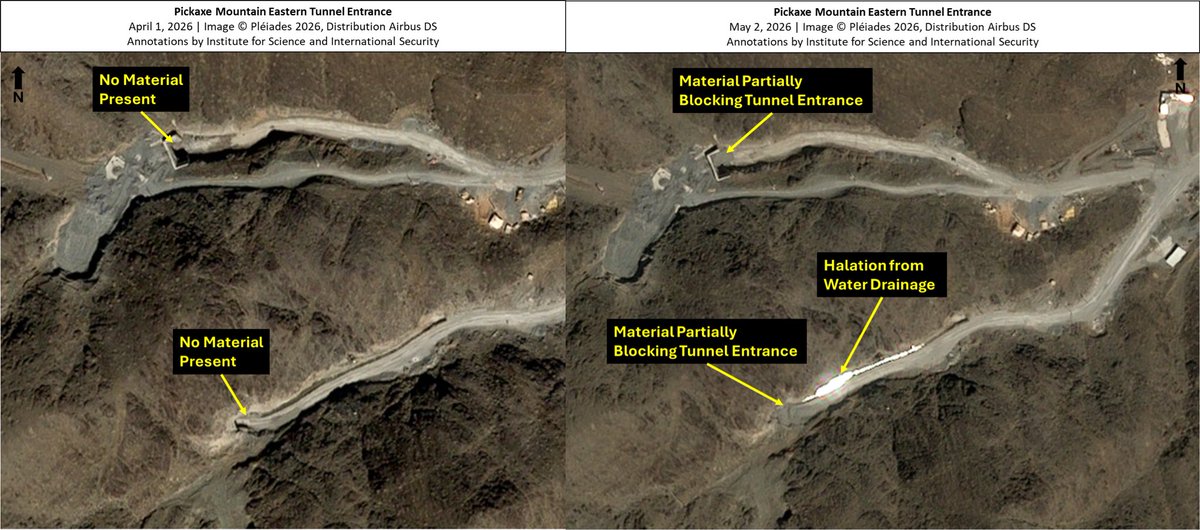
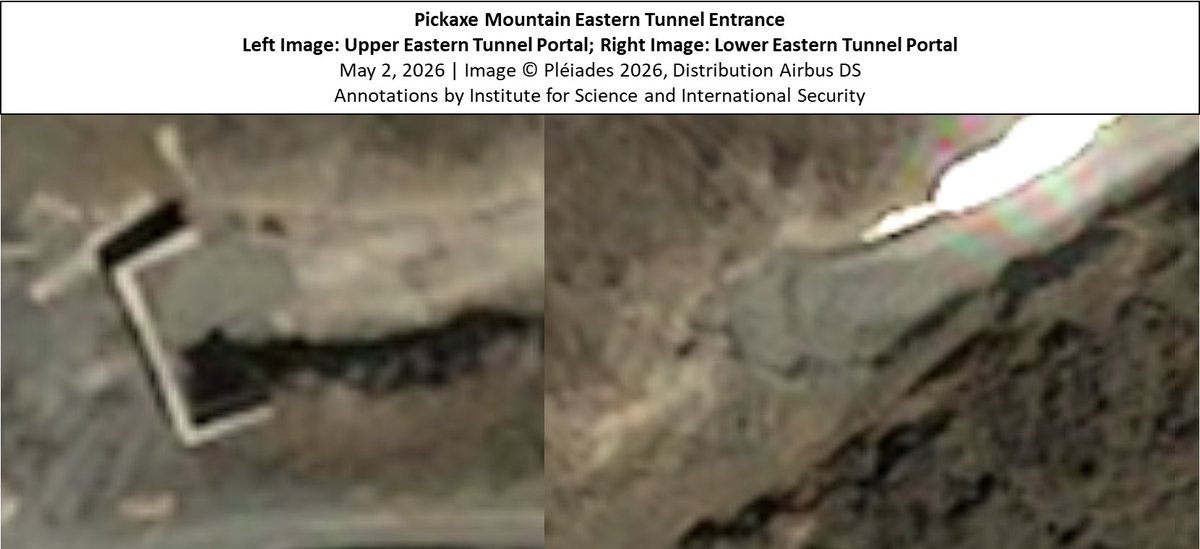
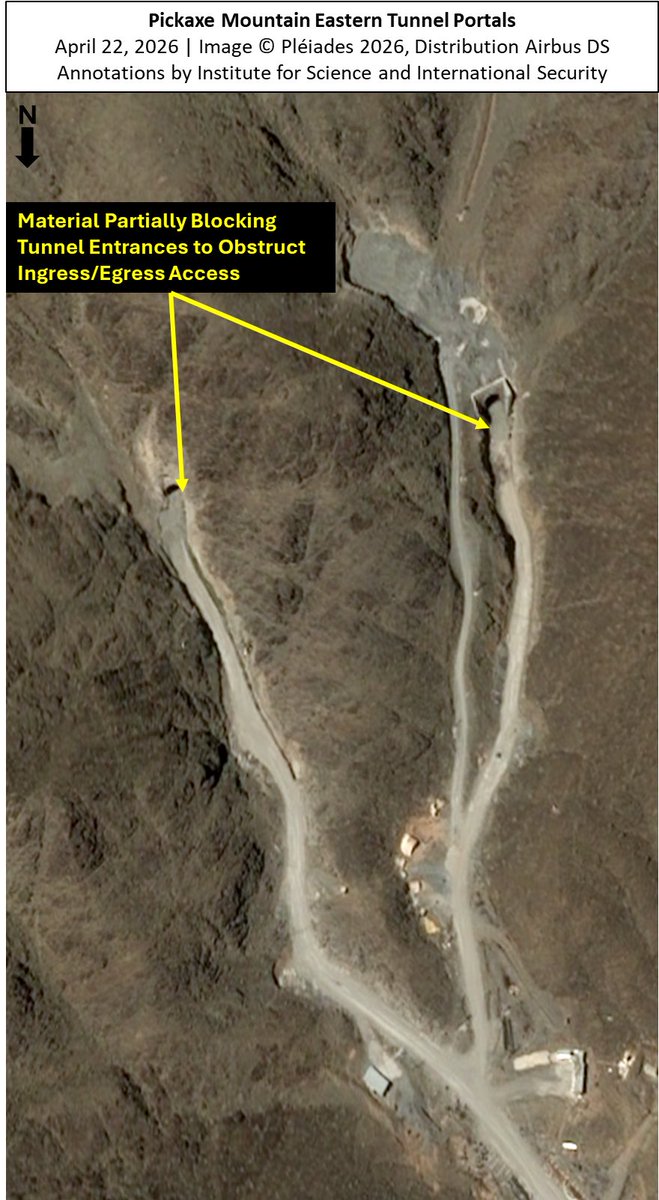
Based upon newly available satellite imagery of the Pickaxe Mountain underground complex, just south of the Natanz Nuclear Complex, it appears that as early as April 22nd, the two eastern tunnel portals have been partially blocked by grey earthen material used to prevent vehicle access to both portals. On April 1, 2026, the portal entrances were clear and unobstructed. Unlike the situation at both the Fordow and Esfahan tunnel entrances, this material does not provide complete tunnel entrance obscuration at either portal. Nonetheless, this material would appear to be sufficient to significantly hinder rapid ingress/egress by vehicles and would require the use of heavy earth moving equipment to gain such access and clear an unobstructed path inside. At present, we do not yet see evidence of such a blockage having been undertaken at the two western tunnel portals. This activity raises significant questions as this is a deeply buried tunnel complex that could be used to protect valuable equipment or materials. To note, earlier in the year, we observed how the old tunnel portals to a complex dating back to 2007 at Pickaxe mountain were buried and hardened with concrete, which suggests that something may have been moved into those tunnels.
43
99
19,005