
Joined April 2013
- Tweets 14,391
- Following 679
- Followers 7,281
- Likes 26,920
493 Photos and videos







Feb 15
Most of my 20s, I spent Valentine's Day pretending I didn't care.
I was alone while couples celebrated.
I felt their eyes on me.
The guy with no one.
Ashamed of what that said about me.
The sadness was there.
I just wouldn't let myself feel it.
Suppressed it.
Acted indifferent.
Told myself I was fine.
Yesterday, I didn't celebrate either.
Both our toddler and newborn were sick.
Crying all day.
Couldn't sleep.
My wife and I had maybe 30 minutes together at the end of the day.
Nothing about the day was romantic.
Yet I was OK.
Not just OK as in "not miserable."
Back then, getting a partner felt like the solution.
And in a way it was.
The pain went away when I finally got my first girlfriend.
But most people with partners aren't happy on Valentine's Day.
They're just not lonely.
Looking back, that’s what I felt.
The want got satisfied.
But it didn't get let go of.
Happiness isn't the absence of pain.
It's not needing the day to go differently than it does.
That shift isn't about finding the right person.
You don't have to stop feeling lonely.
You have to stop fighting it.
And that's usually when love actually has room to find you.
3
7
448
Feb 12
Took the longest break from X.
Posting for the algorithm isn't the same as posting for value.
Back with more intention.
4
15
373
Jan 26
"Just do it" works when the obstacle is external.
It fails when the obstacle is your nervous system convinced that action = danger.
You can't willpower your way through trauma responses.
You have to be with the feeling you've been running from.
4
1
12
362
Jan 23
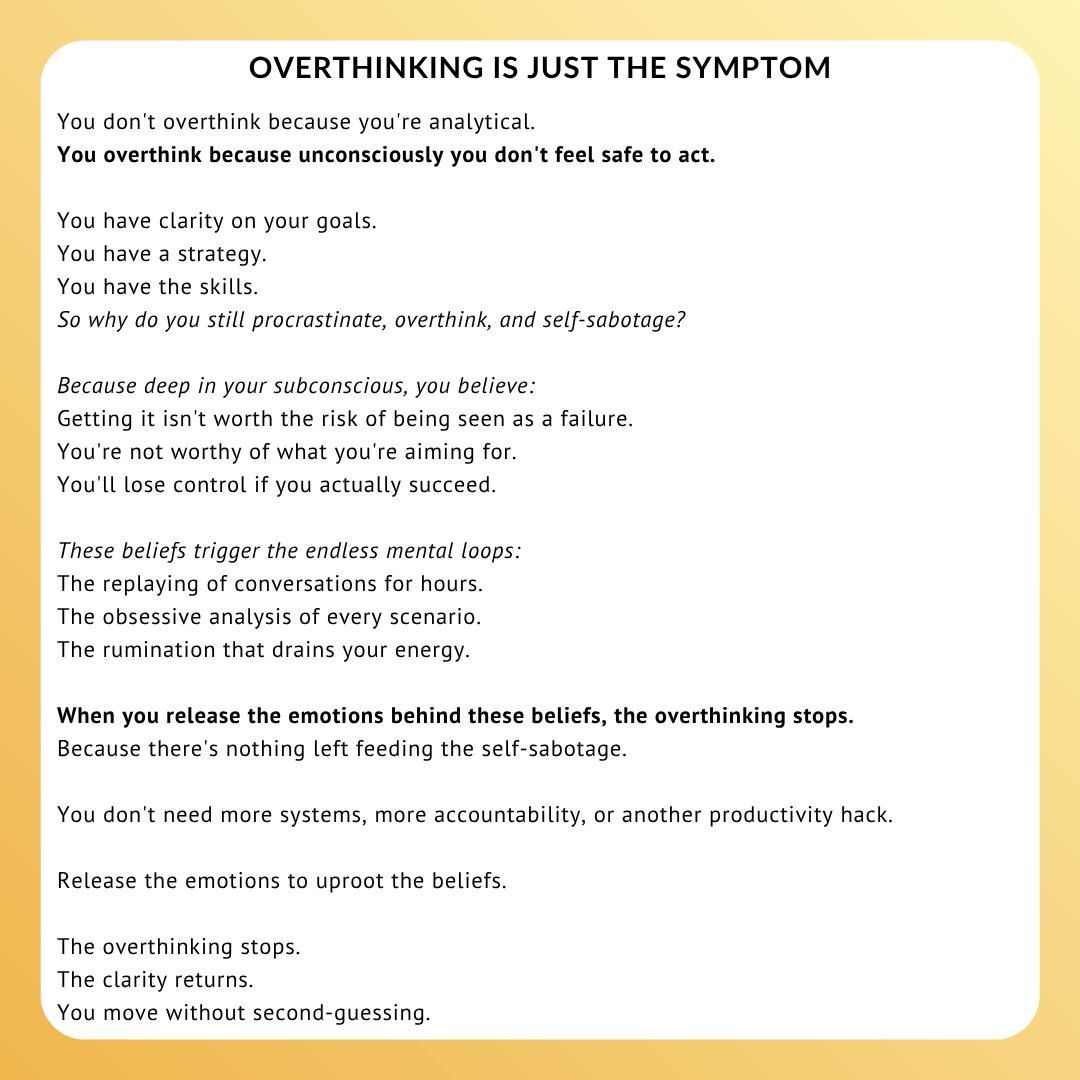
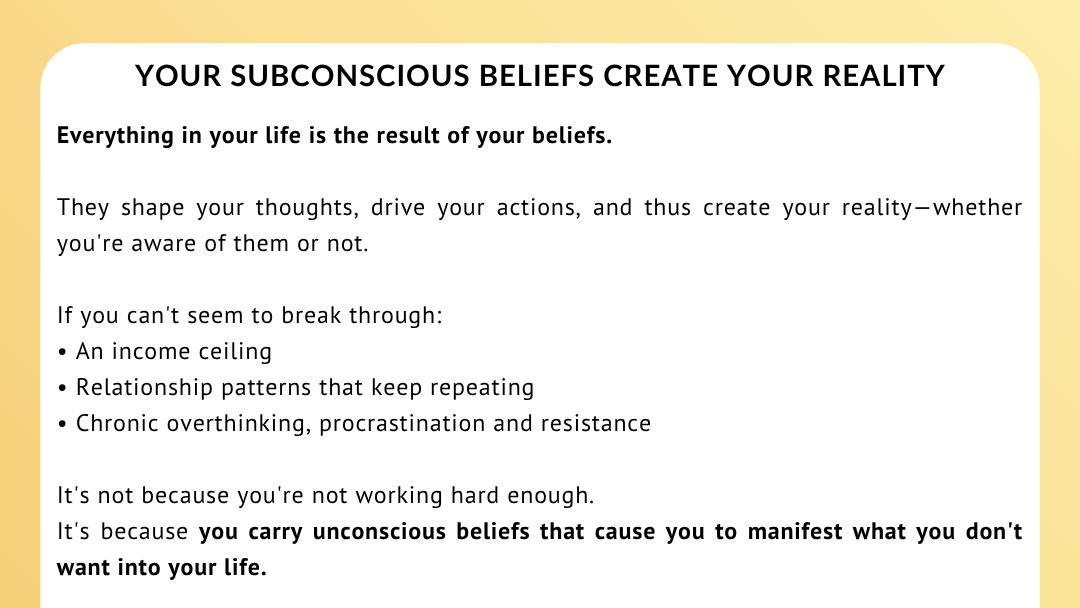
Procrastination isn't the problem.
It's just the symptom.
Underneath it is an emotion you've been avoiding.
Feel it.
Let it go.
The procrastination stops.
12
15
425
Jan 21
I thought being passive was who I was.
It wasn't.
It was unprocessed emotions running the show.
Every time I got close to discomfort, I'd freeze,
convincing myself I was being thoughtful, strategic, patient.
I wasn't.
I was paralyzed by fear, shame and self-doubt.
8
11
271
Jan 21
And for many, pushing through anxiety actually makes it worse.
You just don't notice until it shows up as burnout.

5
1
7
501
Jan 20
What people call laziness is often anxiety they don't recognize.
The high-achiever who can't take action (not the one who can't stop):
Caught between a relentless need to prove themselves and a freeze response that stops them cold.
The moment they try to been, their nervous system says: DANGER.
This isn't fixed with discipline.
It's healed by signaling safety.
9
13
324
Jan 18
I can see why people believe "A job is not about joy".
Many feel trapped in jobs they dislike or even hate.
They stay, going through the motions, running on autopilot, never stopping to question if this is still what they want.
But in today's world, it's easier than ever to change that.
Let's start with the obvious solution:
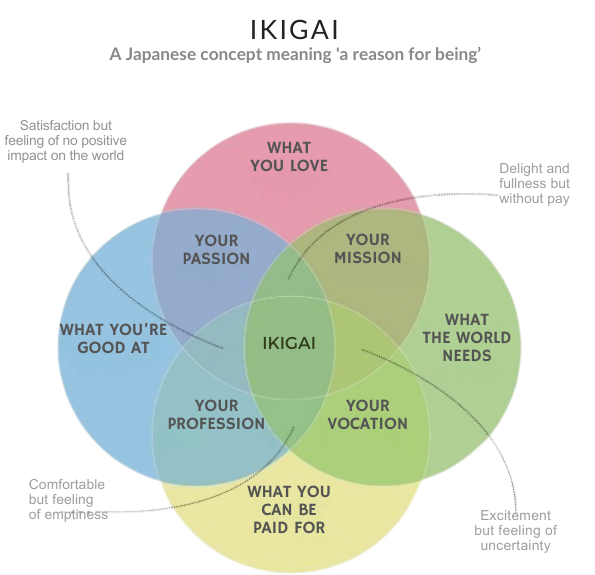
Ikigai.
Ikigai = the intersection of:
• What you love
• What you're good at
• What the world needs
• What you can be paid for
If your job covers all 4, you've found your sweet spot.
If it only checks 3/4 boxes, you're probably in a good place but something's missing.
Looking at Nikita described:
✅ Loves the product
✅ Does what the world needs
✅ Gets paid (though less than before)
✅ Presumably good at it
That's 4/4. That's actually Ikigai.
The pay is lower, the chaos is real, the risk is there.
But the work itself? Aligned.
In my previous job as an engineer, I checked 2/4:
✅ Good at it
❌ Didn't believe it was what the world needed
✅ Paid well
❌ Didn't love it
I was quite comfortable but feeling empty.
So I transitioned to coaching, my actual Ikigai.
Deep down, I always knew personal development was my passion.
That's the easy answer: find better alignment.
But let's go deeper.
Here's what I've learned since then:
Even in coaching (my Ikigai), there are parts I could hate:
• The admin work—scheduling, invoicing, follow-ups
• Inconsistent income early on
• Client cancellations
If I resisted these parts, I'd suffer.
Same work, different internal experience.
This is what many people miss:
They transition to a different job only to discover the same suffering follows them.
Now, being wiser, I genuinely believe:
I could have been happy in my engineering job.
Not because I'd suddenly love engineering.
Because I'd stop resisting what I didn't like about it.
This is the deeper work most people never do:
They think: "If I just find the RIGHT job, I'll be happy."
So they chase passion or alignment (often overlooking that even passion work has hard parts).
And when they find it, they discover: there are still parts they don't like.
Because every job - even your Ikigai - has hard parts.
The ancient Zen saying:
"Before enlightenment, chop wood, carry water. After enlightenment, chop wood, carry water."
The tasks don't change.
Your relationship to them does.
You can chop wood while resisting every swing.
Or you can chop wood while at peace with the chopping.
So here's what's actually happening when you hate your job:
• You dislike your salary → You're in resistance to what you're paid
• You hate the chaos → You're in resistance to disorder • You resent the risk → You're in resistance to uncertainty
The circumstances create the situation.
Your resistance creates the suffering.
This is the mechanism:
Every time you think "this should be different," you create tension in your body:
"I should be paid more."
"I want it to be organized."
"I need to feel secure."
Every time you fight reality, you create suffering.
Here's the wild part.
Two people can have the EXACT same job.
Same pay. Same chaos. Same risk.
One person suffers.
The other person loves it.
You may say the other one has more talent or passion,
But still, the only difference is the resistance.
Most of what you call talent or passion is just the absence of resistance.
There seem to be two paths to finding joy in your work:
PATH 1 (Easy answer): Find better alignment
• Use Ikigai framework
• Transition to work you love
• Get all 4 elements in place
PATH 2 (Deeper answer): Stop resisting what is
• Let go of the resistance
• Accept the hard parts
• Find peace in the work itself
Path 2 is actually the foundation for both.
Without learning to let go of resistance, even Path 1 (perfect alignment) won't work long-term.
Some people spend their whole life chasing passion, hopping from one job to another.
And even when they find a better one, they start to feel uncomfortable after some time.
So the answer to "how to find a job you love" is:
1. Notice what you're resisting about your job
2. Realize resistance is just a feeling that you can let go of
When you let go of resistance:
• Your salary doesn't change.
• The chaos doesn't disappear.
• The risk is still there.
But you stop suffering over them.
You stop creating a story about how things "should" be different.
You chop wood without resisting the chopping.
From this place, something interesting happens:
You can see clearly.
"Is this job actually aligned with me?"
"Do I want to negotiate a raise, or do I rather want to find something else?"
But you're deciding from a conscious place, not from your current emotional state.
From clarity, not resistance.
And sometimes you realize:
The job is fine. Even good.
You're doing what the world needs.
The problem was never the job.
It was you fighting the parts you didn't like about it.
Jan 18

1. I get paid less than I was making before
2. Day-to-day can be chaotic
3. I face reputational & legal risk daily
4. I love the product
A job is not about joy. It’s about doing what the world needs.
2
9
636
Jan 15
Same pattern in every high-achiever I work with:
They know what to do.
They have the goals, the strategy, the plan.
But nothing moves.
It's not a lack of information or motivation.
A part of them learned long ago:
Being seen = threat
11
15
346
Jan 14
You can't think your way out of something you're avoiding.
This is why mindset work, affirmations, and visualization hit a wall.
Your nervous system doesn't respond to logic.
It responds to safety.
If you want to break the pattern, you have to face the feeling driving it.
17
1
18
449
Jan 13
If you want to build an online business you need to:
• Let people know you exist
• Have conversations with them
• Show up on calls (even if you hate it)
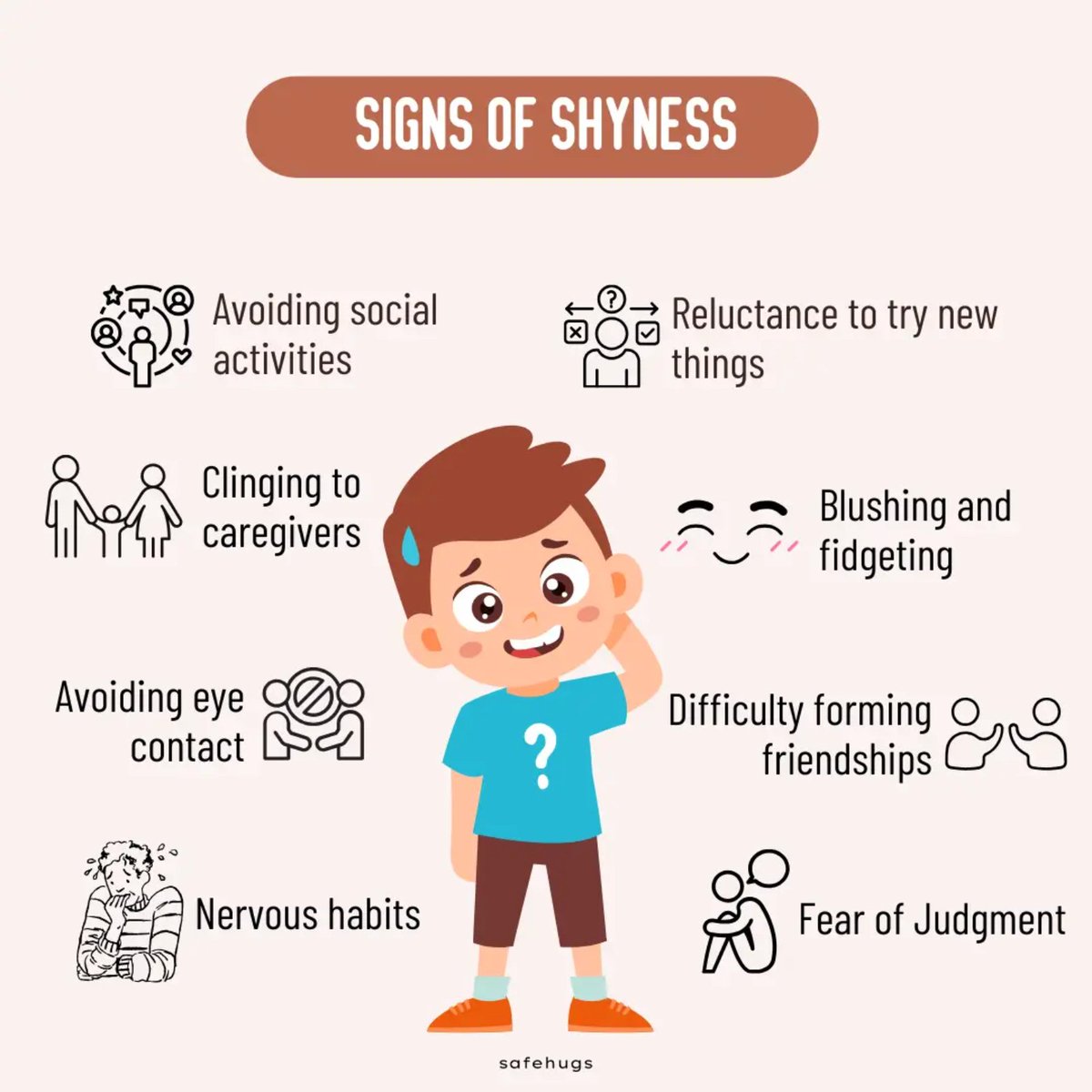
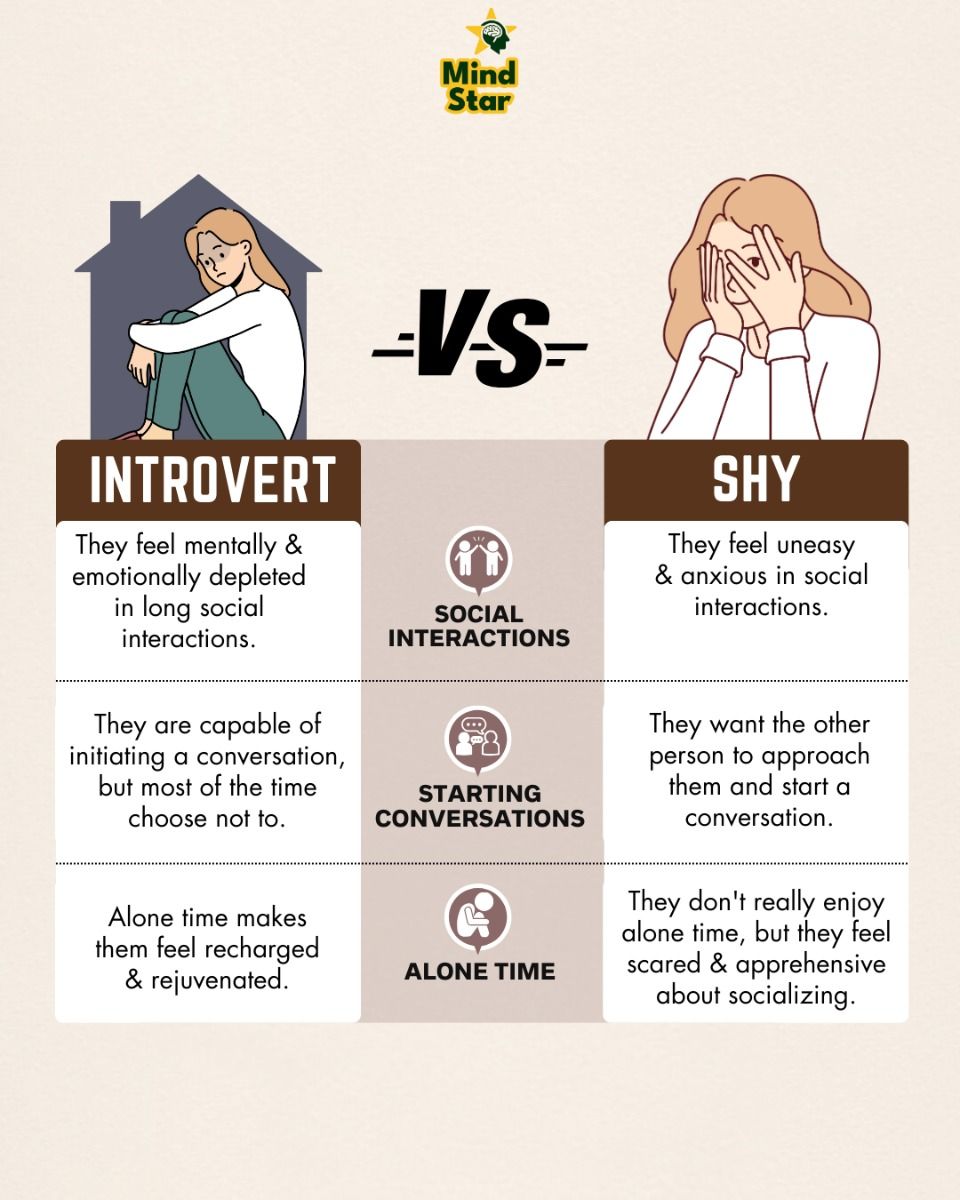
If calling yourself an "introvert" is how you justify avoiding all three, you're not building a business.
You're managing anxiety you've mislabeled as a personality trait.
15
20
559
Jan 12
Yesterday was my birthday, and I gave myself this gift.
I’ll be less active with writing for a bit, moving more into video.
My wife stayed with the kids and gave me quiet space for the whole morning.
Enough to step back and focus more deliberately.
She also booked a table at a café, told me someone was waiting, and covered the bill. She’s the best.
Three friends were sitting there. Had a good time.
Now, with more clarity, moving forward.
10
15
271
Jan 8
Being realistic is the fastest way to waste your life.
If 10% of your friends don't think you're out of your mind when you share your goals, you're playing it too safe.
You're limiting yourself to protect from what strangers think of you.
That's the real insanity.
12
22
463
Jan 7
The anger you're afraid to show isn't the problem.
The decades of swallowed anger you're sitting on - that's the problem.
It doesn't go away when you ignore it.
It calcifies.
Becomes the background static of your nervous system.
Allowing it instead of suppressing would give you back the energy you've been using to hold it down.
6
9
151
Jan 6
We don't walk around thinking 'I'm not enough.'
But if you can't stop achieving, can't stop proving yourself...
You're being controlled by the very belief you deny.
8
14
271
Jan 5
You're not a monster. This is actually more common among men than we realize.
But no one talks about it publicly.
Props to you for your courage.
I'm speaking from my personal experience and from working with other men.
The question isn't about how much time you spend with your kids.
The deeper question is what happens in your body when you're with them.
Notice what you said: your blood starts to boil.
That's not about your son. That's tension rising in your nervous system.
Do you feel it when he interrupts your coffee?
Do you feel it when he wants to play while you want to work?
It's not the activity, it's the contraction happening inside you.
The rational mind tries to fix it: "I should be grateful. I should enjoy this. What's wrong with me?"
But understanding doesn't make the tension go away.
The drive to work, to accomplish, to stay busy is the mind's way of avoiding a feeling.
What does "drinking coffee in peace" actually give you?
Is it the peace?
Or is it that your nervous system finally gets to come down from the constant hum of tension?
You mentioned: "For every single minute, on the inside, I just don't want to be there."
What's happening in that moment? What's underneath that resistance?
Does being just present with your son feel boring?
Or is it even unbearable, like you need to be productive?
When your son asks you to play, something shifts in your body.
Is there a pull to stay productive, to keep working, to not stop?
And when you feel that pull to work, to accomplish, to stay busy, what's underneath that?
Is it wanting control?
Wanting approval?
What do the productivity and achievements give you?
Isn't it about not feeling good enough?
Constantly needing to prove your worth?
And what are you missing when you avoid being present with him?
Next time your blood boils when he interrupts you, pause.
What's the exact feeling behind it? Frustration? Anger? Resentment?
Could you notice that feeling?
The thing is, you won't figure this out rationally.
The mind created this problem in the first place.
But it happens experientially, by noticing what you feel and what's driving these unconscious reactions.
Jan 3

Am I just a monster? It's been 4 years since I became a father and I'm beginning to fear for my soul. The truth is I just don't like being around kids for very long. Historically, this is not uncommon among fathers, but today it feels almost illegal. It's causing me a lot of confusion and anguish.
The ideal amount of time I would like to spend playing with my kids is probably about 70-140 minutes a week—roughly ten minutes each day, maybe 2x/day, taking breaks from work. My feelings of love toward them are perfectly strong, but if I have to watch them or entertain them for more than about 10 minutes my blood starts to boil. I just want to be working, or accomplishing something. I try to be grateful, but it doesn't work.
It's 9 AM this morning, Saturday, January 3. It's a sunny, warm day here in Austin, and my four-year-old son is begging me to play catch in the street. I was drinking coffee, still waking up, so I didn’t really feel like it, but at this age his desire to play is insatiable. He begged and begged, so I conceded, and with a smile. I have no problem being a kind and loving father, the problem is only that I do not enjoy it. It's not that I'm trying to maximize my personal pleasure; it just seems wrong that I experience so little delight when my dad friends all claim to experience so much.
It was beautiful. We live on a picturesque, tree-lined block. I am even relatively relaxed from the holiday rest. Playing catch with your son is supposed to be an iconic, peak experience. Yet for every single minute, on the inside, I just don't want to be there. I want to be drinking my coffee in peace. Then I feel guilty and absurdly ungrateful, and ashamed, when we're done. I know that when he is a teenager, I'll long to have these days back. I have all of this perspective rationally, and I've been very patient and steadfast trying to digest it, but nothing fixes me emotionally.
Am I a terrible person? Or is my feeling within a certain range of historically normal and it's modern parenting norms that are off? Whether it's my fault or not, I don't even care, I just want to figure this out. Something is wrong and I no longer have the excuse of being new to this.
1
3
244
Jan 1
2025 broke every routine I'd built.
For 13 years, I had it together:
• Training 5-6x/week
• Deep work sessions
• Morning routine with reading, journaling, meditation
But 2025 with two kids under two:
• Got sick more often than ever
• Zero time for myself
• Stopped training
Instead of growing my business, I was changing diapers and surviving on 4 hours of sleep.
Nothing changed when the clock struck midnight on January 1st.
But 2025 was one of the toughest years for me.
I had to let go of my plans, my routine, my identity as the coach who had it all together.
Yet, I feel blessed for our daughter we welcomed this year.
For our almost 2-year-old who needs constant attention but is incredibly talented and makes us proud every day.
The challenges forced me to finally address patterns I'd been aware of but ignoring:
• Never having enough time
• Not being present in the moment
• Craving space to think but never creating it
• Being passive with things that aren't urgent but important (fixing the house, admin work, tidying, telling myself "I'll hire someone when I have more money saved up" for years while nothing changes
Here's what shifted:
1/ Time:
I practiced releasing more than ever. My perception of time changed. It's not about having more time, it's about choosing what matters.
2/ Presence:
I let go of my plans and learned to be present. My kids tested whether I could actually live what I teach when it got really hard.
3/ Solitude:
I stopped waiting for space to appear. I create a few minutes for myself even when it feels impossible.
4/ Proactivity:
I stopped avoiding what needs my attention. I handle it, even when it's uncomfortable.
2025 taught me perfect conditions are a trap your mind creates to keep you safe.
2026 won't be perfect either.
If you've been telling yourself:
”When things settle down, then I'll...”
They never will.
The safety you're waiting for?
You have to create it from within.
1
8
465
Bo Bohunicky retweeted
31 Dec 2025
How to actually reach your goals in 2026
Like most people, I set goals and New Year's resolutions.
I used to miss them more often than not.
I'd see the same pattern in myself that I watched play out at the gym.
Every year, hundreds of new faces join the gym in January.
90% are gone by February.
---
Everyone talks about habits.
But habits run on willpower.
Life happens, you miss a day, then two.
You need even more willpower.
Life happens again.
Then you quit.
The way to actually reach goals?
Identity.
If you identify as a gym-goer, an entrepreneur, someone who turns ideas into income—even without proof yet—you'll overcome every obstacle to match that self-image.
---
Thomas was a lawyer.
He took a sabbatical to figure out what he really wanted.
Turned out, he was crystal clear:
Relationship and intimacy coaching.
But he couldn't let himself be seen as that.
The shame of "what will people think?" kept him frozen.
Once we released that shame?
He stepped into that identity.
Now he's fully booked.
---
But here's the hard part:
How do you trust yourself when you feel like an impostor?
How do you get rid of the doubts and self-sabotage?
These are all emotions.
And most people aren't aware of them.
We suppress, avoid, and escape them through distractions.
Emotions are fuel for limiting beliefs.
They keep them alive.
We carry unconscious beliefs from childhood:
• "I have to work hard to prove I'm worthy"
• "If people see the real me, they'll reject me"
• "I'm not qualified enough to charge that much"
And underneath all of them: "I'm not good enough"
---
Let me show you how this works:
Someone calls you stupid.
You have enough proof otherwise.
There’s no emotional reaction.
That insult doesn't hold you back.
But when your friend teases you:
"Look at you, building an online business. You're not an entrepreneur."
You think: "I'm going to prove him wrong."
That trying to prove it?
That means you don't believe it.
There's anger behind it.
To create a new identity, you have to release the emotional charge behind the limiting beliefs.
No emotional reaction = the belief stops making emotional sense.
You're free to act.
---
You already know what you want to do.
But something keeps stopping you.
Maybe it's fear of being seen.
Maybe it's reaching out to people.
Maybe it's trusting your own decisions.
When you release what's blocking you, the excuses disappear.
The gap between who you know you are and how you're acting closes.
You finally act.
That's how you reach your goals.
If this resonated and you want to crush 2026 by dissolving the beliefs that have held you back for months or years—and you're ready to face what you've been avoiding—comment "2026" or DM me.
1
1
4
261