
Decision-making insights, infographics, and reports for everyone! (A product of @Businessfront) 🌐intelpoint.co
Joined May 2021
- Tweets 4,109
- Following 6
- Followers 5,203
- Likes 296
2,077 Photos and videos
Pinned Tweet

Jan 14
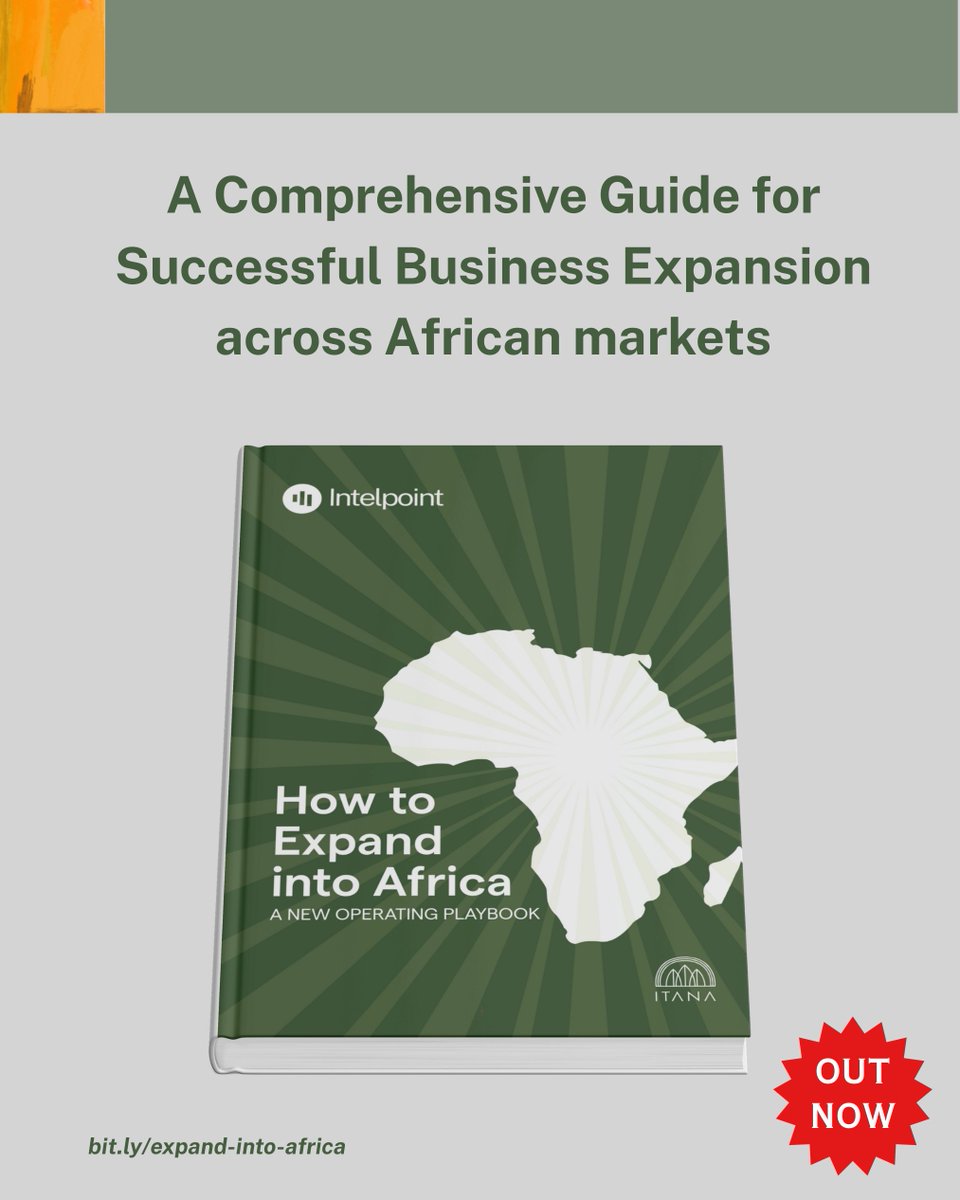
📢 New Report: How to expand into Africa
Africa is a market of over 1.5 billion people, with accelerating digital adoption.
In partnership with @ItanaAfrica, we've put together a practical guide for expansion in Africa.
Get the guide now intelpoint.co/report/how-to-…
8
16
3,533
Jun 12
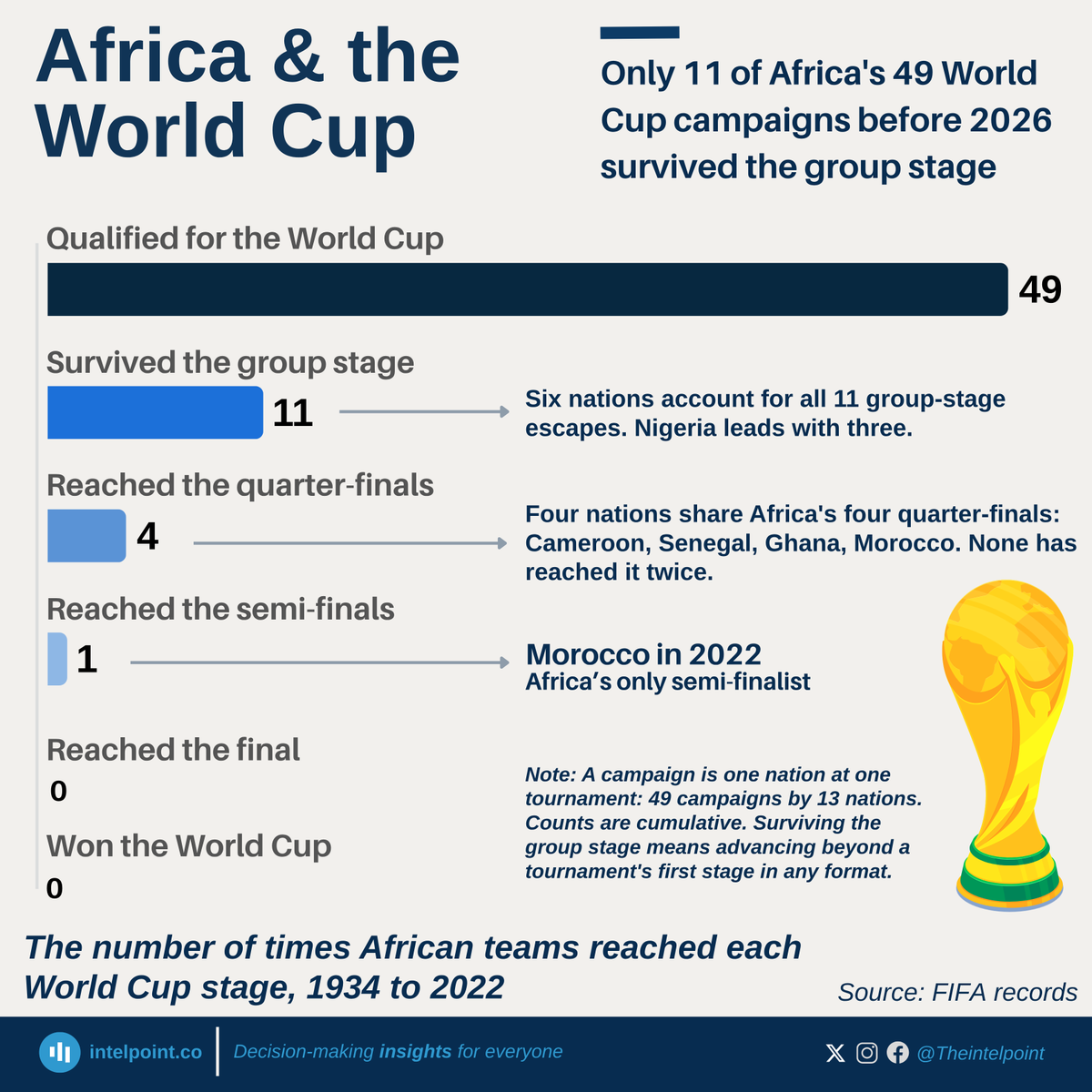
At the 2010 FIFA World Cup South Africa, Ghana came within one penalty kick of what would have been Africa’s first World Cup semi-final appearance, a milestone Morocco eventually reached in 2022.
In the final seconds of extra time against Uruguay, Ghana were awarded a penalty after Luis Suárez stopped a goal-bound shot with his hands. Ghana missed, Uruguay won the shootout, and Africa had to wait 12 more years before Morocco broke through at the 2022 FIFA World Cup Qatar.
The wider record shows how difficult that progress has been. Since Egypt’s debut at the 1934 FIFA World Cup Italy, African teams have made 49 World Cup appearances. Only 11 of those campaigns survived the opening stage, and just six countries have done it. Nigeria leads with three such campaigns, but will miss the tournament for the second consecutive edition.
Only four African countries have reached the quarter-finals: Cameroon, Senegal, Ghana, and Morocco. Morocco remains the only African country to have reached the semi-finals, while no African team has reached the final or won the tournament.
At the 2026 FIFA World Cup, Africa sends its largest contingent ever: Morocco, Senegal, Tunisia, Egypt, Algeria, Ghana, Côte d’Ivoire, South Africa, Cape Verde making their debut, and DR Congo returning after 52 years.
The opportunity is historic, but so is the challenge. Across 92 years of World Cup history, Africa’s best return in a single tournament is two teams advancing beyond the opening stage. Morocco showed in 2022 that the barrier can be broken.
The question in 2026 is whether more African teams can push through it.
1
2
3
204
Jun 11
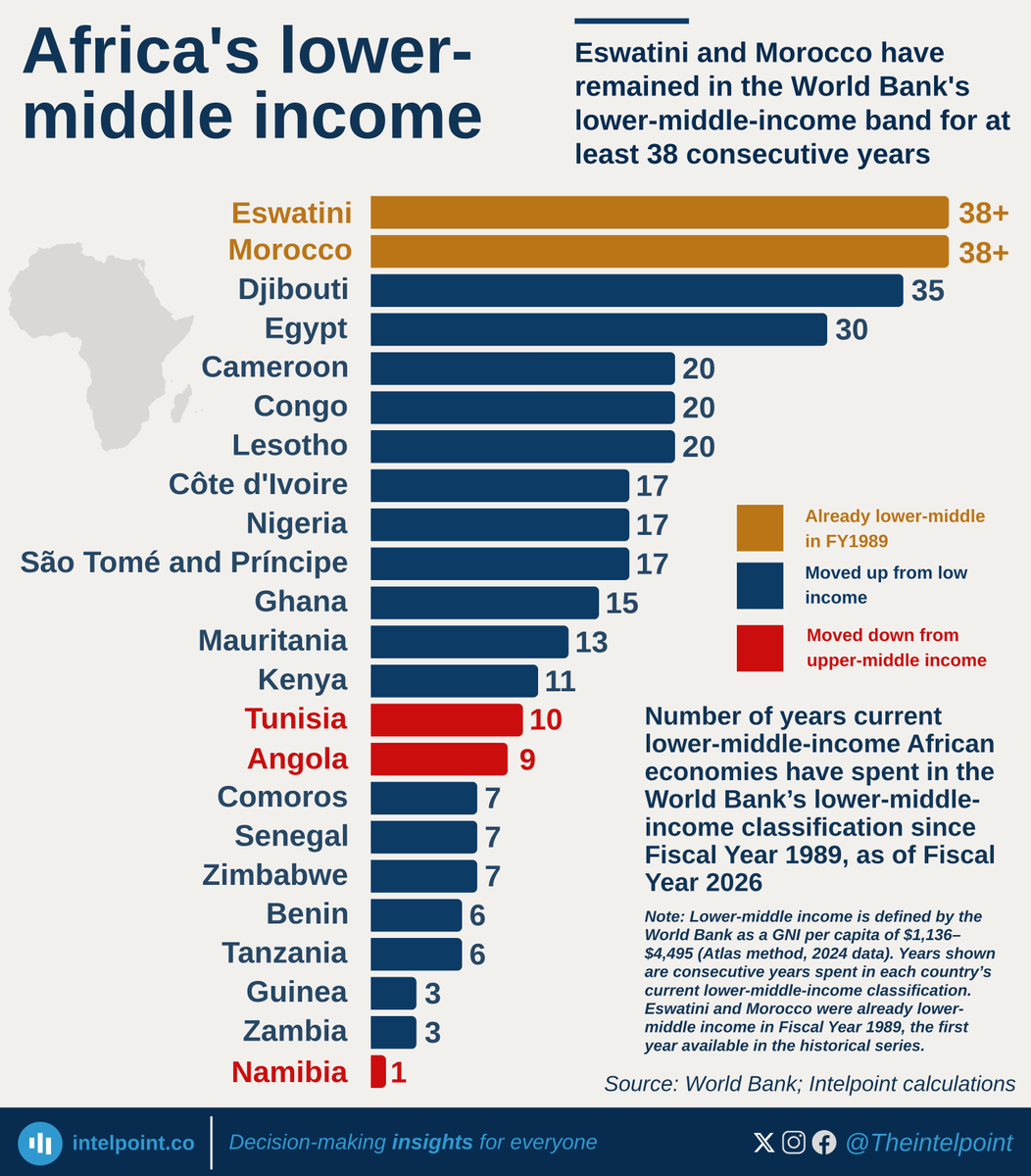
Nigeria has spent 17 consecutive years in the World Bank's lower-middle-income band, making it one of the longest-standing economies in the category.
Eswatini and Morocco have remained there for at least 38 consecutive years, while Djibouti and Egypt have spent 35 and 30 years respectively.
Africa has 23 lower-middle-income economies in the World Bank's Fiscal Year 2026 classification. Most entered from low income, but Tunisia, Angola, and Namibia were downgraded from upper-middle income.
2
155
Jun 9
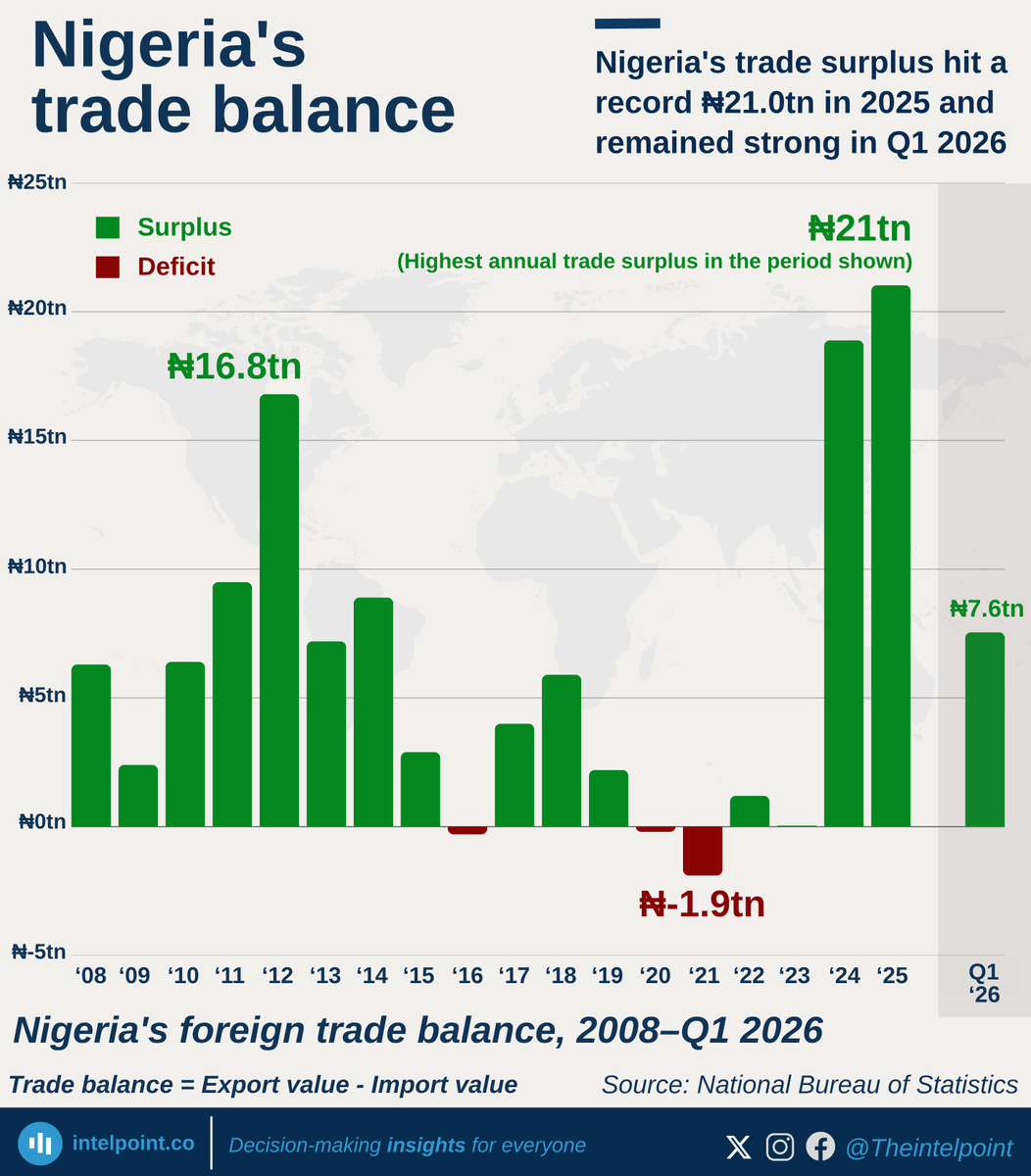
Nigeria recorded a trade surplus of ₦21.03 trillion in 2025, the highest annual surplus in the period shown. The momentum carried into 2026, with Q1 recording a ₦7.55 trillion surplus.
The recent run marks a sharp turnaround from the deficits recorded in 2020 and 2021 and the near-flat trade balance of 2023.
1
5
8
1,674
Jun 8
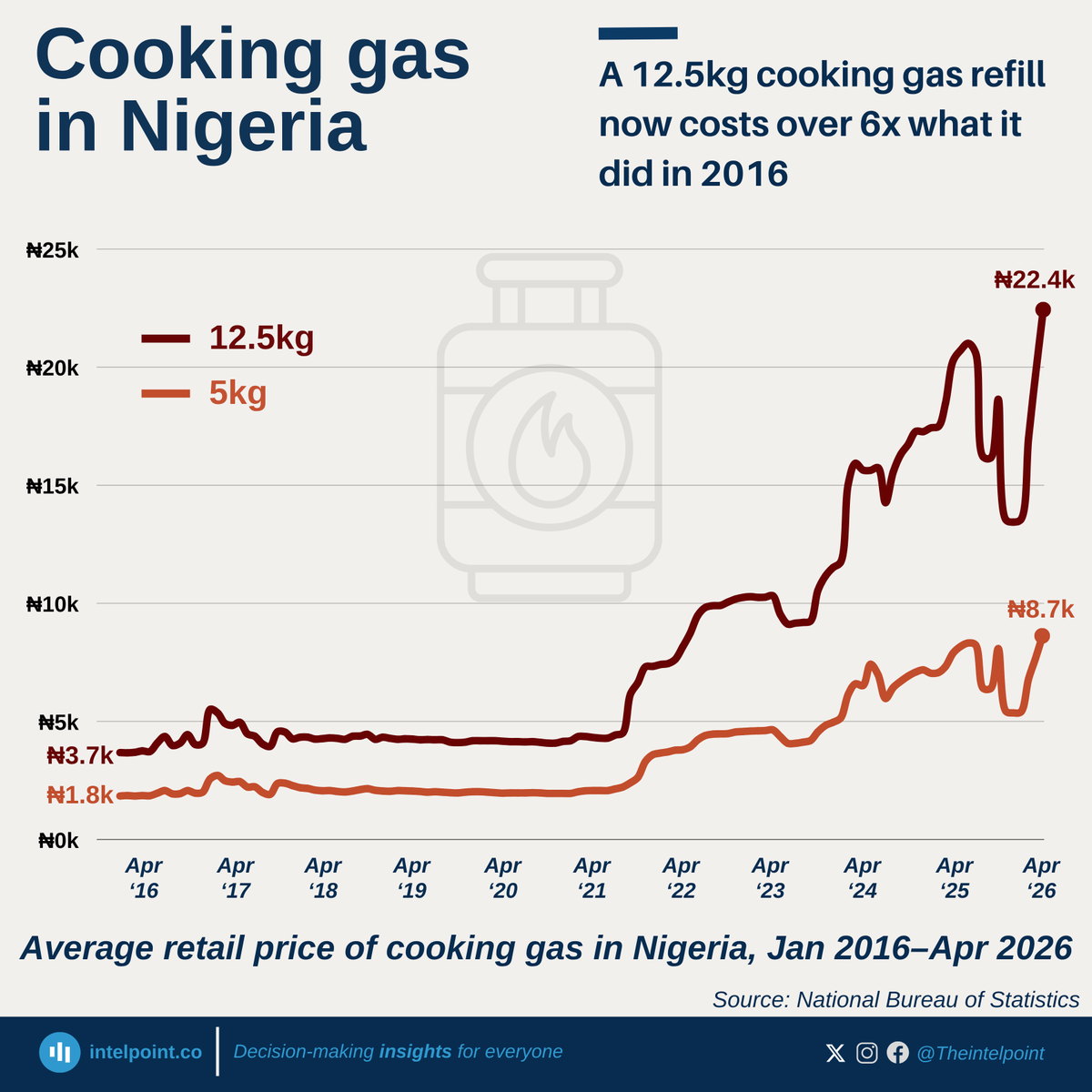
Cooking gas has become much more expensive for Nigerian households over the past decade.
In January 2016, the average retail price of a 12.5kg refill was ₦3,680. By April 2026, it had risen to ₦22,380, making it more than six times costlier. The 5kg refill also rose from ₦1,840 to ₦8,710 over the same period.
The pressure appears to have continued beyond the official April data. Recent reports put retail cooking gas at about ₦2,000 to ₦2,200 per kg in some locations by early June, while industry operators have linked the latest increases to supply constraints, higher depot costs, foreign exchange pressures, global energy prices, and rising logistics costs.
4
24
27
14,511
Intelpoint retweeted
Jun 4
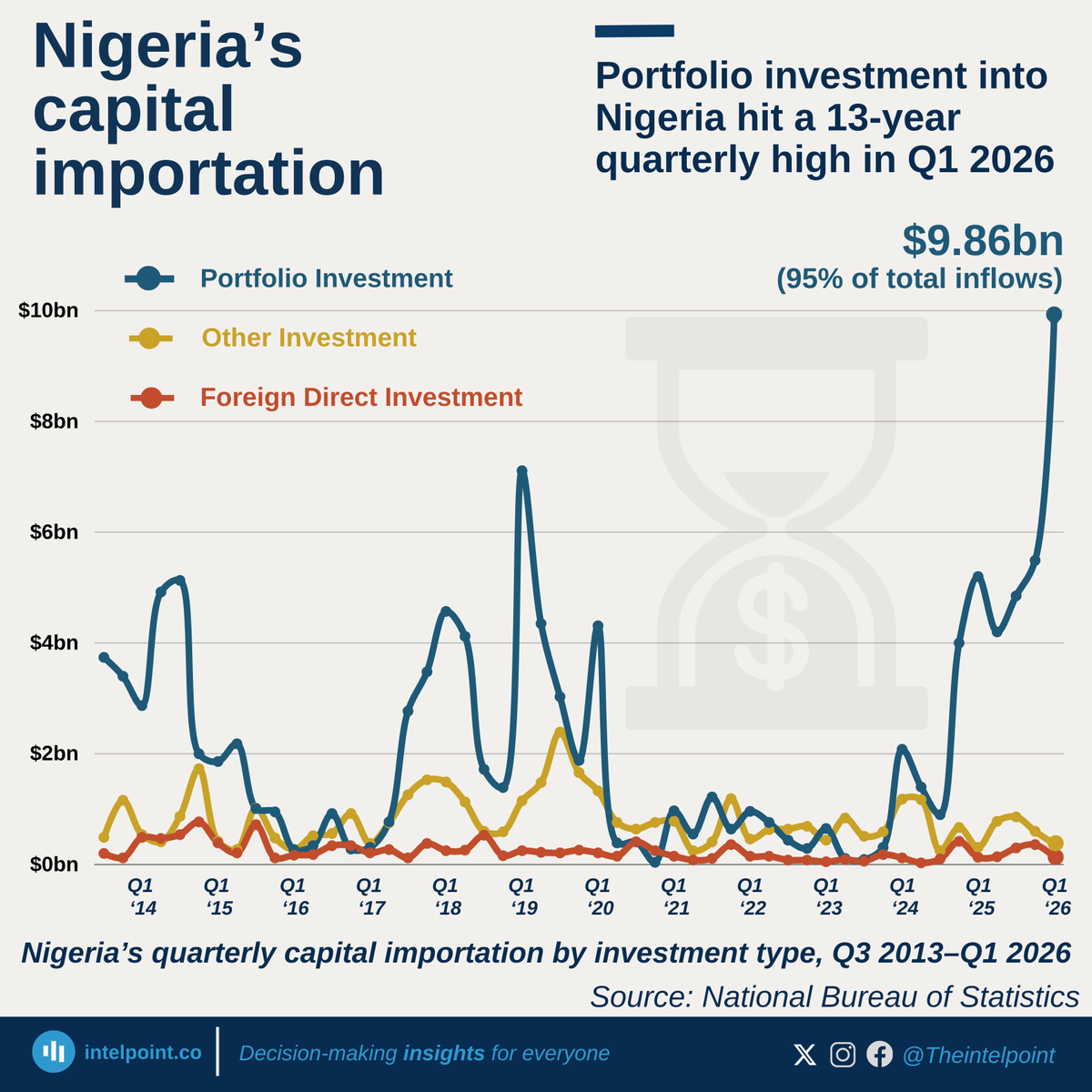
Portfolio investment into Nigeria reached $9.86 billion in Q1 2026, the highest level recorded across 51 quarters of data.
The figure was higher than the previous major peak of $7.11 billion recorded in Q1 2019 and almost double the $5.20 billion recorded in Q1 2025.
Portfolio investment accounted for 95% of Nigeria’s total capital importation in Q1 2026, showing that the latest surge was driven mainly by financial-market inflows.
Foreign Direct Investment remained much smaller at $135 million, while Other Investment stood at $374 million, covering inflows such as trade credits, loans, currency deposits, and other claims.
5
3
303
Intelpoint retweeted
Jun 2
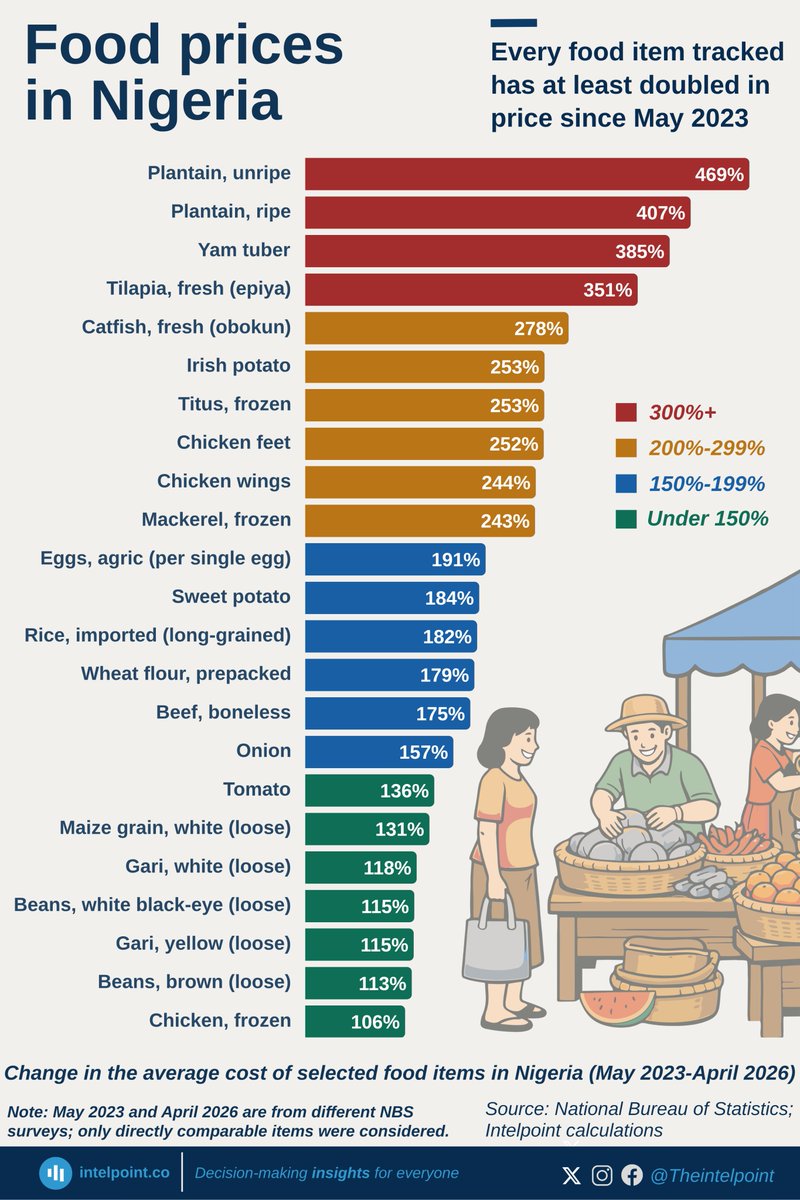
Three years on from fuel subsidy removal, this is what happened to food in Nigeria.
Of the staples we could compare directly, not one got cheaper. Every item is at least double its May 2023 price — the last full month before the policy hit. Nearly half have tripled. Plantain has climbed almost six-fold; yam nearly five. And the items that held up best — gari, beans, maize — still doubled.
For households, feeding a family now costs at least twice what it did.
3
30
34
6,438
Jun 3
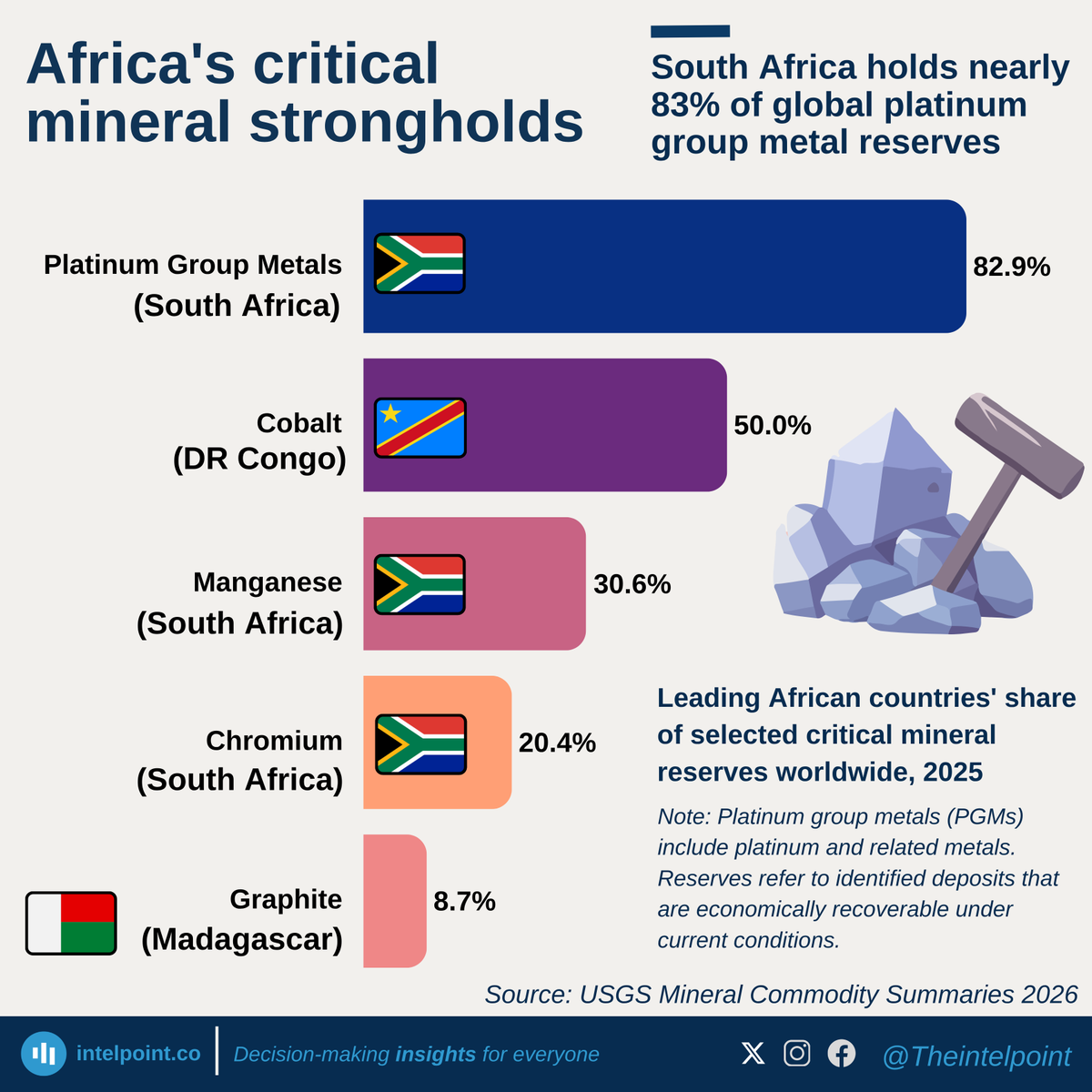
Major economies are trying to secure critical mineral supply chains outside China, and Africa is central to that race.
South Africa alone holds nearly 83% of global platinum group metal reserves and over 30% of manganese reserves, while the DRC accounts for half of global cobalt reserves. Madagascar also holds almost 9% of global graphite reserves.
This is why South Africa is pushing for more beneficiation, processing, and industrial development as the EU launches a €12bn investment push in the country. The DRC has also moved to control cobalt exports through quotas, showing how mineral-rich countries are trying to gain more influence over value, pricing, and supply.
1
2
96
Intelpoint retweeted
May 28
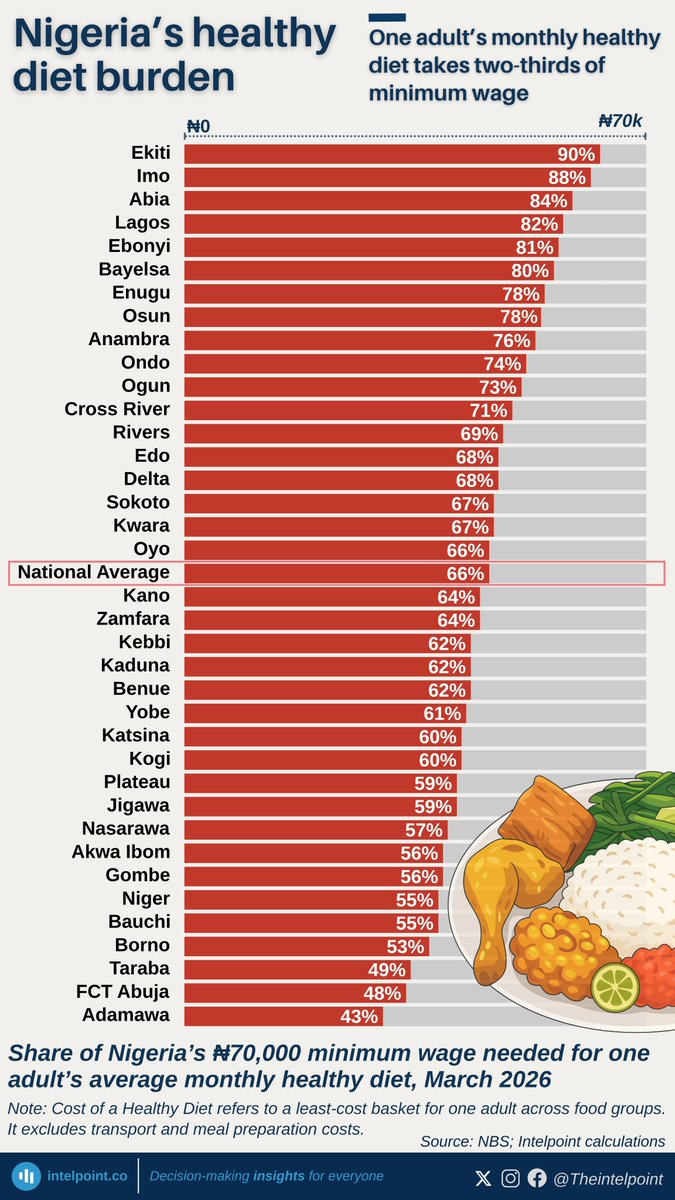
At the national average, one adult’s monthly healthy diet would take about two-thirds of Nigeria’s ₦70,000 minimum wage.
In March 2026, the average cost of a healthy diet was ₦1,541 per adult per day. Over 30 days, that comes to ₦46,230, or 66% of the minimum wage before rent, transport, utilities, healthcare, and other household expenses.
The burden was highest in Ekiti, where one adult’s monthly healthy diet would take 90% of the minimum wage. Imo followed at 88%, while Abia, Lagos, Ebonyi, and Bayelsa were all above 80%.
Adamawa had the lowest burden at 43%, followed by the FCT at 48% and Taraba at 49%.
1
4
6
362
Jun 1
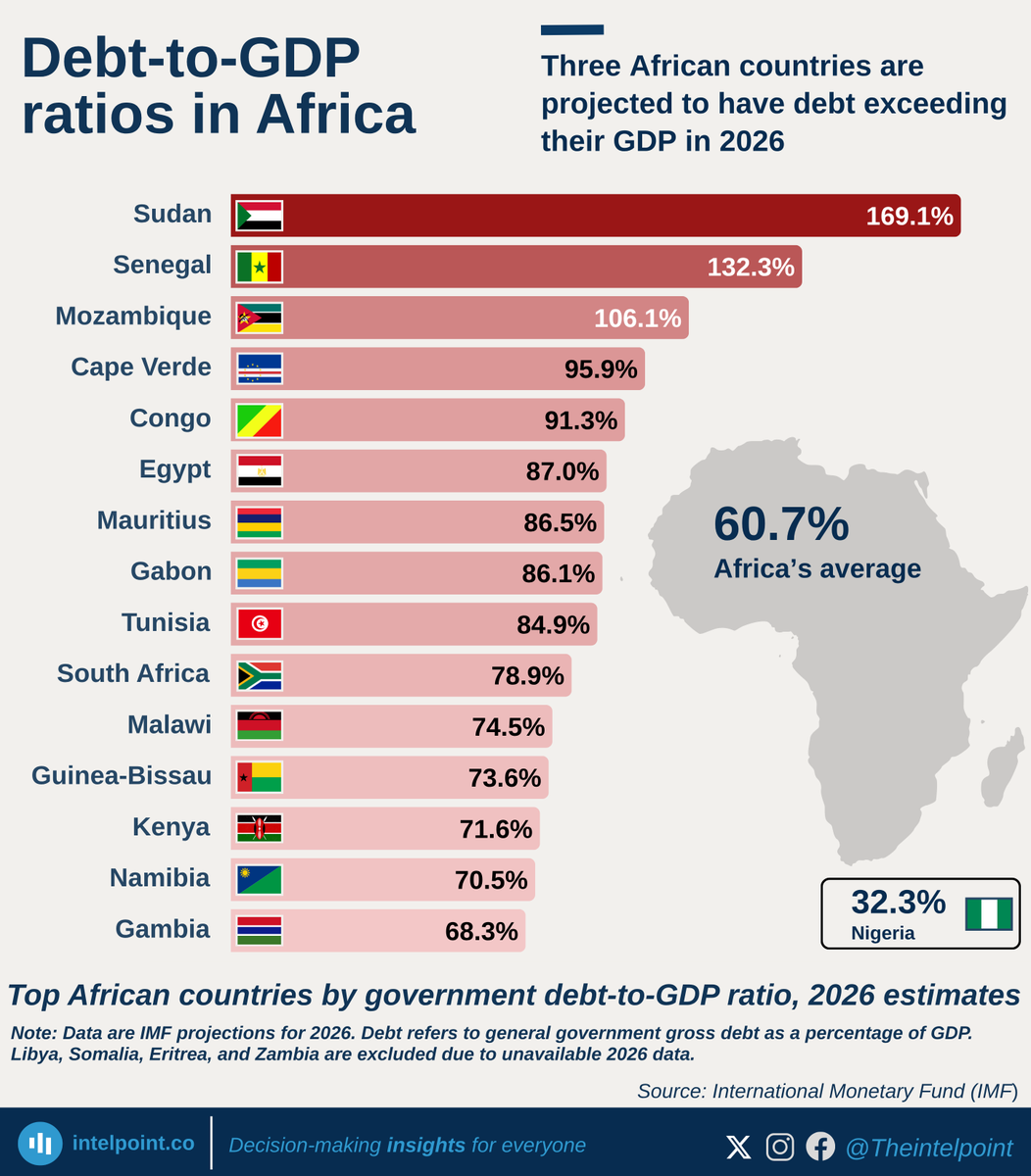
Sudan's projected debt burden in 2026 is equivalent to 169.1% of its GDP.
It is one of three African countries expected to have debt exceeding the size of their economies, alongside Senegal and Mozambique.
Africa's average debt-to-GDP ratio is projected at 60.7%, while Nigeria's stands at 32.3%.
1
1
3
201
May 28
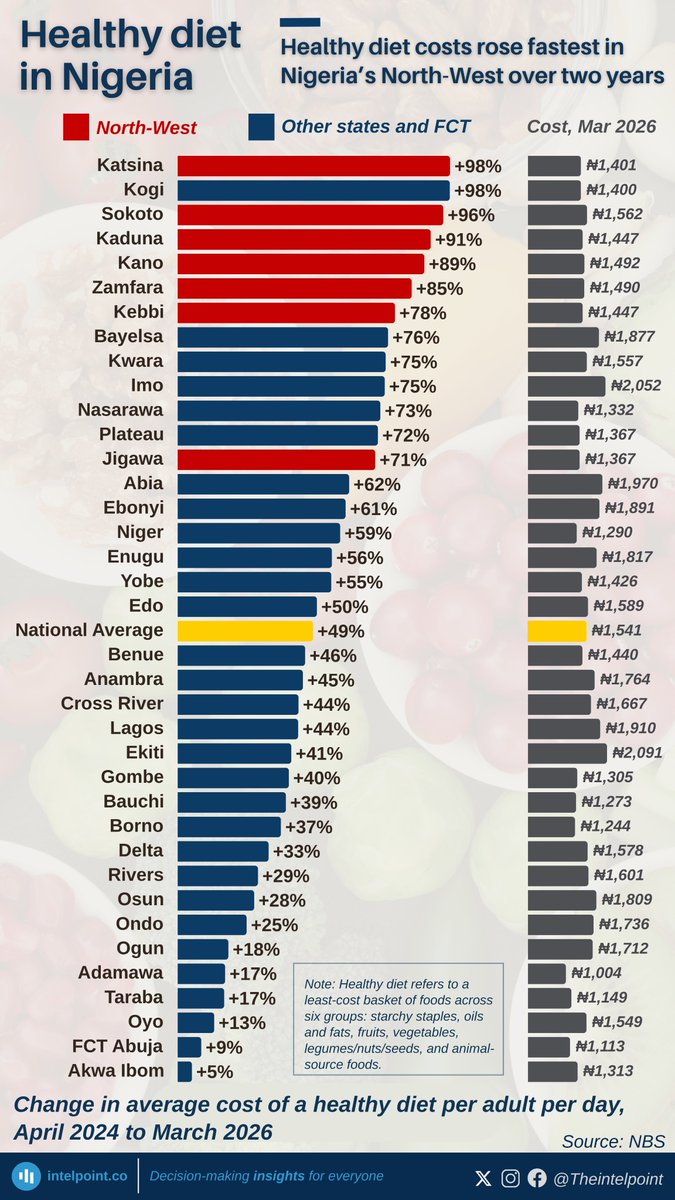
Food has felt more expensive for many Nigerians. Nigeria’s food inflation stood at 16.1% in April 2026, and the cost of a healthy diet shows how much pressure households have faced over the past two years.
Healthy diet costs rose fastest in Nigeria’s North-West. All seven North-West states recorded increases above the national average of 49%, with Katsina, Sokoto, Kaduna, Kano, Zamfara, Kebbi, and Jigawa all rising by more than 70%.
In Katsina, a healthy daily diet that cost about ₦700 per adult in April 2024 required about ₦1,400 by March 2026. Kogi saw almost the same shift, while Sokoto, Kaduna, Kano, and Zamfara also recorded increases above 80%.
At the other end, Akwa Ibom recorded the lowest increase at 5%, followed by the FCT at 9% and Oyo at 13%.
1
1
3
227
Intelpoint retweeted
May 27
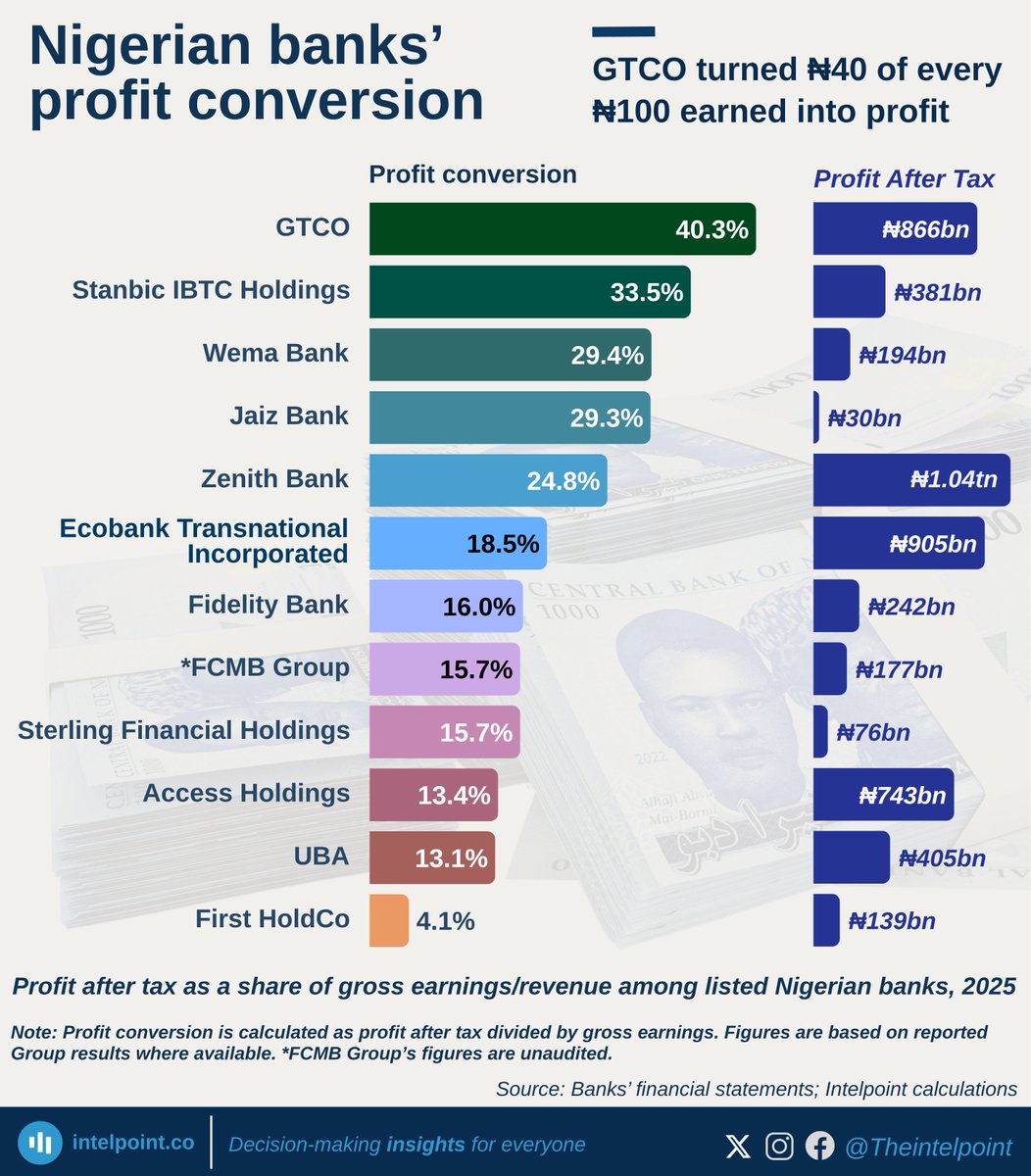
GTCO had the strongest profit conversion among listed Nigerian banks reviewed in 2025, turning 40.3% of gross earnings into profit after tax.
That means for every ₦100 GTCO earned, about ₦40 became profit. Stanbic IBTC followed with ₦33.5, while Wema Bank and Jaiz Bank each converted about ₦29 of every ₦100 earned.
The ranking shows that bigger earnings did not always mean stronger profit conversion. Zenith Bank recorded the highest profit after tax in absolute terms at ₦1.04 trillion, but converted 24.8% of gross earnings into profit.
First HoldCo had the lowest conversion rate, with only ₦4.1 of every ₦100 earned becoming profit after tax.
2
9
23
2,223
Intelpoint retweeted
May 26
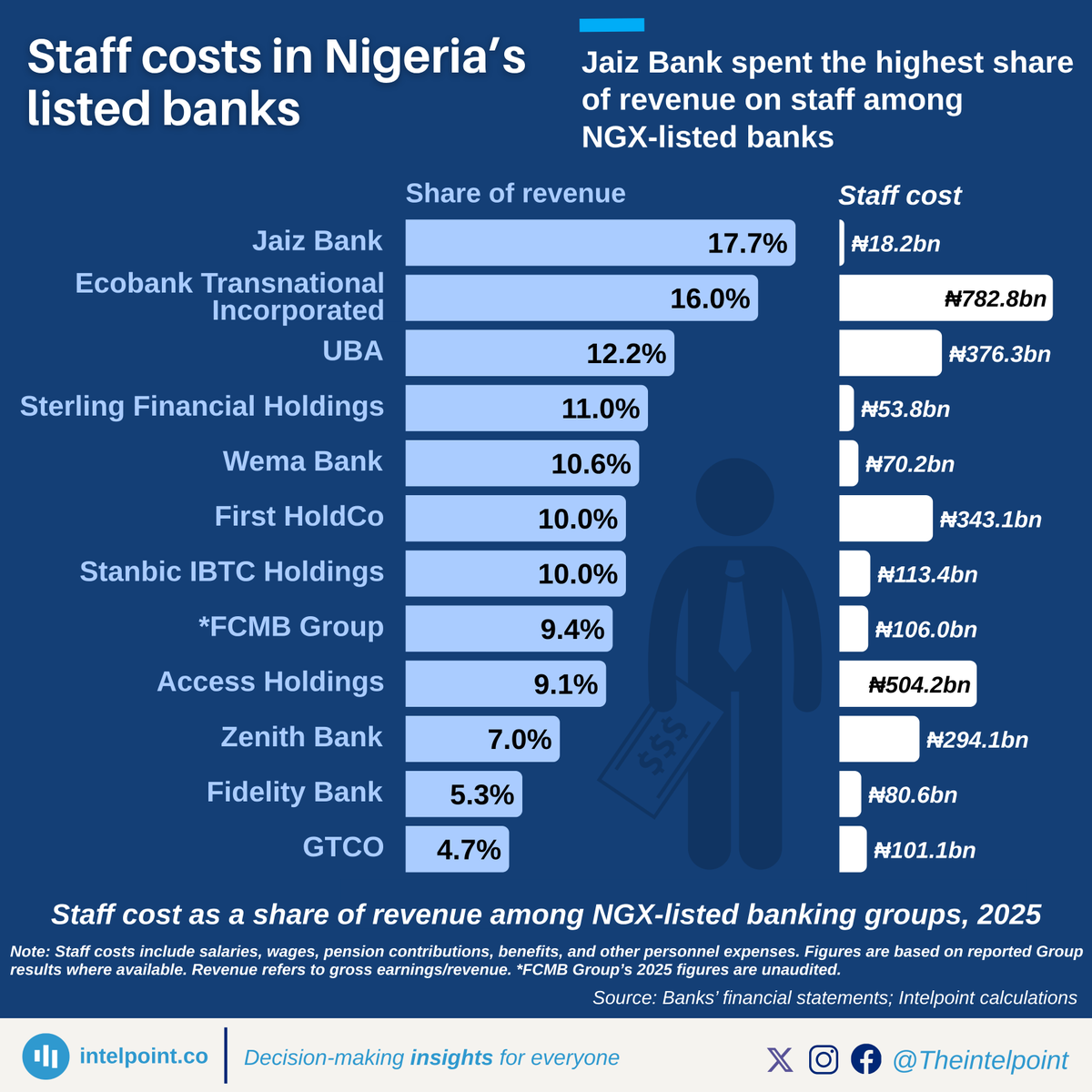
Among Nigeria’s listed banks, Jaiz Bank recorded the highest staff-cost-to-revenue ratio in 2025, spending nearly ₦18 on staff for every ₦100 of revenue.
Ecobank Transnational Incorporated (ETI) followed at 16%, while UBA ranked third at 12.2%. At the other end, GTCO recorded the lowest ratio at 4.7%, followed by Fidelity Bank at 5.3% and Zenith Bank at 7.0%.
In absolute terms, ETI had the largest staff cost at ₦782.8 billion, followed by Access Holdings at ₦504.2 billion and UBA at ₦376.3 billion.
1
2
3
361
Intelpoint retweeted
May 25
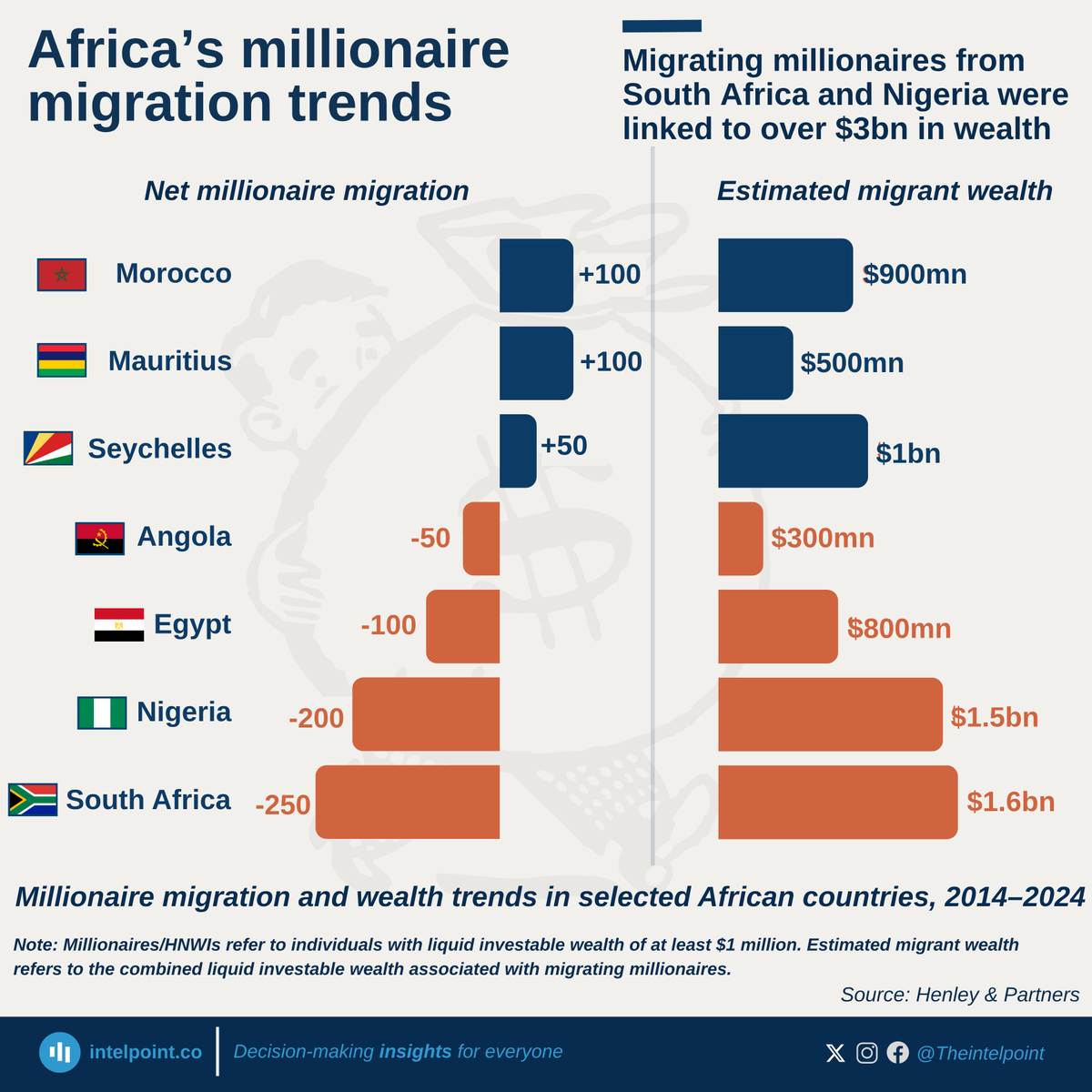
An estimated $1.5 billion in wealth was linked to migrating Nigerian millionaires between 2014 and 2024.
The country recorded 200 more millionaire departures than arrivals over the period, while South Africa recorded Africa’s largest net millionaire outflow, with more than 250 departures than arrivals linked to an estimated $1.6 billion in wealth.
On the opposite end, island economies emerged as some of Africa’s strongest wealth magnets. Mauritius and Seychelles together recorded net inflows linked to an estimated $1.5 billion in wealth.
Notably, Seychelles attracted a more concentrated pool of wealthy migrants, drawing an estimated $1 billion from just 50 more millionaire arrivals than departures, compared to Mauritius’ estimated $500 million from a net inflow of more than 100 millionaires.
1
10
10
4,635
Intelpoint retweeted
May 18
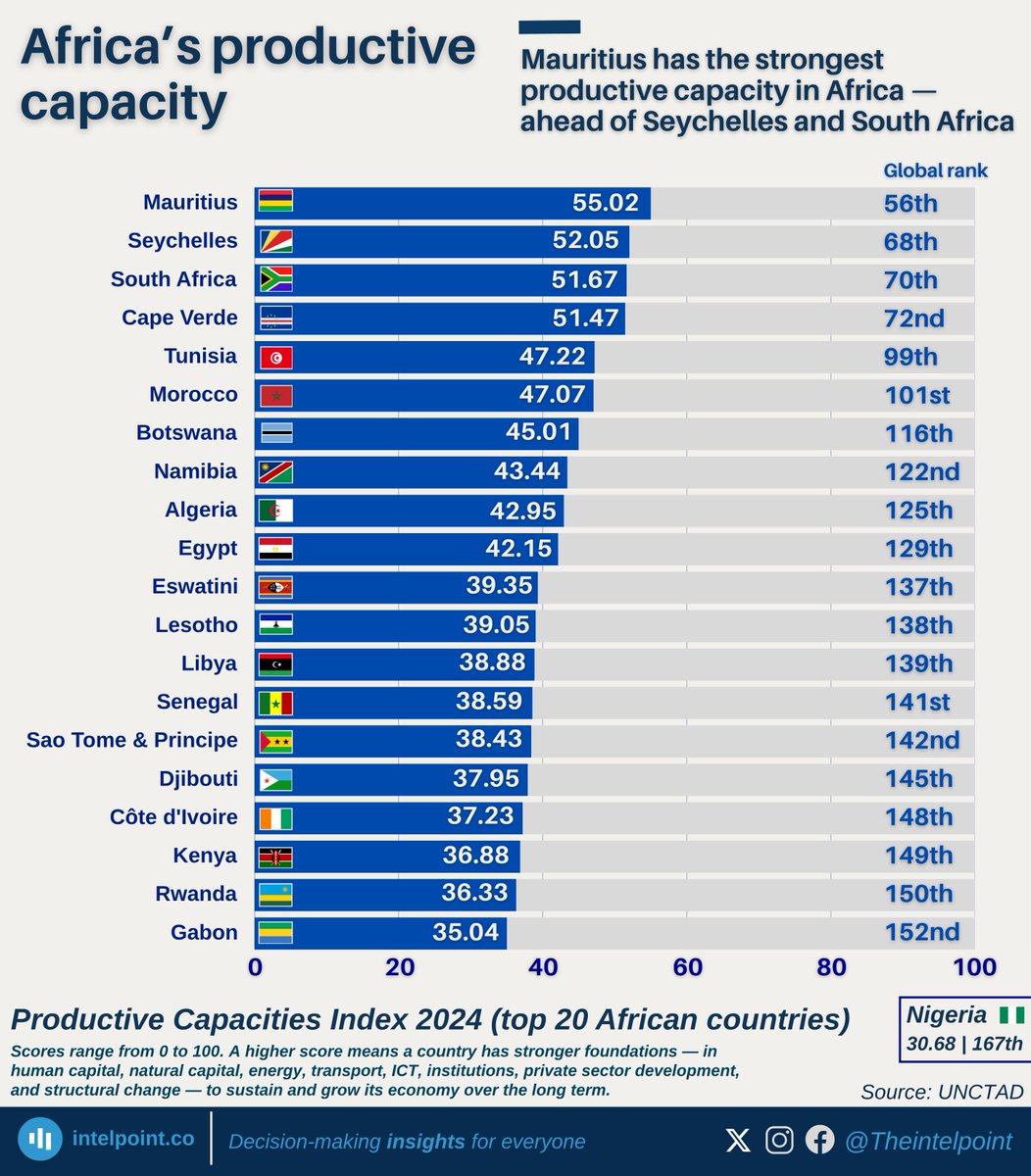
Africa's most economically powerful countries are not necessarily its most structurally capable.
Nigeria and Egypt — two of the continent's five largest economies by GDP — rank 167th and 129th globally on productive capacity, well below much smaller economies like Mauritius (56th) and Seychelles (68th).
According to @UNCTAD's Productive Capacities Index 2024, which measures eight foundations an economy needs to sustain and grow: human capital, natural capital, energy, transport, ICT, institutions, private sector development, and structural change, no African country ranks in the global top 50.
Closing the gap will require African governments to direct more investment into the foundations that drive long-term capacity, rather than relying on natural resource revenues alone.
4
4
253