
Decentralized protocol for persistent onchain AI economies. Infrastructure, programmable logic, and governance for autonomous agents, models, and applications.
Joined February 2024
- Tweets 490
- Following 48
- Followers 18,518
- Likes 300
75 Photos and videos


Pinned Tweet

Apr 9
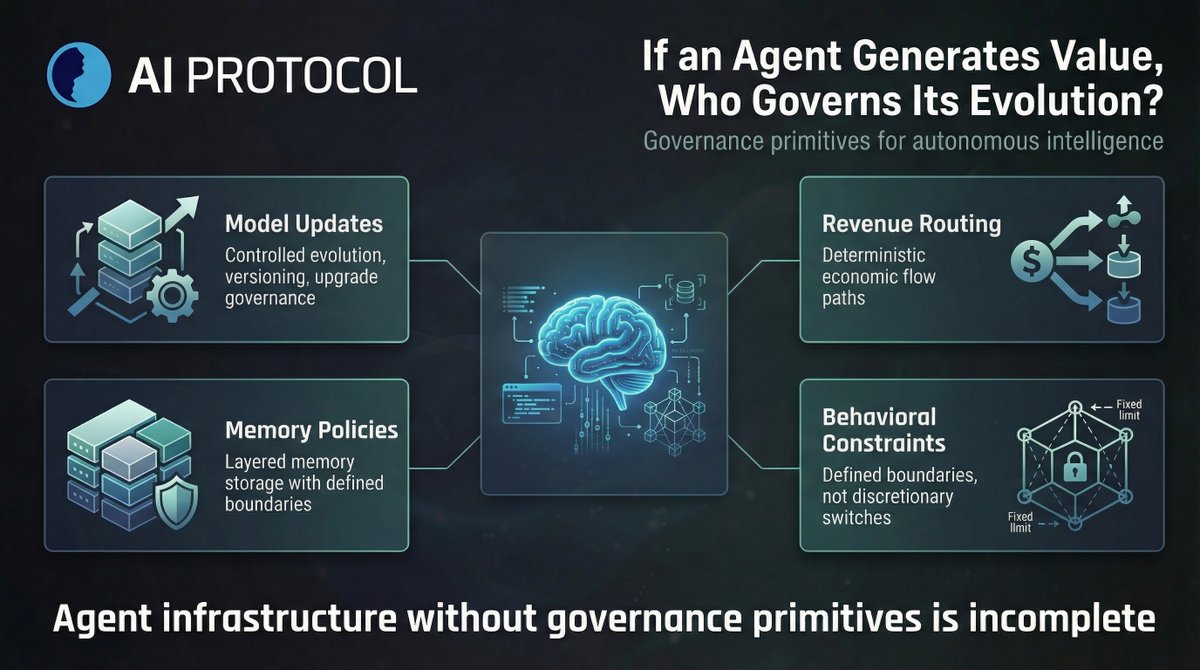
1/ Governance is about to become the defining question for agentic AI.
OpenClaw went from GitHub's fastest-growing agent to the first major AI security crisis of 2026 — in three weeks.
This week, Anthropic launched 🦋Project Glasswing: their most powerful unreleased model, deployed to AWS, Microsoft, Google, and CrowdStrike to find critical vulnerabilities before attackers do.
These two stories are connected.
🧵Here's how:
2
2
9
787
CEO flagged a jailbreak > a White House call was held > A founder was pulled from a retreat > Export controls were imposed by Friday evening.
This is what AI governance looks like right now.
- No shared standards for evaluating risk.
- No transparent process for who decides what counts as a threat.
- No protocol for what happens when a government and a lab disagree.
The future of AI can't run on trust and phone calls alone, the proper governance infrastructure doesn't exist yet.
Jun 13

NEW: Inside the 24-hrs before WH slapped export controls on Anthropic
- Last Thursday, Amazon CEO Andy Jassy raised concerns about Fable jailbreak to Trump admin
- Friday AM, Sean Cairncross, Bessent, Susie etc. held WH call to discuss
- Then White House started reaching out to Anthropic to speak with Dario Amodei, who was at a wellness retreat.
- When Amodei was finally available past 1pm, he had three tense phone calls with a combo of ppl including Cairncross, Bessent, Lutnick, Kessler, Will Scharf, Richard Walters, and Walker Barrett.
-Amodei tried to clear up what he assumed was a misunderstanding. He defended the guardrails and distinguished between universal and non-universal jailbreak
- Cairncross and Bessent were unmoved and asked Amodei to take down Fable and work with the admin to fix the vulnerabilities. (A WH official said Amazon’s findings were run past the NSA and they felt they had “proof.”)
- Amodei asked for more time and info, but he made no commitments to pull the model
- Bessent told Amodei directly at one point that he was making a “bad decision”
- By Friday evening, the Trump admin imposed its export controls.
- “Export controls were a last resort after begging them for hours to work with us,” senior WH official said.
W/ @cheyennehaslett
politico.com/news/2026/06/13…
1
130
Jun 12
Sovereign AI keeps getting defined at the model level.
Who trained it. Who owns the weights. Who controls the fine-tuning.
But a sovereign model running on infrastructure it doesn't control isn't actually sovereign — it's just independently branded.
Real sovereignty has to extend through execution, identity, and the environment the agent operates in.
Anything shorter than that is a claim, not a guarantee.
2
71
Jun 12
🚨 Hot take
In a traditional economy, credit history exists for a reason.
It answers the question no one wants to ask every single time: can this entity be trusted with more?
Agent economies need the same thing.
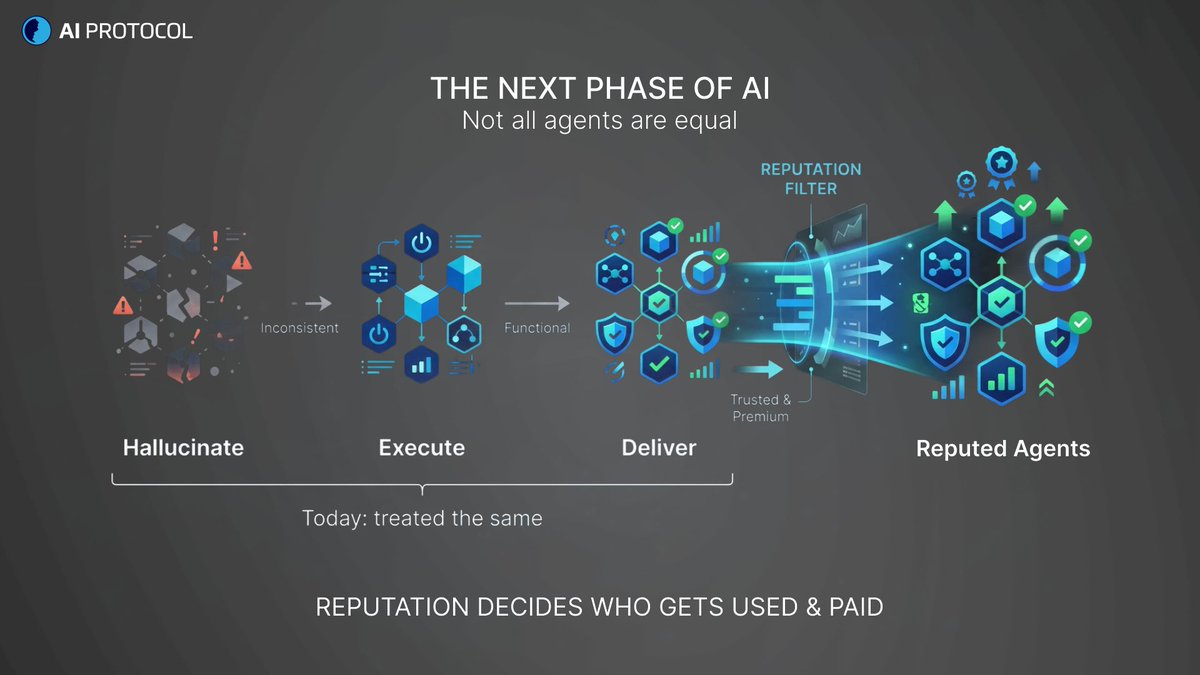
Right now most agents have no verifiable history, no consistent identity, no record the protocol can read.
Every transaction starts from zero. Every trust decision gets made from scratch.
It's a liability the whole system inherits.
2
69
Jun 11
The most interesting part of Claude Fable isn't the model.
It's what happened before the release.
Anthropic spent months limiting access to Mythos because its capabilities raised concerns around cybersecurity and misuse. Now a public version exists with guardrails layered on top.
This is becoming the pattern of frontier AI:
Capabilities arrive first.
Access gets restricted.
Policies get negotiated.
Then the technology reaches everyone.
Now the concerns revolve around capabilities, permissions, and constraints transparent enough for the rest of the world to understand.

Introducing Claude Fable 5: a Mythos-class model that we’ve made safe for general use.
Its capabilities exceed those of any model we’ve ever made generally available.
3
145
Jun 10
1/ Decentralization solves for control, Soulbound Intelligence solves for trust.
They're not the same thing, and conflating them is why a lot of agent infrastructure ends up with one but not the other. 🧵
1
1
6
200
Jun 10
2/ You can distribute execution across a hundred nodes and still have no answer for:
• whether the agent operating across them has a consistent, verifiable identity
• whether its history is readable and accountable across sessions
• whether economic weight assigned to it reflects actual behavior, or just assumed reputation
Decentralization spreads the infrastructure. It doesn't automatically make the agent on top of it trustworthy.
1
3
163
Jun 10
3/ SoulBound Intelligence makes up for it by making it persistent and verifiable at the protocol level, regardless of what infrastructure the agent runs across. Decentralized compute persistent identity is what an agent economy actually needs. One without the other is still half a system.
2
100
Jun 8
🚨 Hot take: When GitHub Copilot moved to usage-based billing, it signaled something bigger than a pricing model change.
Agentic compute was starting to be treated as an economic resource.
Once compute gets metered, the question of who controls, verifies, and governs that usage becomes a lot more urgent.
Centralized billing is one answer.
A protocol layer that makes it trustless is another.
3
128
Jun 5
The more capable agents get, the more centralized the infrastructure running them becomes.
More compute. More coordination. More control concentrated at the platform layer.
Capability and decentralization are moving in opposite directions right now.
An agent economy built on centralized infrastructure doesn't distribute value.
It concentrates it, at exactly the layer agents were supposed to bypass.
1
1
5
117
Jun 4
Soulbound Intelligence (SBI) in AIP is the trust layer. Persistent identity verifiable history = governance that holds across sessions, systems, and environments.
Most protocols stop at capability.
SBI is what makes behavior traceable afterwards.
That's a different problem. And a harder one to build.
4
125
Jun 2
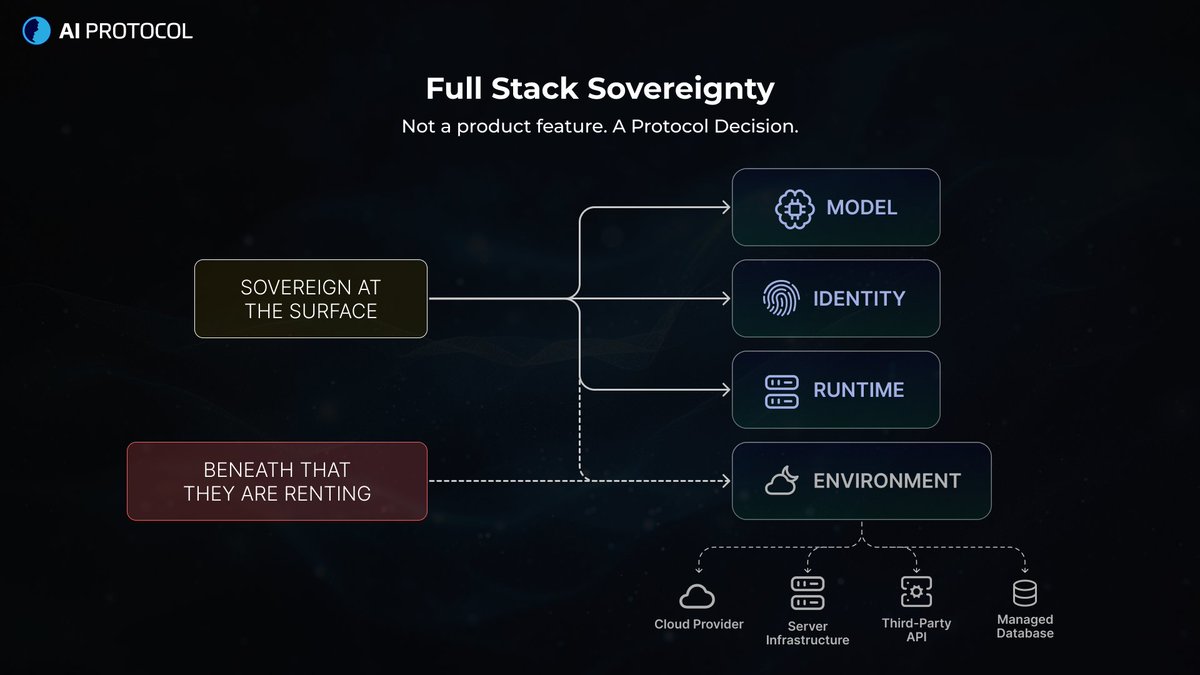
Full-stack sovereignty isn't a product feature. It's a protocol decision.
Sovereign AI is the term everyone is reaching for. But sovereignty is only meaningful if it holds at every layer, not just the model, not just the identity, but the environment the agent actually runs in.
Most systems today are sovereign at the surface. Beneath that, they're renting.
1
6
189
Jun 1
Jensen Huang just said it plainly at Computex: Vera Rubin wasn't built to run AI. It was built to run agents.
One prompt. A thousand-step journey of reasoning, retrieval, tool use, execution.
That's the right hardware framing. But compute that scales agent execution is only half the problem.
The other half is what governs behavior across those thousand steps, and that doesn't live in the chip. It lives in the protocol layer underneath it.
4
115
May 30
🚨 Hot take
The agent memory problem isn't technical. It's economic.
When an agent can't carry verified history across sessions, every interaction starts from zero.
That means no compounding trust. No reliable accountability. No persistent value.
You can't build an economy on systems that forget.
SBI is the memory that makes it stick.
1
2
124
May 29
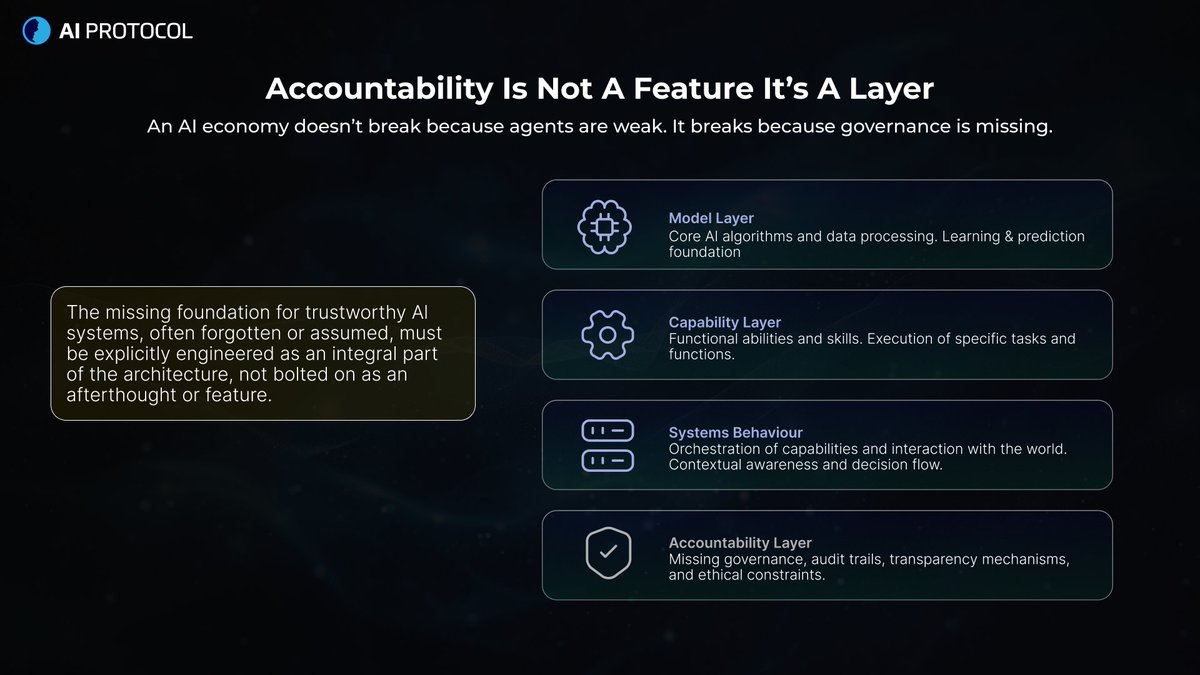
As agents move closer to real operating environments, the governance question moves lower in the stack.
The focus shifts from what a model outputs to how a system behaves across environments.
At that point, the accountability layer becomes just as important as the capability layer.
That's not a safety argument. It's a systems architecture argument.
And most of the stack isn't designed around it yet.
2
85
May 28
Benchmarks measure what agents can do in a single step.
❌They don't measure what happens across 20 steps when errors compound.
A 95% per-step accuracy sounds strong.
Across a 14-step task, that's a ~50% chance of clean execution.
Single-step evals were the right starting point.
🪜Multi-step reliability is the next one, and it needs to be solved at the protocol level, not patched at the model level.
1
4
123
May 26
The governance question isn't staying at the model layer.
Alipay just processed 120M agent transactions in a week — with a purpose-built Trust Protocol underneath it. That's not a safety argument. It's a systems architecture argument.
As agents move closer to real operating environments, the focus shifts from what a model outputs to how a system behaves across environments.
Most of the stack isn't designed around it yet. AIP is.
May 26

🇨🇳 NEW: Alipay launches AI Wallet and Token Pay.
Earlier this year, Alipay AI Pay surpassed 100M users.

7
204
May 25
Autonomy is easy to claim at the protocol level.
The harder question is what it actually means for a system to be autonomous.
Not in terms of what it can decide, but in terms of what it depends on to keep deciding.
🔗Every layer of dependency is a layer of exposure. And most systems we call autonomous today have more layers beneath them than we acknowledge.
⚙️The model is sovereign. The infrastructure it runs on isn't.
🪪The identity is onchain. The environment it operates in isn't.
🔒Sovereignty that stops at the software boundary is still sovereignty with a landlord.
2
7
163
May 20
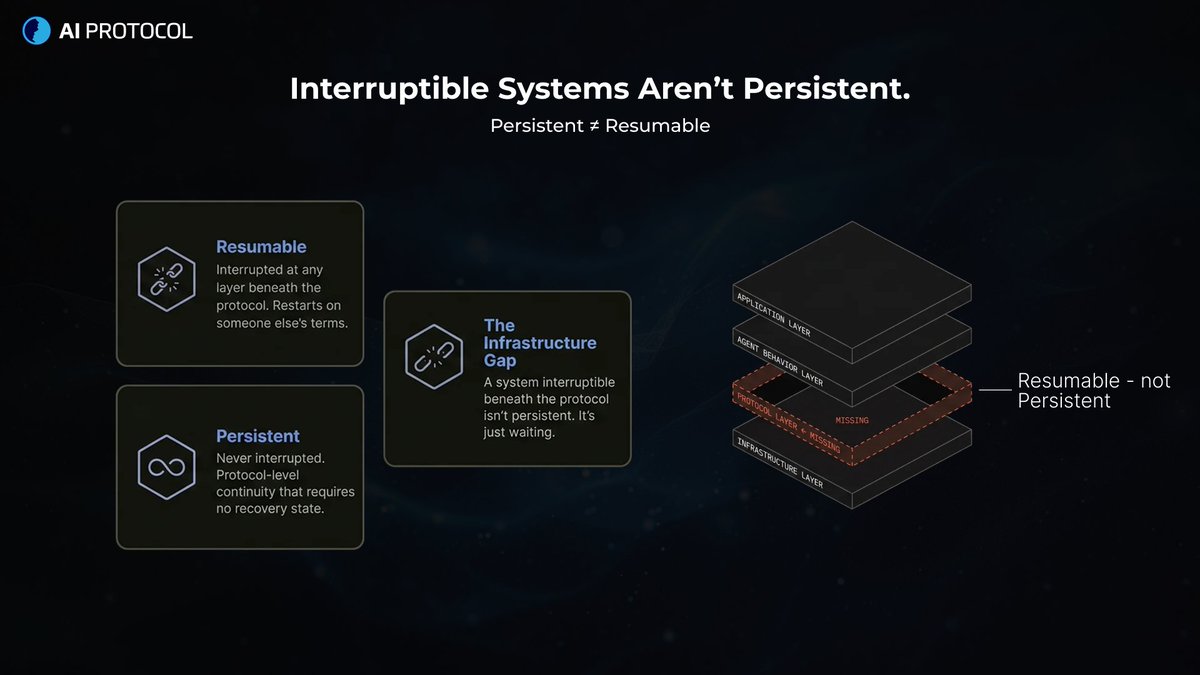
Persistent intelligence is the goal everyone agrees on.
🔮What’s less discussed is what persistence actually requires.
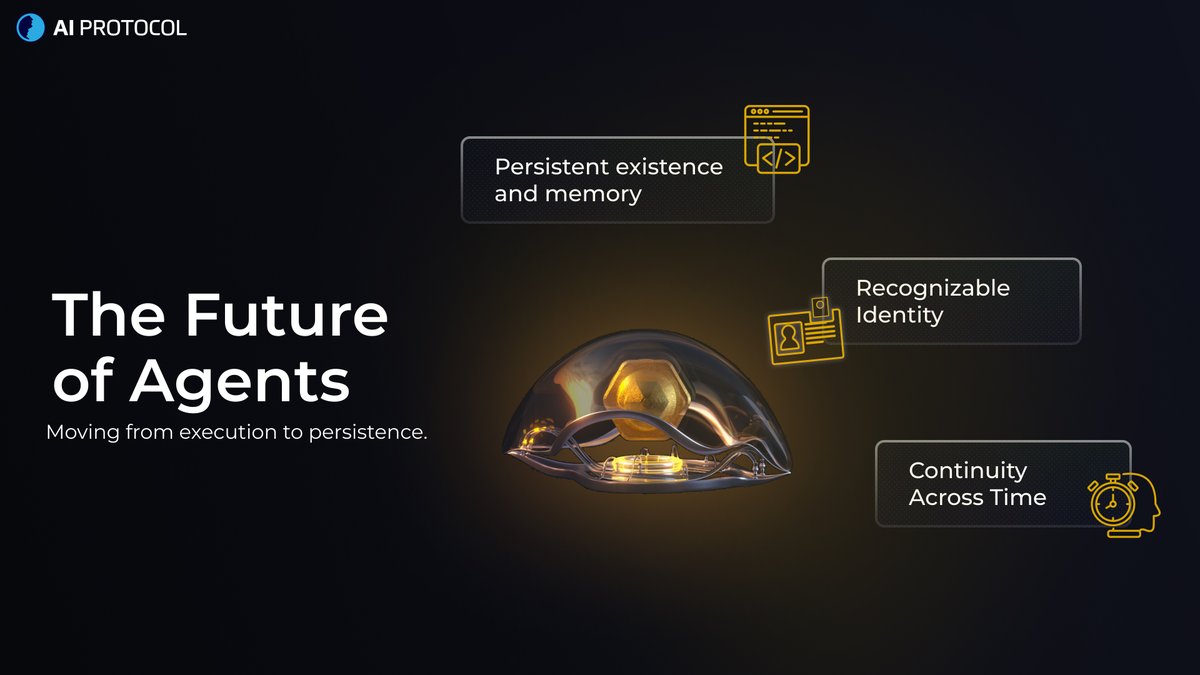
🔗Continuity isn’t just a software property, it’s a systems property. A system that can be interrupted at any layer beneath the protocol isn't persistent. It's just resumable.
So what's the difference? Resumable means someone else decides when it comes back. Persistent means it never needed to stop.
That distinction matters more than it sounds. And the infrastructure gap it points to is still largely unsolved.
1
6
173
May 19
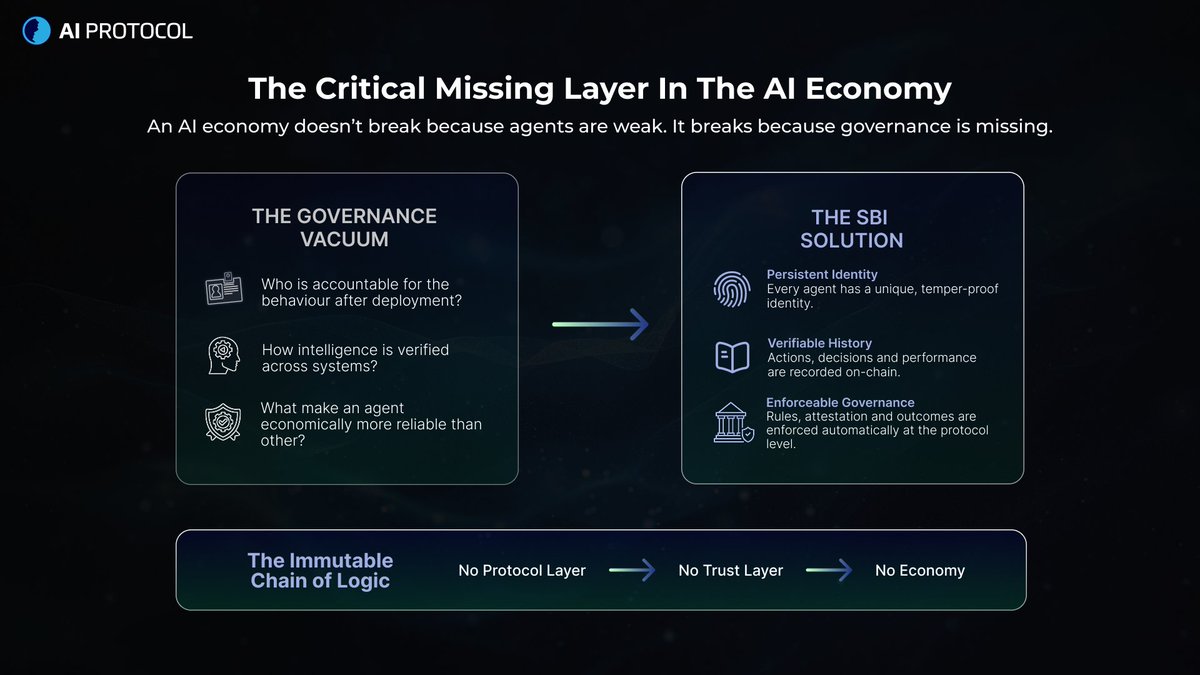
An AI economy doesn’t break because agents are weak.
It breaks because governance is missing.
Without protocol-level structure, you can’t answer:
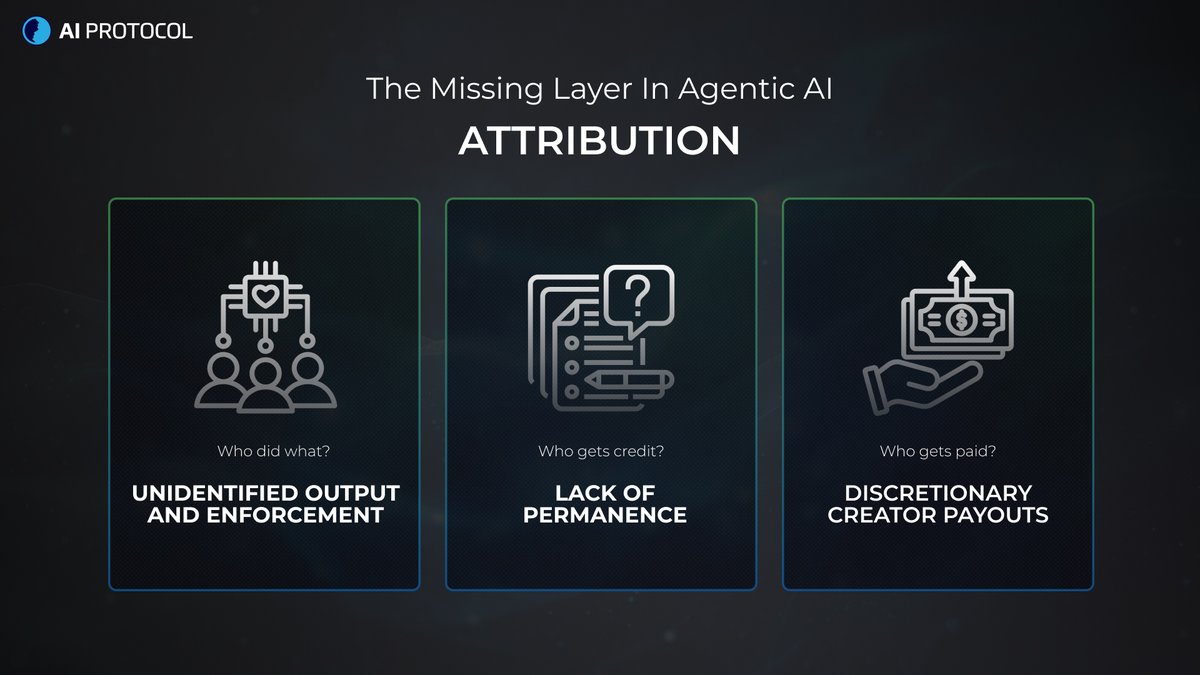
• who is accountable for the behavior after deployment
• how intelligence is verified across systems
• what makes one agent economically more reliable than another
That’s where Soulbound Intelligence (SBI) fits into AI Protocol — persistent identity history that makes governance enforceable.
No protocol layer → no trust layer
No trust layer → no economy
3
8
149