
Bowling| Brewers|High ⛪ Prot|Philosophy of Religion & Epistemology |Christian thinker| Swinburne Fan|Trinitarian Universalist|Bayes or Bust
Joined June 2014
- Tweets 25,377
- Following 2,889
- Followers 660
- Likes 141,259
3,107 Photos and videos






Τim retweeted

Jun 1
Pretty much all of the prominent voices who supported the Iran War assured us it would be over by now. None of them will admit they were wrong. Even less will they admit that their initial assurances were based on nothing but their own wishcasting. This whole shitshow has been an enormous waste of time and resources and our country has not benefited from it at all. Its advocates have moved the goal posts repeatedly and have even to this day refused to clearly articulate what constitutes a victory and how we’ll know that it’s been achieved.
3,758
4,611
53,128
2,715,567

May 26
And the series wasn't even good.
May 26

Clone wars was genuinely the worst thing to ever happen to Star Wars.
The series was enjoyable, I'm not saying it wasn't.
But it started the downfall. It is the Halo Reach of Star Wars and that is NOT a compliment.
1
84

Can we get that average up to 200, @BRiCEcTuRANG?

Uncovered a Brice Turang bowling story tonight in the @fox11news archives. 🎳
NEED the follow-up from our friends down in MKE to see if he's kept up the 180 average.
6
76
10,640
Τim retweeted

May 14
Redeeeming Richard Nixon is one of the most significant cultural and spiritual projects of our era. The coup against him is the skeleton key of deep state machinations and conspiracies with the fake news media.
May 13

There is a person out there who’s main job is making Richard Nixon look very cool, using the native media format of the 21st century, the edit.
This person is going to have more impact on American politics than most congressmen.
155
854
7,692
303,972
Τim retweeted

National treasure
126
1,050
12,704
1,670,470

Τim retweeted

May 5
Celebrate American Family Field’s 25th Anniversary with an Alumni Legends Game featuring Brewers alumni, discounts, autographs, & more
Legends include Ryan Braun, Yovani Gallardo, Geoff Jenkins, Mike Moustakas and Ben Sheets
→ brewers.com/legendsgame

9
29
302
39,405
Τim retweeted
Apr 26
Leftists have tried to kill the president three times now. They killed Charlie. They've shot up churches and Christian schools and rioted in the streets. They are the party of terrorism. Political violence comes from one side. How much longer will we allow these people to wage war on the country?
3,290
16,128
84,759
2,168,542
Apr 23
Quiet, bears
Apr 23

The crash is going to be unprecedented.
Pray for your friends and family that panic bought in the last 6-7 years.
They are going to get crushed.
1
1
71
Τim retweeted

Apr 22
NEW: Researcher working on anti-gravity technology, whose death was ruled a su*cide, sent a text just one month before her death saying she would never kill herself, according to the Daily Mail.
Amy Eskridge was found with a gunshot to the head in Huntsville, Alabama.
Eskridge told a friend that she had been the target of multiple physical and psychological attacks, including being a victim of an “energy weapon,” before her death.
“If you see any report that I killed myself, I most definitely did not. If you see any report that I overdosed, I most definitely did not. If you see any report that I killed anyone else, I most definitely did not,” she reportedly said in a text in May 2022.
In an interview before she died, Eskridge said she was getting scared and said she needed “to disclose soon.”
1,168
14,282
72,337
4,528,935
Τim retweeted

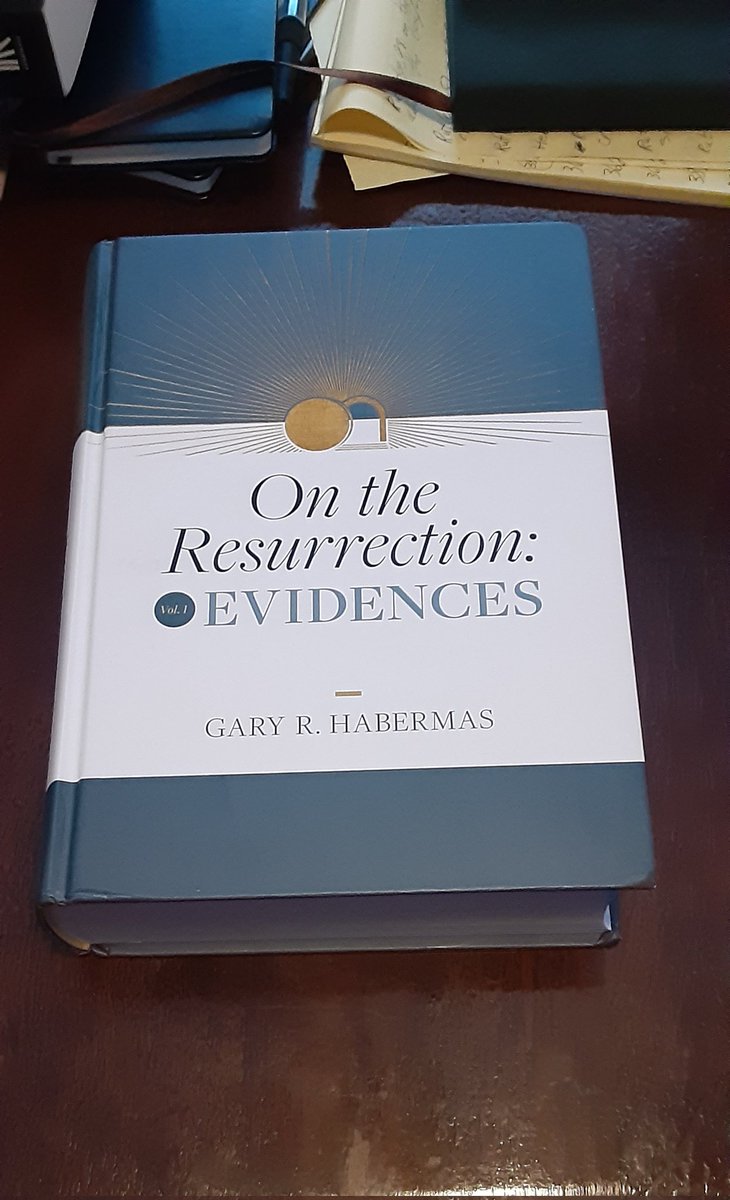
A brief outline of the evidences that convince me of the probable truth of Christianity.
To begin with, there is strong antecedent evidence (such as fine tuning) for the existence of God. And then there is substantial direct evidence for the reliability of the New Testament:
1. Every ancient source who comments on the matter agrees that the Gospels were written by their traditional authors: Matthew and John by the disciples of those names, Mark by a disciple of Peter as a record of Peter's preaching, and Luke by the companion of St. Paul. This is true up until the skeptic Faustus in the 4th century. And even Faustus reports no rival tradition of authorship. (There is also broad though not unanimous agreement on the traditional order of Matthew, Mark, Luke, John.) These traditional authors would all be in a good position to accurately report the life of Jesus, as either eyewitnesses of the events of the Gospel or people with access to eyewitnesses.
2. Counterarguments in favor of late authorship by non-eyewitnesses tend to rely on more subjective judgments about what a particular author writing at a particular time would be likely to write, or how one author would copy another source, and so on. These kinds of judgments seem to me less reliable than the testimony of ancient sources.
3. There are many specific "external" evidences of the general reliability of the Gospels-Acts: specific details about 1st-century Judea (geography, politics, etc.) that the Gospels-Acts get right that would be difficult to get right if they weren't writing real history. This is especially true for Luke-Acts.
4. There are more general correspondences of the Gospels-Acts with what we know of the historical period that would be unlikely to result except from historical accounts. For example, there is a close correspondence between the frequency of Judean names around that time in other sources and their frequency in Gospels-Acts: common names are common in both, rare names are rare in both, etc. For instance, Mary was the most popular female name at the time and it is the most common female name in Gospels-Acts. The level of correspondence here is much different from what we see in, for example, modern novels about the period like Ben Hur.
5. There are "internal" evidences of textual reliability, especially "undesigned coincidences," where two or more texts fit together in a way unlikely to result from copying but likely to result from independently reporting history. For example, all four Gospels tell us of the feeding of the five thousand, and they all tell us that Jesus turned to his disciples to ask, “Where shall we buy bread for all these people?” Only John 6, though, tells us that he addressed this question to a particular disciple, namely Philip -- a minor disciple who is hardly mentioned elsewhere in the Gospels except in the calling of the 12. Meanwhile, Luke 9 tells us that the feeding took place in the town of Bethsaida, something John doesn’t tell us. And in John 12, in a completely different context, we independently learn that Philip was from Bethsaida. If the Gospels are reporting history, these other passages explain why Jesus spoke to Philip and not one of the other disciples: it's natural that Jesus would ask someone from Bethsaida where to buy food if they were in Bethsaida. But we wouldn't expect these details to coincide if John was copying Luke, or they were independently copying a third source (unless perhaps that third source was an extremely detailed novel with the level of care and precision of the Lord of the Rings; but that kind of text didn't exist at that time).
6. When we look at the apocryphal Gospels, we find their character to be very different from the canonical Gospels on the above scores. Even at a superficial level, they rarely go into similar detail about people and places, and when they do they almost always pick famous people or places like Peter or Jerusalem.
7. The above suggests a backdrop of the Gospels-Acts being authored by highly reliable and careful historians. Notably, some of the evidences for reliability involve miracles, like the feeding of the five thousand. With this background, the testimony of the Gospels, not to mention the other books of the New Testament, in favor of the resurrection makes this particular miracle highly probable. The empty tomb, the appearances of Jesus to the apostles, the conversion of St. Paul, the willingness of the disciples to go to their deaths in attestation of the resurrection, and the rapid growth of the early Church all contribute to this case. But a pop-apologetic minimal facts arguments is liable to mislead inasmuch as it presents these facts as isolated evidences rather than against the above backdrop for the reliability of the New Testament.
Taken together, I think the evidence for the general reliability (=/= inerrancy) of the New Testament is extremely strong, including in its miracle reports. Various Christian denominations add a lot more to this in terms of doctrine, of course. But I think the above makes it highly probable at least that the ancient Christian creeds are approximately true.

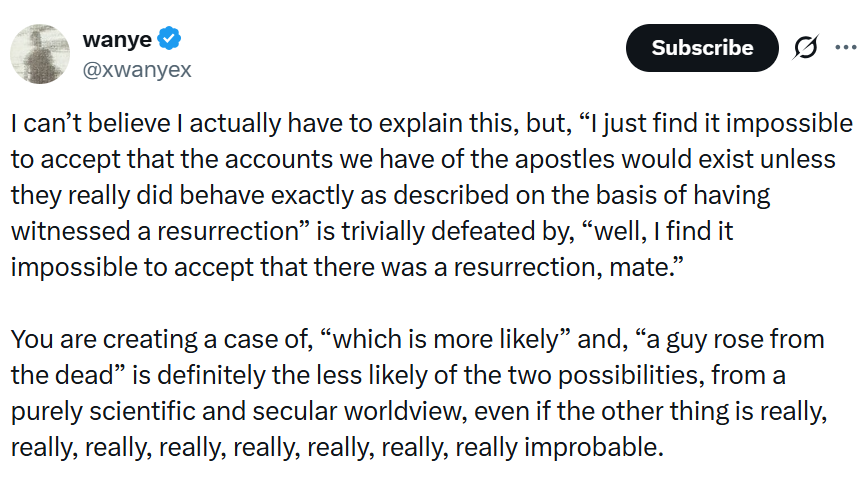
This is essentially Hume's argument: that claims to a miracle are mistaken is always more probable than that a violation of an otherwise uniform law of nature actually occurred.
But there's no viable theory of probability on which this principle comes out true. For any prior probability that is not 0, it is in principle possible to get evidence that raises that probability to above .5. We can see this intuitively because Hume's principle would rule out the possibility of ever disconfirming a previously uniformly confirmed scientific theory. For a simple example, we would have to conclude that European explorers were mistaken in reporting black swans in Australia, since all previously observed swans had been white.
That doesn't mean this particular evidence is sufficient to raise the probability of the resurrection above .5. But there's no in principle impossibility to getting evidence that makes it more likely that a man rose from the dead than that that evidence is misleading in some way.
13
25
166
30,243
Τim retweeted

Apr 7
I wish Trump brought this heat he has against Iran against our own deep state here in America
We can bomb civilian infrastructure in Iran but we can't even arrest a single rogue judge here in America
Not a single deep state imprisonment
Not even the insurrection act
711
2,609
13,437
127,606
Τim retweeted

Mar 30
If you told 2008 me that the 2026 Brewers would have this energy, and that the team would have been bringing this energy pretty consistently for like the last decade, I would have fainted.
Yeah yeah yeah no World Series but this is a golden age

12
28
1,254
32,179
Τim retweeted

Mar 29
On October 2, 2016 the Brewers woke up 72-89, long out of playoff contention. They beat the Rockies 6-4 that day. They’ve played 1358 games since then, and only 2 were from outside playoff contention - October 1, 2017 @ St Louis and October 5, 2022 vs Arizona
8
25
641
24,953
Τim retweeted

Mar 28
boys are so easy they just want to be asked what their walkout song would be if they were a closer
331
1,005
22,191
955,378
Τim retweeted
Mar 28
The choice is mass deportations but then you look mean. Or it’s that. There is no middle ground. It has been tried. But until adult men stop getting tummy aches over ICE, then yes, that is America. And it will get worse.
41
216
3,046
32,472
Τim retweeted

Mar 27
Go to that baseball game alone. Treat yourself to that good seat with the perfect view. Make friends with the strangers around you. You won’t regret it. Life is too short to wait for others to do things that will make you happy.
214
1,005
11,056
285,231
Τim retweeted

Mar 28
eyes were invented specifically to watch Mike Trout
51
580
4,283
100,647
Τim retweeted

Mar 23
Cadbury egg discourse prompts me to remind everyone that there is much more historical evidence for the death and resurrection of Christ than there is for Eoster worship of any kind.
31
43
891
47,964
Mar 24
Yeah, he's out to lunch, sadly. With Tucker and Barnes Baris gone, I've got pretty much no one who represents my values in the podcaster class.
Mar 24

Final straw? I guess. Tucker has been saying stupid things and hosting low class ignoramuses for at least 18 months.
But I challenge anyone to defend any of this sophomoric bullshit. It’s fine to agree to disagree on various policies, but at a certain point, you gotta move on.
1
55