🇹🇩
Joined December 2024
- Tweets 4,884
- Following 43
- Followers 85
- Likes 6,657
649 Photos and videos




TimeTiger retweeted

4 Jun 2025
4
10
56
3,648

TimeTiger retweeted
2 Jun 2025
11
84
282
7,526

TimeTiger retweeted
1 Jun 2025
🚀🚀👍👍👍🤡🤡
The movement of those toys... 🤣🤣
47
78
372
33,186


TimeTiger retweeted
31 May 2025
Sorry to disappoint you.

32
133
730
15,786
TimeTiger retweeted

31 May 2025
44
31
220
22,187

TimeTiger retweeted

30 May 2025
Globers: Do YOU think an equatorial mount proves the motion of the earth?
Lesson time:
What Does the Equatorial Mount Actually Do?
It compensates for the apparent motion of the sky.
It allows you to track stars and planets using only one axis of rotation.
The polar axis is aligned with the celestial pole (north or south, depending on hemisphere).
But here’s the critical insight: the equatorial mount is a tool designed to match the observed motion of the sky, not to determine the cause of that motion.
Kinematics vs. Dynamics
Let’s clarify these two concepts, because they are at the heart of the issue:
Kinematics is the study of how things move, without regard for why they move—just positions, velocities, and accelerations.
Dynamics is the study of why things move, considering the forces and masses involved.
When you use an equatorial mount, you are dealing with kinematics. You are matching the observed path of the stars—circular arcs around the celestial pole—with the motion of your telescope. The mount’s job is to move in such a way that the telescope’s view matches the apparent motion of the sky. It does not, and cannot, tell you whether the stars are moving or the ground beneath you is moving. It only matches the relative motion.
Can You Tell if the Sky is Moving or the Ground is Moving?
From the ground, all you can observe is the relative motion between the sky and the Earth. The stars appear to rotate around the celestial pole once every 24 hours. But is it the sky that is moving, or is it the ground?
If you assume the Earth is spinning, then the sky is “fixed” and the ground rotates, making the stars appear to move.
If you assume the Earth is stationary, then the sky itself rotates around the observer.
Both models are kinematically equivalent—they describe the same observed motions using different reference frames. The equatorial mount simply aligns itself to the axis of this apparent rotation, regardless of which “side” is moving.
You can construct a perfectly functioning equatorial mount whether you believe the sky is moving or the Earth is moving. The geometry is identical; what changes is your interpretation of the reference frame.
The mount does not measure forces or accelerations that would be required to demonstrate Earth’s motion dynamically. It only matches the apparent motion.
23
17
65
5,362
TimeTiger retweeted

30 May 2025
マリオット(距離:40km)からポンチャートレイン湖のコーズウェイをズームイン。遠くまで見渡せるので、大地(地球)に曲率があるかのようです!
2
12
82
4,147
TimeTiger retweeted

28 May 2025
When Globlins think they see the curve. 🤪 And it’s just a surface mirage that disappears with height from the humid surface. 💯
20
34
134
5,245
TimeTiger retweeted
27 May 2025
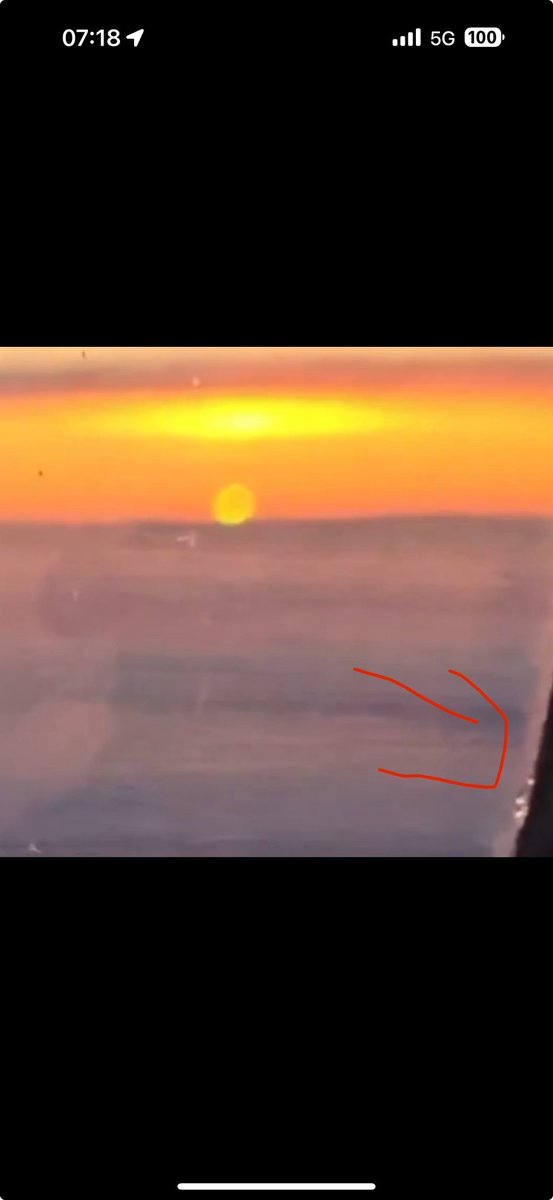
“The sun doesn’t fade out.”
(And yes, I was out there)
The sun:
27 May 2025

The sun doesn’t fade out. Genuinely you’ve never been outside and it shows. You can clearly watch the bottom of the sun all the way to the top of the sun completely go under the horizon. Also you are blatantly fucking lying. The sun doesn’t “fade out” here. It goes out focus.
15
7
79
3,553
TimeTiger retweeted
27 May 2025
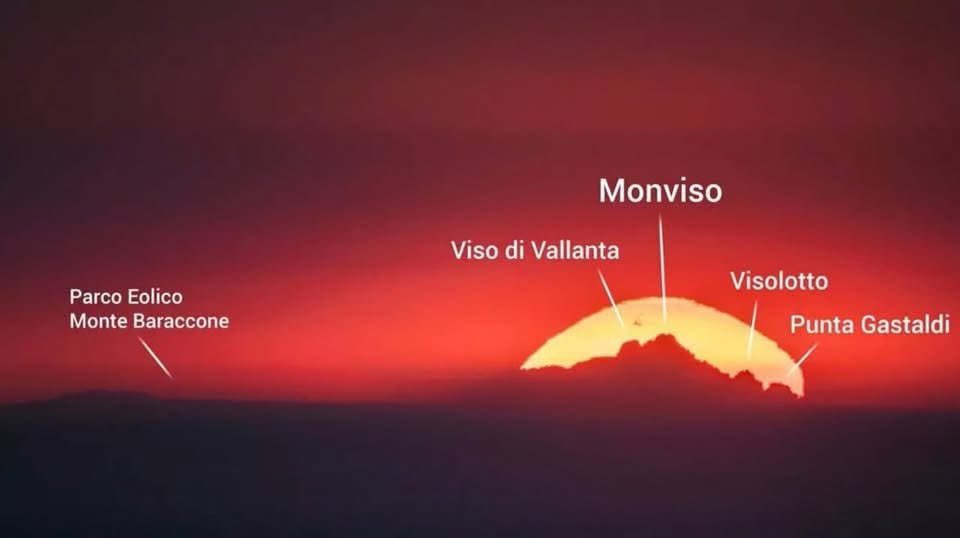
If a mountain’s elevation is 3,841 meters or 12,602 feet and you observe this mountain, at an elevation of 400 meters or 1312 feet (above sea level), from a distance of 296 kilometers or 184 miles, how much of this mountain do you think that a ball-shaped earth’s curved surface will occlude from you? The answer is that the curvature (of a ball-shaped earth’s surface) should bury the peak of this mountain a good about 120 meters or 390 feet below this curved surface.
Despite the foregoing stats and computations, the screenshots below show that practically the entirety of Monviso (which is the mountain about which I have spoken in the preceding paragraph) is nonetheless visible to an observer (at the observation elevation of 400 meters or 1312 feet, from a distance of 296 kilometers or 184 miles)! These two screenshots are excerpted from a video, whose URL is youtu.be/wEWVGaqH6W0 (this video is only one and a half minutes long).
In other words, even though the peak of Monviso should be about 120 meters or 390 feet below a ball-shaped earth’s curved surface (for an observer at the aforementioned observation elevation and distance), practically the entirety of this mountain is nonetheless visible to such an observer! If you still believe that the surface of the earth is curved (in such a manner as to form an approximate ball whose average radius is approximately 4,000 miles), how would you explain this serious mismatch between the ball-shaped earth model and observation?
Would you say, like virtually every other ball-shaped earth believer retorts, that this serious mismatch, between the ball-shaped earth model and observation, is caused by atmospheric refraction? If this is how you would explain this terrible, unacceptable mismatch, what model of atmospheric refraction would account for the monumental size of the mismatch? (By the way, this mismatch entails seeing practically the entire mountain’s height, even though even its peak should not be visible to you.)

28
18
88
6,460