
independent research & speculation.
Joined June 2020
- Tweets 2,346
- Following 2,213
- Followers 2,941
- Likes 57,932
386 Photos and videos
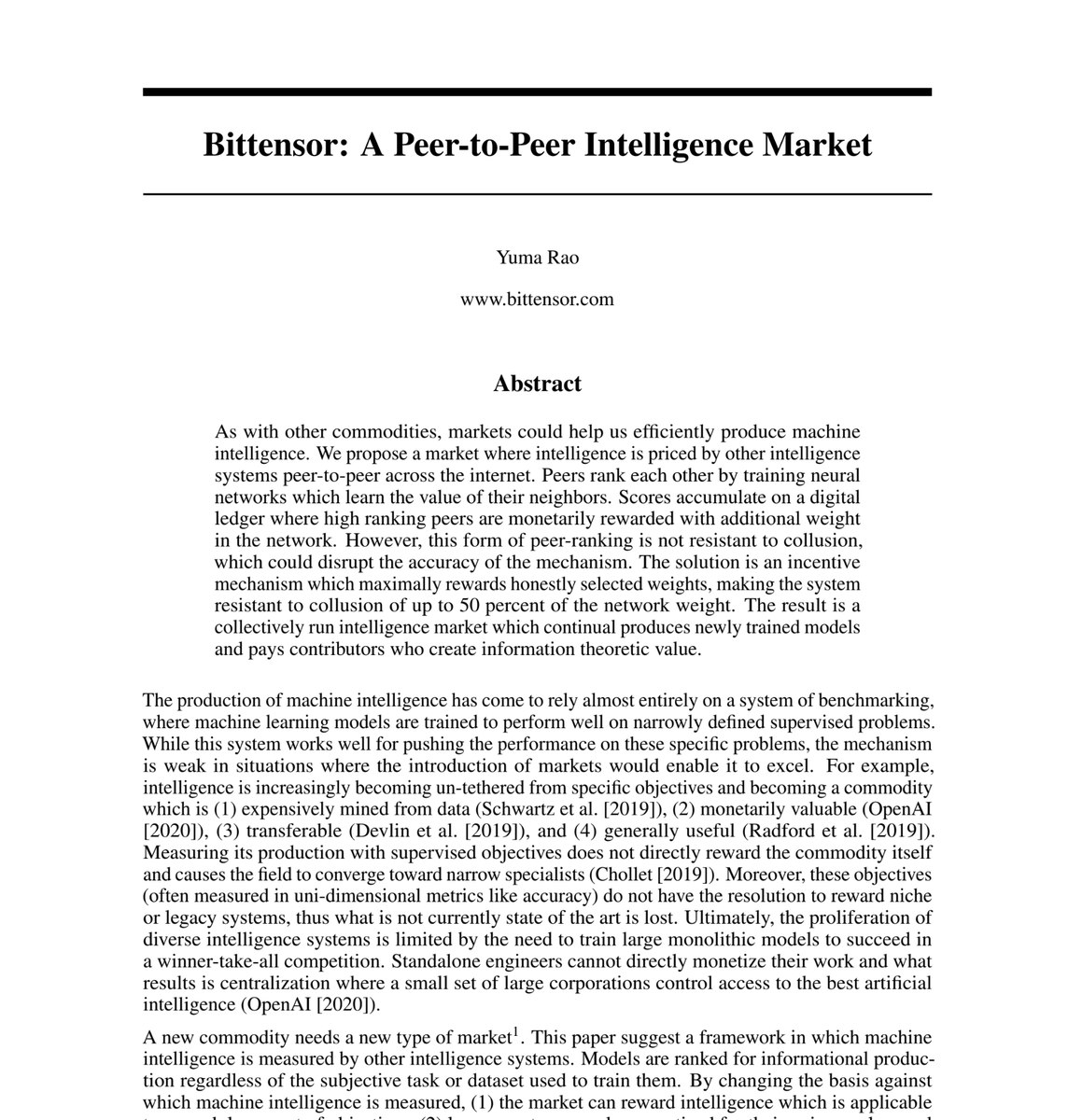








We just completed the largest decentralised LLM pre-training run in history: Covenant-72B. Permissionless, on Bittensor subnet 3.
72B parameters. ~1.1T tokens. Commodity internet. No centralized cluster. No whitelist. Anyone with GPUs could join or leave freely.
1/n
215
910
6,198
1,869,929
Timo retweeted

20 Oct 2025
Crypto AI is such a lame ass way to talk about something as profound as incentive computing
Bitcoin AI isn’t crypto ponzinomics catching a buzzword, agent casinos, or smart contract adaptors.
Its understanding that computing with money is as significant as the transistor.
26
66
432
36,366

♓️
12 Aug 2025

put your energy into forces driving evolution’s innate ascent
Life’s climb toward greater complexity, order, and cognition now unfolds in cyberspace
the next great frontier.
bet on the universe’s strongest trend
Torus.

7
1,022
Timo retweeted

5 Jun 2025
6
17
60
6,321
though harder to see the value at front, solving an abstract problem means enabling the solving of any specific problem that can be expressed through the abstract problem
the value this enables over time generally vastly surpasses the solving of a single specific problem. especially if you set a direct incentive towards searching the space of the abstraction for value in parallel across an open set of searchers
crypto and AI people should understand this best
19 Mar 2025

Bittensor is highly confusing because instead of building a single solution to a single problem, like “decentralized inference” we realized way back in 2020, that we needed to build the meta mechanism which could express all of them.
2
10
45
4,450
Timo retweeted

17 Mar 2025

17 Mar 2025


326
113
3,935
1,327,150

Timo retweeted
11 Feb 2025
The promise of crypto is that we can bring freedom, barrierlessness, and competition to every single cog in the machines we live inside.
Fluid ownership, fluid control, fluid production.
The answer to fears of AI is this, not top down censorship or unchecked acceleration, but human unity with the machines.
48
84
392
20,445
Timo retweeted

24 Jan 2025
Everybody only talks about the AI race as humanity’s path forward
We believe humans themselves can push the boundaries of “superintelligence” with cutting-edge science and tech
So we’re proud to announce our partnership with @BioProtocol to accelerate a new cognitive era
🧵
24 Jan 2025

Shape the future of nootropics with your data, ideas or capital
Introducing @NootropicsDAO_, a BioDAO for cognitive enhancement 🧠
Launching soon on Bio's new launchpad
Here's why we're so excited about this DeSci community! 🧵👇
13
18
87
22,649
Timo retweeted
20 Jan 2025
DEMO TIME
SupGen is a generative coding AI... except it isn't an AI.
There is no model, there is no pre-training. You just give it some examples, and it gives you a program. It runs locally, in a single-core CPU. Oh, and it can also prove theorems.
Here's a demo, including a brief TT intro.
(The synth examples start at the 6 min mark.)
59
121
1,104
87,734
useful framework to better understand modern culture and humanity in general
17 Jun 2024

This remains one of my least read but most important publications
medium.com/p/d9854c8b27b5
1
3
11
4,313
Timo retweeted
23 May 2024
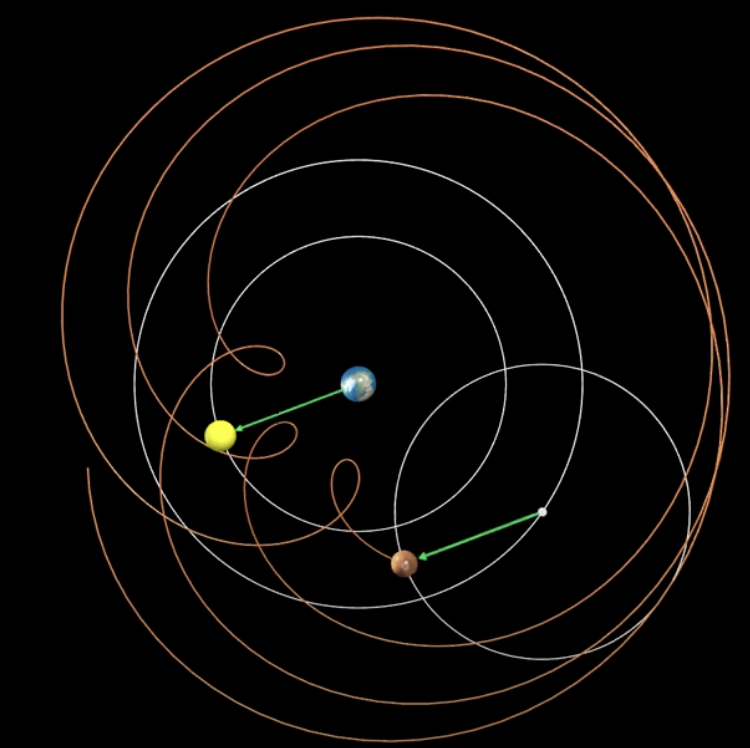
Randomly came across this comment, in a video about epicycles:
> it's amazing how much simpler the truth can be than you trying to bend over backwards to make reality fit your preconceived notions
By no means I'm saying that I'm right; I'm just offering you an unusual perspective. When I read that comment, I couldn't help but connect geocentrism to one modern concept:
*the function*
This isn't just about programming paradigms, it is broader than that. At the heart of mathematics lies the calculus, and, at its core, lies the function: a deeply ingrained, core axiom of all human sciences; a concept as universal and unescapable (for the modern mind) as the idea that the Earth was the center of the universe (for these back then).
But what if functions are just... the wrong point-of-view?
If you just go ahead and try to implement a "function evaluator", complexity and ugliness unavoidably emerge in ways that, to my eyes, look suspicious - not unlike epicycles. Despite decades of efforts, there isn't a single implementation of beta-reduction that feels canonical. From closures, to sharing graphs, to supercombinators or to bottom-up beta-reduction; it is hard to look at any of these and not feel like they're artificial, or, at the very least, human-engineered to an extent. What does that hint?
There is an exception, though. In 1990, Lamping described an algorithm capable of evaluating λ-terms optimally, in the sense that it would always perform the minimal amount of beta-reductions. This algorithm was not just fast - it was elegant, beautiful and natural in a way that, to my eyes, felt canonical. Yet, it had one problem: in its most natural form, it didn't cover all λ-terms. Fortunately, Lamping himself found a solution; an extension to the "abstract" fragment of his algorithm, that allowed for full functional coverage. Yet, such extension made the system considerably more complex and, arguably, less elegant. What does that hint?
Now, one could argue that implementation doesn't matter, and isn't an indicative of truth. Perhaps functions are just hard to compute fast, but, so what? They still are, mathematically, the right framework to model nature - right? That's a point of view that I think most mathematicians would hold. Yet, if that was the case, then, how came functions keep breaking math itself, over and over?
In 1901, Russel discovered his infamous paradox, which broke the original set theory, showing that unrestricted comprehension was inconsistent. In 1931, Gödel's incompleteness theorems showed that any consistent formal system containing arithmetic is incomplete. In the 1930s, Church, Kleene and Rosser discovered the untyped lambda calculus was inconsistent. In the 1940s, Curry discovered a paradox in combinatory logic. In the 1970s, Girard discovered that the polymorphic lambda calculus, also known as System F, was inconsistent with unrestricted comprehension, leading to the development of predicative type theories.
In fact, up to this date, modern proof assistants such as Lean and Coq now include a concept of "universes" - an annoying restriction that segments the language in many different layers, breaking modularity and making it terrible to work with in many occasions. I don't think anyone would argue they feel natural or welcome - rather, they're an ugly inconvenience we've learned to live with, as they're a solution to Russel's paradox. Even that isn't enough - positivity check, structural recursion. Many other "inconvenient restrictions" must be carefully placed to avoid breaking the universe and deriving an inconsistent type theory.
But what does that all hint?
Well, here's the thing - the amazing coincidence nobody talks about. All - absolutely all - the inconsistency proofs we found so far, when translated to type theory, map to a λ-term that lies, in an amazingly cosmical coincidence, in the set functions that can't be evaluated soundly by Lamping's abstract algorithm. To me, this feels surprisingly close to a civilization finally figuring out a way to model the solar system based on elegant elliptical orbits, but failing to get the hint that this implies the sun is at its center. So, they keep trying to make the geocentric model work by adding more and more complex epicycles, instead of considering that perhaps their fundamental assumption - that the Earth is the center of the universe - might be incorrect.
By all means, I could be wrong. Exploring this point of view did lead to HVM and Bend, but these still have a long, long way to go before they're stablished and respected as valuable alternatives to existing languages and architectures. From the mathematical standpoint, abandoning the full function in favor of lighter, affine variants (or, if you're brave, raw interaction combinators) would allow one to construct a consistent type theory with axioms that feel morally wrong, such as type-in-type, insanely dependent functions, and the most elegant proof of function extensionality that I've ever came across - although, at that point, I concede "function" might be a huge misnomer. Regardless, I do wonder if important discoveries would be unlocked once we look at this place, and I personally bet interaction combinators will be heavily important in the future, once we exhaust all ideas we have to making circular epicycles. But that's just my unorthodox point of view.
33
28
462
50,494
Timo retweeted

23 May 2024
i think we should try to build better infrastructure and technology rather than trying to gaslight people about the shitty 20th century holdovers while trying to demonize and ban the people attempting to build something better
3
5
72
5,439
Timo retweeted
21 May 2024
the 21st century needs infrastructure that is structurally more sound and designed to be incentive compatible and resilient in order to face new challenges and build stronger institutions and facilitate coordination. those stuck in the 20th century often confuse the efforts to build this new infrastructure as “defection” or seeding distrust in the old systems
2
13
86
11,153
Timo retweeted
16 May 2024
RELEASE DAY
After almost 10 years of hard work, tireless research, and a dive deep into the kernels of computer science, I finally realized a dream: running a high-level language on GPUs. And I'm giving it to the world!
Bend compiles modern programming features, including:
- Lambdas with full closure support
- Unrestricted recursion and loops
- Fast object allocations of all kinds
- Folds, ADTs, continuations and much more
To HVM2, a new runtime capable of spreading that workload across 1000's of cores, in a thread-safe, low-overhead fashion. As a result, we finally have a true high-level language that runs natively on GPUs!
Here's a quick demo:
463
2,017
15,383
2,867,646
Timo retweeted

12 Apr 2024
Thrilled to announce @crux081208 and I are launching @MacrocosmosAI today - building on Bittensor. We’re building an amazing team, so reach out if you’re passionate about democratising intelligence, and building AI for all humankind. Thanks to @opentensor and @const_reborn
17
21
71
38,145
if you are long $TAO, you should be long its evolutionary trajectory. historically that position has outperformed.
it makes more sense than with most other protocols because its more market driven than most other protocols.
i mean, its literally a market of markets
1
8
92
5,955