
Southerner far from home, advocate for equitable economic opportunity accessible to all Americans
Joined February 2011
- Tweets 8,725
- Following 1,783
- Followers 882
- Likes 9,948
136 Photos and videos













15 Nov 2024
Just want to let my longtime tweeps know that I’ve left X and stopped posting here. I moved over to Bluesky, which is fun, informative, high-engagement, and so far entirely Nazi-free. techradar.com/computing/soci…
1
55
1 Nov 2024
I'm raising a toast to @tomamoran, New Jersey's best political columnist. He's about to be laid off with the rest of the Star-Ledger's editorial staff. It's a huge loss to NJ, and I hope he lands somewhere that enables him to pick up the torch/cudgel again.
1
1
115
1 Nov 2024
Moran has not addressed the impending layoff (so far as I know), but the vilest right-wing hacks in New Jersey rushed to post sneering comments on his most recent tweet. I'm sure his ankles are bleeding profusely. x.com/tomamoran/status/18516…
30 Oct 2024

Other Elon Musk, is there a bigger knucklehead in America? Both in key roles if Trump wins.
1
56
1 Nov 2024
30 Oct 2024

The Star-Ledger is nixing its editorial board as part of its print shutdown. Editor Tom Moran, columnist Paul Mulshine and editorial board members Julie O'Connor and Dave D'Alessandro's jobs are all "impacted," according to the company, i.e. laid off. 🔒 subscriber.politicopro.com/a…
36
Tom Hilliard retweeted

30 Oct 2024
The Star-Ledger is nixing its editorial board as part of its print shutdown. Editor Tom Moran, columnist Paul Mulshine and editorial board members Julie O'Connor and Dave D'Alessandro's jobs are all "impacted," according to the company, i.e. laid off. 🔒 subscriber.politicopro.com/a…
47
38
99
64,190
16 Oct 2024
This is quite shrewd.
16 Oct 2024

President Zelensky has released his plan for victory, which has been met with varying degrees of acceptance. Regardless of differing opinions, we now have a clearer picture of what the President is aiming for.
I don't intend to criticize his plan - after all, it offers some viable options that could benefit Ukraine if implemented. However, given my own skepticism about the West's willingness to admit Ukraine into NATO, I’ve been considering my own "roadmap," which I’d like to share here. This is not intended as a critique of the current plan by our leader, but rather a personal take offered for entertainment purposes:
The core of the strategy should focus on achieving superiority in several key areas: industrial, technological, command structure, and troop morale. The goal is to make the war increasingly unviable and futile for Russia, thereby forcing an end to the war on terms favorable to Ukraine and its partners. At the very least, this should put Ukraine in a position to negotiate with Russia on equal terms when the time comes.
A key step toward this is the creation of a joint military-industrial complex, integrating Ukraine into the West not as a dependent neighbor seeking aid, but as a critical player in Europe’s military production and technology sectors. Specifically, Ukraine could become a hub for military production, especially in areas like unmanned vehicles, which are becoming increasingly vital in global defense, particularly for Europe, whose military-industrial base remains somewhat dormant.
Let's take a look at it more specifically:
External policies:
1. Defense Production Agreements
Ukraine, alongside European nations, the U.S., and potentially Canada, Japan, South Korea, and Australia, should create a series of bilateral defense production agreements. These agreements would establish joint military production facilities for various arms and munitions, from IFVs (Infantry Fighting Vehicles) to drones, missiles, mortars, and artillery ammunition. The construction of these facilities could be financed on credit, with the expectation that frozen Russian assets or future profits from arms sales would pay off the debt. Placing these facilities in Europe would boost local employment and stimulate regional production, with a percentage of output allocated to the host countries.
2. Missile Production Joint Venture
Ukraine’s Pivdenmash plant was a critical hub in the Soviet missile program, producing everything from tactical to intercontinental ballistic missiles. A joint venture between Ukraine and a country like France or the UK would enable faster development and larger-scale production of Ukrainian missiles. Final assembly could occur within Ukraine, and the missiles’ performance could be tested against common Russian defense systems like the S-300 and S-400, giving them market value.
This would also allow Ukraine to strike targets inside Russia without needing permission from other nations, as the missiles would be domestically produced. If Iran can manufacture hundreds of ballistic missiles, so can Ukraine with the right partnerships.
3. Echeloned Defense Construction
Ukraine should launch a national program to construct high-quality defensive positions, drawing on real battlefield expertise rather than arbitrary lines on a map, which has led to wasteful efforts near areas like Pokrovsk and Kharkiv. This could involve both domestic equipment and machinery leased from the EU, with costs partially covered by Ukraine and the remainder distributed among Western partners.
Japan, which may be hesitant to provide direct military aid but leads in construction machinery, could participate by leasing equipment to Ukraine. A model where Ukraine pays 50% on credit and the rest is covered by Japanese foreign aid could be workable, or at least can be a subject of negotiations between countries.
4. Re-arming Existing Brigades
The Ukrainian General Staff has been horrible in forming new brigades, many of which underperform despite receiving new weapons. Simply handing modern weapons to an inexperienced, uncohesive unit doesn’t work. Aid should be conditional, directed to re-arming existing brigades rather than creating new ones. It’s reached a point where some mechanized brigades only have a handful of functional tanks and IFVs, with the rest even using civilian vehicles due to equipment shortages.
5. Interim Military Aid
While Ukraine builds its defense production capacity with the West, it should receive increased short-term aid in the form of artillery, IFVs, mortars, and air-defense systems. Scaling up local initiatives, such as the drone-based air-defense system, like the one led by Ukrainian activist Sternenko, can help shoot down Russian reconnaissance drones more cost-effectively. This isn’t about liberating Crimea right away but maintaining a solid defense while other strategic objectives are pursued.
Internal policies:
1. De-Sovietization of the Military
Ukraine must overhaul its military’s command and control system, moving away from the Soviet-style top-down hierarchy that stifles initiative. While NATO is also bureaucratic, an external audit could streamline many of Ukraine’s military processes, allowing for more decentralized and responsive decision-making. The practice of high-ranking officials personally directing tactical battlefield operations should end.
2. New Mobilization and Rotation Plan
A new mobilization approach is needed, with planned troop rotations and the ability for soldiers to leave after one year of service. While an immediate mass release isn’t feasible, as it could collapse the frontlines, gradual waves of demobilization can be managed. Those required to serve longer should receive additional compensation. Ukraine should secure deals with Europe and the U.S. to train battalions of these brigades abroad, as was done in 2022-2023 with new brigades. However, training programs must be adjusted to reflect the realities of the war, with Ukrainian instructors providing input alongside NATO standards.
3. Anti-Corruption Measures in Recruitment
The West will not continue its support if Ukraine cannot address the rampant corruption in its military recruitment centers, where those with money and connections can avoid the draft. This has led to an army made up disproportionately of poorer citizens. Ukrainians are increasingly unwilling to serve as cannon fodder in senseless operations, often directed by Soviet-minded commanders who prioritize saving face over soldiers’ lives. Ukraine cannot afford to treat its troops the way Russia does. Ukraine should also focus on refitting existing brigades, rather than filling numerous new units, creating an artificial shortage of manpower on frontlines.
4. Veteran Support Program
While there are efforts to care for wounded veterans, much of this is reliant on private funds, personal connections, and public initiatives. Care quality varies, and some severely injured veterans are left with little government support. Ukraine must implement a much better national program to accommodate the needs of disabled veterans, including making cities more accessible for wheelchair users. The current situation is dire, with some disabled veterans having trouble even leaving their homes. Ukraine can have a joint program with countries that have experience, like the U.S., which has developed extensive systems to support disabled veterans. Proper psychiatric and PTSD care is also crucial. Since this is a humanitarian area, the financing can be located among countries which are willing to help, but are not willing to provide military aid. Just like with previous cases, the cost can be partially covered by Ukraine through frozen Russian funds or even in debt or private funding initiatives. If we want to fix recruitment, we need to show that we care about those who served.
Exit Strategy
If Ukraine can consistently exhaust Russia and strike its facilities with drones and missiles, Russia’s ability to terrorize Ukrainian cities and infrastructure will diminish. Any attack would be met with a counterstrike, making such tactics less appealing for Russia. As Ukraine improves its defense and Russia’s advances become costlier, the economic and military calculus will increasingly favor Ukraine. When negotiations eventually take place, Ukraine must secure security guarantees akin to NATO membership, likely with the U.S. or a coalition of European countries. While NATO membership is preferable, it could face obstacles from countries like Hungary, Slovakia, and even maybe Germany with Turkey, and may not happen in the near future. This approach would allow Russia to claim it stopped NATO’s expansion in Ukraine, while Ukraine secures a protective alliance.
This plan may have its flaws and inaccuracies - after all, it's just a brief roadmap written for entertainment purposes. However, it outlines a potential path for Ukraine to secure a viable exit strategy from the war, while facilitating its integration into the West and the European Union. By doing so, Ukraine could become a valuable and fully integrated member of the Western economic and security framework.
116
10 Oct 2024
Well played, @usatodayDC. I saw this headline and panic-clicked it. Turns out some gambling pros placed new bets that Trump will win PA. Could happen, but not because anything has changed out in the real world. usatoday.com/story/graphics/…
1
42
10 Oct 2024
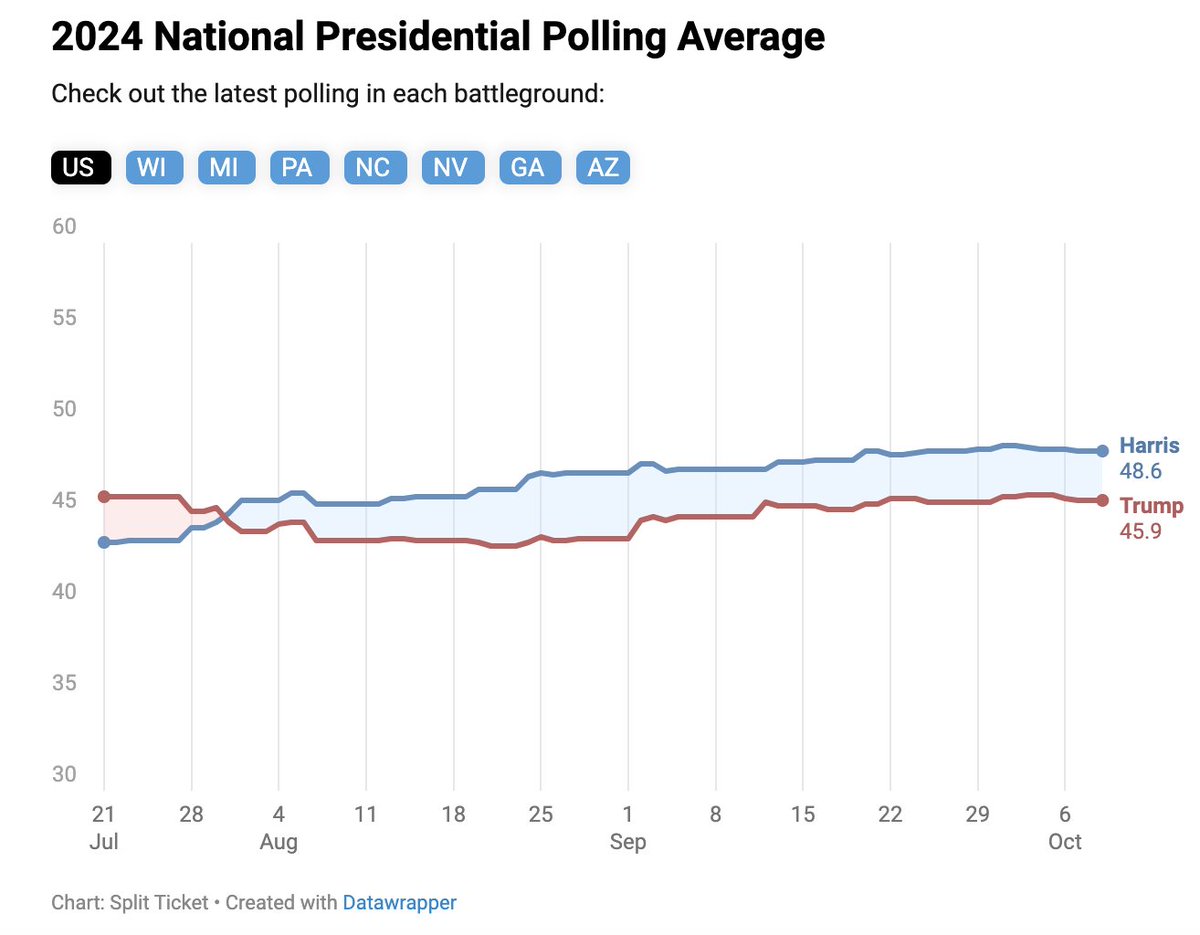
Out in the real world, the Prez race has remained static nationally since the beginning of September, and in PA since mid-September. x.com/lxeagle17/status/18444…

72
8 Oct 2024
Exciting! Everybody should follow PEER and then nitpick their next study, because otherwise why would we be on twitter/X?
8 Oct 2024

It's official! @jdmatsudaira @srcellini and I are launching the PEER Center to help bring together research and policy. Our work will help policymakers understand complex challenges and design effective solutions with the help of researchers, scholars, and economists. #highered
67
5 Oct 2024
So excited @AchieveTheDream DREAM25 is coming to my neighborhood! Pass the word...

Add @AchieveTheDream DREAM25 in #Philly to your list of top higher education conferences to attend in 2025! February 17-21. DREAM attracts more than 2500 #ATDNetwork practitioners, funders, researchers and policy makers. @HigherEdDive highereddive.com/news/top-hi…
3
144
Tom Hilliard retweeted

SNAP restrictions block low-income students from the nutrition support they need to finish or complete college sooner.
College students shouldn’t worry about their next meal. Congress can expand #SNAP access with the #EATSAct #HR3183 @RepJimmyGomez!
time.com/7023432/college-kid…
2
3
3
178
Tom Hilliard retweeted

2 Oct 2024
So profs are complaining that kids wont read long stuff (books) but those same professors at elitist/elite colleges want the #SAT back?
Want “back” the new digital SAT that has reading “passages” that are no more than 150 words.
Make it make sense.
1 Oct 2024

At elite colleges like Columbia, many students are showing up unprepared to read full books. It’s not that they don’t want to, @rosehorowitch writes. Middle and high schools have stopped teaching them how: theatlantic.com/magazine/arc…
7
25
74
9,332
26 Sep 2024
Not a satire. Can’t wait to see this proposal in Project 2029!
26 Sep 2024

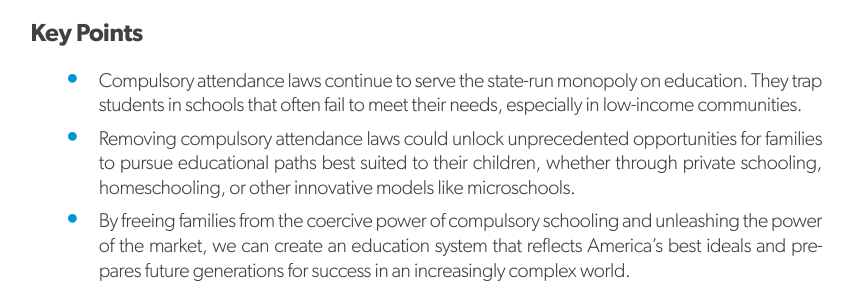
"Public Education: Better If You Don't Have to Do It?"
@DonnellySpeaks's new report for CERN's Sketching a New Conservative Education Agenda considers freeing families from compulsory attendance laws and unleashing the power of the market.
55
14 Sep 2024
It doesn’t seem like too much to ask that a Presidential candidate take an anti-bomb threat position.

Reporter: Do you denounce the bomb threats in Springfield?
Trump: I don't know what happened with the bomb threats. I know that it's been taken over by illegal migrants, and that's a terrible thing that happened.
2
68
5 Sep 2024
Rarely in my life have I encountered a long-form article as well researched and written and, well, just plain maddening as this takedown of the American penny by @caityweaver for @NYTmag. nytimes.com/2024/09/01/magaz…
1
61
Tom Hilliard retweeted

27 Aug 2024
The American Enterprise Institute wants to ban scholars from banding together to defend themselves and their disciplines against political attacks. That's the inescapable impact of this outrageous, petty, nearly unbelievable new censorship proposal. insidehighered.com/news/facu…
6
40
93
26,078
Tom Hilliard retweeted

27 Aug 2024
A recent report from the @USGAO highlights the prevalence of food insecurity among college students and underscores the critical role that SNAP plays in supporting student health. Learn more in a blog by FRAC's Irene Lewis. frac.org/blog/food-fuels-fut…
2
1
218
26 Aug 2024
Bookmark!
26 Aug 2024

Everyone is growing up 🥹 and making me proud 💪🏻 chalkbeat.org/2024/08/26/mee…
1
47
20 Aug 2024
This is remarkable.
19 Aug 2024

BREAKING: Tim Walz just spoke at Aliquippa High School’s Football Practice. That Walz can walk into a football practice and communicate like this makes him one of the strongest communicators in the Democratic party. Retweet so all Americans see this.
2
80