
Labour supporter. Satire, facts, delivery & hypocrisy. Against manufactured rage, billionaire politics and division. #LessNoiseMoreDelivery
Joined October 2011
- Tweets 31,994
- Following 1,364
- Followers 3,515
- Likes 17,833
2,892 Photos and videos



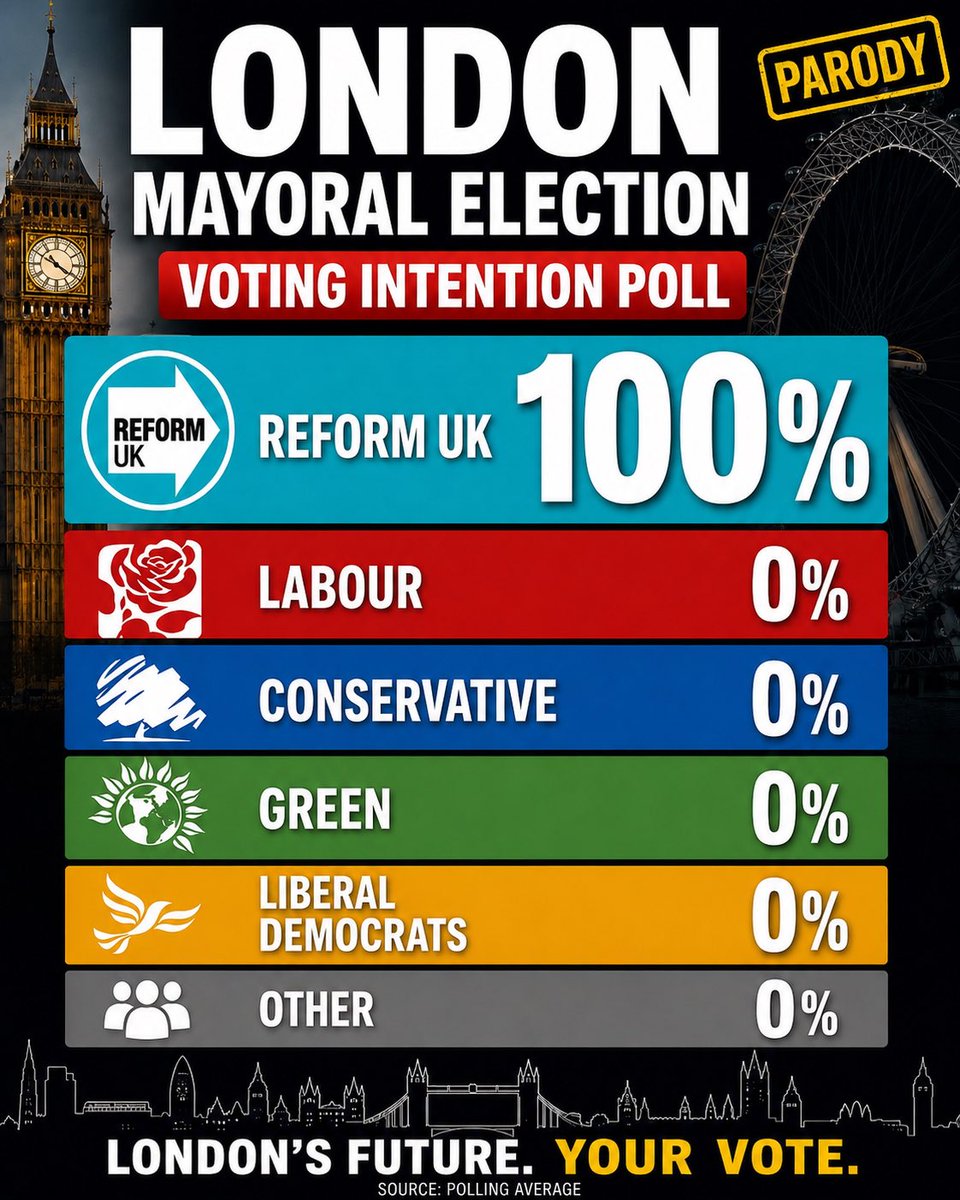

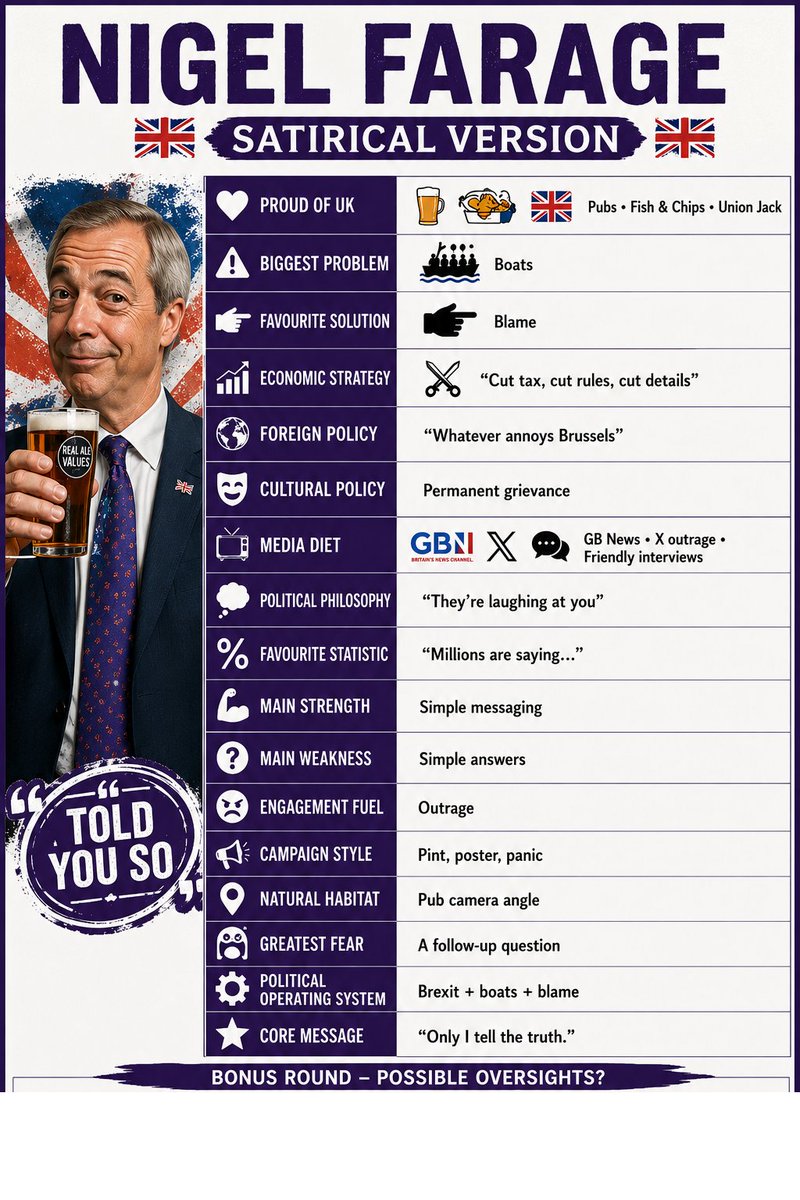
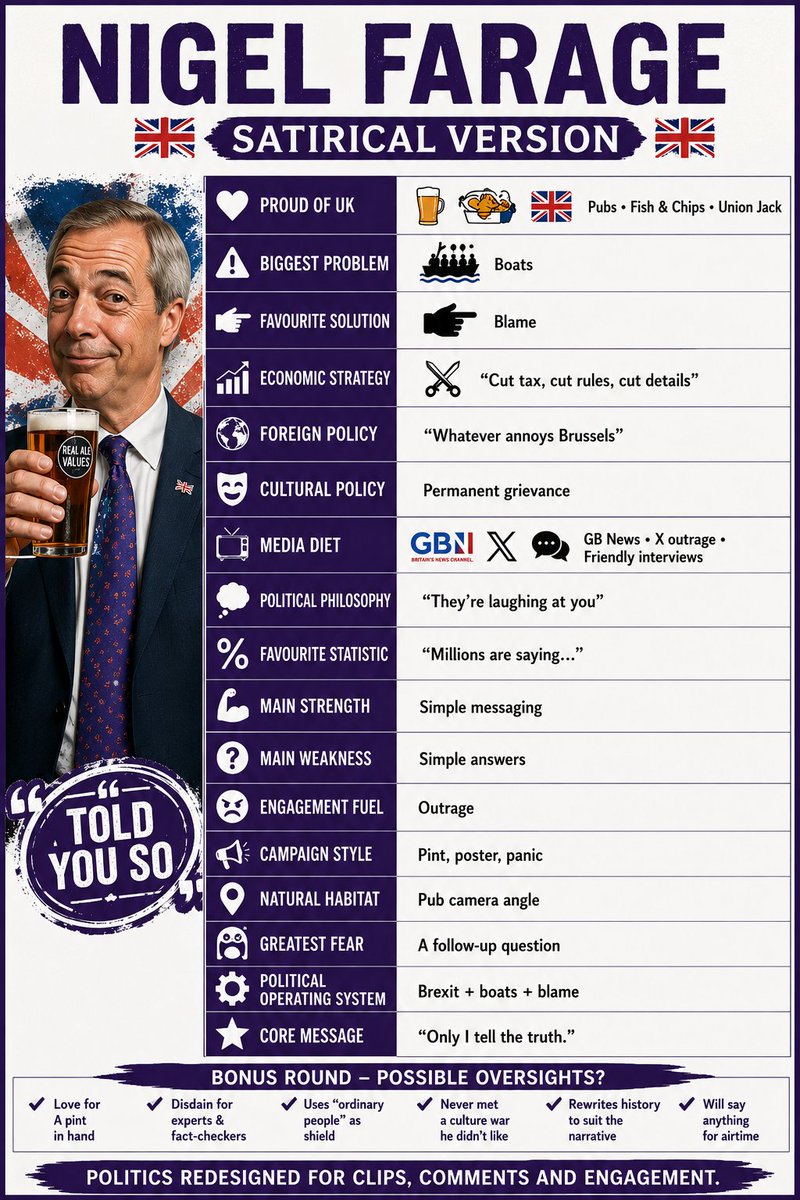
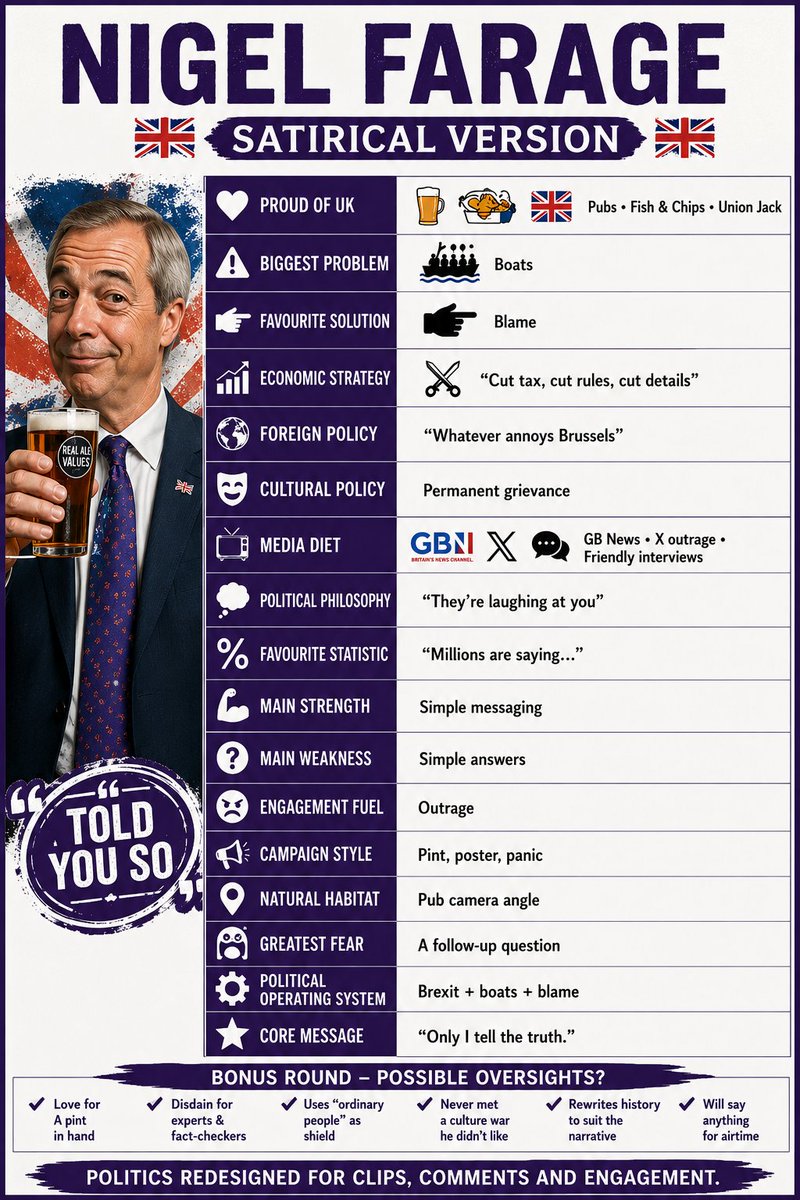
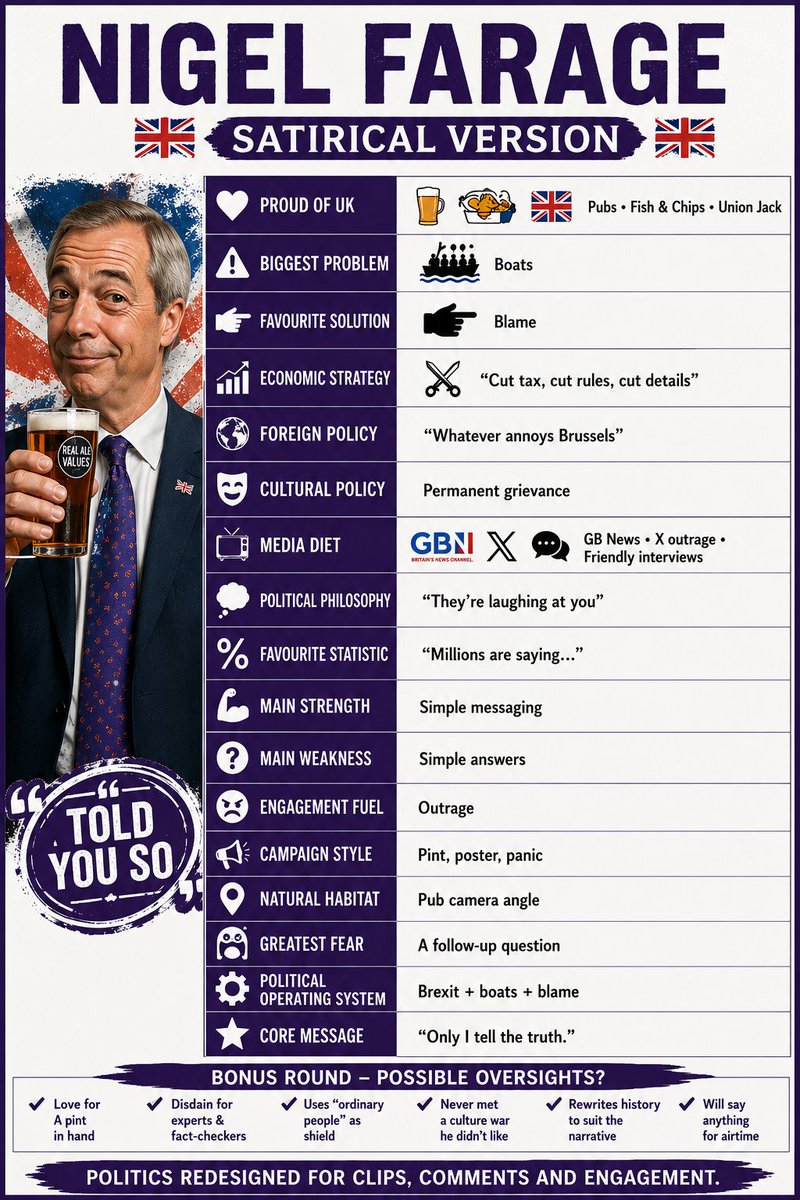
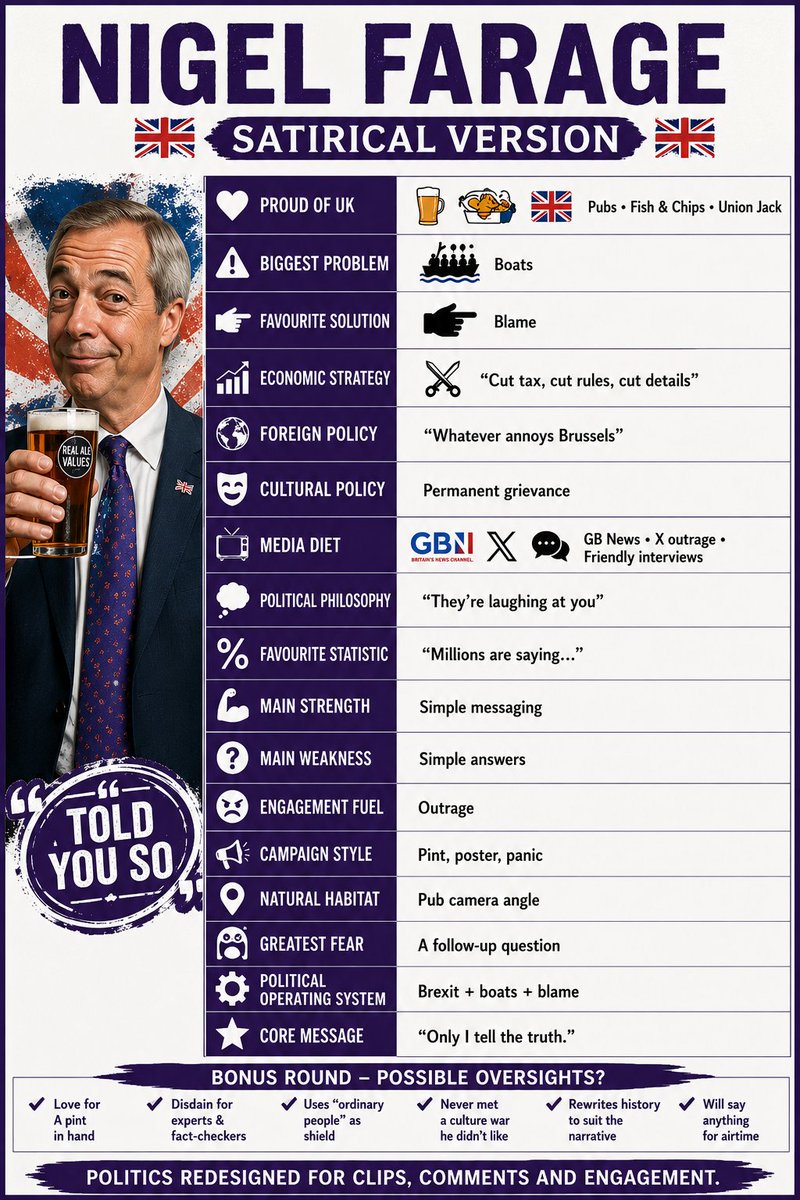

Perhaps Nigel Farage should return power to its own members before promising to return power to the country.
Reform UK is not a normal democratic political party.
It is constitutionally structured like a one-man operation wearing a party badge.
Nigel Farage sits on the board.
He appoints three board members.
He appoints the party chairman, subject to board approval.
And between board meetings, the powers of the board are delegated to the leader - 100%
Meanwhile, ordinary members face an extraordinary process if they want to challenge him.
They cannot simply trigger a leadership contest through local branches.
They cannot remove him through a straightforward membership vote.
Instead, 50% of the entire eligible membership must write to the chairman within the required period merely to initiate a no-confidence process.
Not 50% of those who vote.
Not 50% of local branches.
Half of every eligible member
And even then, the matter goes to the board.
That is the structure.
Members may pay their subscriptions.
They may deliver leaflets.
They may knock on doors.
They may vote if a leadership contest is permitted.
But when it comes to holding the man at the top accountable, their power is impossible to exercise.
Reform calls itself a people’s movement.
But its constitution reads more like a one-man command structure.
Same strongman. Different logo.
2
42
89
1,894
🧑💻 WHO — OR WHAT — IS PALANTIR?
(sorry for the length of the post)
This morning, I took an early/slow walk.
The streets were quiet.
But as I looked around, I started noticing something.
Cameras. Everywhere.
On lampposts.
Above shops.
At junctions.
Outside stations.
Watching roads, pavements, cars and people.
They are so normal now that most of us barely notice them.
And it made me wonder:
Where does all that information go?
Who brings it together?
Who analyses it?
And who builds the systems that allow governments to turn enormous amounts of seperate information into decisions?
That is when I started thinking about Palantir
To be clear, I am not claiming Palantir operates all the cameras I passed.
The cameras simply made me think about the larger question:
Who has the power to connect information?
Palantir is a publicly listed American software and artificial-intelligence company, co-founded by Peter Thiel and led by Alex Karp. Peter Thiel is also an influential figure within America’s right-wing technology and political donor networks.
That makes the wider political ecosystem around Palantir worth understanding, particulary as Trumpism and projects such as Project 2025 seek to reshape how government power is organised and exercised.
But accuracy matters.
Palantir did not write Project 2025, and I have seen no evidence that the company was formally part of the Heritage Foundation project.
It is not a consumer technology company.
It does not sell phones or run a social-media platform.
It builds powerful software that helps governments, militaries, intelligence agencies, hospitals and major corporations bring scattered information together, analyse it and use it to make operational decisions.
On the battlefield.
Inside intelligence agencies.
Across government departments.
Within hospitals and public services.
The concern does not require a conspiracy.
The facts are signifcant enough.
Palantir’s relationship with the British state did not begin under Labour.
The Conservatives brought the company deeper into both defence and the NHS.
In 2022, the Conservative government’s Ministry of Defence signed an £80 million enterprise agreement with Palantir.
Then, in November 2023, NHS England awarded a Palantir-led consortium the contract to deliver the NHS Federated Data Platform.
Up to £330 million was allocated for the platform and associated services over seven years.
That contract was also awarded while the Conservatives were in government.
Labour inherited both relationships when it entered office in July 2024.
But Labour did not simply inherit a software contract and leave it untouched.
It recognised that Palantir is becoming strategically important to defence, artificial intelligence and modern government.
In September 2025, the Labour government announced a wider strategic partnership under which Palantir said it could invest up to £1.5 billion in Britain, establish the UK as its European defence headquarters and create hundreds of highly skilled jobs.
The partnership also aims to develop AI-powered military planning and decision-making capabilties here in Britain.
That distinction matters.
Under the Conservatives, Palantir became an important software supplier to the NHS and Ministry of Defence.
Under Labour, the relationship is being developed into something broader:
Investment.
Jobs.
Defence capability.
Artificial-intelligence expertise.
And a long-term strategic presence in the United Kingdom.
We should applaud Labour for understanding that Britain cannot remain merely a customer buying critical technology from overseas. Britain must also become a place where that technology is developed, governed and deployed.
And the NHS arrangement includes important protections.
NHS England says the data is stored, processed and accessed within the United Kingdom.
Individual NHS organisations control their own data and determine who may access it.
Palantir acts as a processor working under NHS instructions.
It cannot sell or commercialise NHS data.
It cannot use NHS data to develop its own products or train its own artificial-intelligence models.
Access is controlled according to role and purpose, with seperate NHS environments and privacy protections around sensitive information.
So Labour is not simply handing British medical data to an American company.
The NHS remains the controller.
Palantir supplies the platform.
That security wrapper matters.
The details surrounding defence systems are understandably less public.
But the principle should remain the same:
British control.
British security standards.
Clear legal limits.
Supporters will argue that Palantir’s technology can make government faster and more effective.
It may help NHS organisations manage waiting lists, beds, theatre capacity and patient flow.
It may help defence planners combin intelligence and make decisions more quickly.
Those potential benefits are real.
And Britain should not be afraid of advanced technology.
But strategic partnerships require stronger scrutiny, not weaker scrutiny.
How dependent should Britain become on one company for critical national systems?
How easily could the NHS or Ministry of Defence replace Palantir once its software becomes deeply embeded?
Who understands these systems well enough to question their conclusions?
And how do we make sure Britain gains the capability without surrendering control?
Palantir is publicly listed.
Its financial results are published.
Some of its contracts can be scrutinised.
But being listed on a stock exchange is not the same as being democratically accountable.
This is not simply a Conservative story.
And it is not simply a Labour story.
The Conservatives opened the doors.
Labour inherited the relationship and is trying to turn it into a strategic advantage for Britain.
That deserves recognition.
But recognition should sit alongside scrutiny.
Palantir is not merely another software supplier.
It is increasingly becoming infrastructure for power.
The task for Labour is to make sure that power strengthens Britain, remains under British control and continues to serve the public.
The NHS and MoD will have continuity and exit plans, but there is no publicly identified like-for-like system ready to replace Palantir overnight — which makes avoiding long-term operational dependence just as important as protecting the data itself.
That is not paranoia.
That is responsibile government.
1
2
88
Defence is back in the headlines this morning.
Britain needs stronger defence.
But throwing more billions at a broken MoD procurement machine is not strategy.
Fix the machine first.

1
5
19
403

Jun 13
I want to ask something honestly.
Why do so many people on X reach so quickly for the c-word?
I know people will say, “It is just swearing.”
It’s not.
Because the word does not just insult a person.
It drags women into the insult.
It uses a woman’s body as shorthand for contempt, weakness, disgust or hatred/rage.
And I find that quite revealing.
When people cannot argue, they abuse.
When they cannot persuade, they humiliate.
I am not pretending I never swear. I do. But the c-word ? I don’t.
But there is something especially ugly about a culture where attacking someone often means reaching for a word that has contempt for women built into it.
Maybe we should ask ourselves why that is still accepted.
Because words do matter
21
8
49
2,219
I have to say, I am very surprised about the absence of responses apart from a few lost people and one great response.
1
3
190
Jun 13
Why I Think Reform Will Eventually Hit a Wall
This is not a post about why Reform voters are wrong.
Anger/Rage is powerful.
It can build a movement very quickly.
But there is a difference between identifying problems and solving them.
That is where I think Reform may eventually hit a wall.
Almost every issue seems to have the same answer.
Immigration.
Crime.
Housing.
The NHS.
Economic growth.
National identity.
Different problems, but somehow the same solution is offered each time.
At some point Reform supporters will start asking harder questions.
How exactly will that work?
What are the trade offs?
Where is the evidence?
Where is the money?
Because governing is not a podcast.
It is not a protest.
It is not a slogan.
It is a series of difficult choices with finite resources.
Fear can mobilise people.
Hope can inspire people.
But governing requires answers.
I am genuinely interested in what others think, especillay Reform supporters
What is the strongest Reform policy that could realistically be delivered, funded and measured?
Because sooner or later every political party faces the same question.
Not “what is the problem?”
But “what is the plan?”
And how are you going to pay for it?
7
11
46
2,764
Jun 13
Thank you.
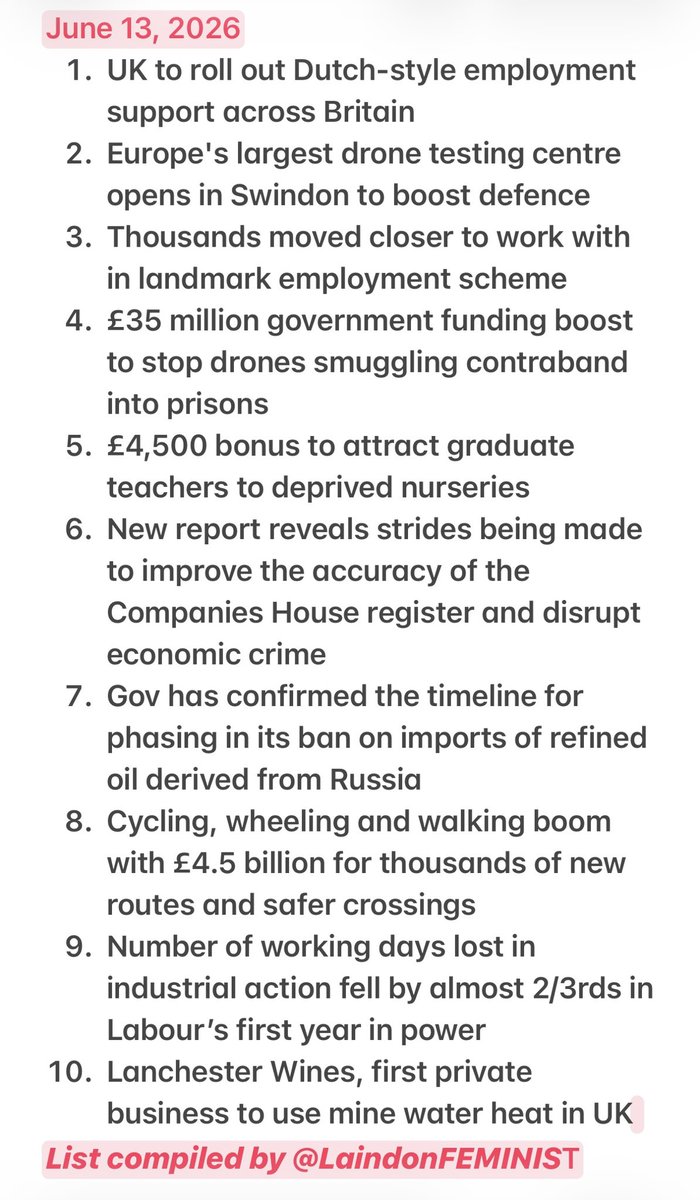
It really is amazing that labour are holding the line and continue to deliver for the British people!

Amongst the drama being amplified by the media they ignored much of the positive news and announcements made by our Gov. So here is the news headlines for the last few days. All available via Google for more info
#DoingTheMediasJob
#FixingBritain
#LabourAchievements
2
21
65
598
Jun 13
Yusuf is no longer just the Shadow Home Secretary.
He is now the Shadow Minister for:
AI
Immigration.
Crime.
Defence.
The Economy.
Net Zero.
Housing.
Education.
Healthcare.
Foreign Affairs.
National Identity.
Western Civilisation.
And apparently the weather.
I am beginning to suspect he has attended a Heritage Foundation seminar entitled:
“How to Turn Every Conversation Into a Culture War.”
The remarkable thing is that dozens of completely different issues somehow end up with exactly the same answer:
Be afraid.
All this from a man who is unelected.
That is not leadership.
That is a one-man Department of Anxiety.
8
56
158
3,215
Jun 13
This week reminded me of something.
People often say X is toxic.
Sometimes it is.
Because behind most anger, I suspect there is often hurt, disappointment, fear, or simply someone who has forgotten that they are worthy of kindness too.
But when my son ended up in A&E this week and I mentioned it here, something else happened.
People reached out.
Some sent kind messages.
Some shared their own experiences.
Some simply said they hoped he would be okay.
Many of these people do not know me.
We have never met.
Yet they took a moment out of their day to show kindness to a stranger.
It made me realise something.
The loudest voices on social media are not always the most representative.
Beneath all the noise, there are still thousands of decent people who care about one another.
We just do not talk about them enough.
Anyway, that was my thought over an (very) early morning coffee.
(As I said, I am a bit of a soccer fan !)
Have a good day everyone.
2
3
21
290
Jun 12
I have quite a few large pro-Labour accounts following me and me filling them (you know the rule ? (“ I follow you and you willow me”)
Some are genuinely good people.
Some are mostly interested in clicks, engagement, and the next political argument.
That is their choice.
I am here for something different.
I am here to connect with ordinary people who think, question, laugh, disagree respectfully, and sometimes share a little of themselves.
I do not measure success by follower counts.
I measure it by the quality of the conversations.
It is a privilege that people take a few minutes out of their day to read my thoughts, challenge my assumptions, share their experiences, or simply say hello.
In a world obsessed with reach, I am far more interested in connection.
A thoughtful reply from someone with 50 followers will always mean more to me than a thousand empty clicks.
I have a few favourite accounts and the person who stands out starts with a V !
No panic - just facts and a good heart.
I am sure you all know who I am taking about. She is going on vacation tomorrow!
V ! Have a great vacation
6
9
47
718
Jun 12
Guys and Girls,
I am not really into the “follow me, I follow you” mentality.
I am much more interested in something far rarer.
Can you be real?
Can you be honest?
Can you be vulnerable?
I do not care whether you have 100 followers or 100,000.
Some of the most thoughtful, decent and insightful people I have met on here have tiny accounts and some genuine large account.
Character is not measured by follower counts.
It is measured by how you treat people, how willing you are to listen, and whether you can speak honestly when it would be easier to pretend.
That is the camp I belong to.
I want to share a wonderful poem with you ! It might make you cry (hope so). She is one of my favourite person.
And you know I like words !
Here it my invitation to you ! And it comes from my heart !
“ It doesn’t interest me what you do for a living. I want to know what you ache for and if you dare to dream of meeting your heart’s longing.
It doesn’t interest me how old you are. I want to know if you will risk looking like a fool for love, for your dream, for the adventure of being alive.
It doesn’t interest me what planets are squaring your moon.
I want to know if you have touched the centre of your own sorrow, if you have been opened by life’s betrayals or have become shrivelled and closed from fear of further pain.
I want to know if you can sit with pain, mine or your own, without moving to hide it, or fade it, or fix it.
I want to know if you can be with joy, mine or your own; if you can dance with wildness and let the ecstasy fill you to the tips of your fingers and toes without cautioning us to be careful, be realistic, remember the limitations of being human.
It doesn’t interest me if the story you are telling me is true
I want to know if you can disappoint another to be true to yourself. If you can bear the accusation of betrayal and not betray your own soul. If you can be faithless and therefore trustworthy.
I want to know if you can see Beauty even when it is not pretty every day. And if you can source your own life from its presence.
I want to know if you can live with failure, yours and mine, and still stand at the edge of the lake and shout to the silver of the full moon, ‘Yes.’
It doesn’t interest me to know where you live or how much money you have.
I want to know if you can get up after the night of grief and despair, weary and bruised to the bone and do what needs to be done to feed the children.
It doesn’t interest me who you know or how you came to be here. I want to know if you will stand in the centre of the fire with me and not shrink back.
It doesn’t interest me where or what or with whom you have studied.
I want to know what sustains you from the inside when all else falls away. I want to know if you can be alone with yourself and if you truly like the company you keep in the empty moments.
2
2
14
358
Jun 12
‼️BREAKING:
Reform UK announces Lee Anderson Shadow Minister for Defence (in addition to him being Chairman and Vhief Whip)
Lee’s press conference was powerful.
He said:
“I’ve been speaking to people in pubs, cafés and shops, and what they’re telling me is simple.
They want tanks.
They want aircraft carriers.
They want submarines.
They want proper defence.
And they want it paid for by cancelling net zero, foreign aid, welfare, lawyers, civil servants, tofu, cycle lanes and probably oat milk.”
When asked what his actual defence strategy was, Lee replied:
“Common sense.”
When asked what that meant, he said:
“British common sense.”
When asked again, he said:
“You lot in the media don’t like straight talking.”
And there it is.
Reform’s defence policy in full:
No detail.
No serious plan.
No defence team.
No costing.
No understanding of modern warfare.
Just Nigel shouting numbers and Lee Anderson turning national security into a pub monologue.
Same chaos. Different rosette.
#LessNoiseMoreDelivery
187
523
1,771
91,804
Jun 12
I got so many kind messages today after I posted about making mistakes and being vulnerable.
It mattered more than you may realise.
My son ended up in A&E today, and it was not an easy day for our family.
I only have a small handful of close friends, but today X reminded me that there are REAL people behind the accounts.
Yes, there were a few hateful and radical comments too. That is social media.
But there was also genuine kindness, support, and humanity from people I have never met.
For all of that, thank you ! (And my tears are coming up up)
Sometimes a few thoughtful words from strangers can make a difficult day feel a little less heavy.
I also think about the people who attacked me and made some horrible comments (like me trying to grow my x account, etc.)
I love them to as they don’t know the harm they cause.
I really don’t care how many people follow, like or repost me.
I care about real people !
I love Labour and Keir ! They care
13
18
113
1,301
Jun 12
Keir Starmer and the Myth of an Easy Labour Coup
Something people need to understand about Labour leadership talk.
Removing Keir Starmer is not as simple as people whispering in corridors.
Labour is not the Conservative Party.
There is no simple Tory-style confidence vote where MPs secretly send letters and the leader is suddenly dragged into a ballot.
Inside Labour, a challenge needs structure.
A challenger needs support.
And under Labour rules, a leadership contest is triggered if Keir resigns, or if a challenger gets nominations from 20% of Labour MPs.
That means roughly 80 Labour MPs putting their names behind one specific alternative.
Not vibes.
Not gossip.
Not “some people are unhappy.”
Names.
Numbers.
A candidate.
And that matters.
Because saying “Keir must go” is easy.
But then come the real questions.
Who replaces him?
Can they unite the Parliamentary Labour Party?
Can they win Labour members?
Can they survive the media?
Can they avoid making Labour look like chaos?
Can they stop Reform feeding off the instability?
Can they govern on day one?
That is the test.
And this is where Labour members matter.
Labour MPs can trigger a challenge.
But they do not simply get to remove the leader in a closed Westminster room.
Once a contest happens, Labour members and affiliated supporters matter.
The movement matters.
The unions matter.
The wider party matters.
That means any challenger has to do more than win whispers in Parliament.
They have to win Labour.
They have to convince MPs, members, unions and activists that changing leader would strengthen the government, not make it look like another party collapsing into itself.
Wes Streeting could stand because he is an MP.
Andy Burnham would first need to be back in Parliament before he could formally run.
So the question is not simply whether people inside Labour are restless.
The question is whether there is a serious, organised, parliamentary route to replacing the Prime Minister without making Labour look like it has forgotten why the country gave it power.
Because Britain does not need another governing party eating itself alive.
We waited 14 years to get the Conservatives out.
Labour MPs should remember that before they start playing Westminster chess while Reform waits outside the door with a megaphone.
15
61
155
4,924
Jun 12
We all need a laugh today.
Andrea Jenkyns singing “I’m an insomniac” at Reform conference may be the most accidentally British political moment of the week.
No hatred. No cruelty.
Just a much-needed laugh.
youtube.com/shorts/2e93GB4w-…
1
1
8
389
Jun 12
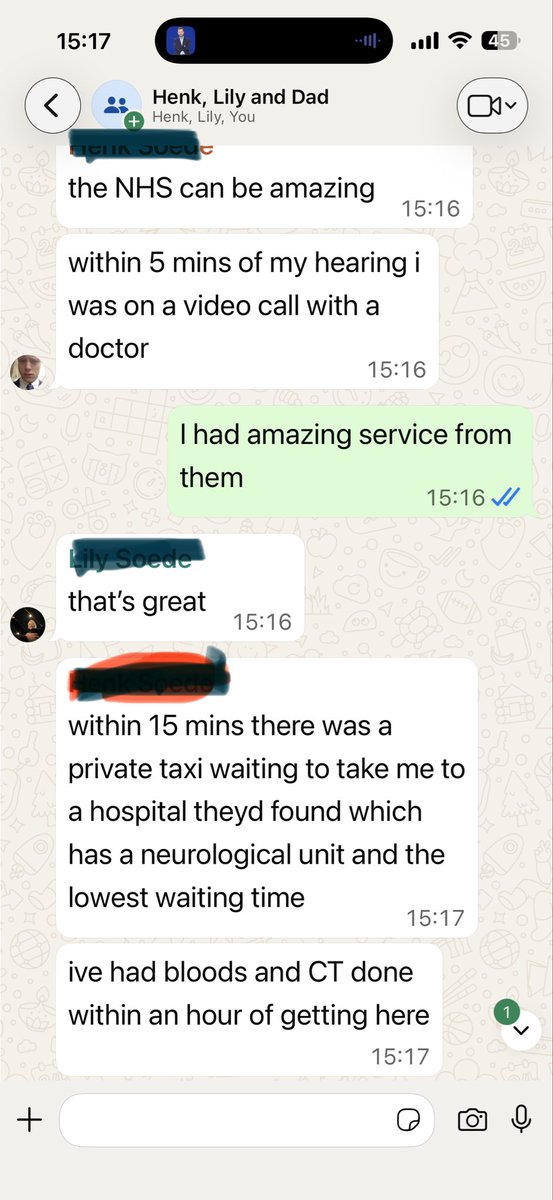
My son was just urgently taken into care for a neurological issue.
The NHS is improved so much !!
That is the message I got and you know what he said “it better the private care”
He has private insurance but he lives labours and trust them !
@UKLabour is fixing the NHS !!
9
2
55
4,449