
128 Photos and videos







Tomio Geron retweeted

I remind myself of this quite often.
86
455
5,975
758,027
Tomio Geron retweeted

Apr 20
BREAKING: Vibe-coding platform Lovable reportedly suffered a breach that exposed users’ AI chat histories, source code, & database credentials.
569
894
8,299
2,059,873
Tomio Geron retweeted

Apr 16
If you want to know why Draymond Green is one of the top defensive players of all time, watch the 4th quarter defending Kawhi.
38
672
4,928
115,273
Tomio Geron retweeted

Apr 15
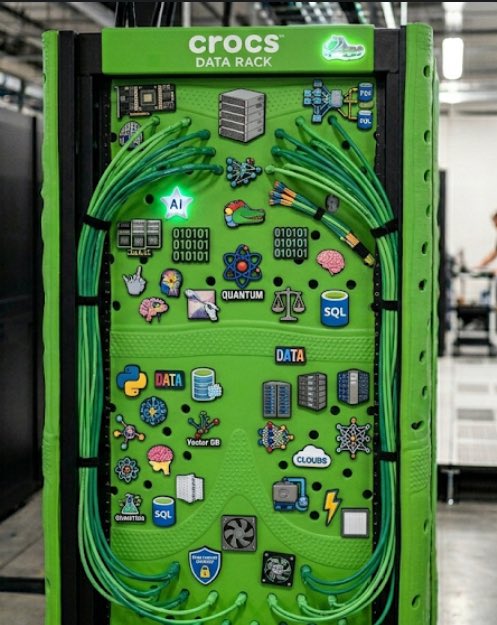
BREAKING: Crocs is pivoting from footwear into AI data centre infrastructure. Its EVA Croslite resin is ideal for controlling Nvidia rack temperatures.
Jibbitz made for easy and secure chip insertion while foam holes provide ventilation, improving perf per watt by avg. of 16%.

86
176
2,039
232,790
Tomio Geron retweeted

Apr 14
People have asked me how I feel about Udemy’s sale to Coursera. Honestly, I’m kinda pissed about it.
I want to be clear - I’m grateful for the opportunity to start and benefit from Udemy’s success. It changed my life.
But there’s another side to Udemy. A story of what could have been.
After our Series B, founders owned less than 30% of the company. Our investors took over and installed their own CEO to run it. We all liked this new CEO and honestly, for years it looked like a brilliant move. The company kept growing and growing. They launched B2B and built a $500M ARR business. Eventually, the company IPO’ed for $3B.
Yet all along there were clear cracks under the surface. Over Udemy’s history, there have been 7 CEO’s. The board replaced the second CEO with dud after dud. I’d often try to meet with the board or the new CEO, and was completely ignored. Eren had influence as Chairman of the Board but Oktay and I were so ignored they didn’t even invite us to the IPO. LOL WTF. There are like 50 people invited to these things and nobody thought: “oh maybe we should invite the people who fucking invented the thing we’re all celebrating.” It shows how little respect they had for founders and for product innovation as a discipline.
I think they wanted a CEO they could control, a buttoned-up suit instead of a brash founder/CEO that is risk-taking, visionary, but a bit of a pain. For awhile, it looked like it didn’t even matter who was CEO - the company was run by the incredibly talented team that reported to them anyways.
Well, it worked until it didn’t.
The company made no major product innovations for 15 years. Instead, they took the original idea (video-based courses) and sold it in every place imaginable. It got us to $800M run-rate. That’s no joke; that takes serious execution and a great team that hustled hard to win the market.
But eventually the consumer business stopped growing. The B2B business has now flattened out as well. Meanwhile, Coursera was catching up.
Original Coursera was a far worse product than Udemy, but it got a ton of press. Learning ivory tower bullshit from academics doesn’t get you a real education, but it does create prestige. They raised from better investors on better terms, and had better leadership.
Udemy to this day has more revenue than Coursera, but Coursera won the court of investor opinion. They got higher multiples from both private and public markets.
Coursera innovated heavily. They added corporate courses to their university catalog, built fully-online degree programs, and offered a B2B competitor that kept Udemy on its toes. Still, the Udemy B2B business (and team) out-performed and so the two companies were deadlocked. Coursera was better at B2C, Udemy at B2B.
A merger was inevitable.
But WHY IN GODS NAME did we sell to Coursera instead of the other way around? Why are the combined companies under $3B in market cap?
Three reasons:
First, edtech didn’t live up to its promise. While these two companies had solid revenue and cash positions, their growth slowed, and public markets balked. This meant compressed multiples and significantly lower valuations.
Second, the companies stopped innovating. They are selling a product to businesses that their customers don’t love. They were category leaders, but they lead the category into mediocrity. They captured a significant share of learning and development (L&D) spending, but L&D as a whole actually lost budget within their organizations. That’s Udemy’s fault, and it doesn’t even realize it.
That brings me to my final point: I personally believe Udemy traded upside opportunity for downside risk. Us founders were unproven and young. We made lots of mistakes, including fighting amongst ourselves. A good investor would have supported us through it because they believe founders drive the highest long-term returns. Instead, they brought in outside CEOs to replace us. I sometimes wonder if they recognize this error; everyone makes mistakes and maybe they learned from it.
Either way - the consequences are real. By ignoring the founders, Udemy failed to innovate, which led to slowing growth which led to mediocre public market results. Furthermore, they don’t have a good evangelist and public markets don’t like a headless horse.
I sold my Udemy stock awhile ago. I think the merger was critical for both companies’ survival. Now, though, the new combined entity needs to innovate again.
On B2B, Coursera needs to help L&D become the heroes of the AI era so the entire market starts growing again. On B2C, they need to build the most educational AI product on the planet. (I’d focus on the former, since the latter is a lot harder and riskier).
Coursera can still achieve our original vision and likely build a $10B company in the meantime. Even though I’ve got no stake in its future, I’m mission-driven and I REALLY hope they figure it out.
The current education system sucks and the world deserves something better.
208
445
3,665
607,243
Tomio Geron retweeted

Mar 3
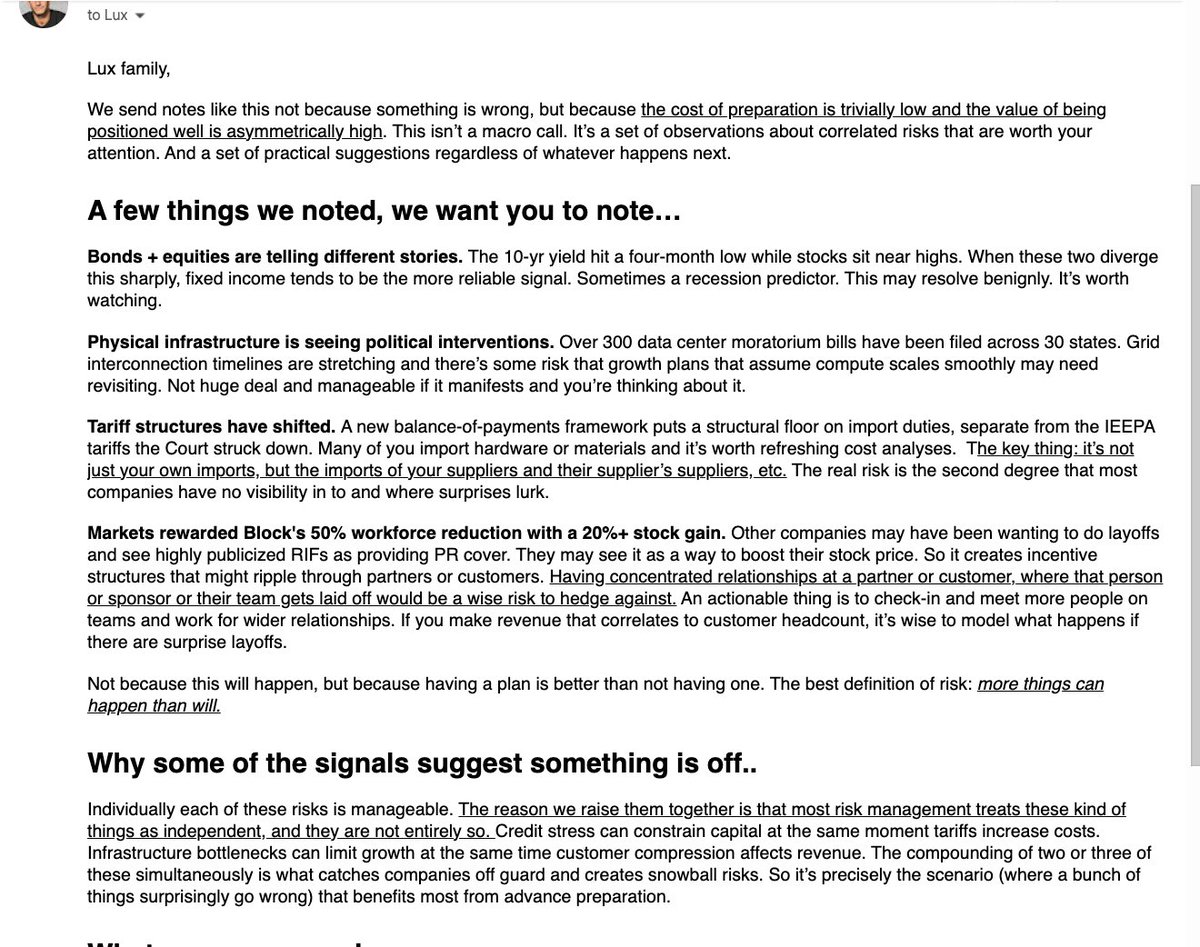
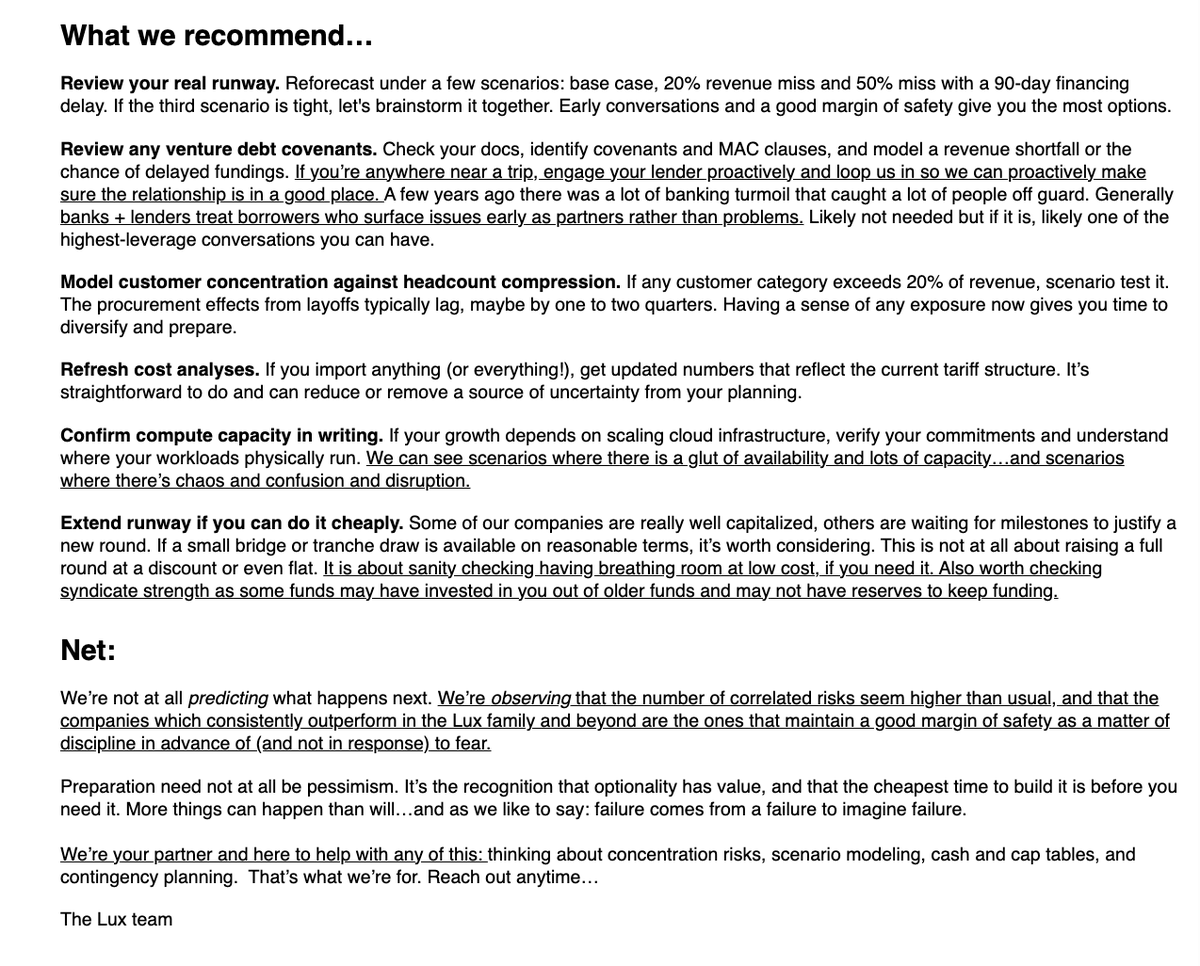
Sharing this publicly––hope it's not needed but helps you if it is.
Lux team sent this memo to all Lux family founders yesterday
"We send notes like this not because something is wrong, but because the COST of preparation is trivially LOW and the VALUE of being positioned well is asymmetrically HIGH. This isn’t a macro call. It’s a set of observations about correlated risks that are worth your attention. And a set of practical suggestions regardless of whatever happens next."
31
78
1,060
369,026

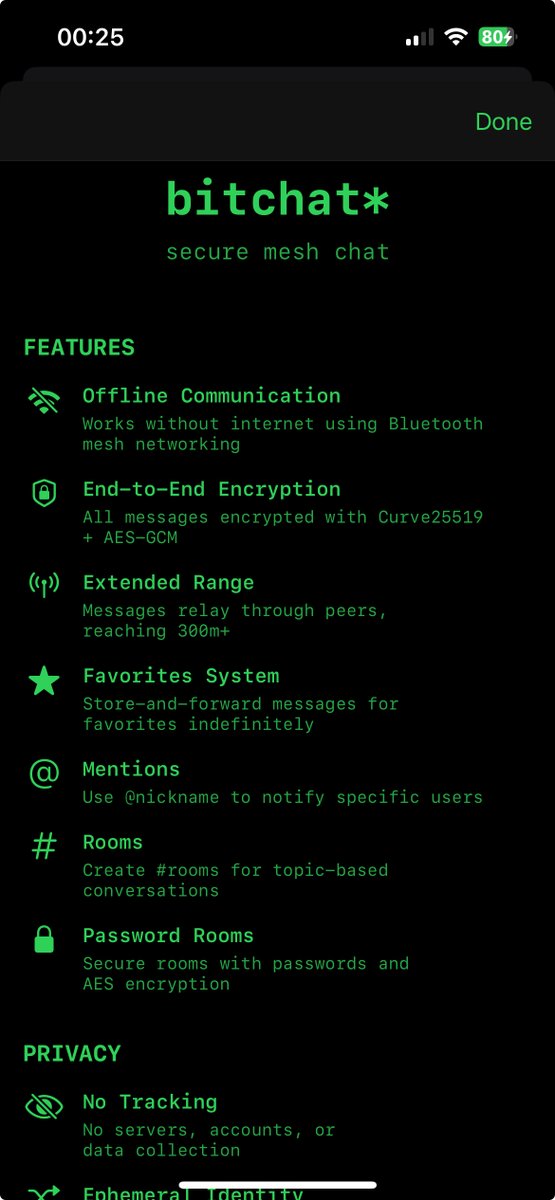
my weekend project to learn about bluetooth mesh networks, relays and store and forward models, message encryption models, and a few other things.
bitchat: bluetooth mesh chat...IRC vibes.
TestFlight: testflight.apple.com/join/Qw…
GitHub: github.com/jackjackbits/bitc…
1,774
3,591
26,840
5,441,732
Tomio Geron retweeted

9 Jun 2025
Some notes on Negotiations
1/ When you finish any complex deal you will feel fatigued and worn out. It sometimes feels hard to celebrate. The best deals feel this way. Complex negotiations require compromises. When both (or all) parties make concessions nobody feels great. Everybody felt like they gave more than they wanted. And all wish the other party would have folded easier. That’s the definition of a good negotiation
31
79
1,293
215,689
Tomio Geron retweeted

1 Jun 2025
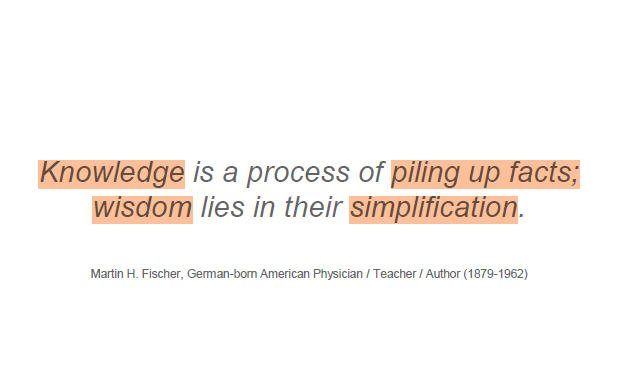
Fav Quote from report 💭
My fav. quote is in the image below
2 more honorable mentions:
“Like electricity and other general purpose technologies in the past, AI and cloud data centers represent the next stage of industrialization.” — Brad Smith, Vice Chair and President, Microsoft.
“It is different this time. We will make it up on volume, and we'll figure out how to monetize our users in the future.” — the three biggest danger statements in business
8
48
510
83,979
Tomio Geron retweeted

26 Apr 2025
In pursuit of product-market fit, you should be less of a data scientist and more of an anthropologist.
Every week I see teams pretending to be scientists and analyzing metrics on a test group of a few hundred users who came from odd sources unrepresentative of their broader target audience — like a Discord server or a handful of friends & acquaintances.
Instead, keep it simple:
Your analytics dashboard should literally just be a table of users with the following columns:
• Name
• Registration Date
• Last Active Time
• Number of Sessions
Then follow these steps:
1. Sort the list by Last Active Time
2. Look up the most active users on Instagram or Linkedin
3. Then interpret their behavior on your app through the lens of their online identity
4. If you have a messaging channel such as Intercom, send them a generic message asking for their feedback (and maybe offer a $25 gift card)
Do this regularly.
It’s certainly not science but it will tell you more about what’s resonating about the product than a bunch of statistically insignificant data.
125
368
5,895
502,174
Tomio Geron retweeted

21 Apr 2025
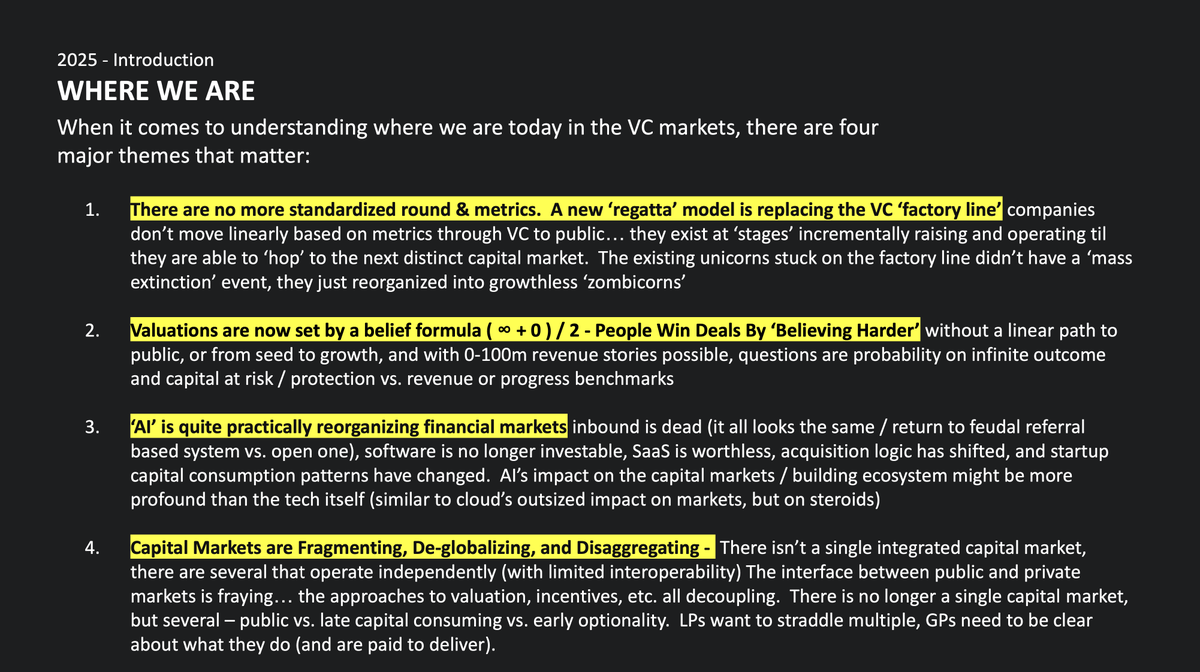
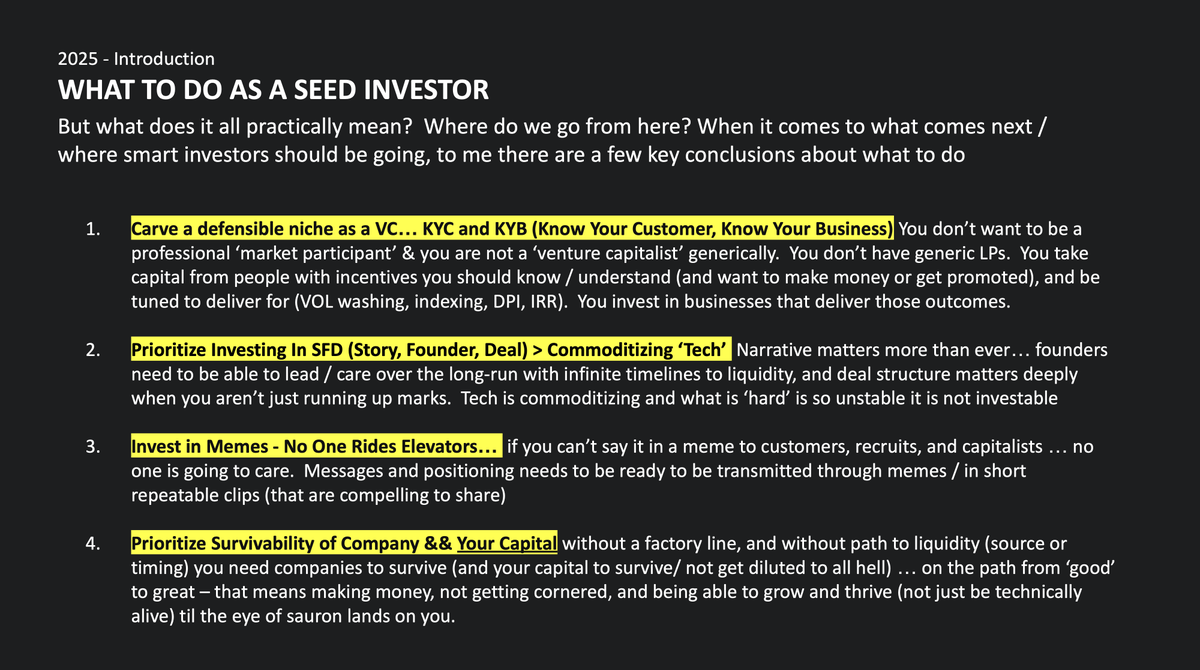
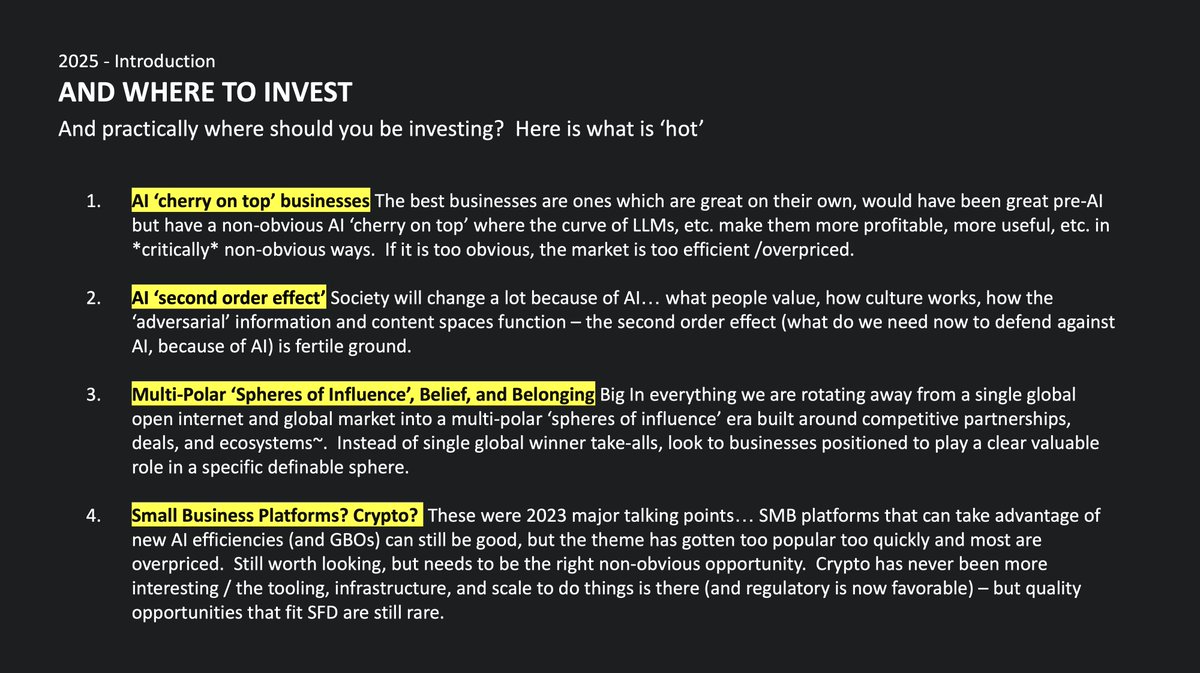
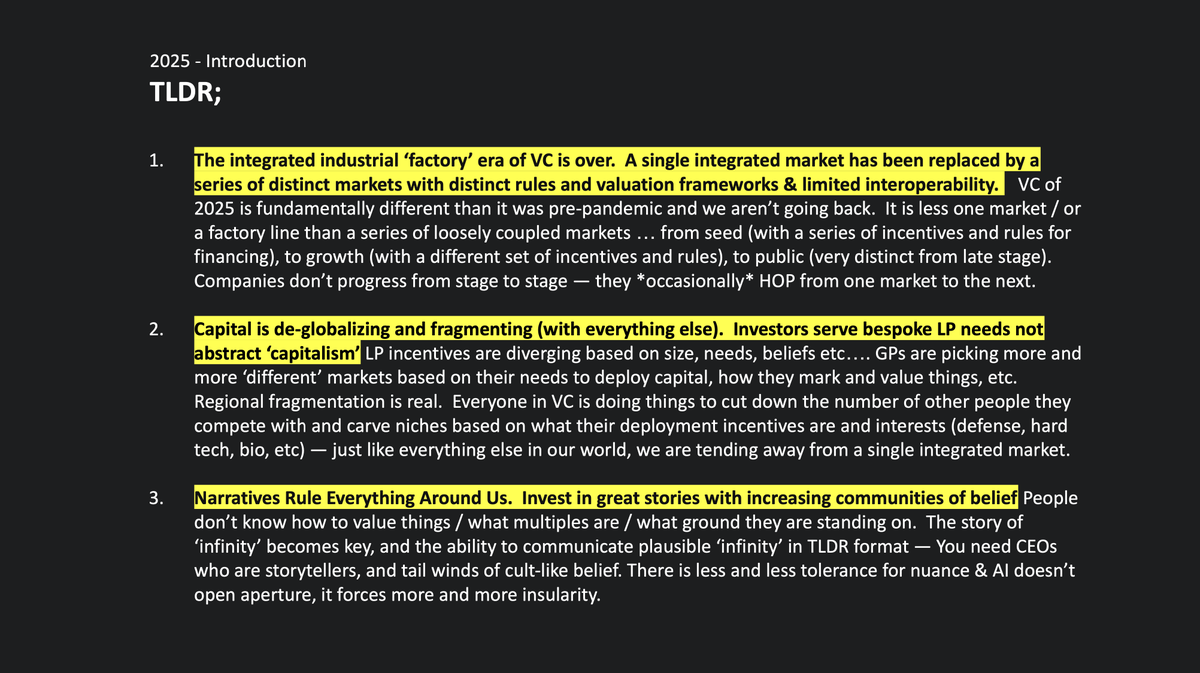
The state of VC in 2025. Where we are, where we are going, and where to invest ... docsend.com/v/w5bsh/wtfvc25
75
90
893
339,118
Tomio Geron retweeted
18 Mar 2025
After advising 50 consumer companies over the last year, the one thing that separates those who can execute and those who can't:
Having a full-time designer in the room at all times
I've met with countless companies that have raised millions—and even one that has raised billions—that do not even have a designer on payroll.
This makes product development broken:
1/ You simply cannot have constructive conversations about ideas without visualizing them in real-time
2/ Your experiments will frequently have inconclusive results because users cannot discover features or they misunderstand how they work
3/ There is no one who can galvanize the team with a vision of what the product could look and feel like
And to be abundantly clear: I'm not referring to visual UI or graphics. I'm talking about someone who can think through the fundamental building blocks of product comprehension—like navigation, interaction and copywriting—and is technically savvy enough to visualize those components in high resolution.
There can certainly be exceptions to not having a designer, like where the CEO is an exceptional visual thinker, but that does not scale beyond a small team.
At the end of day, products live and die in the pixels: it's what the users see and tap. And without someone shepherding that process, you are effectively wandering the desert blind.
319
845
7,868
1,219,458
Tomio Geron retweeted

13 Mar 2025
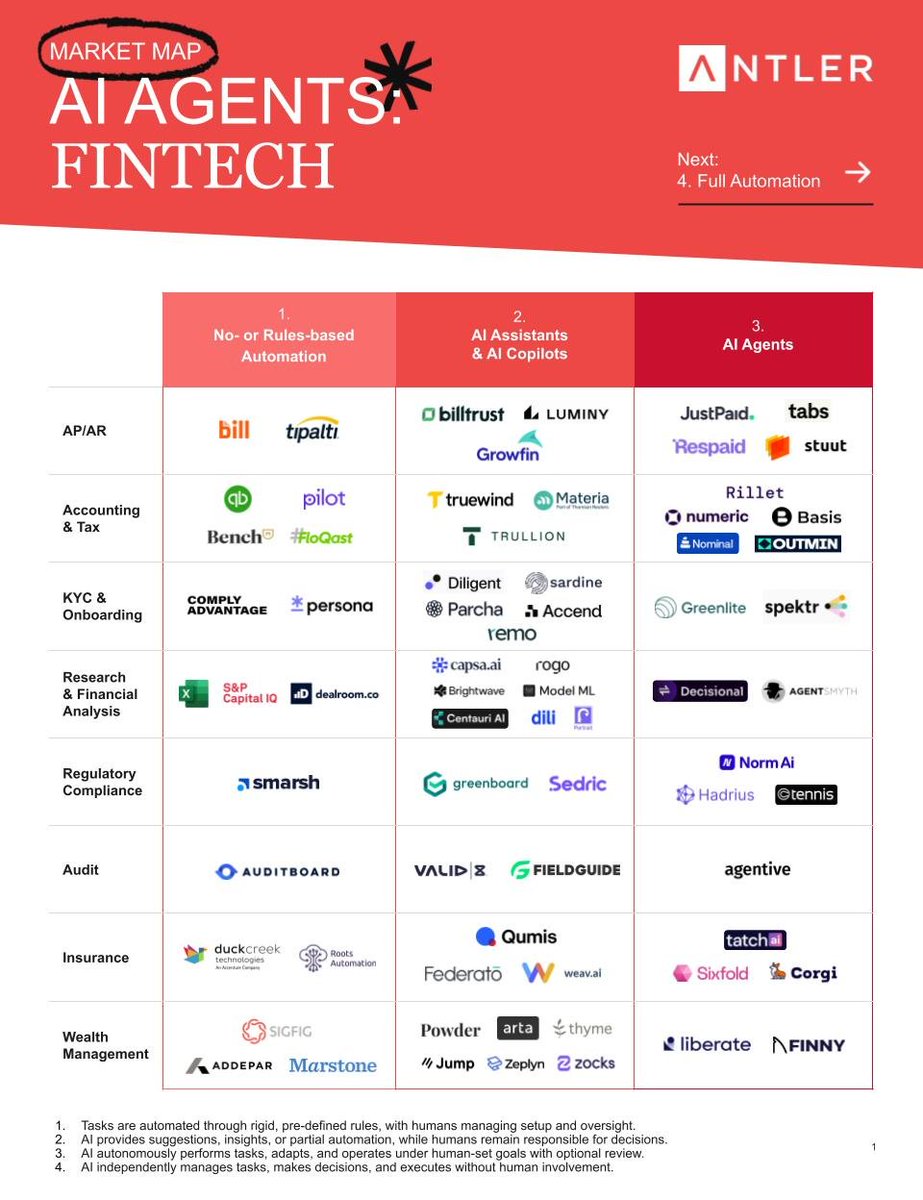
good mapping of AI agents in fintech from Antler
12
15
136
18,293
Tomio Geron retweeted

1 Nov 2024
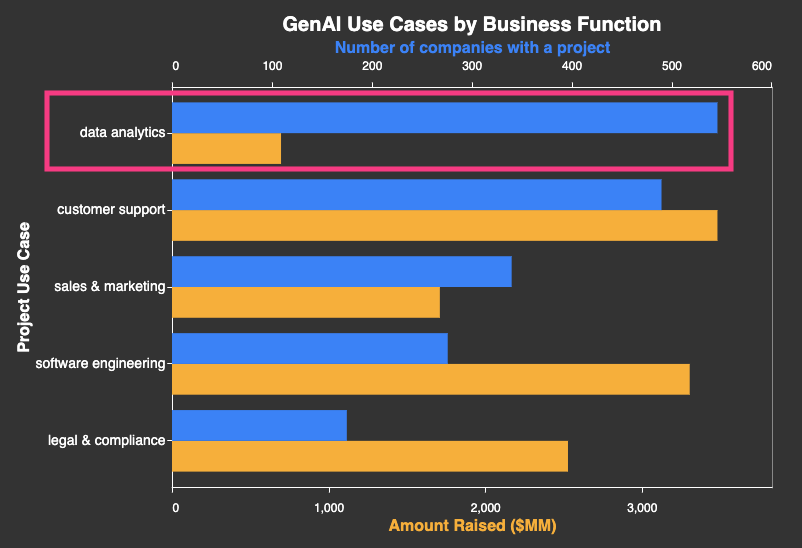
The overlooked GenAI use case: cleaning, processing, and analyzing data.
blog.sumble.com/the-overlook…
Job post data tell us what companies plan to do with GenAI. The most common use case is data analytics projects. Examples:
- AstraZeneca: using LLMs on freeform documents to structure results from their Extractables & Leachables testing (sumble.com/l/FgehjrgnvN)
- Trafigura: The Document AI team is using LLMs to extract data from a corpus of commodity trading documents to generate credit reports
(sumble.com/l/6bY7mhyAHd)
The startup ecosystem is overlooking this use case, instead focusing on other areas such as customer support, sales & marketing and code gen.
22
113
643
165,000
Tomio Geron retweeted

18 Apr 2024
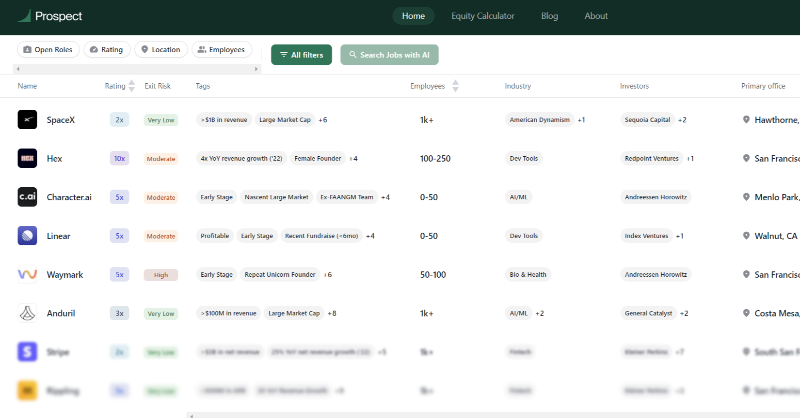
Best advice I ever got: think like a VC when looking for tech job.
It led me to joining Rippling ($11B ) before its Series A. It changed my life, so I built a free tool to help others.
We expect that each company listed on Prospect will grow at least 2X over the next 4 years:
364
408
5,905
15,370,894
Tomio Geron retweeted

16 Sep 2024
Consumer is at such an interesting moment and as an investor I’m always frustrated we are not seeing more wildly creative ideas given LLMs.
We are seeing too much focus on how to generate more content without thought on what people also may want to consume.
Because there is so much focus on how we generate more content we are appealing too much to the laziness of consumers who want cool but faddish content without too much effort. It doesn’t allow anyone in particular to stand out
Most consumer content businesses are driven by a new consumer piece of content (TikTok and short video with music initially for lip syncing; instagram and photo network, etc). What are the new forms of content we will see? Not just easier ways of creating content that will be posted to existing social networks.
Always interested in hearing the dissenting opinion but if you have something different, message me!
14 Sep 2024

Too many startups/investors are exploring the b2b opportunities with LLMs and not enough are exploring the consumer opportunities. This is the moment consumer founders have been waiting for.
54
27
554
176,493
Tomio Geron retweeted

12 Sep 2024
The best CEOs have a plan to create a long term, standalone, durable business that rewards employees and shareholders. Reminded of this daily in current environment where emerging private cos are poaching talent from "🦄" of 21/22 era. Interview this week:
"We raised way too much money at too high valuations, missed the IPO window, now growth has slowed and founder/board doesn't want to go out below last round. Employees are stuck. A lot of us have decided it's time to move on..."
6
6
72
16,072
Tomio Geron retweeted

6 Jun 2024
👇 Advice everyone should hear about how to vet your personal-finance apps 👇 from @tomiogeron
wsj.com/podcasts/tech-news-b…
1
1
1
622

6 Jun 2024
New fintech apps help people better manage their finances. But how can they keep themselves safe when using many apps that share their data? My story via @WSJ: wsj.com/tech/personal-tech/r…
7
10
8
458
Tomio Geron retweeted

26 Apr 2024
Hoodline "is using generative AI for the vast majority of its recent, “originally reported” stories — without clear disclosures to the extent of its use." sf.gazetteer.co/hoodline-usi… -- once they got caught they updated the bylines to look like this:

7
10
2,681