
Joined January 2025
- Tweets 7,774
- Following 327
- Followers 434
- Likes 7,426
516 Photos and videos







Pinned Tweet

Jan 8
“But with me it is a very small thing that I should be judged of you, or of man’s judgment... he that judgeth me is the Lord.” 1 Corinthians 4:3–4
“There is one lawgiver, who is able to save and to destroy... who art thou that judgest another?”
James 4:12
“Who art thou that judgest another man’s servant? to his own master he standeth or falleth.”
Romans 14:4
“For we must all appear before the judgment seat of Christ; that every one may receive the things done in his body, according to that he hath done, whether it be good or bad.” 2 Corinthians 5:10
“For the Father judgeth no man, but hath committed all judgment unto the Son.” John 5:22
“And hath given him authority to execute judgment also, because he is the Son of man.” John 5:27
“The LORD shall judge the people... judge me, O LORD, according to my righteousness.” Psalm 7:8
“For the LORD is our judge, the LORD is our lawgiver, the LORD is our king; he will save us.” Isaiah 33:22
4
2
11
1,192


Tryin 💪🙏 retweeted
Jun 13
False definition of prophet based on poor presuppositions leads you to erroneous conclusions.
1
1
30
Tryin 💪🙏 retweeted

Jun 12
They’re not actually trying to convince us we’re demonic.
They’re trying to convince themselves.
60
23
518
8,298
Tryin 💪🙏 retweeted

Jun 13
Obsession with orthodoxy (right theology) over orthopraxy (right practice) is cancer.
But a true disciple of Christ prioritizes orthocardia (right heart) over all.
So many twitter bros have their priorities all mixed up.
37
16
277
8,512
Tryin 💪🙏 retweeted
Jun 13
Mmm... Lol.
So, you got nothing. I see.
People are allowed opinions and to share them.
Seems you're confused on our Epistemology.
Let me help.
"Not every statement made by a Church leader, past or present, necessarily constitutes doctrine. ... It is commonly understood in the Church that a statement made by one leader on a single occasion often represents a personal, though well-considered, opinion, not meant to be official or binding for the whole Church." (D. Todd Christofferson, "The Doctrine of Christ," Apr. 2012 General Conference)
"The doctrine is taught by all 15 members of the First Presidency and Quorum of the Twelve. It is not hidden in an obscure paragraph of one talk. True principles are taught frequently and by many. Our doctrine is not difficult to find." (Neil L. Andersen, "Trial of Your Faith," Oct. 2012 General Conference)
"Let us not teach or use as official doctrine what does not meet the standards of official doctrine." (Dallin H. Oaks, "Trust in the Lord," Oct. 2019 General Conference)
1
1
1
42
Tryin 💪🙏 retweeted
Jun 13
Just cause someone says something... Is irrelevant. I will conceed some leaders have said some things that aren't doctrine.
This is the whole point... Not everything uttered by a leader is doctrine.
Opinions are like armpits, almost everyone has a couple.
From the very beginning of the restoration we've been taught that not every word spoken by a leader is doctrine.
"A Prophet is not always a Prophet' only when he is acting as such." (Joseph Smith, Journal, 8 Feb. 1843, Joseph Smith Papers)
"What a pity it would be if we were led by one man to utter destruction! Are you afraid of this? I am more afraid that this people have so much confidence in their leaders that they will not inquire for themselves of God whether they are led by Him. I am fearful they settle down in a state of blind self-security, trusting their eternal destiny in the hands of their leaders with a reckless confidence that in itself would thwart the purposes of God in their salvation ... Let every man and woman know, by the whispering of the Spirit of God to themselves, whether their leaders are walking in the path the Lord dictates, or not." (Brigham Young, "Eternal Punishment, 'Mormonism,' Etc.," Journal of Discourses 9:150, 12 Jan. 1862)
"The question is, how shall we know when the things they have spoken were said as they were 'moved upon by the Holy Ghost'? ... I have given some thought to this question, and the answer thereto so far as I can determine, is: We can tell when the speakers are 'moved upon by the Holy Ghost' only when we, ourselves, are 'moved upon by the Holy Ghost.' ... In a way, this completely shifts the responsibility from them to us to determine when they so speak." (J. Reuben Clark Jr., "When Are Church Leaders' Words Entitled to Claim of Scripture?" Church News, 31 July 1954, p. 9, quoted in Teachings of the Living Prophets Student Manual)
"It makes no difference what is written or what anyone has said, if what has been said is in conflict with what the Lord has revealed, we can set it aside. My words, and the teachings of any other member of the Church, high or low, if they do not square with the revelations, we need not accept them. ... We have accepted the four standard works as the measuring yardsticks, or balances, by which we measure every man's doctrine. ... You cannot accept the books written by the authorities of the Church as standards in doctrine, only in so far as they accord with the revealed word in the standard works. ... Every man who writes is responsible, not the Church, for what he writes. If Joseph Fielding Smith writes something which is out of harmony with the revelations, then every member of the Church is duty bound to reject it." (Joseph Fielding Smith, Doctrines of Salvation 3:203-4, 1954-56; quoted in "Finding Answers to Gospel Questions," Teaching Seminary Preservice Readings Religion 370, 471, and 475)
"One of my good brethren years ago was on a Church board, and we were interviewing a young man who was doing some teaching that was contrary to the doctrines of the Church. The brother said to me, 'Why, he has his right to his opinion.' And I said, 'Yes, he has his right to his opinion, but he has no right to teach his opinion as doctrine in the Church.' ... I don't dare answer any of your questions unless I can find an answer in the standard works or in the authentic declarations of Presidents of the Church. ... All that we teach in this Church ought to be couched in the scriptures. ... If it is not in the standard works, you may well assume that it is speculation. It is man's own personal opinion, to put it another way; and if it contradicts what is in the scriptures, you may know by that same token that it is not true." (Harold B. Lee, "Restoration of the Gospel," 1954; "Using the Scriptures in Our Church Assignments," Improvement Era, Jan. 1969, p. 13; quoted in Teachings of Presidents of the Church: Harold B. Lee, chapter 7, 2011)
1
1
1
69
Tryin 💪🙏 retweeted

@holysmoke Thanks for the sincere question. As a member of The Church of Jesus Christ of Latter-day Saints, I can clarify…
We worship the Lord Jesus Christ—the same Jesus of the Bible who is the Son of God, the Creator (under the Father), the Savior who atoned for our sins, and the risen Redeemer. He is Jehovah of the Old Testament.
Our first Article of Faith states: “We believe in God, the Eternal Father, and in His Son, Jesus Christ, and in the Holy Ghost.” These are three distinct divine beings who are one in purpose, will, and glory (see John 17; Acts 7:55–56). We pray to the Father in the name of the Son. The Father is the ultimate object of our worship; Jesus is our Lord and Mediator.
On “many gods”…
We believe the Bible teaches that through Christ’s Atonement, faithful followers can become “joint-heirs with Christ” (Romans 8:17), “partakers of the divine nature” (2 Peter 1:4), and even “gods” in the sense of inheriting all the Father has (Psalm 82:6; John 10:34; D&C 76:58; 132:20). This is eternal progression—not polytheism or competing deities. Exalted beings will forever worship the Father as their Eternal God.
We believe this understanding of the Godhead was restored through Joseph Smith’s First Vision and modern revelation. While there are sincere differences with traditional Christianity on the nature of God (separate beings vs. one substance in later creeds), our devotion is to the same Lord Jesus Christ.
For the official explanation, see the Church’s Gospel Topics entry on the Godhead…
churchofjesuschrist.org/stud…
Happy to discuss further with respect and goodwill. 😇🙏
1
1
10
244
Tryin 💪🙏 retweeted

Jun 13
@JordanBraginton
Yes, I think God has moral agency. If God is capable of love, mercy, justice, and covenant faithfulness, then those seem to involve genuine choices rather than automatic behavior.
But I don't think it follows that moral law is some authority standing over God.
Consider this: if there are objective truths about logic, does that mean logic is a being greater than God? Not really. Logic isn't a person, a ruler, or an object of worship. It's simply part of reality. Likewise, if there are objective moral truths, they don't become a god just because they're true.
So if moral law exists independently of God's will, the question becomes: what kind of thing is moral law? If it's an abstract truth about how persons ought to relate to one another, then it isn't something you can worship. It doesn't love, create, forgive, save, or enter into relationships.
That's why, even if moral truths are eternal, we worship God rather than moral law. We worship God because He is the perfectly good personal being who fully understands, embodies, and lives those truths. Moral law may describe what goodness is, but God is the living person who perfectly manifests goodness.
In fact, I'd turn the question around: if God has no moral agency and goodness is merely whatever He happens to command, then in what sense is God good? We could say He is powerful, but calling Him morally good would seem to lose much of its meaning. God's goodness becomes most meaningful if there is a real distinction between good and evil and God freely and perfectly chooses the good.
So my answer is:
Yes, God has moral agency.
Yes, moral truths can be objective without being a rival authority over God.
No, we do not worship moral law.
We worship God because He is the supreme personal embodiment of goodness, not because He arbitrarily defines goodness.
7
4
50
1,260
Tryin 💪🙏 retweeted

Jun 12
One REALLY interesting question came up last night in our Spaces on the LDS Faith:
"Just because Joseph Smith SAID he was a prophet, doesn't MAKE him one!"
Exactly.
That's why the Book of Mormon exists.
The incredible story of an angel leading Joseph to translate an ancient record from golden plates seems TOO IMPLAUSIBLE.
But if the Book of Mormon is a factual record of a people who were ALSO visited by Christ, then Joseph is indeed a prophet of God and restored the Church of Jesus Christ.
While we rely on the confirmation of the spirit for its validity, the secondary evidence keeps piling up! One of these evidences is: Ancient MIRROR-WRITING — chiasmus.
Ideas march to a center, then return in reverse. Gilgamesh has it. Homer has it. The Book of Mormon's Alma 36 is built on it! (and many other chapters!)
Studies have put the odds of this being an accident at 1 in 5,000.
In 1829, the form was barely named in English.
17
22
291
8,032
Tryin 💪🙏 retweeted

Jun 12
Closest to biblical Christianity poll
6%
Mormonism
23%
Romanism
69%
Orthodox
2%
Jehovah’s Witness.
1,266 votes • Final results
405
9
145
39,634
Tryin 💪🙏 retweeted

Jun 9
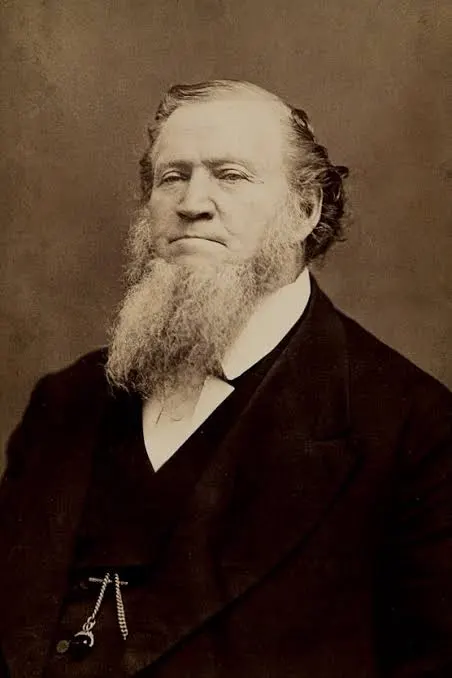
“Every faithful Methodist that has lived up to, and faithfully fulfilled the requirements of his religion, according to the best light he had, doing good to all, and evil to none; injuring no person upon the earth, honoring his God as far as he knows, will have as great a heaven as he ever anticipated in the flesh, and far greater. Every Presbyterian, and every Quaker, and every Baptist, and every Roman Catholic member, every reformer of whatever class or grade, that lives according to the best light they have, and never have had an opportunity of receiving a greater light than the one in their possession, will have and enjoy all they live for.” - Brigham Young
God loves ALL His children. God is fair. God is good.
40
134
1,005
16,211
Tryin 💪🙏 retweeted

Evangelical: I’d like to tell you about Mormonism.
Mormon: Oh, are you a former member?
Evangelical: No.
Mormon: Have you read the Book of Mormon?
Evangelical: No.
Mormon: Doctrine & Covenants?
Evangelical: No.
Mormon: Pearl of Great Price?
Evangelical: No.
Mormon: General Conference?
Evangelical: No.
Mormon: Official Church publications?
Evangelical: No.
Mormon: Then where did you learn what Mormons believe?
Evangelical: A guy on YouTube who learned it from another guy on YouTube who learned it from an anti-Mormon website in 2007.
Mormon: Ah. Please continue explaining my religion to me.
93
75
1,347
21,745
Tryin 💪🙏 retweeted
Evangelical: The Book of Mormon is from Satan.
Mormon: Why?
Evangelical: Because Satan can disguise himself as an angel of light.
Mormon: So Satan can create books about Jesus?
Evangelical: Yes.
Mormon: Books that teach faith in Christ?
Evangelical: Yes.
Mormon: Books that teach repentance?
Evangelical: Yes.
Mormon: Books that testify Jesus is the Son of God?
Evangelical: Yes.
Mormon: How do you know he didn’t write the Bible?
Evangelical: Because the Bible teaches faith in Christ, repentance, and that Jesus is the Son of God.
Mormon: …
Evangelical: …
Mormon: Do you see the problem?
Evangelical: I’d rather not.
171
42
707
23,499
Tryin 💪🙏 retweeted
Jun 11
Here. We. Go.
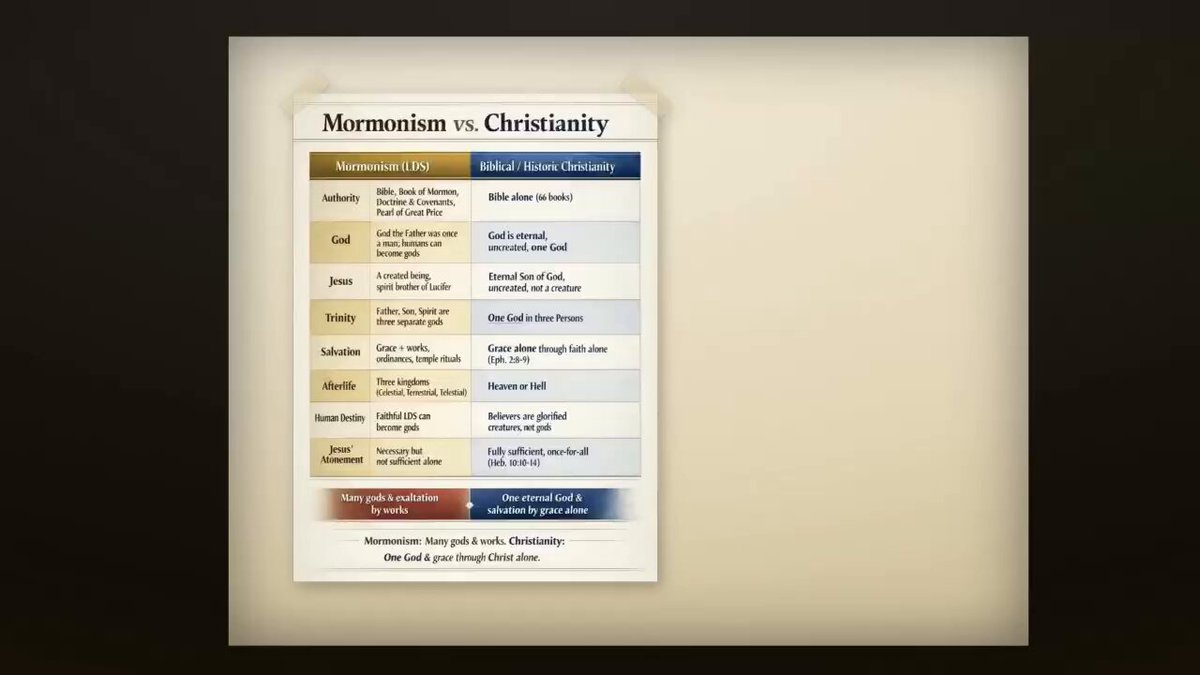
The Godhead vs. The Trinity - a respectful approach to analyzing the LDS vs. the Creedal approach to understanding who God and Christ are.
44
63
436
13,049
Tryin 💪🙏 retweeted

Jun 11
We're not 😂
Trinity means different things to different people. We're basically in line with the social trinity which is becoming the dominant view, it's basically identical to our doctrine.
Because "Trinity" means different things to different people, we use "Godhead" .
2
1
14
170
Jun 11
Creedalists and Trinitarians are indeed Christian.
To be Christian is based on a desire to follow/believe-in Jesus Christ, the Eternal God, as our Savior and Redeemer... The only path to salvation.
We wouldn't seriously tell even JW that they are Christian just because they don't view Christ as God. They do see Christ as their Savior and the Son of God.
Anyone who views Christ as their only path to salvation regardless of how they formulate "God" is a Christian.
Christ defined His Disciples.
His disciples are Christian, no matter their confusion about anything else.
The Good News is that Christ is our Savior... that is the Gospel Paul taught.
Using the silly own argument, that we so frequently and nauseatingly hear about us, is that dude 'turning the tables"... Using the Creedal/Trinitarian Christian's own argument back at them. Horribly so.
Who you're responding to doesn't represent anyone but himself in his, likely sarcastic, comment.
To answer your questions:
We gain nothing. (You do.)
We lose nothing. (You do.)

I keep wondering something: why are the LDS so passionately anti-Trinitarian?
Obviously it’s what Mormonism teaches, and so there is a certain amount of motivated reasoning to attack the Trinity in order to remain in good standing.
But what’s the personal motivation?
If you talk to Christians from many different backgrounds, you will inevitably meet those who can’t explain it, can’t understand it, or are not even sure what to think about it. But rarely do you meet Christians who want to fight you about it. Even rarer to meet someone who thinks Trinitarians are not Christians.
There’s something deep within Mormonism that cannot coexist with this doctrine. Something that completely falls apart if they admit that it’s true.
What do they gain if they defeat Trinitarianism? What do they lose if they can’t?
1
36
Tryin 💪🙏 retweeted
Jun 10
My full analysis of the debate between @LukeFHan and @emuse1955 and why Luke clearly won.
35
15
227
31,114

Tryin 💪🙏 retweeted
The difference is if throw a piece of clay into a lake I have done nothing wrong.
If I throw a baby into the lake that is something very different.
Human beings are Children of God with infinite worth and potential. They are not lumps of clay.
You are bastardizing Pauls analogy.
Jun 8

Jacob telling God the Potter how to behave.
10
2
45
3,137