
Upsetting poker traditions as CEO @UnrationalGames. I designed the feature you hate in @unpoker_rivals (coming soon). The occasional foray into matters @nufc.
Joined December 2011
- Tweets 574
- Following 543
- Followers 291
- Likes 2
Photos and videos
Pinned Tweet

21 Sep 2024
The number of losers at online poker has been increasing. Every hour. Every day. For over a decade. Yet not a single person who has played for real money thinks they are a poor player. This is the crux of why the online poker product is ‘broken’.
2
930
May 30
I wrote the final article in a series about the decline of (online) poker. This one is about the boom that never was. Have a read here 👇
x.com/UnrationalPhil/status/…

124
May 29
I wrote the third article in a series about the decline of (online) poker. This one is about the perception of unfairness. Have a read here 👇
x.com/UnrationalPhil/status/…
1
267
May 28
I wrote the second article in a series about the decline of (online) poker. This one covers the development of the surrounding tool/learning ecosystem and the impact it had on new players.
Have a read here 👇x.com/UnrationalPhil/status/…
152
May 26
I suspect that what you are seeing here is a function of how coding agents have entered product mature organisations (basically engineering outwards). In that scenario, developers, who now have the bandwidth to handle the nice to have refactors/resilience improvements which they could never quite get round to, have simply pushed onwards.
The problem is that, in many cases, such work was marginally useful, or impossible to link to relevant end outcomes (if you improve a set of tests to handle an edge case, but that edge case never got reached in real world use, is the system any more stable?). The bull case is that such work is finite, the bear case is that it is not (and that down/upstream coding changes driven by AI effectively create ever more marginal work).
For most of the last 14 months, @steipete was my AI productivity North Star (in so far as it is possible to adopt Peter's approach, which is basically sui generis). I think I am actually more aligned with @badlogicgames and @mitsuhiko now - it's about a more slowed down, thoughtful application of these powerful tools.
I think pretty soon you will see a different type of organisational structure appear, one where the whole framework is a sort of agentic entity that wraps human activity. @jack somewhat spoke about this recently (and Peter is sort of a forerunner of that as well in a way).

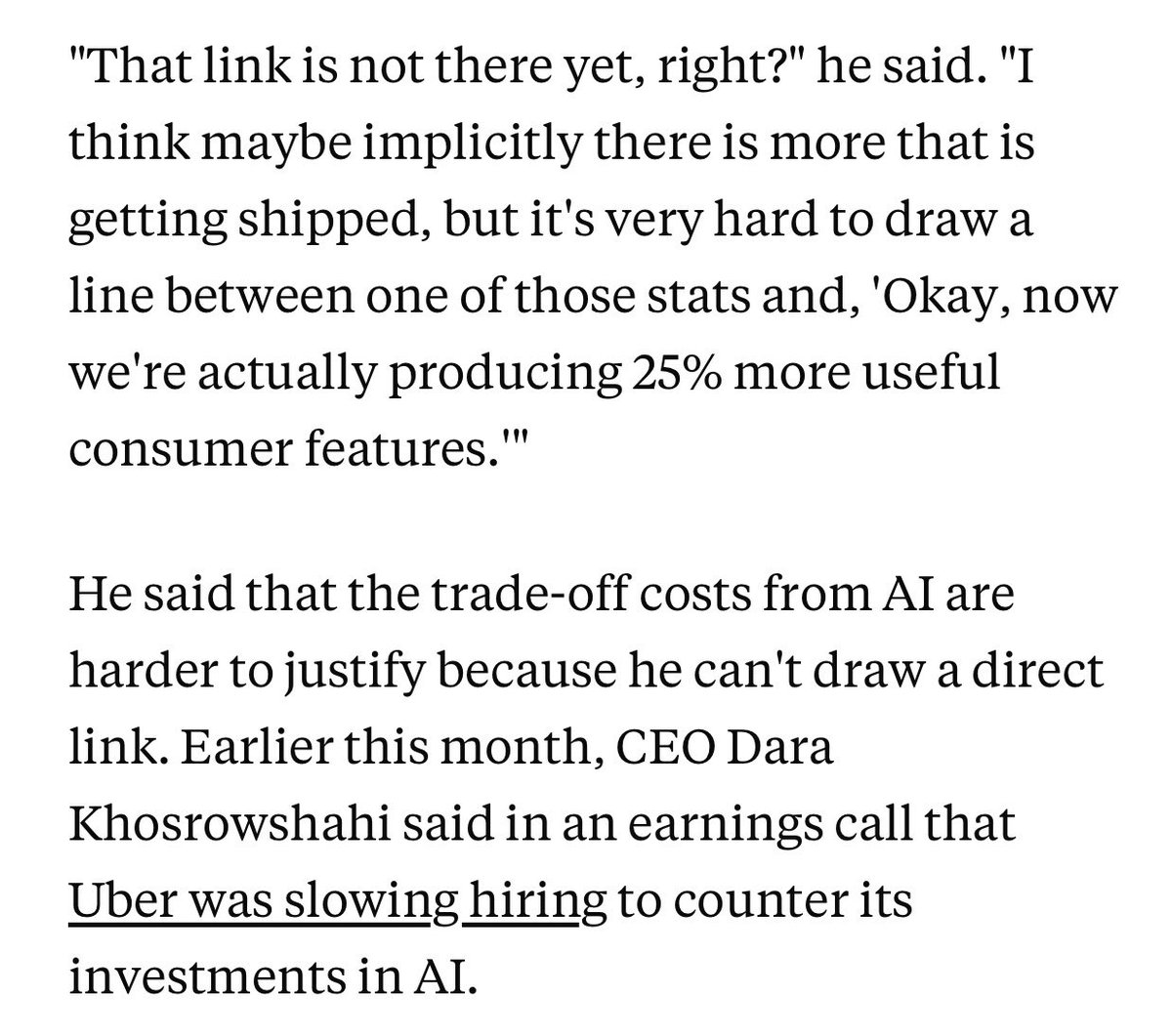
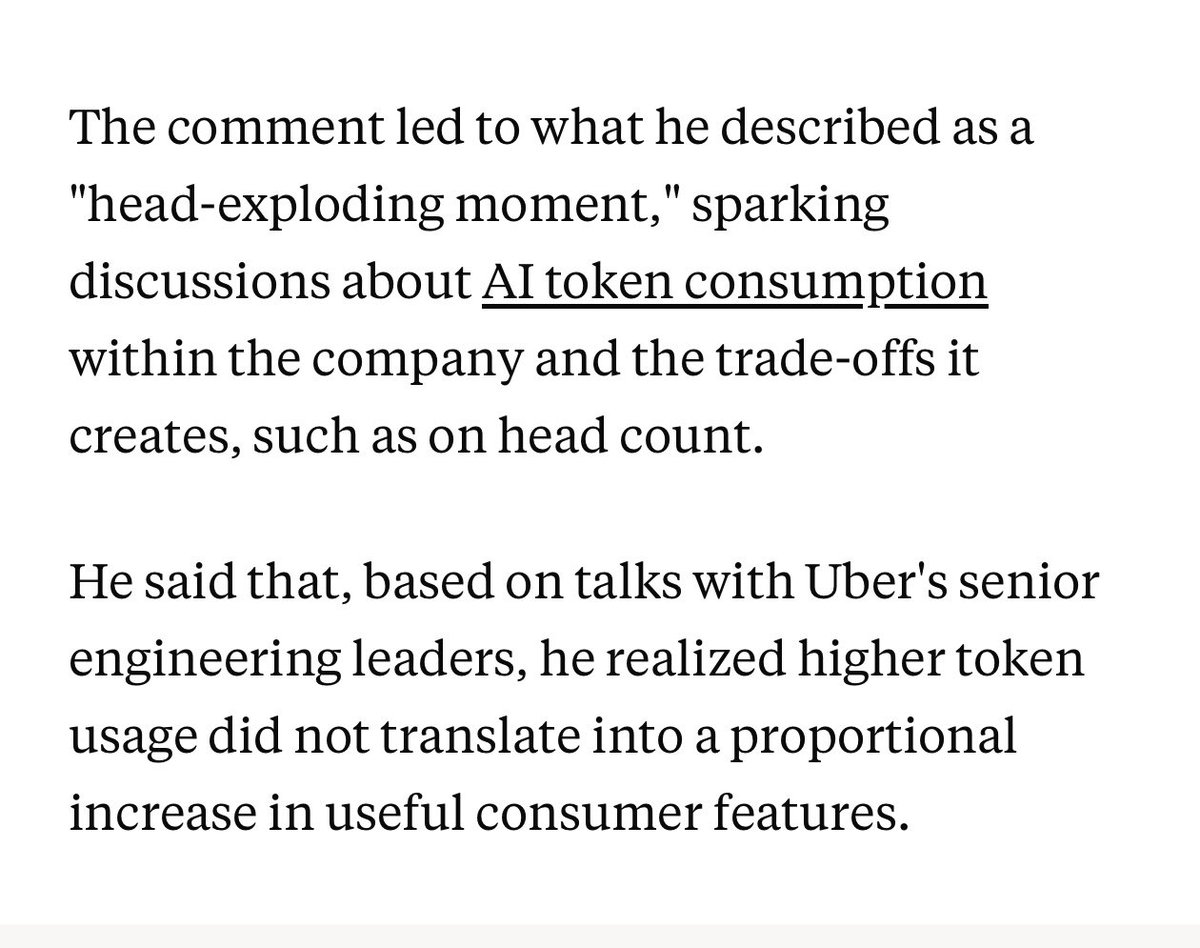
Uber’s COO has said that it’s getting “harder to justify” its AI costs because there was no way to show a link between AI spend and any meaningful increase in useful features. This is the first time I’ve seen a company say this directly.
businessinsider.com/uber-coo…
85
May 22
This is the first (of a few) articles, that I have been planning to write for a long time, on what caused the demise of online poker (in this case how it relates to prediction markets now).
Going to give credit to @mattkalish - the recent prediction market kerfuffles inspired me to get writing. I would note also that @SteveRuddock has been saying essentially the same thing for a long time - strongly recommend you read his newsletters.
x.com/UnrationalPhil/status/…
3
304
Philip Atkinson retweeted
May 19
One of the interesting things about the evolution of online poker (having seen it from the inside and now outside) is that, in general, the love for the game itself never died. Ultimately, many players just became cynical and jaded about the product.
Sports betting, especially on exchanges/PMs, has a much shorter skill level feedback loop and less core product engagement than poker, so you have to work extra hard to keep the retail flow.
1
1
1
137
May 19
I find some of the responses to @mattkalish's posts on @Kalshi (mainly from the people who have been restricted by the likes of @DraftKings) really odd.
Speaking as someone who was (back in the day) limited on every major UK book (and only had @Betfair as an option), I can understand the frustration, but to then make the argument that PMs are superior as they, in theory, allow all participants makes no sense.
One of the things exchanges/PMs always end up doing is revealing the true hierarchy of participants. We saw this all the time at @PokerStars - people would simply not sit at/leave tables when they knew they were facing comparable or superior opponents.
All those people who have had a bit of success with a "sophisticated" model that spots a pricing inefficiency when teams play at altitude, or think that sitting court side gives you an edge on in-play tennis markets, eventually find themselves proverbially looking across the spread at the likes of a Starlizard. At that point they learn the difference between the sort of people DK prefer to restrict and the entities they really, really want no action from.
With exchanges, ultimately the uniformed liquidity dries up (it always does), the informed liquidity becomes hyper cautious and sports betting has always been a game of relative skill. When the revenues drop, the PMs will have to squeeze their remaining customers - the very same people who are ranting at Matt about being restricted.
8
2
28
19,559
Mar 12
This is a really significant concept. Not because it is the first elucidation of the idea, or because it is directionally correct on the technical aspect (which I think is nuanced and situation dependent), but because I think this, and other similar articles, are pointing to something quite consequential.
The end of the organisation.
I'm going to try and pull all my thoughts together in a series of blog posts on it soon, but this (especially if you are technically minded) is well worth your time.

2
133
Philip Atkinson retweeted

26 Dec 2025
I've never felt this much behind as a programmer. The profession is being dramatically refactored as the bits contributed by the programmer are increasingly sparse and between. I have a sense that I could be 10X more powerful if I just properly string together what has become available over the last ~year and a failure to claim the boost feels decidedly like skill issue. There's a new programmable layer of abstraction to master (in addition to the usual layers below) involving agents, subagents, their prompts, contexts, memory, modes, permissions, tools, plugins, skills, hooks, MCP, LSP, slash commands, workflows, IDE integrations, and a need to build an all-encompassing mental model for strengths and pitfalls of fundamentally stochastic, fallible, unintelligible and changing entities suddenly intermingled with what used to be good old fashioned engineering. Clearly some powerful alien tool was handed around except it comes with no manual and everyone has to figure out how to hold it and operate it, while the resulting magnitude 9 earthquake is rocking the profession. Roll up your sleeves to not fall behind.
2,595
7,411
55,657
16,932,537
21 Nov 2025
Agree with @HoldCrunchTom's recent comments - whatever the conceptual/theoretical articulation of prediction markets is, the raw nature of the business is supplying a sufficient (and ideally increasing) stream of unsophisticated parties to transact with entities with far more resources. In that way they are very much like online poker products.
We've seen many examples of these sort of markets, and they tend to end up dominated by a single entity (eventually). Will be interesting to see who can nail the UI and customer journey for this cohort, as I don't think any of them are there at the moment.
2
110
13 Nov 2025
I wonder if, when the history of prediction markets is written, the narrative arc of this week will be seen as an early sign of what was to come? While the growth* teams at @Kalshi and @Polymarket were engaged in a life or death struggle to slay each other's internet rep, the performance marketing teams at @FanDuel and @DraftKings were quietly getting on with the boring business of prepping ad campaigns, media buys/assets and mailing lists.
Sure, it's not like productive work entirely ground to a halt for meme warfare, but it does speak somewhat to the different corporate cultures. If I had been CoS at Kalshi when it erupted, there would have been one tweet denying involvement, then radio silence. Everyone would have been told to focus on the actual existential threat, which is almost certainly now fighting FanDuel and DraftKings to a standstill over the Super Bowl period and beyond. (Though I probably would have quietly commissioned that wash trading research - once online poker black ops, always online poker black ops).
The epic battle for ~24 hours of X sentiment supremacy was certainly fun while it lasted. I think, maybe, Team Kalshi won on account of being able to produce a (sort of?) job application by William LeGate, but then he summoned an image of a (still alive) hawk with an arrow through it, so maybe he lives to fight another (internet) day? Unfortunately, the reality is that it didn't matter, as the customers Kalshi needs to reach are so removed from here that they probably think a John Wang is a type of Chinese tractor.
Anyone interested in hints about how this might play out is probably better off analysing the ads that are run via the Facebook ad library than paying attention to the accounts with badges here. That's where the battle is really going to be. I am intrigued as to what the X mood music will be if/when the accounts which have breathlessly been extolling Kalshi's growth start seeing it bleed market share (which is somewhat likely just because it won't effectively have a monopoly any more).
Think I will write a thread about how Kalshi likely loses, and one about how they might win in the coming weeks. I think their situation is slightly more interesting than Polymarket, as it's more likely to resolve into a binary outcome (Adam Neumann manoeuvre like exit for the founders aside - which would at least comically echo the WeWork story in terms of their prominence in @matt_levine's newsletters).
* If there is any worse recent crypto-corporate-ism than allowing a bunch of mostly mid tier American recent grads to rebrand marketing as 'growth', then I am not aware of it. Only badges are a worse signal at this point.
9
2
41
13,927
27 Oct 2025
On the back of this tweet 👇I spoke to @SteveRuddock on the Straight to the Point podcast about @kalshi, @Polymarket and the parallels with Scheinberg-era @PokerStars . We covered my history as an early user of @Betfair, the important things I learned from Mark and Isai as a very small (but somewhat unique) cog in that machine and how they might apply to the current situation in the US market.
We also covered aspects like innovation and disruption (and historical lack thereof) in our industry, and some of the interesting advantages that prediction markets have in terms of local cultural appreciation. We also discussed some of the aspects which are maybe a bit more troubling, and ask what cultural/ethos/approach aspects they are downstream of (and whether that might have a bearing on whether the likes of Kalshi succeed).
Finally we chatted a bit about @unpoker_rivals, something that has been in my mind for a long time, and will be getting more visibility soon. Have a listen!
straighttothepoint.substack.…
1
5
520
27 Oct 2025
22 Oct 2025
There is a credible bull case for the likes of @Kalshi and @Polymarket disrupting the sports betting space (although maybe it is only a transient advantage), but the bear case is reinforced by too many of their public facing outlets seeming deeply/deliberately oblivious to the nature of a business where the (vast) majority have a losing experience. Prediction markets are (somewhat) novel in a US market sense, but are not something particularly new in a product sense.
Whatever a gaming product looks like from the outside, or how it is promoted/hyped, I haven't worked in, or interacted with, a successful company in the gaming space that wasn't full of deeply serious people on the inside.
The big companies now have decades of institutional understanding of how to provide a sports betting/casino/poker product. They understand bonuses, player retention/reactivation and have extensive tried and tested playbooks for user acquisition in both new and mature markets. They have multiple product lines and are increasingly effective at optimising the player journey to maximise revenue (which they then can reinvest in UA and brand to squeeze out competitors).
From the more mature markets they've learned how to navigate responsible gaming and associated regulatory issues. I doubt many of them like the RG restrictions, but they were smart enough to see that the end stage of a free for all, and the negative publicity/enemies that generates, was doom.
When I think back to the PokerStars org chart (of over a decade ago now) I can see what it really was - an astonishingly optimised structure for entering, establishing and eventually dominating markets. It took a long time, some astonishingly bold, and arguably lucky, decisions from some very serious people to reach that point.
Does this mean they can't be disrupted? Of course not, and the prediction markets have certainly found a regulatory/competitive opportunity to exploit. The established gaming companies (especially in the US) are far from perfect and there are lots of areas where you could outcompete them. But none of that starts from pretending you have some novel customer experience. In the UK we've had @Betfair for decades. It's now a bit of a wasteland of liquidity, generally populated by people you generally never want to be on the other side of a bet/trade from. This is somewhat the story of any gaming vertical. The best poker players don't really want to be sitting at a table with the other best players.
@Kalshi and @Polymarket aren't @Betfair of course. You can make 'predictions' on all sorts of things, but therein lies the paradox. The more opportunity you allow unsophisticated customers to lose their money on niche or comedic markets, the quicker they are going to incinerate their resources and end up churning to a competitor with a prominent sign up offer.
At that point you are in a competition with entities with significant resources. There were hundreds of people working on the demand side at Stars across nearly every territory. The budget I oversaw, for player conversion alone, was nine figures. That was just a part of the overall marketing budget, and it was for a company with essentially a single product line at the time.
Every time I see a hype boi tweet from one of the accounts promoting these companies (and recently it has even been employees!) I'm left wondering whether this is smart UGC adjacent marketing hoovering up the sort of customers who respond to it, or whether it is a sign of an unserious company. The former is a pretty interesting strategy (at least for those of us close to this space) - a sort of less grey take on the Rainbet/Stake approach. If it is the latter then it’s much harder to argue the bull case.
1
158
22 Oct 2025
There is a credible bull case for the likes of @Kalshi and @Polymarket disrupting the sports betting space (although maybe it is only a transient advantage), but the bear case is reinforced by too many of their public facing outlets seeming deeply/deliberately oblivious to the nature of a business where the (vast) majority have a losing experience. Prediction markets are (somewhat) novel in a US market sense, but are not something particularly new in a product sense.
Whatever a gaming product looks like from the outside, or how it is promoted/hyped, I haven't worked in, or interacted with, a successful company in the gaming space that wasn't full of deeply serious people on the inside.
The big companies now have decades of institutional understanding of how to provide a sports betting/casino/poker product. They understand bonuses, player retention/reactivation and have extensive tried and tested playbooks for user acquisition in both new and mature markets. They have multiple product lines and are increasingly effective at optimising the player journey to maximise revenue (which they then can reinvest in UA and brand to squeeze out competitors).
From the more mature markets they've learned how to navigate responsible gaming and associated regulatory issues. I doubt many of them like the RG restrictions, but they were smart enough to see that the end stage of a free for all, and the negative publicity/enemies that generates, was doom.
When I think back to the PokerStars org chart (of over a decade ago now) I can see what it really was - an astonishingly optimised structure for entering, establishing and eventually dominating markets. It took a long time, some astonishingly bold, and arguably lucky, decisions from some very serious people to reach that point.
Does this mean they can't be disrupted? Of course not, and the prediction markets have certainly found a regulatory/competitive opportunity to exploit. The established gaming companies (especially in the US) are far from perfect and there are lots of areas where you could outcompete them. But none of that starts from pretending you have some novel customer experience. In the UK we've had @Betfair for decades. It's now a bit of a wasteland of liquidity, generally populated by people you generally never want to be on the other side of a bet/trade from. This is somewhat the story of any gaming vertical. The best poker players don't really want to be sitting at a table with the other best players.
@Kalshi and @Polymarket aren't @Betfair of course. You can make 'predictions' on all sorts of things, but therein lies the paradox. The more opportunity you allow unsophisticated customers to lose their money on niche or comedic markets, the quicker they are going to incinerate their resources and end up churning to a competitor with a prominent sign up offer.
At that point you are in a competition with entities with significant resources. There were hundreds of people working on the demand side at Stars across nearly every territory. The budget I oversaw, for player conversion alone, was nine figures. That was just a part of the overall marketing budget, and it was for a company with essentially a single product line at the time.
Every time I see a hype boi tweet from one of the accounts promoting these companies (and recently it has even been employees!) I'm left wondering whether this is smart UGC adjacent marketing hoovering up the sort of customers who respond to it, or whether it is a sign of an unserious company. The former is a pretty interesting strategy (at least for those of us close to this space) - a sort of less grey take on the Rainbet/Stake approach. If it is the latter then it’s much harder to argue the bull case.
19
6
109
28,277
15 Oct 2025
I was grateful to talk to Pete about his workflow at CCAnon on Monday. There are probably a tiny number of people working with AI agents at the level he is, and I'm not aware of anyone else documenting their approach. Astonishing signal to noise value. x.com/steipete/status/197817…
14 Oct 2025

📢 Time for an update on my workflow. This one's a 23 min read, so buckle up. 100% organic and hand-written, like an animal. steipete.me/posts/just-talk-…
1
379
Philip Atkinson retweeted

10 Aug 2025
Finding Balance in the AI Boom: Family, FOMO, and My Limits
A personal reflection on balancing family life with AI-fuelled momentum, the pull of FOMO, and learning to set healthier limits
async-let.com/blog/family-fo…
8
5
34
3,461