
Managing Director @CanShieldInst co-author of The Big Fix. making sovereignty make sense.
Joined September 2009
- Tweets 32,195
- Following 5,330
- Followers 10,038
- Likes 54,054
603 Photos and videos



Pinned Tweet

May 5
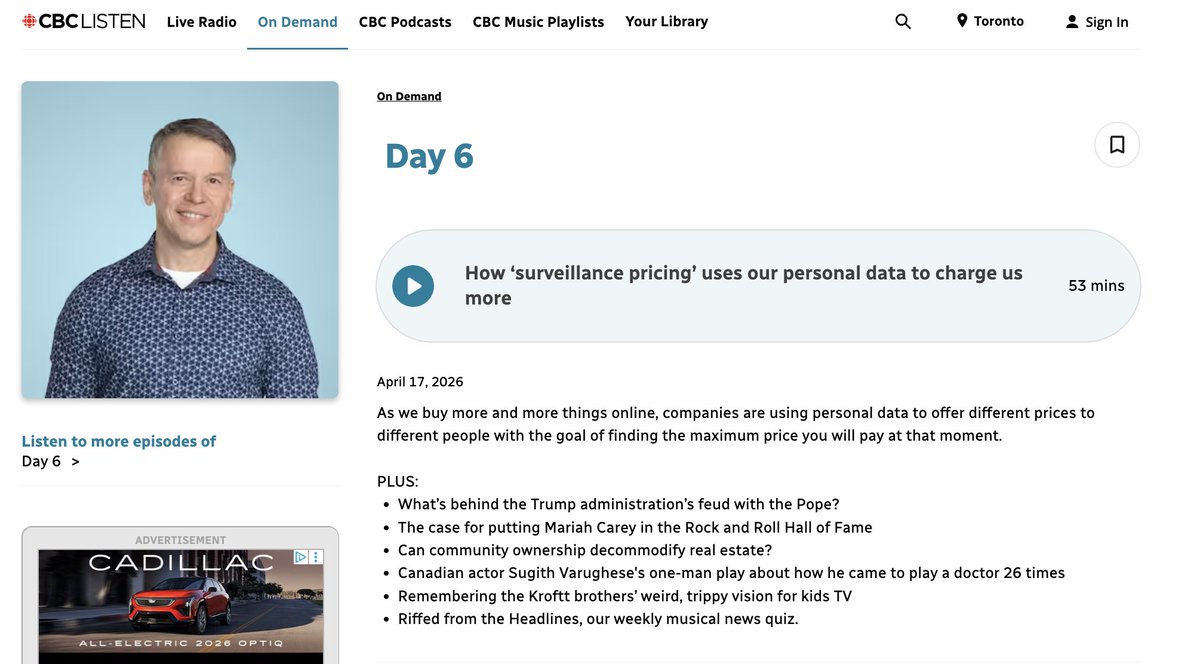
Companies are going to tell us the NEED a bunch of extra information about us in order to selectively offer special discounts. We shouldn't buy it.

Opinion: Surveillance pricing is discrimination by another name theglobeandmail.com/opinion/…
1
12
36
4,139
Vass Bednar retweeted

Lost access to Anthropic’s AI models highlights risk of relying on U.S. tech, Canadian experts say theglobeandmail.com/business…
2
4
14
4,322
Vass Bednar retweeted

Elbows Up, Arms Wide Open
Canada welcomes the world. By @LaVjosa
nytimes.com/2026/06/12/world…
Head over to our homepage for live coverage of the games by our colleagues over at @TheAthletic
1
13
52
2,908

ICYMI: Jim Balsillie gave a sobering talk at BetaKit #MostAmbitious: Town Hall. The @CADInnovators chair walked through all the ways the US has leveraged economic policy to Canadian disadvantage—and all the ways Canada allowed it to happen.
betakit.com/physical-ai-and-…
1
1
3
324
Vass Bednar retweeted

Jun 11
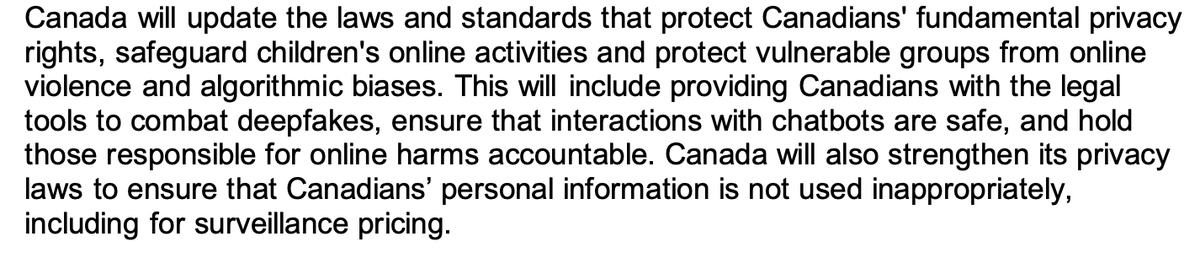
AI Minister Evan Solomon: "We want to make sure that people's personal data cannot be used for surveillance pricing for price gouging."
The NDP's Avi Lewis has pushed to ban the practice, where personal data is used to charge Canadians different prices on the same products.
5
7
26
2,558
Vass Bednar retweeted

Jun 11
What if the problem with the internet isn’t that too many people have voices, but that too few people are willing to say no? Writer @jasonguriel makes the case for a now diminished—and often misunderstood—figure: the gatekeeper. thewalrus.ca/bring-back-the-…
4
6
437
Vass Bednar retweeted

Jun 10
US Big Tech firms have a panopticon-like view of most emerging technologies and business models, allowing them to stay ahead of shifts in adjacent or potentially disruptive markets, note Helena Malikova, Brianna Rock, and Anna Marchese. project-syndicate.org/commen…
2
2
1,122
Vass Bednar retweeted

Jun 10
The New York Legislature approved a bill to require news organizations to disclose when artificial intelligence is used to create content. Supporters say the first-of-its-kind measure will help maintain & restore trust in the age of AI slop @StateAffairsUS pro.stateaffairs.com/dc/disr…
1
13
31
3,050
Vass Bednar retweeted

Foundations of Digital Sovereignty: Chapter 6
If Canada is serious about increasing our sovereign cloud capacity, government procurement is by far the most powerful tool at our disposal.
canadianshieldinstitute.ca/l…

1
1
3
157
Vass Bednar retweeted

The California dream is dead: Tech companies that once claimed to offer connection have done away with the pretense. They now prioritize extraction—and what better place to build towards that goal than Texas?
thebaffler.com/salvos/the-te…
4
9
2,100
Vass Bednar retweeted
Jun 9
We like to think our tastes are our own, but algorithms are now molding what we love in ways seen and unseen. Reflecting on the controversy around the band Geese, writer @CaulfieldTim explores how “manufactured consensus” has become common sense: thewalrus.ca/a-pr-hoax-creat…
4
3
625
Jun 8
Related reading for my @thewalrus snapshot on AI agents. 👇

Millions of Americans are beginning to rely on AI agents.
But if those agents are controlled by Google, Amazon, Microsoft, or Meta, whose interests are they really serving?
NEW REPORT from OMI Senior Fellow @Sally_Hubbard: openmarketsinstitute.org/pub…
1
4
630
Jun 8
"If Ottawa doesn’t get serious, we could be left relying on the U.S. to protect our financial systems, health care records and national security."
Jun 8

Seize the quantum future – or let the U.S. own it. Which way, Canada? theglobeandmail.com/business…
1
7
470
Vass Bednar retweeted
Jun 8
AI shopping assistants act like trusted advisors, but they may be nudging users toward sponsored products instead. As retailers integrate tools like ChatGPT into e-commerce experiences, writer @VassB questions who these agents are really working for. thewalrus.ca/ai-shopping-ass…
1
2
3
512
Vass Bednar retweeted

Americans keep getting walloped by rising prices. Now there’s another culprit for sticker shocks: artificial intelligence.
These are four ways Americans are paying more as a result of AI mania: wapo.st/4v1NuCE
22
36
75
28,318
Jun 7
"...the fact is that we are over-optimising, over-streamlining and forgetting about the things that matter the most."
Jun 7

We are optimising ourselves to death ft.trib.al/nxXBhvw
1
4
13
2,039
Vass Bednar retweeted

Jun 6
Dynamic pricing in economic theory could be a boon to the poor, but more often it favors the hyper-diligent and hyper-vigilant against more normal personality types, then wreaks havoc on poorly educated consumers
3
4
26
4,426
Jun 6
A lazy argument that's been tried in the US is spilling over here. How much extra data do you need to offer a discount again? It's basically a way to legitimize enshrine the practice itself, by allowing firms to set fake price ceilings. It's manipulative, and not a free market.
Jun 6

As the Carney government signals a crackdown on surveillance pricing, major retailers are lobbying for weaker guardrails they argue are necessary for data-based personalized discounts thestar.com/politics/federal… via @torontostar
1
17
1,908
Vass Bednar retweeted
Jun 6
Canada has unveiled its long-awaited national AI strategy, but experts say key questions around regulation, privacy, and accountability remain unanswered. Can Ottawa translate its AI ambitions into public confidence? thewalrus.ca/canada-ai-plan/
6
6
885
Vass Bednar retweeted
Jun 6
In the USA, the level of vigilance the average person has to maintain to avoid getting ripped off extracts its own kind of price -- one most analysis of dynamic pricing doesn't pay any attention to.
21
76
487
21,290
Vass Bednar retweeted

Jun 5
AI raises the stakes much further replacing the very content.
This isn’t about “innovate or die” or building bigger coalitions. It’s about market power - and ability to leverage dominance across competition, data, advertising and copyrighted content. 3/3 digitalcontentnext.org/blog/…
1
6
27
1,221