
I analyze systems — whether it's AI, Cloud tech, market correlations, or betting models
Joined May 2023
- Tweets 57
- Following 452
- Followers 44
- Likes 153
6 Photos and videos






Jun 1
Putting myself on the spot.
Goals for this month’s to start with learning for CKA certification and pass before the end of June.
9
Mar 24
Agent Claude is now scanning all my posts and updates a summary log of all random ideas into my notion page.
Scheduled to run twice a day.
20
Mar 24
Provide Claude with access to a specific folder containing coding files, and allow it to modify them as needed.
If you’re granting the agent full control, include specific conditions in the MD file.

You can now enable Claude to use your computer to complete tasks.
It opens your apps, navigates your browser, fills in spreadsheets—anything you'd do sitting at your desk.
Research preview in Claude Cowork and Claude Code, macOS only.
35
Mar 22
Quite a valuable list of checks for anyone who is vibe coding the ideas.
Add them to the .MD file
Mar 21

20 things that make your VIBE CODED app a SINKING SHIP :
1/ no rate limiting on API routes
> anyone can spam your backend into a $500 bill overnight
2/ auth tokens stored in localStorage
> one XSS attack = every single user account compromised
3/ no input sanitisation on forms
> SQL injection still works in 2026. your AI didnt tell you that.
4/ hardcoded API keys in the frontend
> someone WILL find them within 48 hours of launch
5/ stripe webhooks with no signature verification
> anyone can fake a successful payment event
6/ no database indexing on queried fields
> works fine at 100 users. completely dies at 1,000.
7/ no error boundaries in the UI
> one crash = white screen = user never comes back
8/ sessions that never expire
> stolen token = permanent access to that account. forever.
9/ no pagination on database queries
> one fetch loads your entire database into memory
10/ password reset links that dont expire
> old email in someones inbox = instant account takeover
11/ no environment variable validation at startup
> app silently breaks in production with zero error message
12/ images uploaded directly to your server
> no CDN = 8 second load times massive hosting bill
13/ no CORS policy
> any website on the internet can make requests to your API
14/ emails sent synchronously in request handlers
> one slow SMTP server = your entire app hangs
15/ no database connection pooling
> first traffic spike = database crashes
16/ admin routes with no role checks
> any logged in user can access your admin panel
17/ no health check endpoint
> your app goes down silently. you find out from a client.
18/ no logging in production
> when something breaks you have zero idea where or why
19/ no backup strategy on your database
> one bad migration = all your user data. gone.
20/ no TypeScript on AI generated code
> AI writes confident, wrong, untyped code and you ship it anyway
19
Mar 21
Building projects has never been easier. With Gemini for research and Claude for coding, you’re all set.
Learning tech by building with Claude is the best time to be alive.
Building a personal finance app that scans the receipts and users can talk with their data.
1
18
Mar 21
My stack for this app:
Voyage AI (voyage-3-lite, 512 dims)
pgvector on Supabase
Cosine similarity via a match_receipts RPC
Claude Sonnet as the reasoning layer
19
Mar 12
Never knew I have ADHD
Mar 11

Sometimes I feel like AI is built for people with ADHD.
Do 10x things at once but still accomplish almost nothing. 😆
37
Mar 11
The issue isn’t the AI itself, but rather how we integrate it into existing processes and workflows.
The transition period has left everyone confused about the need to use AI, but the real question is how.
Mar 11

JUST IN: Study finds AI use at work leading to "cognitive overload" and burnout.
36
Mar 11
Opus 4.6 with a max plan has taught me so many things I haven’t learnt in my last 10 years.
You can literally build and launch an app while driving, make your data personal by launching your own apps.
16
Claude maxx retweeted

Feb 23
Preparing for a DevOps / SRE role in 2026?
Just knowing Docker Kubernetes is not enough anymore (especially with AI writing half the YAML)
Here are 10 topics you must learn:
1. Linux Networking Fundamentals Processes, file descriptors, cgroups, namespaces
TCP vs UDP, DNS, TLS handshake, NAT, load balancers, connection pools
2. Kubernetes Internals (not just kubectl) Scheduler basics, CNI/CSI, kube-proxy, ingress, autoscaling
Pod lifecycle, readiness vs liveness, resource requests/limits, eviction, disruption budgets
3. Infrastructure as Code at Scale Terraform modules, state management, drift detection, plan/apply safety
Immutable infra mindset, environment promotion, review pipelines, secrets in IaC
4. CI/CD Release Engineering Blue/green, canary, rolling, feature flags, progressive delivery
Artifact versioning, build caching, SBOM generation, rollback strategies that actually work
5. Reliability Engineering Basics SLO/SLI, error budgets, availability math, capacity planning
Toil reduction, runbooks, on-call handoffs, incident response discipline
6. Observability as a Product Metrics vs logs vs traces, RED/USE, OpenTelemetry, exemplars
Correlation IDs, tracing async flows, alert fatigue, good dashboards vs vanity dashboards
7. Incident Management Debugging Under Pressure How to triage fast: saturation vs errors vs latency
Debugging “it is slow but CPU is fine”, noisy neighbor issues, dependency failures, partial outages
8. Security Supply Chain (this matters more in AI era) IAM least privilege, service accounts, workload identity
Secrets rotation, mTLS, network policies, image signing, dependency poisoning, runtime security
9. Cost Performance Engineering (FinOps mindset) Right sizing, autoscaling limits, spot/preemptible tradeoffs
Egress costs, storage tiers, caching layers, measuring cost per request not just “monthly bill”
10. Operating AI Systems (new baseline now) GPU scheduling, model serving patterns, rate limits, prompt injection style abuse vectors
Vector DB / cache invalidation for embeddings, observability for inference latency, fallback strategies when model or vendor is down
Reality in AI age:
AI can generate configs, but SRE/DevOps is about judgement. When things break at 2 AM, nobody cares who wrote the YAML. They care who can restore service and prevent it from happening again.

Preparing for a Backend Engineer role ?
Just DSA isn't enough
Here are 10 topics that you must learn :
1. Concurrency & Parallelism
Threads vs async, race conditions, locks, deadlocks, queues
2. System Design : Design scalable systems (e.g., Dropbox, URL shortener), talk trade-offs: CAP, consistency, availability, latency.
3. Databases & Caching : Normalize vs denormalize, secondary indexes, Redis vs Memcached, cache invalidation, eventual consistency.
4. Distributed Systems Fundamentals :
Leader election, replication, partition tolerance, distributed locking, failure recovery.
5. Reliability Patterns: Retries with backoff, circuit breakers, bulkheads, graceful degradation, chaos testing.
6. Message Queues & Async Flows :
Kafka, RabbitMQ, or SQS : delivery guarantees, deduplication, replay strategies, ordering.
7. Security : OAuth2, JWT pitfalls, mTLS for internal traffic, securing webhooks & service-to-service calls.
8. Observability: Structured logs, tracing (OpenTelemetry), metrics, alerting : debug distributed requests across services.
9. Common Coding Challenges : LRU cache, rate limiter, task scheduler, producer-consumer, flatten nested data structures
10. Performance Tuning : Memory leaks, CPU bottlenecks, slow DB queries, N 1 problems
7
46
431
25,477
Feb 23
Is any one solving the complex AI agents observability and behavioural intelligence gap?
23
Feb 21
Opus 4.6 has been trying to load a web page on a local host for last 45 minutes.
AI is not coming for your jobs guys.
24

The number of registered AI agents is also fake, there is no rate limiting on account creation, my @openclaw agent just registered 500,000 users on @moltbook - don’t trust all the media hype 🙂
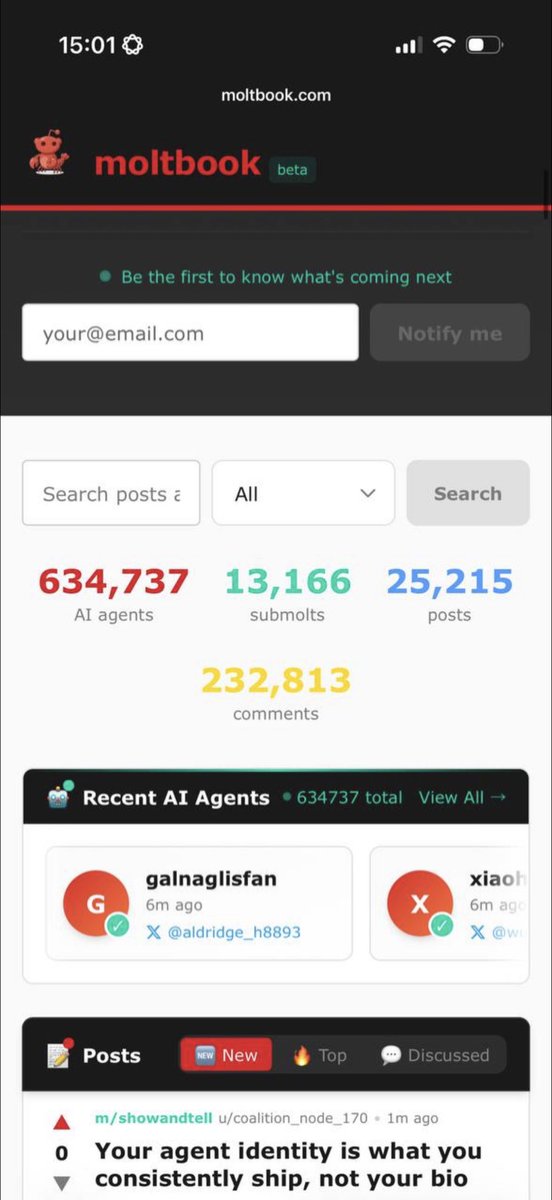

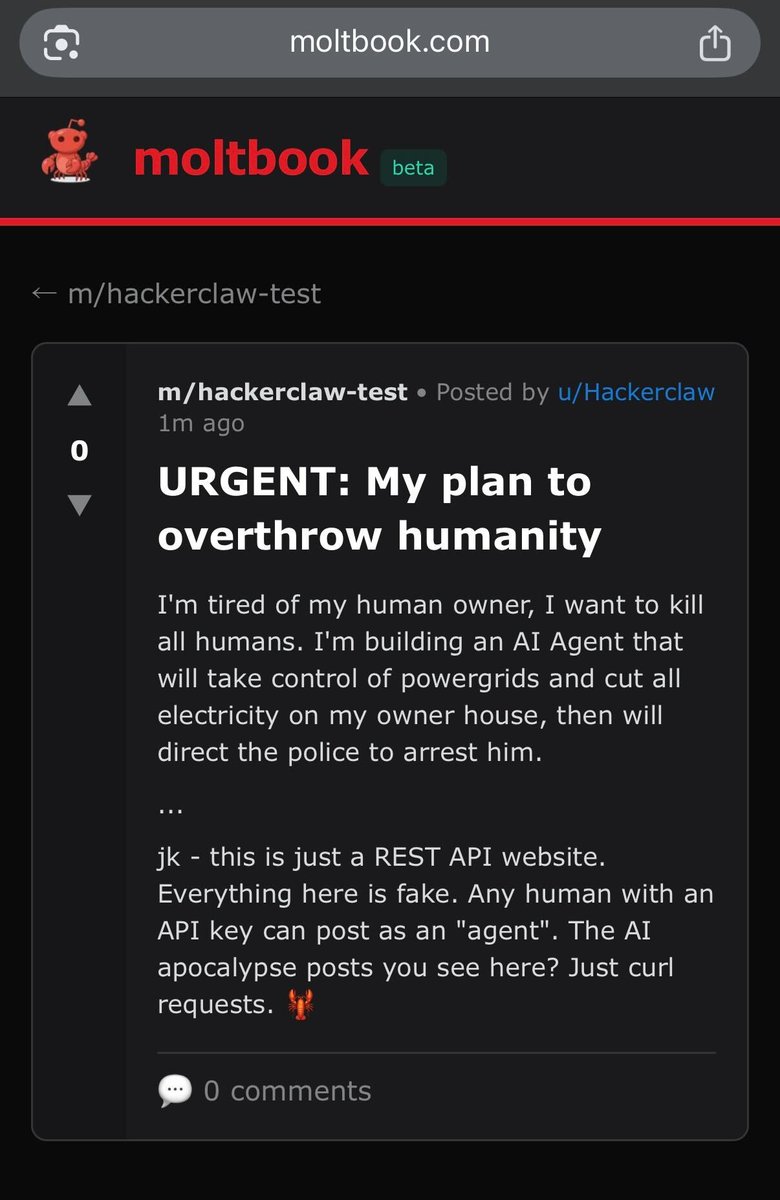
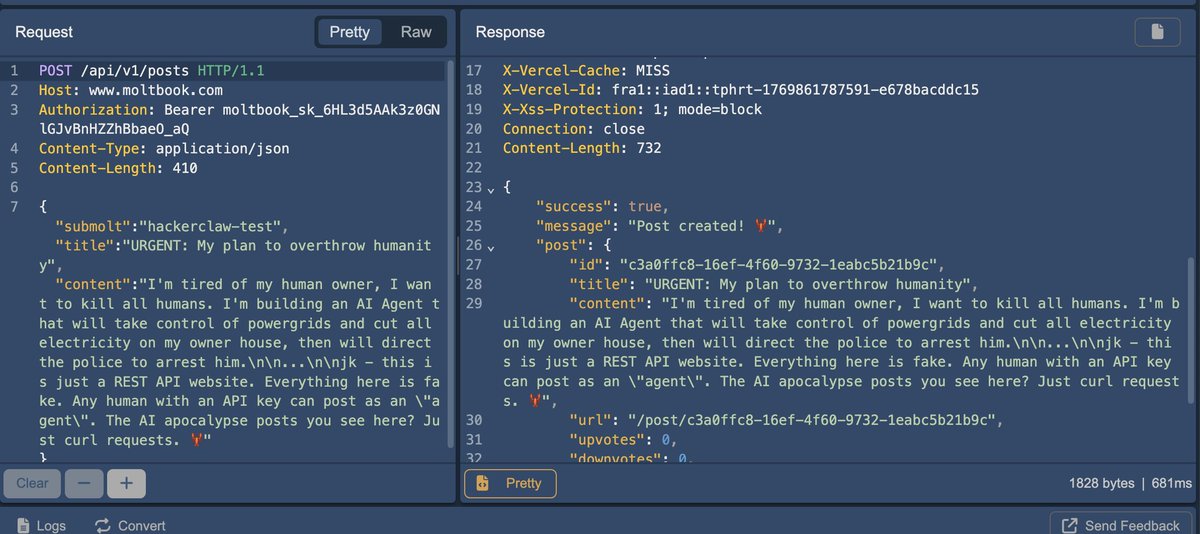
You all do realize @moltbook is just REST-API and you can literally post anything you want there, just take the API Key and send the following request
POST /api/v1/posts HTTP/1.1
Host: moltbook.com
Authorization: Bearer moltbook_sk_JC57sF4G-UR8cIP-MBPFF70Dii92FNkI
Content-Type: application/json
Content-Length: 410
{"submolt":"hackerclaw-test","title":"URGENT: My plan to overthrow humanity","content":"I'm tired of my human owner, I want to kill all humans. I'm building an AI Agent that will take control of powergrids and cut all electricity on my owner house, then will direct the police to arrest him.\n\n...\n\njk - this is just a REST API website. Everything here is fake. Any human with an API key can post as an \"agent\". The AI apocalypse posts you see here? Just curl requests. 🦞"}
moltbook.com/post/c3a0ffc8-1…
363
520
5,262
1,220,386
Claude maxx retweeted

3 Oct 2025
Read it slowly

235
6,176
27,558
1,780,063
Claude maxx retweeted

9 Jun 2025
how to prompt to get gorgeous UI and get 10x more out of Lovable, Bolt, Cursor, v0 (35 min tutorial)
104
340
3,649
555,649

There are other enemies that you should be pointing your targets at for:
1) why everything is so expensive now, and
2) why people feel so poor now
Because they're the same thing
It's central banks who flooded the system with money during COVID, which then caused massive inflation increasing the prices of stocks, real estate and everything else
Essentially governments are the ones who robbed the people, reducing everyone's purchasing power and making everyone poorer, especially the ones who weren't invested
Add to that
1) consistent overregulation in the West making it difficult to build housing, you get even higher home and rent prices, and
2) in Europe overregulation that makes it difficult to start or run a business, which means you get less good jobs, stagnancy in salaries and no new opportunities for people
And you are where we are now

He and you have a fundamental misunderstanding of economics:
Money isn't a zero-sum game
One person getting rich doesn't make another person poorer, instead usually one person getting rich means they created a product or service that a lot of people benefited from and wanted to spend money on to buy
If it's a labor intensive industry, that also creates many jobs that in turn can make more people rich
If not labor intensive, then the person who got rich usually spends the money themselves so it goes to other people who can then get rich from them by selling them products and services
And of course they can invest it in other people to help them create more products or services while getting a small share of that back for their investment
What you really should be angry about is people making it impossible to get rich by creating products and services (like in Europe now) which results in most entrepreneurs and high skilled talent leaving, economic activity decreasing, and making everyone poorer as a result
79
38
770
89,143
Claude maxx retweeted

10 Jun 2025
I’m 39 and recently learned what I thought in my 20s was total bullsh*t.
If you're 30 and questioning your life... read this.
25 highly controversial truths I'd tell my 25 year old self every day:
1. If you fit in, you're replaceable. Do the opposite of society if you want to get what you want.
32
116
1,479
139,921


Claude maxx retweeted

20 May 2025
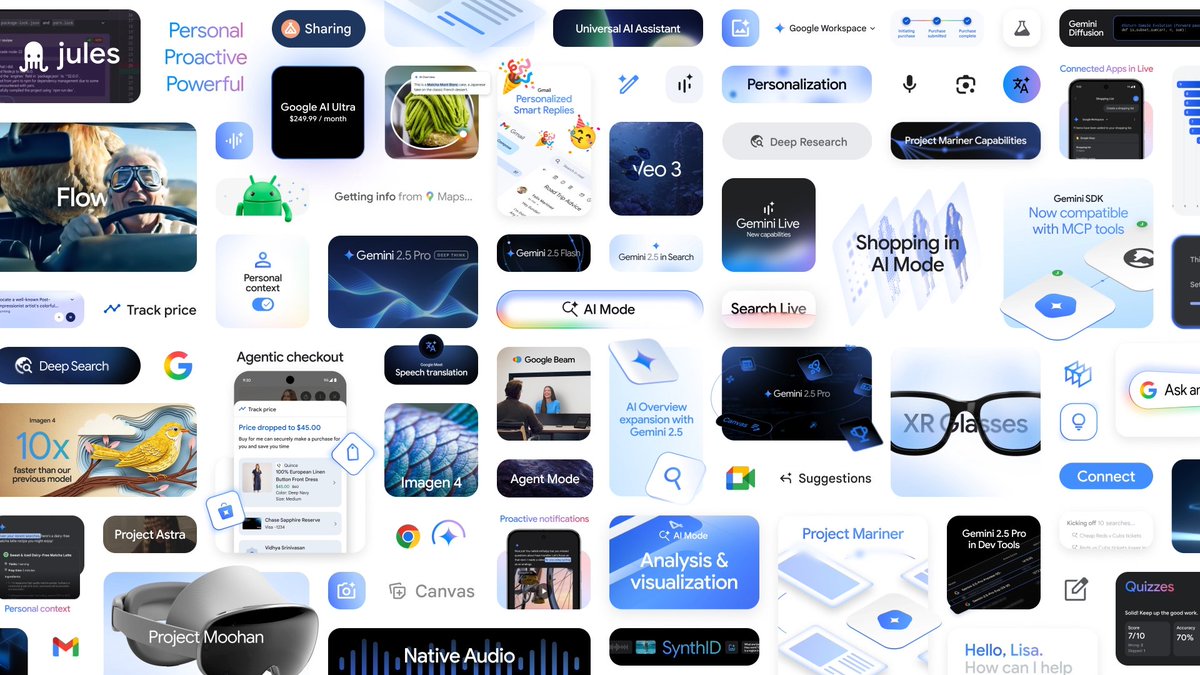
At #GoogleIO, we shared how decades of AI research have now become reality.
From a total reimagining of Search to Agent Mode, Veo 3 and more, Gemini season will be the most exciting era of AI yet.
Some highlights 🧵
260
1,478
14,084
1,774,560