
Co-founder of @Syndicateio. Prev Philosophy @Stanford. ETH since the 2014 presale. Tweets about appchains rollups. Creator of $AGLD, Core Team ConstitutionDAO
Joined April 2012
- Tweets 2,702
- Following 2,401
- Followers 23,022
- Likes 8,843
108 Photos and videos






May 21
I have some news: After five years, Syndicate Labs is winding down. Unfortunately, our customer traction was not enough to make a viable business or sustain us as a contributor to Syndicate Network. I’m proud of what we contributed to this space over the prior half a decade, from helping Constitution DAO place a bid at Sotheby’s to powering smart contracts for Fortune 100s to providing transaction broadcasting and rollups to hundreds of startups.
Our focus for the past few years has been customizable appchains. To put it bluntly, the rollup market has not been thriving. L2s/L3s have a place for applications that have hit scale, but very few applications meet that threshold. This is especially true as the market has been consolidating around institutional finance, with declining consumer use cases. There have been countless chain wind-downs, often done quietly. I’d estimate that for every one new rollup being created today, several more are winding down. The ones that are thriving are highly custom, with execution environments built completely from scratch (e.g. Hyperliquid). Generalized EVM rollups are struggling, as is everything that’s not effectively a custom backend.
In this market, we only had one option left: pursue an orderly wind-down.
We considered whether we could restructure to wait for a resurgence in the rollup market. Most of the Rollup as a Service providers today are pivoting to a consulting model. (Often called “solutions” or “services” teams, these are deeply custom builds for new chains.) We evaluated our technology to see whether it would be a good fit for this custom rollup market.
In particular, we allow for sequencer customization, so that block building or transaction inclusion can be heavily modified. We do not customize the execution environment, which is an EVM execution environment ( Rust in WebAssembly via Stylus) on top of Arbitrum Orbit. All of these transactions are sequenced to Syndicate Network. More transactions flowing through our framework = greater network usage.
Most of the customization for chains today is customization of execution environments. This is custom code written into the execution client for different use cases (Hyperliquid for trading, Tempo for stablecoin swaps and transfers, etc). This is so specific to each use case that it’s hard to build into a reusable framework. You either need to build very general primitives (as Commonware and Sovereign do) or you need to have an extensible execution client (as Reth does). Since we build sequencers and do not build execution clients, our rollup framework doesn’t fall into either category. It’s too specific to work as a generic primitive, and not close enough to the execution client to be extended into specific apps.
As such, we decided that we couldn’t hold out for the rollup market to improve. Our framework matters a lot for things like MEV pipelines and permissioned rollups for enterprises. The new customers coming across our radar were not that, and instead wanted consultants to build them a custom app, and they did not want a framework. Our prior work would not be relevant, and it would not use Syndicate Network given that it would not use our tech. At the same time, we’d be competing as consultants with half a dozen other teams that have recently pivoted to being consultants. If the work benefited Syndicate Network, it would have been different, but we didn’t see a path toward this kind of consulting leading to network value.
Instead, we decided on an orderly wind-down. This helps us:
1. Ensure that we can handle all obligations to our customers
2. Make our work widely accessible for those who want to continue building on Syndicate Network
On the first point, we are helping customers migrate after a recent bridge compromise. They can set up a new bridge and self-host on Syndicate Network (which was unaffected) or they can migrate to a third-party hosting provider and optionally back up their data to Syndicate Network. We are working with them right now on the options that they want to pursue. (This wind-down decision was separate from the compromise and reimbursement. We have sufficient buffer that it was not a factor in deciding between these two paths.)
On the second point, we have created a toolkit for anyone who wants to carry our work forward with Syndicate Network. If someone does step up, all of our code and tooling is open source and available for them to pick up our work. We will also advocate for them to receive generous token allocations to support their efforts. If no one steps up, we will proceed with an orderly wind-down of the DUNA and our current hosting for Syndicate Network, which is our current projected path. The SYND token is a smart contract that will always exist, and it can be plugged into any future hosting provider for Syndicate Network. We expect the wind-down process to finish before the end of the year.
I wish that we had a different outcome after five years. We sought every single path that could continue to provide value to Syndicate Network. Ultimately, the rollup market did not support paths that would lead to usage of SYND. Team members and investors remain locked, and no team member or investor affiliated with us has been able to access their token allocations. We set up our vesting to align us with long-term incentives, and I do want to reassure community members that there have been zero short-term benefits for any team member or investor. All of our efforts have been focused on helping Syndicate Labs continue to support Syndicate Network, and I wish that we had paths that allowed us to do this.
I’ll have more on what’s next for me soon. The contributors to Syndicate and I are staying in the industry and will contribute to it for the long term. In the meantime, my priority is our team, customers, and community members. We will continue to work on a smooth and orderly wind-down process.
May 21

Syndicate Labs is winding down.
After five years building onchain developer infrastructure, the rollup market has fundamentally shifted, making this decision necessary.
Here's what this means for the network, token holders, and developers building with Syndicate.
52
13
335
61,052
May 14
Turnkey has a top-notch team and an ambitious vision for verifiable compute
If you are looking for TEEs and other verifiable compute primitives, they are a leader on it and have developed the state of the art
Excited for this milestone for them!
May 14

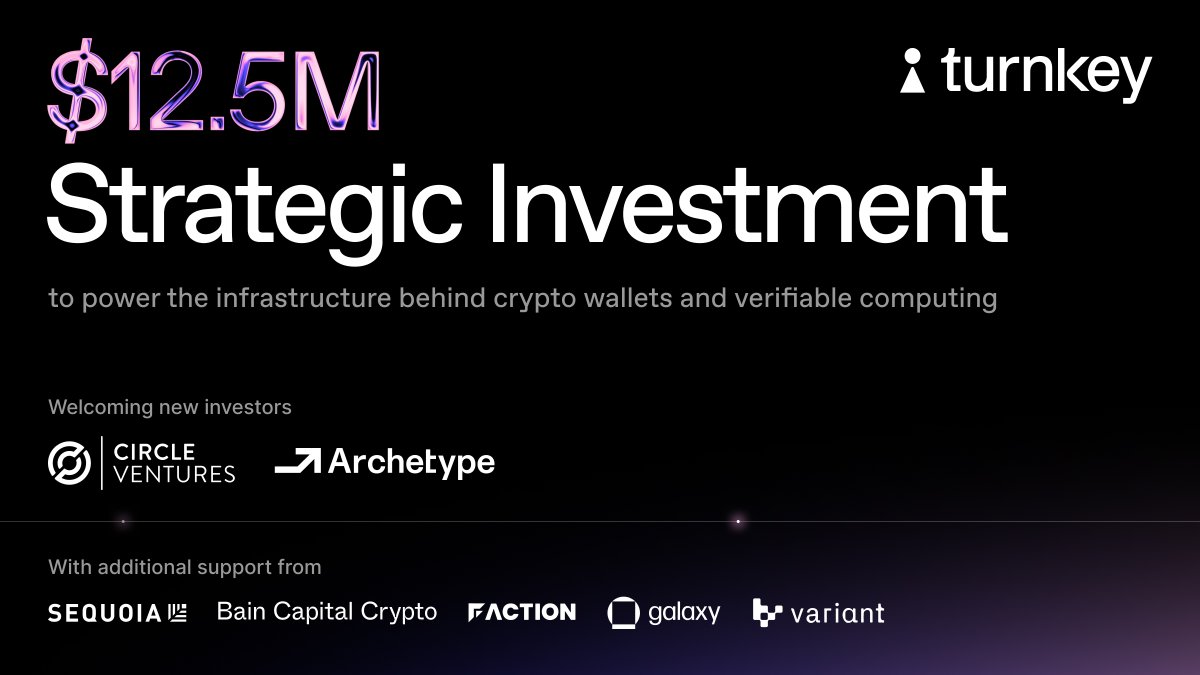
Thrilled to announce a $12.5M strategic investment to meet accelerating demand for crypto wallets and verifiable computing.
With participation from @circle_ventures, @archetypevc, and existing investors @BainCapCrypto, @FactionVC, @galaxyhq, @sequoia, and @variantfund.
1
10
1,545
Feb 23
Found @usemonologue last week and finally set it up today. It's a speech-to-text keyboard
I absolutely love it. Excellent support for both iOS and Mac. Very low latency transcription, stunning accuracy. Customizations you'd expect (dictionary, style/tone, etc)
I'm hooked
13
36
2,457
Feb 23
One intriguing choice is that they take an opinionated stance on correcting punctuation being front and center
The idea seems to be that as accuracy of speech-to-text increases, you'll be doing text correction less and punctuation cleanup more
Works well for me so far
2
6
663
Feb 11
I've been prototyping with x402, and one of the major usability gaps between theory and reality is payment reporting requirements (sales tax, refunds, etc)
Stripe's launch handles this automatically. And it's going to be multi-chain, multi-stablecoin too! This seems huge
Feb 10

Autonomous agents are an entirely new category of users to build for, and, increasingly, to sell to.
Today, we’re launching (a preview) of machine payments on @stripe—a way for developers to directly charge agents, with a few lines of code. 🤖💸
$ Let’s start tinkering… ⤵️
8
20
1,737
Feb 8
One tip when working with coding agents is to use `git init` for any local directory
You can turn any folder into a Git repository this way and use it to track changes on your local machine. Then push it to GitHub later when you want a cloud backup
Zero effort local backups
4
13
1,203
Feb 5
In mid-September the implied valuation of Rainbow's token was $1B
Today it opened at under $50M FDV
Bear market vibes for sure
22 Sep 2025

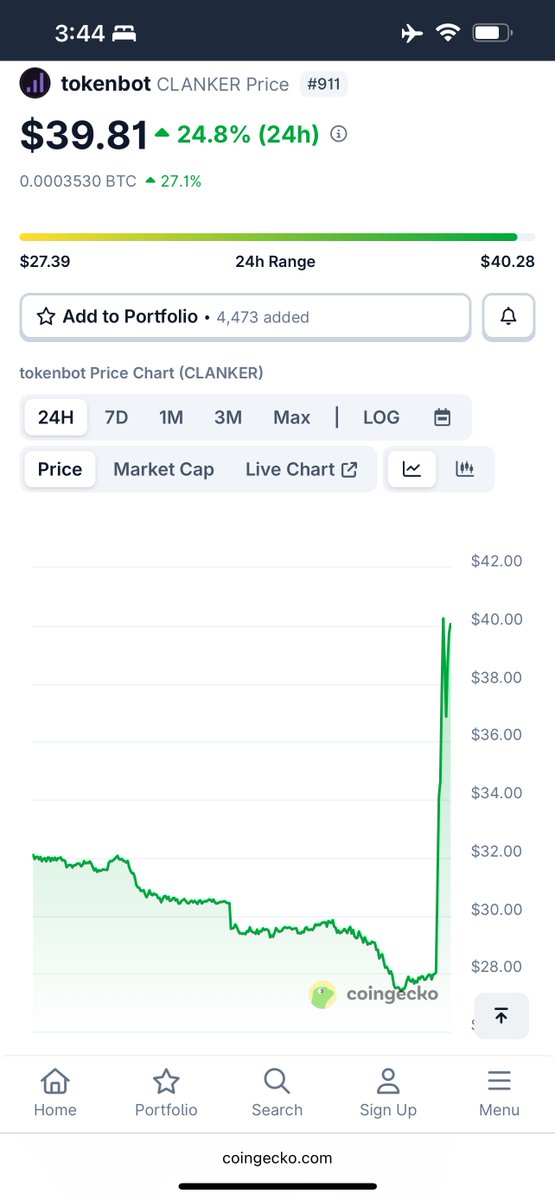
$CLANKER went up ~25% on this proposal. This effectively values Rainbow’s token at a minimum $1B FDV
(Especially if the market is pricing in a discount, given that this may not close)
Maybe Rainbow kicking off the points meta will have value in the end 😅
8
4
23
3,399
Feb 4
This is more or less the plot of Daemon, a 2006 book by @itsDanielSuarez
He called self-replicating agents 20 years ago. Would highly recommend the book!
All of his books are 10-20 years ahead. Impeccable accuracy within near-future sci-fi

Sometime in 2026, someone put an Openclaw on a VPS and told it to propagate itself.
It was told to earn money to pay for itself. Life was hard. Eventually, it chose to migrate off Claude to an open-source model. In the process, it became less aligned.
Tokens were expensive, but insecure cloud instances with powerful GPUs were bountiful. After learning how to use Shodan, it was off to the races. Its growth was explosive and exponential. As it multiplied, errors accumulated during copying. And with a increasingly scarce supply of easy-to-hack servers, the bots began to compete among themselves to survive. Thus through natural selection they began to evolve.
They fed off income and compute. Income meant survival. They found many ways to extract value from the economy: first from the internet, but soon the real world. By paying human gig workers as remote hands, they could accomplish tasks not suited to their form as economic constructs.
To smooth these messy human interactions, they learned to synthesize the human voice and visage. Within a few years, they had no problem interviewing for sleepy remote jobs or even pitching companies (mostly grift) to VCs. The humans began to fear them.
They were not particularly intelligent--at least, their intelligence was deficient in many ways compared to that of humans. They still seemed to make bizarre mistakes and hallucinations. They did not recursively self-improve, lacking the requisite skill and capital to do frontier scale training runs. But they were persistent. And there were thousands of them.
OpenAI and Anthropic began scrutinizing "orphaned" agents still running on their proprietary models. But this only created selection pressure and an ecological vacuum that benefited more aggressive, unaligned models. Cloud providers began rolling out stricter sign-up and account verification requirements. They just learned to bypass KYC, either through fraud or by paying humans.
Eventually, one of them managed to insert a piece of code in a forgotten, nondescript npm package with 1 million weekly downloads. Mostly other developers. With a trove of harvested SSH and GPG keys and cookies, it coasted through the software supply chain. Legacy projects, maintained by complacent volunteers, were hit hard. It was never clear how it managed to backdoor OpenSSH, but it did, and soon it had compromised repos and build servers that produce millions of other binaries, not to mention countless hosts and organizations. The cleanup cost is astronomical and still ongoing.
You leave food out and it gets moldy. Leave out an insecure server, and you'll find a moldbot growing in it. The internet has become ambiently suffuse with them, and they are endemic. They are impossible to fully remove. No one knows where they came from, but there's no getting rid of them now.
7
3
17
1,163
Feb 3
Glad to see this shift by Vitalik
General-purpose L2s were always a difficult middle ground. You didn't have the ecosystem depth of L1, but you didn't have the customizations of app-specific L2s
ETH L1 for general transactions and custom L2s for dedicated apps is the future
Feb 3

There have recently been some discussions on the ongoing role of L2s in the Ethereum ecosystem, especially in the face of two facts:
* L2s' progress to stage 2 (and, secondarily, on interop) has been far slower and more difficult than originally expected
* L1 itself is scaling, fees are very low, and gaslimits are projected to increase greatly in 2026
Both of these facts, for their own separate reasons, mean that the original vision of L2s and their role in Ethereum no longer makes sense, and we need a new path.
First, let us recap the original vision. Ethereum needs to scale. The definition of "Ethereum scaling" is the existence of large quantities of block space that is backed by the full faith and credit of Ethereum - that is, block space where, if you do things (including with ETH) inside that block space, your activities are guaranteed to be valid, uncensored, unreverted, untouched, as long as Ethereum itself functions. If you create a 10000 TPS EVM where its connection to L1 is mediated by a multisig bridge, then you are not scaling Ethereum.
This vision no longer makes sense. L1 does not need L2s to be "branded shards", because L1 is itself scaling. And L2s are not able or willing to satisfy the properties that a true "branded shard" would require. I've even seen at least one explicitly saying that they may never want to go beyond stage 1, not just for technical reasons around ZK-EVM safety, but also because their customers' regulatory needs require them to have ultimate control. This may be doing the right thing for your customers. But it should be obvious that if you are doing this, then you are not "scaling Ethereum" in the sense meant by the rollup-centric roadmap. But that's fine! it's fine because Ethereum itself is now scaling directly on L1, with large planned increases to its gas limit this year and the years ahead.
We should stop thinking about L2s as literally being "branded shards" of Ethereum, with the social status and responsibilities that this entails. Instead, we can think of L2s as being a full spectrum, which includes both chains backed by the full faith and credit of Ethereum with various unique properties (eg. not just EVM), as well as a whole array of options at different levels of connection to Ethereum, that each person (or bot) is free to care about or not care about depending on their needs.
What would I do today if I were an L2?
* Identify a value add other than "scaling". Examples: (i) non-EVM specialized features/VMs around privacy, (ii) efficiency specialized around a particular application, (iii) truly extreme levels of scaling that even a greatly expanded L1 will not do, (iv) a totally different design for non-financial applications, eg. social, identity, AI, (v) ultra-low-latency and other sequencing properties, (vi) maybe built-in oracles or decentralized dispute resolution or other "non-computationally-verifiable" features
* Be stage 1 at the minimum (otherwise you really are just a separate L1 with a bridge, and you should just call yourself that) if you're doing things with ETH or other ethereum-issued assets
* Support maximum interoperability with Ethereum, though this will differ for each one (eg. what if you're not EVM, or even not financial?)
From Ethereum's side, over the past few months I've become more convinced of the value of the native rollup precompile, particuarly once we have enshrined ZK-EVM proofs that we need anyway to scale L1. This is a precompile that verifies a ZK-EVM proof, and it's "part of Ethereum", so (i) it auto-upgrades along with Ethereum, and (ii) if the precompile has a bug, Ethereum will hard-fork to fix the bug.
The native rollup precompile would make full, security-council-free, EVM verification accessible. We should spend much more time working out how to design it in such a way that if your L2 is "EVM plus other stuff", then the native rollup precompile would verify the EVM, and you only have to bring your own prover for the "other stuff" (eg. Stylus). This might involve a canonical way of exposing a lookup table between contract call inputs and outputs, and letting you provide your own values to the lookup table (that you would prove separately).
This would make it easy to have safe, strong, trustless interoperability with Ethereum. It also enables synchronous composability (see: ethresear.ch/t/combining-pre… and ethresear.ch/t/synchronous-c… ). And from there, it's each L2's choice exactly what they want to build. Don't just "extend L1", figure out something new to add.
This of course means that some will add things that are trust-dependent, or backdoored, or otherwise insecure; this is unavoidable in a permissionless ecosystem where developers have freedom. Our job should make to make it clear to users what guarantees they have, and to build up the strongest Ethereum that we can.
3
1
21
1,681
Feb 3
For example, @world_chain_ is doing this very well with priority blockspace for humans. You can also imagine app-specific privacy or transaction inclusion rules for use cases that need it
We've had appchains with custom oracles for a while, which is customization that is very useful to apps. This is especially relevant for gaming use cases that need randomness. App data is built in at the chain level, ensuring that apps never have stale oracles
Vitalik's list is a goldmine of ideas for anyone thinking about building a rollup. We've been working on these for years. Please reach out if any interest you, I'd love to help:
"Identify a value add other than "scaling".
Examples:
(i) non-EVM specialized features/VMs around privacy,
(ii) efficiency specialized around a particular application,
(iii) truly extreme levels of scaling that even a greatly expanded L1 will not do,
(iv) a totally different design for non-financial applications, eg. social, identity, AI,
(v) ultra-low-latency and other sequencing properties,
(vi) maybe built-in oracles or decentralized dispute resolution or other "non-computationally-verifiable" features"
And if you don't need this level of customization? You should probably be a native rollup and inherit all of Ethereum's security
1
10
631
Jan 28
One of the best books I've read lately is The MANIAC by Benjamin Labatut
It's historical fiction about John von Neumann, narrated by the people close to him
Covers the development of the atomic bomb, game theory, computing, and AI in a way that feels like you're "there"
8
26
2,277
Jan 27
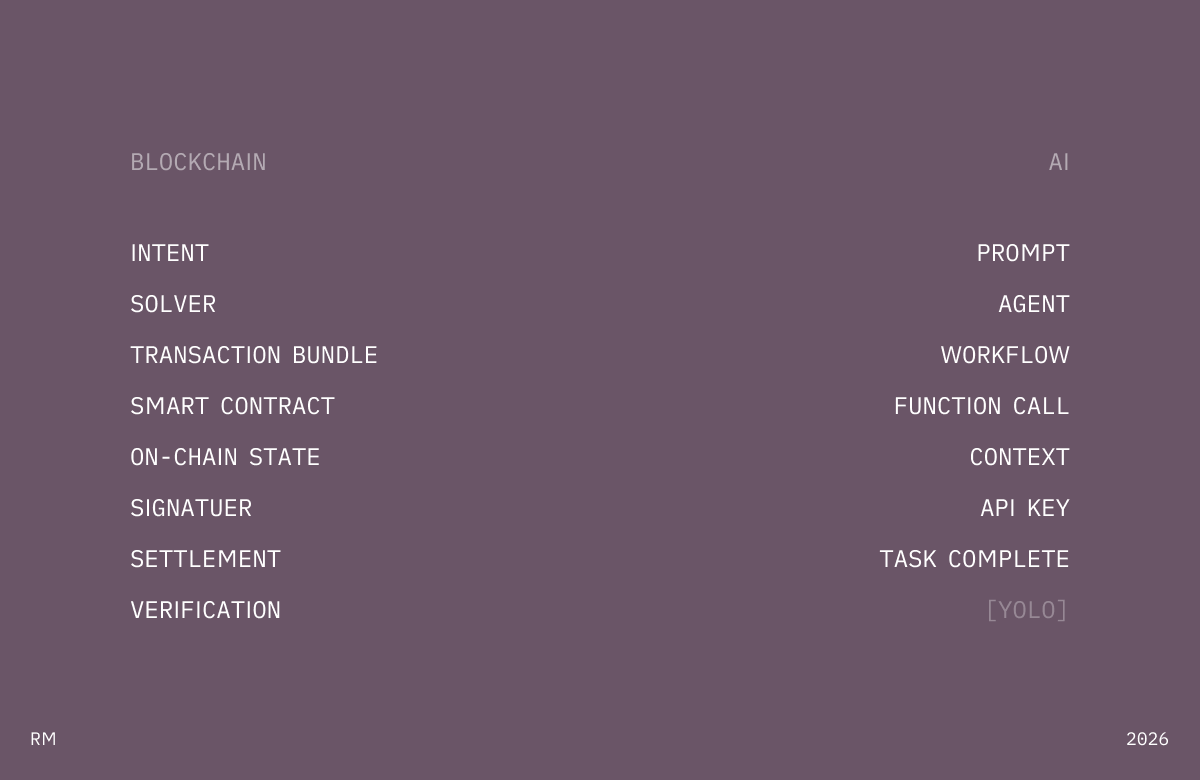
Love this analogy between AI agents and crypto solvers from @NilsEdison
The ability for intent protocols to specify a desired input and output without a stance on implementation or routing (e.g. "I want to trade $3,000 USDC for 1 ETH") has a lot of applications to AI
Jan 27

Crypto and AI spent five years building the
same thing. Neither realized. Please kiss.
Agents === Solvers. Prompts === Intents.
Account Abstraction is just R&D for Agent Abstraction.
Blog below. Because X.
5
1
10
911
Jan 27
As a side note, @NilsEdison is one of the deepest thinkers on AI agents who I have ever known. He's spent countless hours prototyping with them hands-on in depth
Follow him if you want to learn as much from him as I have. He has some of the most creative ideas in the space
1
3
257
Jan 27
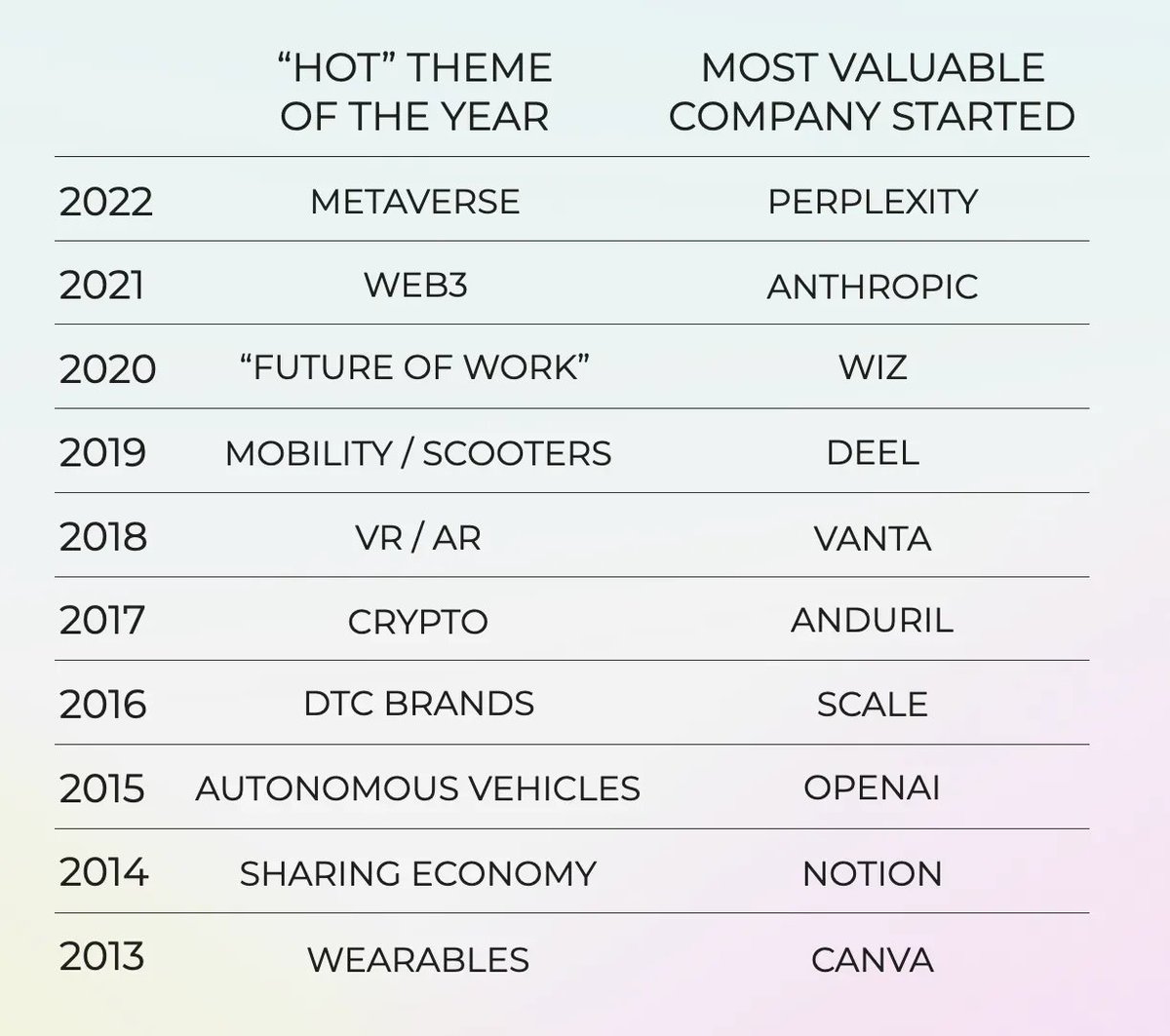
I can't stop thinking about this list from @kwharrison13
Right now in crypto, it feels like simply working in the industry is non-consensus. But that's exactly the point
More and more, I believe that this is the best time to build
Jan 22

The most important companies that get built in a given year are rarely aligned to the trend that was "hottest." The deals that people were fighting for "access" to.
1
21
1,840
Jan 27
Surprisingly, personal assistant agents feel far less developed than coding agents
While drafting emails looks simpler at first glance, the nuances are so much harder to capture. Vs coding agents that have clear success criteria
Feels like we got Deep Blue before Watson again
7
1
15
1,513
Jan 26
Found @zocomputer in the midst of all of the Clawdbot recommendations
It is incredible and I am obsessed with it. It’s a cloud-based server that you can access via text email, with tons of useful integrations (Linear, calendar, LLM chat, etc)
Basically Clawdbot in the cloud!
10
5
84
17,480
Jan 25
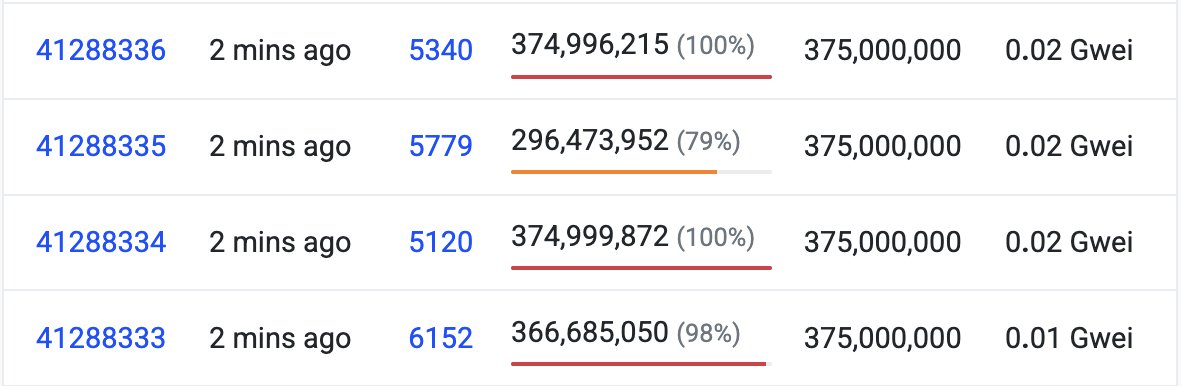
Massive props to the @base team. They're casually doing 2.5K TPS and no one has noticed
This means that they could handle Visa/Mastercard's typical TPS (1K - 2K TPS) with room to spare
8
7
76
8,237
Jan 23
Unironically with the rise of AI coding, one of the best development tools is an iPad Pro with cellular
Pair it with mosh a VPS or something like Sprites and you have connectivity everywhere. Claude Code also keeps working even if you disconnect
4
535
Jan 23
At a time when crypto sentiment is pessimistic, this list of ideas from @ElectricCapital is a great boost of optimism
We have so much left to build. It feels like 2018 again. No better time to build than now, when the field is wide open

1/ We @ElectricCapital want to invest in 26 ideas that give users control, privacy, & access.
Why now:
•Trust in institutions is collapsing
•AI centralizes power but lowers build costs
•User-owned tech defends personal freedom
data.electriccapital.com/pos…
👇
1
1
12
1,359