
We're hiring. Electric Capital is an early stage venture firm focused on cryptocurrencies, blockchain, fintech, and marketplaces.
Joined May 2018
- Tweets 521
- Following 81
- Followers 65,867
- Likes 844
5 Photos and videos

Exposing your entire onchain history to the world is insane.
But you do it with every purchase on your crypto card and every transaction to a friend.
That ends today. @AnomaPay V1 is LIVE on @ethereum.
Get started: anomapay.app
43
32
225
112,529
Electric Capital ⚡️ retweeted

Ren (@0xren_cf) dropping some knowledge on Bitcoin and quantum!
May 28

Quantum computing has become a major topic within Bitcoin discussions.
The team dives into Bitcoin's quantum readiness and why investor education remains critical in a new episode of Bitcoin Brainstorm. Watch. ark-invest.com/podcast/bitco…
4
3
18
3,812

RE TGE is coming soon.
A new era for the internet native insurance capital market begins.
More details here:
blog.re.xyz/re-governance-to…
77
59
499
84,931

This list is no longer up to date. Please visit electriccapital.com/team/ for a full list of current team members.
19
1
4
940
Electric Capital ⚡️ retweeted

May 20
In the early Google X days of what would later become Waymo, designer YooJung Ahn asked a handful of engineers to sketch what came to mind when they imagined a self-driving car.
→ The safety engineer drew a giant mattress.
→ The LiDAR engineer drew a cone.
→ Others referenced futuristic sci-fi vehicles.
The exercise surfaced an important problem: the team had powerful pieces of autonomous-driving technology, but no shared design vision yet for what a self-driving car should actually feel like to the people around it.
So YooJung asked a more fundamental question:
Why are we building a self-driving car?
The answer became surprisingly important to the design process.
The team believed self-driving vehicles had the potential to make roads safer, help reduce crashes, and expand access to mobility.
That clarity helped shape the design work that followed.
Firefly wasn’t designed only to function technically. It was designed to feel approachable and understandable to people encountering autonomy for the first time.
The team explored hundreds of vehicle forms and rethought basic assumptions about cars:
→ What should the inside of a car look like when nobody is driving?
→ What information helps passengers feel calm?
→ Should passengers face each other or forward?
→ What physical details make a vehicle feel approachable rather than intimidating?
Even choices like windshield height, body shape, interior layout, and color were tied back to trust and human perception.
I spoke with YooJung about the behind-the-scenes design decisions that shaped early Google X prototypes, Firefly, and the work of designing autonomy for the real world.
Full story in comments.

4
3
18
2,423
Electric Capital ⚡️ retweeted

Apr 29
Finance is the new entertainment.
The team at Legend Trade is creating the platform where traders are athletes, markets are media, and the game is trading.
@ryohhno, @spaghetti_codes, @apemoney and the Legend team are extraordinary builders.
Who will become the greatest trader in the world? I can't wait to find out on Legend.
Congratulations!
Apr 29

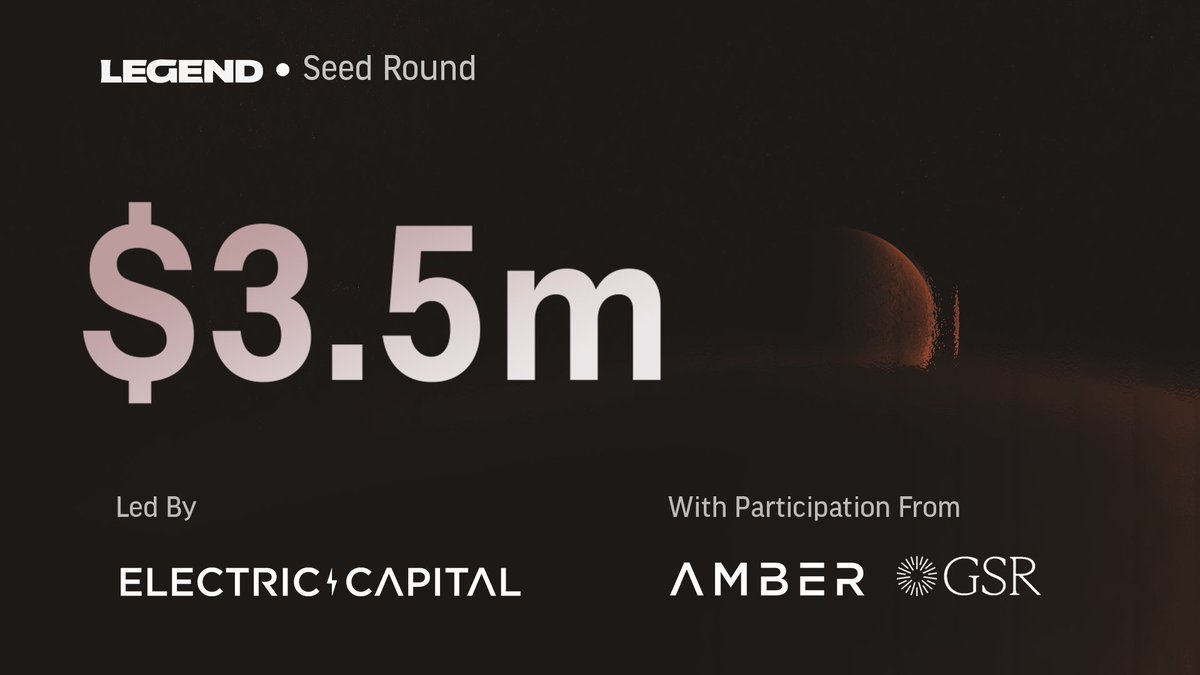
We're pleased to announce that Legend has raised a $3.5 million seed round, led by @ElectricCapital, with participation from @ambergroup_io and @GSR_io, bringing our total raised to over $5 million.
13
5
53
11,898
Electric Capital ⚡️ retweeted

Apr 29
no larp
Apr 29
We're pleased to announce that Legend has raised a $3.5 million seed round, led by @ElectricCapital, with participation from @ambergroup_io and @GSR_io, bringing our total raised to over $5 million.
3
11
1,937
Electric Capital ⚡️ retweeted

Apr 29
APE MONEY UPDATE
Apr 29
We're pleased to announce that Legend has raised a $3.5 million seed round, led by @ElectricCapital, with participation from @ambergroup_io and @GSR_io, bringing our total raised to over $5 million.
15
7
65
7,164

Legend starts with one simple question: who is the best trader in the world?
In 1 year, I believe a Legend-native creator will be born who will be making 1M natively on the platform. I assume they will be technically smart, an unbelievable trader, and given the platform to showcase their personality and be a breakout star on the internet and generate unbelievable economic value for their generation.
If Robinhood brought mobile equities to the masses, Coinbase brought crypto ownership to the masses, and Twitch brought gaming spectatorship to the masses, Legend brings markets as a new form of true financial media.
Legend is:
- Social (60% of our active users are in clans)
- EV (our users are as profitable as a cohort as Insilico, 30% more than MetaMask/Phantom perps users),
- native features that make perps easier to trade and more fun while being non-extractive vs. memecoins, without compromising pro-level execution
- IRL: we build the Legend Trade Series, where we showcase our culture and the best financial athletes in the world. Our NYC LTS had over 3M impressions and 10k live viewers and drove 200% deposit growth on the platform.
In <1mo in our invite-gated alpha, Legend has generated over 80M in volume, with our 7d volume being a top 20 @hyperliquidX builder project. We are now publicly available, with our alpha iOS app in the App Store.
Super excited to continue working with @mariashen at Electric and the goated team at @ambergroup_io and @GSR_io on this next stage.
Apr 29
We're pleased to announce that Legend has raised a $3.5 million seed round, led by @ElectricCapital, with participation from @ambergroup_io and @GSR_io, bringing our total raised to over $5 million.
23
8
120
8,501
Electric Capital ⚡️ retweeted

Apr 29
We're pleased to announce that Legend has raised a $3.5 million seed round, led by @ElectricCapital, with participation from @ambergroup_io and @GSR_io, bringing our total raised to over $5 million.
130
74
640
124,301
Electric Capital ⚡️ retweeted

The 2026 DeFi security stack:
- Audits (human, agentic)
- Formal Verification
- Guarded Launches
- Rate limits, settlement gates with emergency overrides
- Bug bounties
- First loss junior capital tranches
- Multisig opsec review
- Gsuite/slack/telegram/X opsec review
- DNS / package dependencies / Web2 stack security audit
- Collateral asset review and disclosure (market, operational, oracle)
- Infra dependency risk (bridges, pools, oracles, etc.)
- Realtime monitoring
- Incident response run-books
- Periodic reviews to catch drift in any of the above
- Review depth and sophistication that scales with value at risk
What am I missing?
16
13
91
8,259
Electric Capital ⚡️ retweeted
One of the reasons I got excited about @infiniFi in the first place was a strong belief that we had to build a bunch of new duration-aware primitives in DeFi to truly power all of finance.
The team has built the first "duration-native" vault, and that allows the to then do all kinds of other interesting things, especially when it comes to RWAs 👇

10
10
37
7,007
Electric Capital ⚡️ retweeted
Amazing work by @MariaShen to map this all out.
Takeaway: there are so many more RWAs to bring onchain.
Mar 19

We mapped 501 sources of real-world yield in traditional finance.
Only 34 have any meaningful on-chain presence.
We break down:
- what keeps the other 467 off-chain
- why distribution is the biggest bottleneck
- what needs to be built to bring them on
4
9
2,895
Electric Capital ⚡️ retweeted
Great analysis of which off chain assets might come on chain next
16
13
111
26,954
Electric Capital ⚡️ retweeted
Mar 19
Read this article with full data & interactive charts here:
data.electriccapital.com/pos…
1
12
2,115
Electric Capital ⚡️ retweeted
Mar 19
41
35
361
329,112
Electric Capital ⚡️ retweeted
Mar 19
We mapped 501 sources of real-world yield in traditional finance.
Only 34 have any meaningful on-chain presence.
We break down:
- what keeps the other 467 off-chain
- why distribution is the biggest bottleneck
- what needs to be built to bring them on
30
27
157
31,443
Electric Capital ⚡️ retweeted

Mar 13
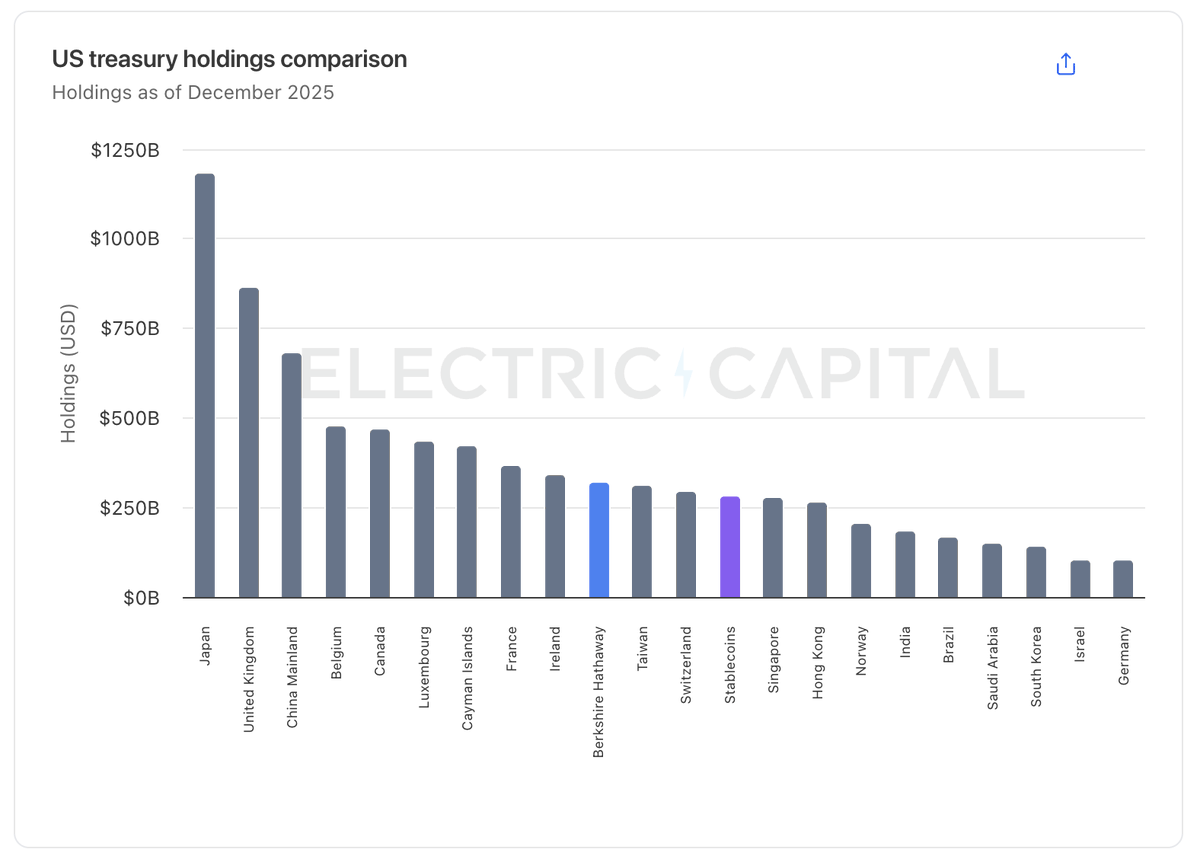
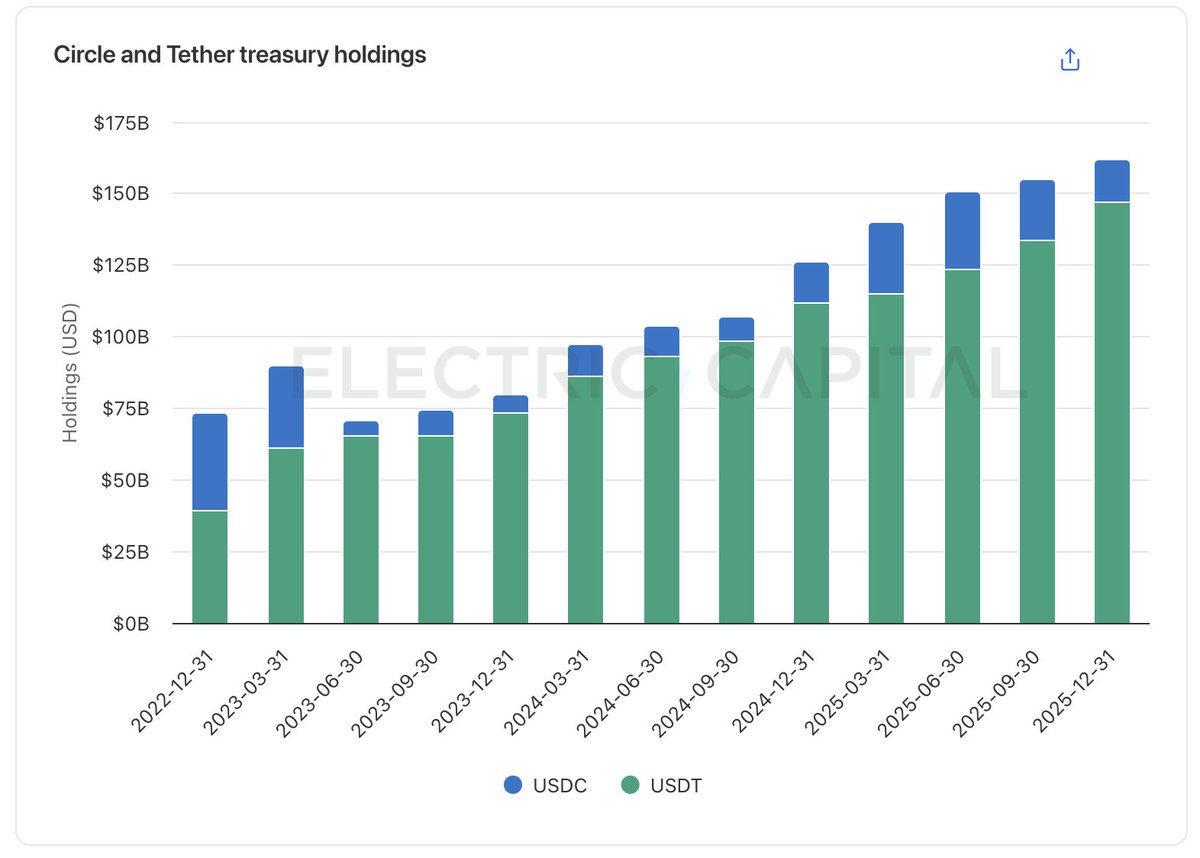
Stablecoins hold more US treasuries than Hong Kong, India, and Brazil.
Circle Tether alone hold $162B.
One of the biggest shifts in how money moves is happening right now.
Stay current with 18 charts on stablecoins at
data.electriccapital.com/pos…
Follow for more data & insights
7
8
39
2,655
Electric Capital ⚡️ retweeted

Feb 12
E158: @avichal - The $5M Bitcoin case, ETH is 2019 Bitcoin, and why crypto is still very niche
Avishal who co-founded Electric Capital, was the first investor in Bitwise, and has backed some of the most important crypto infrastructure companies at seed before any of it was cool. He also shares how growing up as the outsider, the only brown kid in 90s Kentucky, gave him a lens on crypto that most Silicon Valley couldn't see.
Timestamps:
0:00 Introduction
1:38 Please Subscribe
2:04 Plastic Surgery, Important For Online Presence?
4:26 KAST Card Plug & My Life Is Built On Stable Coins
6:24 Why Avichal Wears A Cap All The Time?
8:05 What Can You Tell Us About Bitwise
9:51 The People Who Built Bitwise Are Geniuses Or?
10:53 Lessons From Silicon Valley About Beliefs
12:30 Partnerships: @JupiterExchange @KASTxyz
13:06 What Fuels Belief For Successful Entrepreneurs
15:17 Will The Next 50 Elon’s Be Found Or Make It Themselves
18:22 Your Mission Is Finding This Talent & Unlocking 100x Potential In Humanity
19:34 How Early Did You Invest In These Companies
20:15 Is It Luck Or Genius That You Invested
22:04 How Do You Realize Who’s Worth Investing In?
27:03 Spending Time With People Is The Best Identifier For Investing
28:37 Partnerships: @paradex @zashi_app
29:19 The Commonalities Of Successful Businesses Avichal Invested In
32:37 How Of Your Decision Is Based On The Principle Of “They’re Born To Do It”
34:00 Avichal’s Backstory
40:05 Connection Between Crypto & “The Little Guy”
43:32 How Does Silicon Valley Look At Crypto Investors
44:48 Partnerships: @Trezor @bitwise @SuiNetwork
45:40 What Happens To Those Who Are In Crypto But Don’t Believe In It
47:26 Why The Majority Of People Can’t Buy & Hold In Crypto
53:28 Missionary vs Mercenary Explained
55:03 How High Can Bitcoin, ETH, & Crypto Get Based On These Principles?
1:01:06 The Compounding Effect & Logic Behind Bitcoin Investing
1:02:19 Applying This “Compound Effect” To ETH, SOL, & Bitcoin
1:06:15 Any Other Crypto Assets That May Have Reached Insane Velocity In 2026
1:07:51 Avichal’s Thesis On SUI
1:10:20 Closing Thoughts
39
36
266
258,568

The biggest investors in crypto are backing the Nitro Accelerator:
@paradigm | @ElectricCapital | @dragonfly_xyz | @CastleIslandVC
$500k investments to all accepted teams, on Day 1
Open to builders on any chain: nitroacc.xyz
Feb 10

Introducing Nitro, a 3 month project accelerator:
- Funding from top VCs
- Mentorship from industry-leading founders
- $500k per team, distributed on Day 1
If you’re building in crypto, it’s time to compress a year into 3 months.
Applications are live: nitroacc.xyz
71
77
519
50,860