
Joined September 2024
- Tweets 32
- Following 1
- Followers 214
- Likes 14
14 Photos and videos
Pinned Tweet

23 Jan 2025
Windancer is excited to announce the winners of our inaugural “It Only Takes One” Stock Competition. We thoroughly reviewed all submissions and selected four for the “live” round.
After a lively afternoon of conversations with each of the finalists, we selected Andrew Rosenblum as our Inaugural Winner and Dan Roller as our Runner-Up. We would like to congratulate both Andrew and Dan! We are excited to invest $5 million in Andrew’s idea. Thank you to everyone who supported our competition! We hope to do it again this year so be sure to follow our account to stay in the loop.
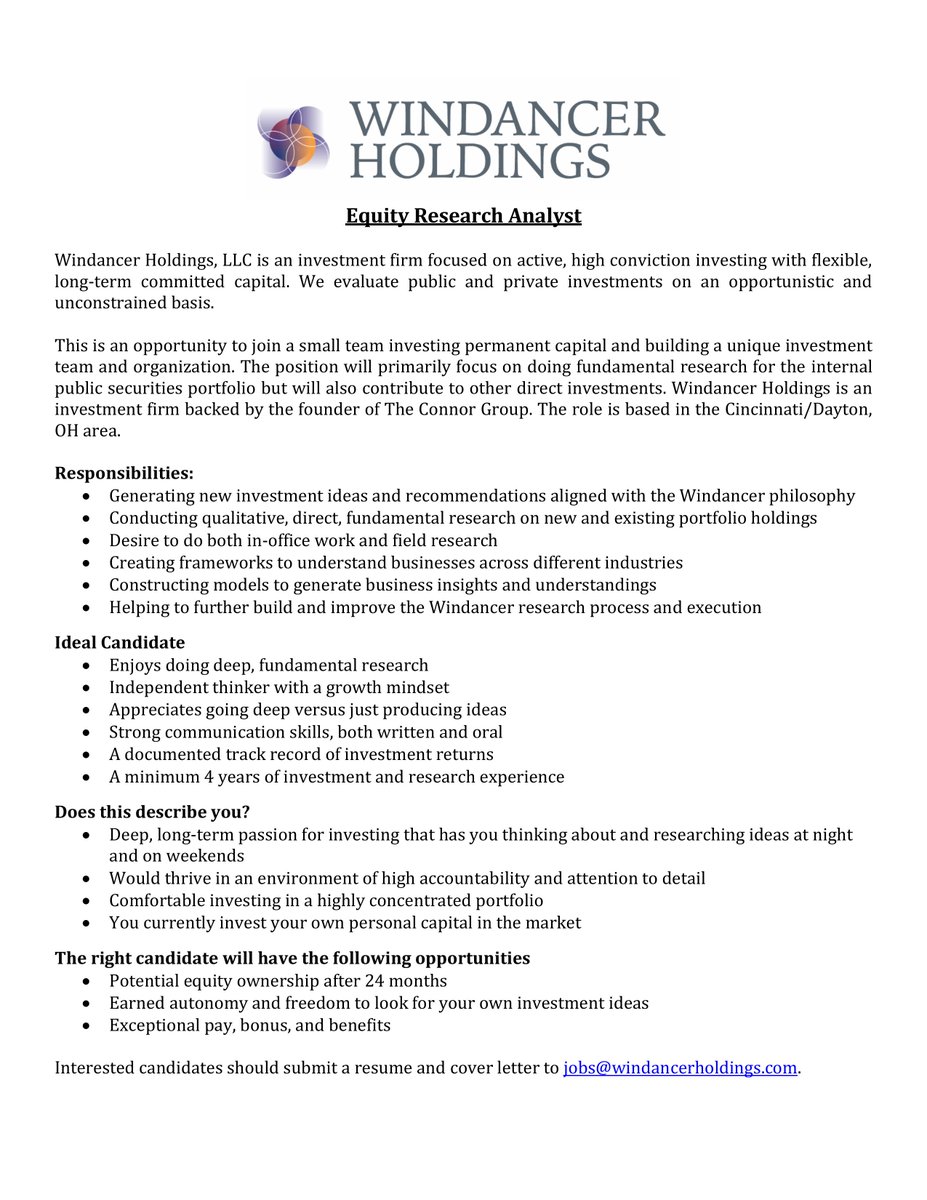
Additionally, we are excited to announce we are expanding our team:
We are Building a Different Investment Firm at Windancer Holdings, LLC.
The Differentiation Starts with Talented Analysts making an Impact by Conducting Qualitative Research to Uncover Unique Insights that Lead to High Conviction Investments.
We are Looking for a Philosophically-Aligned Analyst to Join the Team.
See the attached job post for more details or our LinkedIn posting: linkedin.com/jobs/view/41314…
1
2
8
4,179
Windancer Holdings retweeted

15 Nov 2024
Sharing this again in case it's of interest. The deadline to submit ideas is today.
13 Sep 2024

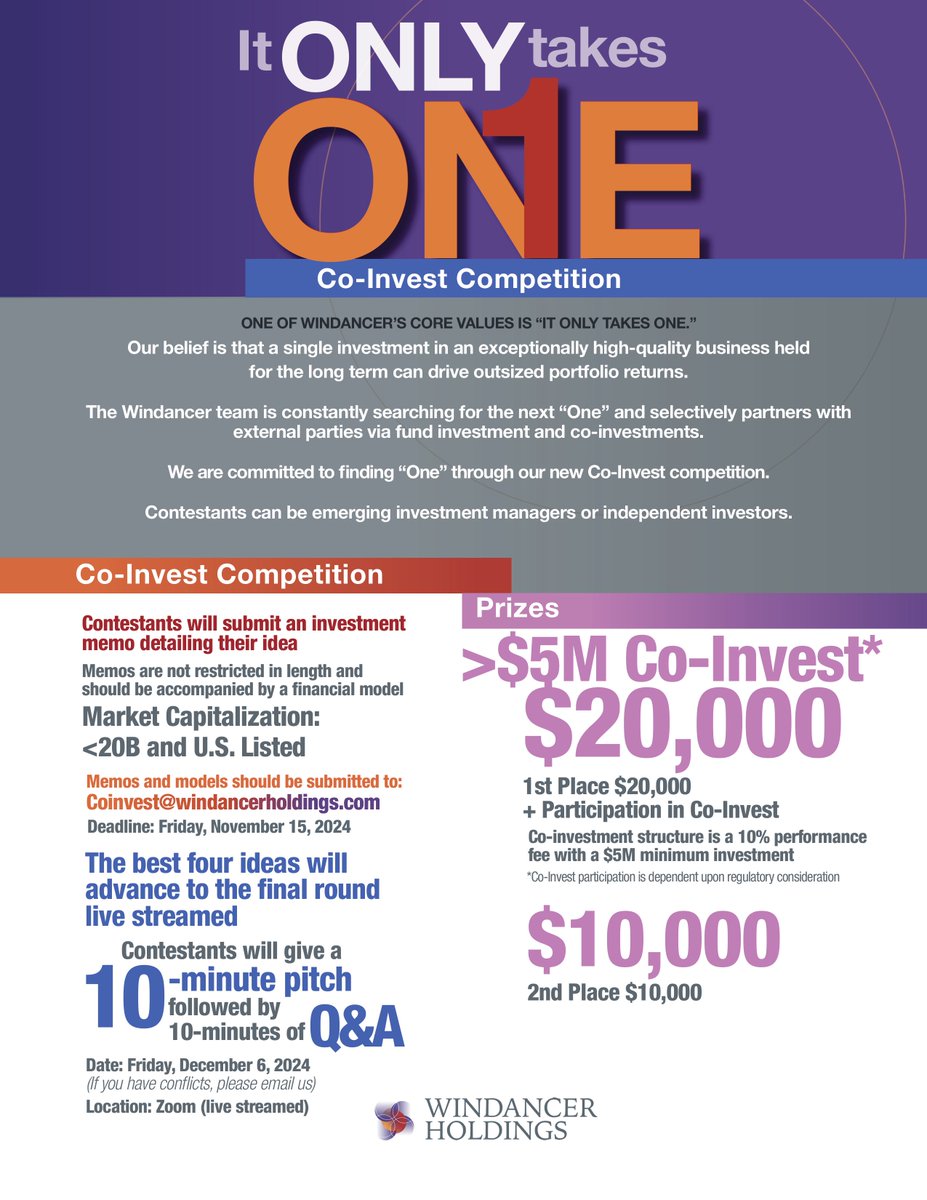
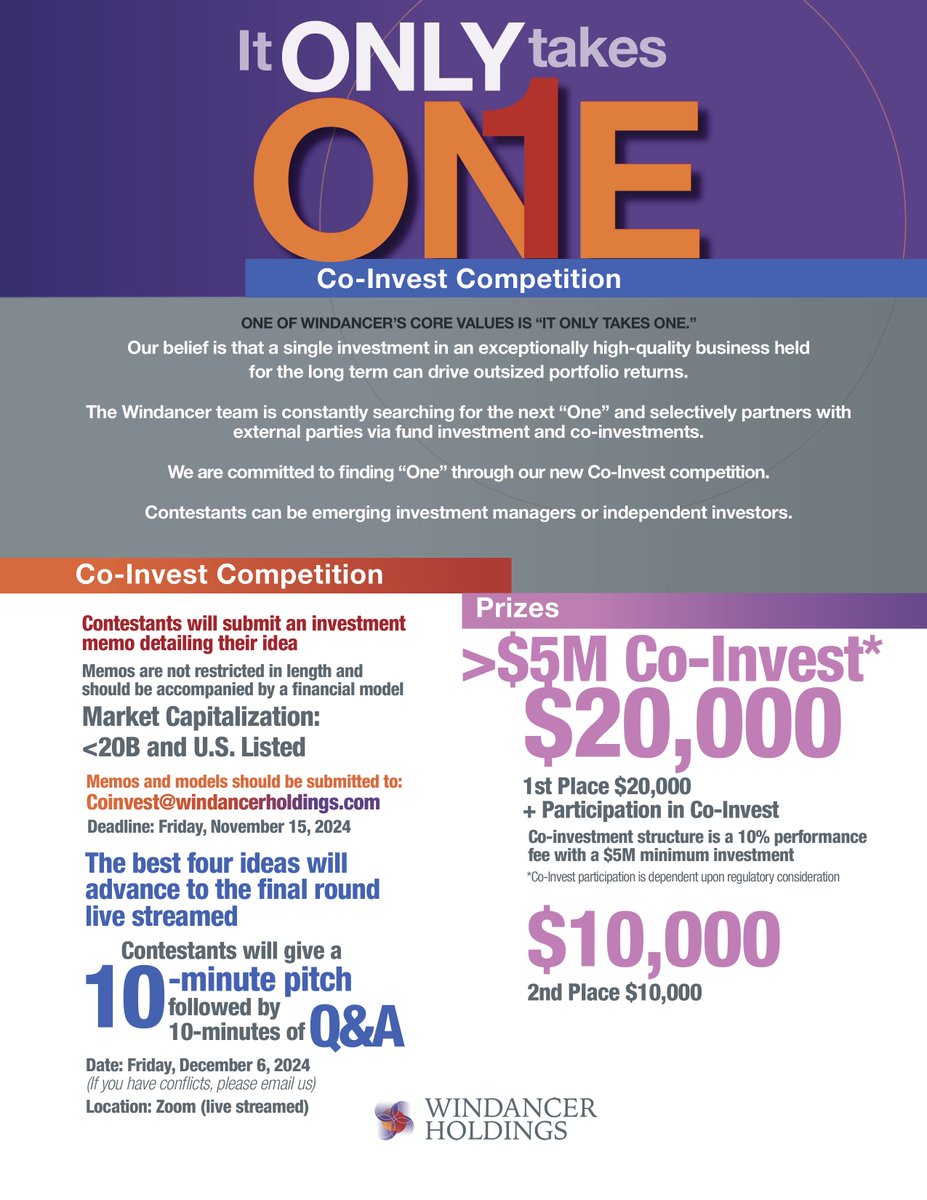
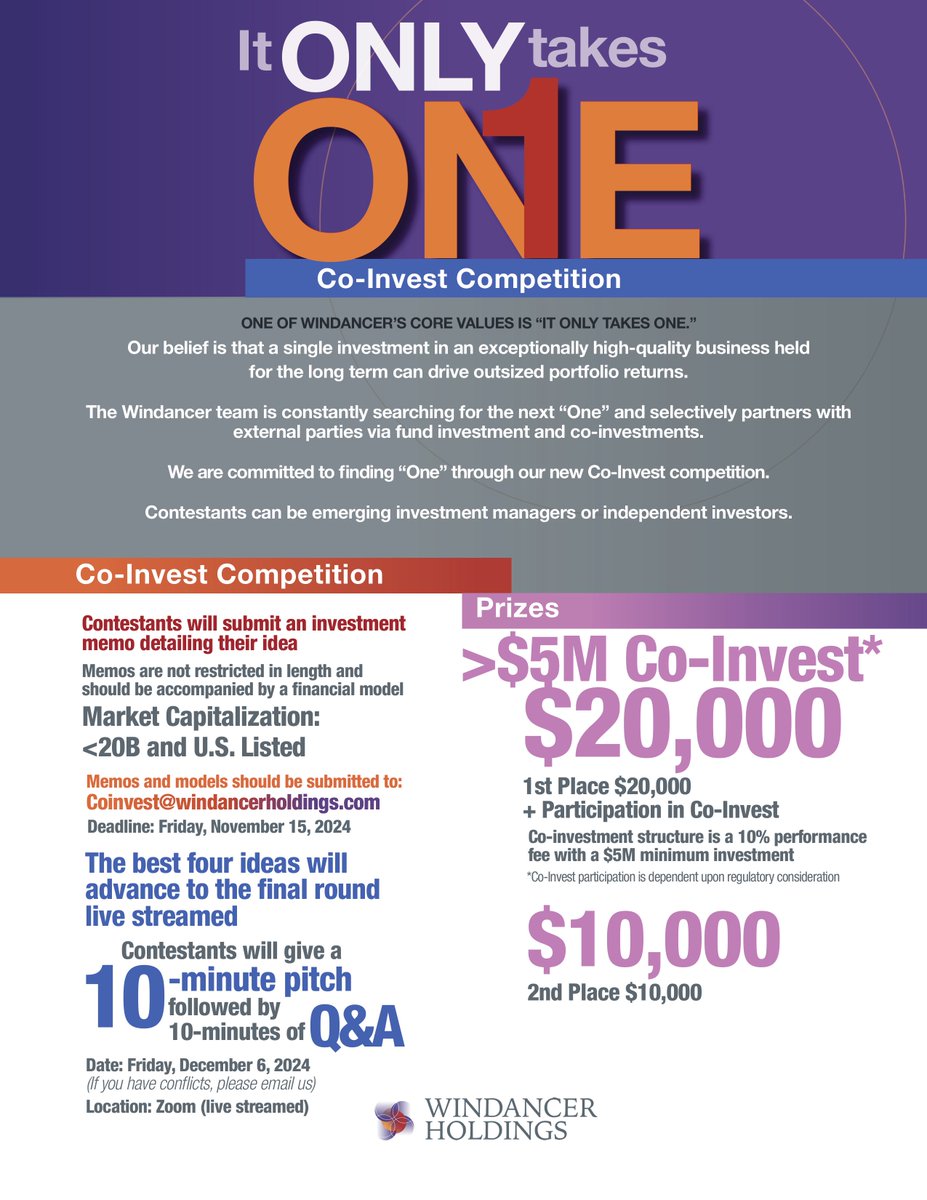
Windancer Holdings is launching our inaugural "It Only Takes One" Co-Invest Competition. See the flyer and thread below for more information on the competition and our investment firm:
1
2
5
9,092
15 Nov 2024
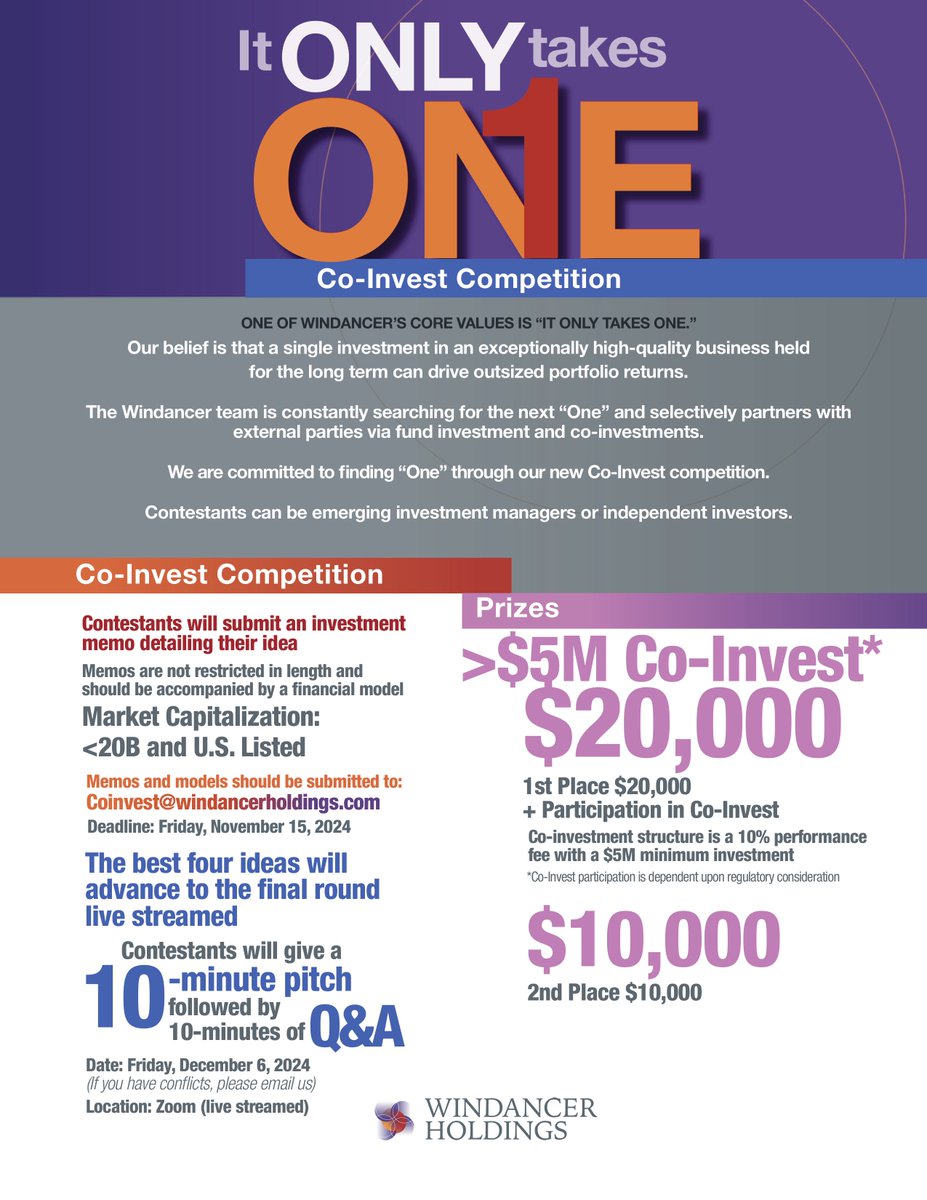
🚨Submissions for our Co-Invest competition are due at midnight tonight! See the flyer below for all the details. Feel free to email us if you have any questions or concerns.
3
410
Windancer Holdings retweeted

14 Nov 2024
Manufactured serendipity is one of life’s most powerful forces.
What an incredible opportunity - personally and financially - especially for a young investor.
Deadline tomorrow!
13 Sep 2024
Windancer Holdings is launching our inaugural "It Only Takes One" Co-Invest Competition. See the flyer and thread below for more information on the competition and our investment firm:
1
5
3,650
Windancer Holdings retweeted

13 Nov 2024
deadline for this is friday
12 Sep 2024

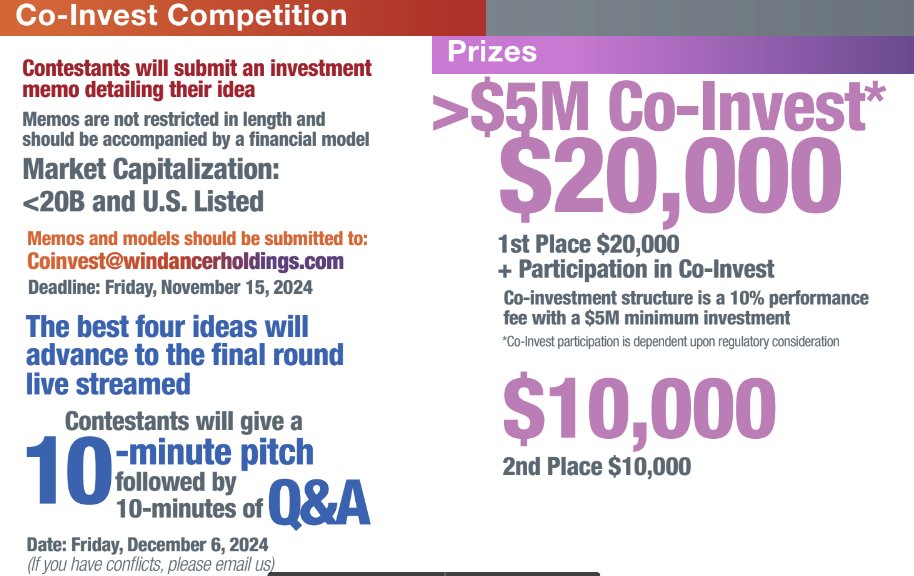
young analysts - heads up, Windancer is holding a stock pitch competition w meaningful $ for the winner ($20k 10% performance fees on a $5mn co-invest)...if interested, email memos/models to coinvest@windancerholdings.com by nov. 15
2
8
5,210
12 Nov 2024
Reflect and Learn
The world is complex and dynamic.
We acknowledge that there is much we do not know.
We approach each day as a learning day.
We try to be open-minded and check biases at the door.
We are in the judgement business.
To calibrate and make superior judgements we must be constantly reflecting and learning with a willingness to adapt.
We monitor key indicators and financial performance to determine whether our theses are being validated or disproven.
It is paramount to adopt a growth mindset.
Assessing and discerning businesses quality and management talent are difficult endeavors, but we relish the challenge!
This “reflect and learn” approach raises our probability of driving exceptional results.
Submissions for our Co-Invest competition are due this Friday, see the flyer below for more details:
4
293
11 Nov 2024
Concentrate It Only Takes One
As business analysts, we are wrestling with and trying to discern which businesses can create substantial long-term shareholder value.
Fact: it is hard to determine long-term business value. This challenge motivates us and presents substantial opportunity.
We remind ourselves of two business history lessons to articulate this point. Google tried to sell itself in its early days (for $1.5 million) and Intuit agreed to sell to Microsoft at a $1.5B valuation in 1994 (U.S. Government blocked the deal). Neither of these founders saw the ultimate potential of their businesses.
Intuit’s market value is $192B today. Intuit has compounded shareholder value at a 16.3% cagr for the past 30 years! Intuit founder and CEO Scott Cook was a brilliant executive and with his front row seat, even he failed to see how much value Intuit could create.
1
2
254
11 Nov 2024
This principle is about compounding and concentration. Compounding is powerful. We believe that owning a high-return, value-creating business with a long reinvestment runway can produce outsized returns. Compounding can be difficult to grasp. We like to remind ourselves that if a stock is up 10 times, the next time it doubles it drives a 20x return on the original investment and the double after that produces a 40x return! The best way to understand compounding is to own an investment that produces multiples on its original investment. This pursuit fires us up. We want our best businesses producing the strongest returns to matter – which is why we concentrate.
Our mantra of It Only Takes One is rooted in a belief that there are only so many great investment opportunities.
If we judge a business correctly, we want that investment to count!
1
185
11 Nov 2024
Ideas are due this Friday for our Co-Invest competition. We look forward to reviewing your submissions!
183
7 Nov 2024
Own High Potential Companies
We want to discover and own high-potential businesses that can generate high returns on the owner’s capital. Why do we aspire to find such companies? We believe that businesses that produce above-average returns on capital with long reinvestment runways can compound our capital at high absolute rates. These businesses provide the prospect for outperformance. Many investors who also focus on buying higher-return businesses wait for the company to produce years’ worth of demonstrable proof. They want the comfort of past financial results.
We take a different approach. We prefer to invest earlier in a company’s evolution or in a business that is undergoing change, where above-average returns on equity are not yet obvious. We find that investing in a business before it shows quantitative excellence can be quite profitable. This is why our research process leans heavily on qualitative research that drives insights and understanding in business models and competitive advantages. Our qualitative research process allows us to find the hidden gems before they are obvious.
We admit that this approach is not easy. We relish the quest! As a reminder, we strive to Be Different, and to be Different, you must act with independence and be willing to follow an unconventional investment approach that produces a unique portfolio.
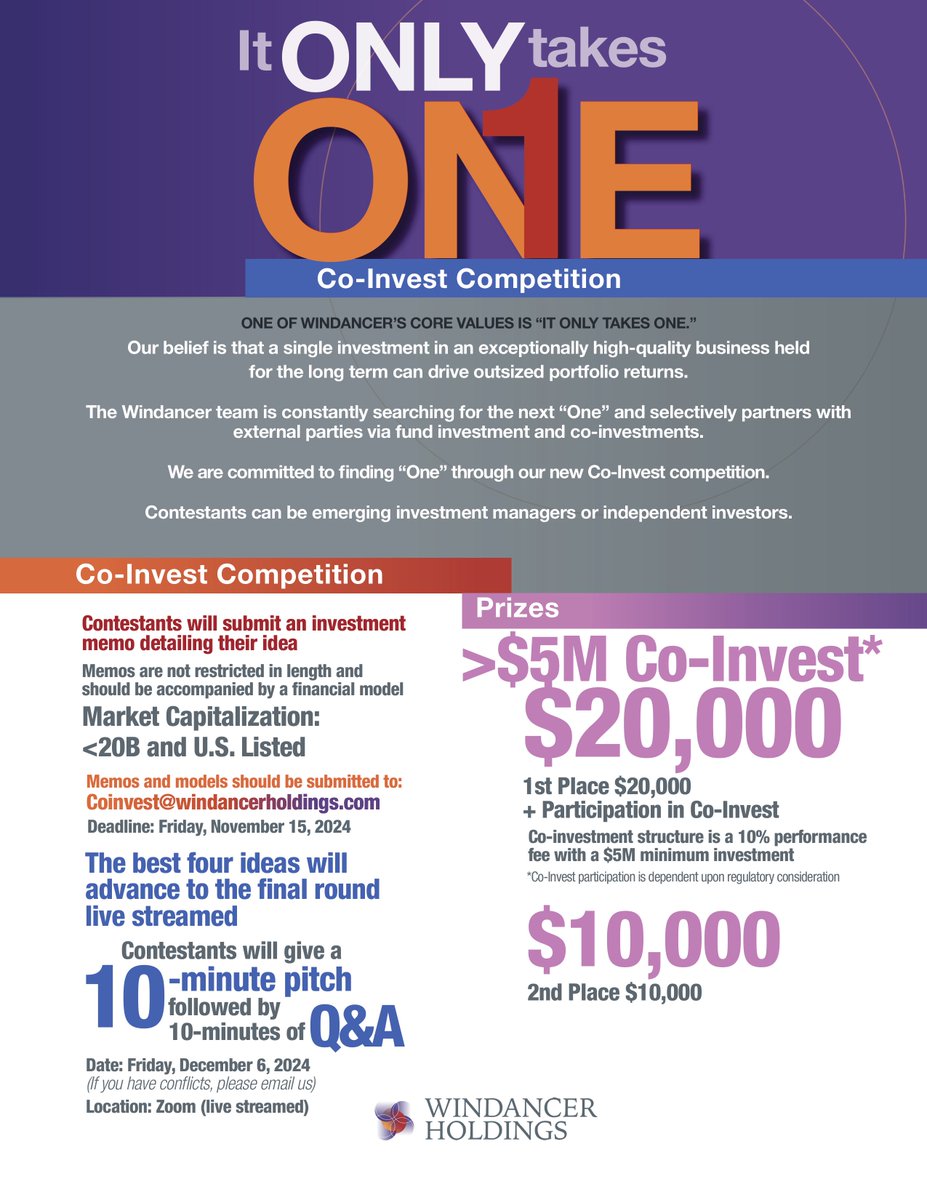
As a reminder, submissions for our co-invest competition are due November 15th. See the attached flyer for details.
1
4
340
6 Nov 2024
Less than 10 days left to submit an idea for our co-invest competition! See the flyer below for more details.
We love to utilize frameworks within our investment process. Oftentimes these frameworks involve us drawing and creating an ecosystem or industry map. We eventually want to understand what the key elements of certain business models are that make that business qualitatively attractive and differentiated.
What makes one distribution business different from another?
We utilize the following framework when investing in distributors:
1) Fragmentation amongst vendors and customers, the more fragmented the better
2) Number of skus
3) Nature of sku’s (fast / slowing moving, unique, etc.)
4) Cost-to-criticality
5) Service component
6) Demand patterns
1
4
2,231
25 Oct 2024
Today, we will dive into our direct field research strategy and process - detailing the how and why we conduct “hands-on” research. Before we dive into this topic, we need to set the table. We still conduct in office research; copious amounts of it. We find that reading drives crucial base level learnings. We read and analyze source material from financial filings, company materials, industry research, interviews and many other scrappy ways to enhance our fundamental understanding of a business and industry. Upon completing a thorough base level of research, this is when we find it valuable to “hit the streets”.
The Why:
We want to uncover and eventually own businesses with qualitative differentiation. Understandable differentiation gives us conviction to invest. When we understand the deeper truths about a business, how it works and out competes peers, we are more likely to be correct in our business assessments. Qualitative “nuggets” of information and learning generated through a direct research process is the best way we’ve found to determine what is actually happening inside a company. It allows us to appreciate the nuances of how a business actually works. This is the key WHY behind our direct research process. We must “tease out” business model understandings and differentiations to build conviction. Another benefit of sourcing qualitative insights is that they can often be leveraged long-term. We are after finding deeper wells to drill where once we find a less than obvious truth, we can mine it for years to come! We want to find and own great businesses that are not yet appreciated by investors for their unique advantages. These advantages provide the potential for a business to post above-average returns on capital for longer than investors appreciate – thus providing kindling for outperformance. The best way we know how to find these differentiated businesses is by marrying in office work with intentional, thoughtful and directed field research.
1
2
544
25 Oct 2024
The How:
What exactly do we mean by direct field research? We want to conduct meaningful conversations with people who know the intricacies of a company, product and industry. Where do we conduct these conversations? In short, a myriad of places - trade shows, industry conferences, user conferences, site visits and one-on-one connections. Oftentimes the learnings and insights are subtle. They need to be “teased out” talking to those in the know. These “in the field” situations allow for such conversations and eventual learnings.
What’s the Catch?
Why doesn’t everyone do this work? For starters it is hard work. It involves lots of travel. Some of the research will be unproductive. As fundamentally driven investors we are in the judgement business. We don’t rely upon backward looking quantitative numbers to determine our investment decisions. We are looking to unlock truths about a business that are not yet known. We find the pursuit to be well worth the effort.
Stay Tuned! Next week we will discuss a tenet of our investment philosophy; We Own High Potential, yet Undervalued Companies.
1
2
241
25 Oct 2024
Reminder, applications for our first ever co-invest competition are due in under a month!
2
232
18 Oct 2024
Windancer is building a Different kind of investment firm. Our firm is an expression of our industry learnings and strongly held beliefs. We are rooted by our investment philosophy, process and team. Simply stated, we aim to Be Different. We invest in businesses across the public and private markets. We are Opportunistic. We also selectively partner with passionate fund managers pursuing differentiated strategies.
Windancer Holdings Investment Philosophy:
*We are Qualitative Investors
*We Discern Business Model Quality
*We Own High Potential, yet Undervalued Companies
*We Partner with Talented, High-Integrity and Aligned Operators
*We Invest Long-Term
*We Concentrate
Stay Tuned! Over the next several weeks we will detail and expand upon aspects of our investment approach.
Don’t forget to get your ideas in for Windancer’s First Ever Co-Invest Stock Pitch Competition.
*Ideas are due by November 15th*
2
9
2,516