
Professor of Economics, @LMU_Muenchen; Director, ifo Center for the Economics of Education, @ifo_Institut
Joined September 2020
- Tweets 2,133
- Following 747
- Followers 6,009
- Likes 3,815
485 Photos and videos

Pinned Tweet

7 Jul 2025
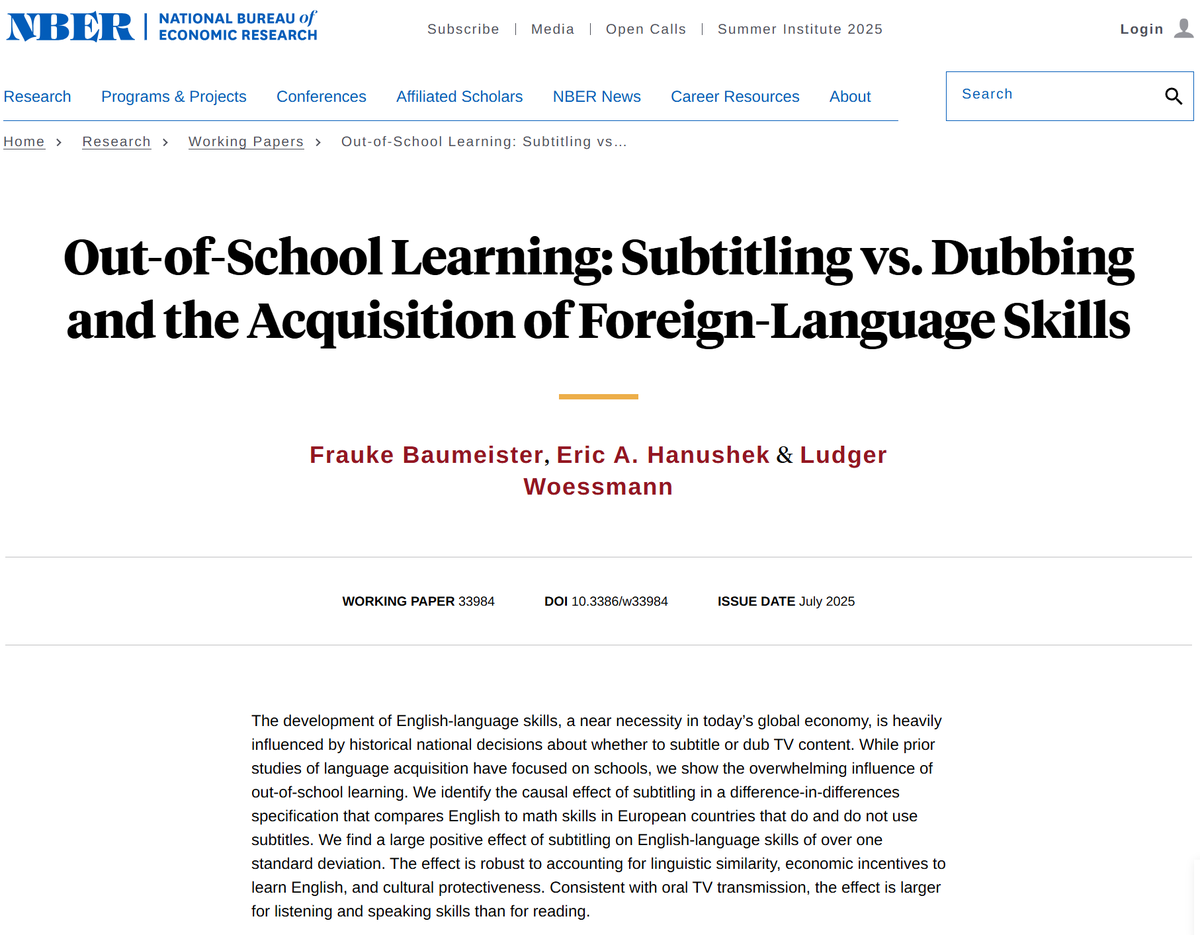
❓Why do the Nordics & Dutch speak English so much better than the Germans, Italians & French?
➡️New Working Paper:
Out-of-School Learning: Subtitling vs. Dubbing and the Acquisition of Foreign-Language Skills
w/ F. Baumeister & E. Hanushek
nber.org/papers/w33984
A🧵1/12
52
198
816
388,799
Ludger Woessmann retweeted

May 27
Heute in BTO Refresh: Die Bildungsmisere schadet mehr als alle anderen Politikfehler zusammen. Mit dabei: @Woessmann
10
38
383
10,585
Feb 12
"Von ganz unten an die Spitze · Ist sozialer Aufstieg möglich?"
📺Spannende Doku im BR @BR24
ardmediathek.de/video/Y3JpZD…
Auch mit kurzen Statements von mir (ab Min 10:00, 16:30, 24:30 und 27:15)
3
4
470
Jan 30
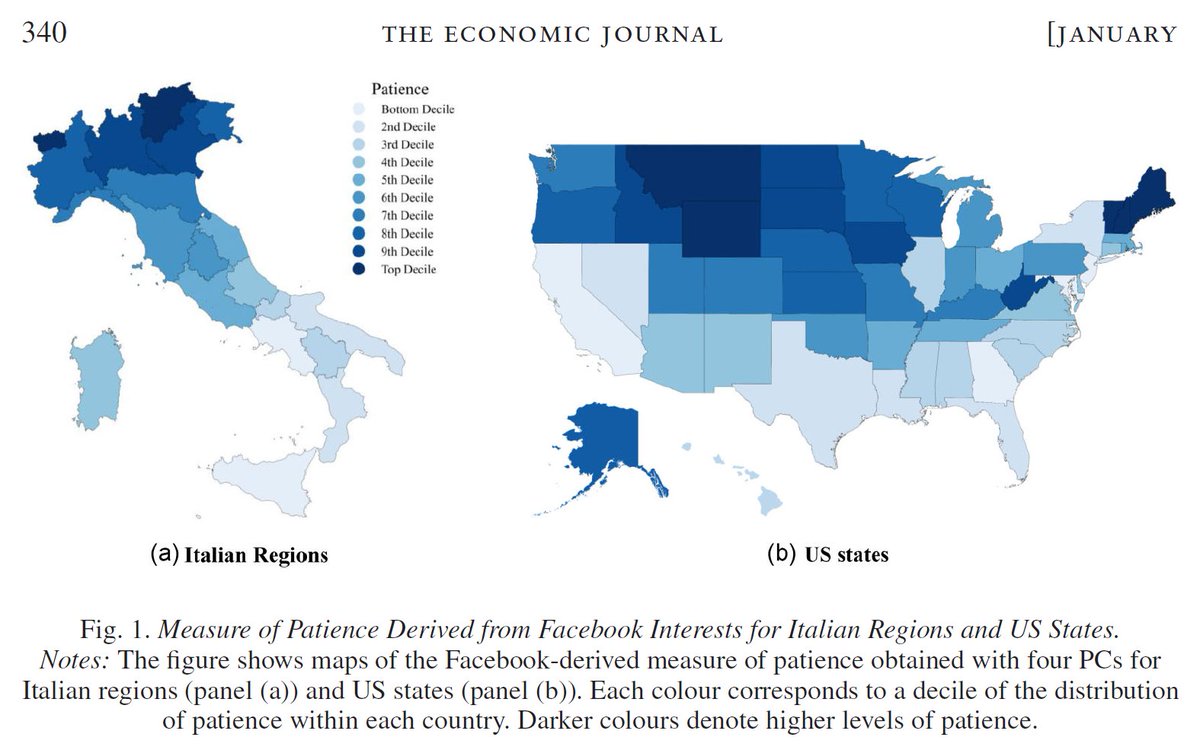
🚨Now out in the Economic Journal:
“Patience and Subnational Differences in Human Capital: Regional Analysis with Facebook Interests”
w/ @EricHanushek, @KinneLavinia & P. Sancassani
💡Patience accounts for ¾ of regional achievement diffs in 🇮🇹, ⅓ 🇺🇸
👉doi.org/10.1093/ej/ueaf045
2
15
60
6,210
Ludger Woessmann retweeted

Jan 29
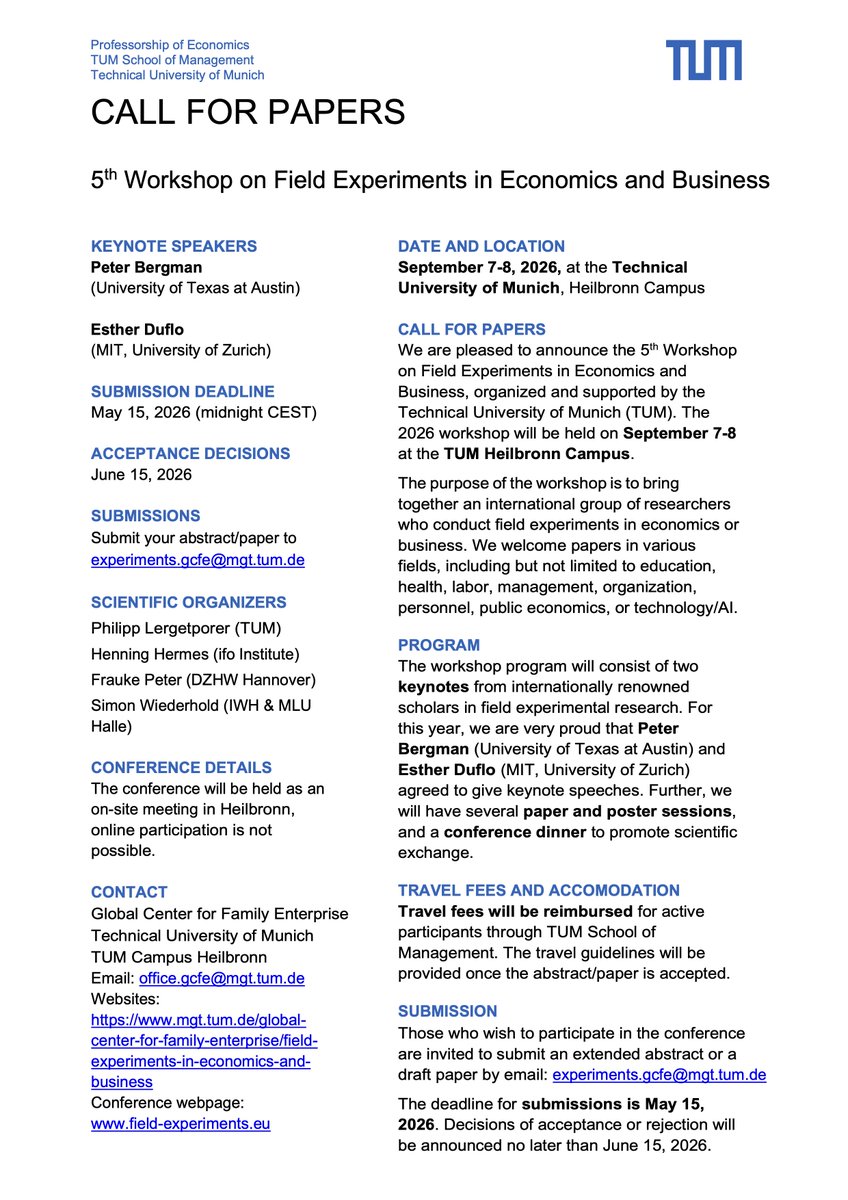
📣 Thrilled to officially announce our 5th Workshop on Field Experiments in Economics and Business, 7-8 Sept 2026, @TU_Muenchen, Campus Heilbronn.
Keynotes: Peter Bergman (University of Texas at Austin) & Esther Duflo (@MITEcon, @UZH_en) 🫶🏻
Submission deadline May 15, 2026 🚨
3
28
71
12,189
Ludger Woessmann retweeted

Jan 26
Munich in September, great colleagues, and a field that matters. If you're working on economics of education, please consider the CESifo Economics of Education conference!
The wonderful @EricHanushek and Ludger Woessmann (@Woessmann ) always put together a great and stimulating program. I will bring some new field experimental evidence for my lecture and provide an overview of what we have learned at CHECC so far.
Looking forward to seeing everyone there!
Jan 26

📢Call for papers:
CESifo Area Conference on Economics of Education
co-organized w/ @EricHanushek (Stanford)
🏛️11-12 Sept 2026, Munich
🧑🏫Keynote: John List (Chicago) @Econ_4_Everyone
👉ifo.de/en/cesifo/event/2026-…
⏰Deadline: 11 May 2026
🖼️Past programs:
sites.google.com/view/woessm…
1
9
54
8,290
Jan 26
📢Call for papers:
CESifo Area Conference on Economics of Education
co-organized w/ @EricHanushek (Stanford)
🏛️11-12 Sept 2026, Munich
🧑🏫Keynote: John List (Chicago) @Econ_4_Everyone
👉ifo.de/en/cesifo/event/2026-…
⏰Deadline: 11 May 2026
🖼️Past programs:
sites.google.com/view/woessm…
1
32
70
15,432
Jan 26
👆CESifo call for papers is out - please distribute @singhabhi @Sandra_McNally @m_silliman @giu_sorrenti @karthik_econ @jmontalbancas @turnersarahe @uZoelitz @SimonWiederhold @henninghermes @chriskarbownik @Lnavarrosola @JeffDenning @BenjaminArold @ECONMunich @ifo_Education
3
527
Ludger Woessmann retweeted

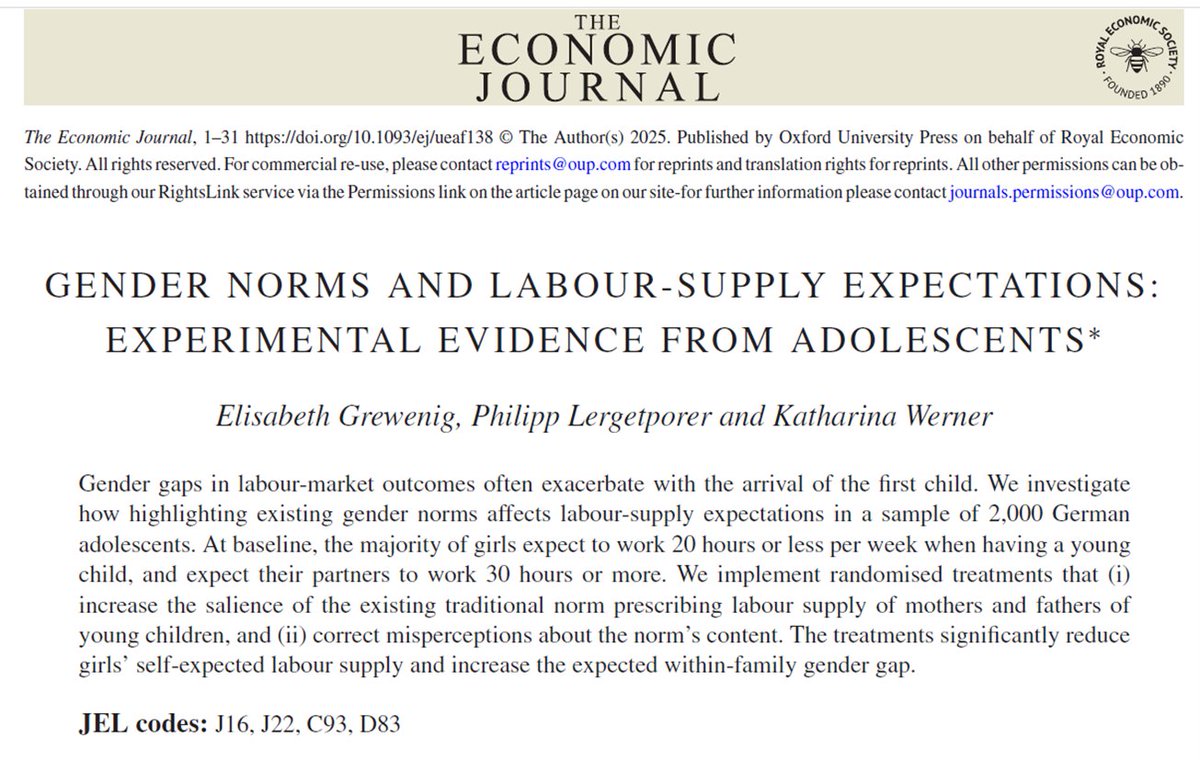
Very happy that our paper “Gender Norms and Labor-Supply Expectations” (w/ E. Grewenig & K. Werner) is published in @EJ_RES (tinyurl.com/56c2dmfb).
In a survey of 2,000 adolescents, making traditional gender norms salient lowers girls’ expected work hours and related outcomes.
3
21
105
8,507
Jan 20
Extremely saddened to learn about the passing of Jon Temple. He was a leading thinker on the economics of growth, and such a decent person.
Here’s a few fond memories of our interactions, for which I’ll always be profoundly grateful:
linkedin.com/feed/update/urn…
R.I.P., dear Jon.
1
1
5
598
🚨 Deadline on Sunday:
🚀 4th CESifo Junior Workshop on the Economics of Education 🤩
👇
7 Oct 2025
📢Call for papers:
🚀4th CESifo Junior Workshop on the Economics of Education🤩
30-31 March 2026, Munich
Keynote: @michelacarlana (Harvard)
PhD students & early postdocs, please apply!
ifo.de/en/cesifo/event/2026-…
Deadline: 11 Jan 2026
Co-organizers @CaterinaPavese1 @mtotarelli

5
9
1,441
Ludger Woessmann retweeted
23 Dec 2025
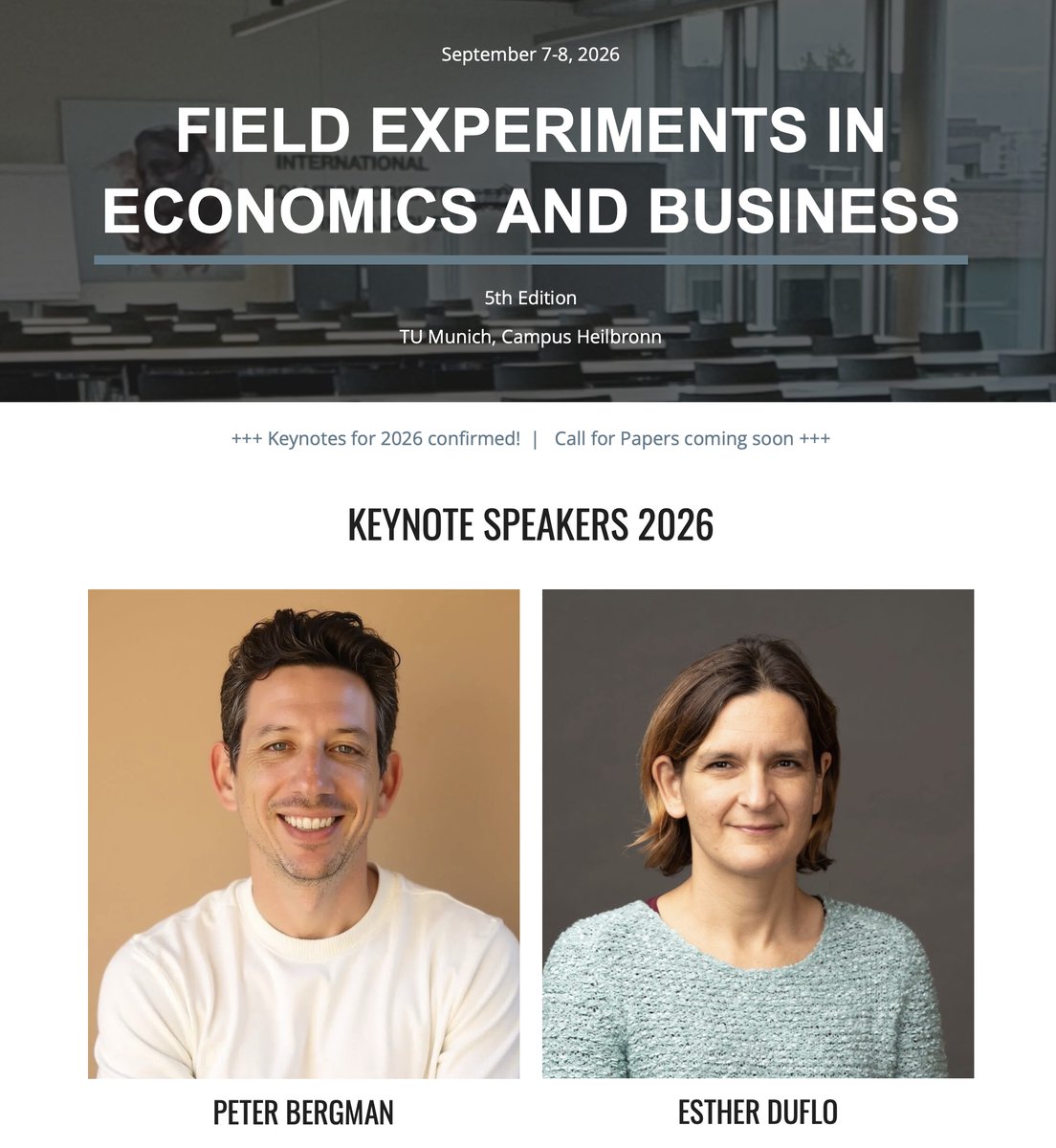
📣SAVE-THE-DATE 📣
Our Workshop on Field Experiments in Economics and Business celebrates its 5th anniversary with FANTASTIC keynote speakers: Peter Bergman (UT Austin) and Esther Duflo (@MITEcon) 🎉🙌
1
9
28
3,178
Ludger Woessmann retweeted

19 Dec 2025
🎅🎁 Unser letzter Newsletter für 2025 ist erschienen!
Themen:
✨Wie sehr sich bessere Bildung volkswirtschaftlich auszahlt
✨Was Facebook-Daten über Geduld & Bildungserfolg verraten
✨Religionsunterricht hat langfristige Auswirkungen
... und mehr!
👉sendlx.com/display.php?M=111…

6
2
2
233
Ludger Woessmann retweeted

19 Dec 2025
🎅🎁Our last newsletter of this year is out!
Topics:
✨What Facebook data reveal about patience & educational achievement
✨Religious education has long-term effects
✨Good schools are especially helpful for disadvantaged children
...and much more!
👉sendlx.com/display.php?M=111…
1
2
2
238
16 Dec 2025
📢Our piece on @JonHaidt's "After Babel" Substack:
Strong public support to restrict social media for children in Germany
afterbabel.com/p/strong-publ…
A huge majority of adults favors a minimum age for social media – and even adolescents themselves see harm from social media
5
10
628

Wohlstand statt Abstieg – So entscheidend ist bessere Bildung aus Sicht von Ökonomen to.welt.de/9onPrUl

4
3
12
6,680
Ludger Woessmann retweeted

15 Dec 2025
Durch bessere Bildung wäre ein Anstieg des deutschen Bruttoinlandsprodukts um 21 Billionen Euro in den kommenden 80 Jahren möglich. Das haben Bildungsökonomen berechnet. faz.net/aktuell/politik/inla…
2
1
10
2,108
Ludger Woessmann retweeted

15 Dec 2025
Um knapp 21 Billionen Euro könnte die deutsche Wirtschaft langfristig wachsen, wenn mehr Geld in Bildung investiert würde. Das haben Forscher des Ifo-Instituts berechnet. Nirgendwo ist der Effekt größer als in Bremen. spiegel.de/panorama/bildung/…
37
25
63
6,918
Ludger Woessmann retweeted

15 Dec 2025
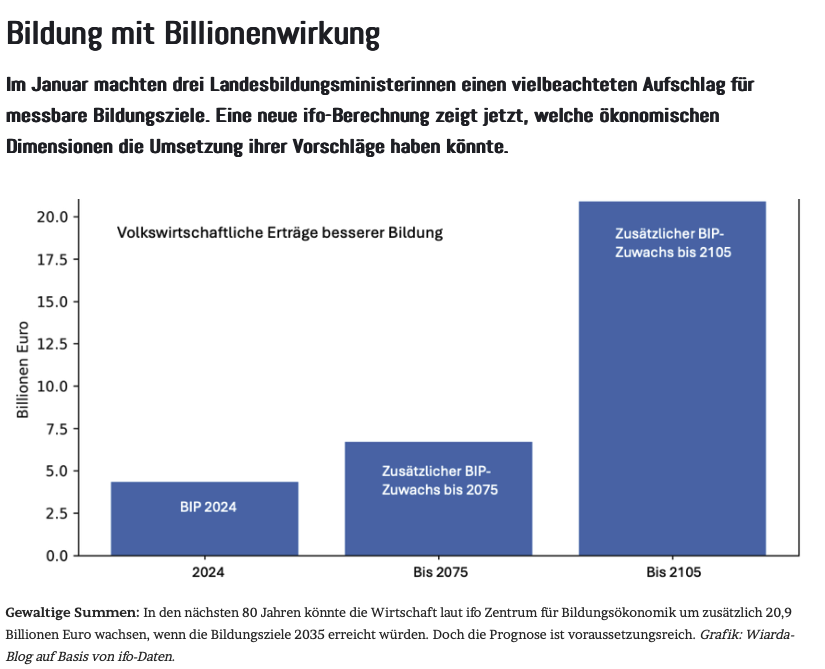
Bildung mit Billionenwirkung
Im Januar machten drei Bildungsministerinnen einen vielbeachteten Aufschlag für messbare Bildungsziele. Eine ifo-Berechnung zeigt, welche ökonomischen Dimensionen die Umsetzung ihrer Vorschläge haben könnte.
Im Wiarda-Blog: jmwiarda.de/blog/2025/12/15/…
1
2
463
15 Dec 2025
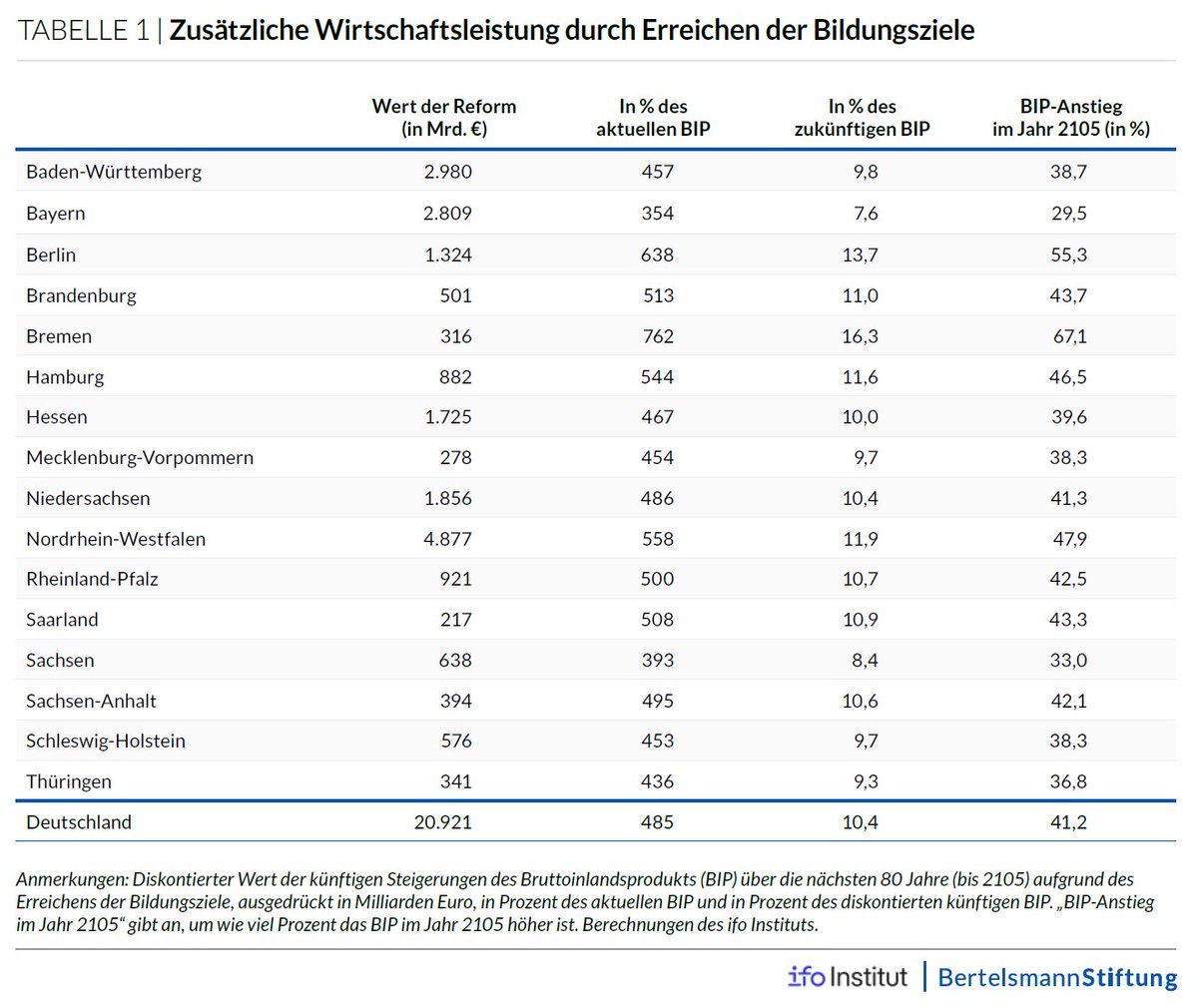
🚨Unsere neue Studie zeigt:
👉Das Erreichen der Ziele „Bessere Bildung 2035“ würde rund 21 Billionen Euro an zusätzlicher Wirtschaftsleistung bringen
"Volkswirtschaftliche Erträge besserer Bildung"
mit Katia Werkmeister für die @BertelsmannSt
ifo.de/publikationen/2025/au…
1/3
1
14
30
2,671
15 Dec 2025
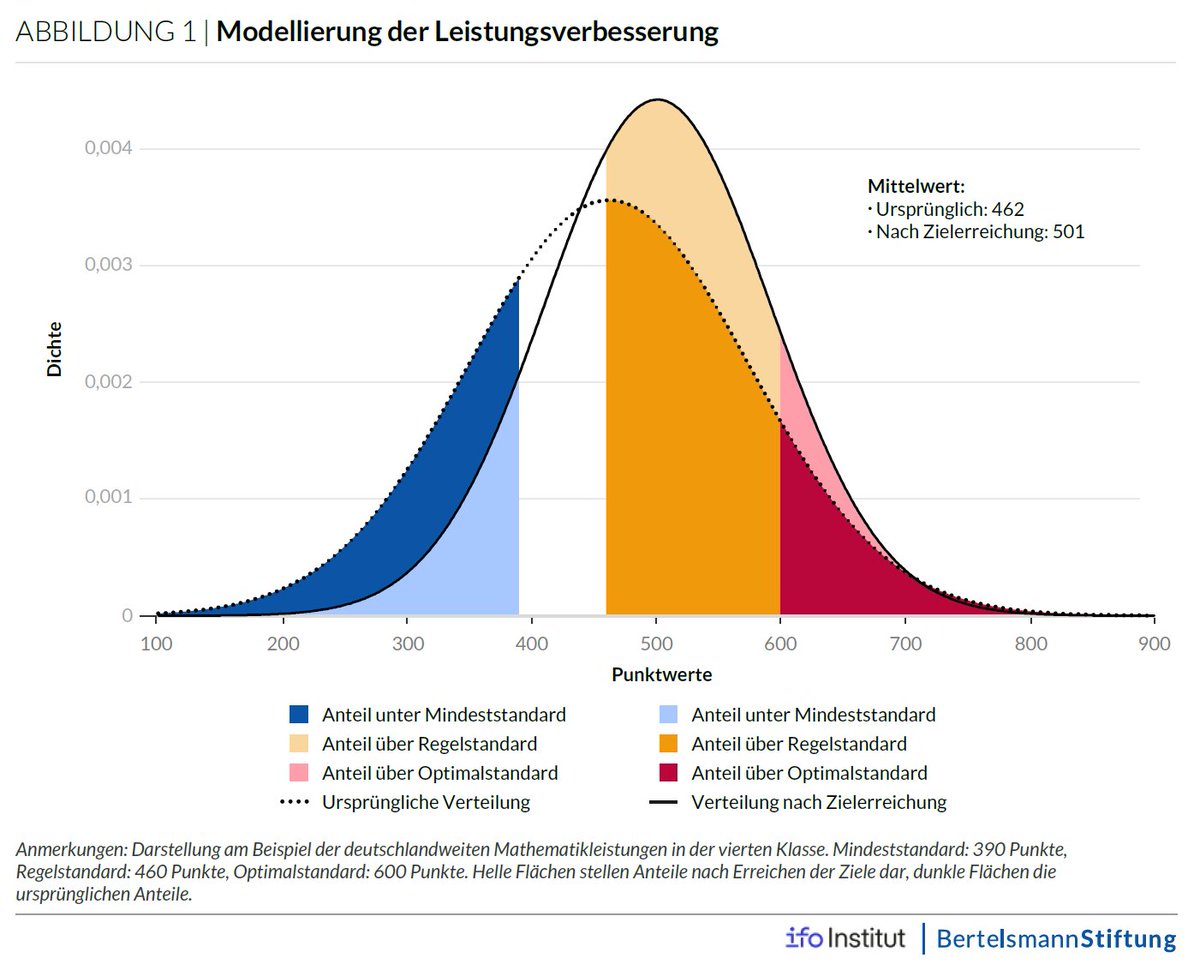
Bildungsziele von Ministerinnen Hubig (SPD), Prien (CDU) & Schopper (Grüne) bis 2035:
1️⃣50% weniger Schüler:innen, die Mindeststandards in Deutsch & Mathematik nicht erreichen
2️⃣20% mehr, die Regelstandards erreichen
3️⃣30% mehr, die Optimalstandards erreichen
2/3
1
3
177
15 Dec 2025
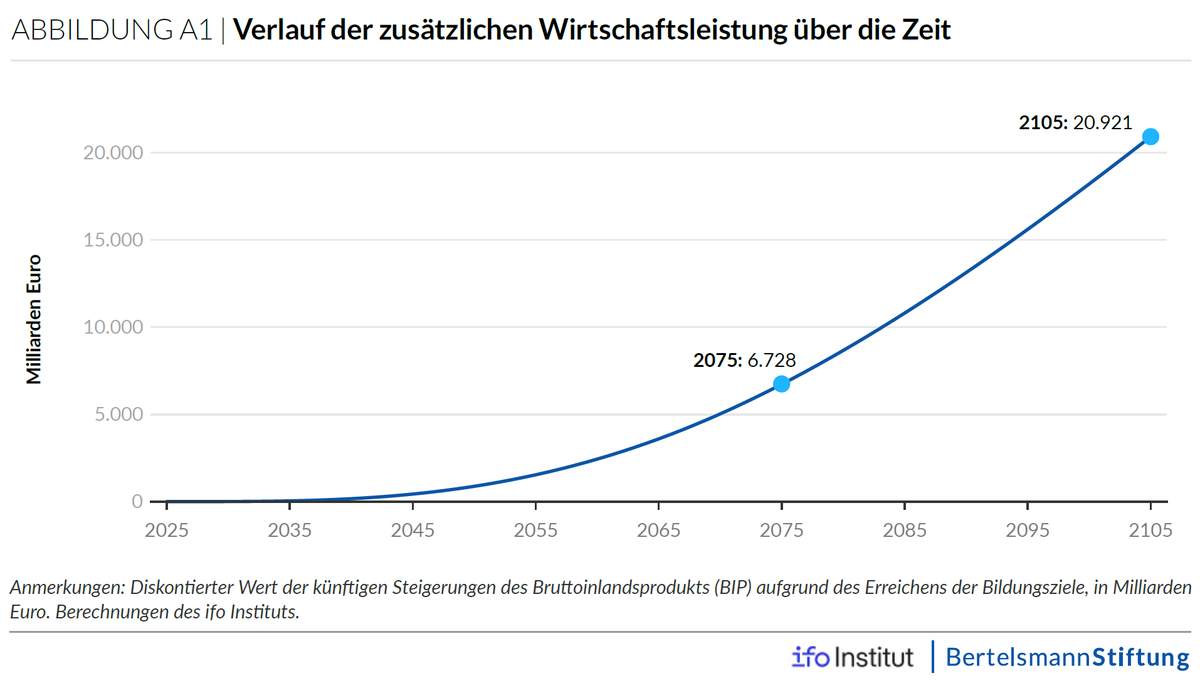
Erreichen dieser Ziele erhöht volkswirtschaftliches Wachstum:
💶20,9 Billionen Euro an zusätzlichem BIP bis 2105 (aktuelle Lebenserwartung)
≈ 5x derzeitiges BIP
≈ 10% des diskontierten BIP
➡️So sehr lohnt es sich, Verbesserung der Bildungsleistungen zu priorisieren
3/3

1
3
195