
1,511 Photos and videos












In May, the long-awaited release of @auroraisnear Intents took place, which marked the beginning of a new chapter for Aurora.
Of course, it was not only me who noticed this, but also many Aurora lovers who were happy to try to learn a lot of useful and interesting things from @declan_hannon on Alpha Leaks about Aurora Intents.
In general, this is the Ask Me category, and I decided not to change it much by adding more questions (Since there have been enough of them over the past month) and making all the questions about Aurora Intents.
You can learn more about Aurora Intents in this article: x.com/auroraisnear/status/20…
You can launch Aurora Intents in one click here: intents.aurora.dev/
More questions and answers are below at the links to all Alpha Leaks for May:
Alpha Leaks - 2026-05-01 youtube.com/watch?v=lj1VKtgm…
Alpha Leaks - 2026-05-08 youtube.com/watch?v=zXagQTZT…
Alpha Leaks - 2026-05-15 youtube.com/watch?v=UuYJ7n3_…
Alpha Leaks - 2026-05-22 youtube.com/watch?v=LbPV4X3R…
Alpha Leaks - 2026-05-29 youtube.com/watch?v=wN_ctVbp…

4
8
933
GM to all those who ate today😁
Plans for today:
- make a long video
- trade on @Polymarket
- wait @IEM cologne major
- go out for a walk
What are your plans for today?
3
5
143
📗@auroraisnear - Great question on alpha leaks about Aurora Intents workability.
There was a question from Kevvlahr with a twist that was answered very well and proved that Aurora intentions works in perfect mode, so Aurora can't have haters hah
In general, see the answer below and also start using aurora intents products in your projects😏
intents.aurora.dev/
1
10
740
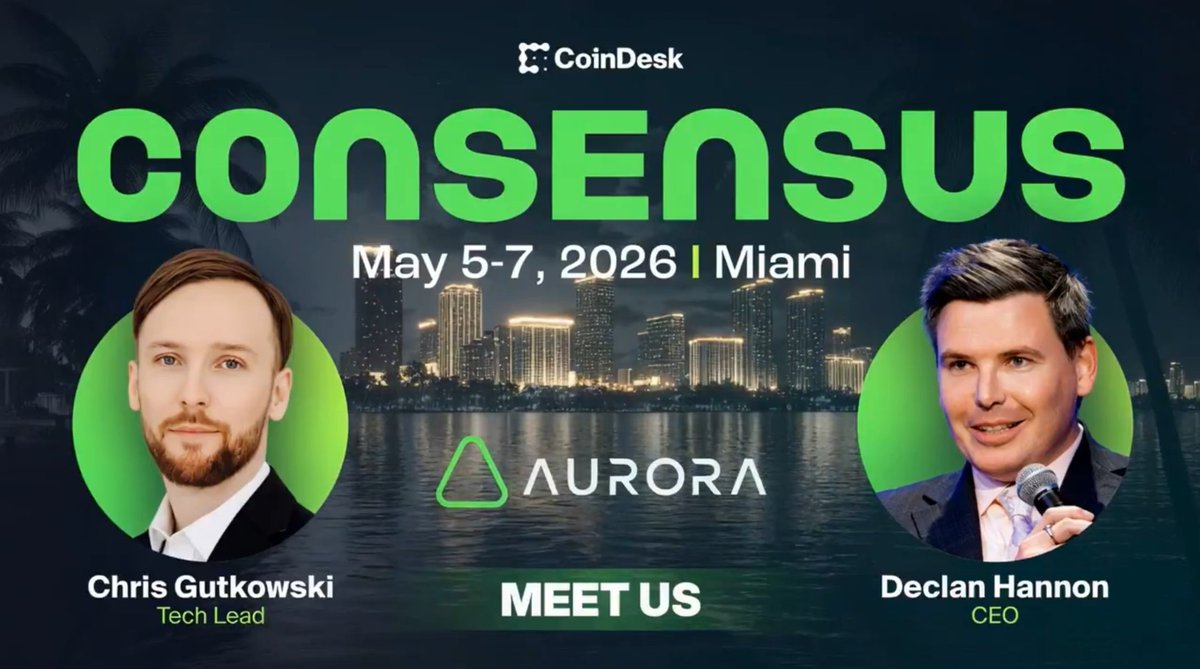
The most important trip was to Miami for @consensus2026 from May 5 to May 7
x.com/auroraisnear/status/20…
x.com/auroraisnear/status/20…
Aurora also held her first private dinner in Miami, where she showed Aurora Intents live.
x.com/auroraisnear/status/20…
And on the evening of May 7, a meeting was held there where they discussed not only Aurora but also Near Intents & Near Ai Cloud
x.com/auroraisnear/status/20…
luma.com/w1nkdm1w


May 8
Aurora - Intentionally connecting people ❇️
1
7
890
Yesterday I made a post with a short video clip from Alpha Leaks about the upcoming Aurora event, and it said that the approximate date when Aurora itself will hold the event is June 15 in 2 weeks, a little insider ahah.
x.com/Y8Slade/status/2061193…

📗@auroraisnear - Great question on alpha leaks about coming events.
There are quite a lot of interesting statements and events at events where Aurora is present, so I decided to highlight this piece about the upcoming events from Aurora.
Look what @declan_hannon said about it, and when will the Aurora event take place:
5
171
📗@auroraisnear - Great question on alpha leaks about coming events.
There are quite a lot of interesting statements and events at events where Aurora is present, so I decided to highlight this piece about the upcoming events from Aurora.
Look what @declan_hannon said about it, and when will the Aurora event take place:
7
783
GM to all those who ate today😁
Plans for today:
- make short videos
- make a post
- trade on @Polymarket
- Wait @IEM cologne major
What are your plans for today?
7
9
224
📗@auroraisnear - Article about Near Intents and Aurora Intents.
Just a couple of days ago, Head of products @armd_didier wrote a huge article titled - Aurora Intents: the Roads Network in the @near_intents Kingdom
By the way, he did the design and writing in the style of Kingdom come (Someone who play in KCD will understand the style and spelling hah) in general, he wrote everything in a clear language for everyone so that everyone could understand the article the first time
In general, see the brief description of the article below and then read it - x.com/auroraisnear/status/20…
May 29
$19B routed volume proved the metropolis works.
Now we are building the roads.
@near_intents moves assets.
Aurora Intents completes actions.
Together, they take users from wherever their assets are to wherever your protocol needs them.
One flow.
One signature.
No bridge-shaped homework.
Read more from @armd_didier 👇
10
777
Guys, how much time does your team spend developing cross-chain swaps?
Months of pain: routing, liquidity, supporting a bunch of networks...
Congratulations, you're wasting your time on the wrong product.
I came across @auroraisnear Intents Swap Widget, which is a game-changer. It's essentially a ready-made component that you embed into your app as a widget. Literally a drop-in.
What's inside:
- Customizable UI to suit your design.
- Select networks and assets in a couple of clicks via Intents Widget Studio.
- No headaches with backend support.
Bottom line: users make cross-chain swaps without leaving your service, and you save months of your developers' lives.
For me, this is an "infrastructure saver" project.
We live in the era of modular blockchains, and no one wants to reinvent the wheel anymore.
Why write your own bridge or integrator when you can use a ready-made API and focus on marketing and the product features of your project?
I think what I wrote above is already enough for you and you can't wait to try, go here faster and try it - intents.aurora.dev/
1
7
784
📗@auroraisnear - New chain added in Aurora Intents Widget.
We continue our journey through new chains that are becoming available in the Aurora Intents widget and this time - @Starknet
In fact, as I said in the last post (Subscribe so as not to miss anything hah) there are many more of them, they all have their own cohesive community and are aimed at strengthening the Aurora Intents widget.
In general, watch the video below, and in the meantime, I'll slowly start writing a post about them for you.
1
8
1,067
GM to all those who ate today😁
Plans for today:
- make short videos
- make a post
- trade on @Polymarket
- I'll continue to watch the @Stake Ranked Episode 2 (Magic win this tournament 100%)
What are your plans for today?
5
9
180
📗@auroraisnear - Aurora Intents Widget Update
It talks about one integration, but actually about 10 of them have happened in the last 2 weeks!
I'll tell you about each one in the next few days, but in the meantime, watch the video about @ADIChain_:
Link on news: x.com/auroraisnear/status/20…
May 21
✨ Aurora Intents Widget Update ✨
@ADIChain_ L2 chain, built for compliant onchain systems across payments, stablecoins, tokenized assets, and large-scale institutional adoption, now added as another entry point for cross-chain swaps, deposits, and app flows.
Live in Aurora Studio 👇
studio.aurora.dev
8
824
We’ve all been there: you’re excited to try a new crypto app, you go to make a deposit, and… oops. Wrong network. Or the wrong address. Or the bridge is acting up again. It’s a common headache that turns many potential users off crypto for good.
But there’s light at the end of the tunnel! The folks at @auroraisnear have created a solution - Intents Deposits that tackles this problem head‑on.
Their goal? To make depositing crypto as easy as sending a text message.
How does it work?
You simply generate a single address. After that, users can send assets to it from absolutely anywhere: any wallet, any exchange, or any network.
Why is this a big deal?
- Wide compatibility: It supports over 30 networks, including Bitcoin, Solana, and Tron. (Yes, this means smooth sailing for all you USDT‑TRC20 users!)
- No connections needed: The service works even if there’s no wallet connection. This is a perfect fit for fintech and neobank solutions.
- Smart automation: The system automatically identifies the asset, handles any necessary conversions, and delivers the funds directly to the app or activates a smart contract - all without manual input.
I believe this is a step in the right direction. We talk a lot about mass adoption, but we often expect users to be crypto experts - to understand networks, bridges, gas tokens… It’s too much.
Intents Deposits acts as an invisible layer that transforms a complex crypto app into a familiar, bank‑like interface. It’s especially impressive that they already support non‑EVM networks - not just “planned for next year”. For projects operating globally, where USDT on the Tron network is a primary asset, this feature is essential.
If Intents Deposits can maintain stability while scaling up, their technology could become the standard for apps that want to grow without overwhelming their users.
Also, be sure to check out the guide from the creators themselves on how to fully integrate Aurora Deposit into your project: x.com/auroraisnear/status/20…
May 15
How to add cross-chain deposits to your app in 4 steps
Most deposit flows still assume users already have the right asset on the right chain.
They don’t.
So instead of sending users to bridge, swap, switch networks, and come back later, you can embed cross-chain deposits directly into your app.
5
762
📗@auroraisnear - New record volume on @near_intents
Not long ago, near intents set a new volume record, @declan_hannon spoke about this at Alpha Leaks, where he also told more details about Near intents.
In general, the main thing is to watch the video below and also read about it here: x.com/auroraisnear/status/20…
May 21
✨ $18B has already moved through the @near_intents solver network ✨
You can tap into the same routing, liquidity, and settlement rails -without building any of it yourself.
With Aurora Intents products, users and systems can move assets, execute actions, and access cross-chain liquidity seamlessly.

1
11
842
GM to all those who ate today😁
Plans for today:
- make short videos
- make a post
- trade on @Polymarket
- I'll continue to watch the @Stake Ranked Episode 2 (Let s go Magic and make magic huh)
What are your plans for today?
4
7
136
📗@auroraisnear - How was the meeting in Miami?
On May 7, Near Miami was held, where Aurora was also present, quite a lot was said about Aurora Intents, and new partners were found, which I will tell you about very soon😏
In general, watch the video below and also read the post from CEO aurora about Miami: x.com/declan_hannon/status/2…
May 8

Big thank you to our partners and friends who attended Auroras first private dinner here in Miami! Great to showcase Aurora Intents and continue our work together.

7
721
Are you tired of spending 15 minutes of your life just throwing liquidity into the protocol?
Forget about this endless quest:
"bridge - swap - network switch - bridge again."
This is the last century. @auroraisnear Intents Connect has found a way to make DeFi truly human.
What's the point? You press ONE button, and the project does the rest for you:
1. Finds the best course.
2. Swaps.
3. Bridget.
4. Performs the final action on the target network.
So, you have TRX, and you want to upload USDT to your landing page on Ethereum? It used to be a pain. With Intents Connect, you simply select "add to pool" and that's it. No switching between tabs and waiting for transactions on different networks.
My thoughts:
The main problem of the current crypto usability is fragmentation. We still live in a world of "fences" between networks. Intents Connect hits exactly this point.
I like that they are focused not just on "forwarding" (like regular breeches), but on execution. Sending money is half the battle. To trap them, open a position or buy an RWA without unnecessary clicks is the very "mass adoption" that we talk about so much.
What do you think? Are you ready to delegate "complex chains" to algorithms, or would you prefer to control each sneeze manually?
Here detail video step-by-step about how Aurora Intents connect works: x.com/auroraisnear/status/20…
May 22
Intents Connect at work.
User sends from any chain.
Funds land in the protocol.
Position created.
No bridge. No extra step. No second transaction.
That's cross-chain execution. Not just routing.
1
6
744