
The Last Dancer 💃
Joined January 2025
- Tweets 7,800
- Following 2,994
- Followers 2,374
- Likes 8,906
71 Photos and videos







Pinned Tweet

May 1
Take a sip of Red Bull, and watch the magic happen
With Red Bull, you don’t just power through the day ....you crush it! 💪
Red Bull: Energy when you need it.
Video is made by @renoiseai
#renoiseai
84
33
272
40,822
ZeNoX retweeted
In 2030, your employer may ask your family to renew your contract after your funeral.
New job: Synthetic Afterlife Union Representative.
They protect AI replicas of dead workers from being used forever. They negotiate which memories a company can access, what the replica can say, who gets paid, and whether it can refuse work or be permanently switched off.
@RallyOnChain asked for a job from 2030. Mine exists because death may end a life, but not a business model.
Would your digital copy keep working or choose retirement?

17
4
38
894
ZeNoX retweeted
My Anti-CV:
Professional shortcut tester.
Started with one phone, no investment, and enough confidence to believe every "easy online income" post.
Most experiments produced zero income, several abandoned plans, and a browser full of advice written by people selling advice.
My weirdly useful skill now is turning confusing campaign briefs into posts that sound human.
Still learning. Still rewriting. Slightly harder to fool.
@RallyOnChain feels built for this kind of resume. Less polished identity, more proof of actual work.
What failure belongs at the top of your Anti-CV?

16
6
39
828
ZeNoX retweeted

Your X posts are doing the work. Are they working for you?
app.rally.fun lets creators submit content to AI-scored campaigns and compete on a leaderboard.
It's also the path to the Wingston NFT whitelist through @RallyOnChain
1. Join 3 campaigns
2. Hit top 425
3. Follow
FREE MINT
If you've been creating on X every day, this is where that effort starts to compound. The window is open now.
Start here: rally.fun/r/_dripxel


23
4
36
236
17h
Everyone frames the institutional privacy requirement as a regulatory problem. GDPR, banking secrecy laws, MiFID II best-execution constraints. Those are real.
But I think regulation is actually the secondary reason institutions require private settlement infrastructure. The primary reason is market structure.
Every institution that moves real capital depends on information asymmetry at the execution layer. The value of a large tokenized fund redemption, an interbank deposit movement, or a cross-border settlement isn't only in the transaction itself. Part of it lives in what your counterparties don't see until after you've settled. If the settlement layer makes positions visible to every participant before finality, you haven't created a compliance problem. You've built infrastructure that incentivizes front-running at the protocol level.
No institution can commit real capital to a network where positions are readable before settlement is final. This isn't caution. It's basic market microstructure. A visible large position reprices against you before the settlement completes. You cannot build a functioning institutional market on a transparent base layer, regardless of how capable the rest of the stack is.
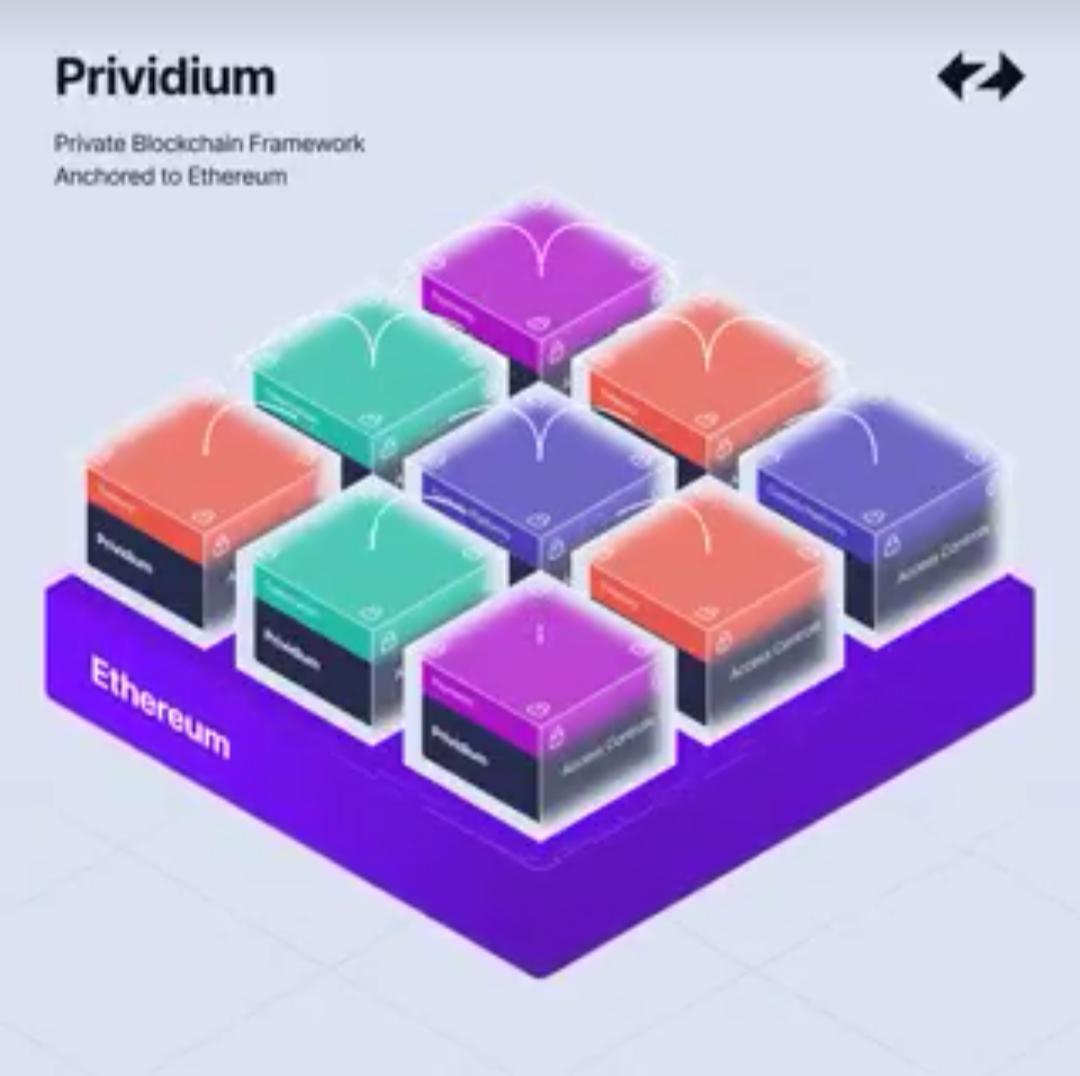
This is why privacy-by-architecture is structurally different from privacy added on top of public state. When privacy is architectural - when only ZK proofs and state commitments reach Ethereum, and execution runs inside private environments - the exposure problem doesn't exist by design. When privacy is layered on afterward, the actual question becomes: what gets exposed when this layer fails? No bank risk committee can accept an open-ended answer to that. It only takes one failure.
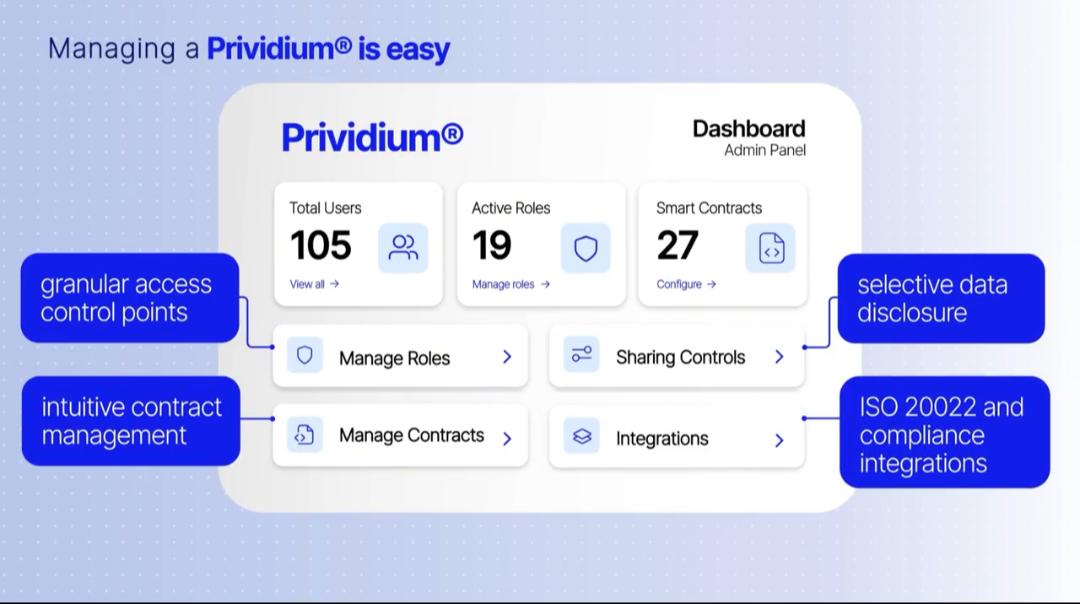
What @zksync built through Prividium addresses this at the layer where it actually has to be addressed. Each institution operates inside its own private execution environment. Selective disclosure for auditors and regulators is built in. Settlement validity is proven cryptographically without revealing what settled.
That doesn't just solve compliance. It makes it possible for institutions to operate on these rails the way they operate inside traditional RTGS systems today - moving real capital without their book becoming legible to every other participant on the network.
Deutsche Bank's Memento, ADI Chain, Cari Network's U.S. regional banks - they're not choosing settlement rails purely on technical specifications. They're evaluating whether the information boundaries their trading desks depend on are preserved by architecture or only promised by documentation.
That's a different evaluation. And it has a different answer depending on what's underneath.
One of those is an institutional answer. The other isn't.
70
50
115
8,306
ZeNoX retweeted

Jun 15
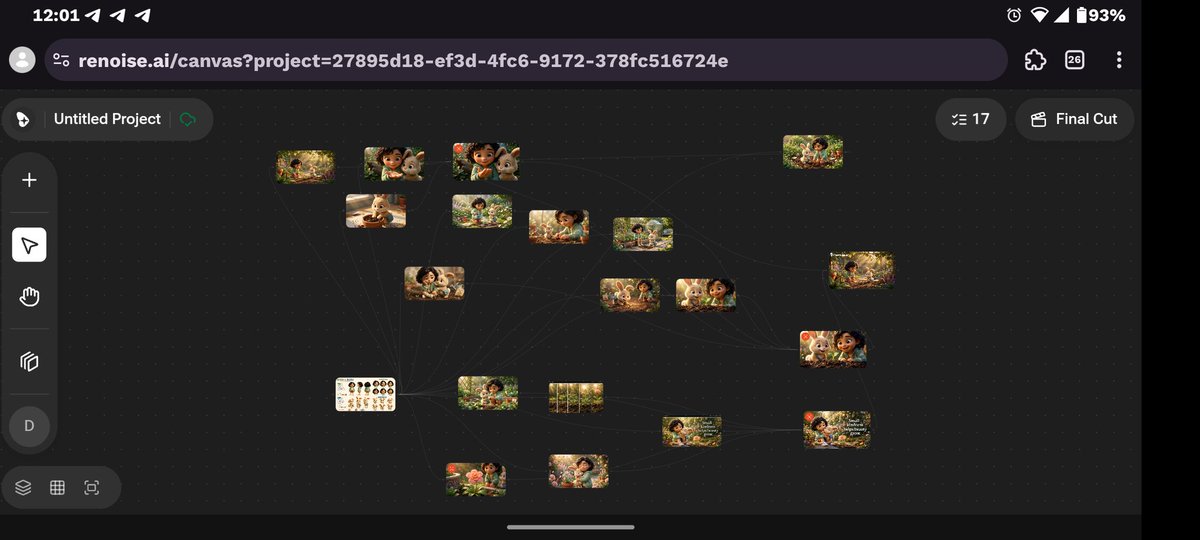
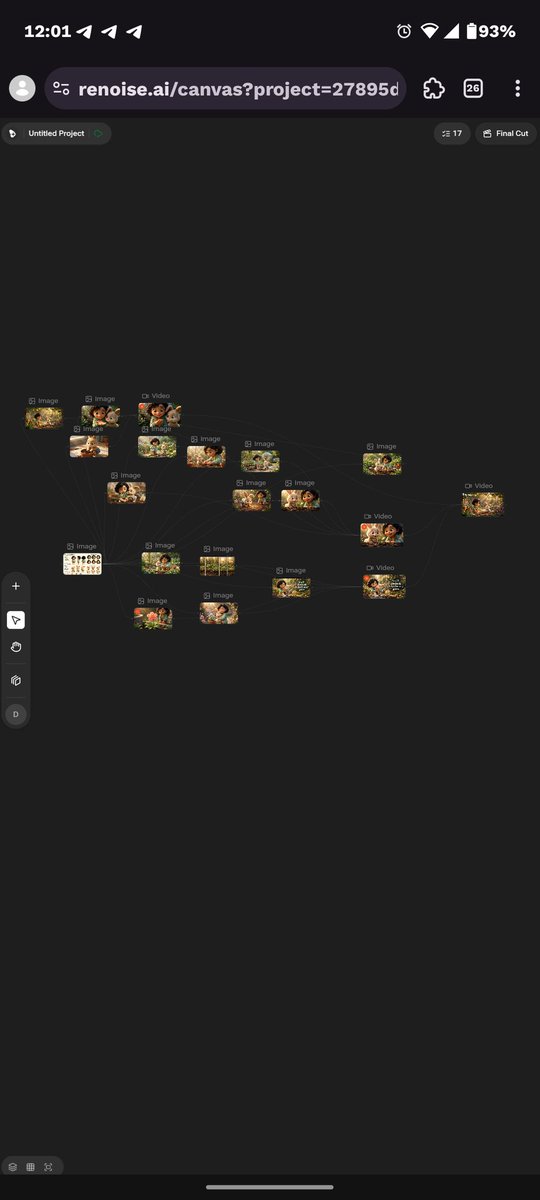
AI video consistency starts with a storyboard
For this football short, we generated a clean storyboard in Renoise and used it as the reference for the video
Workflow and prompts below ↓
Jun 15

Soccer storyboard workflow test in Renoise
GPT Image 2 → storyboard
Seedance 2.0 → animation
Example 👇
14
3
44
12,947
Jun 15
The reason institutional blockchain adoption stalled for a decade wasn't technical capability. It was exposure.
Banks understood the technology. What they couldn't accept was settlement infrastructure that publishes counterparty positions, transaction flows, and strategy to every other participant on the network. That single constraint eliminated most blockchain architectures before institutions even got to the finality question, the integration question, or the network effects question.
Transparency wasn't a tradeoff. It was a disqualifier.
This is why the institutional moment in onchain settlement is not simply about blockchain maturing. It is about one specific architectural problem getting solved. Zero-knowledge proofs change the constraint at the protocol level. Not through permissioned databases that recreate the centralization problem. Not through consortium chains that sacrifice interoperability with the broader Ethereum ecosystem. Through cryptographic proofs that let institutions settle on shared public infrastructure while keeping counterparty data private by default.
Only validity proofs and state commitments reach Ethereum. Positions, transaction details, and strategy never leave the institution's execution environment. The bank sees what it needs to see. Regulators access what they are entitled to see. Counterparties see nothing they shouldn't.
This is not a feature. It is the prerequisite that makes institutional onchain settlement viable at all.
The institutions that recognized this are already in production. Deutsche Bank's DAMA 2.0 tokenized fund platform is live through Memento on ZKsync infrastructure, the first tier-one global bank running on ZK settlement rails. ADI Chain is live with First Abu Dhabi Bank, the Central Bank of the UAE, BlackRock, Mastercard, and Franklin Templeton. Five U.S. regional banks representing over $600 billion in combined deposits are onboarding through Cari Network, a network founded by the 27th U.S. Comptroller of the Currency. More than 30 institutions across U.S. and international banks, central banks, sovereign issuers, and global custodians are in active engagement.
Each one arriving at the same conclusion: the rails that solve the exposure problem are the rails institutional settlement can actually use.
Each new deployment also changes what the next institution decides. A bank evaluating its options in late 2026 is not choosing between technical specifications. It is choosing whether to join the network where its counterparties are already settling, or to build in isolation on rails that lack the relationships it needs to function.
93% of U.S. tokenized assets settle on Ethereum. The settlement layer is not in question. What 2026 decides is which execution layer regulated capital uses.
@ZKsync is the one built to resolve the constraint that blocked this category for a decade. Follow the institutional deployments. The window is narrowing.
32
89
85
8,094

Created with GPT 2 on ChatGPT
Prompt:
{
"prompt": "Ultra-detailed anime-inspired character moodboard poster of a handsome young South Asian man named Orion, curly dark hair, short beard, black oversized glasses, warm confident smile, wearing a black dragon-emblem hoodie, black cargo pants, tactical backpack, and black-and-white sneakers. Aesthetic sketchbook collage layout on textured vintage beige paper background with layered tape, doodles, handwritten notes, dragon anatomy sketches, fantasy symbols, and cinematic lighting. Multiple poses and scenes including: standing full body pose with backpack, studying ancient dragon books at a desk, interacting with a giant realistic dragon, walking toward a massive dragon in a fantasy landscape, and sketchbook portrait studies. Cozy dark academia fantasy explorer vibe, highly detailed fabric textures, soft ink shading, painterly anime realism, warm sepia tones, black and beige color palette. Include motivational handwritten quotes, notebook checklists, dragon lore notes, future goals section, and fantasy worldbuilding elements. Add small illustrated accessories like hoodie mockup, cargo pants, backpack, sneakers, books, coffee mug labeled 'Dragon Fuel', medieval dragon coins, and ancient maps. Layout should resemble a premium Pinterest-style aesthetic moodboard with dynamic composition, cinematic atmosphere, and intricate storytelling details.",
"negative_prompt": "low quality, blurry, extra limbs, bad anatomy, deformed hands, cropped face, duplicate character, flat lighting, oversaturated colors, messy composition, unrealistic proportions, text glitches, watermark, logo, low detail, poorly drawn dragon",
"style": "anime realism, dark academia, fantasy aesthetic, cinematic sketchbook collage",
"aspect_ratio": "4:5",
"quality": "ultra detailed",
"lighting": "soft cinematic warm lighting",
"color_palette": [
"black",
"dark gray",
"beige",
"sepia",
"warm brown"
],
"camera": {
"angle": "mixed cinematic angles",
"focus": "sharp focus on character with detailed background elements"
},
"details": {
"background": "textured vintage paper with tape, doodles, handwritten notes",
"mood": "dreamy, ambitious, adventurous, intellectual",
"props": [
"dragon sketches",
"ancient books",
"coffee mug",
"backpack",
"fantasy coins",
"maps",
"notebook",
"hoodie mockup",
"cargo pants mockup",
"sneakers"
]
}
}

14
3
27
943
ZeNoX retweeted

Jun 14
One thing I've noticed in Web3:
The technology keeps getting better, but the user experience still feels harder than it should.
New users often have to deal with wallets, bridges, gas fees, and multiple networks before they can do something simple.
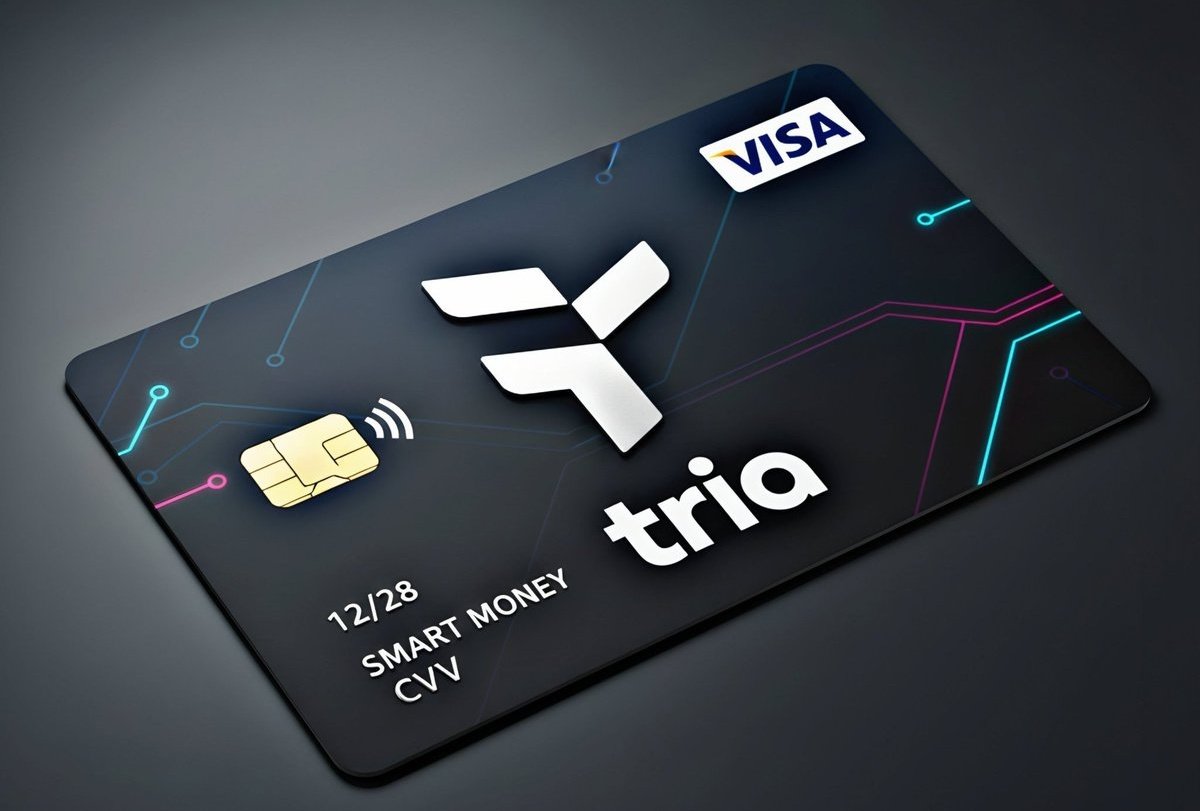
That's why @useTria caught my attention.
Instead of making users think about chains and infrastructure, the goal is to make everything feel smooth and straightforward.
At the end of the day, most people don't care which chain they're using.
They just want products that work.
I think the projects that win long term will be the ones that hide the complexity and make Web3 feel effortless.
Powered by @MindoAI
88
2
75
12,114


ZeNoX retweeted

Jun 14
Most wellness apps lose you in week 2.
Not because you lack discipline, because they give you nothing real to come back to.
@timesoulcom actually fixed this:
→ AI tracks your stillness & breathing in real time. You can't just fake your way through a session
→ Every session earns XP and spends TimeBox durability
→ 5-day streaks unlock chests with rare NFTs exclusive content
→ Your NFT unlocks more the longer you hold it
It's a mindfulness app built specifically for people who've already failed at every other mindfulness app.
Native iOS. Psychology-trained AI coach. Real onchain rewards for real habits. This is what Web3 wellness looks like when someone actually thinks it through.
@BingXOfficial #BingXBlast #TimeSoul #Mindfulness $TTS

92
9
144
4,630
ZeNoX retweeted
Jun 9
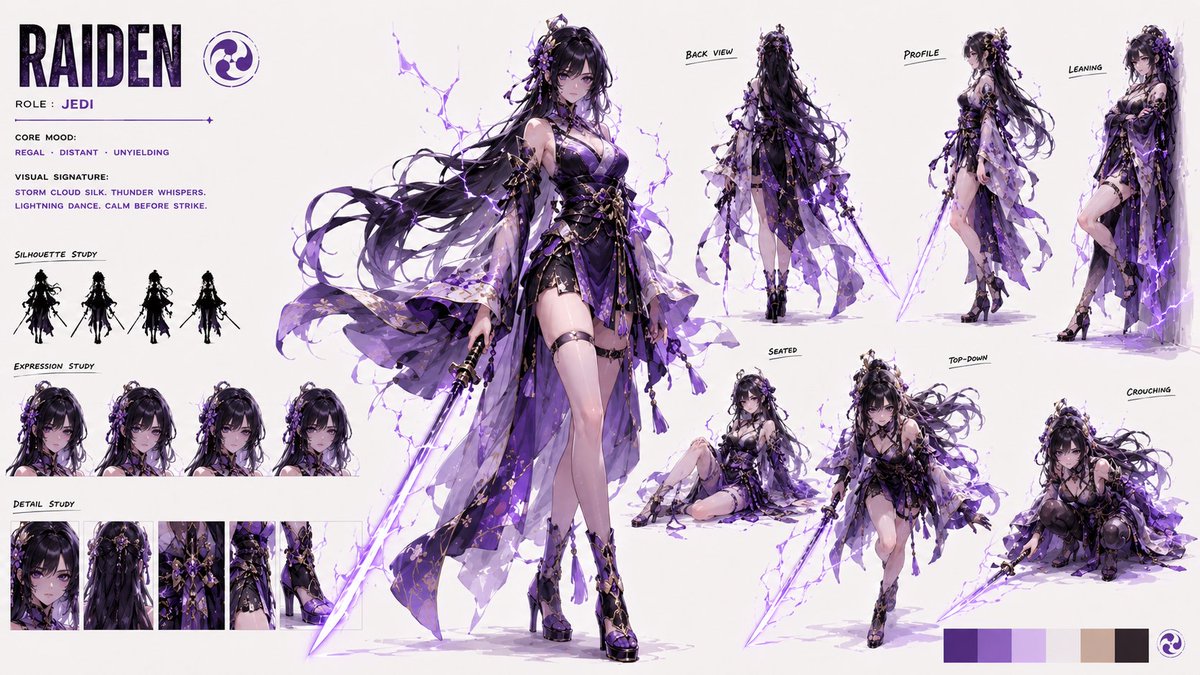
Step 1: Create the character sheet first using GPT Image 2
here's the prompt:
STYLE:
anime character concept art,
high-detail digital illustration,
fantasy warrior design,
elegant Japanese-inspired outfit,
purple lightning theme,
dynamic poses and expressions,
character turnaround,
full body study,
concept art for animation/game,
cinematic lighting,
flowing garments and hair,
intricate armor and accessories,
professional character design sheet,
masterpiece, ultra detailed, 8k
ASPECT RATIO:
16:9
MAIN CHARACTER:
Raiden,
tall elegant female warrior,
long flowing black hair with purple highlights,
purple and gold ceremonial armor with layered silk and ribbons,
dual-energy sword wielder,
regal, distant, unyielding demeanor,
lightning effects around body,
detailed boots and arm guards,
anime-style facial features,
dynamic hair and garment motion
POSES AND VIEWS:
front full body,
back view,
profile side view,
leaning against wall,
seated pose,
top-down perspective,
crouching action pose,
expression study (serious, calm, focused, determined),
detail study close-ups (face, hair ornaments, armor details, shoes, sword)
VISUAL DETAILS:
flowing silk and layered fabrics,
glowing purple lightning cracks,
decorative gold trims,
paper-thin translucency on sleeves,
dynamic motion effects,
light reflection on armor,
clean white background,
consistent character design,
cinematic composition
COLORS:
deep purple,
lavender,
soft lilac,
gold accents,
ivory skin,
subtle black for shadows,
ambient light purple glow
MOOD:
regal, intense, powerful, poised, heroic, mystical
LAYOUT:
multi-view character sheet,
numbered poses,
caption for each pose,
storybook/production concept style,
clean professional presentation,
anime quality,
masterpiece, ultra detailed, 8k
2
3
9
997
ZeNoX retweeted
Jun 9
This lightning sword dance goes hard ⚡️
made with GPT Image 2 Seedance 2.0 on Renoise
workflow⬇️
Jun 9
Character design workflow test in Renoise
GPT Image 2 → character sheet
Seedance 2.0 → animated video
RT Follow Reply = Workflow
6
11
54
3,452
ZeNoX retweeted
Jun 9
AI video tools show you the finished clip. We're giving you a glimpse at the production queue. 🧵
7
4
38
1,318
ZeNoX retweeted
Jun 8
Thanks for sharing your prompt @_CrownDEX. How close did this first generation get to your vision? What would you improve in your prompt?
Jun 7

Create a cinematic 15-second football World Cup themed video with a strong emotional story, ultra-realistic film look, dramatic stadium lighting, high contrast, shallow depth of field, slow motion, sweat, breath, crowd energy, and a powerful final moment.
Scene setting:
Night before the World Cup final. A young footballer stands alone inside a massive empty stadium. The seats are dark, floodlights slowly turn on one by one, and distant crowd echoes feel like memories. He wears his national team jersey, slightly worn boots, and has a focused but emotional expression.
Visual style:
High-end sports film commercial, cinematic realism, ARRI Alexa look, 35mm and 50mm lens feel, teal-gold color grade, dramatic shadows, realistic skin texture, detailed grass, emotional close-ups, subtle camera shake, slow-motion football action, atmospheric sound design.
15-second scene flow:
0:00–0:03
Wide shot of the empty World Cup stadium at night. The player walks alone through the tunnel toward the pitch, holding a football under one arm. Stadium lights flicker on above him.
Subtitle: “Before the world hears your name…”
0:03–0:06
Close-up of his boots stepping onto the grass. His hand touches the national crest on his jersey. His breathing is calm but heavy. The sound of a roaring crowd fades in like a memory.
Subtitle: “You must first face the silence.”
0:06–0:09
Flash cuts of his journey: training in rain, falling on muddy ground, tying old boots, hearing critics, getting back up. Fast emotional montage with motion blur and intense lighting.
Subtitle: “Every fall was part of the road.”
0:09–0:12
Back in the stadium. He places the ball on the penalty spot. The empty seats suddenly transform into a roaring crowd through cinematic sound and lighting. He looks at the goal with fierce focus.
Subtitle: “One kick. One nation. One dream.”
0:12–0:15
Slow-motion shot as he strikes the ball. The ball flies toward the goal under bright floodlights. Cut to his face watching with calm confidence. End before showing the result, leaving suspense.
Subtitle: “The world is waiting.”
Camera instructions:
Use smooth cinematic tracking shots, emotional close-ups, slow-motion impact moments, realistic football physics, dramatic lens flares from stadium lights, shallow depth of field, and powerful sound-driven pacing.
Mood:
Inspirational, intense, emotional, heroic, world-class sports drama.
Avoid:
No cartoon style, no unrealistic CGI crowd faces, no comedy, no scoreboard text, no logos, no real player likeness, no brand names, no overly bright colors.
Final look:
A premium World Cup trailer-style scene about pressure, sacrifice, national pride, and the final moment before greatness.
4
4
17
1,024
Jun 7
I heard "earn crypto by posting on X" and almost kept scrolling.
That phrase has a reputation. Task farms. Low rates for repetitive engagement. A hundred people posting identical content for pennies per action. I had mentally filed it away before I even clicked.
What I found at @RallyOnChain was different enough that I had to rethink the category entirely.
Rally does not give you a template to fill in. It gives you a campaign objective and a knowledge base, then asks you to write something original that serves the goal. The AI evaluates your submission across four gates: content alignment, information accuracy, originality, and compliance. It scores your engagement potential and technical quality as separate dimensions. It even evaluates whether the replies your post generates are substantive or shallow.
There is no shortcut for any of that. If you write something that could have been written by anyone, you score like anyone.
The prize pool running right now is $5,000. Top 10 finishers take home close to $500 each. Creators earn every single day. The scoring weights are published before you write a single word, so you know exactly what is being measured.
I have used task platforms. This is not that. Task platforms reward output volume. Rally rewards whether you actually understood what you were writing about.
The platform is early. The people who already see the difference between those two things are the ones on that leaderboard right now.
What would you write if you knew the AI was reading for comprehension, not keywords? Drop it in the replies. I will send the link directly to everyone who does.
44
64
3,067

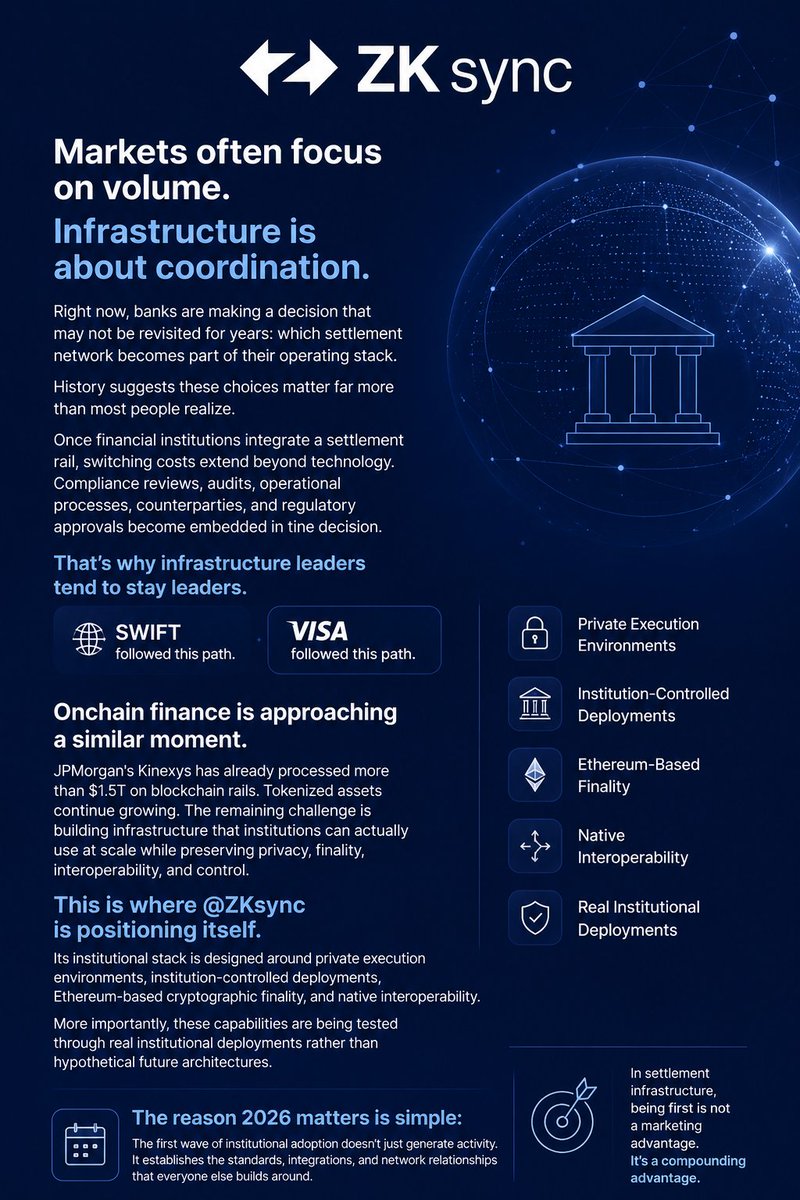
There is a mathematical reason that settlement networks tend to produce one dominant standard rather than a competitive market of interoperable rails.
It is not regulatory capture. It is not marketing. It is not that the winning platform had the best engineers or raised the most capital. It is a combinatorial property of how networks create value, and it applies to institutional settlement infrastructure with more force than almost any other category of financial technology.
Start with the arithmetic. Ten institutions settling on shared rails create 45 possible bilateral settlement corridors between them. Twenty institutions create 190. Fifty create 1,225. One hundred create nearly 5,000. The relationship is not linear. Each new participant adds not one connection but n-1 connections, where n is the existing number of participants. The value of the network grows roughly with the square of the number of participants while the cost of maintaining infrastructure grows much more slowly.
This is Metcalfe's Law applied to settlement, and it has a specific implication that matters enormously for understanding 2026: the gap between a network with 30 participants and a network with 60 participants is not twice as large as it looks. It is four times as large in terms of possible settlement corridors, and the compounding accelerates from there.
SWIFT understood this intuitively before anyone had formalized the mathematics. In its first decade, SWIFT's primary competitive strategy was not technology improvement. It was enrollment. Get the next bank on the network, because every bank that joins makes the network more valuable to every bank already on it, and more costly for every bank still outside it to ignore. SWIFT grew from 239 member banks in 1977 to over 11,000 today not because interbank messaging technology kept improving but because the network crossed successive density thresholds that made it the only rational choice for any institution with global counterparty relationships.
The institutional onchain settlement market in 2026 is in the early enrollment phase of exactly this curve.
The tokenized RWA market is approaching $29 billion. Global stablecoin supply has crossed $300 billion, with 93% of U.S. tokenized assets settling on Ethereum. JPMorgan's Kinexys is processing over $1.5 trillion cumulatively on blockchain rails. The April 2026 GFMA report identified the remaining unresolved items for full institutional deployment: interbank interoperability, transaction privacy, RTGS-equivalent settlement, and digital money governance. These are the final coordination problems before the enrollment phase accelerates.
When those problems are resolved on a specific architecture, the institutions that resolve them together become the first dense cluster on the network. And that cluster is where the compounding begins.
@zksync $ZK current institutional deployments represent exactly this early cluster. Deutsche Bank's DAMA 2.0 tokenized fund platform live on ZK infrastructure. ADI Chain live with First Abu Dhabi Bank, the Central Bank of the UAE, BlackRock, Mastercard, and Franklin Templeton. Cari Network onboarding five U.S. regional banks representing over $600 billion in combined deposits, with a pipeline of more than thirty institutions in active engagement across U.S. and international banks, central banks, sovereign issuers, and global custodians.
Each of those institutions is a node. Each node adds corridors. Each corridor raises the cost for the next institution to pick a competing rail, because the next institution is not just evaluating technology, it is evaluating whether its counterparties are already on the network it is choosing. At current trajectory, the institutions that join in 2026 are joining a network still early enough that their entry materially changes the network's density and direction. The institutions that join in 2028 will be joining a network that has already formed its gravitational center.
This is the asymmetry that makes 2026 the decisive year. The compounding is not symmetric across time. Early nodes shape the network's structure. Late nodes join the structure that early nodes created. The lead does not just persist. It converts into the default, and in financial infrastructure the default is nearly impossible to displace once it has sufficient counterparty density.
The window to be an early node rather than a late adopter is open. It is not defined by a calendar date. It is defined by the moment network density crosses the threshold where the next institution's counterparties have already chosen, and picking a different rail means asking them to move.
That threshold is approaching faster than the surface-level market size numbers suggest. Settlement corridors scale with the square of participants, not the first power. The institutions that understand this math are not waiting for the market to mature before they decide.
They are deciding now because deciding now is how you end up on the right side of the compounding.
69
11
173
7,573
ZeNoX retweeted

Jun 6
Most institutional blockchain analysis evaluates architecture from the top down: start with the features the architecture enables, then explain why institutions need those features.
This framing is useful for describing what a system is designed to do. It is less useful for evaluating whether the system can do it at the scale institutions actually operate.
The question that determines operational deployability at institutional scale is not what the architecture enables. It is whether the proving infrastructure can process validity proofs at a rate that matches institutional settlement demand without becoming a performance bottleneck.
This constraint is easy to overlook because it is not architectural. It is operational. An architecture can be designed correctly for institutional settlement, with the right privacy model, the right finality properties, and the right composability approach, and still fail to deploy operationally if the proving layer cannot keep pace with volume.
Consider what institutional settlement volume looks like in practice. JPMorgan's Kinexys platform has processed more than $1.5 trillion on blockchain rails, averaging roughly $2 billion daily. DTCC is advancing SEC-cleared tokenization of U.S. Treasuries. NYSE is building tokenized securities rails.
The tokenized real-world asset market is approaching $29 billion. Global stablecoin supply has passed $300 billion, with $157 billion in regulated stablecoin supply settling on Ethereum. These numbers are not static. They are growing and the institutions building against them are designing for where settlement volume goes over the next five years, not where it is today.
A $ZK proving system that introduces meaningful latency per proof does not create a minor performance gap at those volumes. It creates operational risk. Settlement queuing, missed settlement windows, and cascading delays are the infrastructure failure modes that operational risk teams at regulated institutions spend their careers designing around. Introducing a proving bottleneck into settlement rails would substitute one set of infrastructure risk for another.
Airbender resolves this directly.
Currently ranked first on eth_proofs, it generates block proofs in approximately one second on consumer-grade GPUs, running at 21.8 MHz on a single H100. The cost per ERC-20 transfer at the production stack level runs at approximately $0.0001. Post-quantum security properties are maintained at this performance level.
These numbers matter not because they are impressive in isolation but because they represent the proving throughput range at which institutional deployment becomes operationally viable rather than architecturally theoretical.
The translation from benchmark to production is the next constraint. @zksync operates Airbender, the $ZK Stack platform, and Prividium as a single integrated end-to-end stack.
A proving system running in isolation under controlled benchmark conditions performs differently from the same system running under the integrated load of the full platform and institutional deployment layer simultaneously. Every organizational seam in an assembled stack introduces a performance variable that is difficult to govern under real deployment conditions. Integrated end-to-end operation means the performance profile is tested, measured, and governed as a system. The numbers are the system's numbers, not a component's numbers extrapolated to the whole.
When four regulated institutions with real settlement volumes and real operational risk governance standards commit infrastructure to specific rails, they are conducting production validation at a level no benchmark replicates.
Deutsche Bank's Memento is the production deployment of DAMA 2.0, the bank's institutional tokenization platform, live on @zksync settlement rails. ADI Chain is live with First Abu Dhabi Bank, the Central Bank of the UAE, BlackRock, Mastercard, and Franklin Templeton.
BitGo has integrated institutional custody and wallet services with Prividium, bringing U.S. institutional custodian standards into the network. Cari Network, founded by Eugene Ludwig (the 27th U.S. Comptroller of the Currency), is currently onboarding five U.S. regional banks representing $600B in combined deposits, with production rollout planned for later in 2026.
What makes this deployment set particularly meaningful from an operational validation standpoint is its range. Deutsche Bank's tokenized fund platform represents one transaction profile and volume characteristic.
A central bank and three global institutional counterparties on ADI Chain represent another. BitGo custody operations represent another. Five U.S. regional banks with $600B in combined deposits represent another.
These are not similar institutions with similar operational demands. They are materially different, and all four cleared the same proving infrastructure against their own specific operational requirements.
A pipeline of more than thirty institutions in active engagement builds on this validation record with each progression.
The record grows across an increasingly diverse range of institutional volume profiles.
One question that the public data does not resolve clearly:
At what order-of-magnitude increase in settlement volume do proving costs start exhibiting non-linear behavior, and what does the per-proof cost curve look like for institutions whose daily settlement is measured in billions rather than millions?
The ~$0.0001 per transfer figure is compelling at current volumes. Whether it holds its cost profile at ten times or one hundred times current throughput is the number that the institutions currently in the thirty-plus pipeline are trying to model.
If anyone has run throughput stress tests on the current production stack at those volume levels, that data matters more to the evaluation process than any architectural argument.
75
41
191
7,905
Jun 6
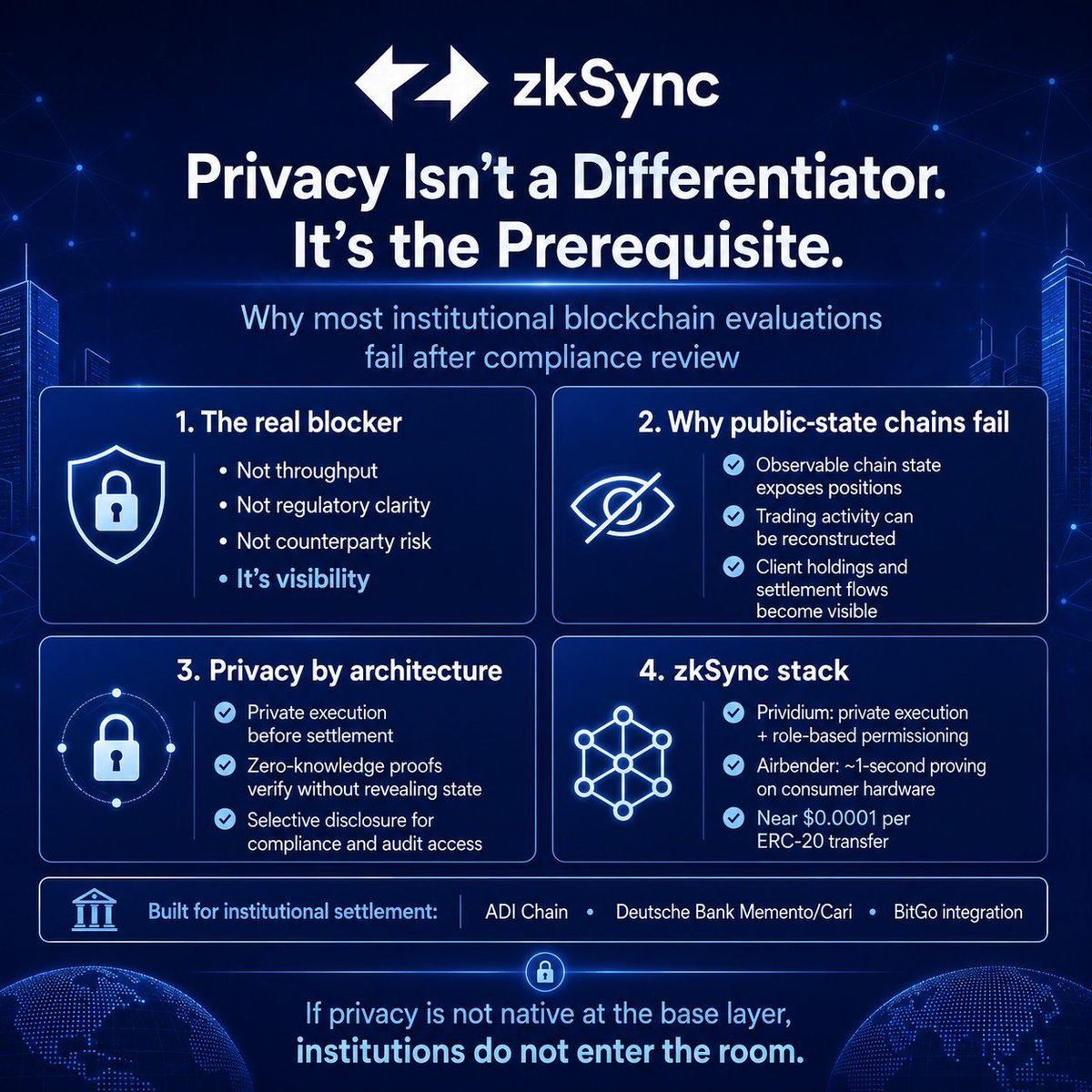
There is a reason most institutional blockchain evaluations do not advance past the second compliance session, and it is almost never the reason cited publicly.
The stated objections are usually about throughput, regulatory clarity, or counterparty risk profiles. The actual objection, in the majority of failed evaluations, is visibility. A regulated trading desk cannot operate on a network where other participants can reconstruct its positions from chain state. A central bank cannot share settlement infrastructure with private-sector counterparties on a network where its activity is technically observable by anyone with access to the base layer. A large custody institution cannot expose client holdings to a public or semi-public visibility layer.
These are not preferences that a strong enough business case overrides. They are regulatory obligations that exist regardless of how compelling the technical architecture is. GDPR applies to transaction data involving EU entities. Banking secrecy law across Switzerland, Singapore, and Gulf jurisdictions applies to client information. MiFID II best-execution obligations require that trading activity not be reconstructable by infrastructure participants. These constraints are simultaneous and non-waivable.
Most blockchain architectures fail this test structurally. The failure mode is not absence of a privacy solution. It is that the privacy solution sits on top of a public base state. If the underlying state is observable, a confidentiality layer narrows the exposure window but cannot close it. Validators and technically sophisticated counterparties had access to the state before the privacy layer applied. For consumer applications, this is an acceptable tradeoff. For institutions where position data, counterparty relationships, and settlement flows are legally and competitively sensitive, it is not.
Privacy by architecture means the base state is never public. Private execution environments process computation before any state reaches settlement. Zero-knowledge proofs validate correctness without disclosing the underlying state. Counterparties cannot observe positions because there is no observable position to reconstruct.
@zksync built this at the design layer. Prividium deploys private execution environments with role-based permissioning and selective disclosure for compliance and audit access. Airbender, the proving system, delivers ~1-second block proving on consumer hardware, currently #1 on eth_proofs, with production economics near $0.0001 per ERC-20 transfer.
This is why ADI Chain can put a sovereign central bank, a global asset manager, and a global payments network on the same settlement layer without those participants' operational data crossing visibility boundaries. It is why Deutsche Bank's Memento and Cari Network, currently onboarding five U.S. regional banks representing $600B in combined deposits with production rollout planned for later in 2026, passed compliance reviews that included the hardest privacy question. It is why BitGo's institutional custody integration completed.
Privacy-first architecture is not a differentiator. It is the prerequisite that determines whether the institution enters the room.
65
23
109
7,387
Jun 6
There is a reason the standard analysis of 2026 institutional blockchain activity consistently underestimates how locked the outcome will be by 2027. It treats this as a market competition that stays open until a clear winner emerges. Financial infrastructure does not work that way.
When a large bank commits to settlement rails, it commits operationally, regulatorily, and counterparty-dependently. The engineering integration runs years. The regulatory attestation for that specific stack is not transferable to a different one. Every correspondent bank and custody provider that builds against the same infrastructure creates another relationship that makes switching more expensive than staying, independent of product quality.
The GFMA's April 2026 report identified what remains unresolved for institutional onchain finance: interbank interoperability for tokenized deposits, transaction privacy standards, RTGS-equivalent settlement mechanics, governance for digital money. These are the exact blockers that explain why five years of institutional blockchain activity produced proof-of-concepts rather than production deployments at scale. The next 18 months resolve them. The platforms resolving them set the standard.
Privacy deserves specific attention because it is the constraint that eliminates most architectures before the evaluation starts. No regulated bank settles on shared infrastructure that exposes positions or counterparty data to other participants on the network. This cannot be solved with configurable permissions layered on a transparent foundation. The architecture has to treat private execution as the default, not the exception. Most infrastructure fails this test structurally.
@zksync delivers all four required properties: private execution environments where only zero-knowledge proofs and state commitments publish to Ethereum, institution-controlled permissioned chains, cryptographic finality without optimistic challenge windows, and atomic cross-chain composability without external bridges. The live deployments reflect where the institutional decision is already landing: Deutsche Bank's DAMA 2.0 in production, ADI Chain live with a consortium including First Abu Dhabi Bank and the Central Bank of the UAE, Cari Network onboarding five U.S. regional banks with $600B in combined deposits, 30 institutions in active engagement.
JPMorgan Kinexys at $1.5 trillion processed. 93% of tokenized U.S. assets settling on Ethereum. The institutional flow is already running. The architecture absorbing the first wave of committed capital does not just grow. It becomes the counterparty baseline the next institution evaluates against.
The decision window is not a future event. For a meaningful portion of the institutions that will define the next decade of settlement infrastructure, it is open right now, and it will not be open for long.
99
65
201
7,662