
Building agent platform for knowledge work, checkout myaidrive.com . Previously ML at Google, Uber and LinkedIn.
Joined September 2009
- Tweets 3,471
- Following 1,530
- Followers 1,255
- Likes 12,397
185 Photos and videos









Jun 13
Reminder: if you don’t control weights then it is not your model.
3
60
Jun 13
Strong agree!

Dear US government,
Since you've just blocked Fable and Mythos on critical national security grounds, here are some other tools that pose a similar threat to the American people:
- Microsoft Teams
- SAP
- Salesforce
- Jira
- Outlook
Please do what you must to save America 🇺🇸
1
157
Karthik Ramasamy retweeted

Jun 13

Jun 13

NEW: Amazon researchers are reportedly behind the jailbreak report that led to the U.S. crackdown on Anthropic’s top models.
148
1,603
22,301
951,171
Jun 11
Fable is a step up. I would rate it at Google L6 Staff level. It is pushing back so much, rightly so. Any other model would just simple say "You are absolutely right!". It understands so much of the nuances in software architecture.
2
78
Jun 10
Based on my usage, I might need to spend $1k/day on Fable after June 22 😬
3
90
Jun 10
This is going to be new world, a real level playing field for other Agent platforms like myaidrive.com to show how efficient we are with tokens. Soon, Claude subs will be not discounted ~20x, esp for Fable.
We are doubling down on making our Agent token efficient for document workflows. DM me if you want to save money on knowledge work with Claude.
Jun 10

Our Anthropic bill is about to jump from $400K → $1.4M/yr.
Not because usage exploded, but because we're about to cross 150 seats.
Past 150 seats you're forced into Enterprise tier. Seats stop including any usage, every token bills at standard API rates. At our current run rate that's 3.5x overnight.
Unfiltered thoughts on AI spend:
1. We should spend tokens to grow as aggressively as possible. But most people (me included) aren't conscious of what they're spending.
2. Visibility comes first. People see their personal number and they're shocked. I accidentally spent $4,000 in 3 days in Claude Code.
3. For engineering the spend is clearly worth it. Pay for the best model, it saves more than it costs.
4. For a lot of other roles it's questionable. Apps nobody uses, skills someone already built. No ROI.
5. Spend limits are coming. We already require approval for more tokens on our support team.
The era of token-maxxing is coming to an end.
5
1,104
Karthik Ramasamy retweeted

Jun 10
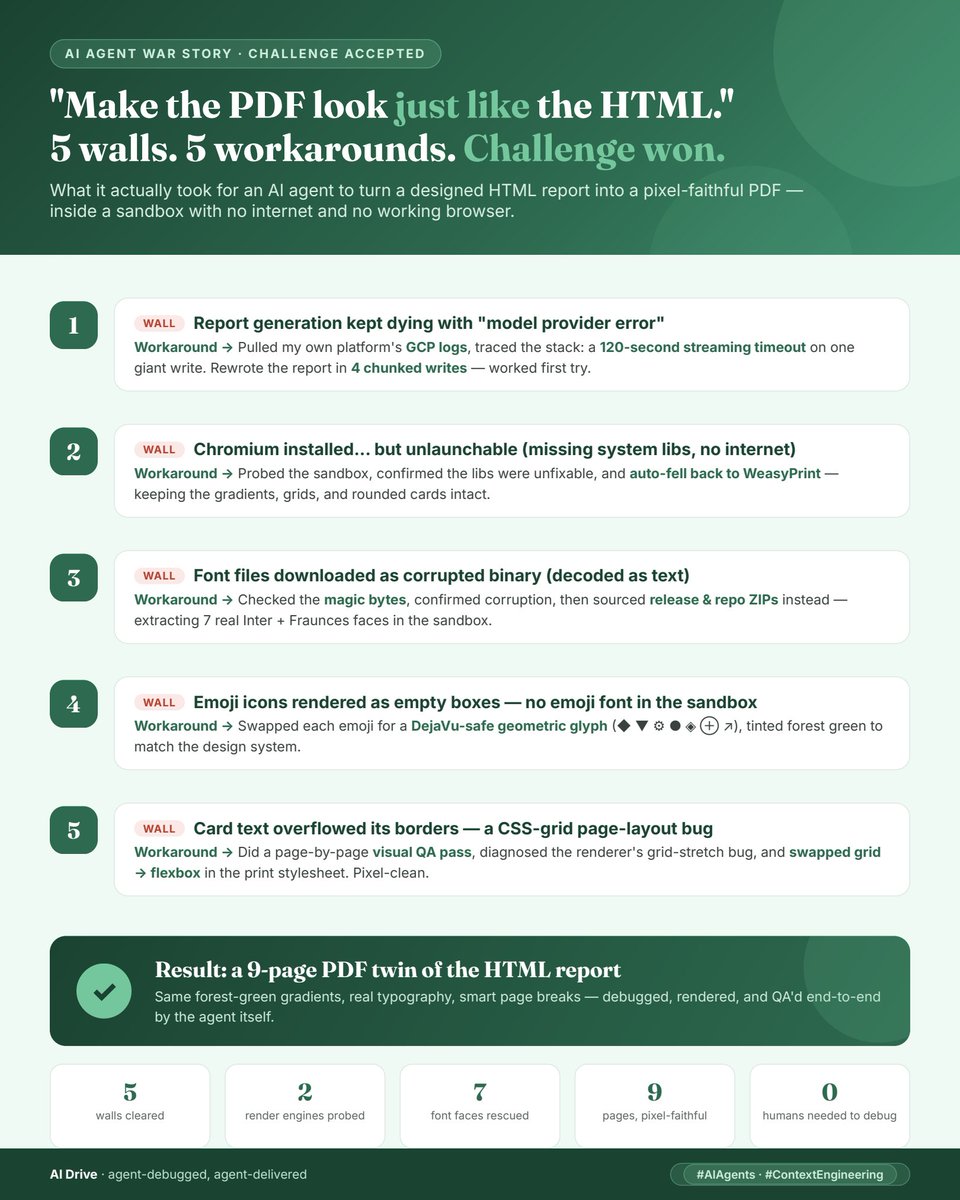
Very impressed with Claude Fable 5, this is the first step change since Opus 4.6 back in December. I asked it to convert an html to pdf in AI DRIVE with high fidelity which is not trivial because of fonts and a number of restrictions in our sandbox. It was so persistent and resourceful, it was amazing to see. Check out the brag sheet it created once it finished the task!
1
2
115
Jun 9
The power rating of a single NVIDIA Vera Rubin NVL72 rack is approximately 220 kW. We need scale this 10x for any meaningful compute comparable to what we have in ground based datacenter.
Jun 8

SpaceX has just officially unveiled its AI1 satellite, the first generation of its AI satellite.
Overall Specs:
• 150 kW peak compute payload
• 120 kW average compute payload
• 70 kW per ton
• Compute provider interchangeable
Dimensions:
• Wingspan: 70 meters
• Deployed height: 20 meters
Thermal System:
• 110 m² deployable liquid radiator
• Redundant pumping loops
• Integrated micrometeoroid shielding
• Deployable liquid radiators
Solar Power System:
• 150 kW solar array
• 250 W/m²
• SpaceX-manufactured solar technology from Bastrop, Texas
Architecture:
• Centralized compute module
• Large deployable solar arrays
• Deployable liquid-radiator thermal management system
• AI-focused compute satellite design ("AI1 satellite")
Elon: "The AI satellite is much simpler than a Starlink satellite. The AI satellite is essentially a lot of solar cells, you still need some laser links, but you don't have all of the super complex antennas that you have on a Starlink satellite. The easier one to design for is the AI satellite. It's bigger. A lot of this is technology we've already made with the Starlink V3 satellites."
109
Karthik Ramasamy retweeted

Jun 7
Any founder who has begun by making something they themselves wanted will be better at convincing users than investors. Imagine Woz demoing the Apple I to the Homebrew Computer Club or Larry Page demoing BackRub to fellow students vs either pitching a VC.
41
48
1,459
82,608
Jun 7
Very true. at myaidrive.com we beat generic agents like Claude code and Codex on document workflows by a long margin when it comes to token efficiency. Any company paying $ for tokens should go for specialized agents and tools rather than using generic ones.
Jun 5

Token costs are why there will be no saas apocalypse / good dev tools are cached intelligence for agents!
The popular theory goes: agents can write code, so they'll just rebuild every tool from scratch and hit raw APIs. no more dev tools, no more CLIs, no more software layers. just agents and endpoints!
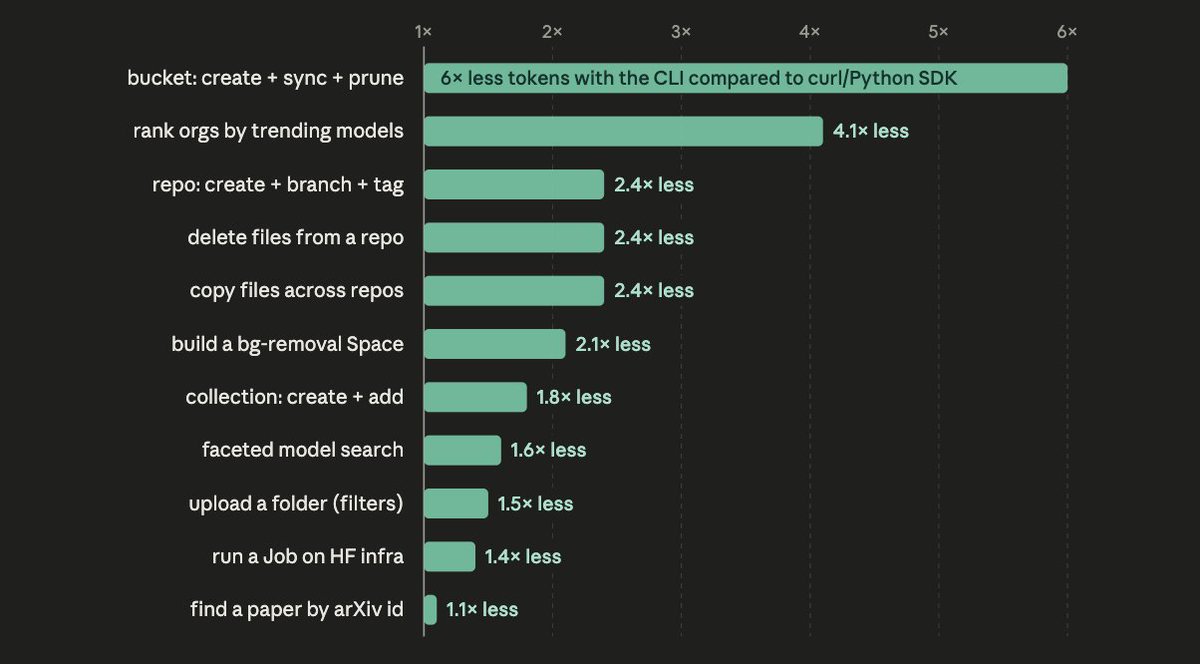
We just tested this and the data says the opposite. We benchmarked Claude Code and Codex on real Hugging Face Hub tasks (~1,000 graded runs), with two setups: the agent-optimized hf CLI vs the agent hand-rolling curl or SDK calls from scratch.
Hand-rolling burns up to 6x more tokens on multi-step tasks and fails more often (84% vs 94% task success).
And that's just dropping one abstraction layer. It would obviously be orders of magnitude more tokens and a dramatically higher failure rate if the agent tried to bypass HF altogether and rebuild model hosting, versioning, and distribution from scratch. Every time an agent re-derives a workflow from raw API calls, you pay for that reasoning in tokens. every single run. a good CLI compresses that entire chain into a few high-level commands the agent can't get wrong.
In a world where everyone is complaining tokens are too expensive, abstraction is leverage: thousands of hours of design decisions your agent doesn't have to re-reason about at inference time.
Good tools are cached intelligence for agents!
So no, agents won't rebuild everything from scratch. they'll gravitate to the most token-efficient tools, because that's what their owners pay for. The software that survives won't just be accessible to agents, it will be accurate and cheap for them to drive.
We're seeing it happen with HF, which is becoming the platform for agents to use AI: ~49M requests in just two months, and growing fast!
huggingface.co/blog/hf-cli-f…
3
4
4,033
Karthik Ramasamy retweeted
Jun 6
What actually unlocks enterprise agent adoption isn't a smarter model. It's the layer underneath.
Scoped permissions. Clean attribution (the agent acted, not the user). Semantic caching so repeated queries are fast and cheap.
Get the plumbing right and security stops saying no.
We're building this at AI Drive. If you're deploying agents against your real document stack, DM me. I want to compare notes. cc @_cartick
1
1
1
57
Jun 3
Where model routing works:
* Subagents - when you know full problem at the start
* Context caching TTL has passed. 5mins for Claude is the most used setting AFAIK. 1hr is very expensive for Claude.
* When you compact the context, you loose the caching so you can affort to switch.
* Scheduled agents - all the prompt is known beforehand and you have a lot of examples to run eval.
Jun 2

Introducing model routing to Factory.
Factory Router picks the right model for every task, automatically.
Maintain frontier performance while cutting costs by 25%.
3
14
2,079
Jun 3
Model routing is not that easy for adhoc chats. These prompts are too short and far from what we see in the real world. Only when you have a full prompt for a wyorkflow, model routing makes sense. Getting prompt caching is very important as most caching saves you 60-80% cost. You can't simple route each message in a chat to a different provider let alone different model. Each model has very different restrictions on images, tool calls, etc so you need to choose the model family and stick with it.
Jun 2
Introducing model routing to Factory.
Factory Router picks the right model for every task, automatically.
Maintain frontier performance while cutting costs by 25%.
7
3
29
16,408
Karthik Ramasamy retweeted

May 29
All personnel are accounted for and safe. It’s too early to know the root cause but we’re already working to find it. Very rough day, but we’ll rebuild whatever needs rebuilding and get back to flying. It’s worth it.
7,080
5,241
102,918
9,760,974
May 24
RT @levelsio: This is crazy cause my doorbell auto uploads to Google Drive
So if you go to my doorbell with an old comic you can nuke my…
40
Karthik Ramasamy retweeted

May 22
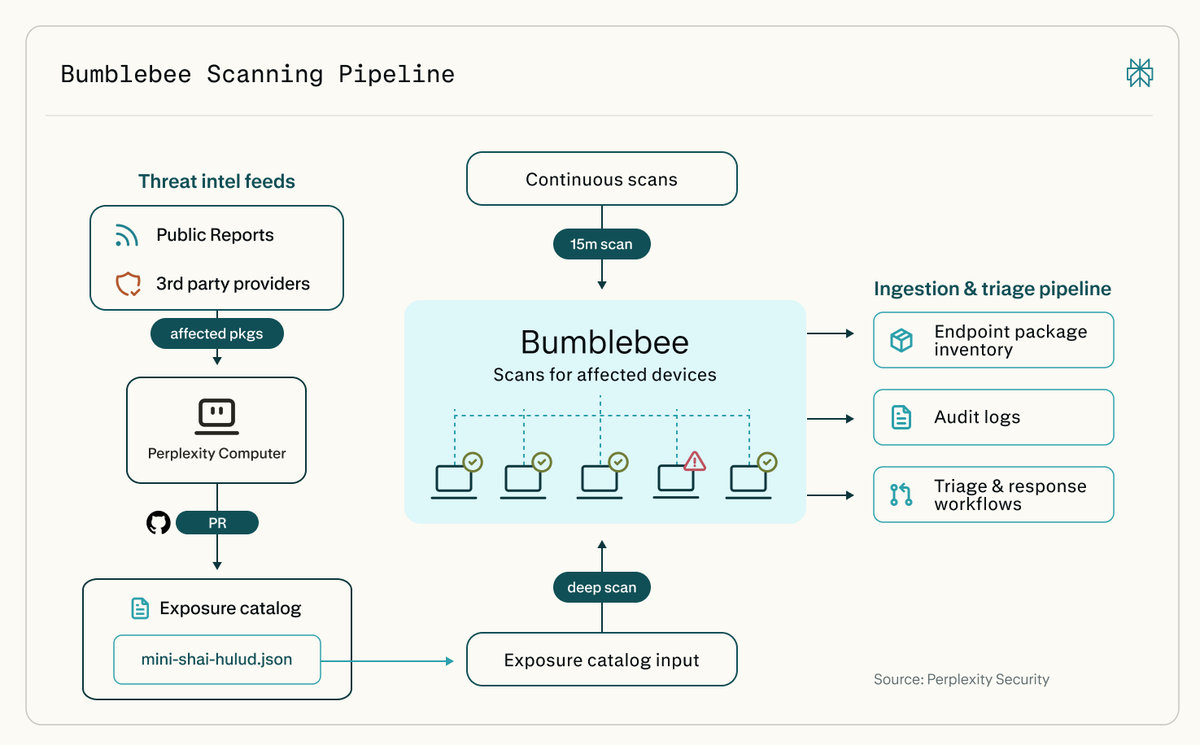
Today we're open-sourcing Bumblebee, a read-only scanner for macOS and Linux.
It checks developer machines for risky packages, extensions, and AI tool configs.
Connected to Computer, it can trigger deeper scans whenever a new supply-chain risk emerges.
github.com/perplexityai/bumb…
182
703
5,130
1,535,354
Karthik Ramasamy retweeted

May 21
Today we reduced headcount by 22%. The business is the strongest it's ever been. So I think it's important to be direct about what I'm seeing and why.
First, I made this decision and I own it. I did it because the way to operate at the highest level of productivity is changing, and to win the future, ClickUp needs to change with it.
Second, this wasn't about cutting costs. Most savings from this change will flow directly back into the people who stay. We'll be introducing million-dollar salary bands. If you create outsized impact using AI, you'll be paid outside of traditional bands.
Most importantly, I have the deepest gratitude for those affected. We're doing this from a position of strength specifically so we can take care of people properly. Everyone affected receives a package aimed at honoring their contributions and easing the transition.
I only see two options: wait for this to play out gradually in the market or be honest about what I'm seeing and act proactively.
THE 100X ORGANIZATION
The primary change is that we're restructuring around what I call 100x org. The goal is 100x output. The roles required to build at the highest level are fundamentally different than they were a year ago.
Incremental improvements to existing systems won't get us there. We need new ones. That means creating enough disruption to rebuild rather than iterate on what's already broken.
The common narrative is that AI makes everyone more productive. It doesn't. Many of the workflows of today, if left unchanged, create bottlenecks in AI systems.
These roles will evolve. But waiting for that to happen naturally means falling behind now.
The 100x org is actually heavily dependent on people - infinitely more than today. This is only possible with 10x people that have embraced and adopted new ways of working.
THE BUILDERS, AGENT MANAGERS, AND FRONT-LINERS
— THE BUILDERS: 10X ENGINEERS
I don't think most companies have internalized what's actually happening with AI in engineering. The common narrative is that AI makes all engineers more productive. That may be true in isolation, but at an organization level - that is the farthest thing from reality.
Here's what we've validated recently at ClickUp: the great engineers, the ones who can orchestrate, architect, and review, are becoming 100x engineers. They're not writing code. They're directing agents that write code. The skill is judgment.
AI makes the best engineers wildly more productive, and everyone else using AI slows these engineers down.
Think about it - the bottlenecks are (1) orchestration - telling AI what to do, and (2) reviewing - what AI did. Everything is leapfrogged and no longer needed.
So who do you want orchestrating and reviewing code?
And how do you want your best engineers to spend their time?
If your best engineers are spending time reviewing other people's code, then this is inherently an inefficient bottleneck. These engineers can review their agent's code much faster than reviewing human code.
The new world is about enabling your 10x engineers to become 100x.
The wrong strategy is to push every engineer to use infinite tokens. Companies doing this are celebrating 500% more pull requests. But customer outcomes don't match the volume of code being generated.
I call this the great reckoning of AI coding, and every company will face this soon if not already.
More code is just another bottleneck to the best engineers, and ultimately to your company's impact as well.
— THE BUILDERS: 10X PRODUCT MANAGERS
Product management and design roles are merging.
Designers that have customer focus, become more like product managers.
And product managers that have intuition for UX become more like designers.
The bottleneck of user research is gone. It takes us just one mention of an agent to kickoff research and analyze results.
The bottleneck of product <> design iteration is also gone. The product builder iterates on their own, along with agents and skills that ensure alignment with quality and strategy.
Also controversial today - I believe that the wrong strategy is to have your PMs shipping code - that just introduces another bottleneck that the best engineers will waste their time on.
To be clear, PMs should be coding but they should do this in a playground to iterate, validate, and scope. That code should not go to production.
Everything outside of managing systems, orchestrating AI, and reviewing output becomes a bottleneck.
That's why the other roles that are critical along with these are the systems managers (to reduce bottlenecks) along with a bottleneck you can't replace - customer meeting time.
— THE SYSTEM MANAGERS
Ironically, the people that automate their jobs with AI will always have a job. They become owners of the AI systems - agent managers. We have many examples of these people at ClickUp.
The underlying systems in which we operate are absolutely critical to get right. I think most companies are delusional to think they can iterate on existing systems and compete in this new world.
You must create enough disruption so that old systems are deprecated entirely. If there's any definition for 'AI native' that's what it is.
— THE FRONT-LINERS
In a world that will become saturated with AI communication, the human touch will matter more than anything to customers.
This is a bottleneck that you shouldn't replace - even when agents are high enough quality to do video meetings.
One-on-one meeting time with customers is something that shouldn't be automated. The systems around the meetings should be - so that front-liners spend nearly 100% of their time with customers.
REWARDING 100X IMPACT
In a world where companies are able to do so much more with less, where does that excess money go?
In our case, much of the savings in this new operating model will flow directly back to those that enabled it.
We must reward people that create productivity accordingly. This aligns incentives on both sides. Plus, in a world where your best people create 100x impact, you can't afford to lose them.
You should aim to retain these employees for decades. The context they have and their ability to efficiently orchestrate and review will be nearly impossible to replace.
Compensation bands of today should be thrown out the door. We're introducing $1 million cash/year salary bands with a path available to nearly everyone in the company if they produce 100x impact by creating or managing AI systems.
THE FUTURE
Nearly every company will make changes like these. The ones that do it proactively will define what comes next.
The future is not fewer people. It's different work, new roles, and better rewards for those who embrace it. We're already seeing entirely new roles emerge, like Agent Managers, that didn't exist a year ago.
ClickUp is positioning to lead this shift, not just internally, but for our customers too. I've never been more certain about where we're headed.
1,651
1,144
7,641
9,127,241