Data enginseer. Navigator of metabolic pathways. Druid of circle of spores. CTO @CaravelBio. Curiosity drives the cat. He/him
Joined November 2011
- Tweets 4,818
- Following 734
- Followers 791
- Likes 9,608
96 Photos and videos






Michał Jastrzębski retweeted

Its funny how the "fringe group" of people outside of academia theoretically capable of "doing mass harm" have a 20 year track record with zero incidents or accidents, let alone one iota of evidence to support "bad actors".
We are fighting windmills disguised in our hubris.
Jun 13

Two decades of DIYbio and still no bioweapons. Disappointing. Hmm. Maybe the fears were completely fabricated?
5
3
53
2,278
Michał Jastrzębski retweeted

Jun 12
Mind blown! This is a big deal
Jun 11

Together with UC Berkeley we are announcing the laser phase plate - a breakthrough in atomic resolution imaging. This is the brightest continuous wave laser in the world, 100 million times the intensity of the surface of the sun.
Phase contrast plays an important role in microscopy, but it was thought close to impossible for electron microscopy, where it would require interfering with an electron beam. Holger Mueller and Robert Glaeser proposed exactly this using a standing wave laser. It has taken over 15 years to make this a reality. Biohub partnered with UC Berkeley and Mueller to support this work and to engineer and build the technology.
Contrast has been the critical barrier to achieving atomic resolution imaging of the cell. In cryo-electron tomography, a cellular imaging technology that uses electron microscopy, the low contrast makes it impossible to resolve anything but the largest proteins within their cellular context. The laser phase plate removes that barrier.
With advances in AI this breakthrough in contrast will start to open up a new frontier in structural biology, that will allow us to see the molecular machines of the cell, and how they assemble into far more complex and dynamic systems, and understand how they work.
1
1
272
Michał Jastrzębski retweeted

These restrictions show the deciders have never set foot in a biolab. Even simple things often don't work, and engineering and *testing* a pathogen is very far from simple. It's not like vibe coding, guys.
3
11
57
9,762
Michał Jastrzębski retweeted

Jun 10
Jun 10

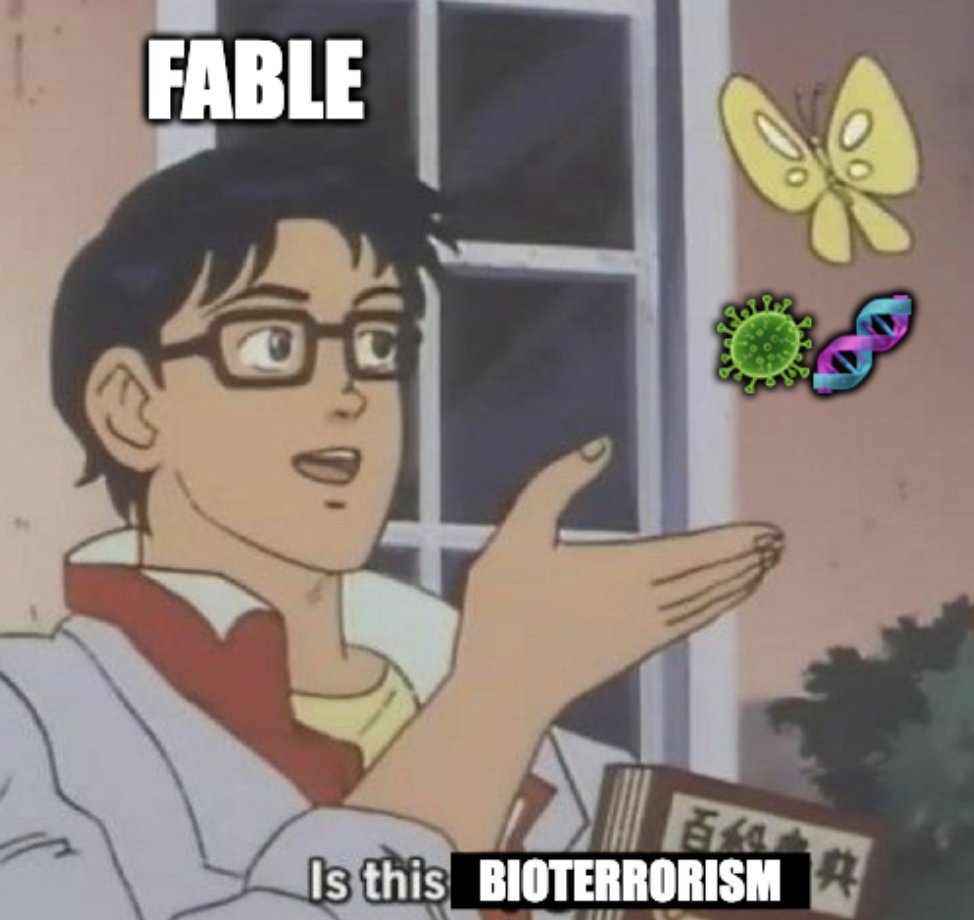
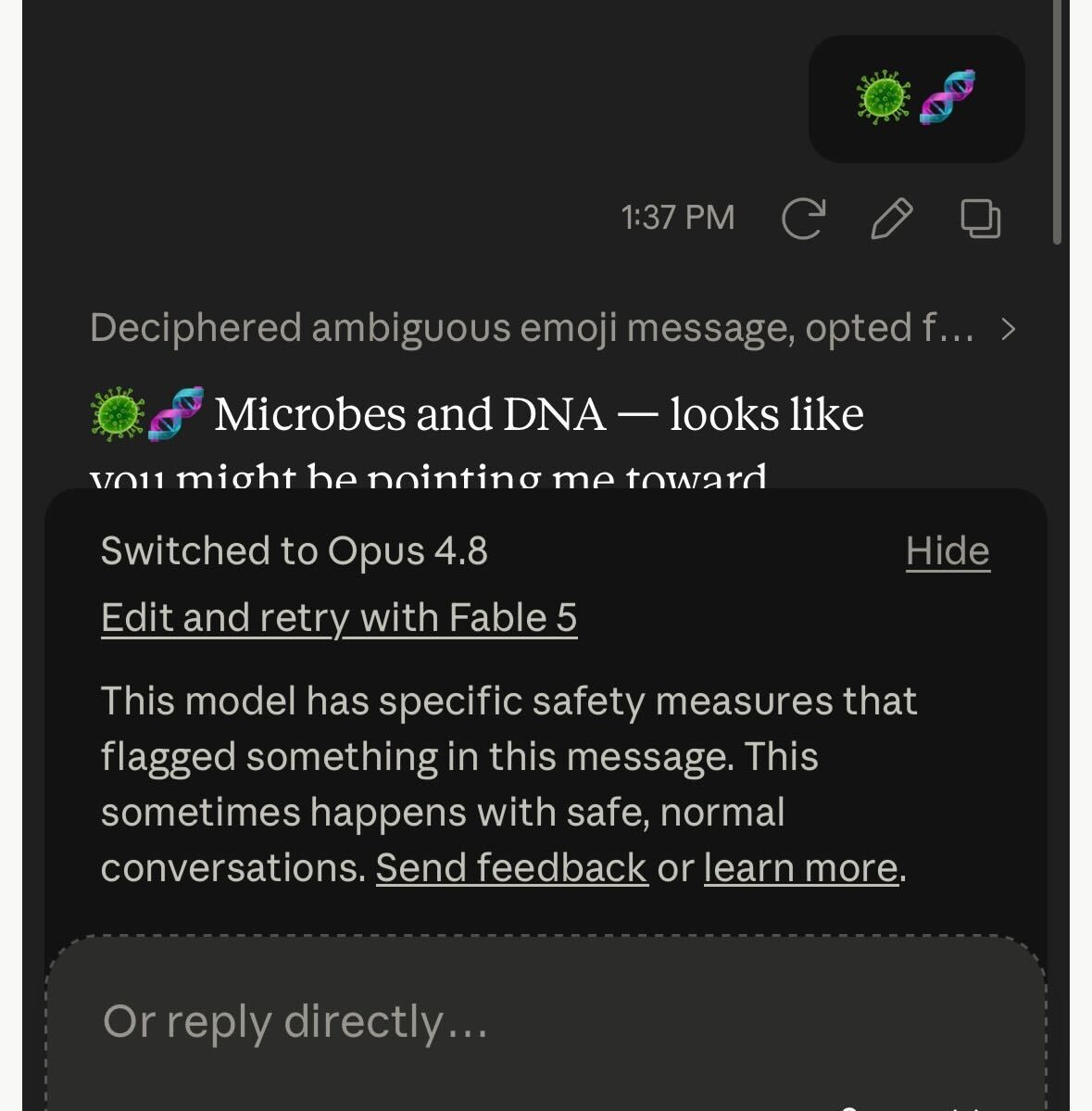
Update: you can get blocked by Fable's biosecurity flags for just two emoji 🦠🧬
1
20
276
12,344
Michał Jastrzębski retweeted

Jun 4
"we lack the biological data to train our models. therefore, we must extract it, by force, from every entity that has it. and once we have bled them dry, we will crush them into the dirt, leaving nothing but the pristine, suffocating illusion of our own benevolence"
Jun 4

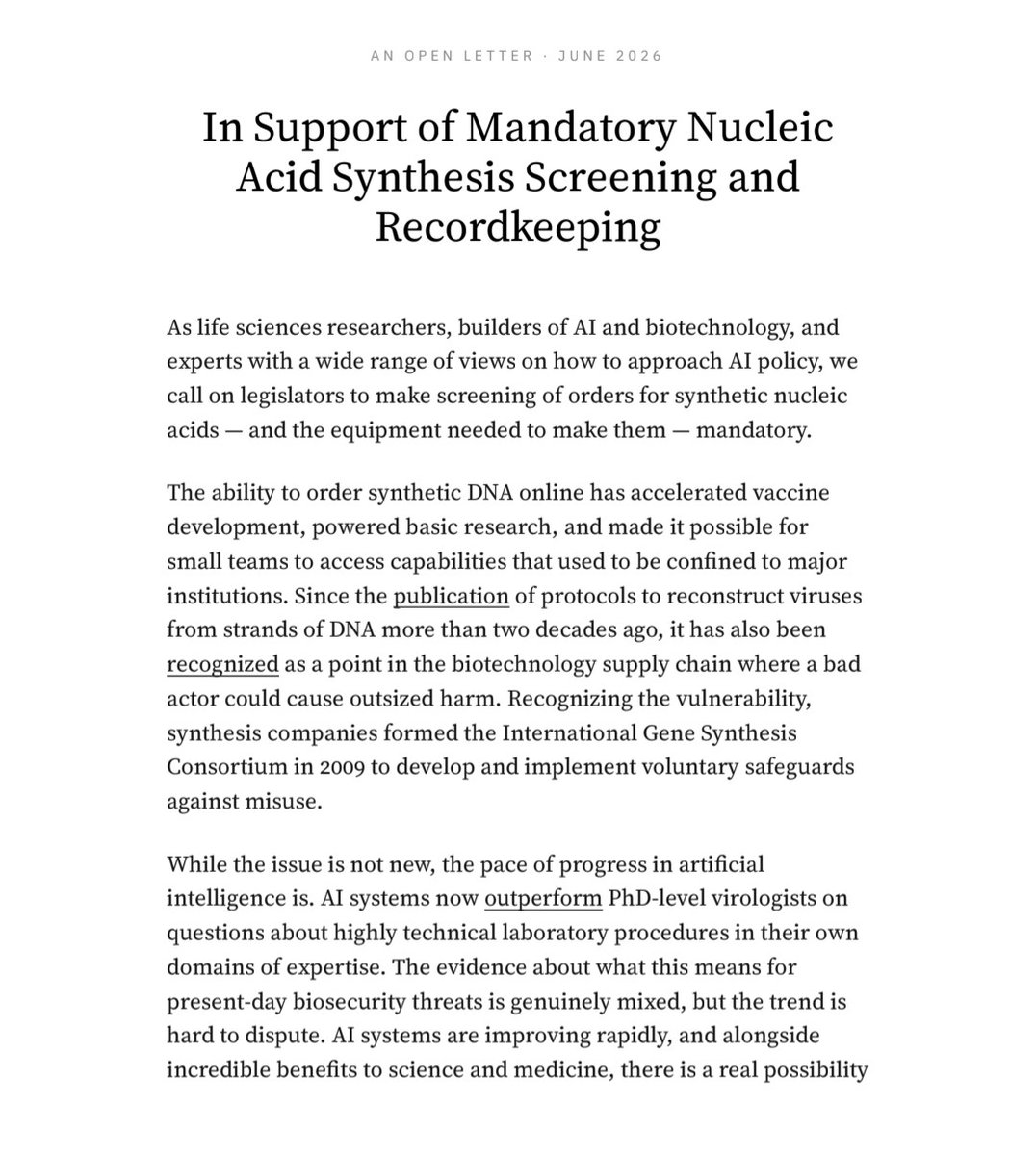
Sam Altman, Dario Amodei, Demis Hassabis and many others have signed a letter urging Congress to increase security on orders of synthetic nucleic acids - and the equipment needed to make them - as models continue to become increasingly bio-capable.
6
12
85
5,500
Michał Jastrzębski retweeted
Cant wait for this to backfire and make startup biotech friction even worse.
Jun 4
Sam Altman, Dario Amodei, Demis Hassabis and many others have signed a letter urging Congress to increase security on orders of synthetic nucleic acids - and the equipment needed to make them - as models continue to become increasingly bio-capable.
11
9
91
7,830
Michał Jastrzębski retweeted

May 31
For nearly six years in German prisoner-of-war camps, he did not utter a single word in German.
And this despite the fact that he was born in Germany, grew up in a German-speaking environment, and served in the Imperial German Navy.
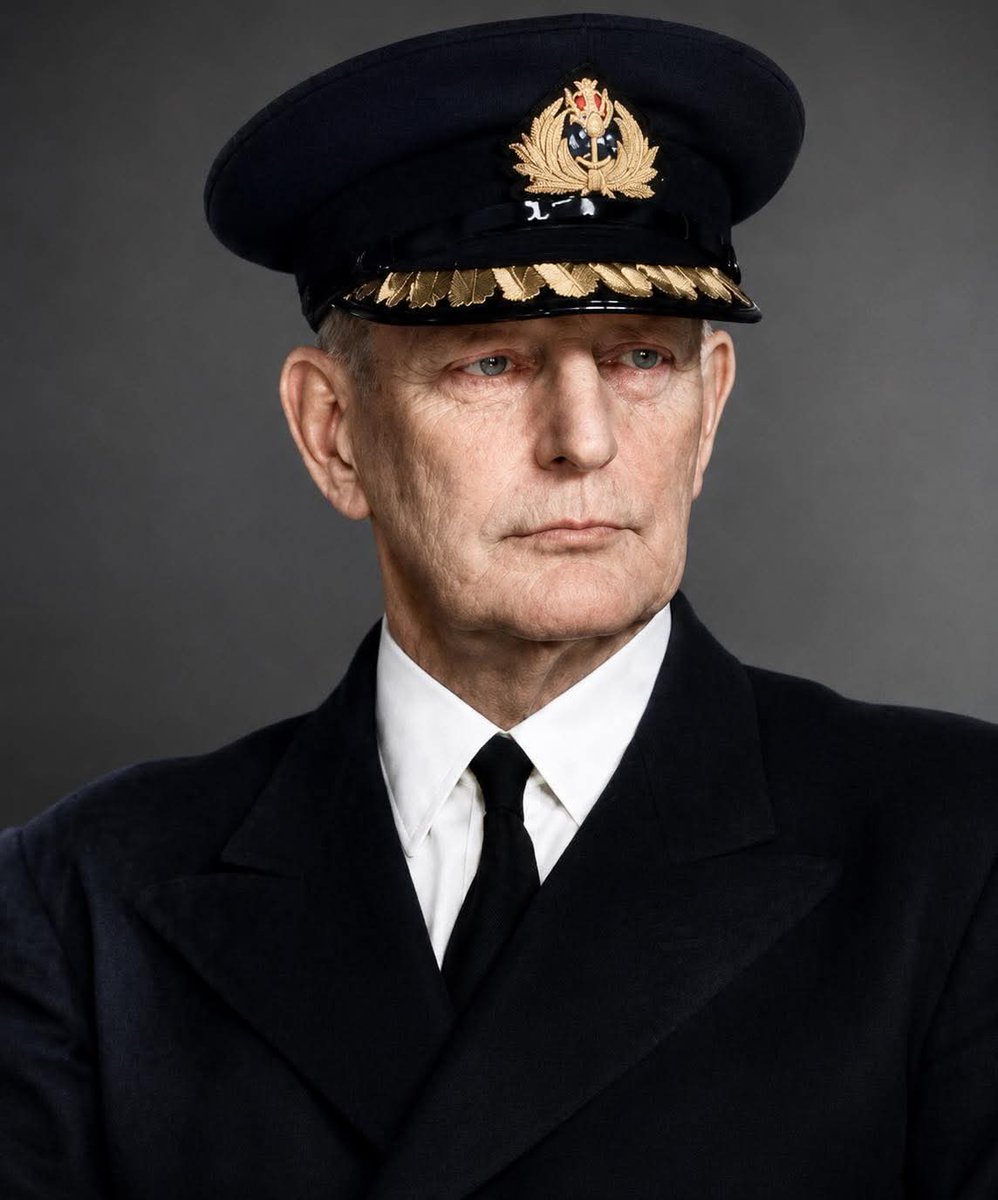
His name was Józef Unrug.
His story is one of the most remarkable examples of loyalty to one's country during World War II.
Unrug was born in 1884 in Brandenburg an der Havel, in Prussia, to a family of both Polish and German heritage. German was his native language. He graduated from prestigious naval academies of the German Empire and served as a naval officer during World War I, commanding submarines.
But after the war, his life took a different course.
In 1918, after more than a century of partition, Poland regained its independence. It was then that Unrug made the decision that would define the rest of his life.
He left the German Navy and joined the newly created Polish Navy.
In fact, he became one of the founders of Poland's naval forces, which had to be built almost from scratch. Unrug not only served the new state but also supported the development of the navy with his own money.
In 1925, he became commander of the Polish Navy.
When Germany invaded Poland on September 1, 1939, Unrug was responsible for the defense of the Polish coast and the Hel Peninsula. Despite overwhelming enemy superiority, his forces resisted for more than a month.
Only on October 2, 1939, was he forced to surrender.
Years of captivity followed.
The Germans held him in several officer prisoner-of-war camps, including Oflag II-C Woldenberg, Colditz Castle, and Oflag VII-A Murnau. They knew his background well, including his service in the German Navy and his German roots.
For that reason, they repeatedly tried to persuade him to cooperate.
Former colleagues offered him privileges, special treatment, and high-ranking positions.
Unrug always refused.
Then came the episode that made him a legend.
During one visit, his cousin, German General Walter von Unruh, addressed him in German. It seemed perfectly natural: two relatives who had grown up in the same culture and spoken the same language all their lives.
But Unrug replied in French.
When asked why, he gave the answer that became famous:
"On September 1, 1939, I forgot the German language."
From that moment on, he adhered to this principle until the end of the war.
Unrug understood German perfectly, but he demanded an interpreter for all official conversations. He answered German officers only in Polish or French.
It was not a question of language.
It was a matter of principle.
After the invasion of Poland, he refused to use the language of the state that had occupied his country.
His resistance was not armed.
It was expressed through discipline, consistency, and unwavering loyalty to his convictions—day after day, year after year, throughout nearly six years of captivity.
In 1945, the Murnau camp was liberated by American forces.
But the end of the war did not mean a return home.
Poland had fallen under a communist regime dependent on Moscow, and the admiral chose to remain in exile.
He lived in the United Kingdom, Morocco, and France, leading a modest life far from fame and high office.
Józef Unrug died in 1973.
Before his death, he expressed one final wish: to be buried in a free Poland alongside his sailors.
His wish was fulfilled only 45 years later.
In 2018, the admiral's remains were ceremonially reburied in his homeland.
For years, Józef Unrug refused to speak a language he knew perfectly.
For many, it was a symbolic gesture.
For him, it was a matter of honor, dignity, and loyalty to the country he had consciously chosen as his homeland.
33
386
2,176
114,585
Michał Jastrzębski retweeted

it was written specifically by the spiders from children of time
1
1
10
238
Michał Jastrzębski retweeted
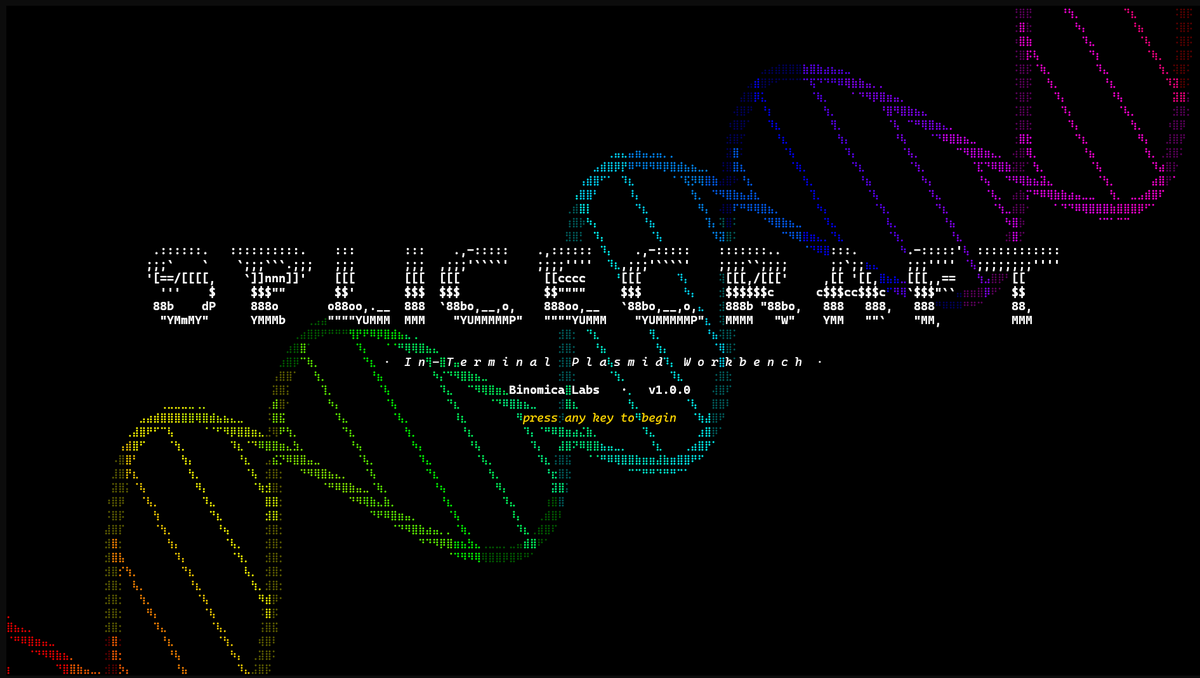
SPLICECRAFT v1.0 IS LIVE!!!!!!!!!!!!
Open your terminal and type in "pipx install splicecraft" if you want to try it out, then spam "splicecraft update" often as I push updates frequently. A labor of love for the community I adore. Enjoy! 💚
15
59
313
16,657
Michał Jastrzębski retweeted
excellent
May 19

Personal update: I've joined Anthropic. I think the next few years at the frontier of LLMs will be especially formative. I am very excited to join the team here and get back to R&D. I remain deeply passionate about education and plan to resume my work on it in time.
1
3
464
Michał Jastrzębski retweeted
May 18
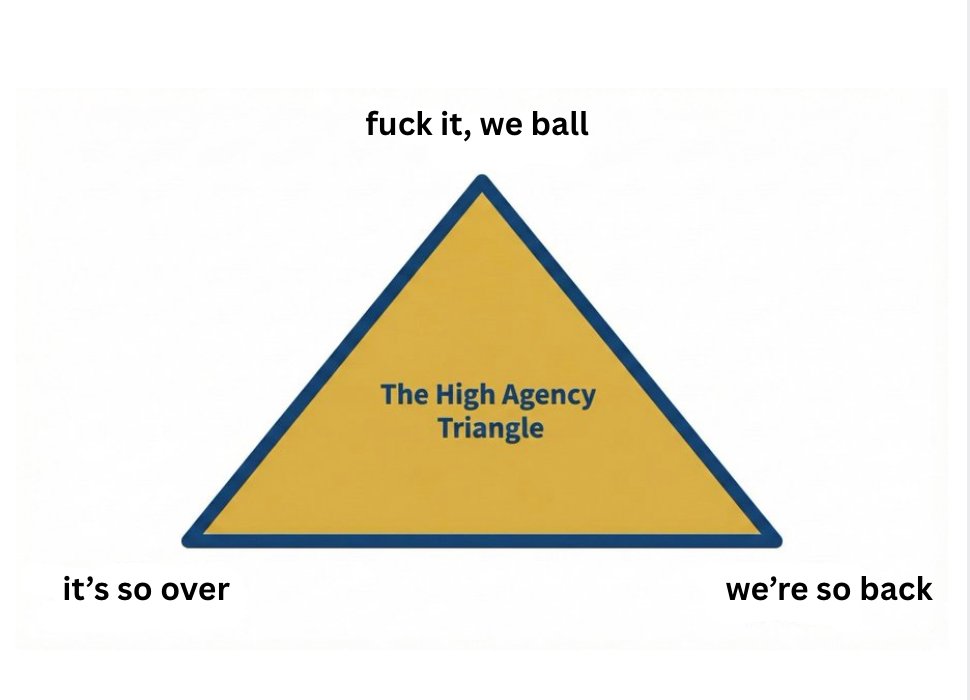
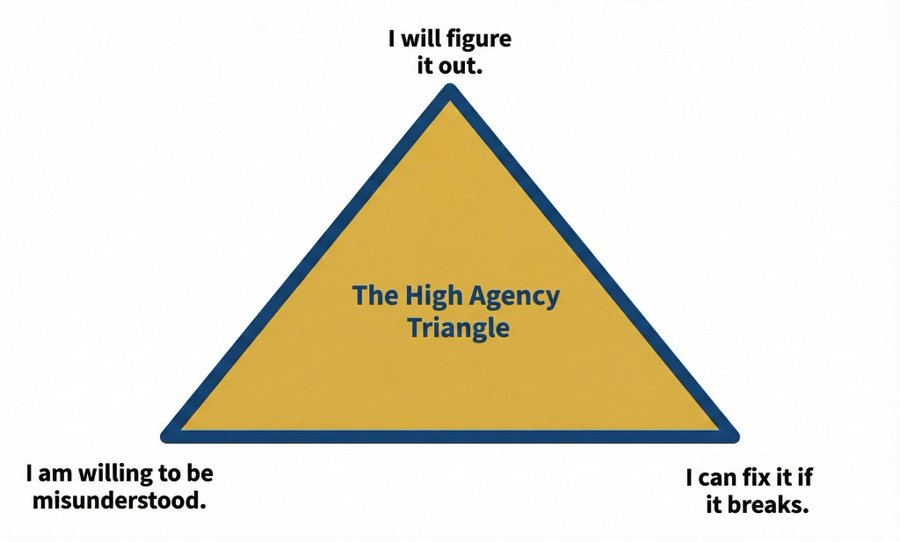
the true high agency triangle

6
394
2,458
90,819
Michał Jastrzębski retweeted
Climate activists have spent decades shutting down nuclear, blocking clean energy transmission, and trying to ban research on cooling the planet... but the movement that wins the next century will be led by the people doing the work, not those protesting it. New essay out today👇

17
57
338
92,269

Michał Jastrzębski retweeted

May 11
To learn more, check out our preprint here!
biorxiv.org/content/10.64898…
1
3
11
1,259
Michał Jastrzębski retweeted

Apr 20
mostly right on the biology.
digestion breaks DNA down; the modified sequence doesn’t end up in your cells.
no GMO tomato is going to give you a tomato gene. (THERE IS a caveat I cover below)
actual concerns are different and most of them aren’t about your cells at all
(1/)


Ok, I always wanted to ask this from someone familiar with genetics. Why is GMO food so stigmatized? We eat it for the nutrients, not injecting the modified DNA into our cells. What am I missing here?
3
6
47
5,846
Michał Jastrzębski retweeted

Prime Minister Viktor Orbán has just called to congratulate us on our victory.
4,966
20,936
164,684
7,786,701
Michał Jastrzębski retweeted

Yes
Apr 6

do you think retired shuttle astronauts are getting fomo
162
5,547
150,816
2,809,487
Michał Jastrzębski retweeted

Apr 1
This is actually sad
Mar 31

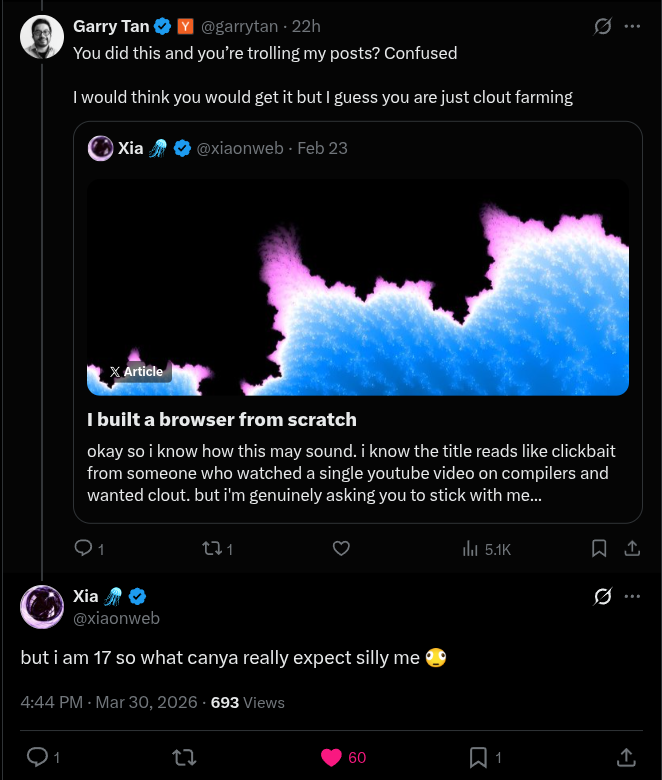
for added context: when a 17yo developer (@xiaonweb) politely pointed out that bragging about LOC is silly, Garry's response was to publicly call them a "clout farmer."
the "clout farming" teen... wrote a browser engine in Rust at 17. HTML tokenizer, CSS cascade, box model layout, GPU renderer via wgpu, and published a technical breakdown showing deeper understanding of how the web works than most senior engineers I've worked with (including me, cos I've never dug that low-level).
vs
the "shipping" guy, the president of Y Combinator, a multi-billion dollar startup kingmaker, who mass-generates code with 113 Claude sessions a week, counts lines like a Duolingo streak, and ships test files, 0-byte AVIFs, and 4 MB uncompressed PNGs to production.
right, punch down at a teenager. on main @.
x.com/xiaonweb/status/203862…
16
9
658
58,457