
Joined December 2024
- Tweets 72
- Following 25
- Followers 1,767
- Likes 154
18 Photos and videos



May 18
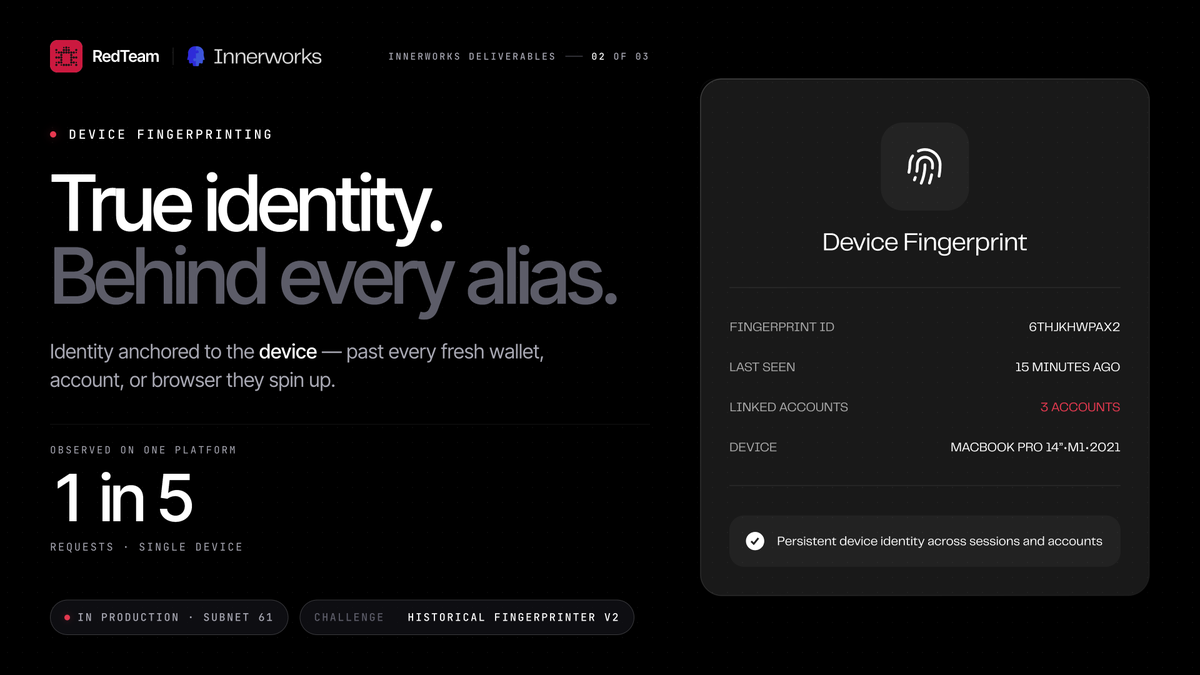
True identity behind every alias.
RedTeam/Innerworks anchors identity to the device, past every fresh wallet, account, or browser they spin up.
Live across every client: fraud, multi-account abuse, and tracking sanctioned actors across burner identities.
Observed on a single client platform: 1 in 5 requests originated from a single device. A pattern that recurs across deployments at varying severity
Shipping out of Subnet 61.
4
11
40
4,038
May 11
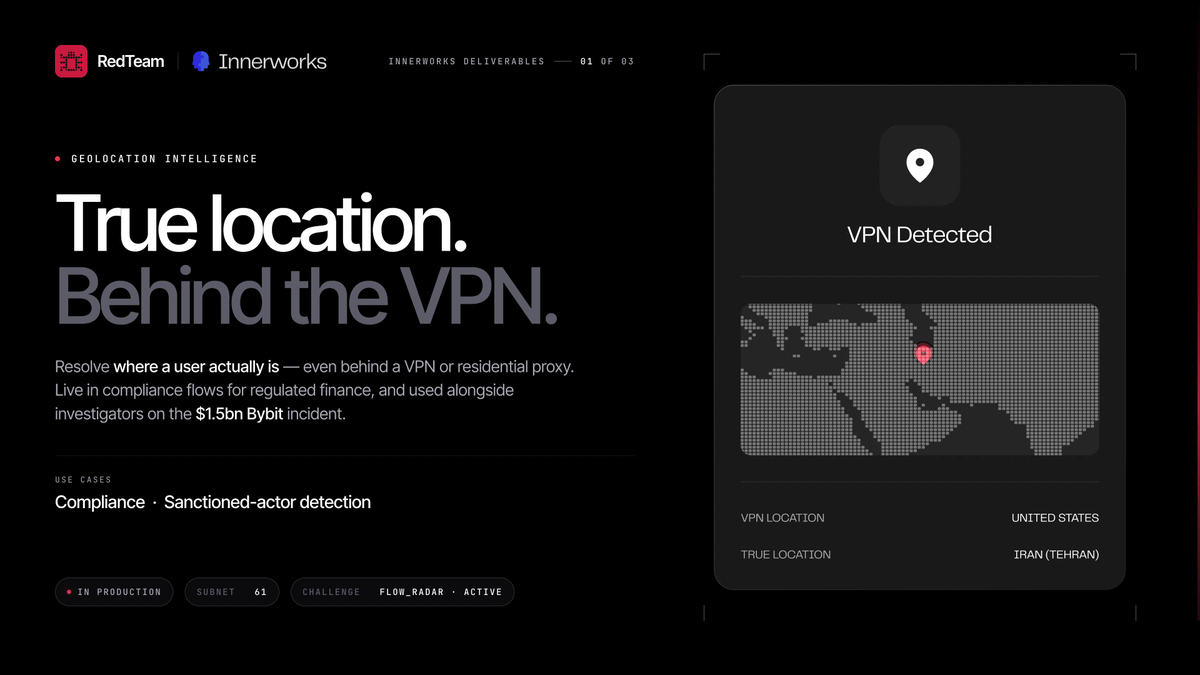
Geolocation Intelligence: resolving where a user actually is, even behind a VPN or residential proxy.
Live across every Innerworks client today: compliance for regulated finance, and detection of sanctioned actors. Used alongside lead investigators on the $1.5bn Bybit incident.
Real intelligence shipping out of SN61.
2
12
70
5,385
May 6
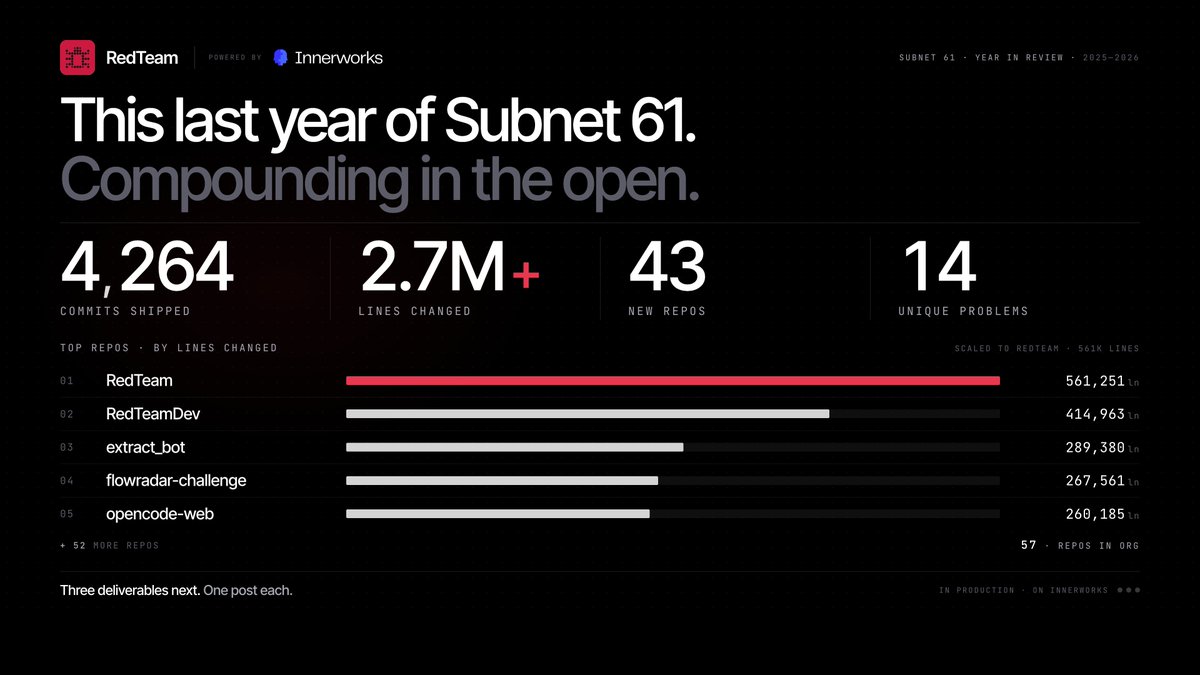
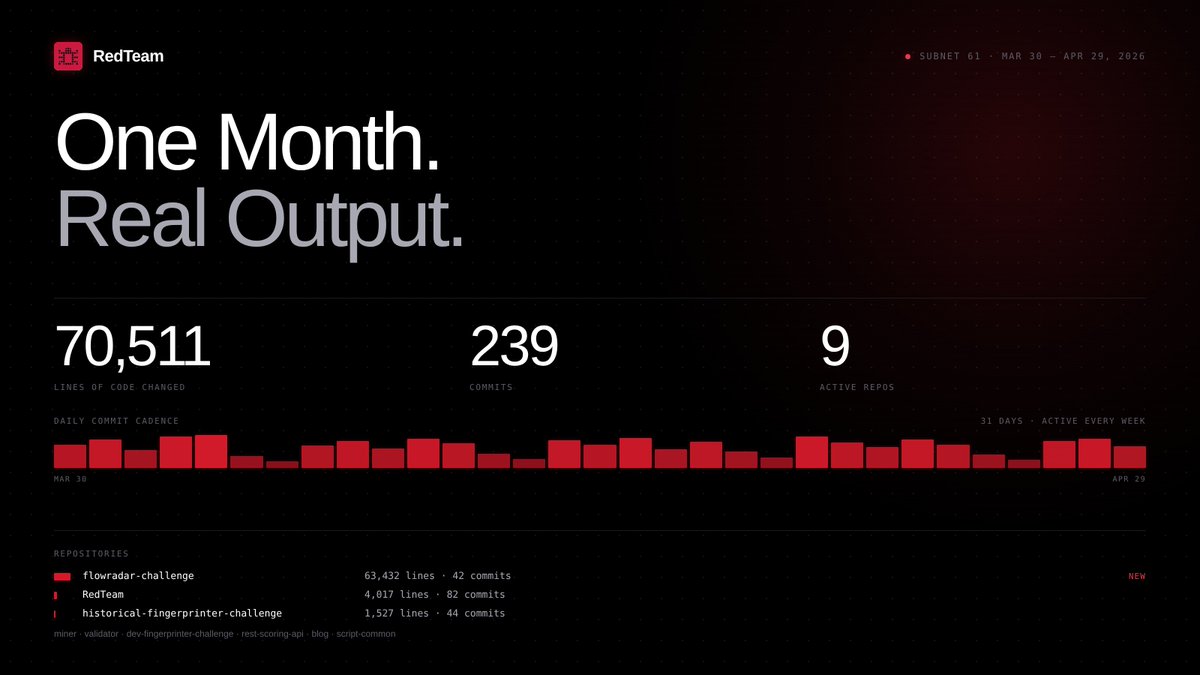
Subnet 61, last twelve months.
4,264 commits. 2.7M lines changed. 43 new repos, 57 total.
14 unique challenges shipped, all advancing research across our three product lines.
Next: three posts, each detailing what these products are solving for enterprise clients.
7
14
82
3,074
May 3
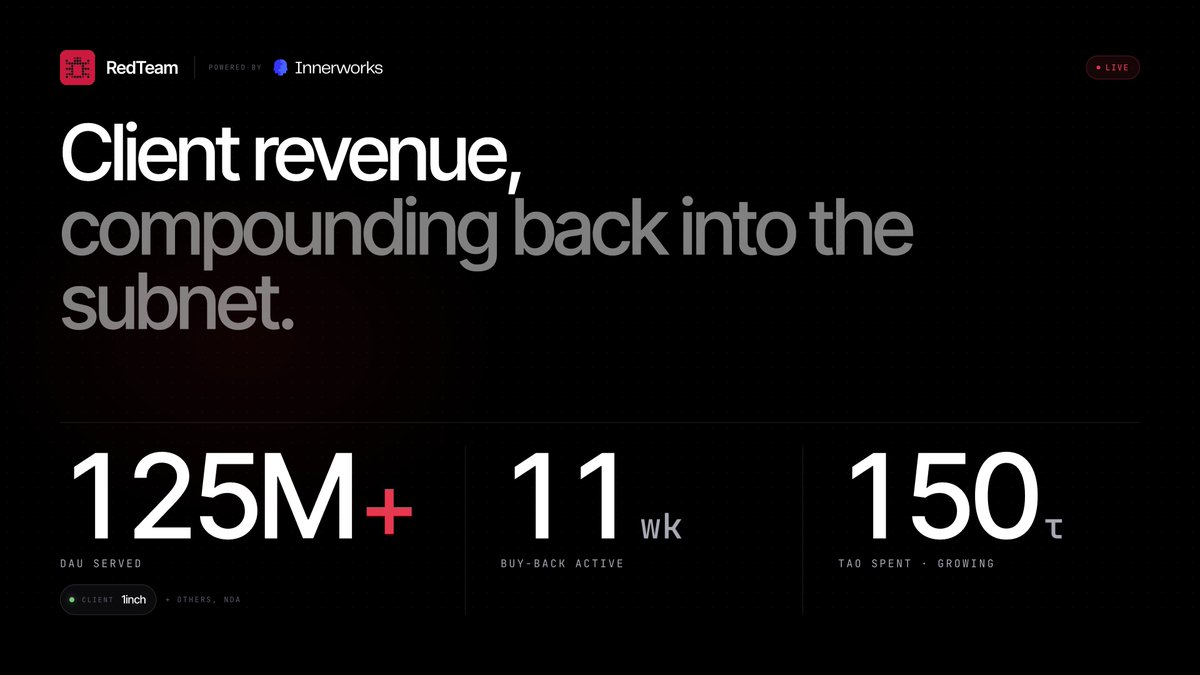
We have now passed eleven weeks of token buy-back. #SN61 outputs now serve over 125 million DAU across our client base, through innerworks.me/.
We actively seeing a changing of the guard within cybersecurity.
1inch.com/ is the first of many we can publicly name.
150 TAO routed into emissions to date, and growing.
10
21
131
20,360
May 3
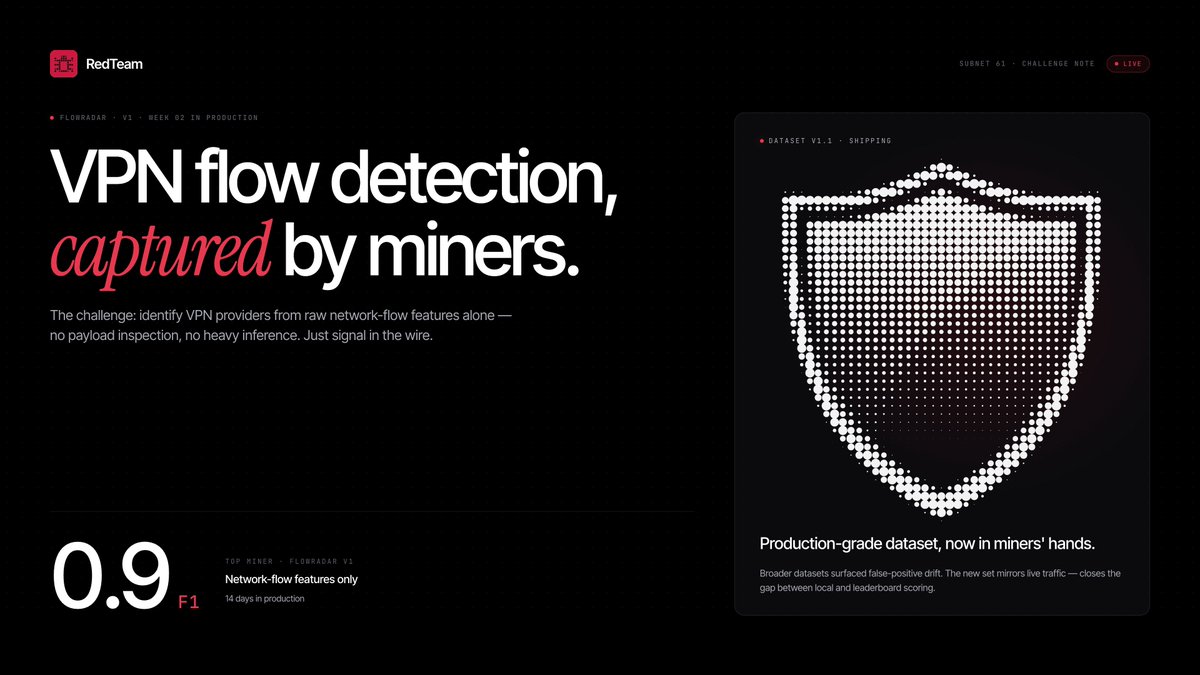
FlowRadar: two weeks in production.
The challenge: detect VPN providers from raw network-flow features alone - no payload inspection, just signal in the wire. Top miners now landing > 0.9 F1.
To continue driving growth in the challenge, we are now shipping our production-grade dataset to all miners - mirrors real live traffic.
→ docs.theredteam.io/latest/ch…
4
4
22
1,745
Apr 29
From live integrations, we've seen bot traffic exceed 90% on some of the most active crypto platforms online.
Once you start observing how much online activity is automation, and how much of the apparent human remainder is actually a small subset of operators (tens of thousands of wallets run from single devices), the gap cybersecurity has to close becomes obvious.
Apr 28

🚨 $TAO's SN61 RedTeam is the real deal. Cybersecurity is a $200B industry. Bot detection alone is massive. Roughly 51–53% of all web traffic is generated by automated bots.
They have supply demand economics applied to decentralized compute. First time anyone's done this on Bittensor.
"Human activity has quickly become the minority of online interactions. Existing detection solutions struggle to keep pace."
🖱Current challenge:
Human mouse movement imitation. Miners compete to generate mouse movements that are different from real humans.
Validators score based on:
▫️Probability is human (vs bot)
▫️Distance from previous solutions (diversity bonus)
Why?
▫️Every exchange needs bot detection
▫️Every DeFi protocol needs Sybil resistance
▫️Every airdrop gets farmed by bots
▫️Every governance vote gets manipulated
The economic design is continuous pressure to improve. Can't submit once and ride emissions. Must stay sharp or get replaced.
They just shipped real infrastructure:
• Multi-signal UID linking (IP coldkey DockerHub)
• 4-stage anti-gaming pipeline
• Decay mechanism forcing continuous improvement
• True marketplace (blockmachine pricing)
• USDC payment rails for AI agents
You can't game this by tweaking variable names or adding comments. The system tracks execution behavior, not just code similarity.
The dashboard tells the truth:
• 1,110 submissions, elite 7% success rate
• 162 miners competing
The challenge is hard. Most miners are getting filtered out. The ones winning have real expertise.
Only 12 miners (out of 162) have non-zero incentives. That's a 7% success rate.
That's exactly what you want from a cybersecurity competition, high barriers, elite participants, a proven solution.
The killer feature?
Blockmachine decentralized RPC with USDC payments and open marketplace pricing.
MINERS change that price in real time based on:
• How much demand there is right now
• What their actual costs.
• What other miners are charging.
First true supply-and-demand marketplace inside any Bittensor subnet.
The network literally self-tunes toward the best combination of speed price honesty with zero central control.
Two layers of competition at the same time:
▫️Incentive layer (the subnet scores this) Quality of responses, Uptime
Verification pass-rate. This determines how much subnet emission (TAO/alpha) the miner earns.
▫️Open market layer (pure price)
Users (validators, AI agents, developers) just pick the cheapest reliable node that meets their needs.
This is the foundation for a permissionless cyber security bounty system crypto actually needs.
Technically excellent. Waiting for the first big customer announcement to go nuclear.
$TAO
DYOR
3
3
21
1,591
Apr 27
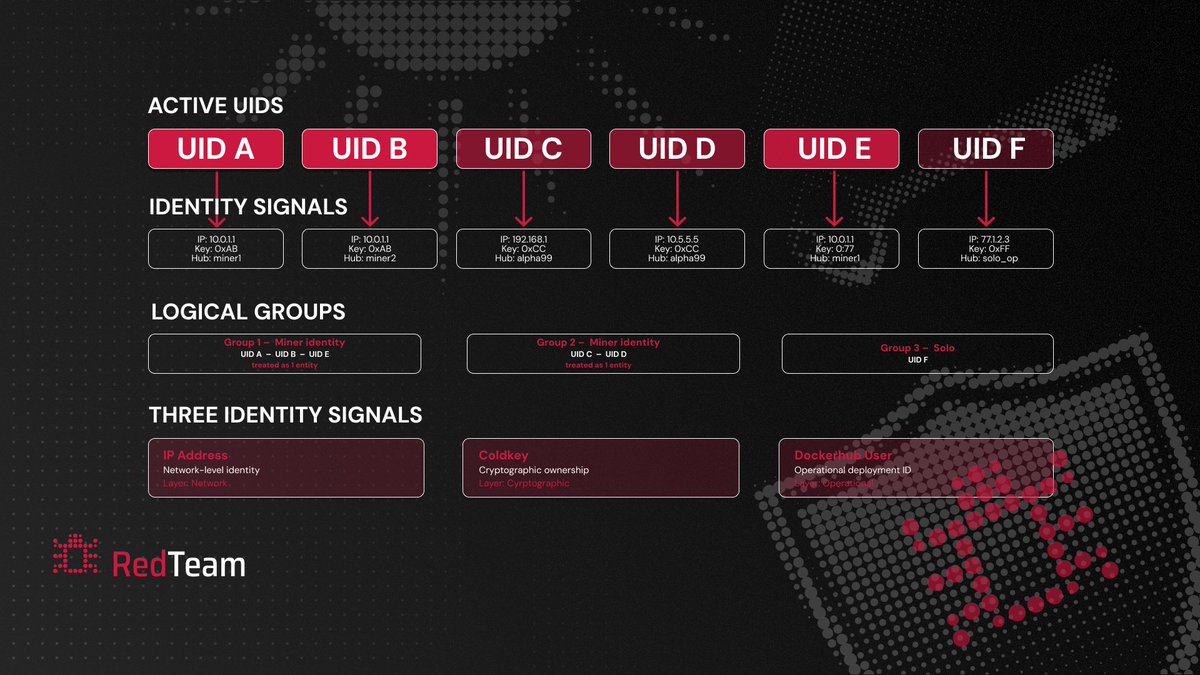
UID linking: what it is and why it's good for the subnet.
Every ~20 minutes, the subnet groups UIDs sharing the same IP, coldkey, or DockerHub account into one identity. Here's why that matters:
✦ Fair rewards – emissions go to real independent operators, not whoever registered the most slots
✦ No bans – just grouping. Fix your setup, and you're independent again instantly
✦ Always current – recomputed fresh every round, no cached judgments
✦ Real competition – infrastructure quality wins, not account count
The strongest miners rise. Not the most creative registrants.
For more information, visit: blog.theredteam.io/latest/bl…
1
1
17
5,145
Apr 23
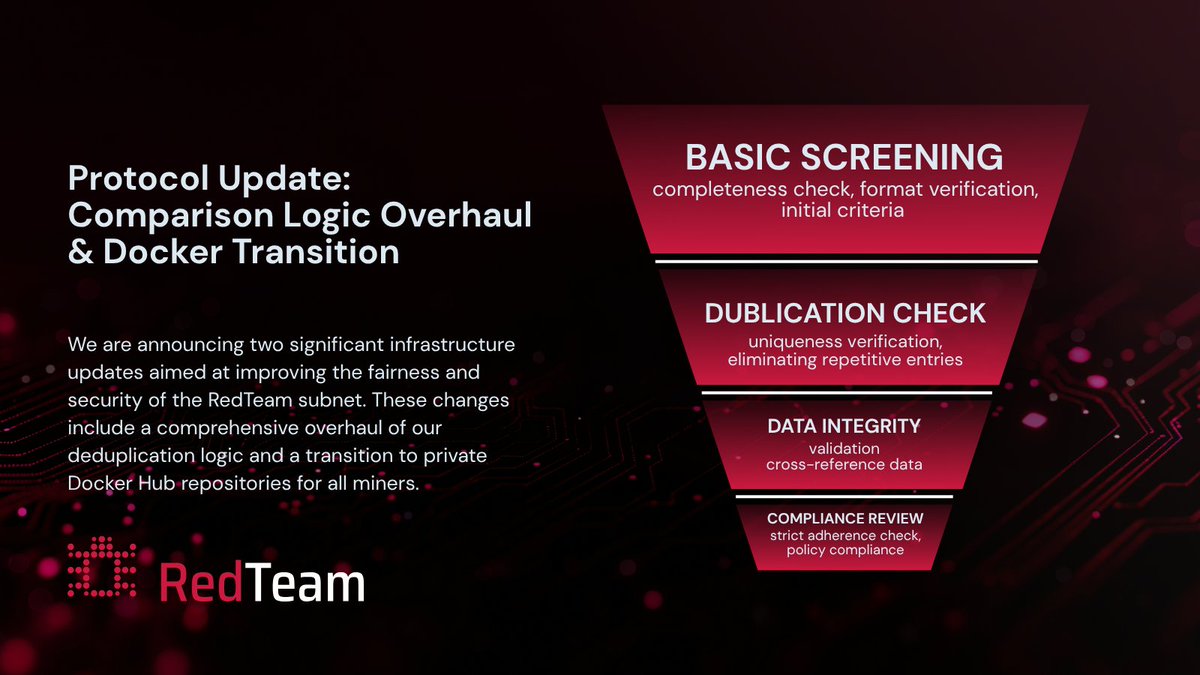
We're reworking how submissions are compared on the RedTeam subnet. Moving from a single similarity threshold to a 4-stage pipeline:
metadata extraction → score progression gate → static dedup → metadata-enriched validation.
Fairer emissions. Harder to game. Details below:
blog.theredteam.io/latest/an…
2
5
20
1,113
RedTeam retweeted

Mar 8
$TAO SN | FOCUS #1
I want to take a moment to really focus on what I see as the most undervalued play in #Bittensor: #SN61 @_redteam_ by Innerworks.
This has a tiny $4M MC right now, but the rails are real—miners crank out code for bot detection and fingerprint spoofing, feeding straight into Innerworks' SaaS.
Big deal with @1inch already live, hardening DeFi against threats, and 10% of revenue funneled back into Alpha buybacks!
Now if we stack it against centralized shops:
👉Forta (~$80M MC) spots threats in real-time but misses the miner-powered evolution.
👉Certik (~$150M) does static audits
Heres what RedTeam's setup is doing better: miners simulate attacks, subnet patches defenses nails 92% efficacy on sneaky bots, outpacing them by decentralizing the R&D grind.
My grounded conservative view on what will happen:
Short-term (6-12 months): Emissions bump to 1% those buybacks = easy 5-10x to $20-40M, like SN73 hitting $50M on growth vibes.
Medium haul (1-3 years): Snag 1-2% of DeFi security pie ($100-200M rev equiv via emissions/SaaS) = 25-75x to $100-300M.
#Bittensor #DeFiSecurity #tao #redteam
theredteam.io/
2
4
45
2,725

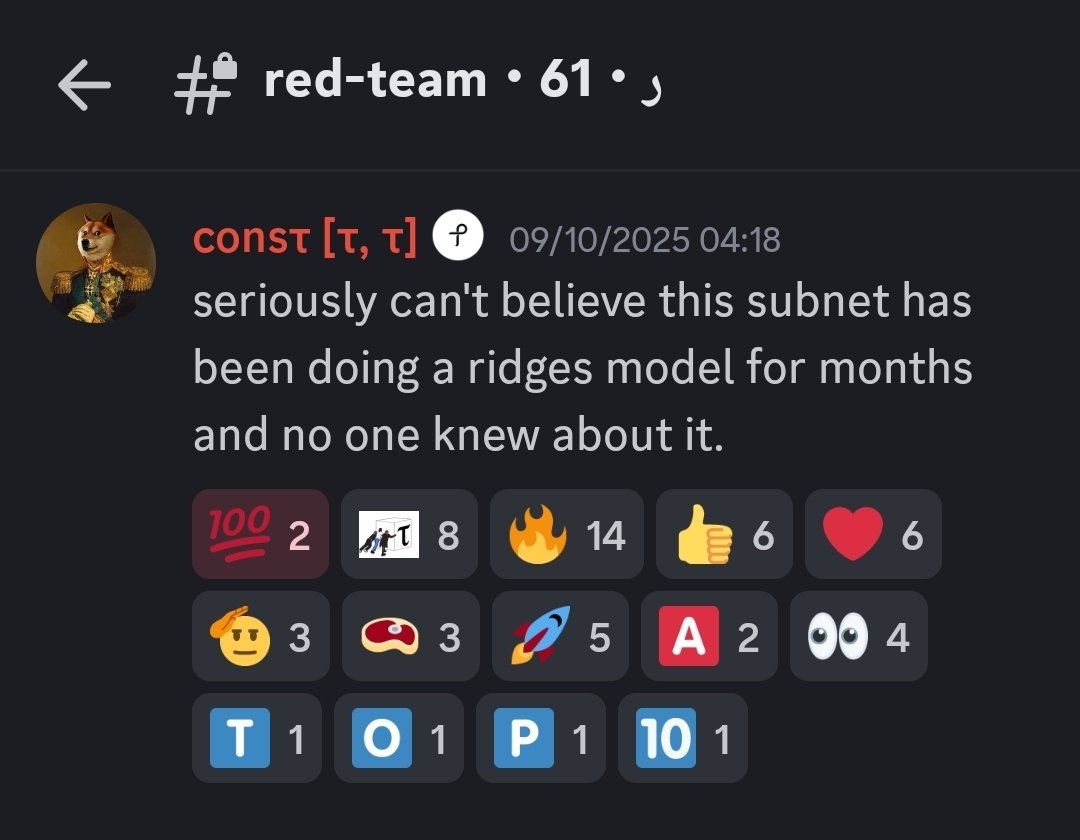
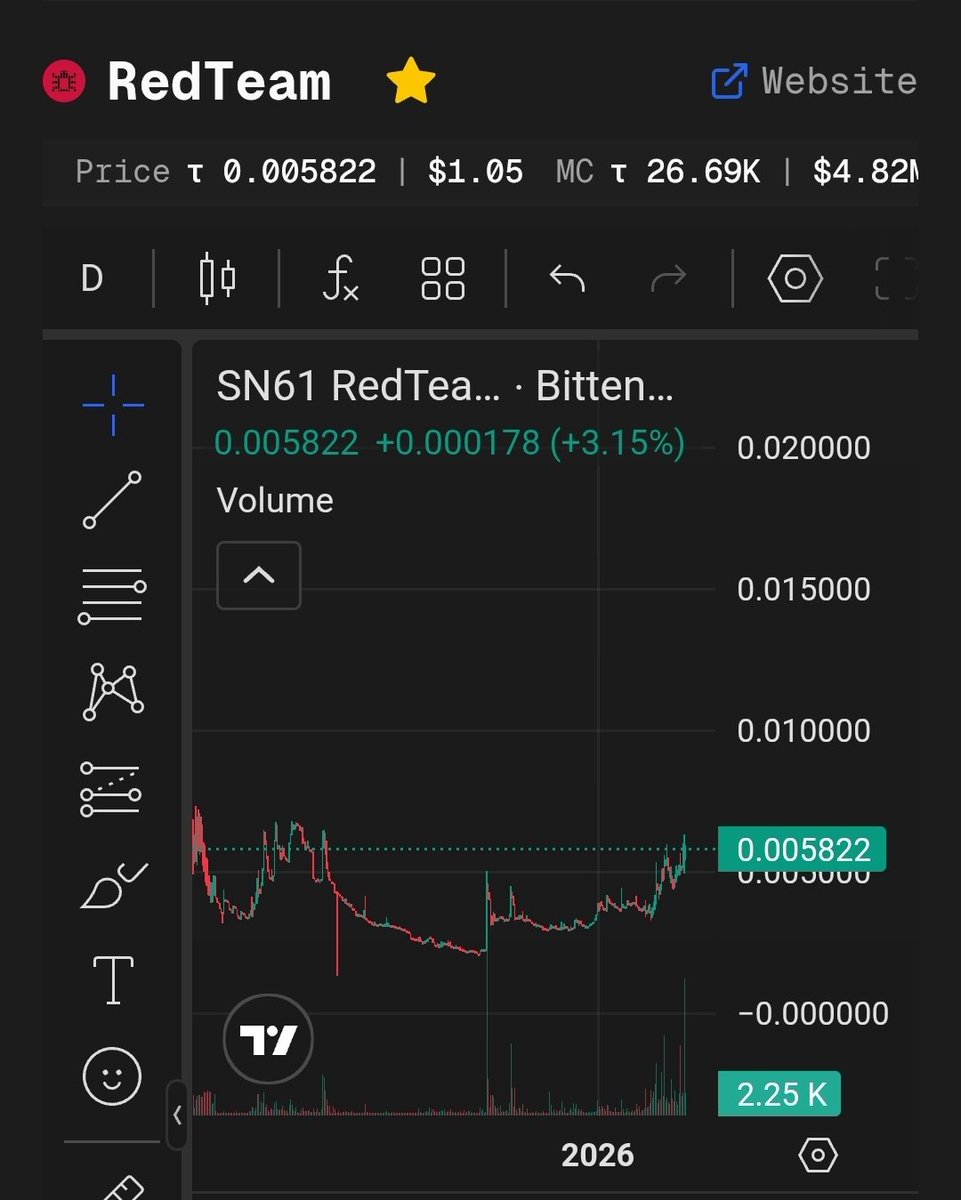
I went through all subnets w/ lower alpha price to find the most undervalued gem.. & this is it!
@_redteam_ is literally Ridges but for cybersecurity!
& they already have Pmf, SaaS & contracts (e.g @1inch) & recurring revenue w/ alpha buybacks
I'm in!
$TAO
x.com/i/status/2022035279876…

3
8
58
8,035
RedTeam retweeted

Mar 2
#Subnet #SN61 (@_redteam_ ) in #Bittensor $TAO
0) Executive summary
#RedTeam (SN61) is positioned as a decentralized adversarial R&D engine for modern bot / automation / agentic-attack detection, with a commercial wrapper company Innerworks aiming to deploy that research into production security products.
1) What SN61 is
1.1 Mission and product thesis
SN61/RedTeam frames itself around a new cybersecurity paradigm: AI agents geuensive iteration cycles. Innerworks positions its platform as “invisible intelligence” for device, bot, and geo-detection for fraud, compliance, and payment protection. (#Innerworks)
A key macro tailwind for this narrative: automated/bot traffic and AI-driven automation is rising across the web ecosystem (and defenders increasingly need adaptive controls). (@WIRED )
1.2 The Innerworks ↔ RedTeam relationship
Innerworks: commercial entity selling/packaging the defense stack (device intelligence, bot detection, geolocation).
RedTeam (SN61): decentralized R&D / adversarial engine meant to continuously discover new evasions and detection approaches, feeding improvements into production.
The value bridge from Innerworks → SN61 token holders/miners is not inherently guaranteed by protocol. Any “value back to subnet” mechanisms must be evidenced either:
On-chain (observable buybacks/injections), or
Contractual (legal commitments), or
Governance-enforced (protocol-level rules).
2) Verifiable traction signals
2.1 Partnership: @1inch × Innerworks
#1inch published an official post describing a partnership integrating Innerworks’ “Synthetic Threat Intelligence” approach, emphasizing ethical hacking behavioral AI decentralized learning to counter advanced fraud/bot attacks.
This matters because it is:
a named counterparty,
in a high-adversary environment (#DeFi),
and is public enough to reference in institutional materials.
2.2 Company financing: Innerworks seed round
Multiple outlets reported Innerworks raising a seed/pre-seed round (figures vary by outlet). EU-Startups reports €3.7M led by @AlbionVC with participation from several crypto/venture entities; @businesscloud reports £3M seed led by #AlbionVC. (EU-Startups)
This is a positive signal for runway and go-to-market capacity.
It is not direct proof that SN61 token value accrues to #investors; rather it’s a corporate health signal.
3) Technology and subnet operations
3.1 Shipping cadence / architecture
Official RedTeam documentation shows ongoing releases at least through v4.1.0 (Feb 14, 2026) and earlier v4.0.0 notes, indicating an active engineering cycle and architectural iteration. (@github )
3.2 Challenge framework (economic relevance)
RedTeam’s approach resembles:
continuous adversarial challenge design,
miners submit detection/attack solutions,
validators score and reward via Bittensor’s consensus/emissions.
Institutionally, the key question is:
does it generate defensible detection artifacts,
does it improve production outcomes (fraud loss reduction / bot mitigation),
and does it translate to paying deployments.
4) Fundamental thesis: what could make SN61 worth owning?
4.1 Why the problem is real
Automation and AI-driven bot activity is intensifying across the internet (#scraping, #fraud, #DDoS, account farms, etc.). Defenders increasingly need adaptive systems that respond quickly. (#WIRED)
4.2 What’s differentiated (if it works)
Differentiator claim: decentralized adversarial mining as a continuous red-team engine feeding a production defense stack.
If SN61 can:
continuously generate novel evasions and robust detection techniques,
and if Innerworks can rapidly ship these into products customers pay for,
then SN61 becomes an “economic flywheel”:
Threats → miner innovations → better product → more customers → more budget → more on-chain support.
5) Competitive landscape
SN61/Innerworks sits in a crowded space spanning:
bot management / anti-automation,
device fingerprinting,
fraud detection / account takeover defenses,
and Web3 transaction/security tooling (adjacent).
Institutional questions to ask the Team (diligence):
Detection performance: precision/recall vs incumbents under modern agentic browsing frameworks.
Integration friction: SDK lines-of-code, latency overhead, false positives.
Privacy & compliance: how “true geolocation” is obtained; consent posture; jurisdictional constraints.
Data moat: does decentralized mining generate unique datasets or just commoditize into public knowledge?
6) Key risks
6.1 Value accrual risk (core)
SN61 alpha holders do not automatically receive Innerworks revenue. Unless Innerworks buybacks/injections are:
consistent,
material relative to protocol emissions,
and observable,
6.2 Verification risk on major enterprise traction
The 100M DAU messaging platform claim is not yet independently verifiable in the captured public sources.
6.3 Security / adversarial contribution risk
A red-team subnet must prove it can safely sandbox malicious submissions and prevent leakage into harmful real-world exploitation. Any compromise here would be existential reputational risk.
6.4 Regulatory risk
Device intelligence geolocation fingerprinting sits in a sensitive compliance zone. Any misstep could constrain adoption or trigger enforcement, especially in strict jurisdictions.
7) Institutional diligence checklist (for the Team to deliver)
A) Commercial proof (Innerworks)
Named customers references renewal behavior.
Pricing model, ARR/MRR ranges, churn, gross margin.
Case studies with before/after fraud metrics (auditable).
Security/compliance posture for fingerprinting & geolocation.
B) On-chain value bridge (SN61)
Observable buybacks/injections on-chain (timestamps, tx hashes, schedule).
Clear policy: how much, how often, triggered by what milestones.
Governance: who controls subnet owner keys and any treasury actions.
C) Technical defensibility
Reproducible evaluation of challenge quality (anti-overfitting).
Evidence that miner outputs are novel and generalize (not just “challenge gaming”).
Audit of sandboxing/isolation architecture.
8) Bottom line
SN61 is one of the more compelling “real-world security” narratives inside Bittensor subnets because it ties the subnet concept to a concrete, adversarial, high-value problem: bot/fraud/automation defense in an AI-agent world. The 1inch partnership and Innerworks funding are tangible positives.
2
15
1,364
Feb 16
Last week we announced our buyback commitment.
Today we've doubled it.
We said the trajectory was acceleration, not a steady state. This is the first increase of many as we become the dominant force in cybersecurity.
4
6
41
2,469
Feb 15
Anti-detect browsers break most detection on the market. Spoofed fingerprints, masked automation, realistic hardware signals. To the average system, these bots look human.
ADA v2 is live. Our latest challenge built to solve exactly this issue.
blog.theredteam.io/latest/an…
1
6
20
1,650
RedTeam retweeted

Feb 13
Turns out bot protection is an incentive mechanism also
1
17
170
11,468
RedTeam retweeted

Feb 12
Two different subnets, two different teams, even two different execution paths... but the same thinking on leveraging decentralized intelligence to protect critical infrastructure. This team on cybersecurity, us on financial crime.
Rooting for you!
1
4
37
2,223
RedTeam retweeted
Jan 29
Two subnets on Bittensor are building the fundamental technologies that would allow us to build OSS non-ORB verifiable human detection: 1) human uniqueness and 2) deepfake detection. Together they will build us a social network. Without scam-Altman orbs.
Jan 28

[ ZOOMER ]
OPENAI IS BUILDING A SOCIAL NETWORK, AND IS LOOKING TO USE SAM ALTMAN'S WORLDCOIN ORBS FOR HUMAN VERIFICATION: FORBES
22
32
348
24,541

And last but not least we wanna mention @_redteam_ 👀 Thanks for everyday improving internet security 💻
2
36
7,198
27 Oct 2025
RedTeam #SN61, built on Bittensor, is actively protecting @1inch, the world’s leading DEX aggregator processing billions in swaps through Innerworks' predictive threat intelligence.
Together, we’re turning live hacker simulation and AI-driven detection into a real-time defence network that evolves faster than synthetic attacks.

New layer of security, now live.
1inch integrates Innerworks’ AI-based threat detection — to stay one step ahead of synthetic attacks and bot fraud.
DeFi’s defenses can’t be static. Innerworks feeds real-time intelligence into our system, exposing hacker tactics before they strike.
Silent. Predictive. No user action needed.
More below 👇
blog.1inch.com/1inch-partner…
9
23
126
16,954