
Stanford CS PhD w @jure and @guestrin. Prev. CMU w @zacharylipton, IIT Delhi. I like neural networks.
Joined March 2022
- Tweets 59
- Following 226
- Followers 277
- Likes 361
10 Photos and videos
Pinned Tweet

30 Oct 2025
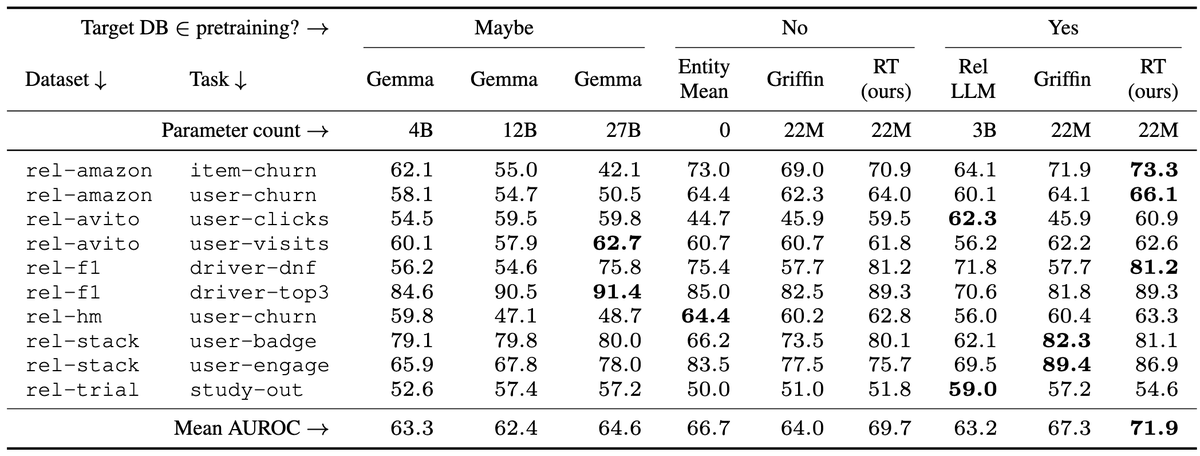
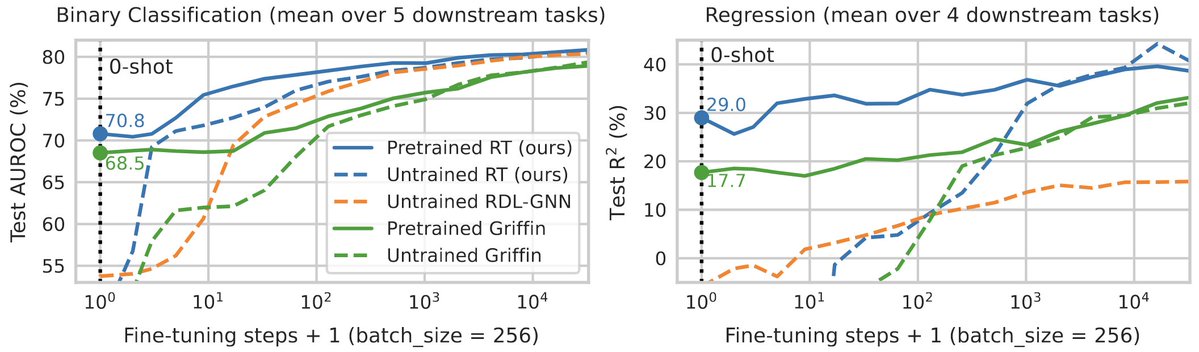
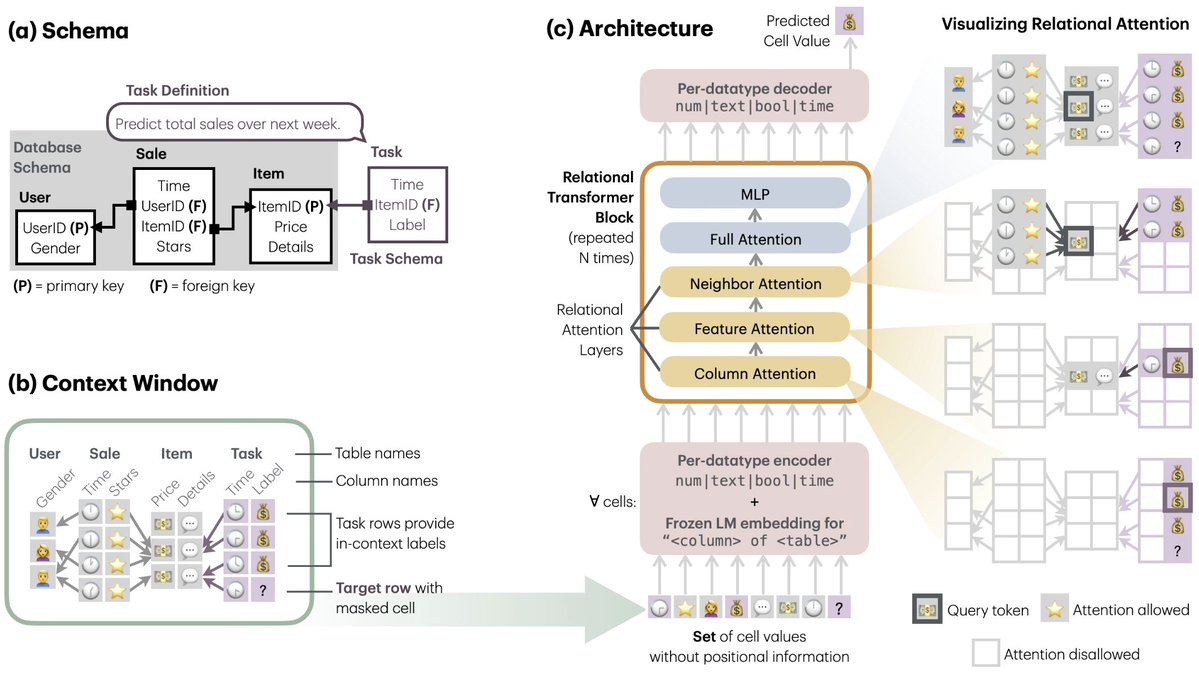
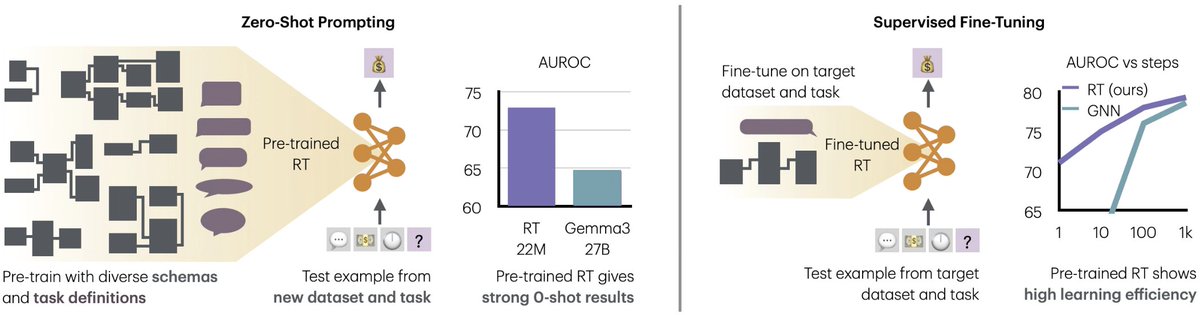
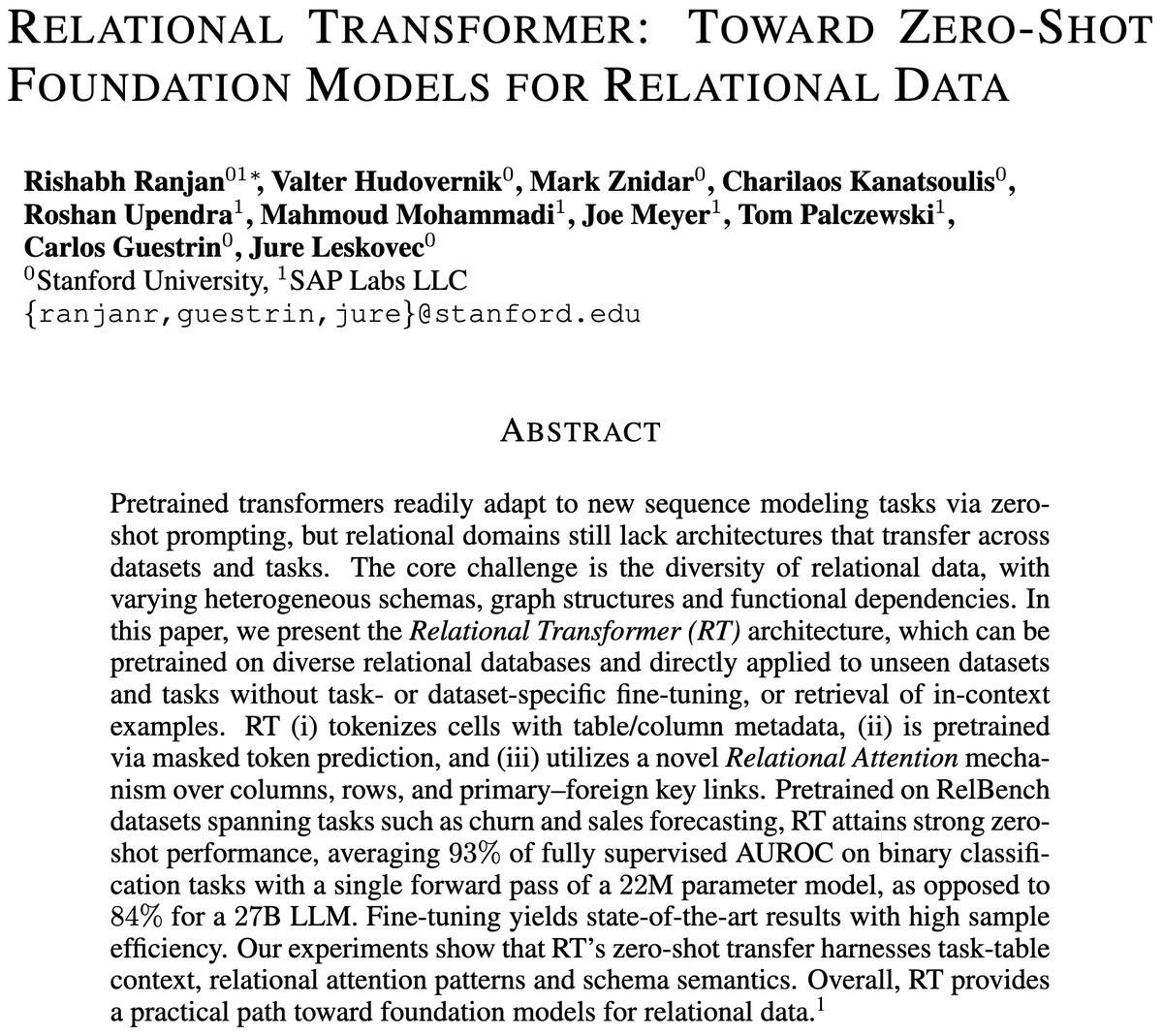
Transformers are great for sequences, but most business-critical predictions (e.g. product sales, customer churn, ad CTR, in-hospital mortality) rely on highly-structured relational data where signal is scattered across rows, columns, linked tables and time.
Excited to finally share what I have been working on over the last year: a Foundation Model architecture which brings the power of Transformers to relational domains, enabling large-scale pretraining and zero-shot generalization in enterprise settings. 🧵1/n
ALT Title and abstract of the paper.
5
40
152
60,535
rishabh ranjan retweeted
Can reasoning models become overly reliant on chain-of-thought examples? 🤔
Our #ACL2026 work shows excessive CoT supervision is not always beneficial, and gives a recipe for tuning the CoT fraction to improve novel-task accuracy. 🧵
Website: kvignesh1420.github.io/cot-i…
2
9
23
2,781
PluRel has been accepted to ICML 2026!✨ See you in Seoul 🇰🇷

Relational Foundation Models face a scaling problem: diverse training datasets are rarely public due to privacy constraints 🔒.
🚀 We are excited to introduce "PluRel": a framework that synthesizes diverse multi-table relational databases from scratch, unlocking scaling laws for RFMs. 🧵
Kudos to the amazing collaborators at @StanfordAILab @Kumo_ai_team , and @SAP : @_rishabhranjan_ @VHudovernik @vijaypradwi @johanneshoffart @guestrin @jure
1
18
1,171
We're presenting PluRel at the Data for Foundation Models Workshop at ICLR! 🇧🇷
Apr 26
Come check out PluRel at the DATA-FM workshop @iclr_conf tomorrow (04/26) Room 203 A/B
1
255
If you're at ICLR, come check out our poster for RelBench v2 (arxiv.org/abs/2602.12606) at the DATA-FM (Data for Foundation Models) Workshop! Apr 26, Hall 203 A/B 🇧🇷

Although relational databases are everywhere, there is no equivalent of the public internet for pretraining Relational Foundation Models (RFMs). Excited to see RelBench bridging that gap, growing from 7 datasets in v1 to 88 datasets in v2.
Deeply grateful to the numerous community contributions for helping RelBench serve as the central data repository for RFM research. ❤️
2
243
Excited to present Relational Transformer at ICLR 2026 tomorrow (Apr 25)! 🇧🇷 Please come by our poster (#823, Pavilion 3) in session 1 (10:30am - 1pm) 🧑🎓
30 Oct 2025
Transformers are great for sequences, but most business-critical predictions (e.g. product sales, customer churn, ad CTR, in-hospital mortality) rely on highly-structured relational data where signal is scattered across rows, columns, linked tables and time.
Excited to finally share what I have been working on over the last year: a Foundation Model architecture which brings the power of Transformers to relational domains, enabling large-scale pretraining and zero-shot generalization in enterprise settings. 🧵1/n
ALT Title and abstract of the paper.
1
6
20
9,955
rishabh ranjan retweeted

Feb 26
Thoroughly enjoyed the discussions on PluRel and Relational Foundation Models during the talk! Thanks to an amazing audience @tempgraph_rg
Slides: drive.google.com/file/d/1oF-…
Website: snap-stanford.github.io/plur…
Github: github.com/snap-stanford/plu…
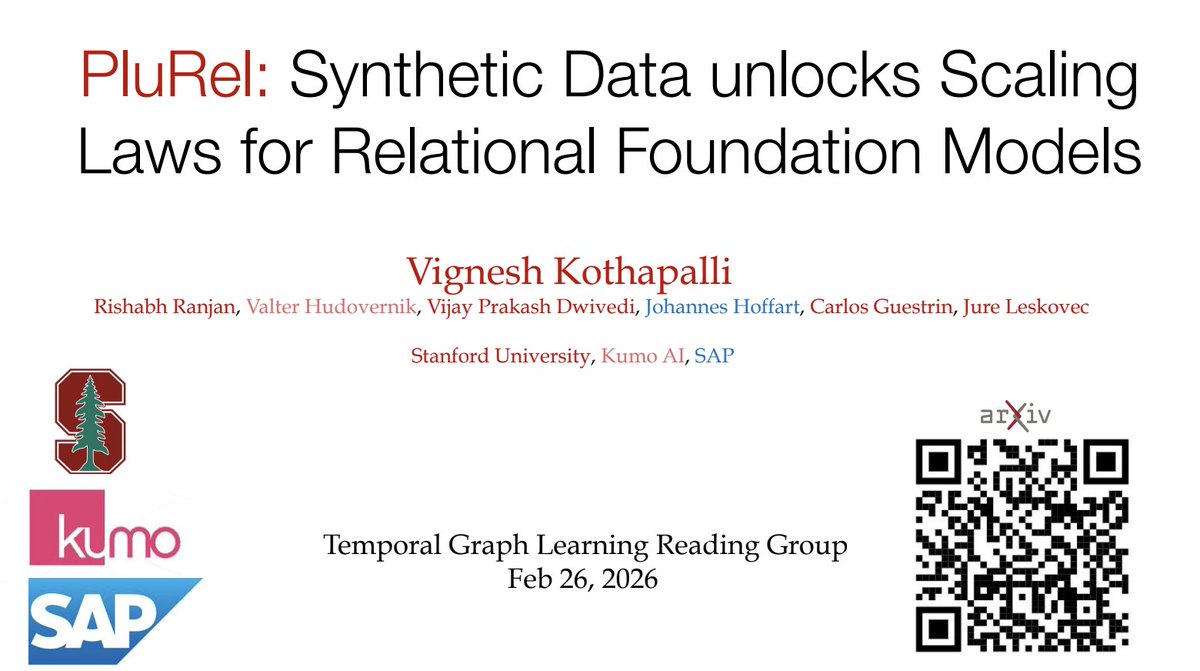

📚 Today at the Reading Group, Thu, Feb 26, 11am EST, we’re excited to host Vignesh Kothapalli @kvignesh1420 (Stanford University) presenting:
PLUREL: Synthetic Data Unlocks Scaling Laws for Relational Foundation Models
zoom link on our website
See you there! 🚀
2
5
21
1,664
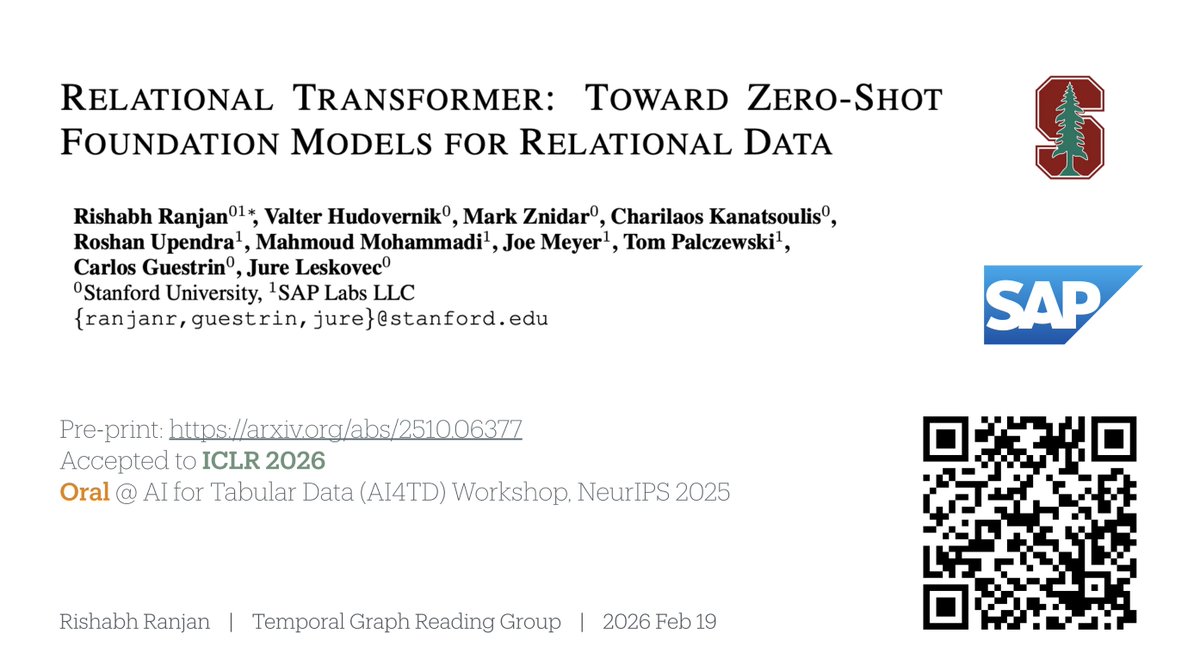
Enjoyed presenting our ICLR 2026 work (Relational Transformer) at the TGL reading group today. Thanks for the insightful discussion!
Slides from today: drive.google.com/file/d/1CPS…
Paper: arxiv.org/abs/2510.06377
Code, data, models: github.com/snap-stanford/rel…
ALT First slide from presentation.
This Thursday (Feb 19, 11am EST) at the reading group: Rishabh Ranjan (Stanford) presents Relational Transformer: Toward Zero-Shot Foundation Models for Relational Data.
Paper & code: github.com/snap-stanford/rel…
Hope to see you there! zoom link on website!
1
5
30
3,104
Excited to talk about our recent work on Relational Transformers at the TGL Reading Group tomorrow. Please drop by on Feb 19, 11am EST (see shenyanghuang.github.io/rg.h… for Zoom link).
This Thursday (Feb 19, 11am EST) at the reading group: Rishabh Ranjan (Stanford) presents Relational Transformer: Toward Zero-Shot Foundation Models for Relational Data.
Paper & code: github.com/snap-stanford/rel…
Hope to see you there! zoom link on website!
6
208
rishabh ranjan retweeted
Feb 18
The PluRel webpage is now live!
snap-stanford.github.io/plur…
Relational Foundation Models face a scaling problem: diverse training datasets are rarely public due to privacy constraints 🔒.
🚀 We are excited to introduce "PluRel": a framework that synthesizes diverse multi-table relational databases from scratch, unlocking scaling laws for RFMs. 🧵
Kudos to the amazing collaborators at @StanfordAILab @Kumo_ai_team , and @SAP : @_rishabhranjan_ @VHudovernik @vijaypradwi @johanneshoffart @guestrin @jure
3
14
871
rishabh ranjan retweeted

Feb 10
Quite exciting work on synthetic data generation that for the first time demonstrates scaling laws for graph/relational foundation models.
Great work by @kvignesh1420 @_rishabhranjan_ @VHudovernik and our collaborators at @Kumo_ai_team and @SAP
Relational Foundation Models face a scaling problem: diverse training datasets are rarely public due to privacy constraints 🔒.
🚀 We are excited to introduce "PluRel": a framework that synthesizes diverse multi-table relational databases from scratch, unlocking scaling laws for RFMs. 🧵
Kudos to the amazing collaborators at @StanfordAILab @Kumo_ai_team , and @SAP : @_rishabhranjan_ @VHudovernik @vijaypradwi @johanneshoffart @guestrin @jure
2
9
57
9,551
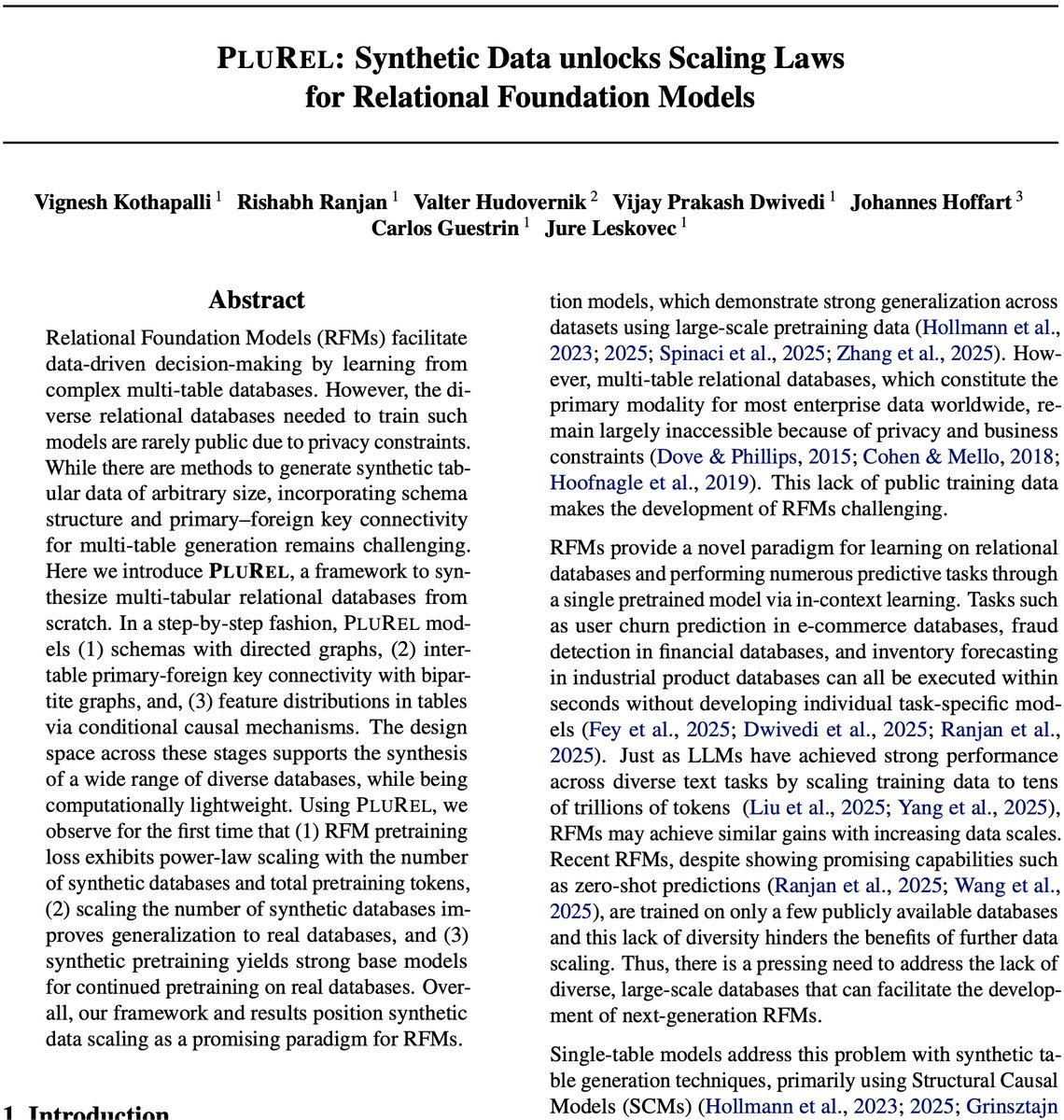
Synthetic data is critical for foundation models, even more so in relational and tabular domains where public data is scarce. Our new work shows how synthetic pretraining unlocks a whole new axis to scale up relational foundation models (RFMs)!
This was a super fun collaboration with @kvignesh1420, @VHudovernik, @vijaypradwi, @johanneshoffart, @guestrin and @jure.
Paper: arxiv.org/abs/2602.04029
Code, data, models: github.com/snap-stanford/plu…
ALT Title and abstract of the paper.
Relational Foundation Models face a scaling problem: diverse training datasets are rarely public due to privacy constraints 🔒.
🚀 We are excited to introduce "PluRel": a framework that synthesizes diverse multi-table relational databases from scratch, unlocking scaling laws for RFMs. 🧵
Kudos to the amazing collaborators at @StanfordAILab @Kumo_ai_team , and @SAP : @_rishabhranjan_ @VHudovernik @vijaypradwi @johanneshoffart @guestrin @jure
1
5
24
2,081
rishabh ranjan retweeted
Relational Foundation Models face a scaling problem: diverse training datasets are rarely public due to privacy constraints 🔒.
🚀 We are excited to introduce "PluRel": a framework that synthesizes diverse multi-table relational databases from scratch, unlocking scaling laws for RFMs. 🧵
Kudos to the amazing collaborators at @StanfordAILab @Kumo_ai_team , and @SAP : @_rishabhranjan_ @VHudovernik @vijaypradwi @johanneshoffart @guestrin @jure
4
25
53
19,050
Relational Transformer has been accepted to ICLR 2026!!🎉
See you in Brazil 🇧🇷
30 Oct 2025
Transformers are great for sequences, but most business-critical predictions (e.g. product sales, customer churn, ad CTR, in-hospital mortality) rely on highly-structured relational data where signal is scattered across rows, columns, linked tables and time.
Excited to finally share what I have been working on over the last year: a Foundation Model architecture which brings the power of Transformers to relational domains, enabling large-scale pretraining and zero-shot generalization in enterprise settings. 🧵1/n
ALT Title and abstract of the paper.
2
26
1,240
rishabh ranjan retweeted

Jan 22
Relational Transformers provide zero shot predictions for complex databases!
30 Oct 2025
Transformers are great for sequences, but most business-critical predictions (e.g. product sales, customer churn, ad CTR, in-hospital mortality) rely on highly-structured relational data where signal is scattered across rows, columns, linked tables and time.
Excited to finally share what I have been working on over the last year: a Foundation Model architecture which brings the power of Transformers to relational domains, enabling large-scale pretraining and zero-shot generalization in enterprise settings. 🧵1/n
ALT Title and abstract of the paper.
7
37
5,402
Although relational databases are everywhere, there is no equivalent of the public internet for pretraining Relational Foundation Models (RFMs). Excited to see RelBench bridging that gap, growing from 7 datasets in v1 to 88 datasets in v2.
Deeply grateful to the numerous community contributions for helping RelBench serve as the central data repository for RFM research. ❤️
Jan 12

🚀 Announcing RelBench V2, a major update to our benchmark for foundation models on relational data!
With V2, we are significantly expanding the benchmark’s scope to catalyze further research in Relational Deep Learning (RDL) and Relational Foundation Models (RFMs).
Key features:
🍺 4 new databases, spanning domains like e-commerce and beer reviews to scientific research and clinical healthcare.
🧩 40 new predictive tasks, including 28 autocomplete tasks, across new and existing databases.
🔌 External data integrations: 70 datasets from CTU, 7 datasets from 4DBInfer, and your own data via SQL connector, all in RelBench format.
🛠️ Bug fixes and performance improvements.
🔥 Introducing autocomplete tasks: As opposed to forecasting tasks, autocomplete tasks predict existing columns in the database. We found that models need to deeply understand the relational context to autocomplete database fields, a critical capability that expands the scope of real-world RDL applications.
Learn more:
🌐 Website: relbench.stanford.edu
💻 GitHub: github.com/snap-stanford/rel…
Huge thanks to @justingu32 @_rishabhranjan_ @jakub_peleska @VHudovernik @CKanatsoulis @fengyuli607, Tang Haiming, Alistiq and everyone else who contributed to our GitHub for making this possible!
3
9
729
rishabh ranjan retweeted
Jan 12
🚀 Announcing RelBench V2, a major update to our benchmark for foundation models on relational data!
With V2, we are significantly expanding the benchmark’s scope to catalyze further research in Relational Deep Learning (RDL) and Relational Foundation Models (RFMs).
Key features:
🍺 4 new databases, spanning domains like e-commerce and beer reviews to scientific research and clinical healthcare.
🧩 40 new predictive tasks, including 28 autocomplete tasks, across new and existing databases.
🔌 External data integrations: 70 datasets from CTU, 7 datasets from 4DBInfer, and your own data via SQL connector, all in RelBench format.
🛠️ Bug fixes and performance improvements.
🔥 Introducing autocomplete tasks: As opposed to forecasting tasks, autocomplete tasks predict existing columns in the database. We found that models need to deeply understand the relational context to autocomplete database fields, a critical capability that expands the scope of real-world RDL applications.
Learn more:
🌐 Website: relbench.stanford.edu
💻 GitHub: github.com/snap-stanford/rel…
Huge thanks to @justingu32 @_rishabhranjan_ @jakub_peleska @VHudovernik @CKanatsoulis @fengyuli607, Tang Haiming, Alistiq and everyone else who contributed to our GitHub for making this possible!
24
41
4,928
5 Dec 2025
Our "Relational Transformer" work is ORAL at the AI for Tabular Data Workshop! If you are in Europe for NeurIPS (EurIPS), come find us (mainly @VHudovernik) on Dec 6! sites.google.com/view/eurips…
30 Oct 2025
Transformers are great for sequences, but most business-critical predictions (e.g. product sales, customer churn, ad CTR, in-hospital mortality) rely on highly-structured relational data where signal is scattered across rows, columns, linked tables and time.
Excited to finally share what I have been working on over the last year: a Foundation Model architecture which brings the power of Transformers to relational domains, enabling large-scale pretraining and zero-shot generalization in enterprise settings. 🧵1/n
ALT Title and abstract of the paper.
5
295
rishabh ranjan retweeted

6 Nov 2025
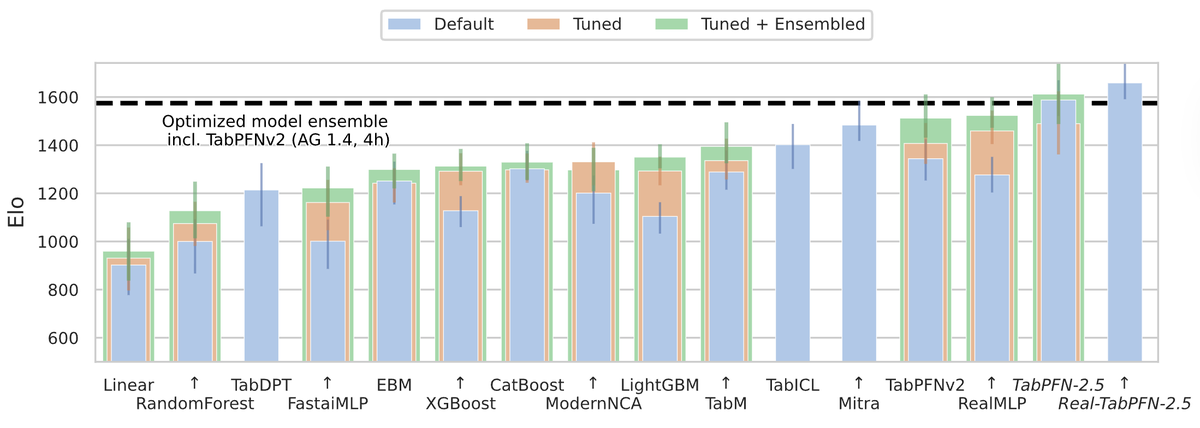
The data science revolution continues — TabPFN is now SOTA up to 50k data points and 2000 features 🚀
For the size limits of TabPFNv2, in a forward pass Real-TabPFN-2.5 outperforms AutoGluon 1.4 (complex ensemble including TabPFNv2 tuned for 4h) by 93 ELO points on TabArena.🧵1/
1
6
31
2,332