
Macroeconomist| Labor Macro| NCAER| Centre for Gender and Macroeconomy| Shiv Nadar IoE| PwC India| NCFE, RBI| Delhi School of Economics
Joined November 2015
- Tweets 70
- Following 255
- Followers 84
- Likes 82
1 Photos and videos
Aakash Dev (Ph.D.) retweeted

Jun 12
Studying India’s low female labour force participation, @aakash_dev94 & Chatterjee show that the reason lies at intersection of 2 forces that have largely been studied in isolation—macroeconomic environment & distribution of unpaid work within household
ideasforindia.in/topics/macr…
3
3
380

Writing for Policy Edge, NCAER faculty members
@ratna_sahay and @aakash_dev94 caution against viewing rising female labour force participation and leadership representation as sufficient indicators of economic inclusion.
They argue that meaningful progress in women’s economic empowerment requires addressing structural barriers through stronger care systems, safer mobility, better skilling, more formal employment opportunities, and greater decision-making power.
Read more: ncaer.org/publication/womens…
1
4
187
📢NCAER is hiring Research Associates!
Join us to build your career and contribute to rigorous, evidence-based economic policy research in India.
Apply here: ncaer.org/career/research-as…

3
10
557

#WATCH | Delhi | Former Special Advisor to MD IMF and current Professor at NCAER, Ratna Sahay says, “I would say that there are two major takeaways. One is that India is very well positioned in terms of the buffers that it has to absorb shocks, and also the inflation targeting framework. They have managed to establish credibility… However, if the oil price shock and supply disruption continue for a long time, then it is very important for India to allow the pass-through of prices… The second thing I would say is that the uncertainty regarding the future in terms of the energy shock is extremely high. Countries are still trying to figure out how long it will stay… But I have to say that the Indian authorities have done very well in terms of actually consolidating the fiscal deficit and going on the right path now…”
3
4
19
5,285
How is India positioned to deal with the oil price shock and manage its inflation-targeting framework?
NCAER faculty member, @ratna_sahay, explains, arguing that India is well positioned due to the buffers it has to absorb shocks, as well as the strength of its inflation-targeting framework.
Watch interview 👇 at ANI:
1
3
245
Aakash Dev (Ph.D.) retweeted

Excited to deliver a keynote at the LEO Economics Conference 2026 @PlakshaUniv (Apr 24–26) organized by @prakarsh9. My talk is based on joint work with @AakashDev_Econ: "Households, Frictions, and the Gender Gap: A Search Model of Labor Force Participation in India." Paper:

2
2
10
741
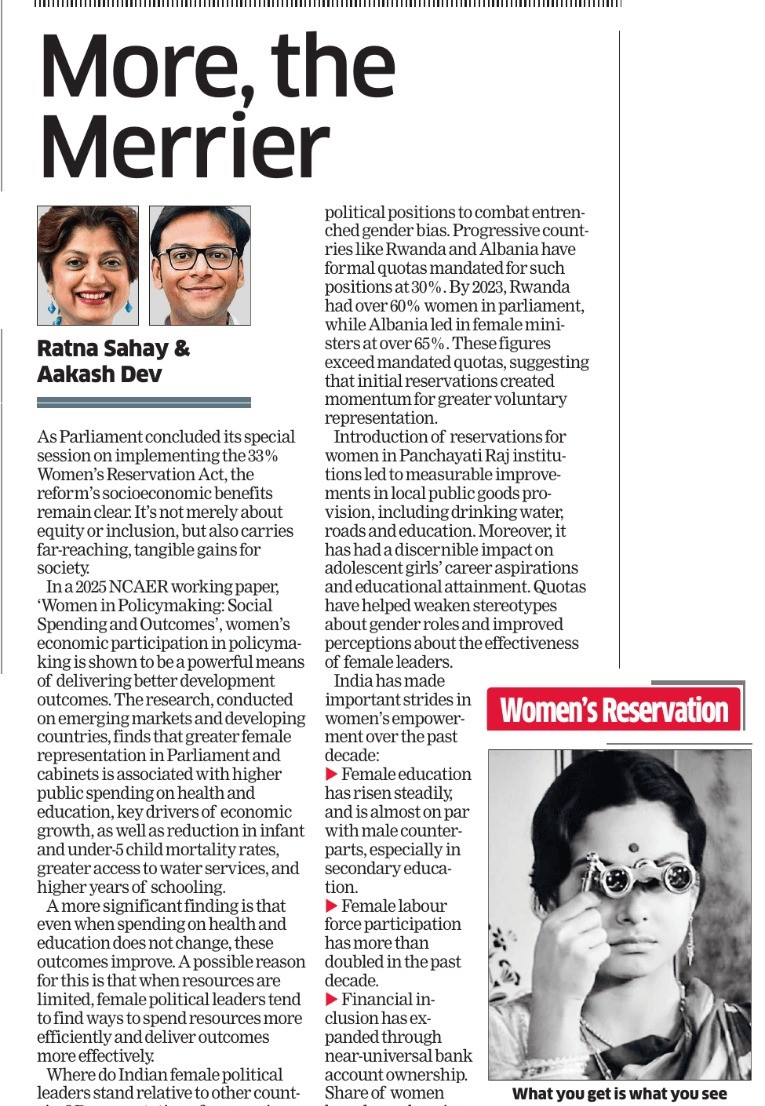
Greater representation of women in policymaking leads to better social outcomes and stronger economic performance.
NCAER faculty members @ratna_sahay and @aakash_dev94 argue that in settings marked by significant gender disparities and entrenched cultural biases, expanding women’s participation has played a critical role in advancing cultural change and enhancing macroeconomic results.
#WomenInPolicy #GenderEquality #InclusiveGrowth
Read more: bit.ly/4mLF0Mh
1
4
202
Despite recent improvements, women’s participation remains well below its potential, especially in urban areas and in higher-productivity sectors.
Writing in the Deccan Herald, NCAER faculty member @aakash_dev94 reflects on what Budget 2026 signals for care infrastructure, women’s work, and the road ahead.
🔗ncaer.org/publication/from-c…
1
2
197

Today in @DeccanHerald: My opinion piece on Budget 2026 and the care economy.
If growth is the goal, care must be treated as a core economic strategy, not a social afterthought. @ncaer
Read: deccanherald.com/opinion/fro…
#Budget2026 #CareEconomy #WomenInWork #GenderAndGrowth #NCAER
1
42
My latest piece for #HerConversation reflects on our recent @epw_in research on women’s labour market potential and why #UnpaidCare must be at the centre of how we understand female labour force participation.
Read here: lnkd.in/gK5fUEAt
#Gender @ncaer @girlpowertalk
40
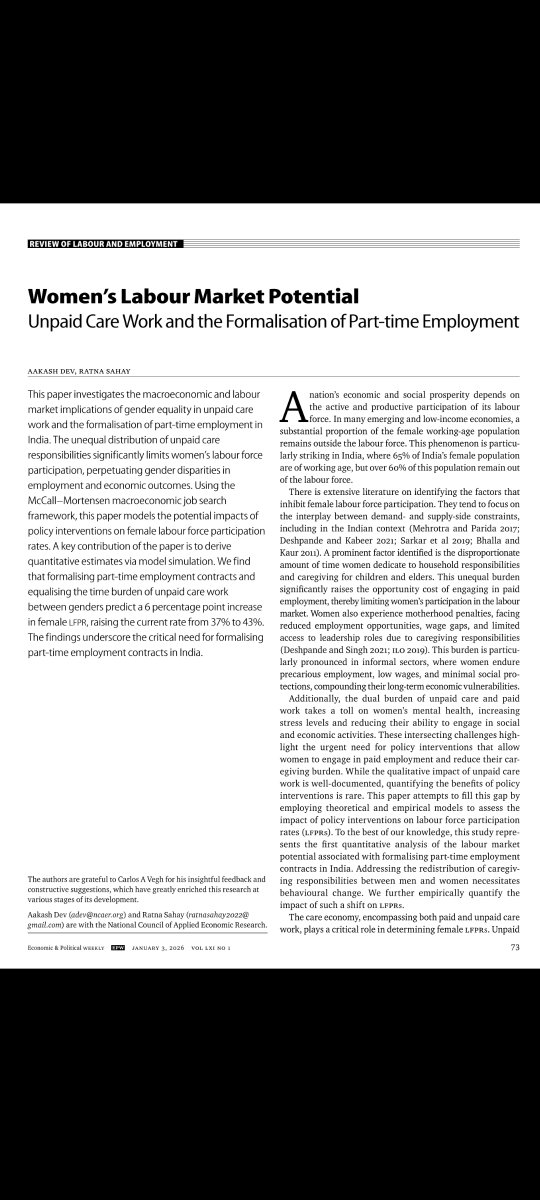
How can India unlock women’s labour market potential?
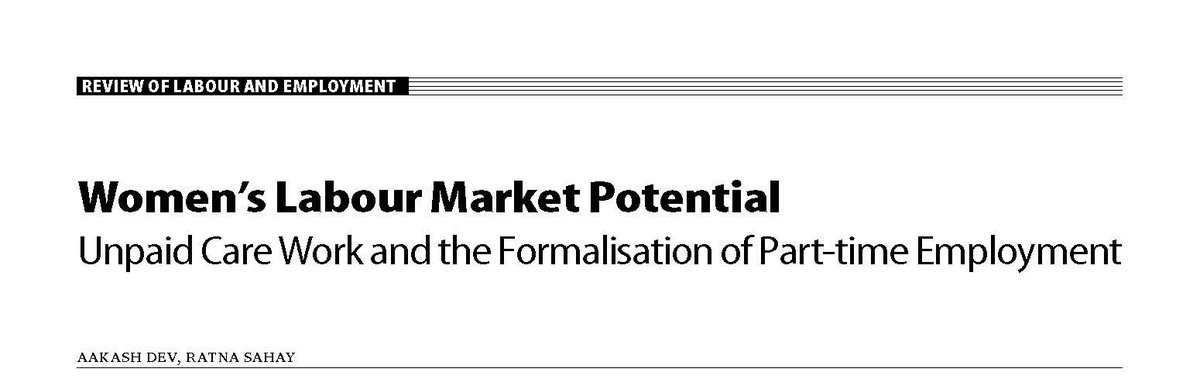
Using a macro-simulation framework, this study by NCAER faculty members @aakash_dev94 & @ratna_sahay, finds that formalising part-time work and redistributing unpaid care responsibilities could increase female labour force participation (FLFP) by around 6 percentage points.
Read more: bit.ly/49n0rgw
1
2
213
Pleased to share our recent paper in @epw_in, “Women’s Labour Market Potential,” co-authored with Dr. Ratna Sahay. Using a simulation-based macro framework, we examine policy levers to raise female LFPR in India.
#Economics #India #LabourMarkets #Gender #PolicyResearch #EPW
1
1
8
860
We show that formalising part-time work and redistributing unpaid care work could raise FLFP by ~6 pp, with positive growth spillovers and lower gender gaps.
Read here: lnkd.in/gzwbZp8s
36
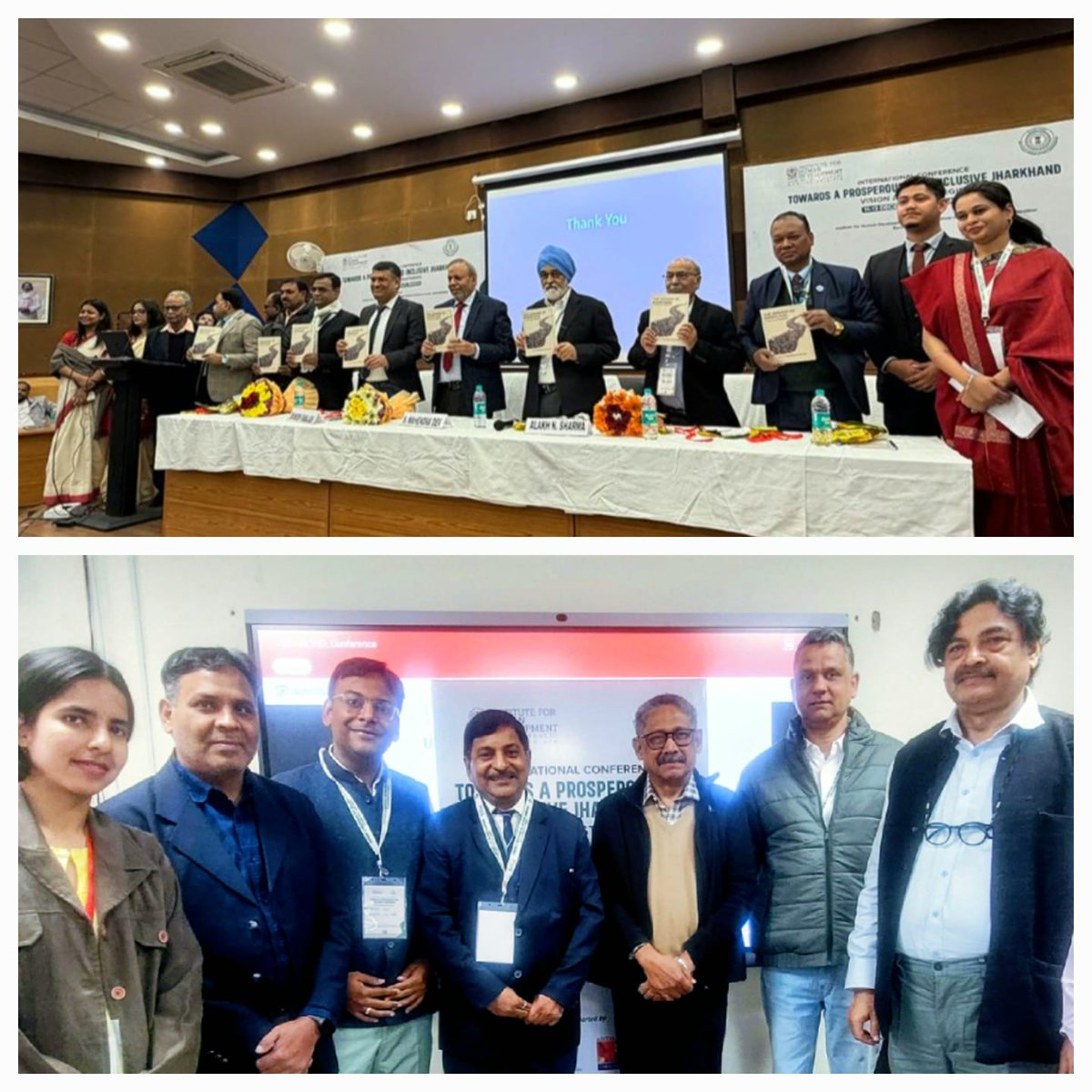
NCAER faculty member @aakash_dev94 served as a Lead Discussant in the thematic session on “Generating Quality Employment, Reaping the Demographic Advantage, and Strengthening Social Programmes” at the International Conference on “Towards a Prosperous and Inclusive Jharkhand”, held in Ranchi on December 12, 2025.
#NCAER #InclusiveGrowth #QualityEmployment #DemographicDividend
1
1
247
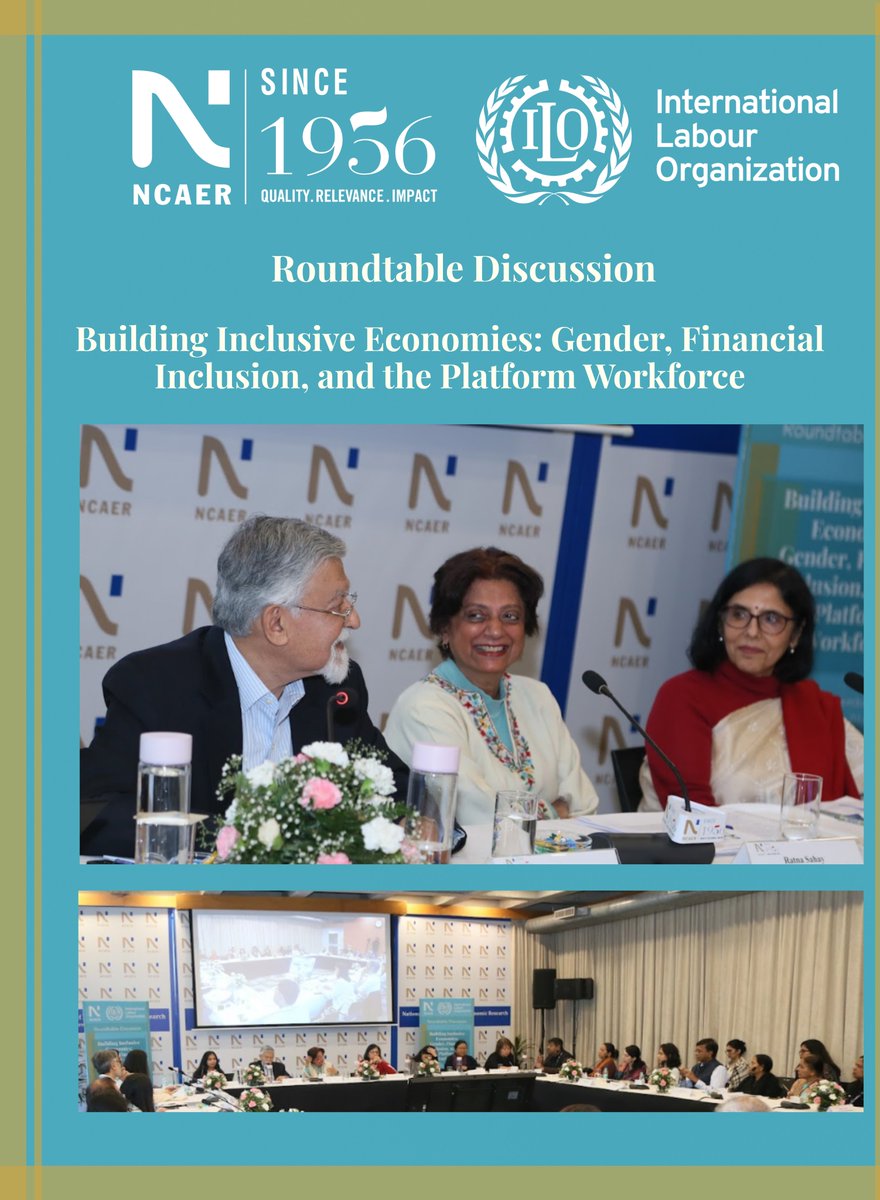
Stronger digital access, improved financial inclusion, and more robust social protection systems can significantly reshape the future of women in the platform economy.
The @ncaer, in collaboration with the @ilo, organised a workshop on “Building Inclusive Economies: Gender, Financial Inclusion, and the Platform Workforce”, where these themes emerged as key points of discussion.
#DigitalInclusion #WomenAndWork #PlatformEconomy #GenderInclusion #ILO #NCAER
1
1
195
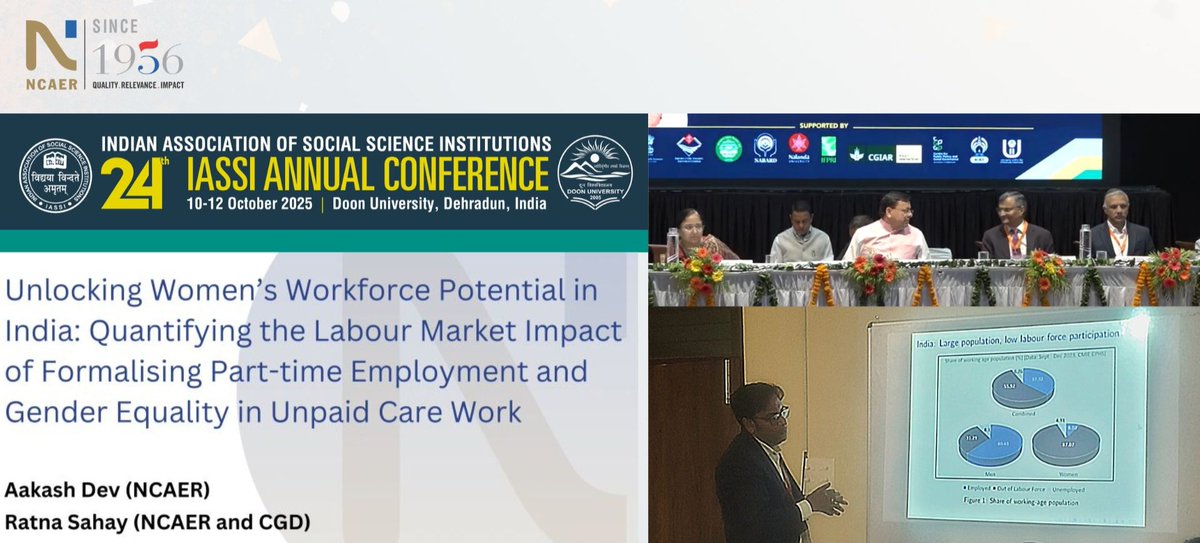
NCAER faculty member @aakash_dev94 presented a paper on “Unlocking Women’s Workforce Potential in India” at the 24th International #IASSI2025 Annual Conference.
The simulations in the paper showed that formalising part-time jobs could increase India’s female labour force participation rate (LFPR) by 6 percentage points.
#WomenInEconomy #GenderEquality
2
1
244
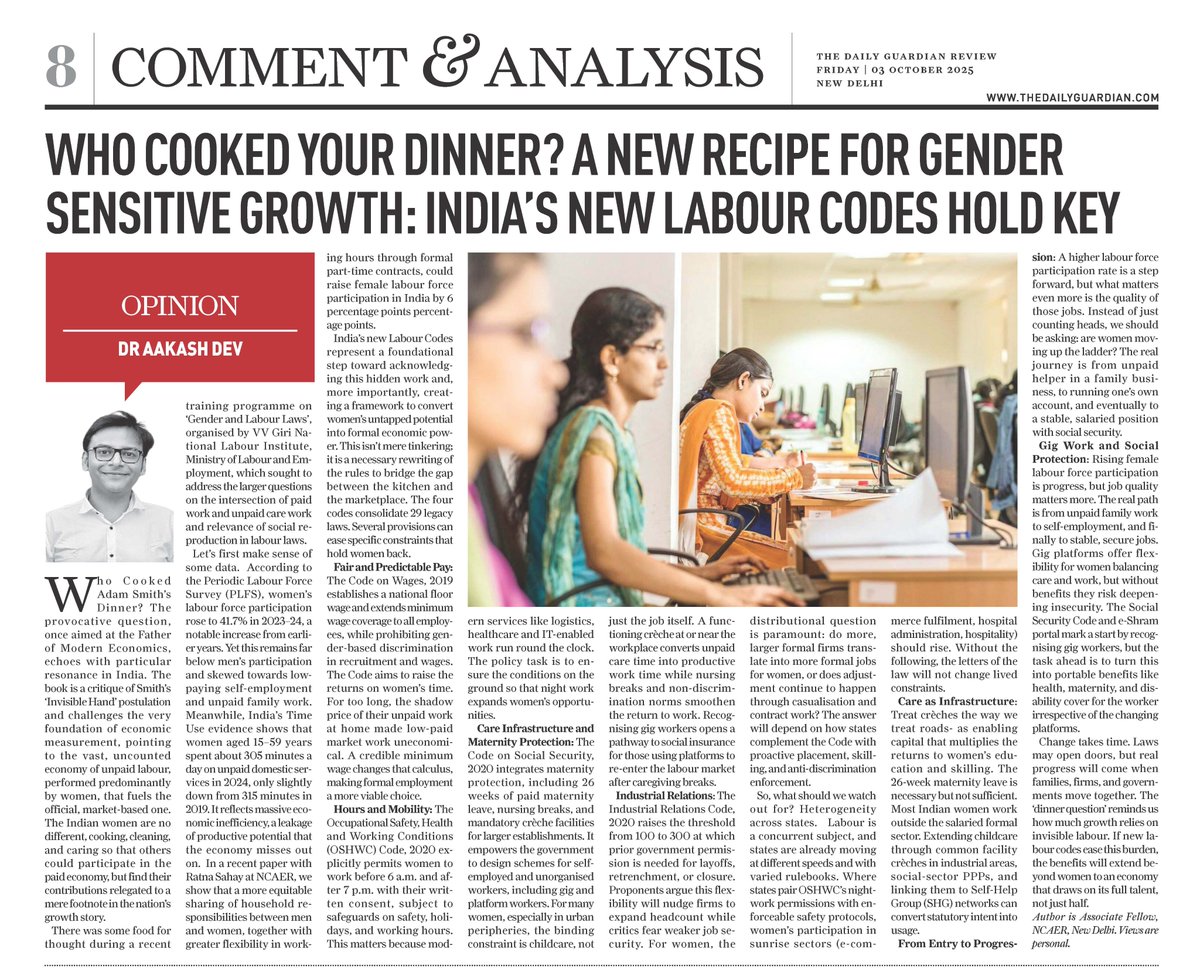
Women’s unpaid care work supports the economy but remains largely invisible.
@ncaer faculty member @aakash_dev94 notes that India’s new Labour Codes with provisions for wages, childcare, maternity support, and gig worker protections, are a step toward acknowledging its value.
#GenderEquality #WomenAtWork #NewLabourCodes
Read more: bit.ly/3Wspvwp
3
6
261
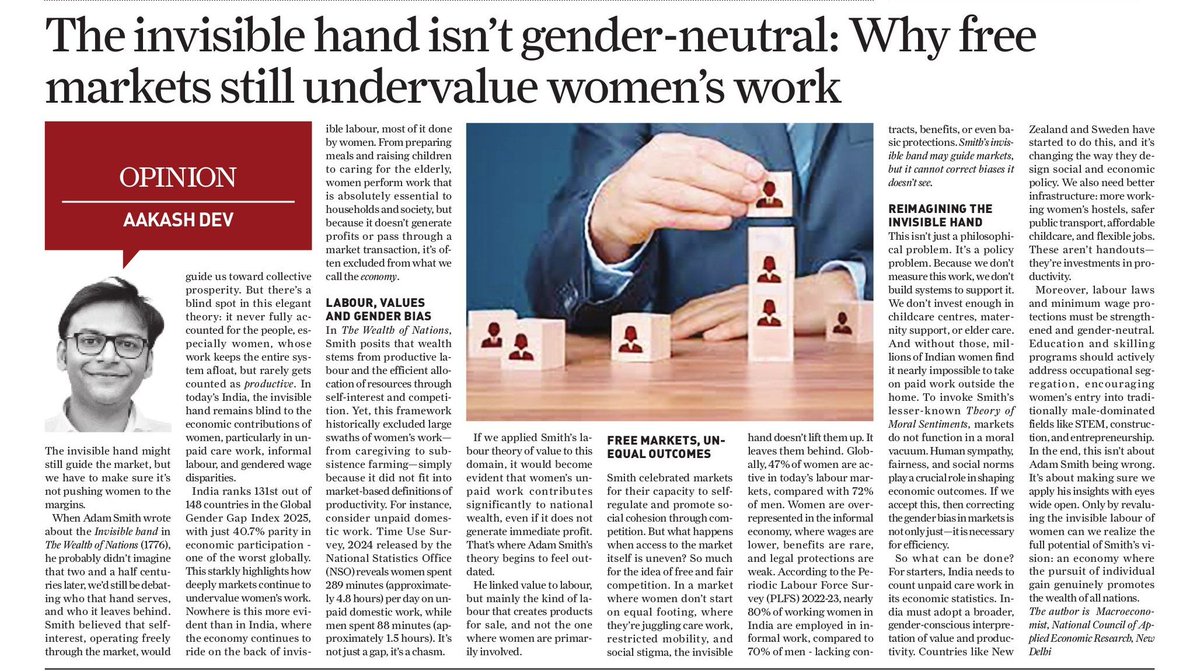
Why do free markets continue to undervalue women’s work, and what can be done to change this?
NCAER faculty member @aakash_dev94 argues that market forces alone can’t correct gendered labour biases and calls for policies that genuinely recognize and reward women’s contributions, especially the often-invisible labour.
🔗bit.ly/4mMQ3DR
3
5
400
Countries such as Chile, Sweden, and Germany have increased female employment through quality childcare, affordable housing, and reforms supporting part-time work.
NCAER faculty @ratna_sahay & @aakash_dev94 argue that India can achieve the same by investing in women-friendly transport, safe hostels, childcare infrastructure, and by formalising part-time jobs with fair wages.
🔗ncaer.org/publication/build-…
#FLFPR #NariShakti #WomenAtWork

1
1
262
In a recent paper, @ncaer faculty members @aakash_dev94 & @ratna_sahay at the Centre for Gender and Macroeconomy, NCAER find that female labour force participation in India can increase by 6 percentage points, in part through the formalisation of part-time employment.
Read more here: bit.ly/43jcARV
1
2
233