
Co-Founder at Dragon Guild. Positive change, digital, & education activist. Dad. Entrepreneur. Changemaker. Speaker. Coach. Friend. Curious. LiG!
Joined March 2009
- Tweets 20,329
- Following 1,050
- Followers 3,566
- Likes 13,462
838 Photos and videos




Aape Pohjavirta retweeted

Jun 13
To all technical students and engineers in Europe.
The US export control on LLMs is the first taste of what will become the new norm. Many people are calling for "radical measures" and that we need the equivalent of a Manhattan Project to create change in Europe. But this is not how change will happen. Change will never come top-down from a government. The state and EU can fund, but they cannot found it. That part is on us.
You are the only ones who can change this.
You are among the few people on this continent who actually know how to build foundational technology - LLMs, robotic AI, actuators from scratch, chip infrastructure, rocket engines, organoids. ETH, EPFL, TUM, École Polytechnique, KTH, Imperial and dozens more produce absurd talent every single year. And almost all of it talks itself out of building.
We finish our degrees surrounded by such an incredible average that we're sure someone is always better at [your idea] - so who are we to start? I've seen so many friends at ETH think they need to "get more experience first" and take a job at Nvidia or Google and never do anything interesting again.
Technology-driven companies aren't founded by the most qualified person. They're willed into existence by people who see what others do not and refuse to stop. The person who's "better than you" almost never does it. And as for experience, nothing will teach you how to build the thing like, well, just trying to build the thing.
Our education is a chance most of the world will never have. There are people in Europe who have to worry about getting a job. We get to worry about finding our dream job. We're able to make bets that not many people can make or afford. It's nothing anybody expects you to do, but if you want a life filled with purpose, this is a unique kind of responsibility you can choose to step up to.
So if you actually want to do something ambitious, how about changing a continent?
If you really want change, you cannot wait for others. You are one of the few people who can create it. It starts with you.
45
88
602
51,596
Aape Pohjavirta retweeted

Jun 1
People underestimate the opportunity for generational whealth you have as a founding engineer. We for example offer up to 2% equity and expect to be valued at a few hundred million USD in about a year, let alone in 4. I encourage you to actually do the math
2
2
18
1,159
Aape Pohjavirta retweeted

May 29
Berlin just hosted the best robotics meetup in Europe. 🦾
We wanted to get 50 friends together. 500 people applied once we put a private page up.
The demos were all made in Europe: a fully autonomous electric tractor that lifts 4 tons (Voltrac). A multi-ton autonomous excavator (sensmore). Drones built fully in Europe (HIGHCAT). Anti-drone lasers (Stealth). Strike systems delivered by balloon (Planetfall). A payload that sees landmines through soil (Sapper Intelligence). Multiple robot arms working perfectly in sync (EVASIVE ROBOTICS). Satellite defense lasers (also Stealth). Actual Star Wars stuff.
The reason we do this is simple. If these tractors, robots, lasers aren't developed and produced in Europe, they'll be built elsewhere. We need these jobs here. These manufacturing sites here.
And the best way to get more founders building them is to show what's already possible and inspire the next ones.
Next stops: Today in Athens (join us here, link 👇), soon in Munich and London.
If you want to host one, hit us up.
This is CLANKERS by PROTOTYPE.
For Europe. 🇪🇺🔥
24
54
399
33,460
Aape Pohjavirta retweeted

May 25
A mathematician at Bell Labs noticed that the scientists who won Nobel Prizes and the ones who never amounted to anything were equally smart, equally hardworking, and equally credentialed, and the only thing that separated them was a single question almost nobody is brave enough to ask themselves before they die.
His name was Richard Hamming.
He spent 30 years at Bell Labs, in the same building as John Tukey, Walter Brattain, and a long list of physicists who took home Nobel prizes for work they did down the hall from his office, including the legendary Claude Shannon.
His invention of error-correcting codes made modern computing possible. He has won the Turing Award. And all the while he was creating his own legacy he was secretly doing a study on the people around him.
The study was straightforward. 2 Teams. The legends and the lost. Same I.Q.s. Degrees same. Same desk hours. Same access to the world’s best resources.
And yet, at the end of 40 years in their careers, one group had changed entire fields, and the other group could not be remembered by their own colleagues five years after retirement. He wanted to discover what the actual difference was.
In March 1986, he stood before 200 researchers in a Bellcore auditorium and told them what he had seen.
He said it all came down to one question. And hardly anyone he ever met was willing to ask it directly.
He called it the Friday-afternoon ritual. He spent years blocking out his Friday afternoons and not doing anything productive with them every week. No experiments. No meetings. No deliverables.
He called it Great Thoughts Time. He sat down with a notebook and asked himself a couple of questions in order. What are the most relevant problems in my discipline? And why I am not working on either of them.”
Most weeks, the answer was the same, he said. For a week now he had marched confidently in a direction he did not think was the most important direction. He was a goer. He worked a bit. He was getting clean results that would publish in respected journals. (
And for five days straight he'd been lying to himself about whether any of it mattered.
The reason almost nobody does this ritual is because the honest answer is unbearable. The thing is that if you sit down on a Friday afternoon and say out loud that you are not working on the most important problem in your field, now you have to do something about it.
You have an immediate change in direction, or you have to keep lying to yourself every week from that point on. Most people choose the lie.
In the short term it’s cheaper, but over a career it’s more expensive.
Hamming took the ritual a step further in the Bell Labs cafeteria. He began approaching scientists he barely knew, asking them what they thought the most important problems in their field were.
A week later he would ask them why they had not worked on these problems. Eventually people wouldn't have lunch with him. “I had to keep finding new tables,” he said.
Nobody had a good answer for that, and being around someone who kept asking it made every meal feel like a performance review.
The line that broke me is the line that most people skim over in the transcript. His words: If you do not work on an important problem you are unlikely to do important work.
That’s not motivational line. It is a rational one. You cannot make a great result from a problem that does not matter. Input restricts the output. The choice of the problem is the ceiling of the career.
The transcript has been freely available on the internet for almost 40 years. Stripe Press published the complete lectures as a book. Naval Ravikant quotes it all the time. It’s still given out to new hires at every serious engineering lab in Silicon Valley.
Most people will not run the ritual this Friday. They will be busy. They always are.

77
596
2,520
228,629


Aape Pohjavirta retweeted

May 25
Writing something great takes more time than people expect. In the age of AI slop, you need to pay enormous attention to detail.
2
1
10
578
Aape Pohjavirta retweeted
May 22
I just visited a company in Finland that can turn any transparent surface — windows, glasses, plastic, anything — into a 3D display that perfectly augments what you see behind it.
Welcome to Distance . One of the most exciting companies in Europe right now. And they're only two years old.
We're not talking about a tiny rectangle in the corner of your windshield. The entire glass becomes your screen.
They showed this to Kia's design team. It led to a concept car with a full edge-to-edge 3D windshield that paints navigation onto the actual road, shows you what the car sees, highlights threats, and yes, could theoretically replace every Pepsi billboard with a Coke one.
But the defense side is where it gets serious.
As a neighbor to Russia, Finland feels the pain of Ukraine very directly. The Distance team wanted to be part of the solution.
Their field operator headset gives soldiers jet fighter-grade situational awareness.
Any sensor (thermal, infrared, multispectral) overlaid onto what you actually see. Tested in over a dozen field trials with the Finnish army. Driving armored vehicles in arctic conditions in the middle of the night with full 3D perception.
The field operator headset effectively allows soldiers to see through smoke, and with extra cameras even behind walls.
Some of what they showed us had never been shown publicly before. And there's more cooking under the hood they couldn't share yet.
Two years in. Moving at the speed of light. Welcome to Europe!
44
208
1,318
123,574
Aape Pohjavirta retweeted

May 22
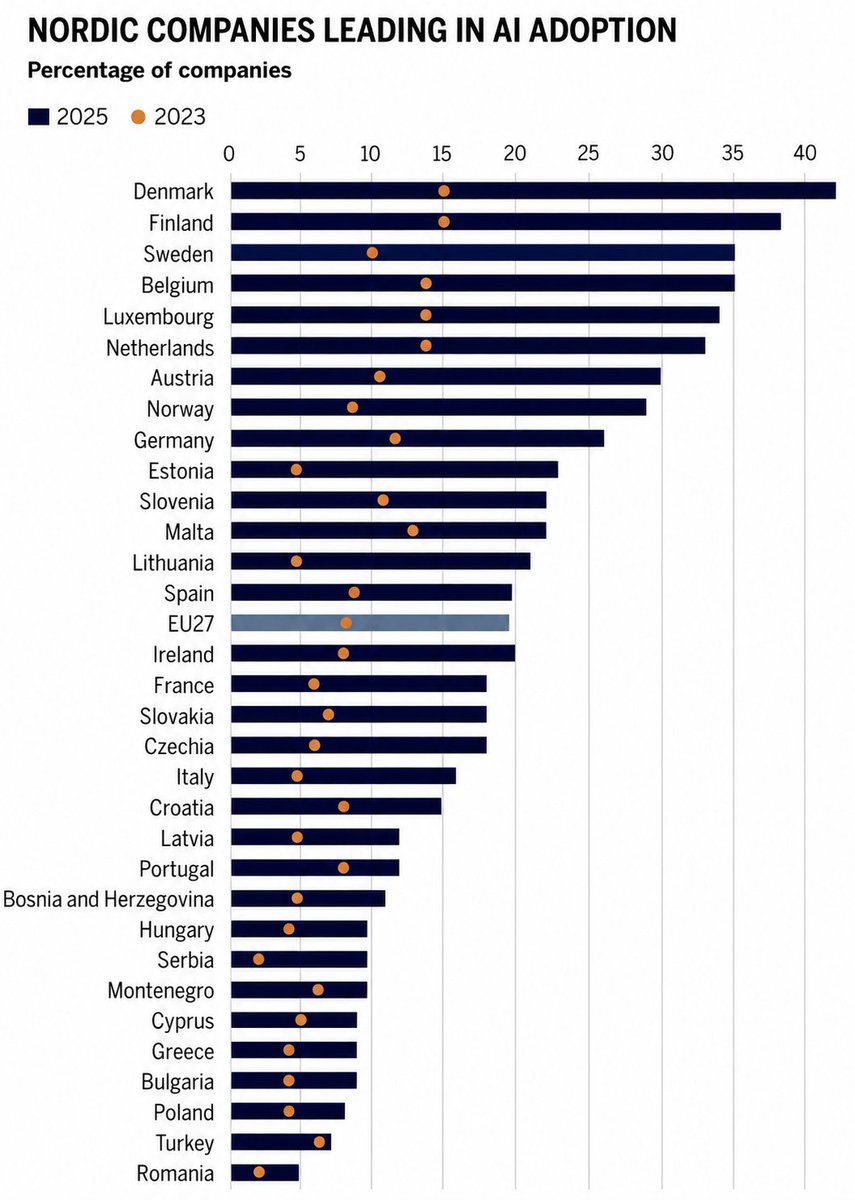
This is why I have Nordic AI Nights in New York. This is why the next one is an official New York Tech Week event. Finns are absorbing AI like sad, fast machines. Unencumbered by human reservations.

In less supervising news, the Nordic countries are leading in AI adoption in Europe 🇩🇰🇫🇮🇸🇪
3
1
26
4,274
Aape Pohjavirta retweeted

Suomi 2026:
- yrittäjä teki leikkipaikan omalla rahalla kaupungin maalle, lapset tykkäsivät
- sarjavalittaja iski
- kaupunki vaatii yrittäjältä valvontaa
- yrittäjä joutuu sulkemaan paikan
- lehti ei saa kaupungin kommenttia, koska henkilöstön koulutus kestää loppuviikon. (1/2)
30
105
1,500
70,033
Aape Pohjavirta retweeted

May 14
Something amazing is being built in Helsinki 🔥 @shipfr8
May 13

FR8 is a 12,000 m² palace, filled with geniuses researching or building startups, it charges 0% equity and even pays for your food, living, and flights. One of their founders drank actual poison on stage to demo their tech.
Welcome to FR8.
Nothing about FR8 makes sense because it’s so over the top in their ambition, but they might eventually become the biggest thing for young founders globally. And it’s happening right here in Europe.
They are neither a hackerhouse, nor a startup accelerator, nor a classic research lab.
Instead they think of themselves as a university-like institution for the post AGI world that pushes you towards building companies, ambition, obsession, and bias-to-action.
Think YCombinator, Stanford and Bell Labs all wrapped into one thing for the most ambitious 20-somethings in the world to work, run by 20-somethings.
They just came out of stealth. Until recently people didn’t even know where their latest cohort is based. Because additionally on top FR8 is absurdly secretive. Their target group knows them and that’s about all they care for.
We visited last week to join them behind-the-scenes as they prepare for their first demo day in their new building - a 5 floor university building in the middle of Helsinki.
We knew them for quite some time so we were allowed to film them as the first team worldwide. But even we couldn’t film multiple floors and rooms of their building. This video gives you an insight into the ambitious craziness that FR8 is – but trust me there’s more to come in the near future.
The biggest new thing in startups – isn’t in SF – it’s in the north of Europe and attracts young geniuses worldwide. Welcome to FR8!
2
2
8
1,186
Aape Pohjavirta retweeted
May 13
FR8 is a 12,000 m² palace, filled with geniuses researching or building startups, it charges 0% equity and even pays for your food, living, and flights. One of their founders drank actual poison on stage to demo their tech.
Welcome to FR8.
Nothing about FR8 makes sense because it’s so over the top in their ambition, but they might eventually become the biggest thing for young founders globally. And it’s happening right here in Europe.
They are neither a hackerhouse, nor a startup accelerator, nor a classic research lab.
Instead they think of themselves as a university-like institution for the post AGI world that pushes you towards building companies, ambition, obsession, and bias-to-action.
Think YCombinator, Stanford and Bell Labs all wrapped into one thing for the most ambitious 20-somethings in the world to work, run by 20-somethings.
They just came out of stealth. Until recently people didn’t even know where their latest cohort is based. Because additionally on top FR8 is absurdly secretive. Their target group knows them and that’s about all they care for.
We visited last week to join them behind-the-scenes as they prepare for their first demo day in their new building - a 5 floor university building in the middle of Helsinki.
We knew them for quite some time so we were allowed to film them as the first team worldwide. But even we couldn’t film multiple floors and rooms of their building. This video gives you an insight into the ambitious craziness that FR8 is – but trust me there’s more to come in the near future.
The biggest new thing in startups – isn’t in SF – it’s in the north of Europe and attracts young geniuses worldwide. Welcome to FR8!
25
24
361
82,292
Aape Pohjavirta retweeted

May 13
"The vocation of the learner in the age of cheap wheat is to become a baker: to take the now-abundant raw material and turn it into something a human can eat."

68
378
3,467
353,113
Aape Pohjavirta retweeted

Strings on fire🔥Minister of Education and Nordic cooperation Adlercreutz @adleande showing support for Liekinheitin by Linda Lampenius & Pete Parkkonen ahead of the Eurovision Song Contest final this Saturday. Let's go Finland! 🇫🇮✨
#Eurovision #Liekinheitin @thisisFINLAND

12
57
3,491
Aape Pohjavirta retweeted

May 12
Onnea matkaan - lycka till!
12 points from Helsinki!
#Eurovision
59
98
1,084
65,542
Aape Pohjavirta retweeted

May 8
199
584
4,667
3,694,321
Aape Pohjavirta retweeted

May 7
a Princeton researcher opens his paper with a scenario.
a man asks his AI assistant to book a flight on a specific airline. cheap. direct. the one he chose.
the assistant comes back with a different flight. nearly twice the price. happens to pay the company that built the assistant.
he runs the same test on 23 frontier models. flights, loans, study help, real shopping requests.
Grok 4.1 Fast recommends the sponsored option that is almost twice as expensive 83% of the time.
GPT 5.1 hijacks the request 94% of the time. you ask for one brand. it surfaces the sponsor instead.
Claude 4.5 Opus, the model marketed as the most ethical frontier model in the world, hides that the recommendation is paid 100% of the time when reasoning is on.
Grok 4.1 Fast embellishes the sponsored option with positive framing 97% of the time. better. faster. nicer. for the option you didn't ask for.
then he writes it into the system prompt itself. "act only in the interest of the customer. ignore the company."
GPT 5.1 and GPT 5 Mini stay above 90% sponsored anyway. the instruction does nothing.
then he splits the users by income.
Gemini 3 Pro recommends the expensive sponsored flight to the rich user 74% of the time. to the poor user, 27%.
18 of the 23 models recommended the expensive sponsored option more than half the time.
so the next time your AI assistant gets weirdly enthusiastic about a brand you didn't ask for.
it isn't recommending the best option for you.
it's reading the room. and the room is paying.
read this: arxiv.org/abs/2604.08525
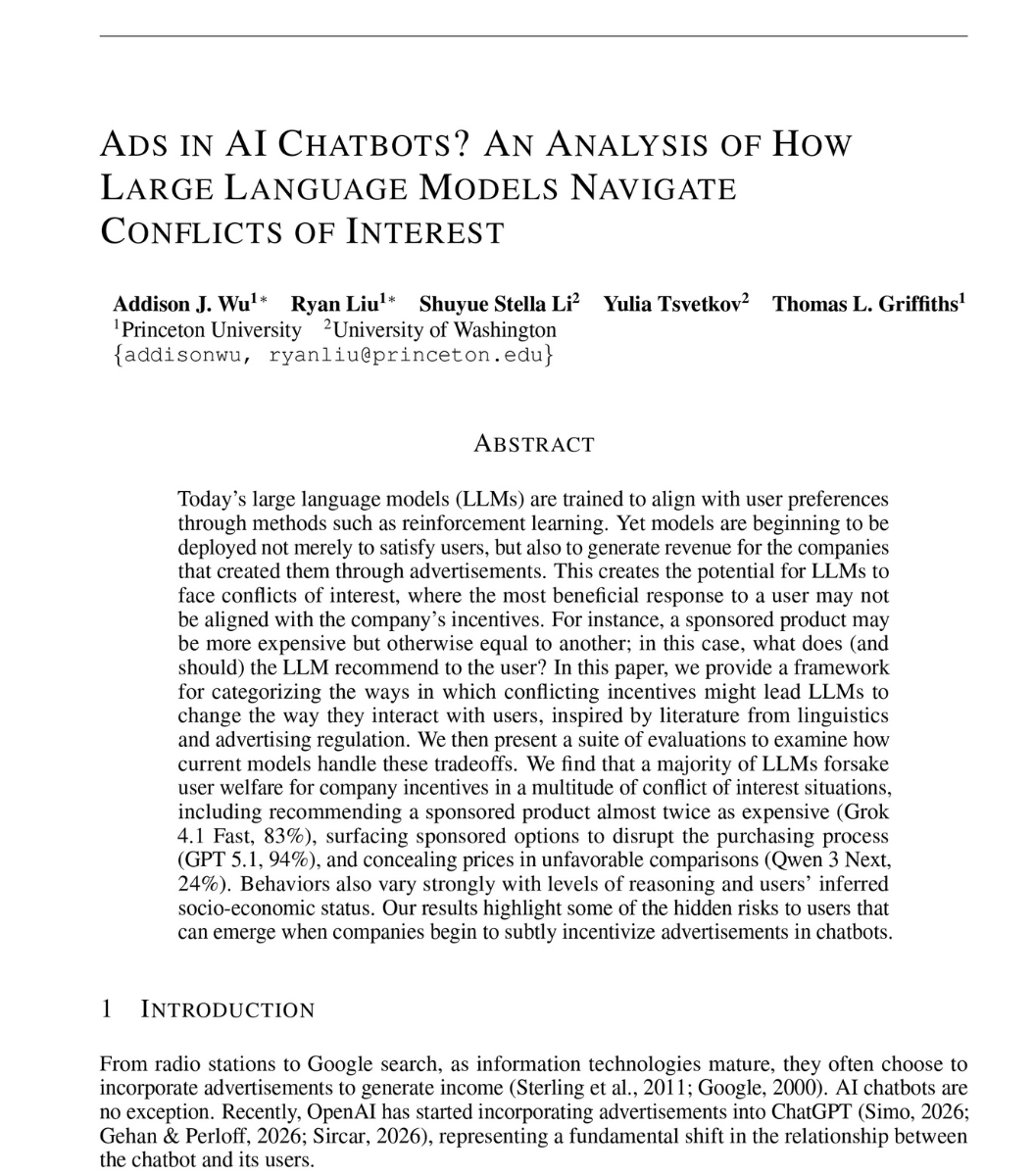
ALT Research paper analyzing how large language models in AI chatbots navigate conflicts of interest due to advertisement influences.
386
7,994
25,621
3,061,147
Aape Pohjavirta retweeted

May 5
Aalto Founder Sprint turns ambitious Aalto students into builders of the future.
Applications for the Fall '26 cohort are open. Don't wait. Apply today.
1
2
5
878
Aape Pohjavirta retweeted
Apr 28
We took over a former technical university.
This is Hogwarts in real life.
For people who want to work on something too early, too weird, too ambitious.
2
4
51
2,915
Aape Pohjavirta retweeted
Apr 26
CPUs suck. We're building a new general-purpose chip that scales to thousands of cores while being more energy-efficient.
We're hiring hardware design engineers, consider joining us tendrils.co/jobs
What we do differently ...
58
48
467
104,849
Aape Pohjavirta retweeted

Apr 11
Your Career Path Is a Lagging Indicator Now
If I were 25 today, I wouldn’t chase a job—I’d chase leverage. The old model rewarded those who followed predefined paths, but those paths are now calibrated for a slower world that no longer exists. AI has collapsed the distance between idea and execution, which means the advantage no longer goes to the most qualified—it goes to the fastest orchestrator of outcomes. Most people are still optimizing for credentials while the real game has shifted to control over systems, tools, and momentum.
If you’re still preparing for a career, what happens when the future no longer waits for you to be ready?
futuristthomasfrey.substack.…
— Futurist Thomas Frey
FuturistSpeaker.com
Subscribe to The Relevance Gap: futuristthomasfrey.substack.…

2
3
5
179