
Likes building good software
Joined September 2014
- Tweets 272
- Following 712
- Followers 69
- Likes 3,216
10 Photos and videos




Afzal retweeted

Jan 25
Never gamble
[📹 jeremytanmagic]
106
2,119
13,944
439,234
Afzal retweeted

Jan 6
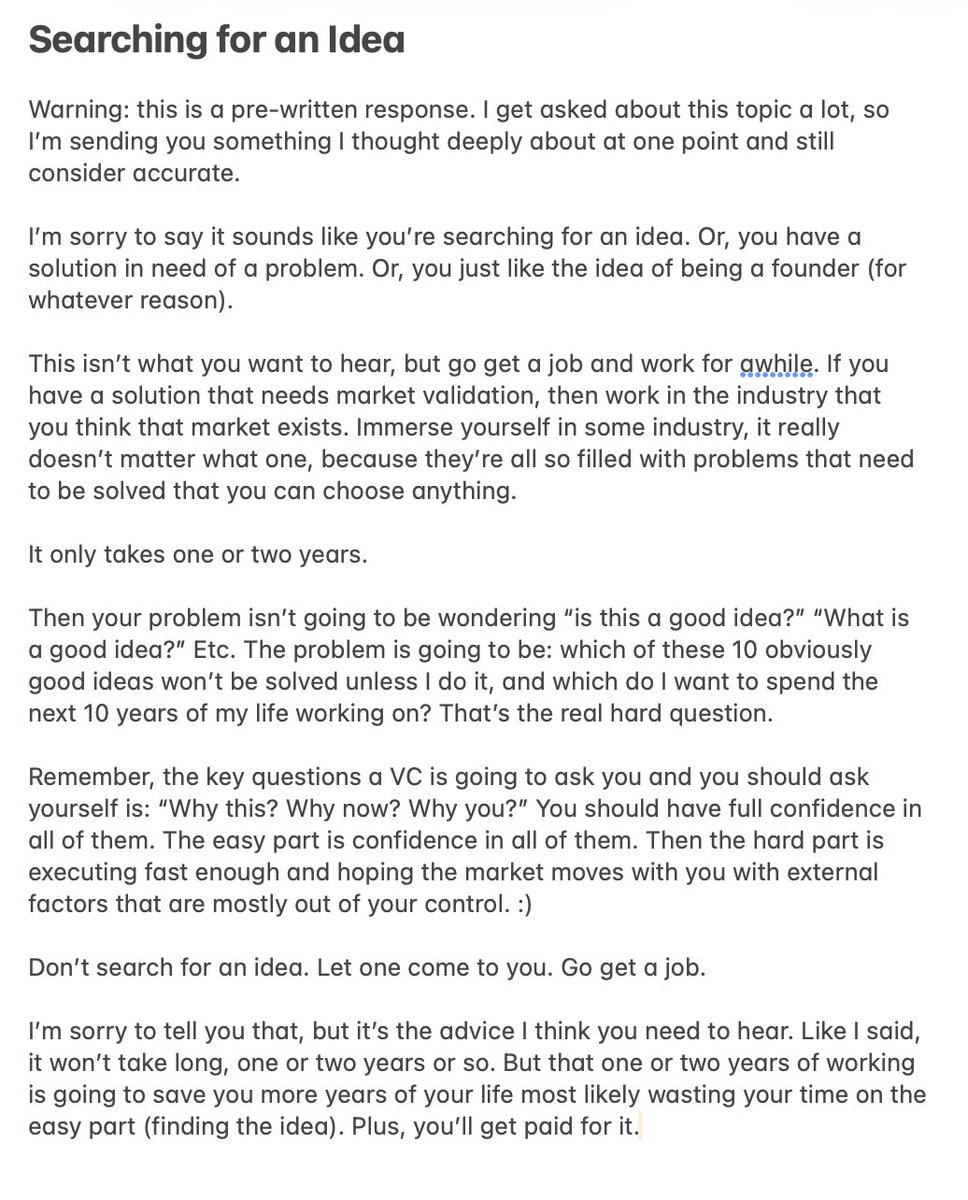
I answer about a dozen or so emails every week from students and early stage founders. One of the most common red flags I see are people who want to be a founder for the sake of it and are chasing ideas or guessing. It's so common I have a canned response. Here it is:
(Starting the canned response here)
I’m sorry to say it sounds like you’re searching for an idea. Or, you have a solution in need of a problem. Or, you just like the idea of being a founder (for whatever reason).
This isn’t what you want to hear, but go get a job and work for awhile. If you have a solution that needs market validation, then work in the industry that you think that market exists. Immerse yourself in some industry, it really doesn’t matter what one, because they’re all so filled with problems that need to be solved that you can choose anything.
It only takes one or two years.
Then your problem isn’t going to be wondering “is this a good idea?” “What is a good idea?” Etc. The problem is going to be: which of these 10 obviously good ideas won’t be solved unless I do it, and which do I want to spend the next 10 years of my life working on? That’s the real hard question.
Remember, the key questions a VC is going to ask you and you should ask yourself is: “Why this? Why now? Why you?” You should have full confidence in all of them. The easy part is confidence in all of them. Then the hard part is executing fast enough and hoping the market moves with you with external factors that are mostly out of your control. :)
Don’t search for an idea. Let one come to you. Go get a job.
I’m sorry to tell you that, but it’s the advice I think you need to hear. Like I said, it won’t take long, one or two years or so. But that one or two years of working is going to save you more years of your life most likely wasting your time on the easy part (finding the idea). Plus, you’ll get paid for it.
52
107
1,530
125,869
Afzal retweeted

26 Aug 2025
Steve Jobs on what John Sculley didn’t understand about building great products
“One of the things that really hurt Apple was, after I left, John Sculley got a very serious disease. And that disease—I’ve seen other people get it too—is the disease of thinking that a really great idea is 90% of the work.”
But that’s never the case. As Steve explains, a product idea never turns out as originally conceived because you learn a lot from the details of building it, and there are always tradeoffs you have to make.
“There’s a tremendous amount of craftsmanship between a great idea and a great product… and it’s that process that is the magic.”
He compares a team working hard on something they’re passionate about to a rock tumbler:
“It's through the team--through a group of incredibly talented people--bumping up against each other, having arguments, having fights sometimes, making some noise, and working together... they polish each other and polish the ideas. And what comes out are these really beautiful stones.”
13
134
743
79,541

New Screaming in the Cloud episode! Corey Quinn and our CEO @jedberg "chat about Jeremy's "build for three" rule, a plan for scale without going crazy, why he set Reddit's servers to Arizona time to dodge daylight saving time, and how DBOS makes your app as tough as your data."
Check it out here: lastweekinaws.com/podcast/sc…
5
12
1,392

hey @GeminiApp why don't you support projects on your App yet? every other major provider like Claude and ChatGPT supports it. You guys should be cloning these apps, and yet...
1
37
Afzal retweeted

15 Apr 2025
Warren Buffett: "There's a lot of interest in investing and people are going to yak about it all the time. In the end, what counts is buying a good business at a decent price and then forgetting about it for a long, long, long time. Some people can do it and some people can't."
12
80
671
43,034
Afzal retweeted

13 Apr 2025
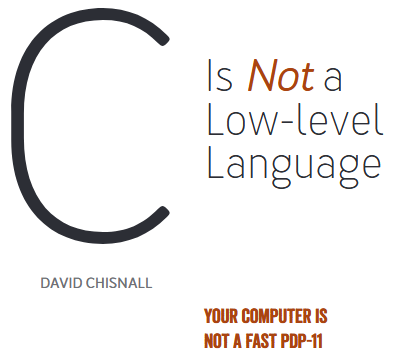
C is Not a Low-Level Language
That sounds pretty scary, doesn’t it! C is the lowest-level language most of us know. If it isn’t “low-level” enough, then what is?
This is a really cool article because it invites us to take a close look at what “low-level language” means. If we think about it, a low-level language should be “close to the metal.” It should have as few abstractions as possible between the programmer and the computer.
Now, C feels like it’s close to the metal. After all, you’re manipulating memory directly with primitive operators and none of those fancy abstractions you’d find in a more modern language. And that’s because C was close to the metal–50 years ago. C was designed as a truly low-level language for DEC’s PDP-11, one of the most popular computers of the 1970s and 1980s. But computers have changed a lot since then!
The first fundamental change in how computers work is instruction-level parallelism. C assumes that all instructions in one thread of your program execute sequentially in order. But that hasn’t been true for years! Modern CPUs are tremendously sophisticated parallel processors that inspect adjacent instructions and try to run as many as possible in parallel, even speculatively executing instructions that may never run. And most modern CPUs contain many such processors, so fast programs must be truly parallel, with many threads–something C doesn’t make easy.
The other fundamental changes in how computers work is hierarchical memory. C assumes that memory is a big array that you can randomly index into. But modern architectures have multiple layers of cache between memory and the CPU, and random indexes into memory are slow. To make C run fast, you have to be aware of how the cache works and use it as much as possible, but C provides absolutely no help with this.
So how is C so fast if it isn’t a low-level language? The answer is tremendously sophisticated compilers. A modern compiler, like Clang, runs to 2 million lines of code that was built by hundreds of developers over decades. All this code is necessary to perform dozens of optimizations to fundamentally change how your C code executes so it can be fast on a modern processor, while keeping (roughly) the semantics you want. The resulting machine code is extremely fast, but almost unrecognizable compared to your original program. And if you want the fastest possible code, you have to deeply understand what these optimizations do and how your computer really works–because your computer is not a fast PDP-11, and C is not a low level language.
6
11
120
18,733
Afzal retweeted

29 Dec 2024
when you look around yourself: do you see inspiration or do you see villainy? do not dwell on the ugly and hope for it to diminish - bask in the beautiful and become a way for it to grow. this is what it means to be inspired
32
72
647
52,025
Afzal retweeted
18 Dec 2024
Want to run a task on a schedule? Want to:
- Track a stock’s price every minute?
- Migrate data once a day?
- Email inactive users once a month?
Check out this new video (w/@qianl_cs) on how to build a scheduled application and deploy it to the cloud in under five minutes!
5
11
1,341
I’m a big believer in Postgres for its versatility.
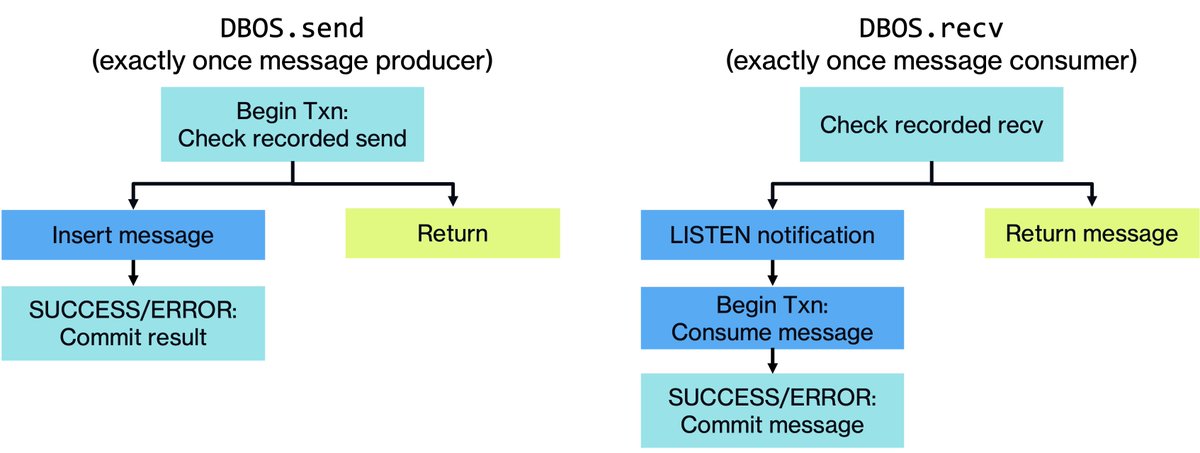
Recently, I was asked why we use Postgres for message queues instead of standard solutions like Kafka. The answer is simplicity: if you don’t need a full-blown message queue, Postgres gets the job done.
Thanks to ACID transactions, tools like PGMQ (used by @supabase) and @DBOS_Inc message queues leverage Postgres where durability and exactily-once delivery are built-in. Messages are just rows in a table, and sending/receiving them is handled by database operations.
Efficiently consuming messages can be challenging. While polling works, it’s inefficient. DBOS improves this by combining Postgres triggers and LISTEN/NOTIFY with database lookups. This allows consumers to be notified instantly when new messages arrive.
Even if a consumer is offline, messages are safely stored in the database. When it comes back online, the messages are there waiting. This hybrid approach ensures durability and responsiveness while keeping the system simple and reliable.
7
34
251
19,798
Afzal retweeted
13 Dec 2024
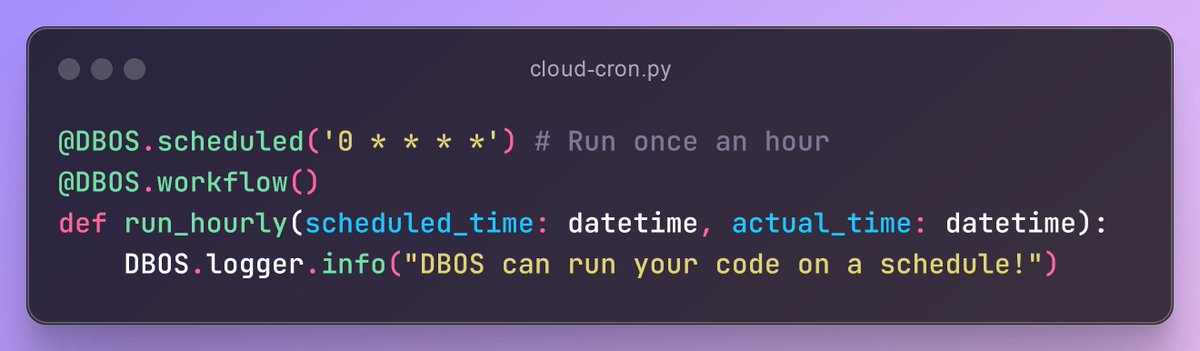
We recently had a user sign up for a paid account with a use case that surprised me–all they need to do is run a Python function every few minutes. The function doesn’t use any unique DBOS features, but instead calculates and posts the value of a financial index.
They could have built this app without DBOS. So why use (and pay for) it? Simplicity.
They wanted a serverless solution that wouldn’t require operations and maintenance, and what sold them on DBOS was that it “just worked.” They could take their existing function, add a “DBOS.scheduled” decorator to it, and it was running on a schedule locally. They could then run a “deploy” command and serverlessly deploy it with tracing and monitoring built in. DBOS helped them ship their tool in a couple days with full confidence it would keep running for as long as they need it.
1
5
11
1,353
Afzal retweeted

29 Aug 2024
how ppl think you get perf: io_uring
how you get e2e perf: napkin math, trace everything, simplify everything, tune TCP (for real), tune LB, hedging, profile client lib
7
22
253
25,432
Afzal retweeted

4 Aug 2024
Yesterday was World Health Innovation Day - I am Chair of @WHIS2020 - a global organisation committed to helping improve the health and wellbeing of the whole population of the world.
To mark the day, here is what we did youtu.be/LAnxm-ofnIk
1
1
350
Afzal retweeted

22 Jul 2024
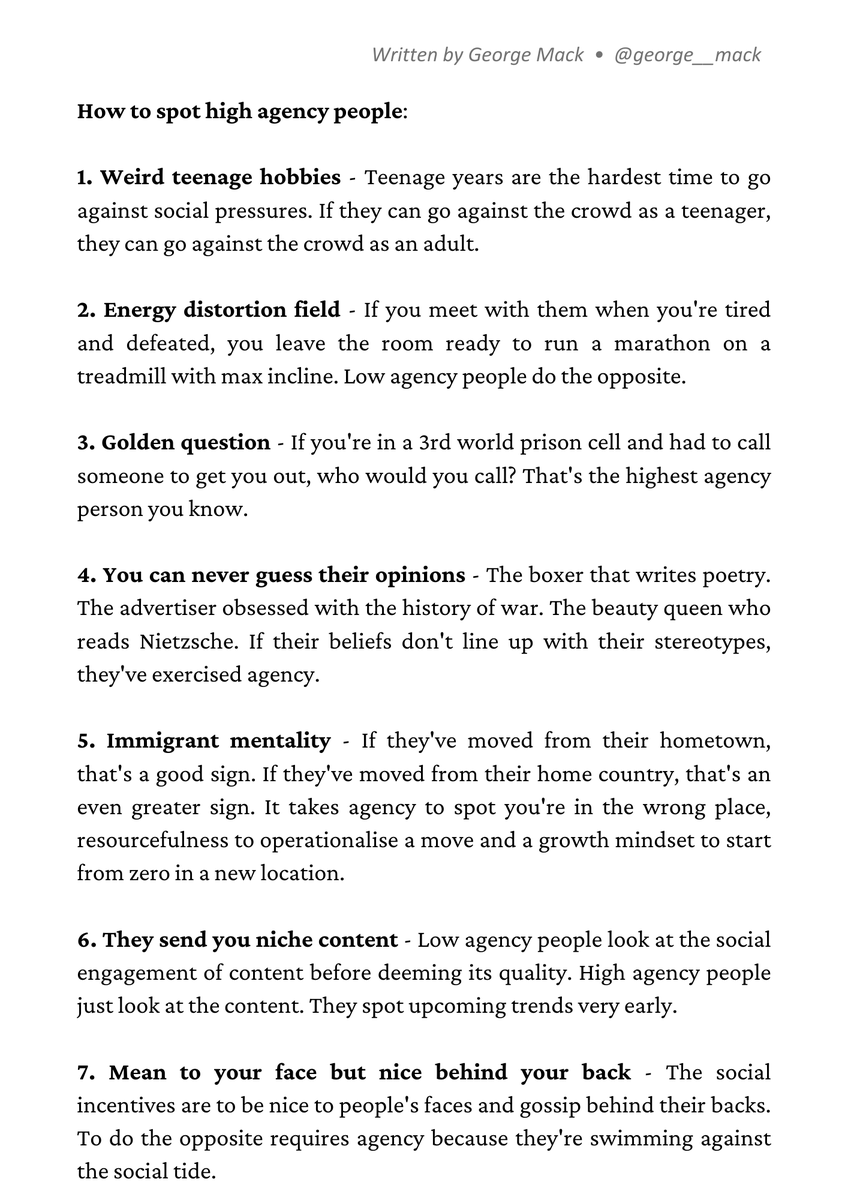
I hate classifications but this is very very good.

44
878
7,046
585,252

From 100,000 miles away 📸
This Apollo 10 image of Earth was taken 55 years ago in 1969.

ALT An Apollo 10 photograph of Earth taken from 100,000 miles away. Visible are many areas of Europe and Africa. Among the features and countries identifiable are Portugal, Spain, Italy, the Mediterranean Sea, Greece, Turkey, Bulgaria, the Black Sea, Libya, Egypt, Saudi Arabia, the Sinai Peninsula, the Nile Delta, Lake Chad, and South Africa. Image credit: NASA
2,038
3,022
21,642
3,722,583
Afzal retweeted

28 Mar 2024
I'm speaking at the Manchester Go user meetup on Wednesday 3rd April - doing an intro to templ. meetup.com/golang-mcr/events…
If you're interested in Go (even if you're not currently using it), come along. It's a nice way to find out what's happening in your local area.
1
2
4
486
Afzal retweeted
1 Dec 2023
Effective cloud systems design is 50% napkin math and 50% figuring out undocumented limits, quotas, throttles and performance characteristics
1
1
25
1,323
Afzal retweeted

22 Nov 2023
Kicking off our Manchester event with Afzal taking us through LLM and Retrieval Augmentation Generation ✨ @afmd97
1
2
4
906
Afzal retweeted

15 Nov 2023
"To get what you want, you have to deserve what you want"
--- Charlie Munger
5
62
406
26,447
Afzal retweeted
10 Aug 2023
to some extent the challenge of adulthood is to not become your trauma
21
30
465
37,536