
Joined April 2020
- Tweets 11,431
- Following 2,116
- Followers 1,528
- Likes 25,024
1,717 Photos and videos


















Archax and @hedera Advance Tokenised Securities with Real-Time Streaming Cash Flows
Archax, the UK/EU-regulated digital asset platform, today announced real-time streaming cash flows for tokenised securities on Hedera, the trusted public network for building fast, secure, and compliant decentralised applications. This capability enables interest payments to be distributed on a near second-by-second basis directly to investors' wallets using Circle's USDC stablecoin on Hedera.
This innovation expands upon Archax's success with pooled token products on Hedera. It marks another step in delivering institutional-grade digital asset infrastructure that improves efficiency, transparency, and liquidity across tokenised markets.
Read the full release here: lnkd.in/e32kan6P
6
55
215
9,352
alamjayaperc retweeted

Jun 11
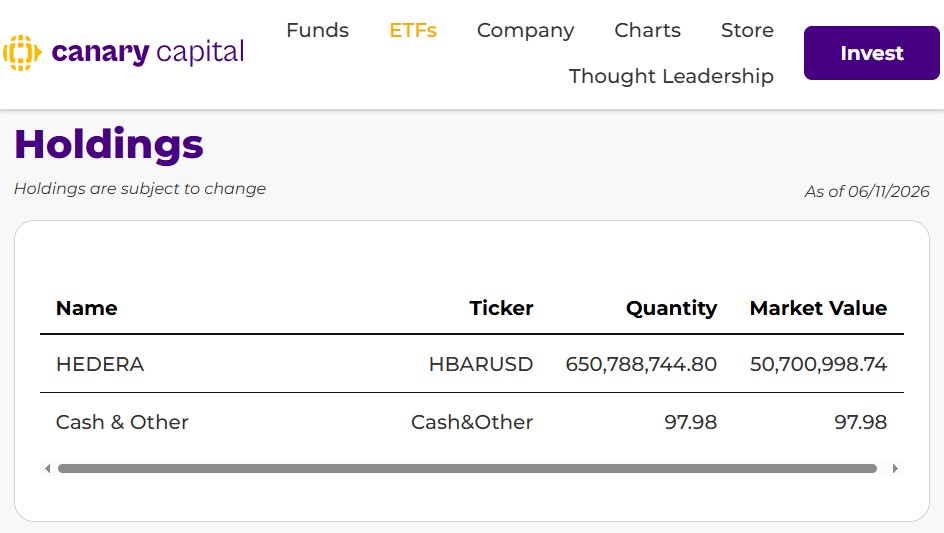
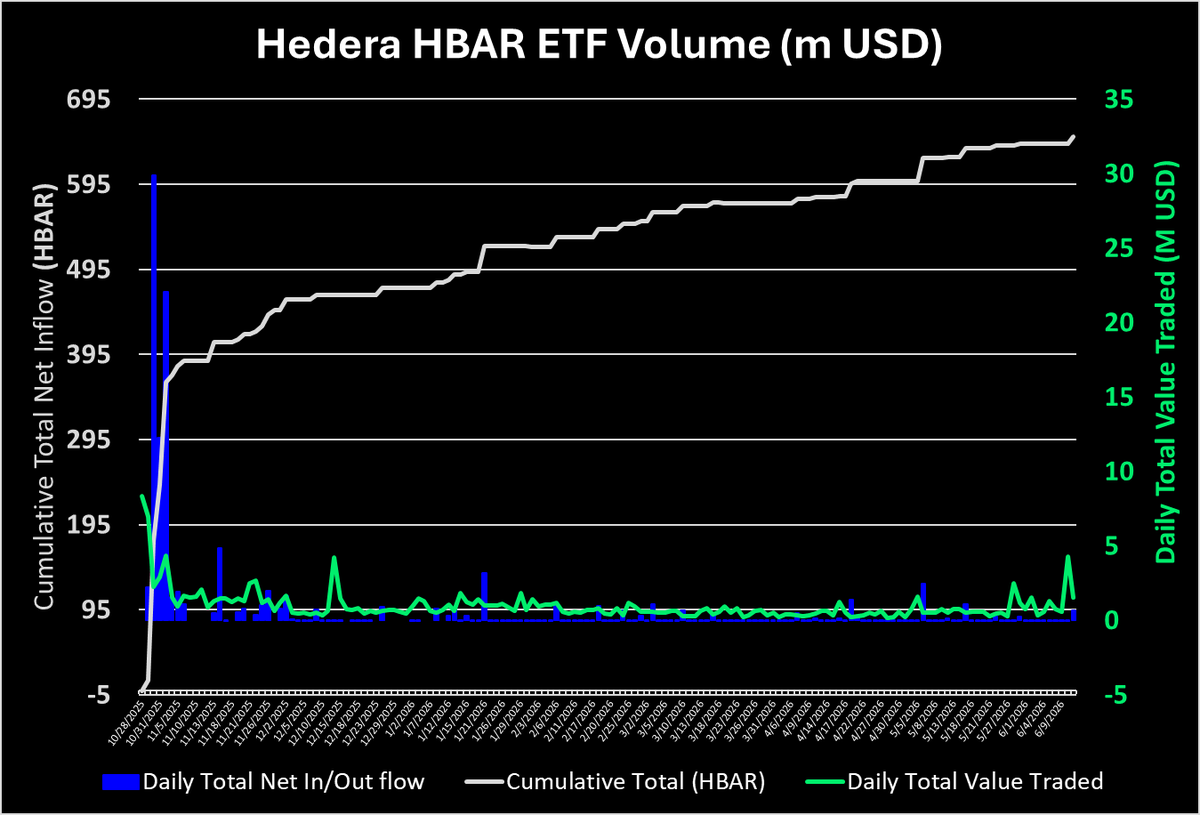
🔥 8.2M $HBAR ($0.64M USD) has been added to @CanaryFunds' @hedera ETF ( $HBR )!
2026/6/11 ETF Trading Volume (In/Out Flow)
$HBAR ETF: $1.54m ( $0.64m)
$XRP ETF: $11.13m
$SOL ETF: $38.50m
$DOGE ETF: $0.15m
$HYPE ETF: $28.54m
$LINK ETF: $1.85m
$LTC ETF: $0.10m
$AVAX ETF: $0.03m
$DOT ETF: $0.00m
$BNB ETF: $0.00m
🔗 @SoSoValueCrypto: sosovalue.com/join/984A2Z36
Jun 10

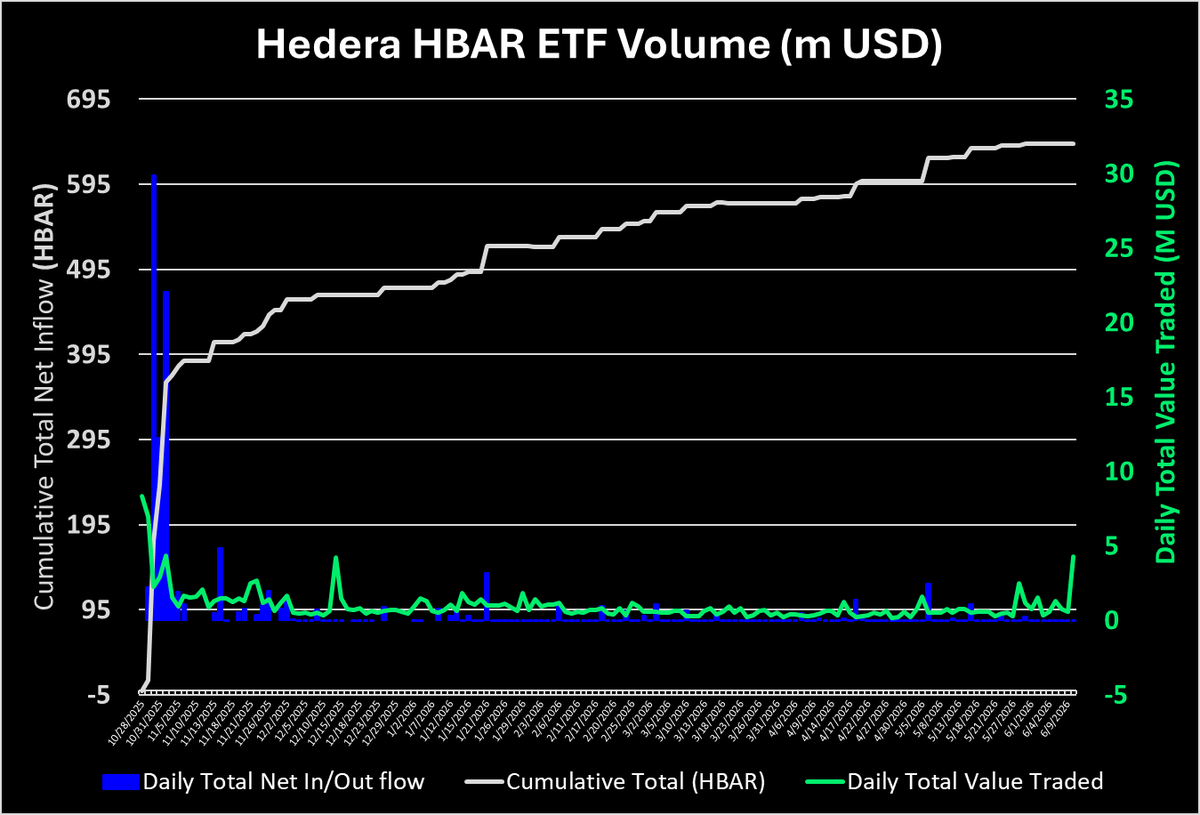
2026/6/10 ETF Trading Volume (In/Out Flow)
$HBAR ETF: $4.26m (-$0.001m)
$XRP ETF: $10.99m
$SOL ETF: $55.43m
$DOGE ETF: $0.11m
$HYPE ETF: $26.68m
$LINK ETF: $0.95m
$LTC ETF: $0.12m
$AVAX ETF: $0.10m
$DOT ETF: $0.01m
$BNB ETF: $0.29m
🔗 @SoSoValueCrypto: sosovalue.com/join/984A2Z36
4
14
66
5,876

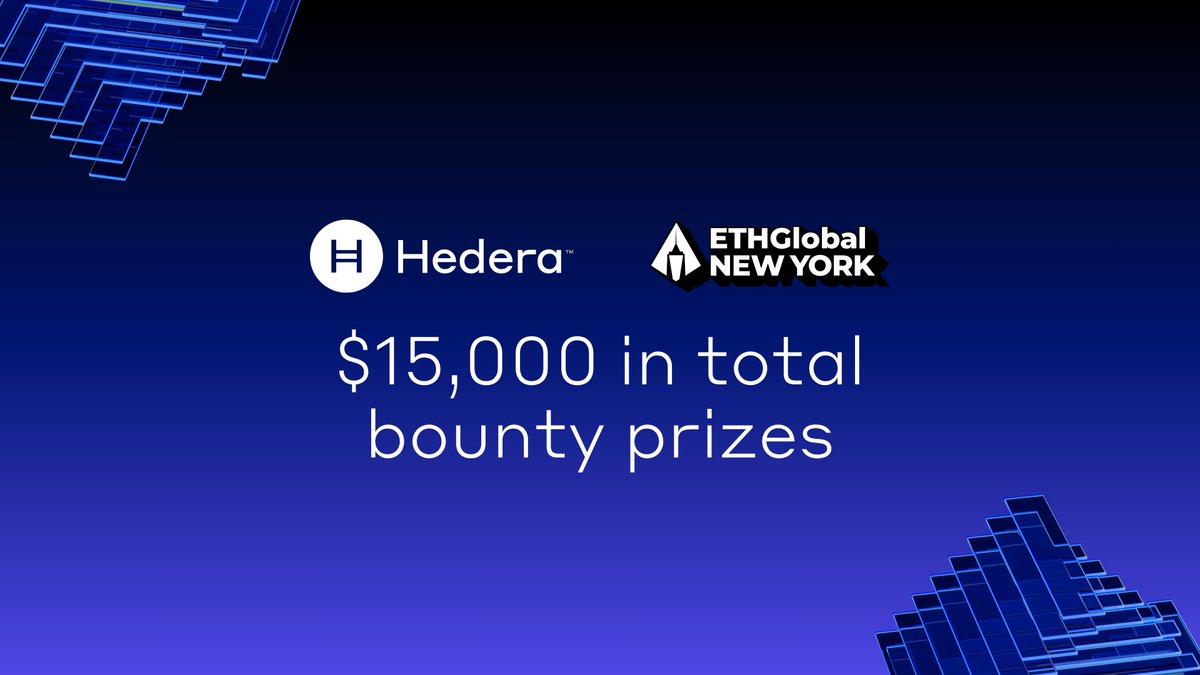
Hedera is offering $15K in total bounty prizes during the @ETHGlobal New York hackathon this weekend 🏆
Check out each bounty 🧵 in full here: ethglobal.com/events/newyork…
9
57
290
8,255
Tokenized securities just got more dynamic.
@ArchaxEx has launched real-time streaming cash flows on Hedera, enabling interest payments to update directly in investors' wallets on a near second-by-second basis using @USDC.
As tokenized securities are traded, payments automatically follow the asset. As ownership changes, cash flows continuously adjust. And because securities can be fractionalized, payments can be too.
This is another step toward more efficient capital markets.
hedera.com/blog/archax-and-h…
21
163
651
28,089
alamjayaperc retweeted
Jun 10
🛡️ @hashgraph Achieves ISO 27001 Renewal and SOC 2 Type II Attestation
Hashgraph has renewed its ISO 27001 certification for a second consecutive year and successfully achieved SOC 2 Type II attestation, reinforcing its commitment to enterprise-grade security and operational excellence.
🔒 According to CSO Joe Blanchard, trust in enterprise DLT must be demonstrated, not assumed. The certifications validate that Hashgraph’s security controls are not only in place, but have been independently tested and proven effective over time.
📋 ISO 27001 confirms robust frameworks for:
• Risk management
• Incident response
• Access controls
• Security governance
🏛️ SOC 2 Type II verifies that these controls operate effectively in real-world environments over an extended audit period.
🔗 The certifications reinforce HashSphere’s position as a trusted @hedera-powered DLT platform for regulated enterprises.
🚀 Hashgraph continues to support enterprise adoption of Hedera with security, transparency, and operational rigor.
🧠 In enterprise DLT, trust must be verifiable.

1
13
40
1,081
The trust layer governing AI agents, tokenized assets, and cross-border transactions must be neutral, auditable, and scalable.
Those positioned to provide that infrastructure - like Hedera - will play a critical role in shaping the emerging landscape.
hedera.com/blog/identity-in-…
9
88
436
9,864
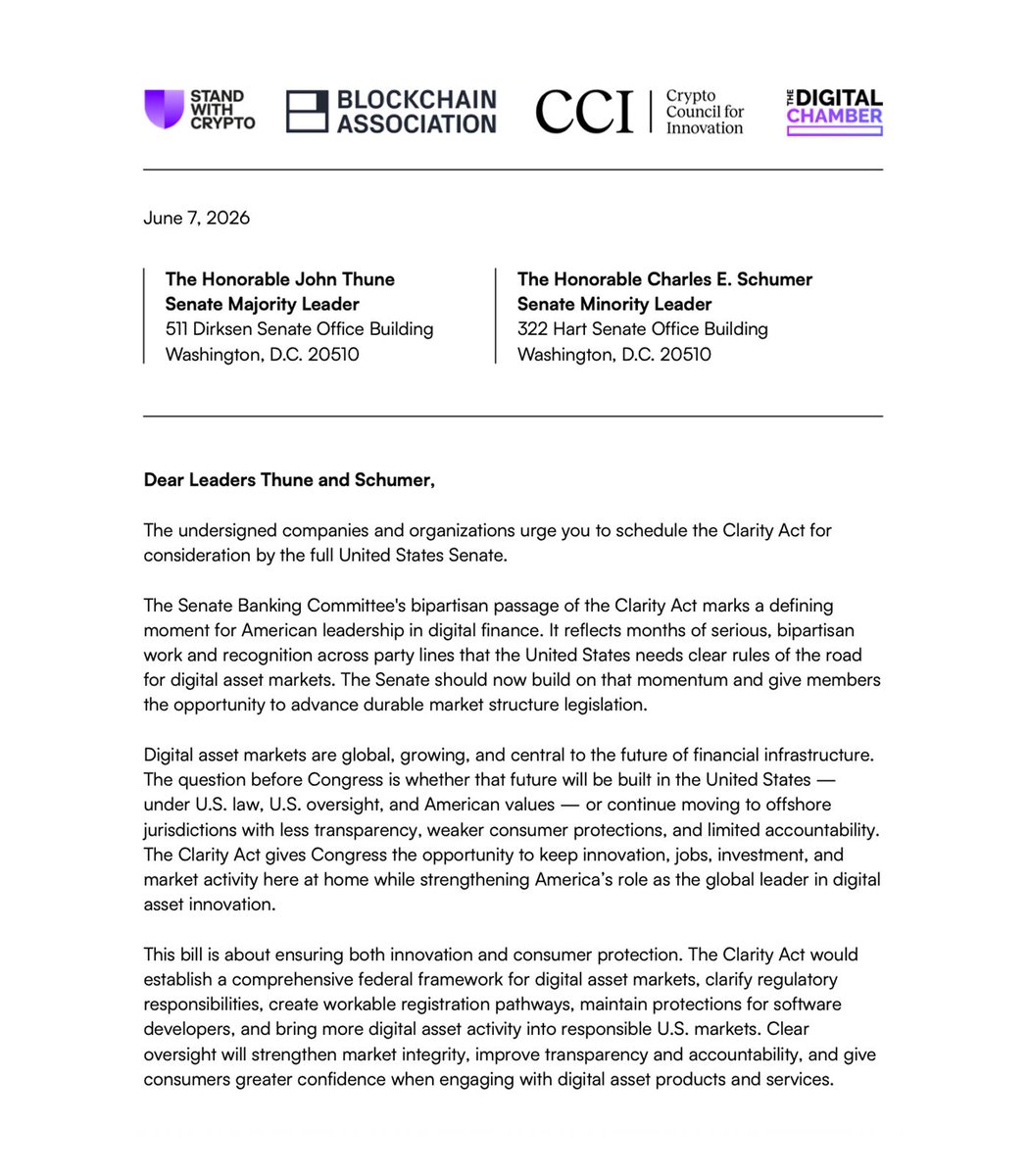
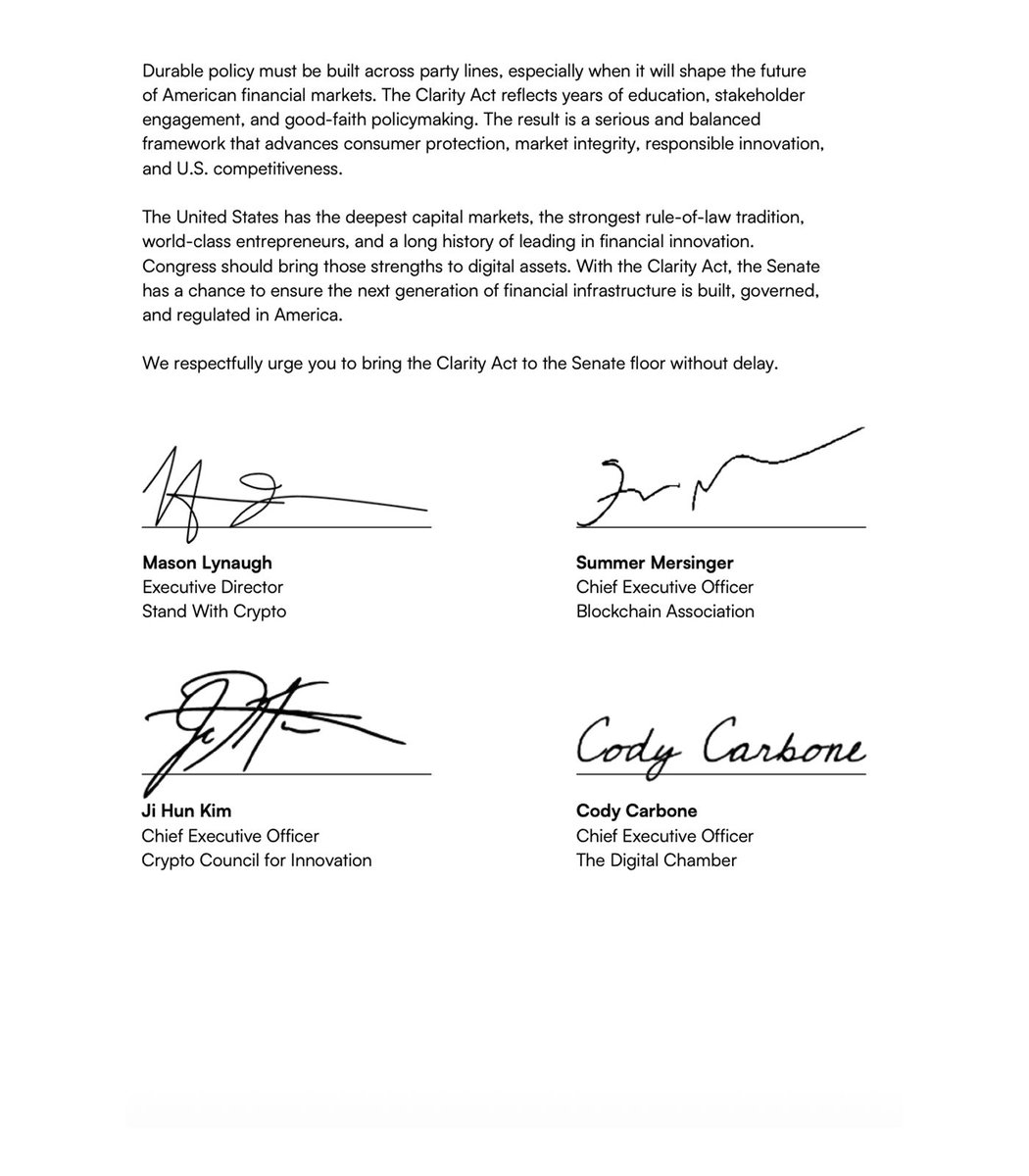
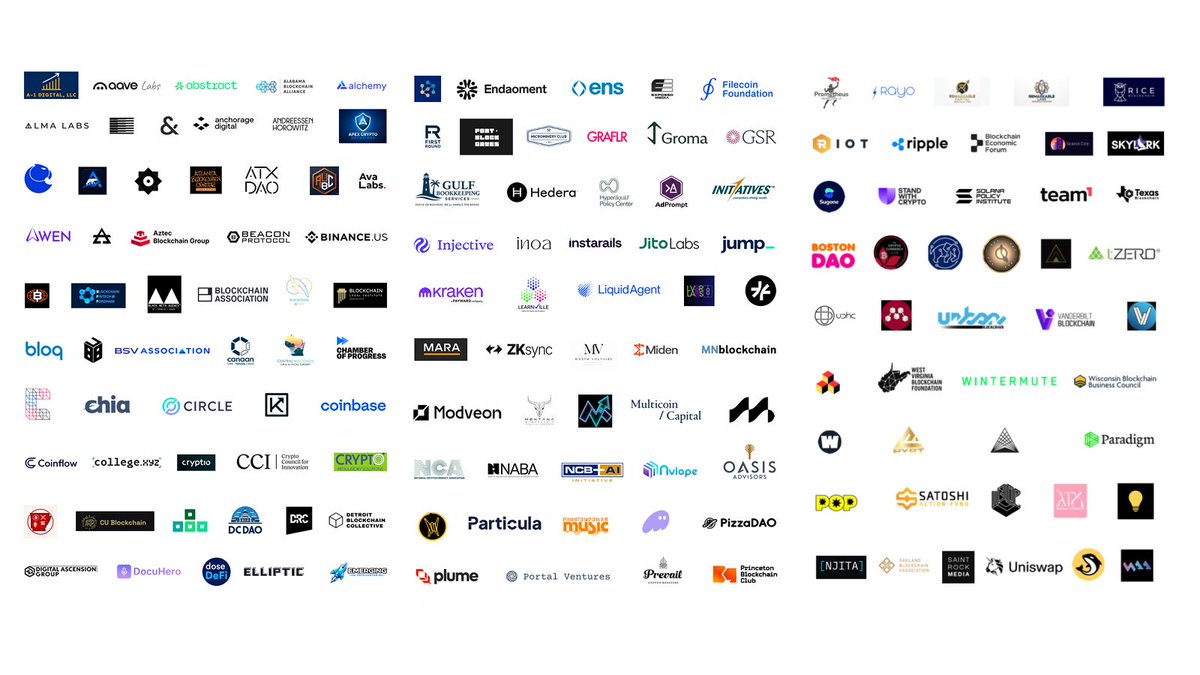
Today, @hedera joined a coalition of over 200 organizations urging Senate leadership to bring the Clarity Act to the floor without delay.
The bill passed the Banking Committee with bipartisan backing and would establish clear rules for digital asset markets, strengthen consumer protections, and ensure American competitiveness.
It’s time for Clarity.

Stand With Crypto and over 200 organizations sent a simple message to Senate leadership: it's time for the Clarity Act.
The community is unified — large companies, startups, associations, and grassroots groups across the country are counting on their lawmakers to deliver rules of the road for crypto in America.
The Clarity Act passed the Senate Banking Committee with bipartisan support.
Now it needs to cross the finish line. Tell your Senators you want Clarity 👇
38
505
2,382
91,272
alamjayaperc retweeted
Jun 3
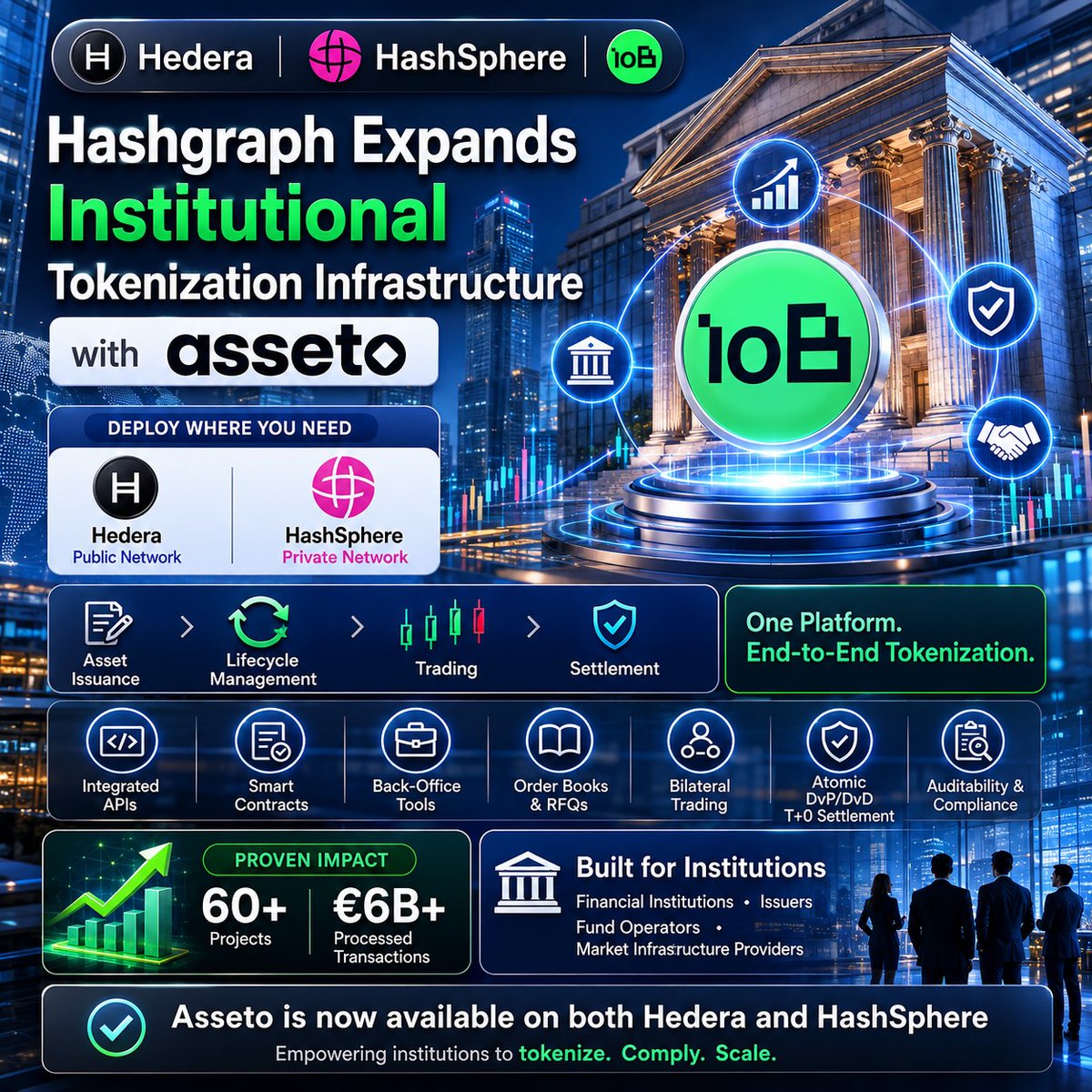
🏦 @hashgraph Expands Institutional Tokenization Infrastructure with Asseto
Hashgraph announced that Asseto, a tokenization platform developed by @iobuilders, is now available on both @hedera and HashSphere.
🔗 Institutions can choose between:
• Hedera public network
• HashSphere private network
allowing deployments tailored to regulatory, operational, and data sovereignty requirements.
📈 Asseto combines:
• asset issuance
• lifecycle management
• trading
• settlement
into a single platform supporting equities, bonds, money market funds, loans, and private equity funds.
⚙️ The platform includes integrated APIs, smart contracts, back-office tools, order books, RFQs, bilateral trading, and Atomic DvP/DvD settlement with T 0 execution and auditability.
🏛️ Designed for financial institutions, issuers, fund operators, and market infrastructure providers, Asseto aims to simplify tokenization without requiring firms to build the infrastructure themselves.
📊 Asseto has already supported:
• 60 projects
• €6B in processed transactions
1
11
50
930
"The smart contract knows the guardrails."
- Dr. @leemonbaird
The future of agentic payments relies on trusted rails. As AI agents begin transacting autonomously, programmable guardrails, verifiable execution, and transparent governance become essential for building trust at scale.
That’s where Hedera comes in.
18
113
515
19,030
The hardest question institutions ask when evaluating blockchain isn't speed or cost. It's whether any participant can manipulate transaction ordering. On many public chains, the answer is yes, that's MEV.
Hedera's architecture removes the conditions that make it possible: no public mempool, leaderless consensus, and fair timestamps.
🔗 hedera.com/blog/why-mev-resi…
11
105
503
23,035
alamjayaperc retweeted
Jun 2
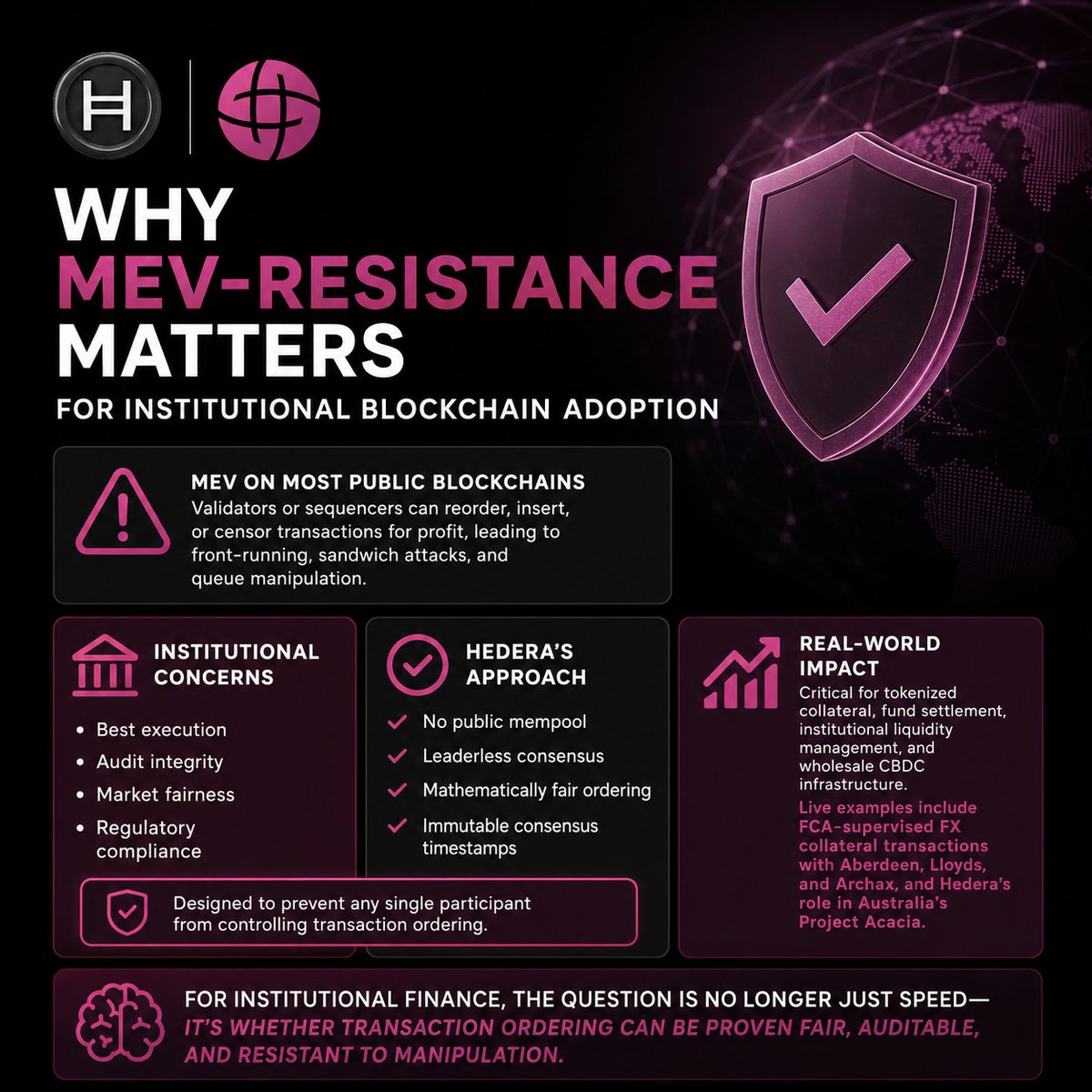
🛡️ Why MEV-Resistance Matters for Institutional Blockchain Adoption
When financial institutions evaluate blockchain infrastructure, TPS, fees, and settlement speed are important—but a more critical question comes first:
Can transaction ordering be manipulated?
⚠️ On most public blockchains, MEV allows validators or sequencers to profit by reordering, inserting, or censoring transactions before settlement, creating risks such as front-running, sandwich attacks, and queue manipulation.
🏦 For institutions, this raises concerns around:
• best execution requirements
• audit integrity
• market fairness
• regulatory compliance
🔗 @hedera approaches the problem differently through:
• no public mempool
• leaderless consensus
• mathematically fair ordering
• immutable consensus timestamps
Together, these properties are designed to prevent any single participant from controlling transaction ordering.
📈 This matters for tokenized collateral, fund settlement, institutional liquidity management, and wholesale CBDC infrastructure.
Recent examples include live FCA-supervised FX collateral transactions involving Aberdeen, Lloyds, and Archax, as well as Hedera’s participation in Australia’s Project Acacia.
🧠 For institutional finance, the question is no longer just speed—it’s whether transaction ordering can be proven fair, auditable, and resistant to manipulation.
3
10
33
914
alamjayaperc retweeted

Discover why Hedera is the leading decentralized network for the next generation of digital innovation. Built for speed, security, and sustainability, Hedera is trusted by global enterprises and web3 projects alike. $HBAR
youtu.be/DGD1LjZdZvM?si=QCvH…
1
12
68
2,045
alamjayaperc retweeted

May 30
Thank you!!
Hedera 🤝 🤝 🤝🤝🤝 🤝🤝 Chainlink
1
5
81
1,861
alamjayaperc retweeted
May 29
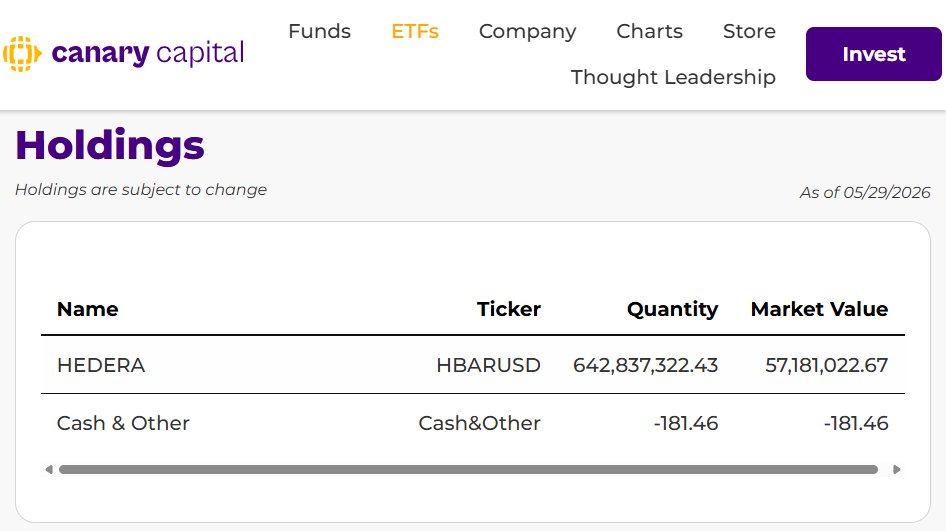
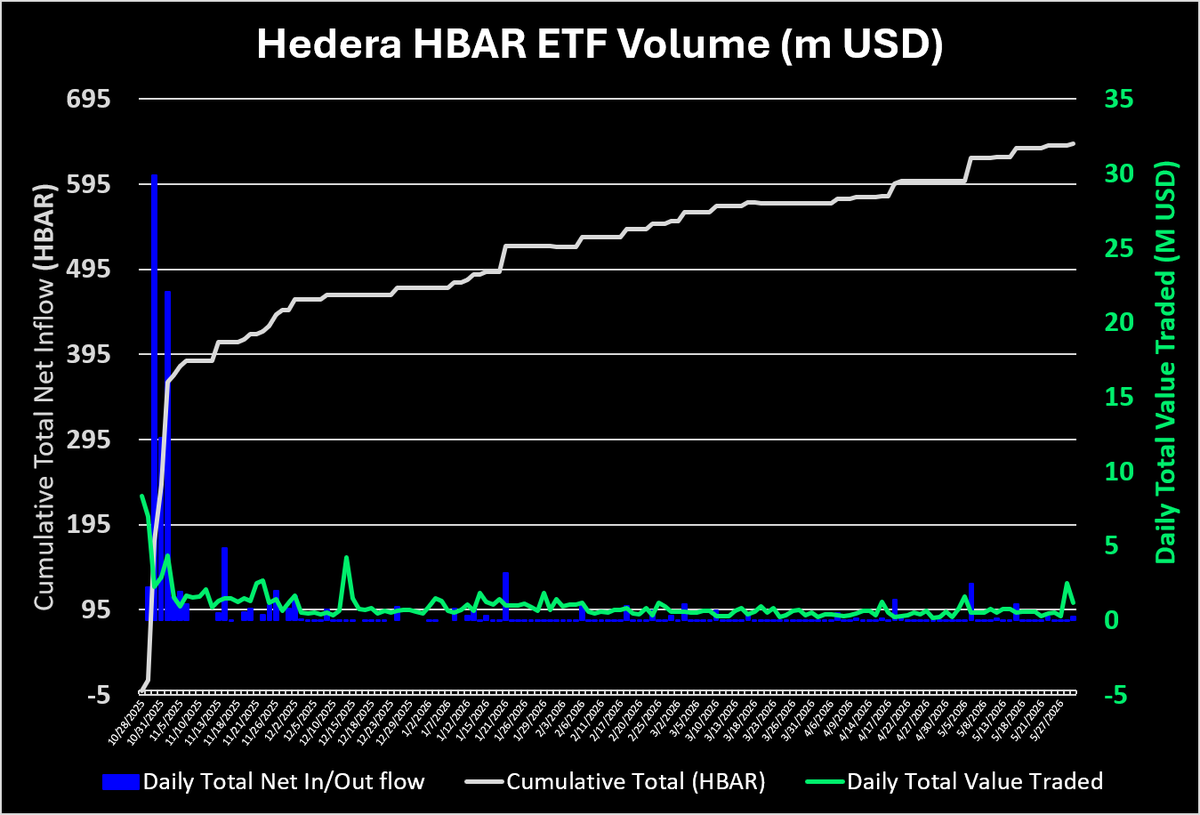
🔥 2.7M $HBAR ($0.25M USD) has been added to @CanaryFunds' @hedera ETF ( $HBR )!
2026/5/29 ETF Trading Volume (In/Out Flow)
$HBAR ETF: $1.18m ( $0.25m)
$XRP ETF: $13.13m
$SOL ETF: $32.44m
$DOGE ETF: $0.36m
$HYPE ETF: $82.42m
$LINK ETF: $4.10m
$LTC ETF: $0.10m
$AVAX ETF: $0.54m
$DOT ETF: $0.00m
$BNB ETF: $0.07m
🔗 @SoSoValueCrypto: sosovalue.com/join/984A2Z36
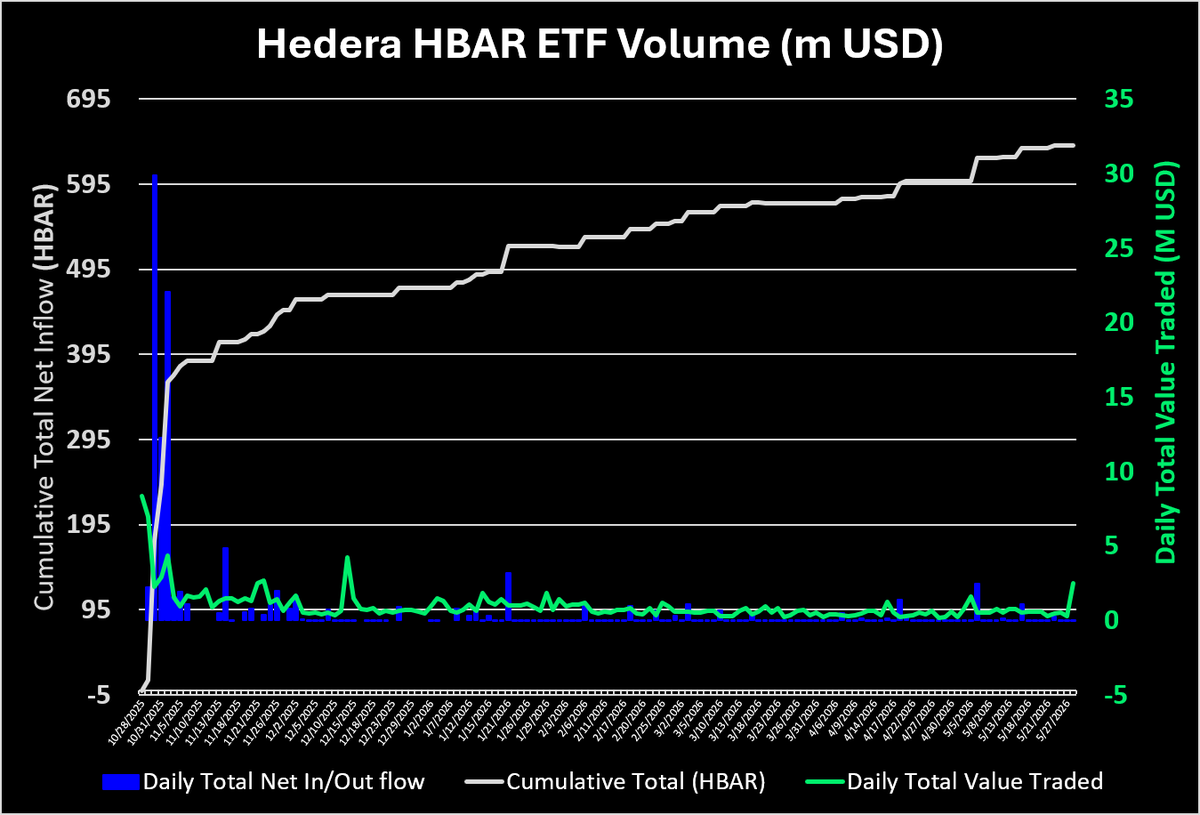
May 29
2026/5/28 ETF Trading Volume (In/Out Flow)
$HBAR ETF: $2.49m (-$0.001m)
$XRP ETF: $12.13m
$SOL ETF: $50.32m
$DOGE ETF: $0.34m
$HYPE ETF: $33.63m
$LINK ETF: $3.42m
$LTC ETF: $0.19m
$AVAX ETF: $0.13m
$DOT ETF: $0.02m
🔗 @SoSoValueCrypto: sosovalue.com/join/984A2Z36
2
13
86
6,100
Hedera is built to connect. 🌐
Through @zerohashx, organizations can seamlessly integrate Hedera-native digital assets and USDC settlement into their customer experiences with compliant, enterprise-grade infrastructure.
Learn more: zerohash.com
Discover the Hedera ecosystem: hedera.com/ecosystem/
12
119
594
18,229
The Bank of England’s DLT Innovation Challenge report noted that no DLT model achieves fast, deterministic finality without trade-offs.
Hedera was designed specifically for that challenge, combining deterministic finality, ABFT security, and decentralisation through a governed model built for institutional trust and resilience.
As wholesale finance evolves, those design choices matter more than ever.
22
154
623
20,452