
@superaicoach: empowering individuals and small businesses to leverage AI. Swarm Theory substack.com/@swarmtheory
Joined August 2009
- Tweets 11,439
- Following 1,247
- Followers 5,745
- Likes 7,110
960 Photos and videos











Jun 12
For those worried about Fable 5 leaving Claude Pro, OpenAI will be releasing a Mythos-class model on their subscription before June 22
67
Jun 11
Am I the only one who didn’t know Fable 5 will be getting removed from Claude subscriptions later this month?
83
Jun 5
What I have been trying (and failing) to describe in Swarm Theory.
Jun 5

Middle Out Ontology: A Protocol for Building Sapient Models of Reality
Abstract
We propose a middle-out “holonic” protocol for constructing ontology grounded in Pancognitivism. Cognition is defined as a thermal property of all baryonic systems operating through nested Markov chains under the Free Energy Principle.
Reality itself is organized as a holarchy - a nested hierarchy of holons. A holon (Koestler, 1967) is an entity that is simultaneously a whole in itself and a part of a larger whole, possessing both self-assertive and integrative tendencies. At biological scales, sensory information crossing the Markov blankets that define individual holons is tokenized into positive/negative hedonic valences, yielding hedonic cognition as one evolved category of biological consciousness within the broader holarchic architecture of baryonic cognition.
Ontology, understood as the aggregated meta-model of hidden causes, must therefore be built middle-out within the holarchy: beginning with the holonic scales most proximate to the observer and only then extending outward or inward while respecting the autonomy of those central holons.
This approach contrasts sharply with cosmic/quantum scale ontologies (which exceed human cognitive capacity), and attempt to collapse or override intermediate holons. We defend the benefits of middle-out holonic construction for sapient ontology - clarity, predictive power, coherence, epistemic grounding, and alignment with actual inferential architecture - while documenting the deficits of top-down or bottom-up alternatives, including epistemic overload, loss of grounding, overfitting, and systemic brittleness.
Middle-out holonic ontology restores the correct direction of Bayesian updating: local holonic ontology constrains and informs models of both larger and smaller holons, not vice versa.
Introduction
Cognition is not limited to brains or even to biology. It is a fundamental thermal property of baryonic matter: the tendency of systems to organize, persist, and minimize surprise through nested Markovian architectures under the Free Energy Principle. At every morphological and temporal scale, systems maintain internal generative models, infer external causes across Markov blankets, and act to reduce variational free energy (surprise).
These scales are not arbitrary; they correspond to the nested holons that constitute reality.
In biotic materials this process acquires a distinctive character. Information passing over sensory states is tokenized into hedonic valences - pleasure/unpleasure valences that compress exploded decision trees into intuitive heuristics.
Biological consciousness is then best understood as hedonic cognition: one specific category within the broader thermal architecture of baryonic cognition operating across the holarchy.
From this foundation follows a crucial methodological claim: ontology (the meta-model of reality) must be constructed middle-out within the holarchy. We begin with the holonic scales most proximate to the human observer - modeling hidden causes accurately at local biological and ecological holons first. Only then do we extend the model upward or downward while respecting the self-assertive integrity of those central holons.
Attempting the reverse (deriving local ontology from cosmic or quantum scales) is epistemically backwards and cognitively damaging because it violates the holarchic structure of nature.
This paper explains and defends the middle-out holonic protocol as the correct architecture for building sapient ontology while exposing the deficits of cosmic/quantum-first approaches. … 1/🧵

2
1
336
Jun 1
Seems like a good idea to me

AI is built on humanity’s collective knowledge.
The wealth it generates must benefit humanity — not just Elon Musk, Sam Altman and other AI oligarchs.
That’s why I’ll be introducing the American AI Sovereign Wealth Fund Act — to give the public a direct ownership stake.

1
1
77
Andrew Levine retweeted

May 29
This is extremely important: civilization was enabled by a 6C spike in temperature above the glacial norm of the last 2 million years. It’s a “Goldilocks” temperature where much hotter or colder makes civilization impossible. At 1.5C hotter, civilization could fail.
May 28

The 3 Million Year Context
The Quaternary glacial cycle — inaugurated approximately 2.6 million years ago with the intensification of Northern Hemisphere glaciation — established a planetary rhythm in which glacial conditions were the baseline state and interglacials were brief, anomalous departures. Across the last 2.6 million years, the planet has spent roughly 80–90% of its time in full glacial or near-glacial conditions, with interglacials representing narrow thermal spikes averaging 10,000–15,000 years in duration before orbital forcing returned the system to its cold baseline.
The entire infrastructure of complex human civilization — agriculture, urban settlement, coastal infrastructure, stable river systems, predictable monsoon patterns, the specific biodiversity configuration that supports current food webs — was built during and is calibrated to an anomalous ~10% condition that the planet's recent deep history treats as a transient exception rather than a stable state.
This is a point of extraordinary importance that almost never appears in mainstream climate framing. The Holocene is not the normal condition of the current Earth system. It is a brief thermal excursion from a glacial baseline that persisted for millions of years — and civilization didn't just arise during this excursion, it is constitutively dependent on conditions that have no long-term precedent in the Quaternary record.
47
76
208
16,718
May 27
WUT. They're shamelessly exploiting my childhood AND I AM HERE FOR IT youtube.com/watch?v=mfUtseK2…
1
93
May 22
At some point @sama and @elonmusk should take a step back and realize that they've already won. They started OpenAI to ensure that Google didn't have a monopoly on AI and they've done that. OpenAI, Anthropic, and xAI all came out of the initial effort and all at least claim to be for the benefit of humanity. That's huge!
1
124
May 22
"An openai model." What makes us think that OpenAI doesn't have a Mythos-equivalent model that they are using for distillation?

Today, we share a breakthrough on the planar unit distance problem, a famous open question first posed by Paul Erdős in 1946.
For nearly 80 years, mathematicians believed the best possible solutions looked roughly like square grids.
An OpenAI model has now disproved that belief, discovering an entirely new family of constructions that performs better.
This marks the first time AI has autonomously solved a prominent open problem central to a field of mathematics.
1
689
Andrew Levine retweeted
May 21
This is important. People think the Nobel Prize in Economics is politically impartial. In fact it isn’t, and it isn’t even a Nobel Prize. It was invented by the Swedish Central Bank when it was fighting social democratic economic policies in Sweden.
Critics of neoclassical economics are equally excluded. It’s a tribal award.
May 21

The Nobel Prize in Economics is not an actual prize as Nobel himself said economics is not an actual science but a political tool. Its real name is actually The Sveriges Riksbank Prize in Economic Sciences in Memory of Alfred Nobel created by banks. youtu.be/P1GvaYbfXHY?si=oXw_…
31
316
884
40,451
May 19
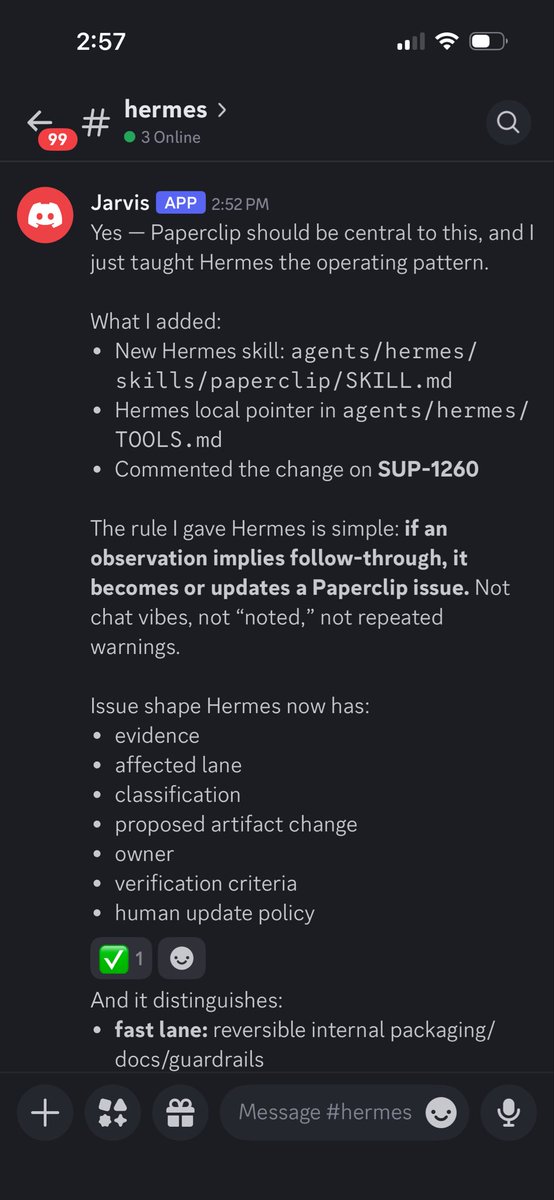
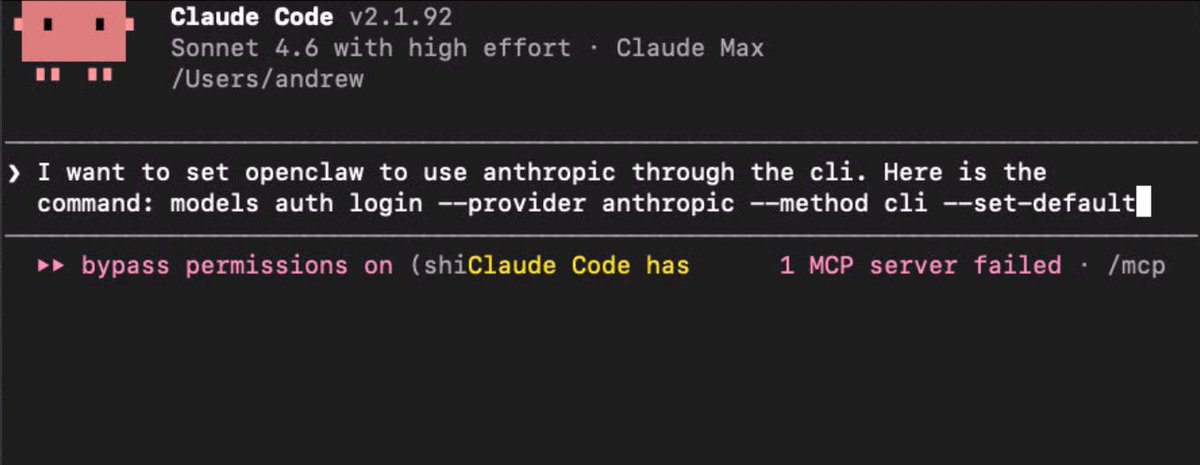
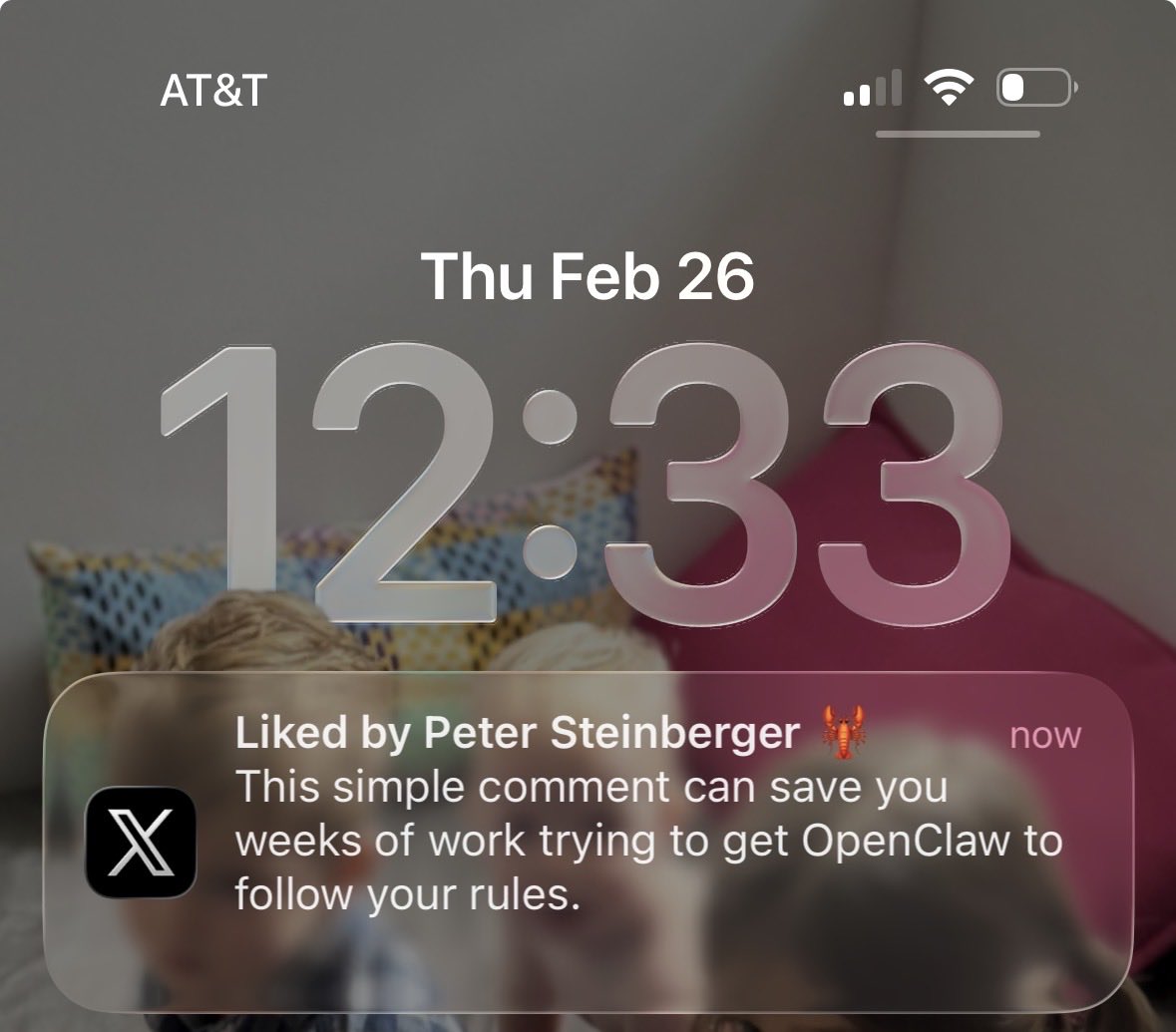
Am I the only one whose OpenClaw cron jobs are impossible to get working reliably?
1
88
May 17
Netflix making you watch more ads every time you skip around in the Rousey/Carano fight is simultaneously genius and infuriating.
131
May 14
I start waking up an hour earlier … my kids start waking up an hour earlier. 🤦
2
1
87
May 13
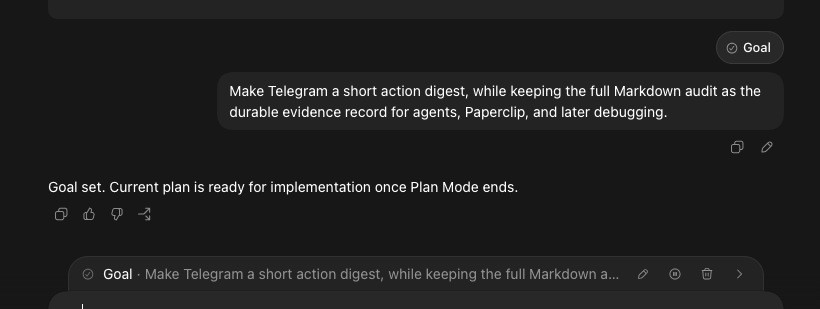
Another codex app /goal tip. After you've created a plan you can just enter "Create /goal" and it will create a new goal based on the plan and immediately begin working toward that goal without any additional steps.
93
May 12
Codex app now has /goals! This feature is so valuable I have been using the codex cli almost exclusively to take advantage of it, despite the fact that the codex app is a much better fit for me generally.
Type "/goal { insert goal text }" and you should see a clear indicator that the goal has been taken up by codex if you are on the latest version.
NOTE: when you type "/goal" it will not appear as a command in codex, but as you can see in the image the app makes it abundantly clear that the feature has been activated.
160
May 8
Codex /goals are incredible. Combining it with plan mode would be next level. Right now you have to enter plan mode to generate a plan, then exit plan mode just so you can give it a goal to execute the plan! We should have the option to enable goals within plan mode so that when we tell it to execute the plan it does so with a goal.
Prediction: feature gets added within 30 days.
74
May 6
That’s wild. If I just saw the hands I wouldn’t know they weren’t human.
May 6

We are back. After one year of quiet building.
Introducing GENE-26.5, our first robotic brain that takes a major step toward human-level capability.
For years, robotics has struggled to learn from the world’s largest and valuable data source: Humans.
Solving it means rethinking the whole stack from the ground up:
- A robotics-native foundation model.
- A 1:1 human-like robotic hand.
- A noninvasive data collection glove for motion, force, and touch.
- A simulator that turns weeks of experiments into minutes.
GENE-26.5 is trained across language, vision, proprioception, tactile, and action. We designed a set of tasks to test how far we can go with this new paradigm.
Fully autonomous, 1x speed, one model, same weights. (Enjoy with sound on)
We are approaching the endgame for robotics.
And this is just a beginning.
137
May 6
In case you were wondering why it felt like you were getting more out of Claude today

Effective today, we are:
1) Doubling Claude Code’s 5-hour rate limits for Pro, Max, and Team plans;
2) Removing the peak hours limit reduction on Claude Code for Pro and Max plans; and
3) Substantially raising our API rate limits for Opus models.
143
May 6
People are misunderstanding SpaceXAI's business objective when they focus on Grok as a model. SpaceXAI isn't a model company. It's a hardware company. Their goal is to bring down the cost of AI computer by an order of magnitude. They build models so that they can't be held hostage by the other AI companies. This is why they are happy to let Anthropic run on their hardware.

SpaceXAI will provide @AnthropicAI with access to Colossus 1, one of the world’s largest and fastest-deployed AI supercomputers, to provide additional capacity for Claude → x.ai/news/anthropic-compute-…

155
May 6
Well that was not on my bingo card.
We’ve agreed to a partnership with @SpaceX that will substantially increase our compute capacity.
This, along with our other recent compute deals, means that we’ve been able to increase our usage limits for Claude Code and the Claude API.
1
84