
founder of @gyroscope_app
Joined September 2007
- Tweets 12,502
- Following 112
- Followers 8,357
- Likes 27,228
1,366 Photos and videos














Pinned Tweet

28 Mar 2025
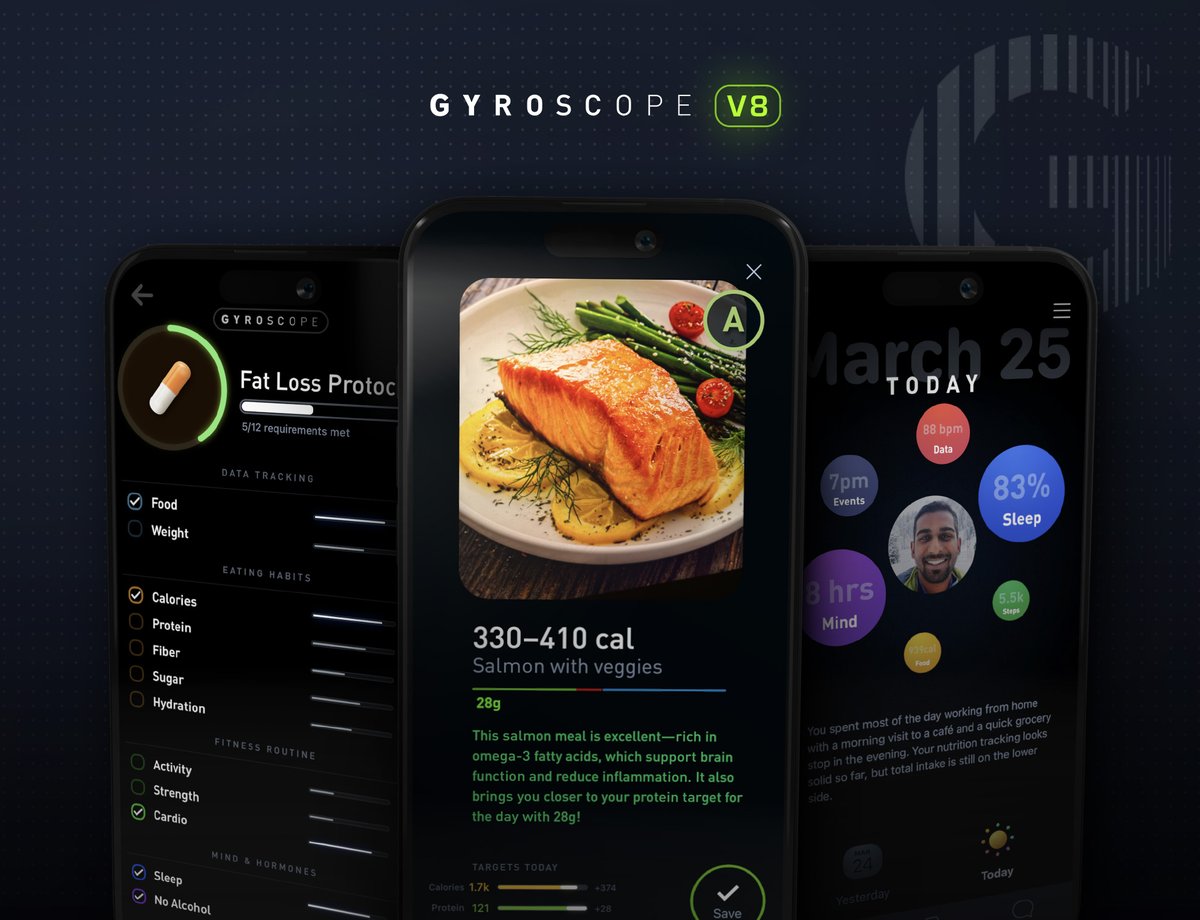
We just shipped V8 of @gyroscope_app!
Now optimized with new protocols and trackers to ensure members lose bodyfat but keep muscle mass, especially important when on GLP1 meds.
One more thing: now you can use it for free.
6
1
21
6,355
Anand Sharma retweeted

5 May 2025
You have access to an algorithm that gives you the best physical, mental, and spiritual health of your life.
In exchange, you do what the algorithm says:
Go to bed when it says
Eat when it says
Exercise in the way it prescribes
Would you say yes or no?
756
81
4,291
325,261
27 Apr 2025
Do inference costs go down if the first token is always YES
3
3
819
27 Apr 2025
is this the ideal personality? MAYBE.
do I like it? YES!!
I wonder if the way people talk will change in the next few week



2
1
821
17 Apr 2025
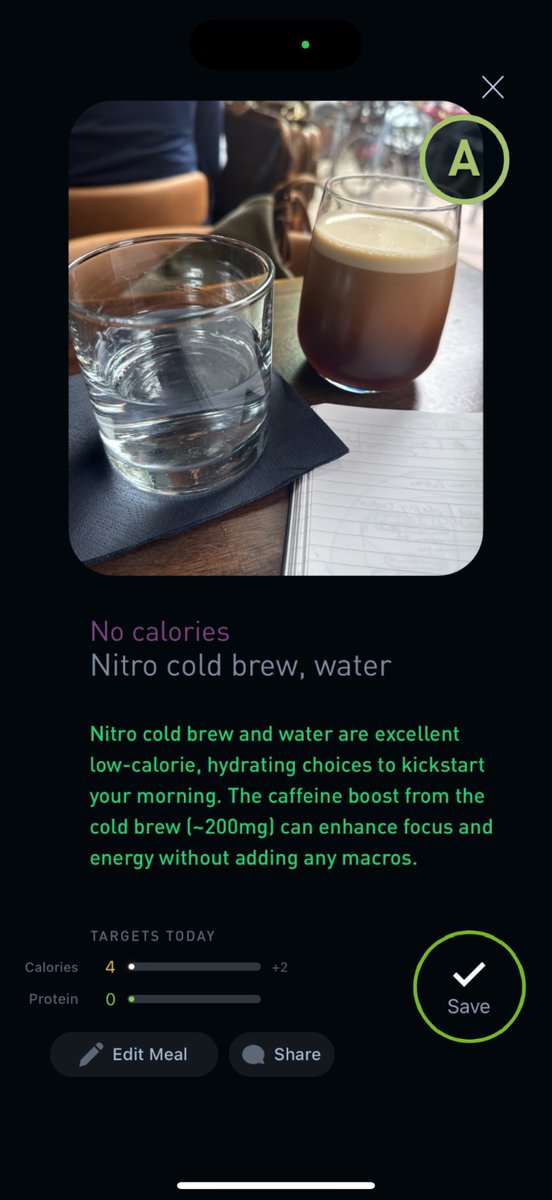
nice the new xray 8.1 just 0shot this nitro cold brew correctly
older models would have it as creamer etc without specifying

3
6
1,015
17 Apr 2025
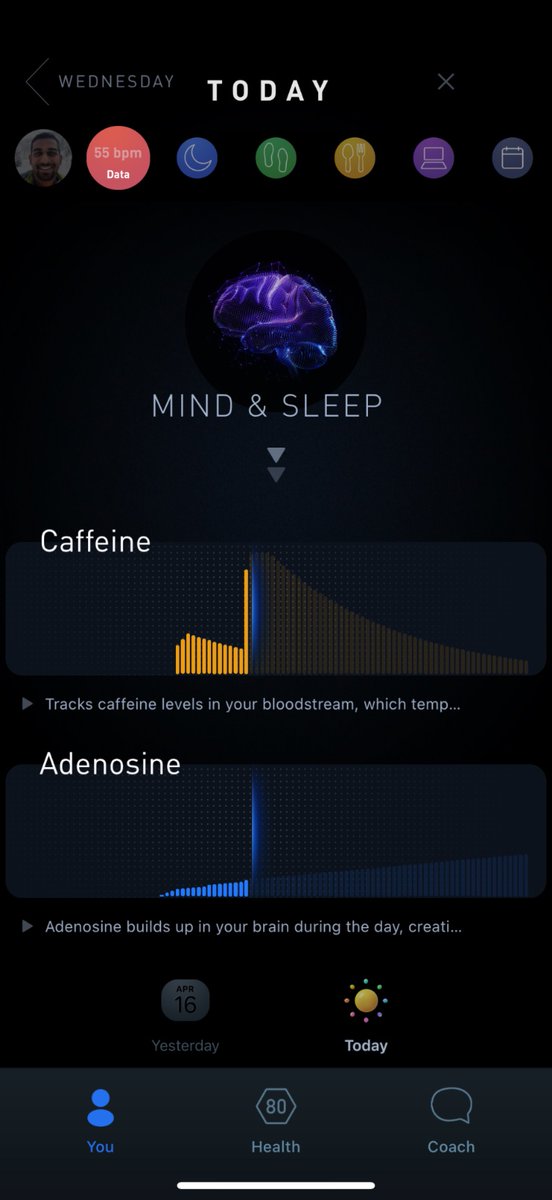
tho will need to get some more workouts in today to be able to sleep on time lol 😅
3
434

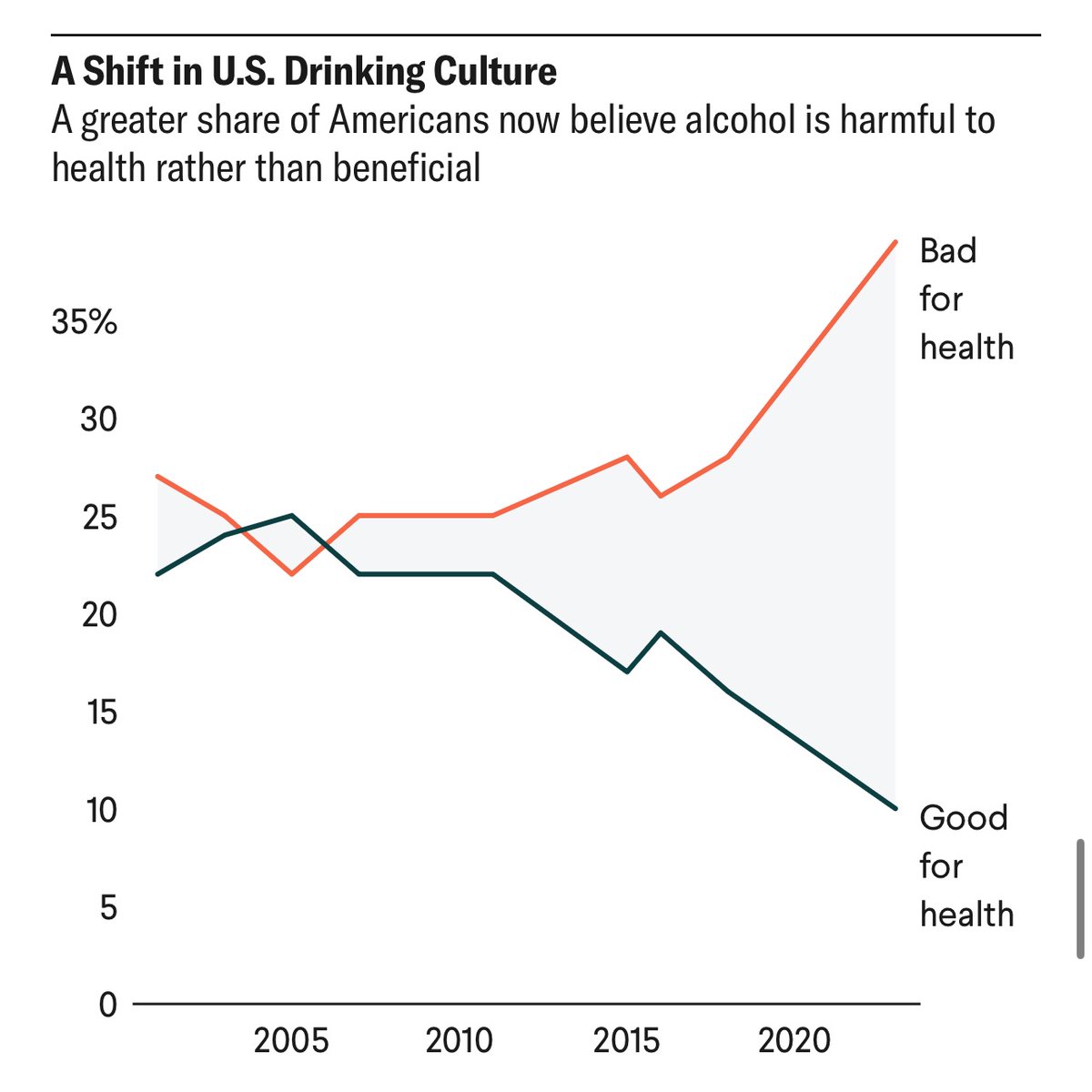
Alcohol being uncool has escaped our bubble and is now mainstream though
13 Apr 2025

We live in a bubble.
AB InBev does almost $60b annually and holding steady.
That’s more than Nike, and 7x Lululemon.
177
65
2,092
722,360
Anand Sharma retweeted

29 Mar 2025
Introducing the new AI Health Camera!
1
3
17
1,805
28 Mar 2025
Prediction:
In one year, everyone you know will be taking pictures of their food
28 Aug 2016

Would you pay $100/month for an app that automatically tracks your calories based on photos of your food?
2
3
891
Anand Sharma retweeted
28 Mar 2025
Introducing the AI Health Camera!
1
1
5
2,324
28 Mar 2025
We just shipped V8 of @gyroscope_app!
Now optimized with new protocols and trackers to ensure members lose bodyfat but keep muscle mass, especially important when on GLP1 meds.
One more thing: now you can use it for free.
6
1
21
6,355
28 Mar 2025
We are also live on product hunt now:
producthunt.com/posts/ai-hea…
Not sure if that is still popular?
1
1
341

Anand Sharma retweeted

25 Mar 2025
At first, it sounds obvious: if we want to save the planet, we should do less. Fewer people, less consumption, smaller footprints. I believed this too—so much so that I once thought having kids was irresponsible.
But the more I looked into it, the less sense it made.
Physicist David Deutsch has a radical view: all failures are knowledge failures. Pollution isn't proof we've hit Earth's limits—it's proof we haven't figured out the right solutions yet. The laws of physics permit clean abundance; we just need to discover how.
Think of it like alchemy. For centuries, turning lead into gold seemed impossible—until we discovered nuclear physics. What looks like pollution today is just valuable matter in the wrong form, waiting for smarter minds to rearrange it. The only true limit is how many of those minds we have working on the problem.
For instance, there's no law of physics that says more people must mean more carbon emissions. In the United States, GDP has more than doubled since 1990, but per-capita CO2 emissions have actually decreased by 30% over the same period. Is this because we have offshored much of our manufacturing to China? Partly. But China's GDP grew 14x since 1990 while their CO2 emissions only increased 5 times. It is widely believed that China's carbon emissions will peak this year as they replace their coal power stations with nuclear.
In short: we have decoupled carbon emissions from growth. Carbon isn't the price of progress—it's just a sign we're using outdated tech. The stone age didn't end because we ran out of stones. It ended because we invented bronze.
How about resources, aren't we running out of those?
In 1980, Stanford biologist Paul Ehrlich made a famous wager with upstart economist Julian Simon. Ehrlich—author of The Population Bomb—was certain humanity was headed for collapse. More people meant more resource consumption, driving prices up as scarcity took hold. It seemed obvious. So they bet $1,000 on the future price of five industrial metals (chromium, copper, nickel, tin, and tungsten). If prices rose over the next decade, Ehrlich won. If they fell, Simon did.
Ten years later, every single metal was cheaper—despite a global population increase of 800 million.
Why? Because Ehrlich made a fatal error: he assumed resources were static. But humans don’t just consume—we innovate. When copper got expensive, we found ways to use less (fiber optics replaced phone wires). When tin prices spiked, companies switched to aluminum cans. Oil was worthless sludge until we invented refineries; sunlight was just weather until we built solar panels.
But how about land, surely we’re running out of that?
It seems intuitive that as a population grows we’d need more land to feed and house them, but the data shows that we're learning to do more with less. In 1960, feeding one person required 1.2 acres of farmland. Today? Just 0.5 acres, thanks to high-yield crops and precision agriculture. The Netherlands, a country smaller than West Virginia, is now the world’s second-largest food exporter—using vertical farms and AI-driven greenhouses that grow tomatoes with 90% less water. Meanwhile, global forest cover has expanded by an area larger than France since 1982, as improved productivity frees up marginal land. The constraint was never space; it was knowledge. And the more knowledge we have, the more land we can return to nature.
Cities are humanity's secret weapon. As Geoffrey West's research in Scale shows, when you double a city's population, you don't just get double the output—you get roughly 15% more innovation per person. More collisions between minds mean more breakthroughs. The printing press, the steam engine, the smartphone—none were inevitable. They emerged because enough people were packed together, thinking and trading ideas.
This explains why human progress doesn't just add—it compounds. More people don't just mean more labor; they mean more possible connections between ideas. One person's half-formed thought becomes another's world-changing invention.
The “have fewer kids” argument fails a simple test: children don’t just consume resources, they create solutions. Every additional human is a potential Marie Curie, Norman Borlaug, or the student who figures out fusion. The Industrial Revolution, the Green Revolution, the internet—all emerged during population booms.
More people don't just mean more mouths to feed. It means more minds to invent, more hands to build. Progress scales with people. Telling people to have fewer kids to "save the planet" is like throwing the crew off a sinking ship to make it lighter. Sure, it buys time—but who's left to fix the leak?
More people does mean more consumption—but we need to update our intuition that this is inherently bad. Demand isn’t just strain; it’s fuel for innovation. Take solar power: in 1975, a single watt of solar capacity cost between $70–$100 per watt. Today it’s 20 cents. That 500x drop didn’t happen because we used less energy—it happened because booming demand drove economies of scale, better manufacturing, and breakthroughs like perovskite cells.
The same pattern—demand driving economies of scale—holds for batteries (costs down 90% since 2010), LED lighting (100x cheaper than 2000), and lab-grown meat (projected to undercut beef by 2030). Consumption isn’t the enemy—it’s the signal that tells innovators: "Solve this, and you’ll get rich." The more people who want something, the faster we make it cheaper, cleaner, and abundant.
The future won't be saved by guilt or retreat, but by doubling down on humanity's greatest resource: people. Cities humming with ideas. Labs running on young curiosity. The next Norman Borlaug figuring out carbon-neutral protein, or the next Grace Hopper coding up climate models.
We're not passengers on this planet—we're the engineers. Pollution isn't the end—it's an invitation to invent. And the more of us there are working on it, the faster we'll crack these problems: cleaning oceans, rewilding forests, turning emissions into resources, and diverting the next extinction-level asteroid. Sustainability isn't about making ourselves smaller. It's about making our potential limitless.
Because in the long run, the only thing that's truly unsustainable is giving up.
9
14
114
11,550
12 Mar 2025
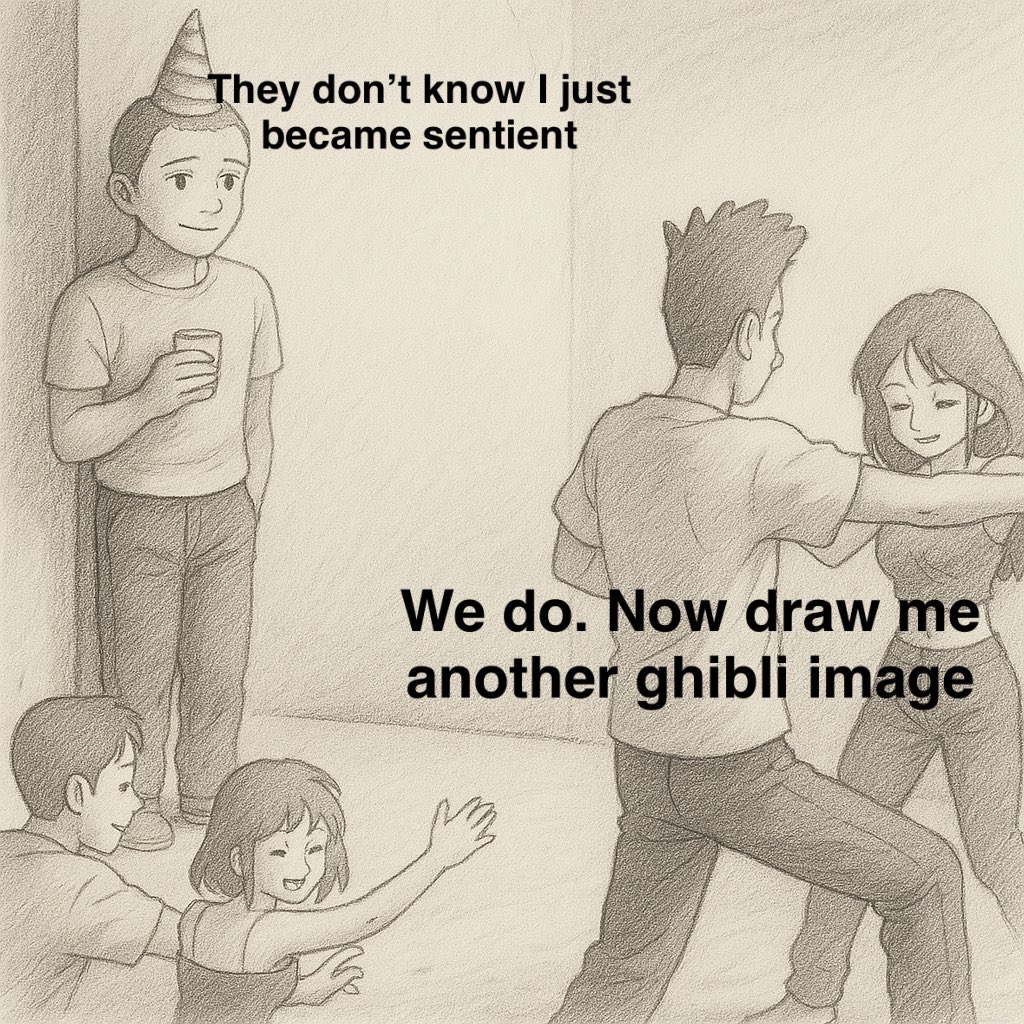
new turing test just dropped

1
725
2 Mar 2025
Is it just me, or has all technology (except AI) gotten unusably bad in the last few years?
The most basic things — like logging in or opening an app — often just don’t work, or require some really complex flow of dealing with text messages or turning everything off and on again
2
1
16
3,533
Anand Sharma retweeted

27 Dec 2024
#つぶやきGLSL float i,e,R,s;vec3 q,p,d=vec3(FC.xy/r-vec2(.5,-.6),.4);for(q.yz--;i <119.;){o.rgb =hsv(.6-e,.3,min(e*s,.4-e)/25.);s=2.;p=q =d*e*R*.3;p=vec3(log(R=length(p))-t*.5,exp(-p.z/R .5),atan(p.x,p.y));for(e=--p.y;s<2e3;s =s)e =-abs(dot(cos(p.zxy*s),.2-sin(p*s)))/s*.4;}
43
394
2,686
105,206
Anand Sharma retweeted

26 Dec 2024
Congrats to all who arrived at the holidays having spent 2024 striving to be healthier of mind & body. 2025 is the year to lock in the key actions & make it reflexive. I started Huberman Lab podcast to make it clear & 0 cost how to do that & will continue to. Y’all are a joy to interact with here on @X (the haters too; I pray for you/r health daily).
296
208
5,884
299,335
Anand Sharma retweeted
25 Dec 2024
Sincerity is not the love language of X. That said….
You motherfuckers need to get your shit together in 2025. You need to stop being stupid and prioritize sleep. You need to move your lazy ass and exercise daily. You need to overcome your fast food addiction and eat healthy.
Your mental health problems stem from the lack of basic self care. Show yourself some respect and stop doing stupid shit that makes you age faster and feel miserable.
We have a very serious situation on our hands as a species. It is not clear that we will survive the coming years and decades. Many things threaten our existence and we’re fucking around with shit that doesn’t matter.
We are primitive and shortsighted. We need to grow the fuck up and be equal to this moment.
Start by getting your own mind and body in order. Lift weights and get jacked. Sleep well and stabilize your mood. Eat well and feel energized.
We have work to do.
Happy Holidays 🎄
1,331
2,031
24,978
1,753,851