Joined September 2022
- Tweets 24,662
- Following 465
- Followers 8,793
- Likes 29,730
365 Photos and videos

Pinned Tweet

May 29
Goddamnit, you all called my bluff. Reach/engagement here is absolutely anemic compared to Bluesky, but we'll start posting again for you holdouts who never made the switch.
2
10
518
Assigned Media retweeted
What's it like being in prison while trans or LGBTQ? Our reporter, B Speaks, reports on life behind bars. This month he wrote about queer inmates' experiences with the Prison Rape Elimination Act.
The Trump administration has removed protections for trans inmates under the act.
1
4
15
496
Everyone telling you it's not that bad is lying. Stop waiting for the moment when everyone wakes up, go out and shake them awake yourself.
150
What's it like being in prison while trans or LGBTQ? Our reporter, B Speaks, reports on life behind bars. This month he wrote about queer inmates' experiences with the Prison Rape Elimination Act.
The Trump administration has removed protections for trans inmates under the act.
1
4
15
496
Here's a link to our original reported story. Check it out and tell your friends about Assigned, your trans news source.
assignedmedia.org/breaking-n…
2
154
Learn about the everyday impacts of microaggressions in this new piece on Assigned Media. It's the most recent entry in our monthly Journal Club column where therapist Veronica Esposito writes about papers or research you should know.
assignedmedia.org/breaking-n…
1
246
Assigned Media retweeted

May 30
The right-wing website Rowling links to was founded by a group that first billed itself as Women for Judge Thomas. It is explicitly anti-feminist by any normal definition of feminism
May 29

I challenge every single person who believes minors should be enabled and even encouraged to transition to read this first person testimony to the end.
1/3
via @IWF independentwomen.com/2026/05…
3
10
270
Assigned Media retweeted

May 29
The role of the Governor is to protect Californians, and to stand between them and danger.
That's a role I take very, very seriously, particularly when it comes to trans youth.
3,173
754
9,425
1,030,296
Assigned Media retweeted

Prior to transition, trans women have brains that makes them want to become women; ciis men do not
It is also likely that over time, through a combination of hormonal exposure, and female – type experiences and interactions, that the brain becomes more female typical with the passage of time

The claim that trans women “have female brains” is not supported by the evidence. One of the most persistent problems in this literature is the failure to disentangle “gender identity” from sexual orientation. Several findings interpreted as evidence of a “female-typical” neuroanatomy in trans women closely resemble patterns previously reported in homosexual males. This is precisely why Savic & Arver (2011) restricted their sample to gynephilic trans women (natal males attracted to women), despite the expectation of feminisation, they actually found that major sexually dimorphic neuroanatomical characteristics remained male-typical and explicitly rejected a simple feminisation account.
The sexual-orientation confound is particularly important because some of the most widely cited “sex-atypical” findings in trans women are not unique to trans populations. Berglund et al. (2006) reported that homosexual women exhibited hypothalamic responses to putative pheromonal compounds that resembled those observed in heterosexual men, while Savic & Lindström (2005) found that homosexual men displayed female-typical patterns of hypothalamic activation. Similar findings have subsequently been cited as evidence of feminised neurobiology in trans women (Burke et al., 2014), despite the fact that the study cohort were predominantly homosexual relative to natal sex. Any interpretation that attributes these neural characteristics specifically to “gender identity” must therefore explain why comparable effects are observed in homosexual individuals who do not experience gender dysphoria.
Cross-sex hormone exposure introduces an equally serious interpretive problem. Estradiol and anti-androgen treatment have been shown to alter cortical thickness, grey matter volume, white matter microstructure, hypothalamic morphology, and patterns of functional connectivity within months of treatment initiation. Hulshoff Pol et al. (2006), for example, observed measurable structural brain changes following hormone treatment, promoting a “sex-atypical” phenotype. Consequently, studies examining participants after years of hormone therapy cannot reliably distinguish pre-existing developmental characteristics from treatment effects. Yet many highly cited papers either include hormonally treated participants or compare treated and untreated individuals in ways that make causal inference difficult.
These issues are compounded by small sample sizes, inadequate control for developmental stage, and the fact that male and female brains are not discrete categories but highly overlapping distributions. The most defensible conclusion from the current evidence is that *some* neural features MAY be associated with gender dysphoria, but causality cannot be implied. The much stronger claim that trans women simply “have female brains” remains unproven and is not the consensus finding of contemporary neuroscience.
43
6
124
12,837
May 29
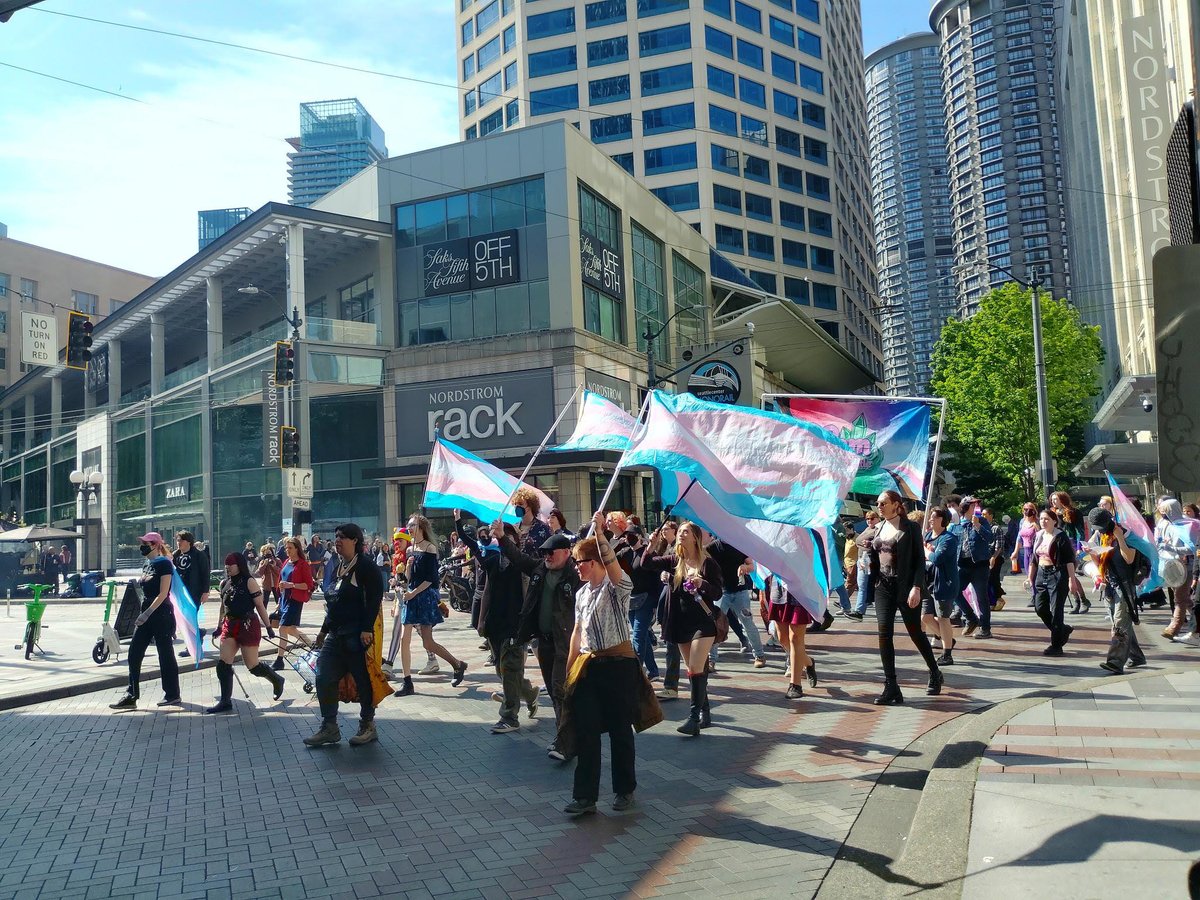
In Seattle, trans activists are calling on the mayor to declare a state of emergency.
The reason? Community nonprofits and mutual aid groups are strained to breaking due to the influx of refugees fleeing oppression in red states.
1
3
13
323
May 29
Reporter Evan Urquhart spoke with local organizers as well as a recent arrival from Utah to get the full story of a community straining to help internal refugees whose dreams of safety are crashing against high costs of living and a lack of jobs.
assignedmedia.org/breaking-n…
1
1
5
203
May 29
Assigned Media is your trans news site, but the algorithm is against us here. If you see this and care about trans news, try to help us beat Elon Musk, the wicked billionaire who hates our community and wants to break us by suppressing our news.
1
1
3
137
May 29
It's hard to get excited about Democrats, writes Aly Gibbs for this week's TWIBS.
Assigned Media is your independent trans news site. We publish daily, and we're not going anywhere until all of us are free.
1
3
387
May 29
Here's a link to Aly's post in the replies, because this terrible website hates when you link out.
assignedmedia.org/breaking-n…
2
308
May 29
Goddamnit, you all called my bluff. Reach/engagement here is absolutely anemic compared to Bluesky, but we'll start posting again for you holdouts who never made the switch.
2
10
518
May 29
(You should really follow us there, where we've got 64K followers now. bsky.app/profile/assignedmed…)
1
363
May 28
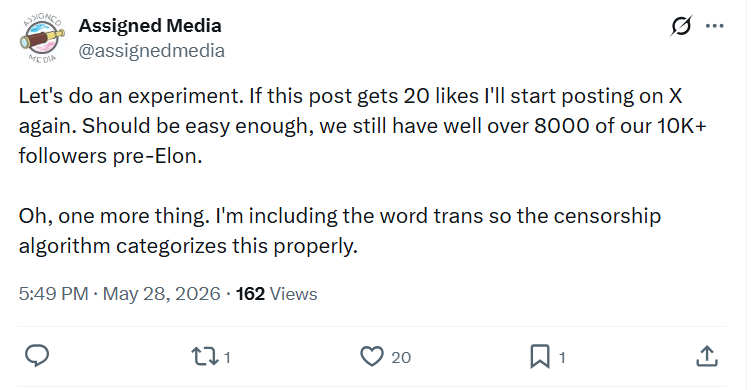
Let's do an experiment. If this post gets 20 likes I'll start posting on X again. Should be easy enough, we still have well over 8000 of our 10K followers pre-Elon.
Oh, one more thing. I'm including the word trans so the censorship algorithm categorizes this properly.
1
22
198
Assigned Media retweeted
8 Dec 2025
New from Assigned Media: @TheFIREorg has gotten lots of attention as an alternative to the ACLU, but I took a close look at its record and found it consistently favours religious-based viewpoints over all others in free speech cases.
assignedmedia.org/breaking-n…
1
5
7
1,259