
Interested in history, anthropology & philosophy. Kurd ☼ ރ
Joined April 2022
- Tweets 6,369
- Following 358
- Followers 2,081
- Likes 23,250
626 Photos and videos
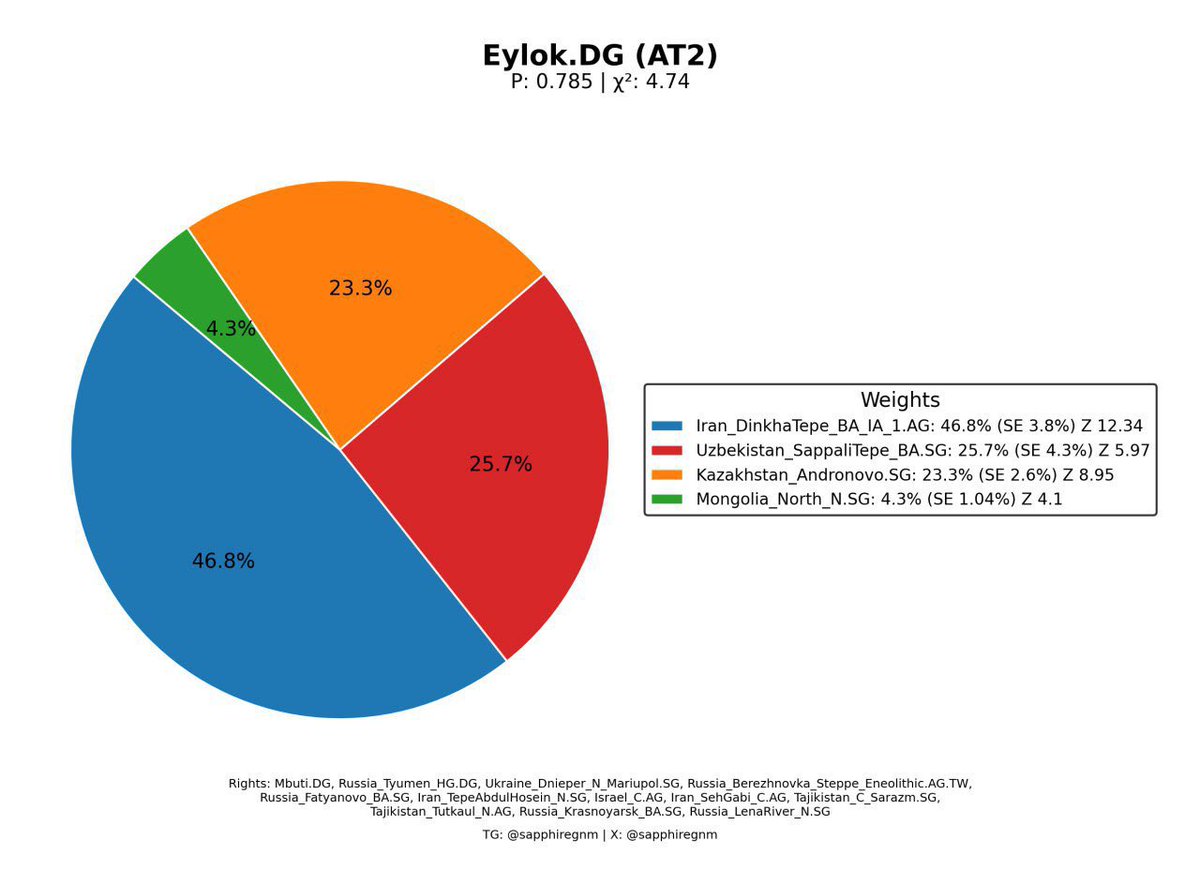
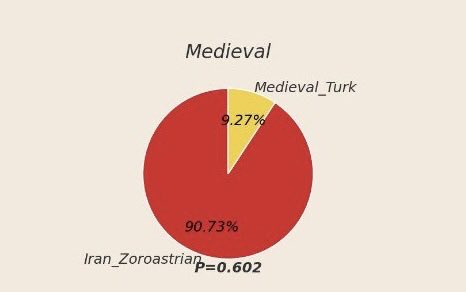



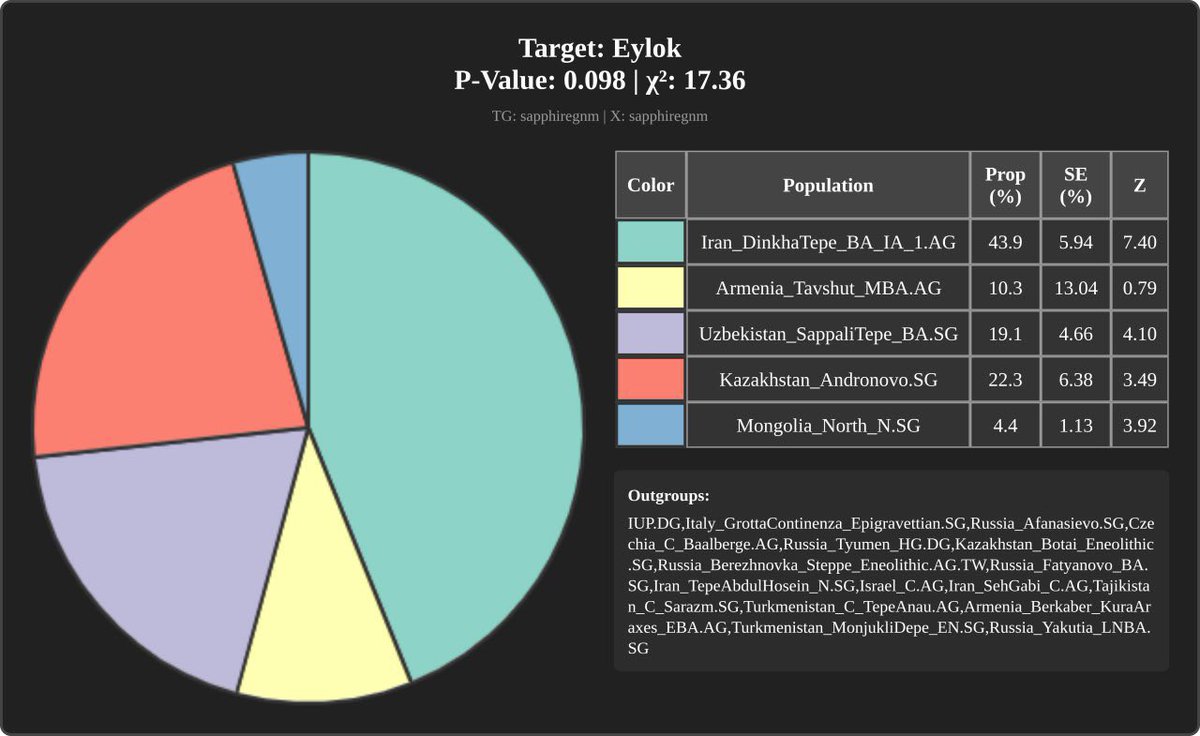


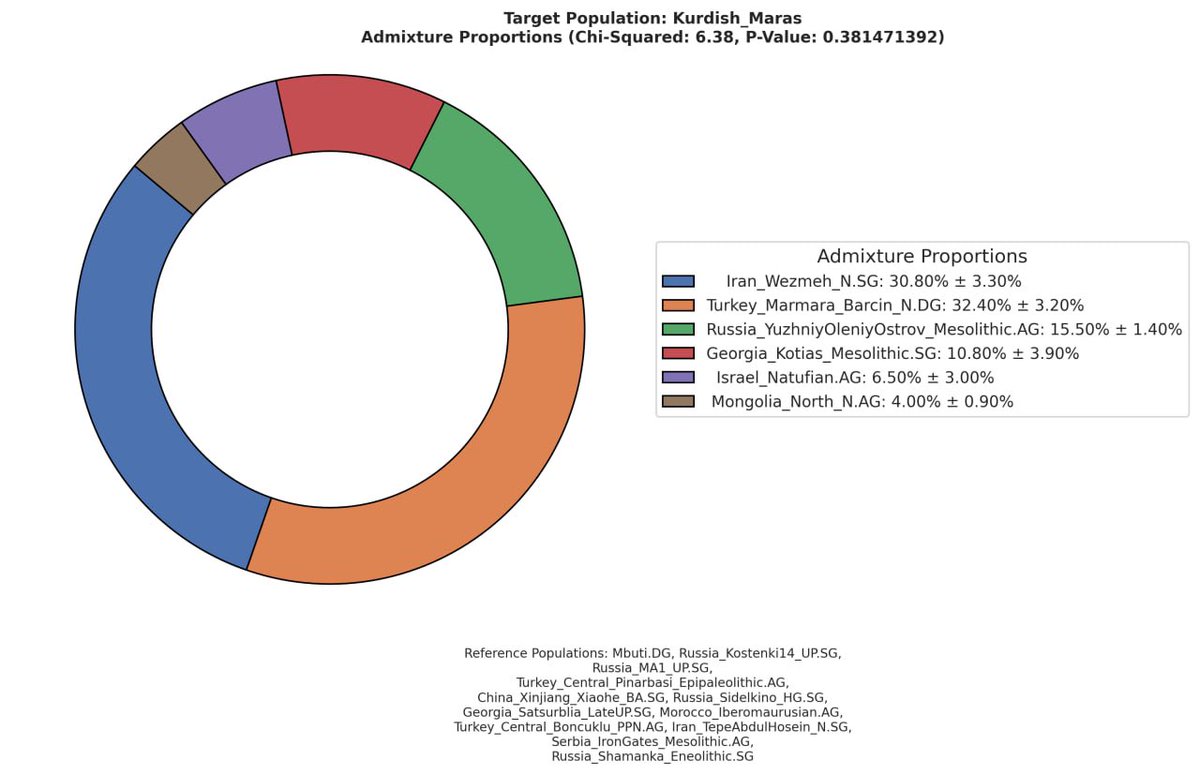
My hunter-gatherer & farmer breakdown with qpAdm by @sapphiregnm
30.8% Zagros Neolithic Farmer
32.4% Anatolian Neolithic Farmer
15.5% EHG
10.8% CHG
6.5% Natufian
4% East Asian
22
6
104
70,581
eylok retweeted

15h
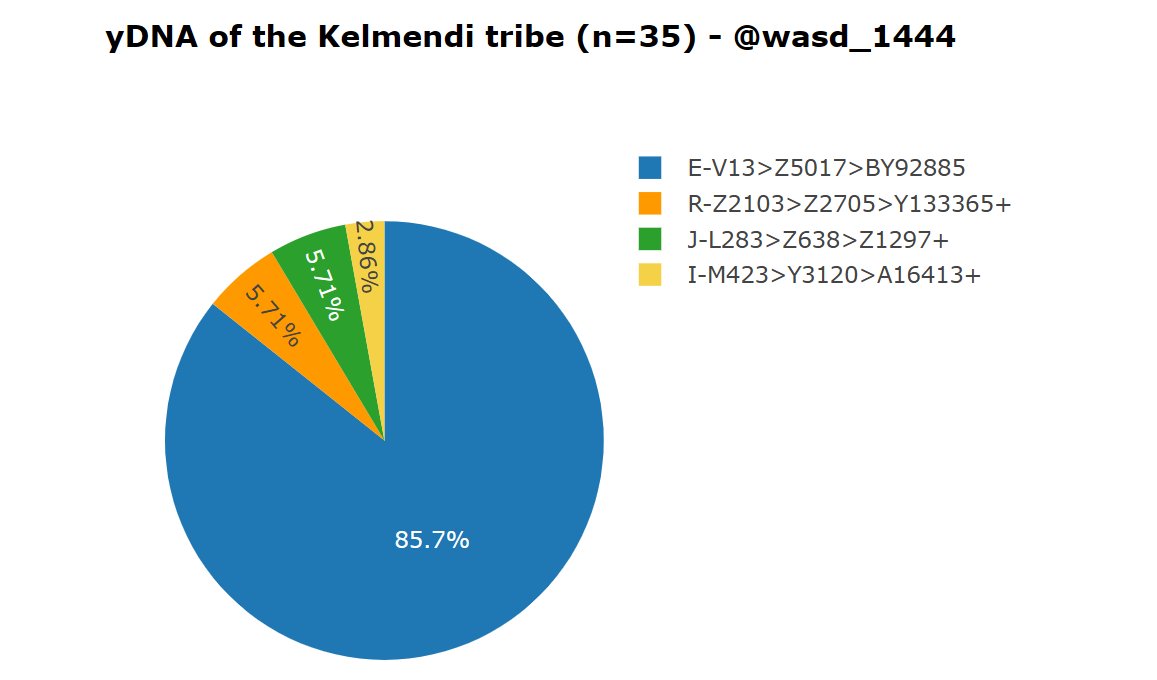
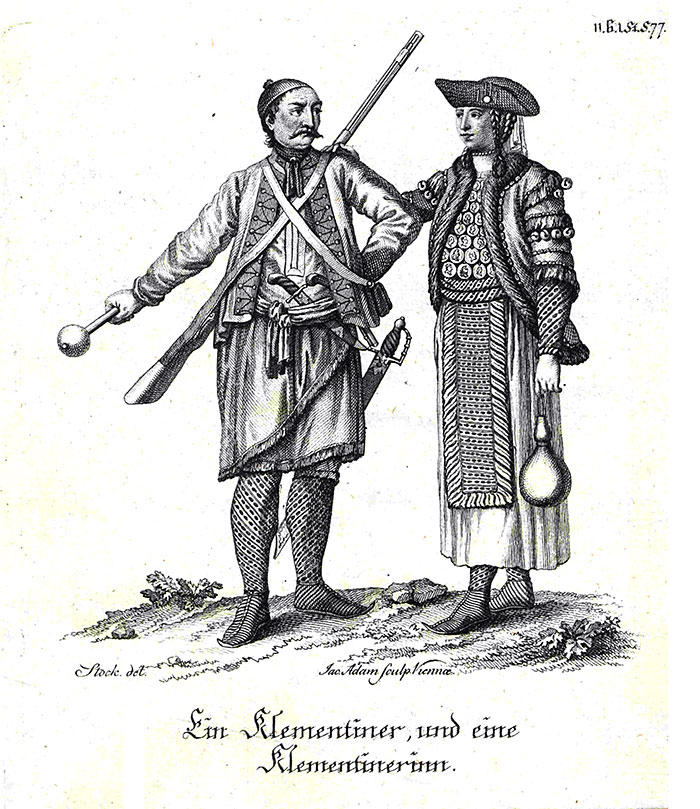
yDNA of the Kelmendi tribe, one of the oldest and largest Albanian tribes.
E1b-BY92885 - TMRCA 1100AD, Paleo-Balkan>Albanian>Gheg
R1b-Y133365 - TMRCA 1050AD, Paleo-Balkan>Albanian
J2b-Z1297 - TMRCA 2300BC, Paleo-Balkan (has to test deeper)
I2a-A16413 - TMRCA 500AD, South Slavic
10
5
54
3,172
eylok retweeted

18h
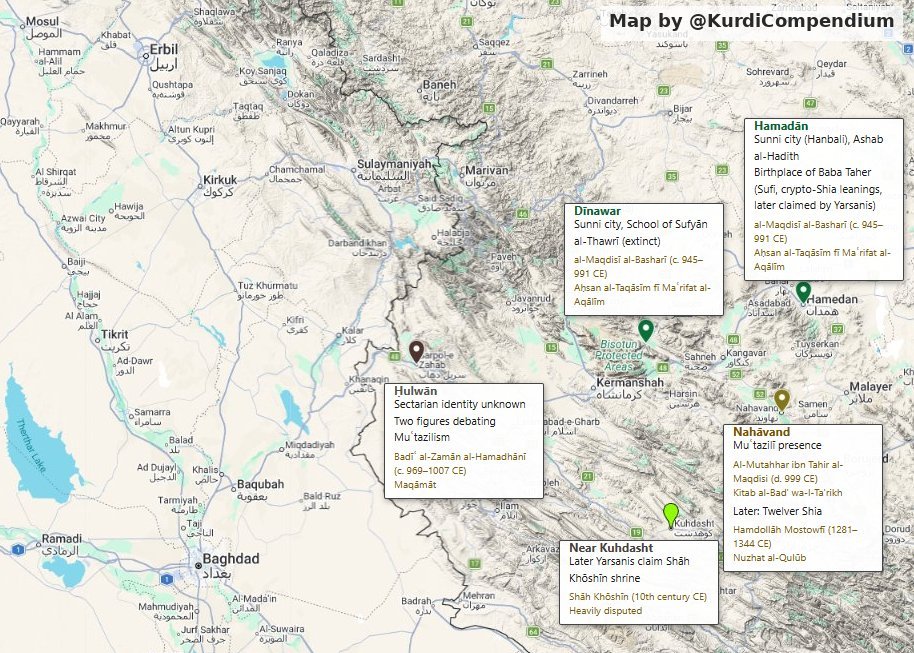
Approximate religious demographics of southern Kurdistan during the high medieval period (900AD - 1300AD).
Southern Kurdistan's traditional association with Shiism is often traced to the rise of the Kurdish Hasanwayhid dynasty, yet Sunni presence appears to have remained dominant in many cities well into later periods. The Mongol conquests shattered central authority in Iran, opening considerable space in which Shia and Shia-influenced movements gained ground, even before the Safavid dynasty's rise. Sultan Sahak, the central figure of the Yarsani faith, supposedly met Timur himself in the late 14th or 15th century and was well received.
Despite Sunni dominance in southern Kurdistan during the high medieval period, some degree of Shiite influence clearly persisted in cities like Hamadan, which was otherwise majority Sunni. Notably, Bābā Ṭāher, a Sufi with crypto-Shiite tendencies, was born into this Sunni environment and was later incorporated as a central figure in the Yarsani faith as well. The historicity of other figures, such as Shah Khoshin near Kuhdasht, remains heavily disputed, and it's unclear whether this represents a later Yarsani invention.
Mu'tazilism during the high medieval period can be traced to multiple locations in southern Kurdistan, such as Hulwan and Nahavand, though it's not entirely clear how prevalent this theological school of thought was.
Conversions to Twelver Shiism from both Yarsani and Sunni communities in southern Kurdistan occurred on a large scale, even into recent times; the Kalhor tribe, for example, underwent a major conversion during the Qajar period (1789–1925).
This map should be considered a first version of the religious demographics of southern Kurdistan. New version will be made in the future if I forgotten to add anything.
1
14
37
2,716
eylok retweeted

I've finally organized years of notes and essays into a blog focused on Kurdish history, philosophy, theology, MENA history more. Most of the material will remain unpublished for a while longer, but I'd appreciate thoughtful feedback on the blog's organization and structure.
5
8
36
1,669
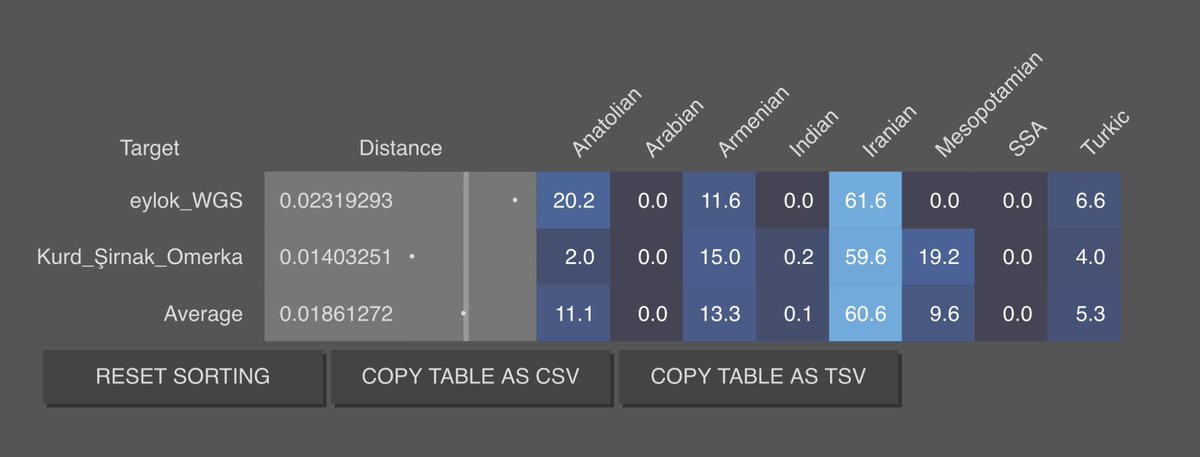
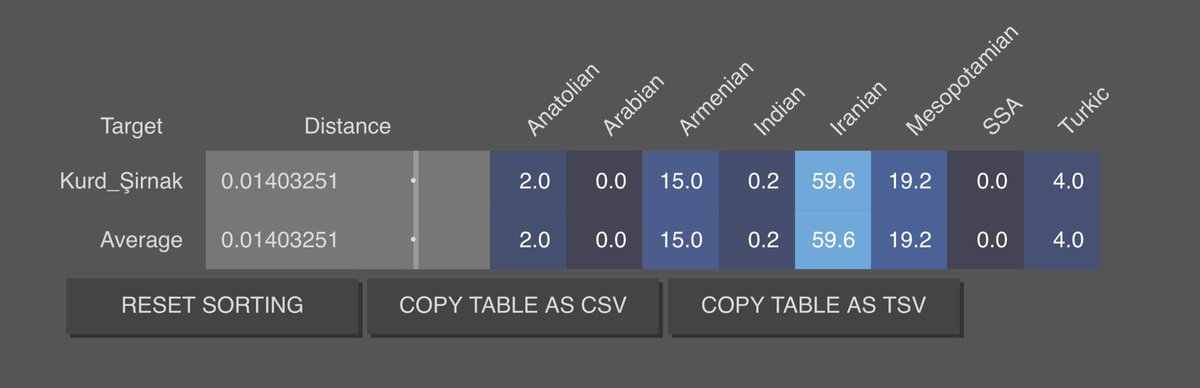
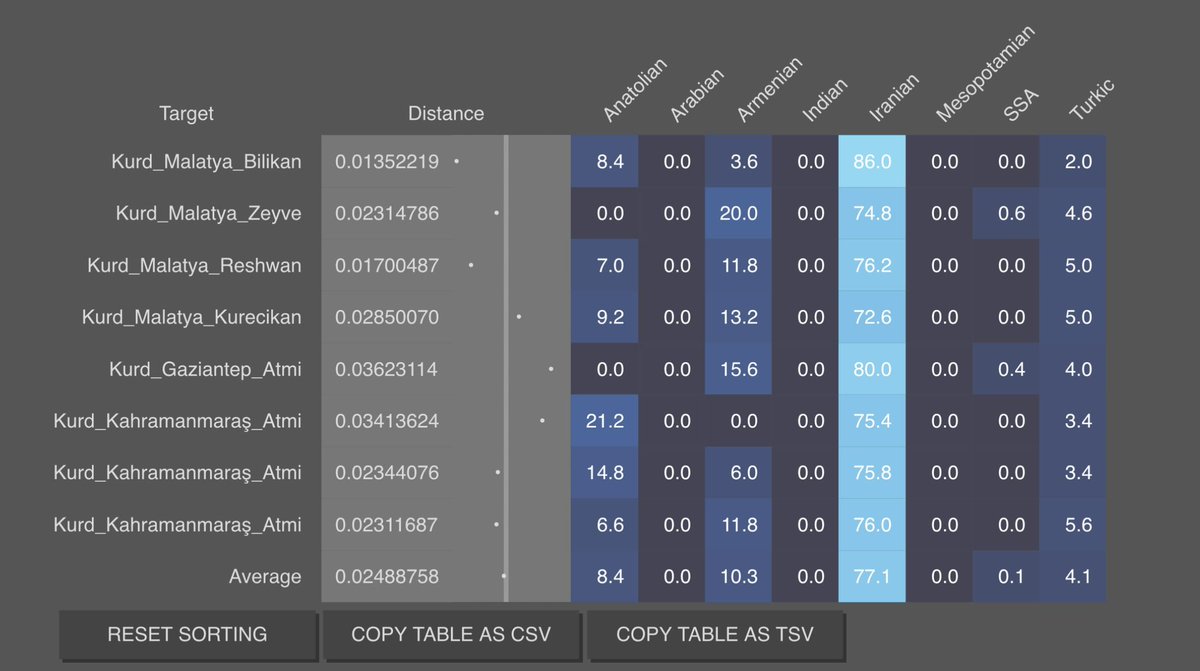
Here is a comparison between my friend from Şirnak and me. We have roughly the same amount of Iranian ancestry and almost the same amount of Armenian admixture. The biggest difference between her, an Eastern Euphrates Kurd, and me, a Western Euphrates Kurd, lies in our differing levels of Anatolian and Mesopotamian admixture. My Anatolian admixture is likely from mixing with Anatolian Turks due to geographic proximity, whereas my friend’s Mesopotamian admixture likely reflects mixing with Syriacs.
11
35
3,034
TIL that there’s an Iranian language called Ishkashimi, spoken by only about 2500 people in Badakhshan. It sounds surprisingly Western Iranian to my ears, even though it’s classified as an Eastern Iranian language. Also, this old man could be from my village.
May 25

what an absolute gem of a guy. genuinely this dude's analysis completely beats that of 99.9% of the "enlightened" Marxoids, socdems, and liberals we have in the West. he does all this while speaking in an Afghan minority language w less than 3000 speakers
youtube.com/watch?v=2xdhUuGF…
1
20
1,445
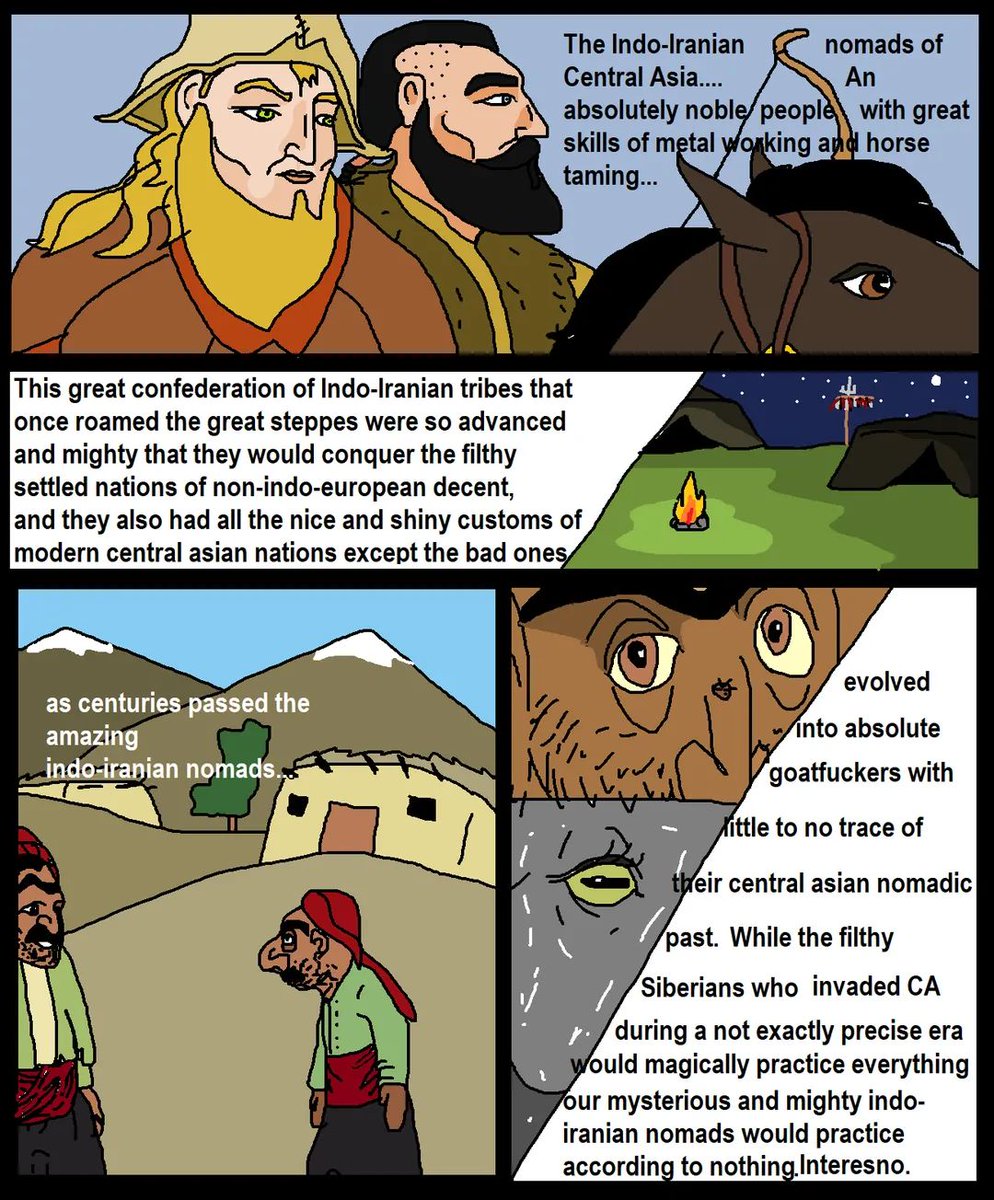
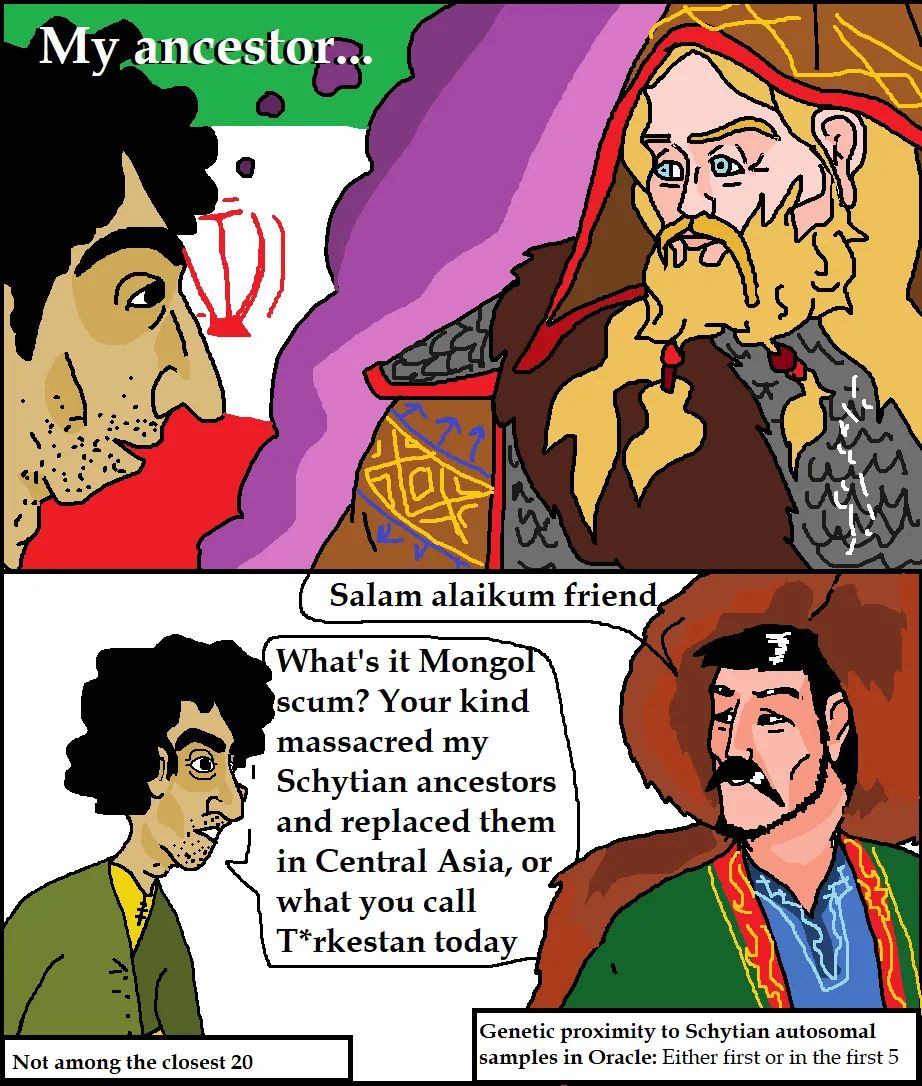
There is a great deal of romanticization of the Scythians, both among brownoids and westoids. The Scythians were not the badass steppe warriors they are often portrayed as. They were gradually conquered and assimilated by Turkic peoples, unlike Western Iranians. And a small side note, they also had literal femboys (see Enaree).

19
5
82
8,133
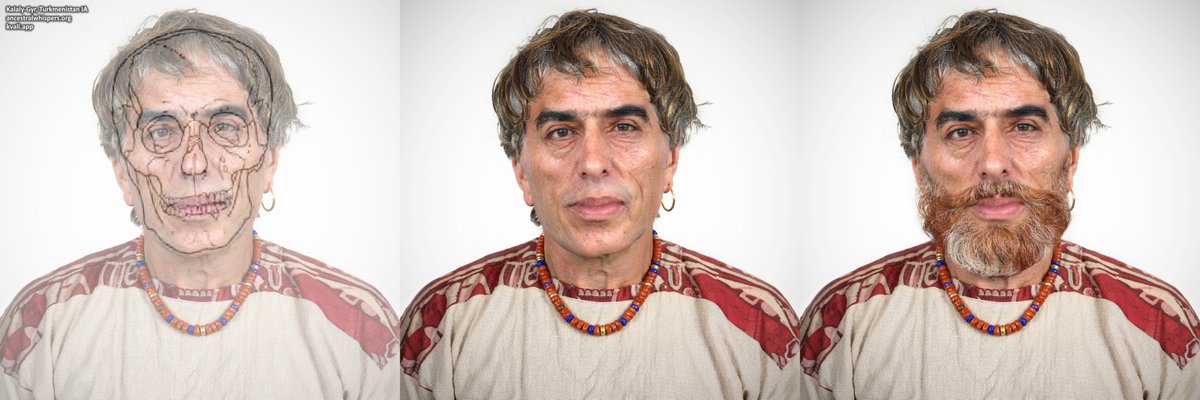
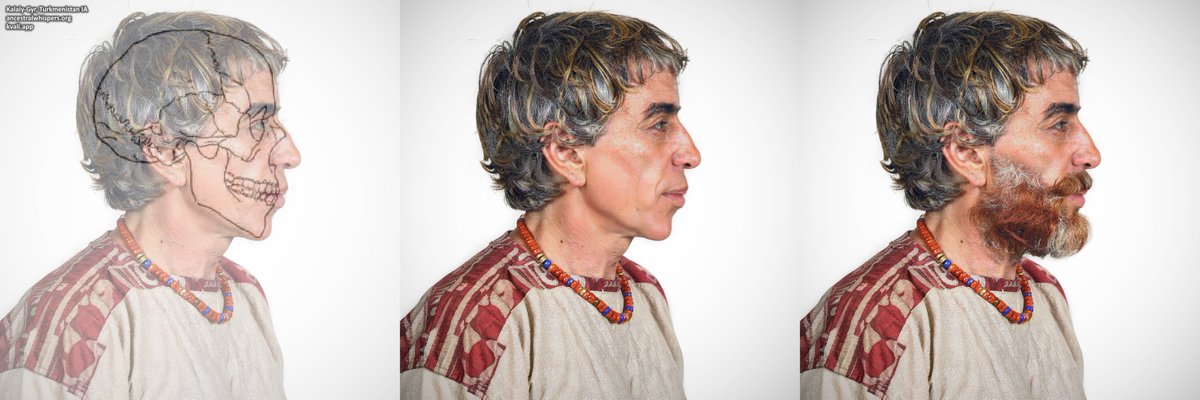
This individual is believed to represent an early Iranian associated with the Yaz culture. His genetic ancestry is likely an admixture between BMAC and Andronovo. However, since this is the only sample currently believed to be from the Yaz culture, the genetic composition of early Iranians likely varied across individuals. This man represents the ancestral stock that contributed to the ethnogenesis of modern Iranic peoples.
Thanks to @Sulkalmakh for the reconstruction and to @shoresh03 for the commission at my request.
Jun 10

Facial reconstruction of a 2,500-year-old man from Kalalygyr, Turkmenistan
Kalalygyr was an ancient city in northern Turkmenistan that disappeared in antiquity. It served as the second capital of ancient Khwarezm during the 5th-4th centuries BC. According to the Khwarezm Archaeological Expedition, the fortress of Kalalygyr 1, covering nearly 70 hectares, is the largest known settlement site in Khwarezm.
One of the city's fortresses, Kalalygyr 1, was a rectangular fortified settlement measuring approximately 1,000 × 700 meters. Its walls were reinforced with towers and contained four gates protected by complex entrance labyrinths and bastions. The inhabitants lived primarily within long vaulted corridor-like chambers built into the thickness of the massive defensive walls. Near the western wall, on the inner side of the fortress, stood a monumental palace complex.
Construction of both the fortress walls and the palace was never fully completed, and the site was eventually abandoned. The foundations consisted of large pakhsa (rammed-earth) blocks over one meter high, upon which mud-brick masonry of standard ancient dimensions was erected. The palace was square in plan (80 × 80 meters) and contained two internal courtyards and two external courts. Around these courtyards were approximately thirty rooms of various functions. The palace halls had flat roofs supported by columns, some of whose bases survive.
Researchers believe construction of the colossal fortress of Kalalygyr 1 began in the late 5th or very early 4th century BC, during the period when Khwarezm was under the rule of the Achaemenid dynasty. The project may have been part of broader Achaemenid initiatives connected with irrigation and water management, reminiscent of the policies described by Herodotus.
The male skull series from Kalaly-Gyr I is mesocranic (cranial index 79.9) with average length (182.0 mm), broad width (144.7 mm), and notably high vault (138.6 mm). The forehead is slightly sloping, with a well-developed glabellar region.
Facially, the skulls show medium height (72.9 mm) and medium bizygomatic breadth (132.5 mm), with a moderate facial index (54.9). The face is orthognathic, with moderate profiling at the nasomalar angle and slightly stronger at the zygomaxillary region.
Orbits are moderately high, the nose is medium-width (nasal index 48.7), with moderate nasal projection and a relatively high nasal bridge.
Overall, the series is mainly Eastern Mediterranean in type but shows clear mixture. The increased cranial index may reflect both admixture and brachycephalization. Some facial flattening and reduced nasal projection suggest slight Mongoloid influence. There is also evidence of Andronovo-related Europoid admixture, possibly mixed Srubnaya–Andronovo/Tazabagyab, and one incidence of an equatorial-influenced specimen.
The Iron Age and Early Antiquity inhabitants of Turkmenistan belong to the Tkm_IA/Yaz genetic cluster, which is a mixture of BMAC-related and Indo-Iranic Andronovo-related ancestry. This genetic cluster is pivotal in the spread of the Iranic languages; all modern Iranic languages, with the likely exception of Ossetic, ultimately stem from this genetic cluster.
Reconstruction commissioned by @shoresh03 at the request of @asteraex
3
2
28
3,762
„There are no Turks in Turkey, they are all turkified Greeks, Armenians and whatnot“
Meanwhile an Anatolian Turk with 22% East Eurasian ancestry and yDNA Q1a1-M120 ⬇️

Aşağıdaki örneğin Dodecad K12b sonucu.
".64 Doğu Avrasya, yaklaşık V Ortaçağ Türk mirasına tekabül eder. Sonuç sahibinin ilçesi bilinmemekle beraber otozomal ve soyadından dolayı Çanakçı veya Güce'nin dağ köylerinden olduğunu tahmin ediyoruz.
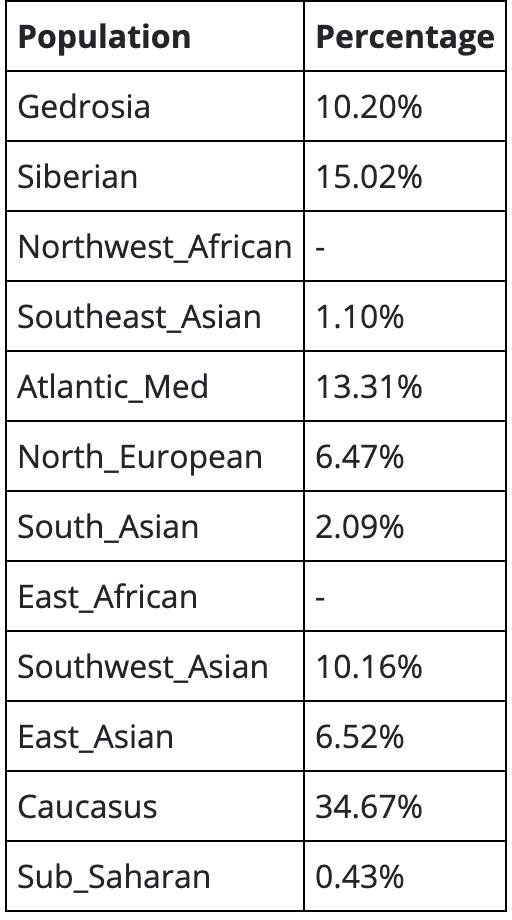
15
2
67
9,433
There is nothing more annoying than people who talk so confidently about topics they know nothing about. Most Kurds should honestly stay away from archaeogenetics.
Almost half of my Bronze Age ancestry is from Central Asia (BMAC/Andronovo) btw.
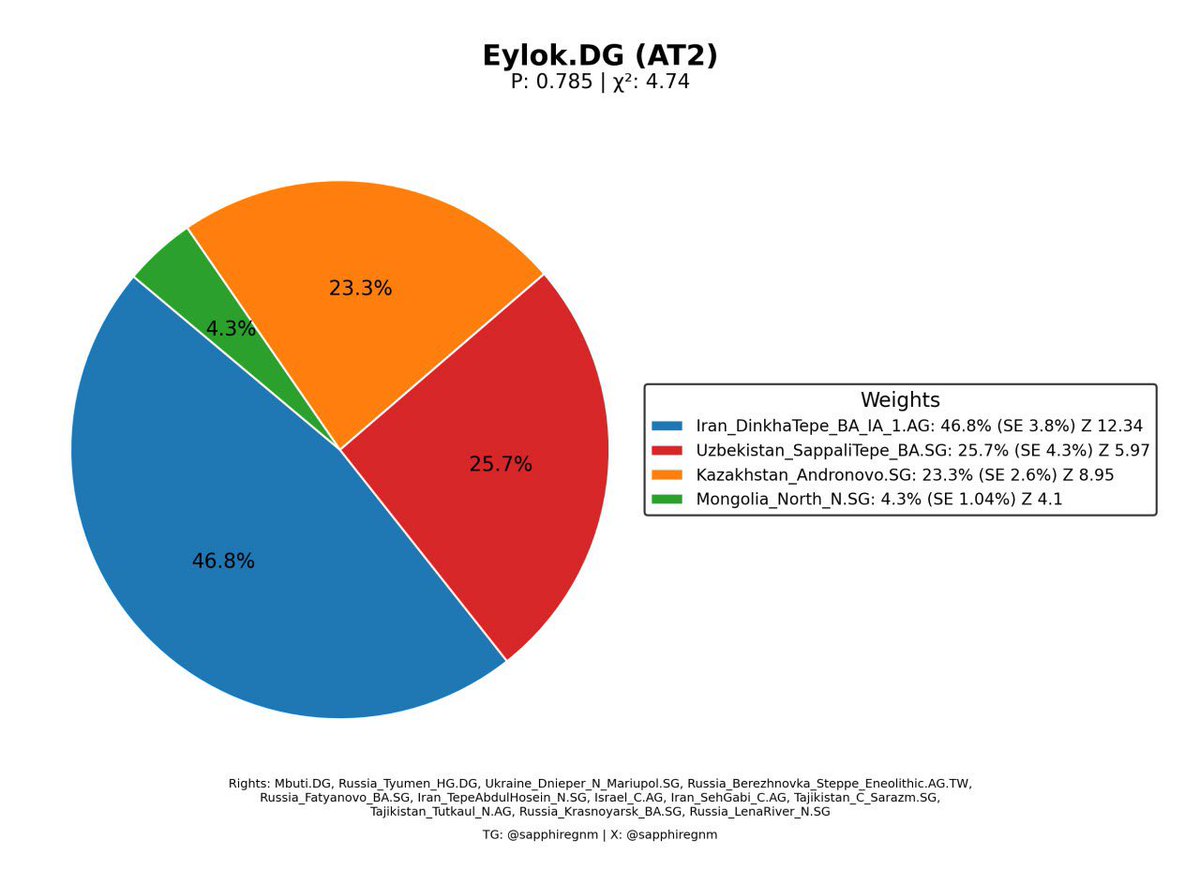
Jun 9

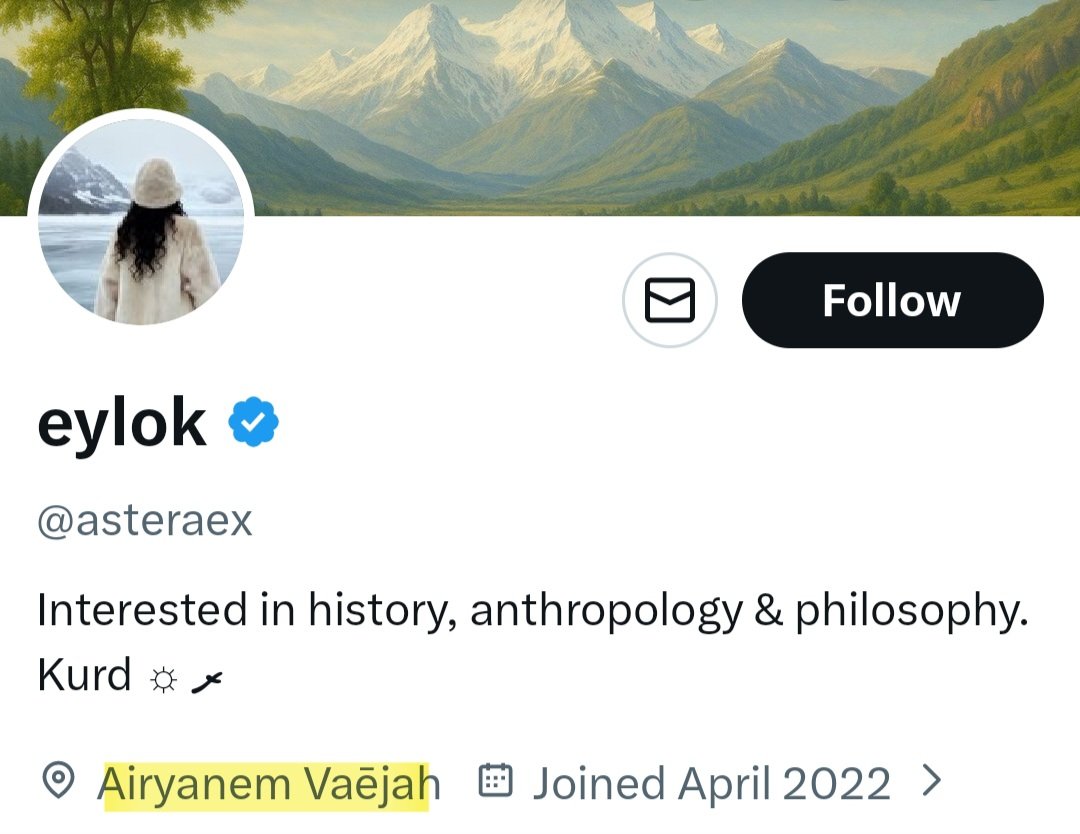
Location: Airyanem Vaejah
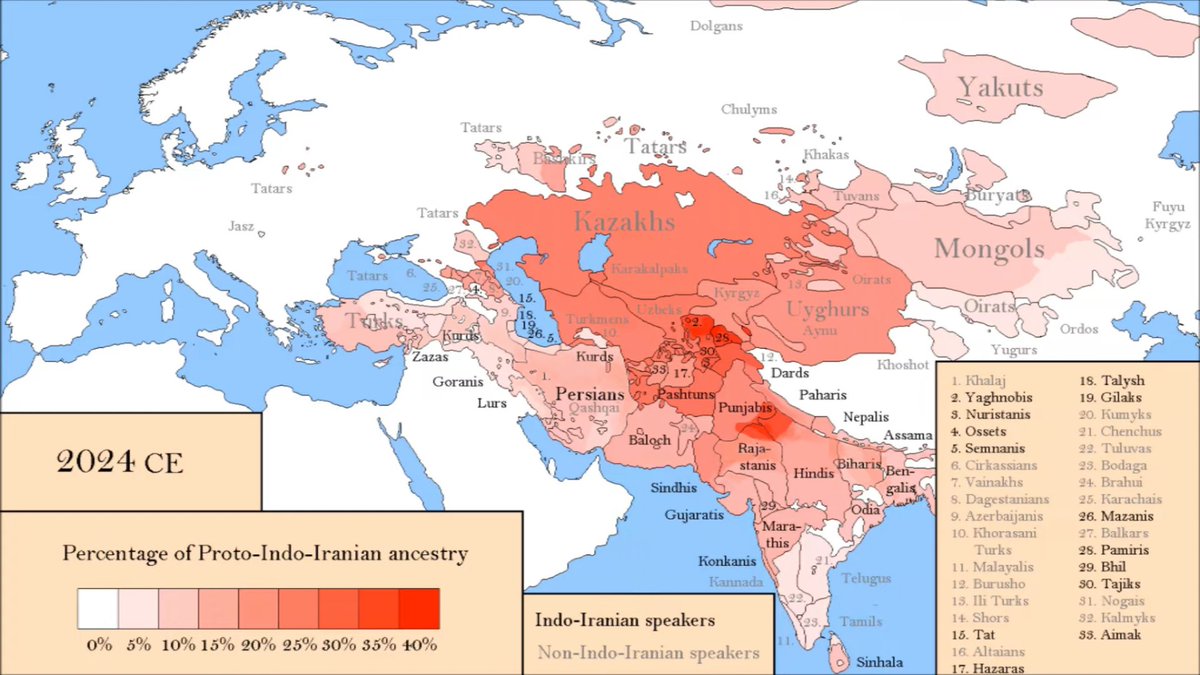
Yet most of the genome traces back to the Zagros, Anatolia, and the Caucasus, not the Indo-Iranian steppe.
Reducing Kurds to "Aryans" is odd when most of their ancestry predates the arrival of Iranic languages.
11
1
35
6,443
eylok retweeted

Jun 7
Middle Eastern version

135
711
15,769
1,419,892
In Western Kurmanji (Maraşki dialect):
water -> āv
fire -> ār
earth -> ard/zamîn
sun -> ro
moon -> hîv
star -> istêrik
father -> bāv
mother -> dāk/atê
brother -> bira/birāng
sister -> xwah/xwāng/xuşk/xuç
house -> māl/xānî
God -> Xodê
king -> şah
horse -> hasp
dog -> sa/kutik
blood -> xün
hand -> dast
eye -> çāv
heart -> dil
name -> nāv
good -> rind
new -> taza
old -> kavn
day -> ro
night -> şaw
road -> rê
wind -> bā
mountain -> çê/çiyā
friend -> havāl/dost
war -> cang/şêr
15
3
40
3,196
eylok retweeted
Jun 7
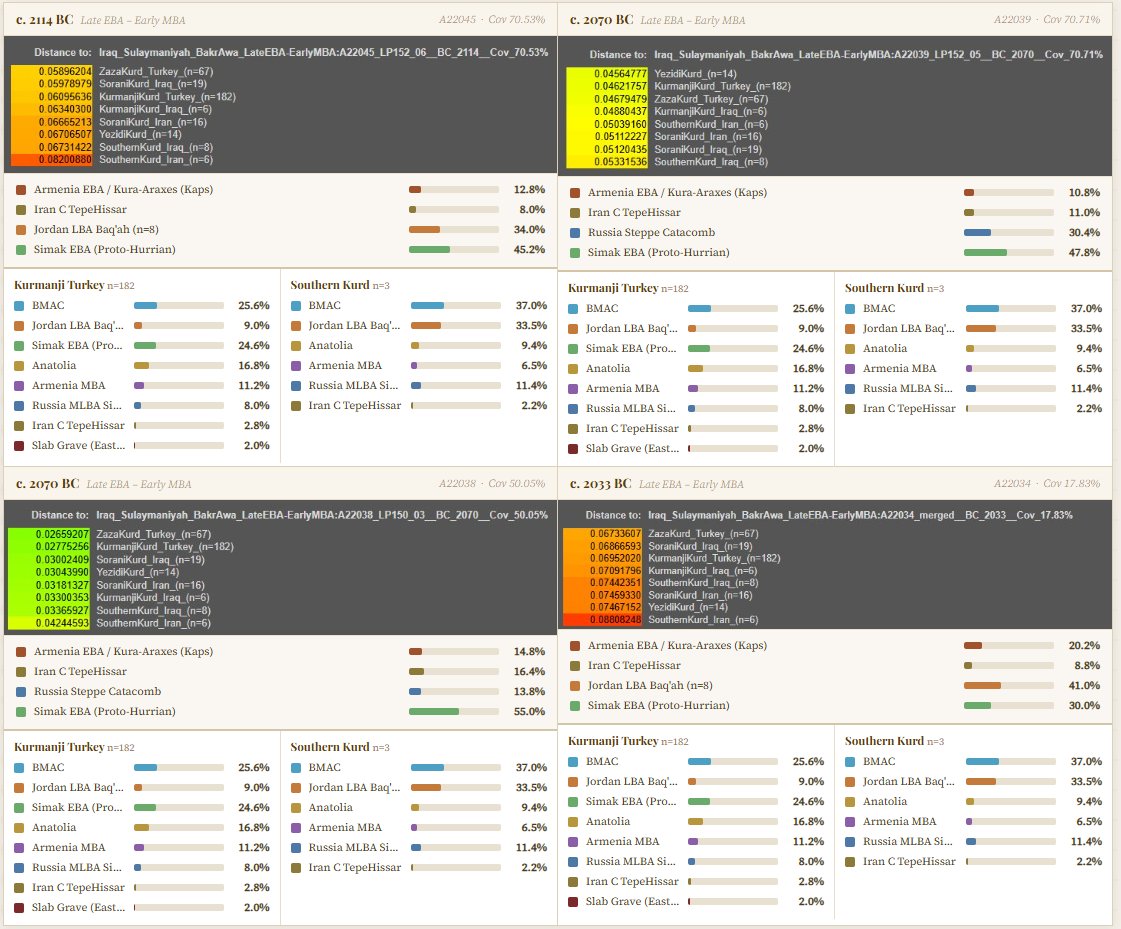
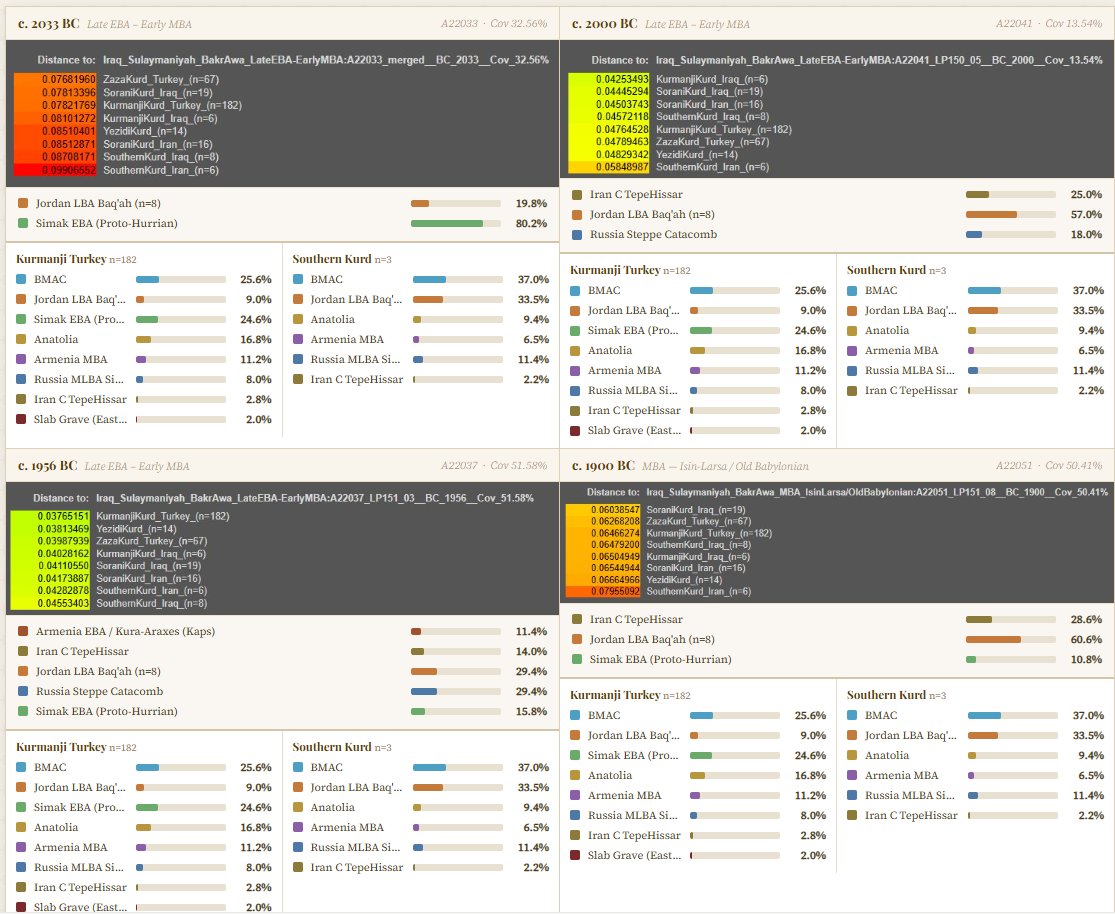
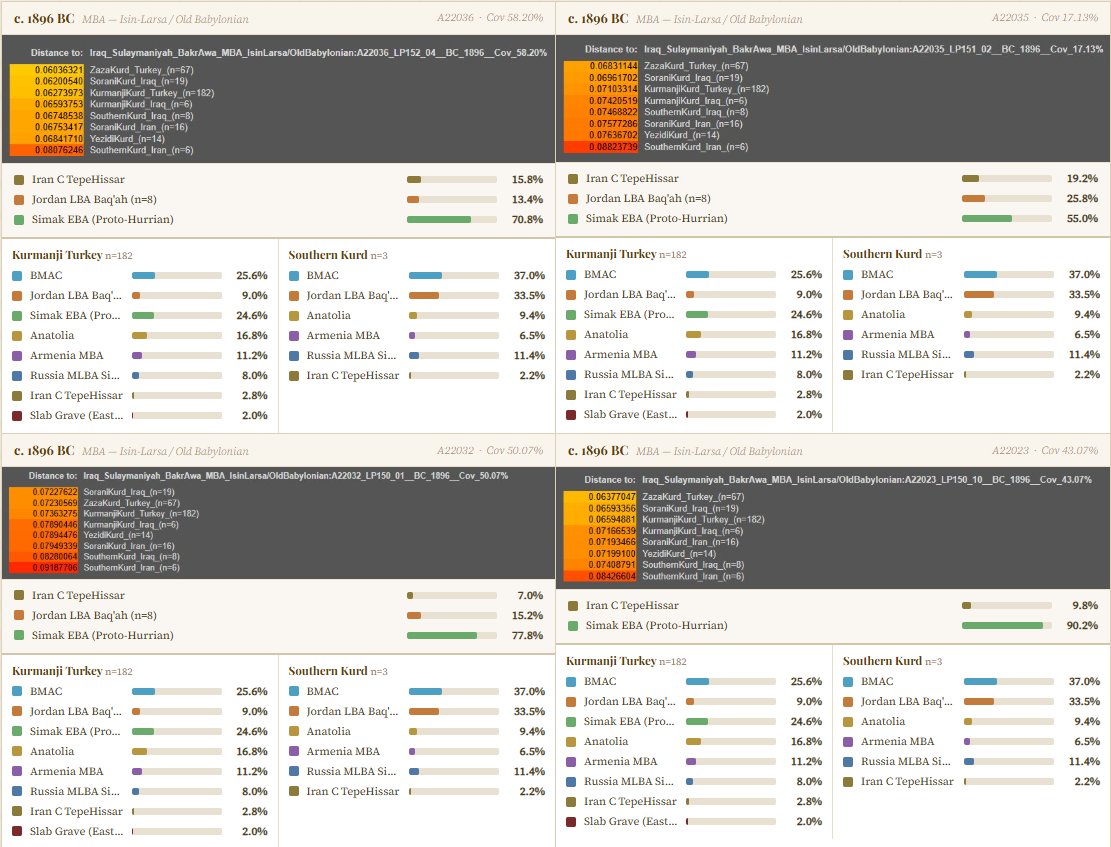
Why are the ancient Lullubi at Bakr Awa genetically close to Kurds? 15 out of 20 samples are very distant racially from Kurds. The 5 samples that artificially plot "closer" to Kurds and north-west Iranians such as Tats are in fact autosomally very distinct, proven in the screenshots below, which concretely debunks the decades-old myth that Kurds descend from the Lullubi. The Kurds who plot closest to these samples are those with extensive Armenian/Assyrian ancestry, while Kurds from the core parts of the Zagros are the most genetically distinct. The only way to sustain this narrative is to argue that having more medieval Armenian ancestry makes one more authentically ancient Kurdish or Lullubi, which is obviously absurd. Take for example sample A22025, which is supposedly the closest of all ancient Bakr Awa samples to modern Kurds: it models with 60% Proto-Hurrian-type ancestry, whereas modern Kurds score between 0 and 20% Proto-Hurrian-type ancestry, with Kurds lacking Armenian ancestry not picking up this signal AT ALL. Meaning that this population signal is not relevant ancestrally for Kurds. What people don't understand is that two distinct populations can come together, to plot closest to a third unrelated group. Take for example a Kurd who mixes with a Moroccan. The child will plot close to Palestinians on G25. This does NOT mean the child is Palestinian, as his ancestry is completely different.
Furthermore, not a single one of these 20 genetic samples carries patrilineal Y-DNA descent attributable to Kurds. Close to 50% of Kurdish Y-DNA lineages descend from Iron Age south-central Asia. It should also be noted that the presence of Bronze Age Armenian or Semitic ancestry in Kurds, as found in these Bakr Awa samples, does not mean that Kurdish ancestry derived from Bakr Awa itself. Semitic ancestry has expanded extensively across almost the entirety of the Middle East and into central Asia. The same applies to Hurrian-related profiles, which entered the Iranian plateau through later Mesopotamian migration rather than necessarily through these cis-Zagrosian groups. It is not unreasonable to suppose that cis-Zagrosian groups contributed something to the ancestry of Iranian-speaking populations, but this contribution is greatly exaggerated and obscures the straightforward reality that populations in this part of the world have been continuously subject to successive waves of new admixture.
Thinking that Kurds have 4000 years of continuity is completely absurd when we know with historical and genetic data that Kurds have mixed quite a lot in the past 1000 years. This is quite normal in the middle east. Genetic profiles are constantly shifting.
7
17
62
18,050
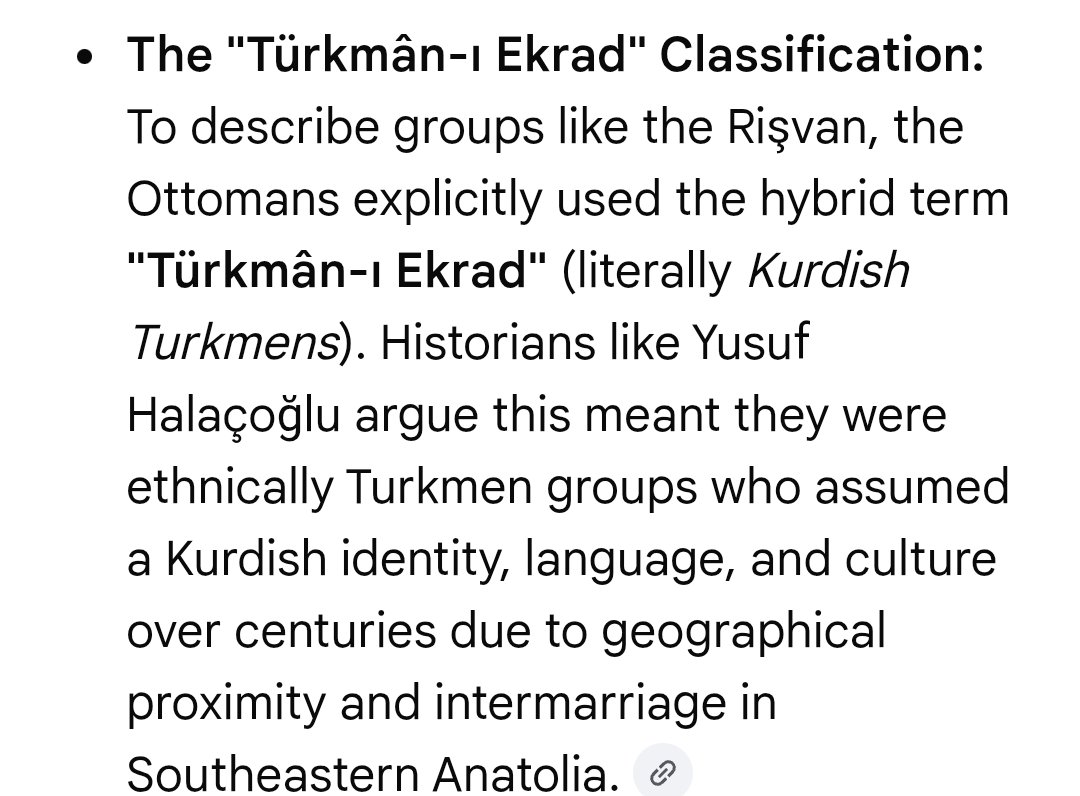
Ekrad-i Turkmen (that’s the correct term) refers to nomadic Kurdish tribes during the Ottoman period. They are not actual Turkmens, but regular Kurds from the western Euphrates region. In fact, some of the highest Iranian-scoring samples can be found among people from these tribes.
Jun 6

14
6
70
6,324
eylok retweeted
Jun 6
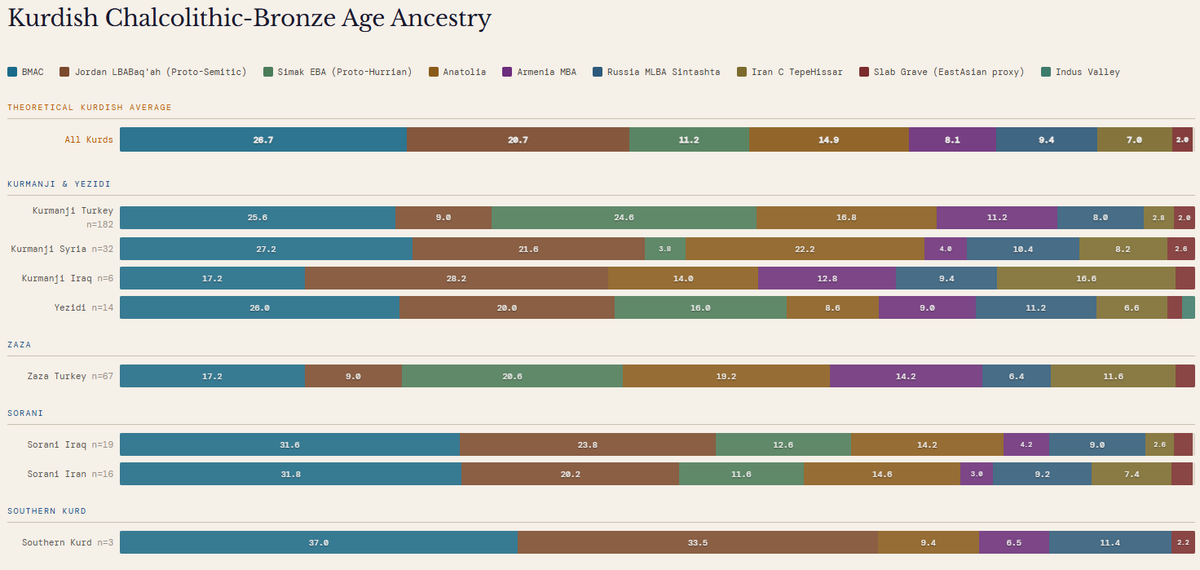
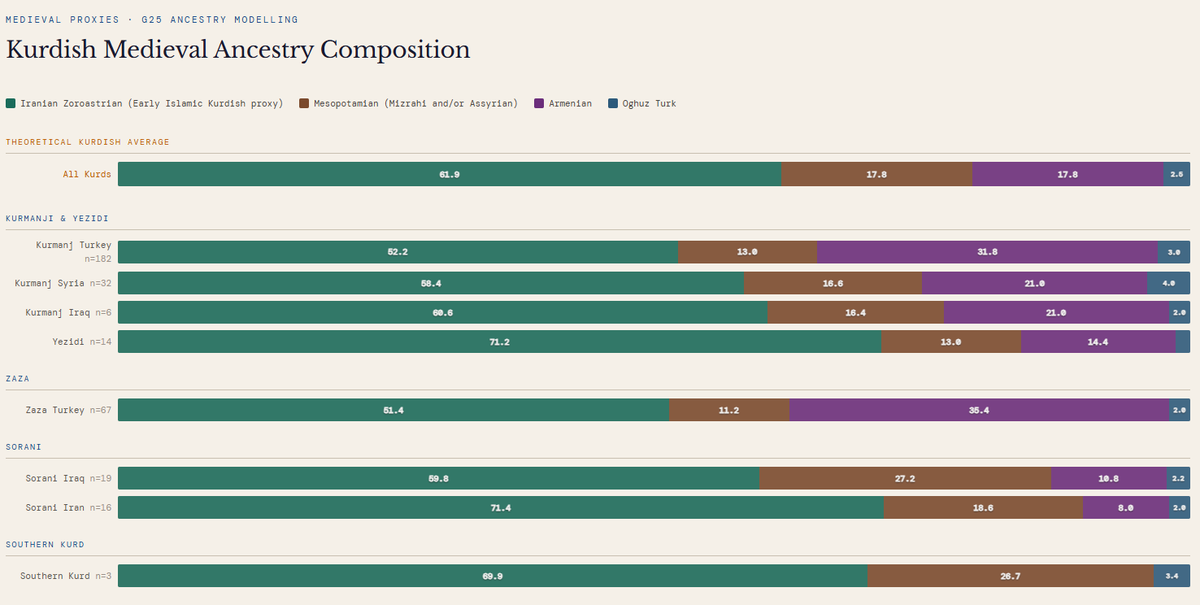
Autosomal composition of Kurds from two perspectives: a Chalcolithic to Bronze Age scale, and from the perspective of the medieval era. The former can be replicated on G25, and the latter can be replicated on G25 and qpAdm. The precise breakdown should not be taken too literally, as these admixture tool softwares are not particularly robust.
A simple breakdown of the Chalcolithic-Bronze Age component: the first Kurdish tribes appear within the Iranian plateau in the late Achaemenid to early Seleucid periods, who given their Iranian nature would be a combination of BMAC and Sintashta components. Some degree of local plateau ancestry was subsequently absorbed, which was a combination of Semitic, Hurrian, and related derived groups.
A simple breakdown of the medieval component: from the late Sasanian era onwards, large-scale expansions into what is now Kurdistan resulted in additional admixture from Adharic-speaking Iranians localised to northwest Iran and the Armenian highlands. It is difficult to gauge how impactful this admixture was, as the groups in question are genetically very similar to Kurds to begin with due to their common "West Iranian" roots. Additionally, some degree of Mizrahi, Assyrian, and Armenian admixture was gained through contact with non-Kurdish populations as Kurds expanded over their lands. Kurmanji and Zaza speakers carry very significant amounts of Armenian admixture that is considerably lower in Sorani speakers, and is often absent entirely in Xwarin speakers. It is also quite likely that Xwarin speakers proportionally carry more Adharic-type ancestry than Kurmanji speakers.
8
14
45
8,543
eylok retweeted

Jun 5
There are some indications that the first Iranian confederations to settle in the western plateau were not initially Zoroastrian. These include the theophoric name Agnu-parnu (*Agni-farnah-), the total absence of Western Iranian lands from Young Avestan geography and the ->
Jun 5

Yanlış anlaşılmaya müsait bir şekilde yazmışım: Yalnızca Medlerin değil, Ahamenişlerin de Avesta ile özel bir ilişkisi yok. Medler ve Persler Batı Asya'yı İranileştirirken Avestik Aryanlar büyük ölçüde Afgan yaylaları ile Sistan arasındaki bölgedelerdi.
2
6
31
5,501
eylok retweeted
Jun 4
Complete Kurdish history before the Islamic age (reupload because I mistakenly didn't screenshot my commentary I had written on the Kār-Nāmag). As stated previously, any connection to Corduene/Carduchi/etc, is not listed here given that it is not only unlikely, but entirely unfeasible to be connected with Kurds, and is rejected by modern academic consensus. Furthermore, while it is true that Kurds were not defined as a distinct ethnic group within this period, it is certainly true that the Kurds were a distinct tribal confederation within the Iranian ethno-religious framework. Only direct historical attestations are included here.
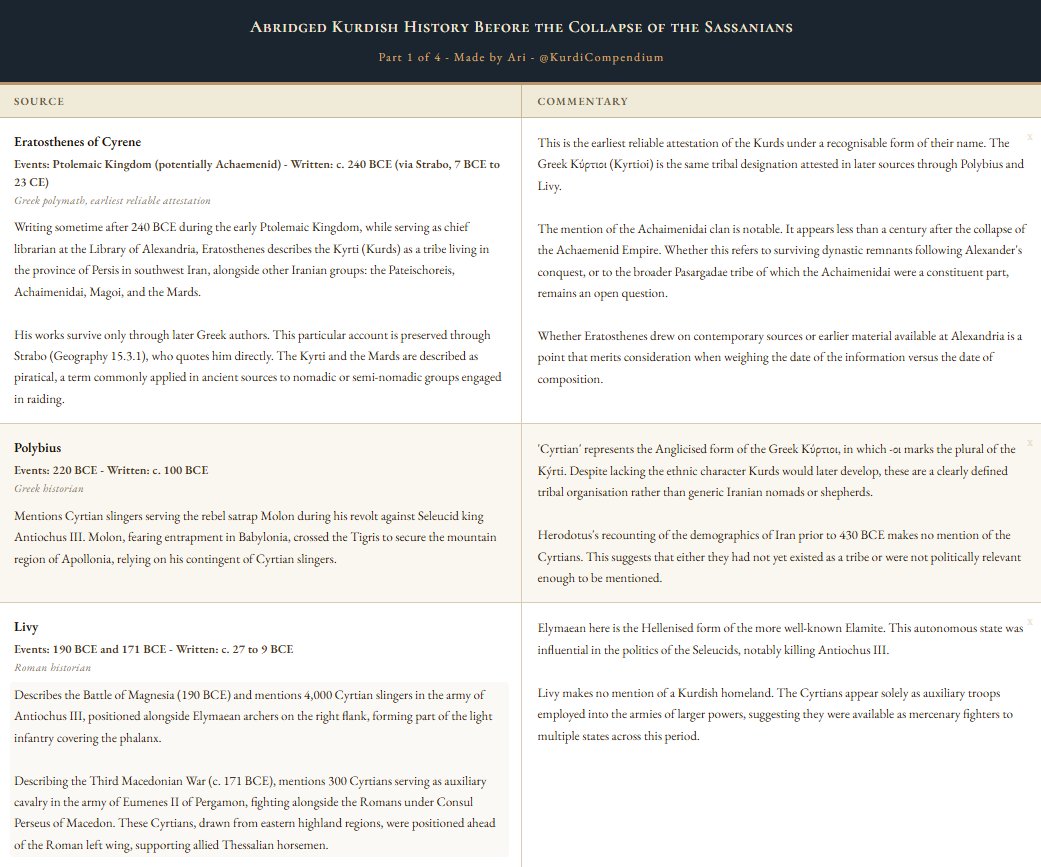
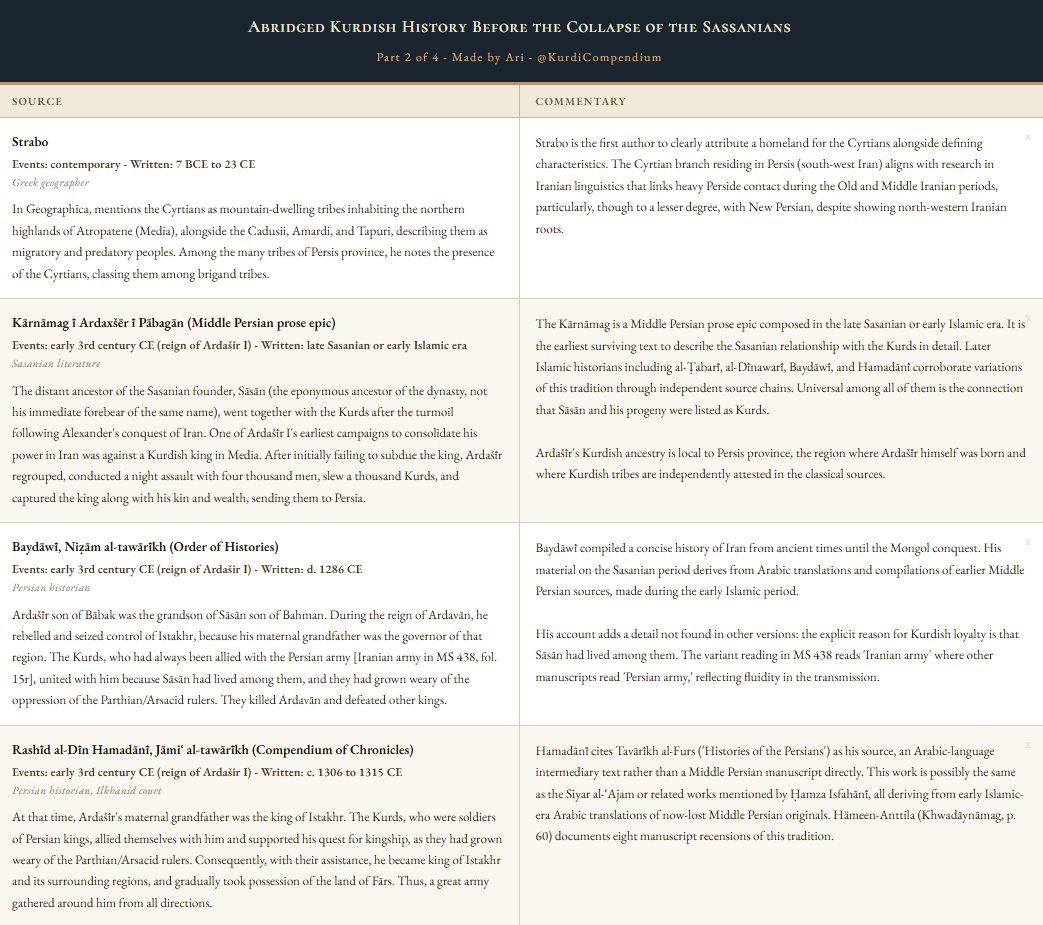
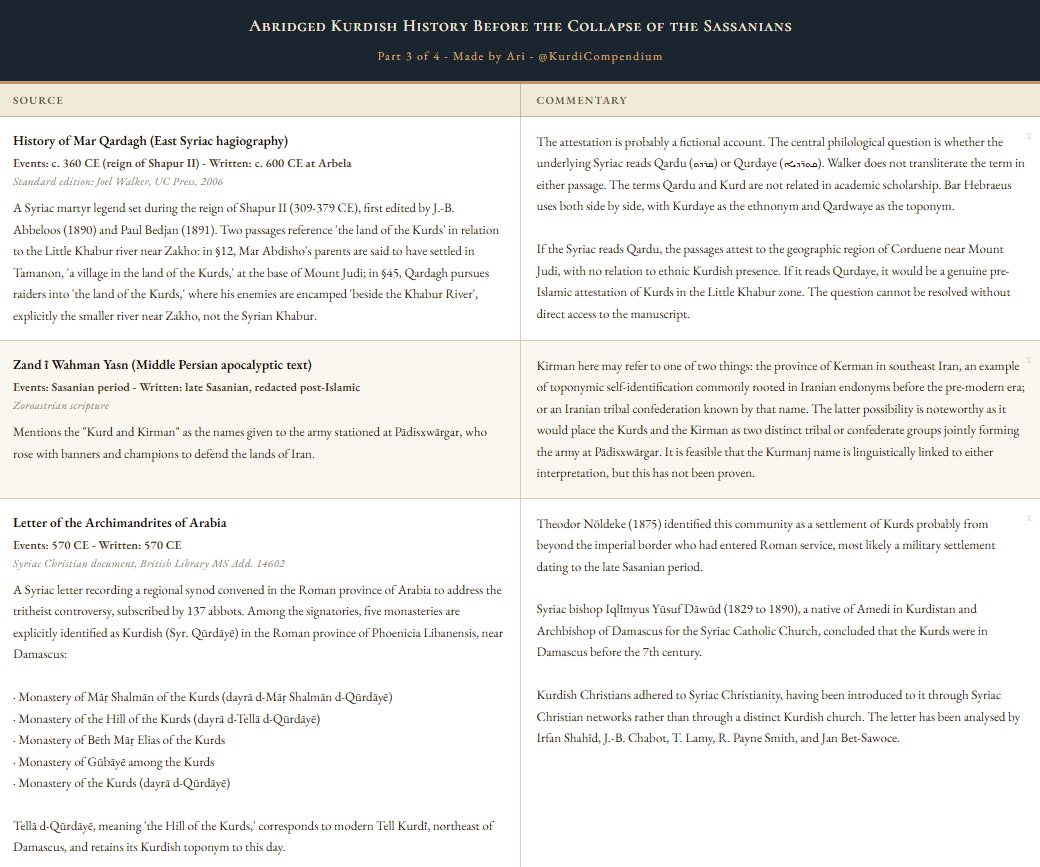
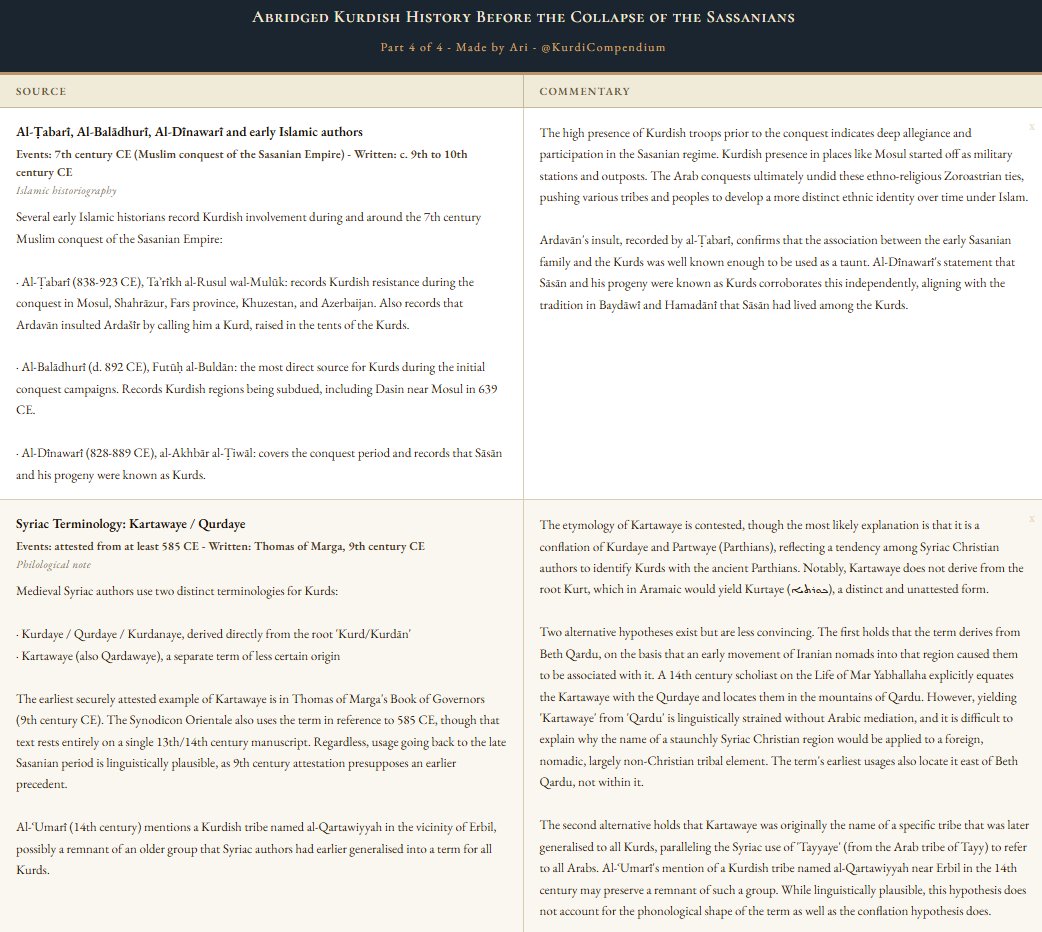
7
17
70
20,088
eylok retweeted

May 21
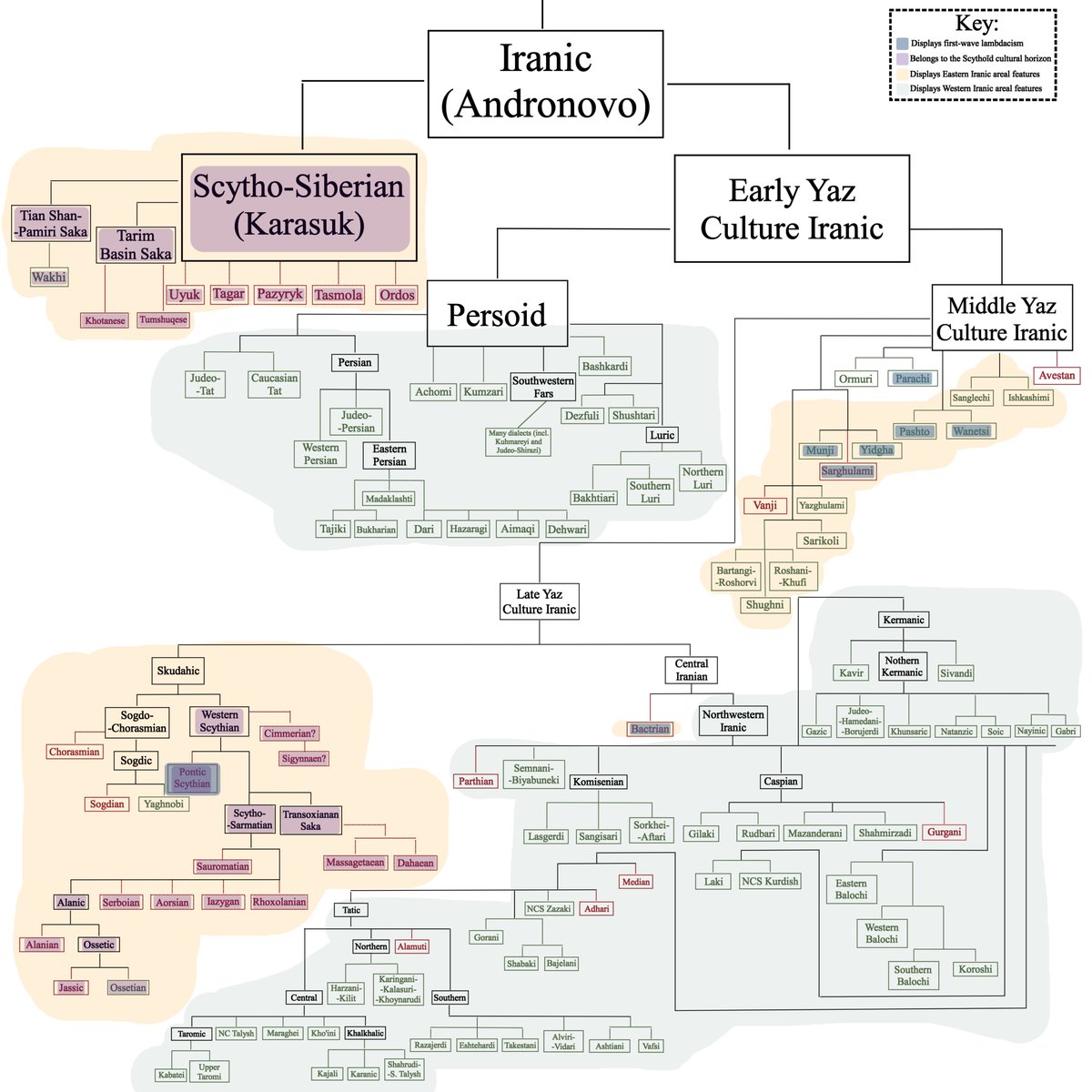
okay the 1st thing i'll show is the revised Iranic language family tree I just finished. it breaks a linguistic cardinal sin (trying to blend in archaeology and linguistics is inherently going to result in dubious guesses), but i believe it should help a lot and is relevant here:
7
7
21
4,472
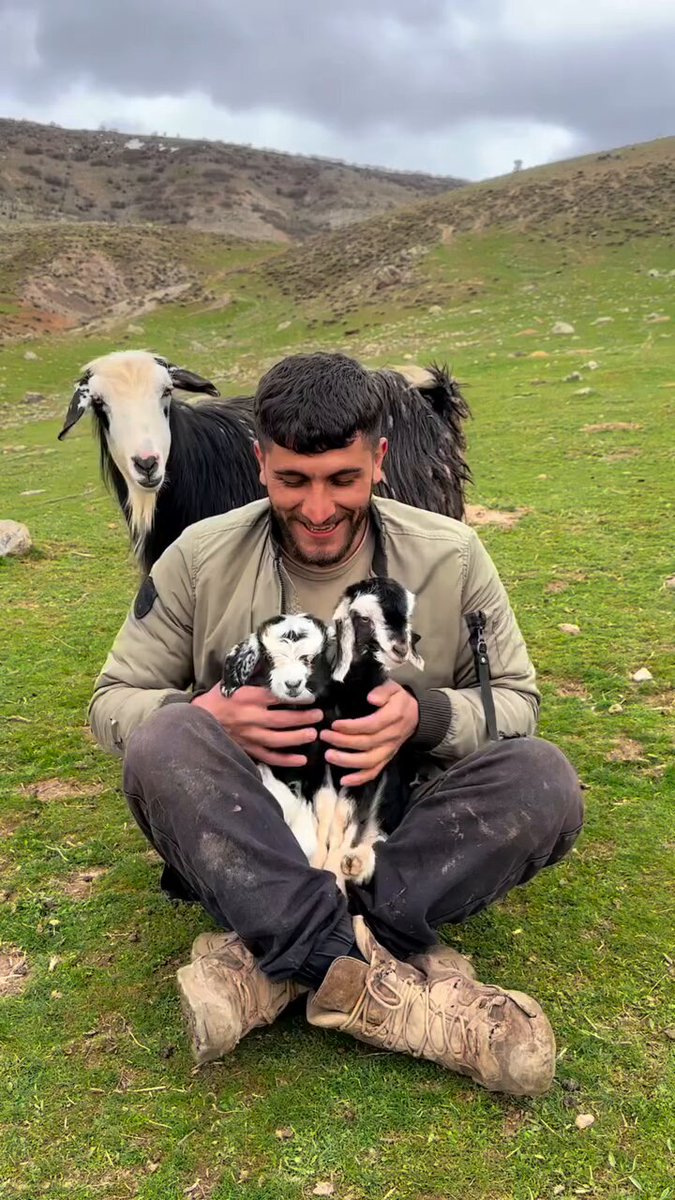
This Kurdish goat herder > all of Sindh
Jun 1

You're a Kurd, not a settled Irani.
A roaming gypsy Khana Badosh living on genocided Armenian land.
Know your fucking place, which is always next to your fucking sheep.
4
2
73
4,841