Understanding bats through research. Pathogen surveillance/Host-Pathogen responses/Comparative Biology. opinions my own. GZLab @batresearch@bsky.social
- Tweets 7,196
- Following 1,834
- Followers 2,488
- Likes 17,798













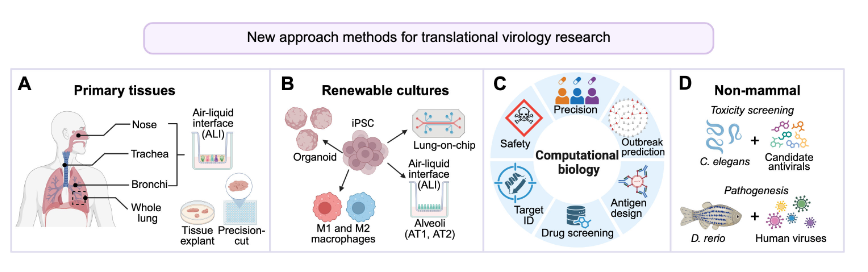
ALT Representative new approach methods (NAMs) used in translational virology research. (A) Primary human lung tissues support the development of differentiated air-liquid interface cultures, permitting viral exposure from the apical “airway” surface to better mimic natural infection. Tissue explants and precision-cut lung slices preserve native cellular architecture and resident immune populations, increasing physiological relevance. (B) Renewable human cell systems, including induced pluripotent stem cell (iPSC)-derived respiratory epithelium and immune cell subsets, provide scalable platforms when primary tissues are limited. (C) Computational NAMs incorporate data-driven modeling tools to predict viral behavior, identify therapeutic candidates, and support vaccine design, as well as forecast transmission and immune escape dynamics. (D) Non-mammalian whole-organism models (e.g., Caenorhabditis elegans, Danio rerio) enable scalable in vivo testing of candidate antivirals and host-virus i