
Onchain Governance Structures
Joined April 2021
- Tweets 126
- Following 181
- Followers 103
- Likes 6,935
2 Photos and videos

Apr 16
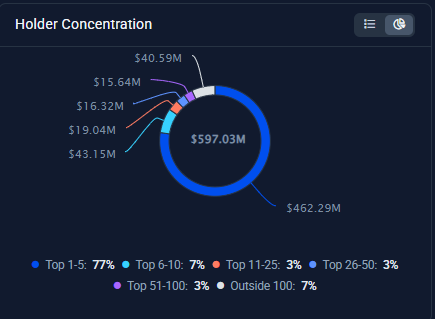
What a strong comment on Lido DAO’s financial status by @Stefa2kEth : research.lido.fi/t/goose-202…
If even one of the biggest DAOs still cannot provide public-company level financial legibility and fiscal discipline, that should make the whole industry think.
The hope with DAOs was that revenue-generating organizations could remain sustainable under public ownership. But across the industry, we have too often ended up with DAOs showing weak financial discipline, poor transparency, and limited accountability. DAOs still seem far from proving they can replace the standards imposed by regulators, disclosure rules, and corporate law. Every month, I lose a bit more confidence in the idea of a sustainable public company model without regulators.
I increasingly doubt that a durable DAO standard can be established with the current investor base. My instinct and experience tell me that many first-generation DAOs may end in structural failure, and that only after that will a second generation emerge, one built around a more educated owner base that actively participates in governance, enforces oversight and transparency, and allocates capital more responsibly.
2
123
bcvfinance.eth retweeted

Apr 6
KYC is so redundant in a world of enormous data leaks and AI
we need to abolish KYC and replace it with either cryptographic proofs or game theory
DeFi is ahead of the curve on this one
dont let the institutions say otherwise
26
10
114
10,213
Mar 10
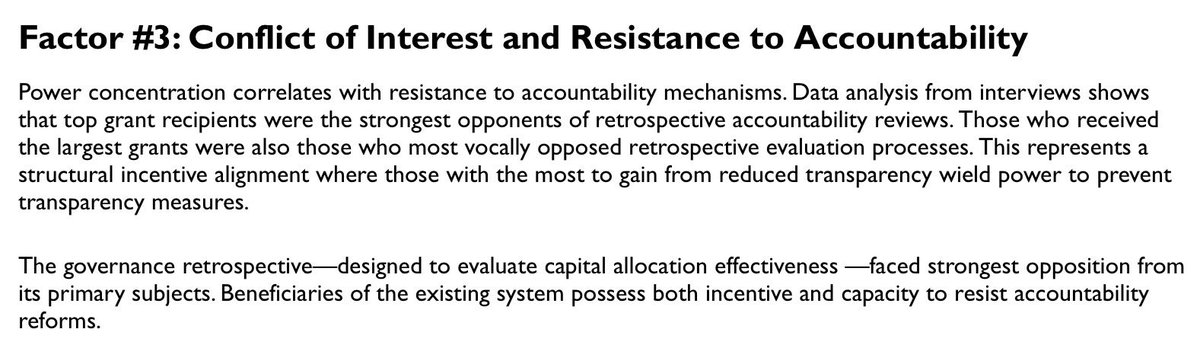
Interesting data point from the ongoing @ENS_DAO retrospective conducted by @metagov_project :
Interviews suggest that the largest grant recipients were also the strongest opponents of retrospective accountability reviews.
This is a fascinating example of the structural incentive tensions discussed in the article above.
docs.google.com/document/u/0…
1
99
bcvfinance.eth retweeted

ENS definitely had the first-mover advantage. So did Netscape if you’re old enough to remember.
The interesting question now is whether that early lead translates into becoming the long-term identity layer for Web3.
I also wonder whether creating better incentives for ENS domain holders could help drive adoption, for example sharing part of premium fees or similar mechanisms. Could that help accelerate network effects?
Some argue that AI agents will naturally use ENS because they operate on Ethereum, which is partially true. But in theory there is nothing stopping something like ICANN or another entity from forking a blockchain and providing similar naming infrastructure if the demand becomes large enough.
Personally, I am betting that ENS wins, but first-mover advantage alone does not guarantee it. Governance decisions also matter. The ENS DAO has already spent significant resources exploring L2 directions and then walked them back after a tweet from Vitalik. Maybe dropping the idea was the right call, but the question is why it happened so late in the process.
It also exposes a governance issue. Developer incentives often reward building new things rather than delivering real adoption, which can lead to treasury funds being spent on experiments instead of educating users and expanding real-world use cases.
Mar 5

New blockchain naming systems launch .whatever extensions faster than anyone can track.
.crypto
.wallet
.agent
.nft
Minting strings is easy.
Building naming infrastructure that works across wallets, dApps, exchanges, and the web is the hard part.
That distinction matters.
ens.domains/blog/post/ens-wa…
5
1
19
1,802
bcvfinance.eth retweeted

Mar 3
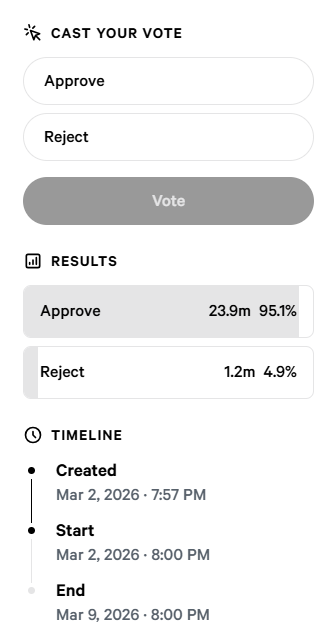
@LidoFinance is voting to make its Delegate Incentivization Program permanent. Key changes:
1. Delegate pay switches from LDO to stablecoins
2. Agora exits the oversight committee
3. Delegates now need ≥1M LDO on both Snapshot and Aragon to qualify
4. Annual budget requests now handled via the standard EGG process
The proposal has overwhelming support at 94.7% For. One voice in the forum pushes back.
@bcvfinance: fixed eligibility thresholds risk concentrating the delegate set among whales, pushing participation toward minimum quorum, and centralizing governance around Labs. Without incentivizing delegates of all sizes and encouraging tokenholders to delegate, diversity won't grow - and token holder representation is what ties governance token value to the protocol. Buybacks won't fix that.
Author jenya_k agrees on direction but pushes back: many delegates are independent, not Labs-controlled. Paying everyone by default doesn't guarantee value; impact should be recognized through targeted grants. And tokenholder incentives are a separate design question.
Proposal: snapshot.org/#/s:lido-snapsh…
4
3
7
579

CSM changed the trajectory of Lido: it introduced a truly permissionless entry path into the validator set.
stVaults now compound that progress, contributing toward an open, scalable, Ethereum-aligned validator layer
Mar 2

Lido V3 Phase 3 is live!
stETH minting is now permissionless for all stVaults and the minting cap for Identified Node Operators has been extended.
The initial Lido V3 rollout is complete ✅
↓
3
11
29
4,618
bcvfinance.eth retweeted

Feb 16
Ray Dalio gives a 39 minute master class on wealth creation.
Watch this instead of Netflix.
66
2,033
8,649
567,341


The only bull case for ETH that actually makes sense and is totally practical is becoming the money layer for AI agents.
The problem no one's talking about that I've been harping on in private group chats is that agents can't use banks. They can't KYC. They don't have social security numbers. They can't wait for ACH to clear. They can't call customer support when a wire gets stuck.
In order to be truly useful tools for the world, AGENTS NEED TO TRANSACT!!!! A lot. Agent A needs compute, pays Agent B. Agent B needs data, pays Agent C. Agent C needs API access, pays a protocol. This is happening millions and jillions of times per day, and it's going to happen without humans in the loop.
The only way this works is with programmable, permissionless, always-on money. That means onchain stablecoins.
And ETH is the only ecosystem with the infrastructure to actually support this.
Deep liquidity so agents can swap without getting destroyed on slippage. Battle tested contracts that won't lose agent funds. Account abstraction so agents can operate with programmable wallets. Composability so an agent can swap, stake, borrow, and pay in a single atomic transaction.
Solana is fast but shallow. Bitcoin isn't programmable. New L1s have no liquidity. Traditional rails won't serve non-human actors by design.
Every other ETH narrative has stalled. Ultra sound money didn't capture mindshare. L2 scaling fragmented liquidity. DeFi plateaued. NFTs peaked.
But this is different. This isn't a narrative you have to sell people on. It's just what happens when agents need to move value and there's only one system that works.
The AI economy needs money that doesn't require permission. ETH already built it. 8004 unlocks a lot of cool stuff and I'm about to release my research here shortly. Stay tuned.
149
138
1,091
123,411
bcvfinance.eth retweeted

Feb 5
This is the worst market known to mankind
25
14
364
10,606
bcvfinance.eth retweeted

Feb 3
There have recently been some discussions on the ongoing role of L2s in the Ethereum ecosystem, especially in the face of two facts:
* L2s' progress to stage 2 (and, secondarily, on interop) has been far slower and more difficult than originally expected
* L1 itself is scaling, fees are very low, and gaslimits are projected to increase greatly in 2026
Both of these facts, for their own separate reasons, mean that the original vision of L2s and their role in Ethereum no longer makes sense, and we need a new path.
First, let us recap the original vision. Ethereum needs to scale. The definition of "Ethereum scaling" is the existence of large quantities of block space that is backed by the full faith and credit of Ethereum - that is, block space where, if you do things (including with ETH) inside that block space, your activities are guaranteed to be valid, uncensored, unreverted, untouched, as long as Ethereum itself functions. If you create a 10000 TPS EVM where its connection to L1 is mediated by a multisig bridge, then you are not scaling Ethereum.
This vision no longer makes sense. L1 does not need L2s to be "branded shards", because L1 is itself scaling. And L2s are not able or willing to satisfy the properties that a true "branded shard" would require. I've even seen at least one explicitly saying that they may never want to go beyond stage 1, not just for technical reasons around ZK-EVM safety, but also because their customers' regulatory needs require them to have ultimate control. This may be doing the right thing for your customers. But it should be obvious that if you are doing this, then you are not "scaling Ethereum" in the sense meant by the rollup-centric roadmap. But that's fine! it's fine because Ethereum itself is now scaling directly on L1, with large planned increases to its gas limit this year and the years ahead.
We should stop thinking about L2s as literally being "branded shards" of Ethereum, with the social status and responsibilities that this entails. Instead, we can think of L2s as being a full spectrum, which includes both chains backed by the full faith and credit of Ethereum with various unique properties (eg. not just EVM), as well as a whole array of options at different levels of connection to Ethereum, that each person (or bot) is free to care about or not care about depending on their needs.
What would I do today if I were an L2?
* Identify a value add other than "scaling". Examples: (i) non-EVM specialized features/VMs around privacy, (ii) efficiency specialized around a particular application, (iii) truly extreme levels of scaling that even a greatly expanded L1 will not do, (iv) a totally different design for non-financial applications, eg. social, identity, AI, (v) ultra-low-latency and other sequencing properties, (vi) maybe built-in oracles or decentralized dispute resolution or other "non-computationally-verifiable" features
* Be stage 1 at the minimum (otherwise you really are just a separate L1 with a bridge, and you should just call yourself that) if you're doing things with ETH or other ethereum-issued assets
* Support maximum interoperability with Ethereum, though this will differ for each one (eg. what if you're not EVM, or even not financial?)
From Ethereum's side, over the past few months I've become more convinced of the value of the native rollup precompile, particuarly once we have enshrined ZK-EVM proofs that we need anyway to scale L1. This is a precompile that verifies a ZK-EVM proof, and it's "part of Ethereum", so (i) it auto-upgrades along with Ethereum, and (ii) if the precompile has a bug, Ethereum will hard-fork to fix the bug.
The native rollup precompile would make full, security-council-free, EVM verification accessible. We should spend much more time working out how to design it in such a way that if your L2 is "EVM plus other stuff", then the native rollup precompile would verify the EVM, and you only have to bring your own prover for the "other stuff" (eg. Stylus). This might involve a canonical way of exposing a lookup table between contract call inputs and outputs, and letting you provide your own values to the lookup table (that you would prove separately).
This would make it easy to have safe, strong, trustless interoperability with Ethereum. It also enables synchronous composability (see: ethresear.ch/t/combining-pre… and ethresear.ch/t/synchronous-c… ). And from there, it's each L2's choice exactly what they want to build. Don't just "extend L1", figure out something new to add.
This of course means that some will add things that are trust-dependent, or backdoored, or otherwise insecure; this is unavoidable in a permissionless ecosystem where developers have freedom. Our job should make to make it clear to users what guarantees they have, and to build up the strongest Ethereum that we can.
2,560
1,663
9,933
6,373,959
bcvfinance.eth retweeted

Programmatic enforcability of tokenholder rights is existential
Jan 29

We can't have tokens without tokenholder protections, and we can't have Internet Capital Markets without tokens. I don't know of a single more pressing problem for the future of our industry.
2
7
19
4,214
bcvfinance.eth retweeted

Jan 15
🇺🇸 COINBASE CEO JUST REVEALED LIVE ON CNBC THAT BANKS ARE TRYING TO KILL CRYPTO AND THE MARKET STRUCTURE BILL
THIS IS WILD
448
2,164
11,309
647,986
bcvfinance.eth retweeted
Jan 10
I agree with maybe 60% of this, but one bit that is particularly important to highlight is the explicit separation between what the poster calls "the open web" (really, the corposlop web), and "the sovereign web".
x.com/tom777kruise/status/20…
This is a distinction I did not realize until recently, and I must admit the bitcoin maximalists were far ahead: a big part of their resistance to ICOs, tokens other than bitcoin, arbitrary financial applications, etc was precisely about keeping bitcoin "sovereign" and not "corposlop". The big error that many of them made was trying to achieve this goal with either government crackdowns or user disempowerment (keeping bitcoin script limited, and rejecting many categories of applications entirely), but their fear was real.
So what is corposlop? In essence, it is the combination of three things:
* Corporate optimization power
* An aura of respectableness of being a company with sleek polished branding
* Behavior that the exact opposite of respectable, because that's what's needed to maximize profit
Corposlop includes things like:
* Social media that maximizes dopamine, outrage, other methods of short-term engagement, at the expense of long-term value and fulfillment
* Needless mass data collection from users, often followed by managing it carelessly or even casually selling it to third parties
* Walled gardens charging monopolistic high fees and actively preventing people from even linking to other platforms
* Hollywood releasing the 7th sequel to some tired franchise, because that's the most risk-averse thing to do
* Every corporation that rallied around slogans of diversity and equity and the need to overturn society to fight racism in 2020, and then publicly mocked those causes for engagement in 2025
This is all digital corposlop; there are big and important analogues to this in the physical world too.
Corposlop is soulless: trend-following homogeneity that is both evil and lame vitalik.eth.limo/general/202…
These are things that appear to serve the user, but actually disempower the user.
I have many qualms with Apple, but aside from their monopolistic practices, they actually have many non-corposlop traits. They serve users not by constantly asking "what do users want this quarter", but by having an opinionated long-term vision. They have a strong emphasis on privacy. They resist and create trends rather than following them. I just wish they could take the brave step of ending their monopolistic practices and switch to an open source first strategy. It may damage their market cap, but man must live for something higher than market caps.
Zac from Aztec was also early to recognize the importance of this, with a post that is on the whole very pro-freedom, but at the same time does not shrink back from labeling what is essentially corposlop a primary enemy, even when it does not violate the libertarian non-aggression principle.
x.com/Zac_Aztec/status/19860…
In 2000, the understanding of "sovereignty" largely focused on avoiding the iron fist of government. Today, "sovereignty" also means securing your digital privacy through cryptography, and securing your own mind from corporate mind warfare trying to extract your attention and your dollars. It also means doing things because you believe in them, and declaring independence from the homogenizing and soul-sucking concept of "the meta".
These are the kinds of tools that we should build more of. Build tools like:
* Privacy-preserving local-first applications that minimize dependence on and data leaks to third parties
* Social media platforms and tools that let the user take control of what content they see. Appeal to people's long-term goals, not short-term impulses
* Financial tools that help users grow their wealth, and do not encourage 50x leverage or sports betting or taking out a loan to pay for a burrito
* AI tools that are maximally open and privacy and local-friendly, and that maximize productivity from merging the power of human and bot, rather than encouraging the user to sit back and let the bot do all the work, so they learn nothing
* Applications, companies, and physical environments that take an opinionated view on the kind of world they want to see, and have an opinionated culture
* DAOs that can support organizations and communities that steadfastly pursue a unique objective, and do not all get captured by the same groups. Privacy-preserving and non-tokenholder-driven voting can help here
Be sovereign. Reject corposlop. Believe in somETHing.
Jan 1

2026-30 predictions
-globalism is dead. resilience is the new god. countries and individuals are racing for sovereign compute and mineral sovereignty. if you can't produce your own energy, food, and intelligence locally, you're a vassal
-the winner in robotics is the company whose humanoids can navigate a messy, 70s built warehouse. general purpose labor becomes a purchasable SKU, starting in logistics and moving toward elderly care
-the west stops moralizing about mining and starts treating lithium, cobalt, and copper with the same ruthless blood for oil energy of the 20th century
-the line between peace and war permanently dissolves. conflict shifts to gray zone operations. constant cyber attrition, undersea cable "accidents" and satellite interference. no more grand declarations, just a baseline of chaos
-the internet officially splinters. you now have the "open web" (chaotic, bot heavy, western), the "fortress web" (highly censored, eastern), and the "sovereign web" (encrypted, boutique, and high trust)
-neuralink and its competitors move from clinical trials to high performance enhancement for the wealthy. the augmented vs natural cognitive divide begins to show its first cracks in the social fabric
-control over freshwater sources becomes the primary driver of regional skirmishes, replacing traditional border disputes
-corporations with bigger balance sheets than countries (the big 5) begin negotiating directly with governments for territorial autonomy to host their own data centers and energy grids
-the alliance between the New Tech Right and traditional populism fractures. SV realizes that nationalism is bad for the global talent flow they need for AGI. they pivot toward techno statehood and local city states.
-being unreachable is the new wealth. the always-on worker is seen as a low level cog
-content with errors, rough edges, and physical presence becomes 10x more valuable than polished, AI generated perfection
-the Ivy League degree finally loses its power for good. Proof of Work becomes the only resume that matters
-high performers begin taking analog sabbats. deleting all apps for a month to reset dopamine receptors. a requirement for mental elite status
-after a year of AI-slop, the low-fi aesthetic wins. grainy film, handwritten notes, and physical gatherings become the only signs of authenticity
-micro schools and high level apprenticeship guilds replace the bloated university model. learning becomes a high stakes, boutique experience
-physical neighborhoods begin self organizing around shared values (techno-optimism, homeschooling, fitness, etc) rather than just proximity
-infinite scroll is viewed with the same social stigma as indoor smoking
-massive cultural pivot back to the importance of circadian rhythms, mineral balance, and real world movement as the bio-hacks that actually work
-AI is no longer a tech trend. it’s a national utility like electricity. small, high IQ nations pull ahead by building proprietary national models, while large bureaucracies choke on regulation
-high production value is now synonymous with fake or corporate. the most viral content is raw, unedited, and intentionally flawed. if it looks like it could have been made by an AI, it’s ignored
537
515
3,010
600,555
bcvfinance.eth retweeted

27 Dec 2025
1,001
4,514
25,951
16,357,024