
Love the Lord. Love each other. Love learning together.
Joined August 2011
- Tweets 6,547
- Following 1,187
- Followers 667
- Likes 50,176
742 Photos and videos

23h
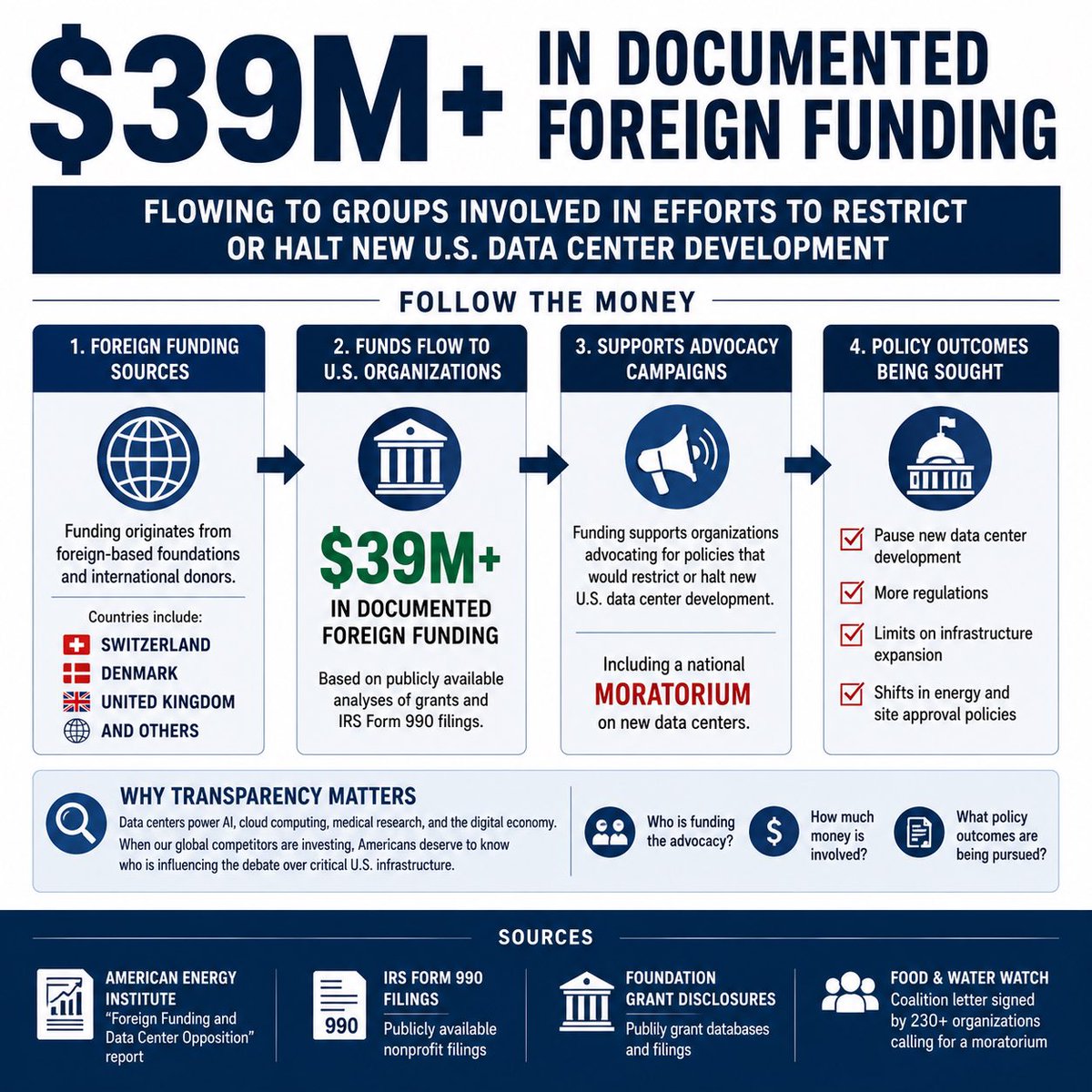
More than $39 million in documented foreign funding has flowed to organizations that are now actively involved in efforts to restrict or halt new U.S. data-center development.
Regardless of where you stand on data centers, one thing should be non-negotiable:
Transparency.
Americans deserve to know:
• Which organizations are receiving foreign funding?
• How much money is involved?
• What policy outcomes are being pursued?
• Who is influencing the debate over critical U.S. infrastructure?
According to publicly available analyses, funding has originated from foreign-based foundations and donors, including organizations associated with Switzerland, Denmark, the United Kingdom, and other international philanthropic networks.
This isn’t about whether people agree or disagree with data centers.
It’s about understanding who is financing advocacy campaigns that seek to influence U.S. energy, technology, and infrastructure policy.
When billions of dollars of AI infrastructure investment and America’s technological competitiveness are at stake, sunlight matters.
Follow the money.
Ask questions.
Demand transparency.
Sources:
• American Energy Institute, “Foreign Funding and Data Center Opposition” report
• IRS Form 990 filings
• Foundation grant disclosures
• Food & Water Watch coalition letter signed by 230 organizations
#Transparency #FollowTheMoney #DataCenters #AIInfrastructure #anthropic #fable
17
23h
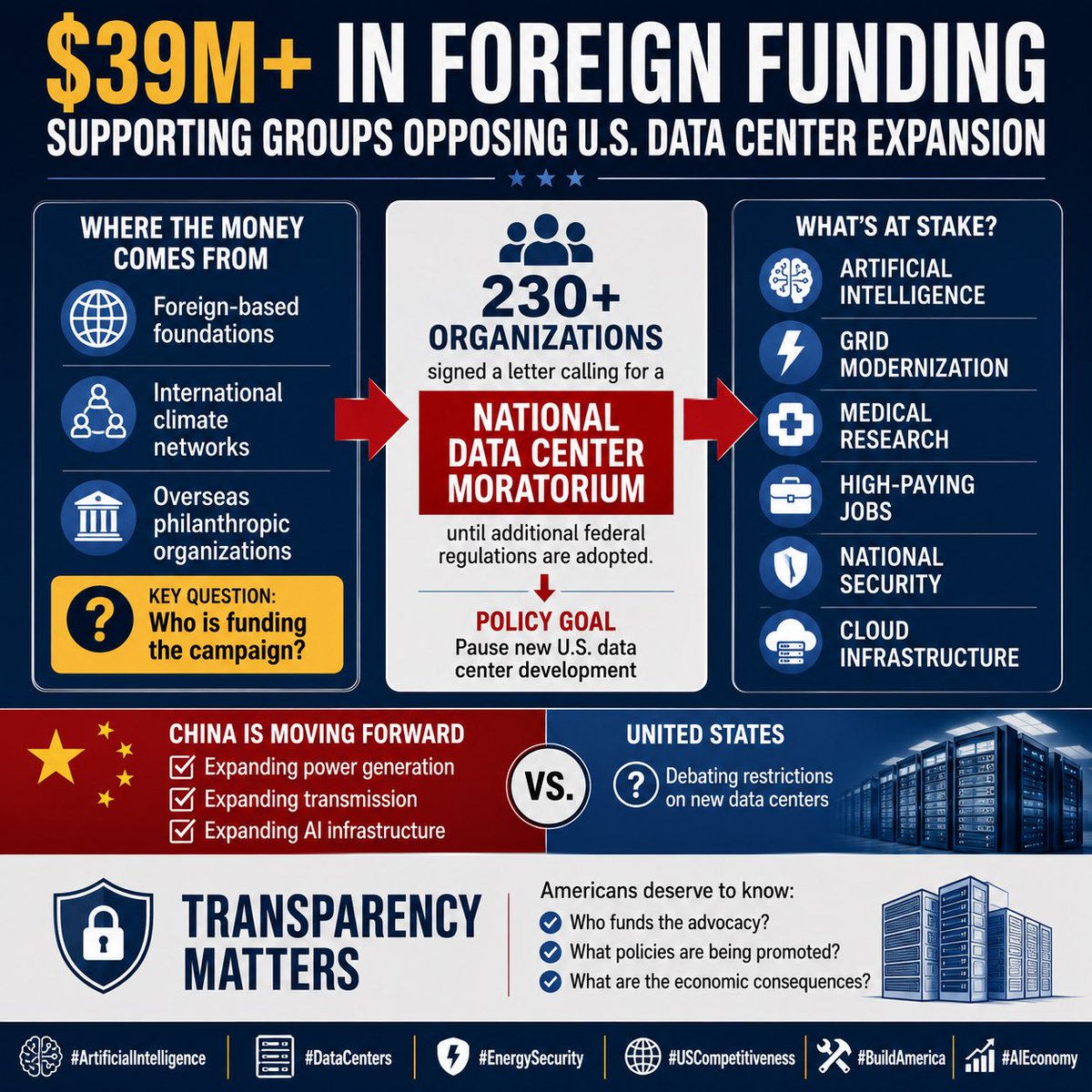
More than $39 million in documented foreign funding has flowed to organizations now supporting efforts to slow or halt U.S. data-center expansion.
That matters because data centers are becoming critical infrastructure for:
• AI development
• Medical research
• National security
• Cloud computing
• Economic growth
Recently, more than 230 organizations signed a letter calling for a national moratorium on new data centers until additional regulations are implemented.
Everyone is entitled to their views on energy, water use, and development.
But Americans should know:
✓ Who is funding the advocacy?
✓ How much foreign money is involved?
✓ What policy outcomes are being sought?
✓ How would a moratorium affect U.S. competitiveness?
As China rapidly expands power generation, transmission, manufacturing, and AI infrastructure, transparency around efforts to limit U.S. infrastructure investment is not a partisan issue.
It's a transparency issue.
Before America slows the buildout of the infrastructure powering the AI economy, policymakers and citizens deserve to understand who is influencing the debate—and why.
#ArtificialIntelligence #AIInfrastructure #DataCenters #EnergySecurity #NationalSecurity #EconomicDevelopment #USCompetitiveness #DigitalInfrastructure #EnergyPolicy #Manufacturing #BuildAmerica #fable
1
26
Jun 12
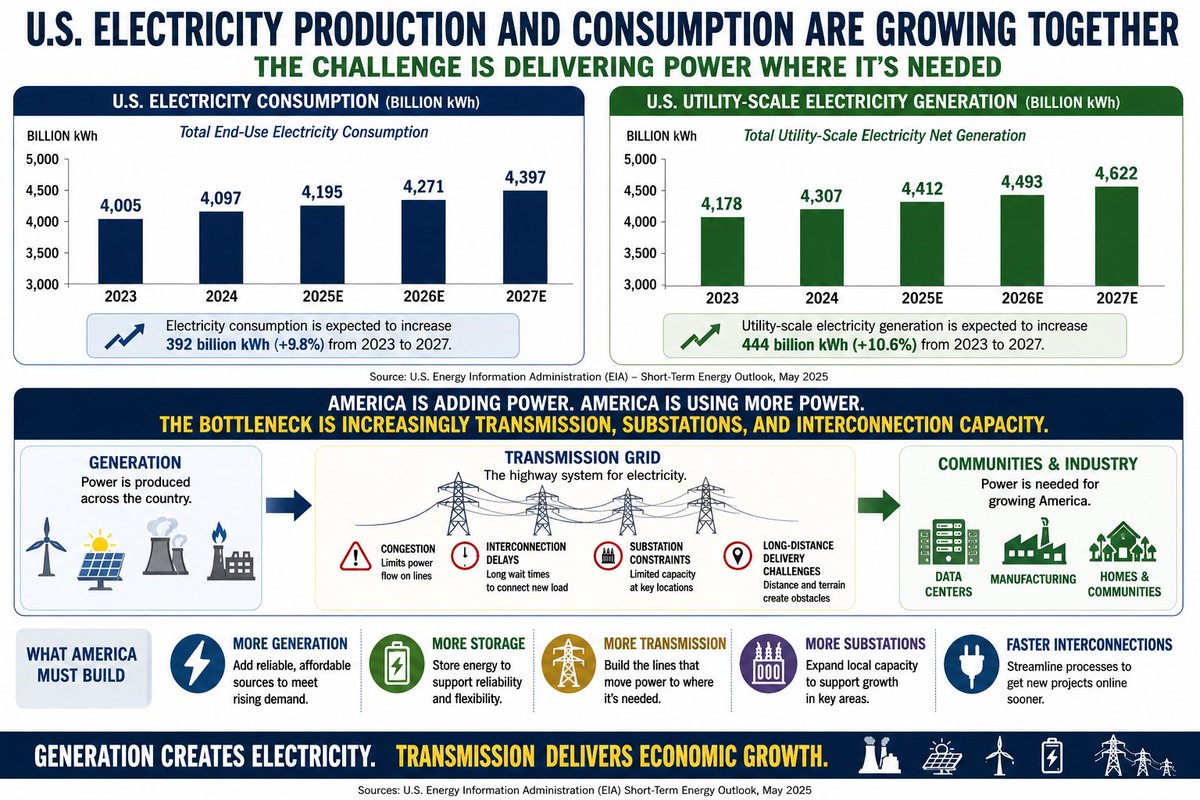
America’s power production and power consumption are growing together.
The problem isn’t that we’re running out of electricity.
The challenge is getting electricity to where it’s needed.
The U.S. is adding record amounts of:
☀️ Solar
🔋 Battery storage
🔥 Natural gas generation
At the same time, demand is rising from:
🤖 AI data centers
🏭 Manufacturing reshoring
🏘️ Population growth and electrification
On a national level, generation and demand are both moving higher.
But electricity doesn’t magically appear where it’s needed.
It must travel across a transmission network that was largely designed for a different era.
Think of it this way:
🚗 Power plants create the electricity
🛣️ Transmission lines move the electricity
🏙️ Communities, factories, and data centers consume the electricity
You can have enough power in one part of the country and still face shortages, delays, or higher costs somewhere else if the transmission system can’t move it efficiently.
That’s why the next phase of America’s energy buildout isn’t just about:
⚡ More generation
🔋 More storage
It’s also about:
🛣️ More transmission
🔌 More substations
🏗️ Faster interconnections
The AI race may ultimately be won not by who generates the most electricity, but by who can deliver reliable megawatts where they’re needed most.
Generation creates value. Transmission unlocks it.
Sources: EIA, ERCOT, NERC, Goldman Sachs Research, DOE
17
Bryan R Daniel retweeted

Jun 12
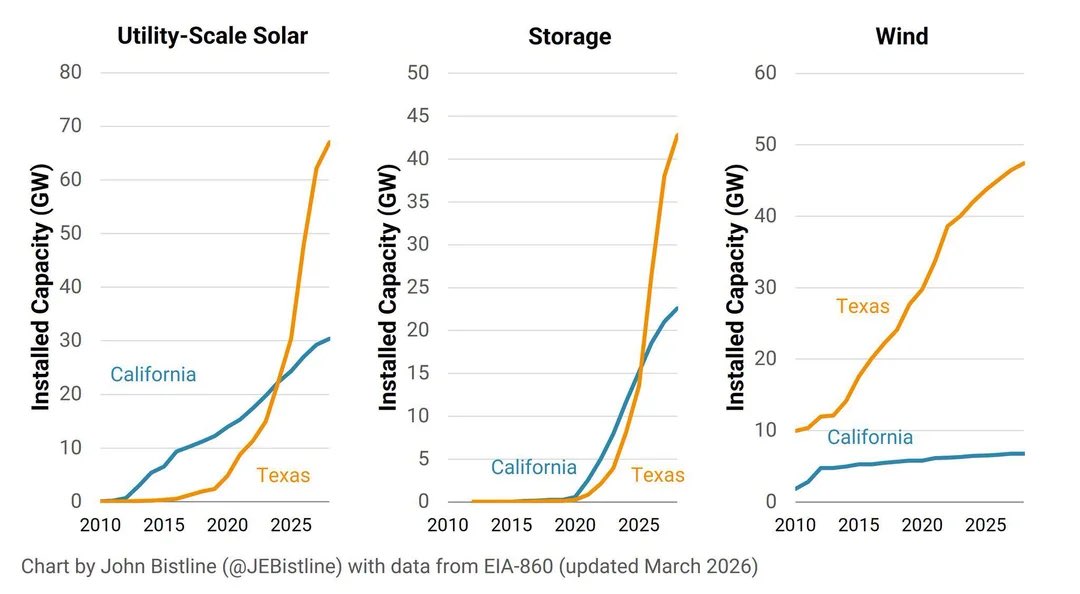
It will never not be funny to me that Texas is the Renewable Energy Capital of America
60
170
1,909
84,338
Jun 11
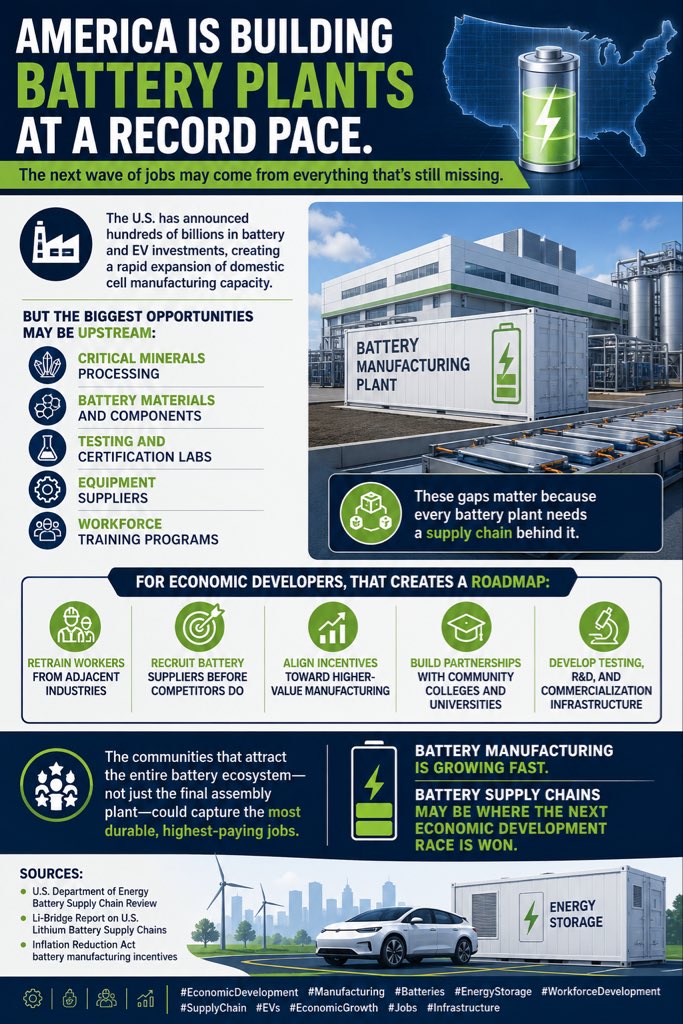
America is building battery plants at a record pace. The next wave of jobs may come from everything that’s still missing.
The U.S. has announced hundreds of billions in battery and EV investments, creating a rapid expansion of domestic cell manufacturing capacity.
But the biggest opportunities may be upstream:
🔋 Critical minerals processing
🔋 Battery materials and components
🔋 Testing and certification labs
🔋 Equipment suppliers
🔋 Workforce training programs
These gaps matter because every battery plant needs a supply chain behind it.
For economic developers, that creates a roadmap:
✅ Retrain workers from adjacent industries
✅ Recruit battery suppliers before competitors do
✅ Align incentives toward higher-value manufacturing
✅ Build partnerships with community colleges and universities
✅ Develop testing, R&D, and commercialization infrastructure
The communities that attract the entire battery ecosystem—not just the final assembly plant—could capture the most durable, highest-paying jobs.
Battery supply chains may be where the next economic development race is won.
Sources:
• U.S. Department of Energy Battery Supply Chain Review
• Li-Bridge Report on U.S. Lithium Battery Supply Chains
• Inflation Reduction Act battery manufacturing incentives
#EconomicDevelopment #Manufacturing #Batteries #WorkforceDevelopment #SupplyChain
2
22
Bryan R Daniel retweeted

Jun 8
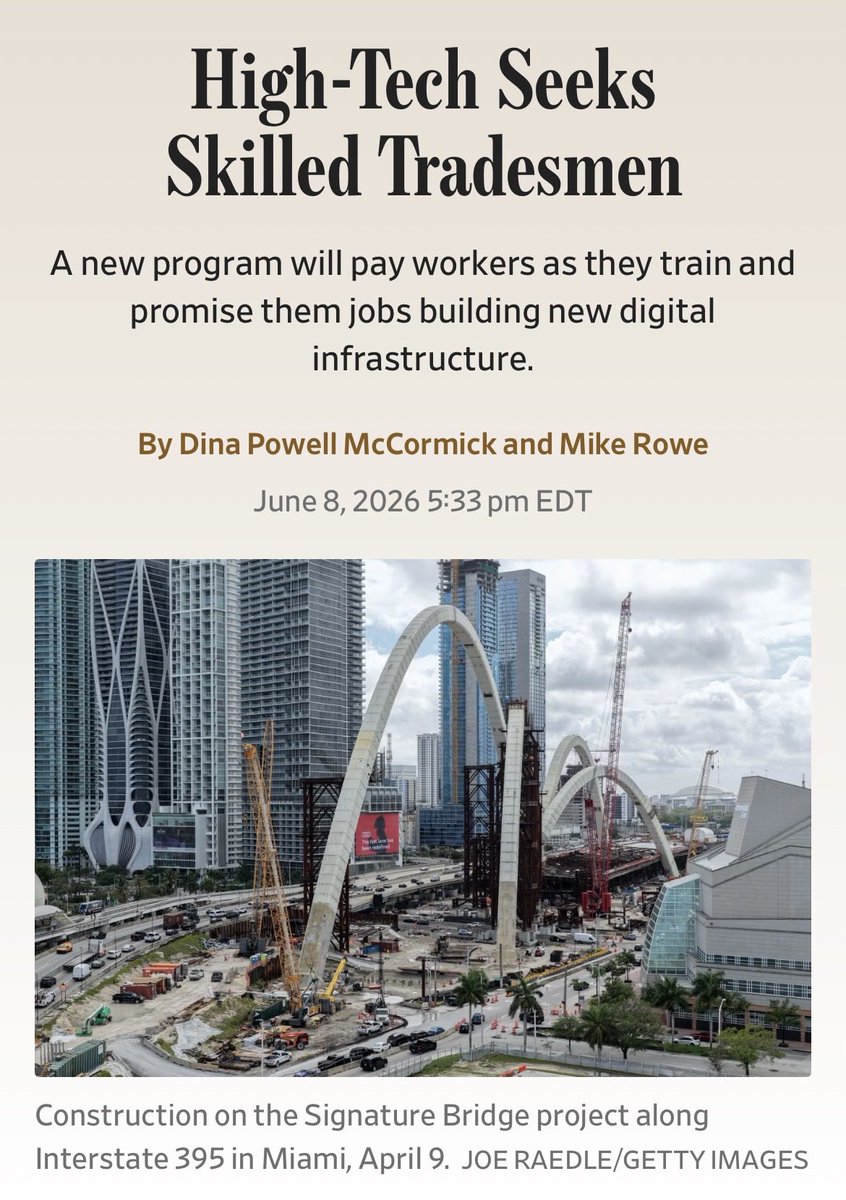
The AI infrastructure boom is generating strong demand for skilled blue-collar workers. In fact, there’s a shortage of electricians, fiber technicians, and mechanical tradespeople needed to build and maintain AI data centers. Meta’s new $115M America’s Workforce Academy provides paid training plus job guarantees for exactly these roles. This is the kind of practical jobs training program that we need more of.
201
314
2,500
221,929
Jun 9
Most people hear “Blackwell GPUs” and think bigger AI.
Consumers should think:
✅ Faster AI responses
✅ Better digital assistants
✅ Lower cost AI tools over time
✅ More personalized healthcare and education
✅ Faster drug discovery and medical breakthroughs
The new Blackwell systems from NVIDIA pack far more AI computing power into a single data center rack. That means companies can serve more users, run larger AI models, and deliver better results at lower cost per query.
Just as cheaper computing gave us smartphones, streaming, and cloud services, cheaper AI computing can make powerful AI available to everyone—not just large corporations.
The technology may be built in data centers, but the benefits show up in everyday life.
#AI #DataCenters #NVIDIA #Healthcare #Innovation #Blackwell #FutureOfWork
16
Jun 7
One of the largest beneficiaries of AI may not be software.
It may be patients.
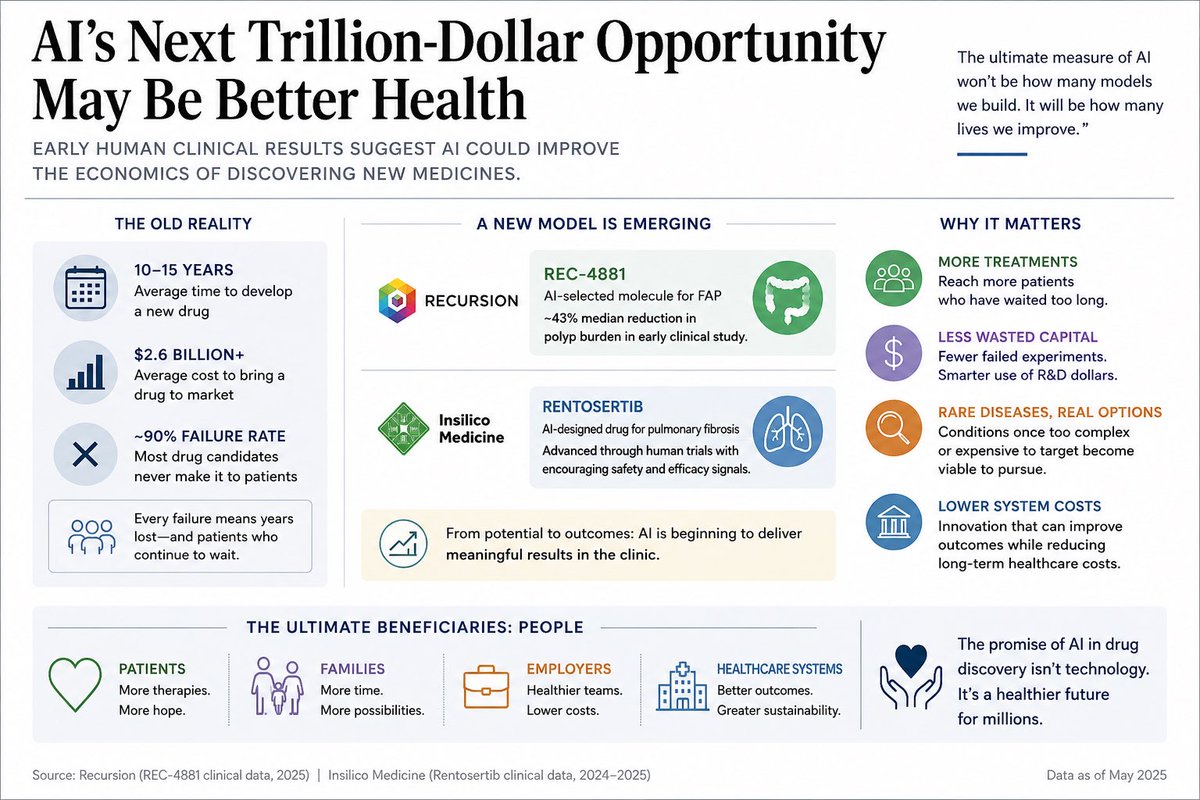
The average drug takes more than a decade to develop and costs billions of dollars. Most candidates fail. Every failure means years lost for people waiting on treatments.
That equation may be starting to change.
In recent months, AI-driven drug discovery programs have reported some of the strongest human clinical signals seen so far:
• Recursion’s REC-4881 demonstrated a ~43% median reduction in FAP polyp burden in an early clinical study.
• Insilico’s Rentosertib, a generative AI-designed drug for pulmonary fibrosis, has advanced through human trials with encouraging efficacy and safety data.
The significance extends beyond two drugs.
If AI can improve the odds of finding successful therapies, the benefits compound across the healthcare system:
→ More treatments reach patients.
→ Fewer research dollars are wasted on dead ends.
→ Rare diseases become economically viable to pursue.
→ Healthcare systems gain access to innovation at lower cost.
For years, AI drug discovery was a story about potential.
Now it is becoming a story about outcomes.
The ultimate measure of AI won’t be how many models we build.
It will be how many lives we improve.
#AI #Healthcare #DrugDiscovery #Biotech #Innovation
60
Jun 6
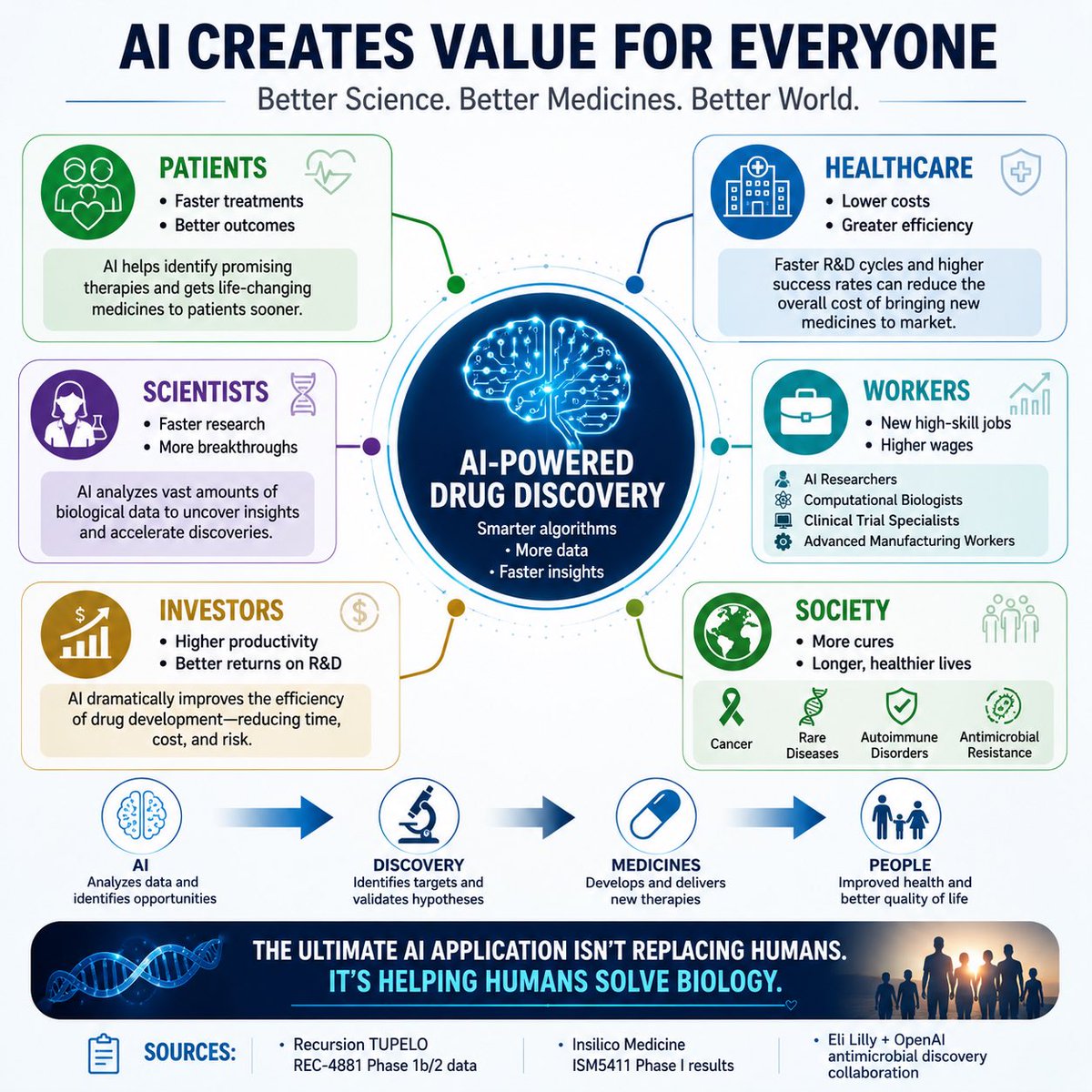
AI isn’t just creating value for biotech companies.
It’s creating value for patients, doctors, workers, investors, and society.
🔬 Patients benefit from faster drug discovery
• Recursion’s REC-4881 showed a ~43% reduction in polyp burden in early clinical data
• AI helps identify promising targets years faster than traditional methods
👩⚕️ Doctors benefit from better treatment options
• More potential therapies entering the pipeline
• Precision medicine tailored to specific diseases and patient populations
💼 Workers benefit from new high-paying jobs
• AI researchers
• Computational biologists
• Clinical trial specialists
• Advanced manufacturing workers
🏥 Healthcare systems benefit from lower costs
• Faster R&D cycles
• Higher probability of success
• Potentially lower costs to bring new medicines to market
💰 Investors benefit from increased productivity
• Drug development often takes 10 years and billions of dollars
• AI can dramatically improve the efficiency of scientific discovery
🌎 Society benefits from more cures
• Cancer
• Rare diseases
• Autoimmune disorders
• Antimicrobial resistance
The biggest AI opportunity may not be chatbots.
It may be helping humanity discover treatments and cures that were previously impossible.
Sources:
• Recursion TUPELO REC-4881 Phase 1b/2 data
• Insilico Medicine ISM5411 Phase I results
• Eli Lilly OpenAI antimicrobial discovery collaborati #AI #datacenters #innovation
1
2
74
Jun 4
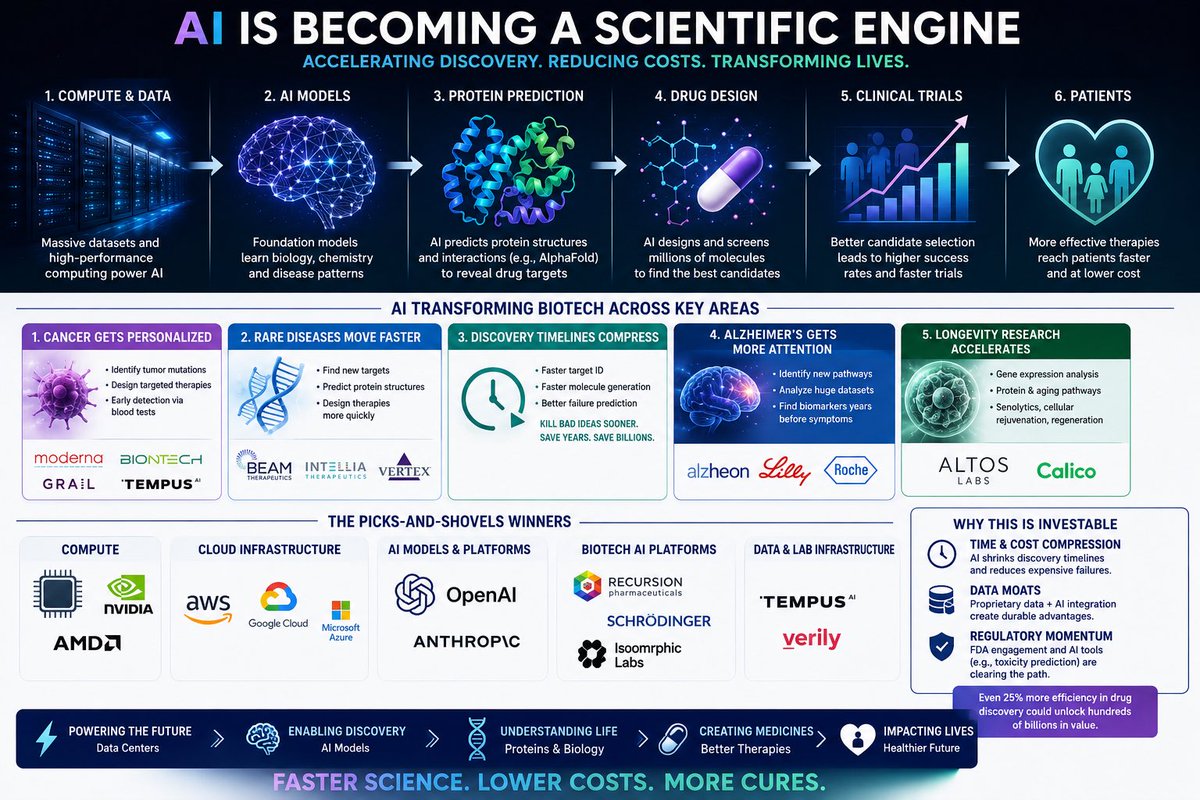
AI isn’t just writing emails.
It’s helping scientists:
🧬 Predict protein structures
💊 Design new drugs
🦠 Identify disease targets
🧠 Search for Alzheimer’s treatments
🎯 Personalize cancer therapies
The biggest breakthrough may not be finding more drugs.
It may be eliminating bad drug candidates years earlier.
If drug discovery becomes even 25% more efficient, the economic impact could rival the internet itself.
The winners won’t just be biotech companies.
They’ll include the compute, cloud, and energy infrastructure powering this new scientific revolution.
#AI #Biotech #DrugDiscovery #AlphaFold #Healthcare #NVDA #GOOGL #AMZN #Longevity
1
37
Jun 4
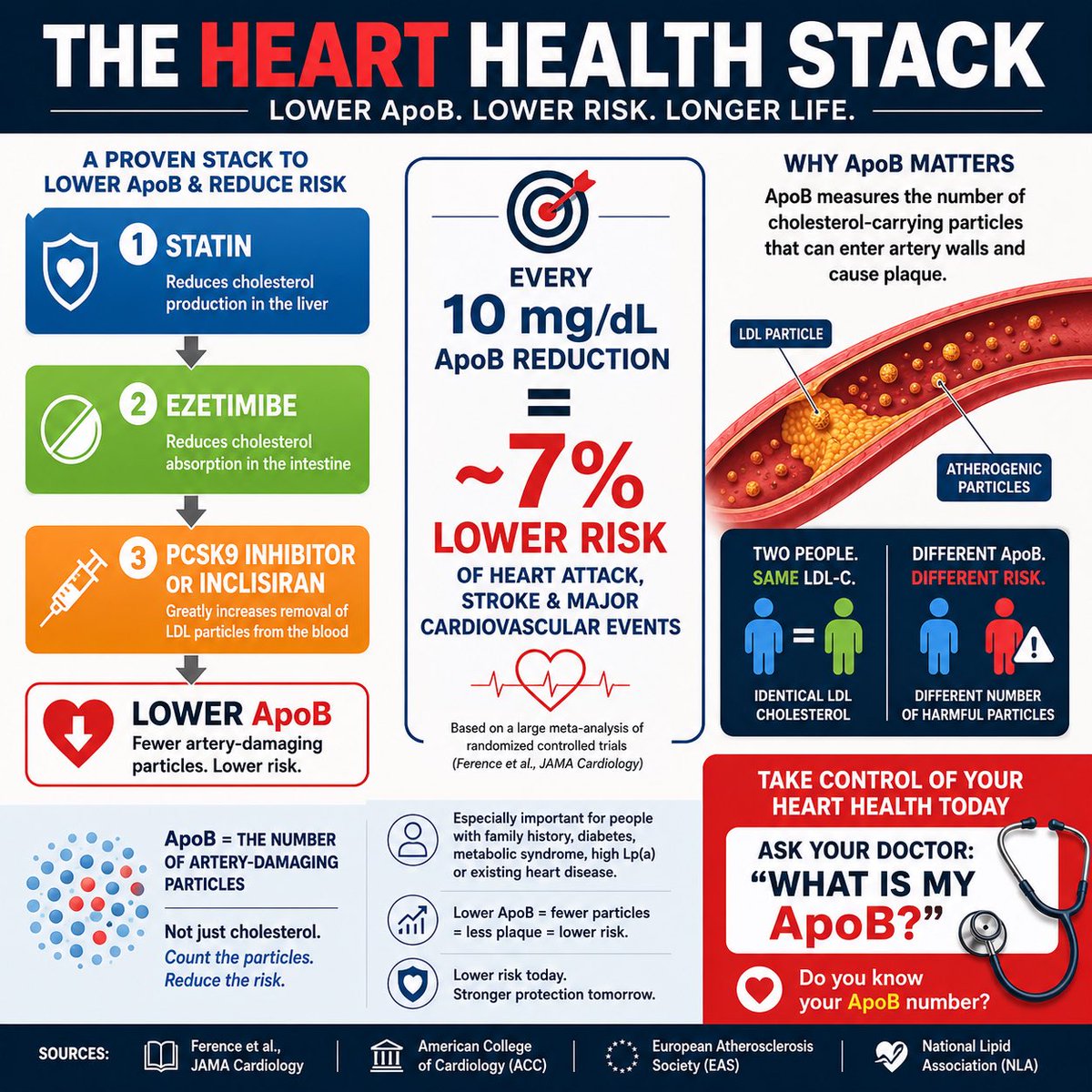
One of the most powerful heart disease prevention stacks available today may already exist.
✓ Statin
✓ Ezetimibe
✓ PCSK9 inhibitor or Inclisiran (for higher-risk patients)
The goal?
Reduce ApoB—the number of cholesterol-carrying particles that can enter artery walls and create plaque.
A large meta-analysis of randomized clinical trials found that every 10 mg/dL reduction in ApoB was associated with about a 7% lower risk of major cardiovascular events.
Many people know their LDL cholesterol.
Far fewer know their ApoB.
That may be a mistake.
Two people can have identical LDL levels but very different numbers of artery-damaging particles—and very different risk profiles.
As precision medicine advances, ApoB is becoming one of the most important markers for understanding cardiovascular risk.
Talk with your physician about adding ApoB to your next lipid panel and ask whether your current treatment plan is targeting particle count, not just cholesterol.
Do you know your ApoB number?
Sources:
• Ference et al., JAMA Cardiology
• American College of Cardiology
• European Atherosclerosis Society
• National Lipid Association
#HeartHealth #ApoB #Longevity #PreventiveMedicine #Cardiology
41
Jun 2
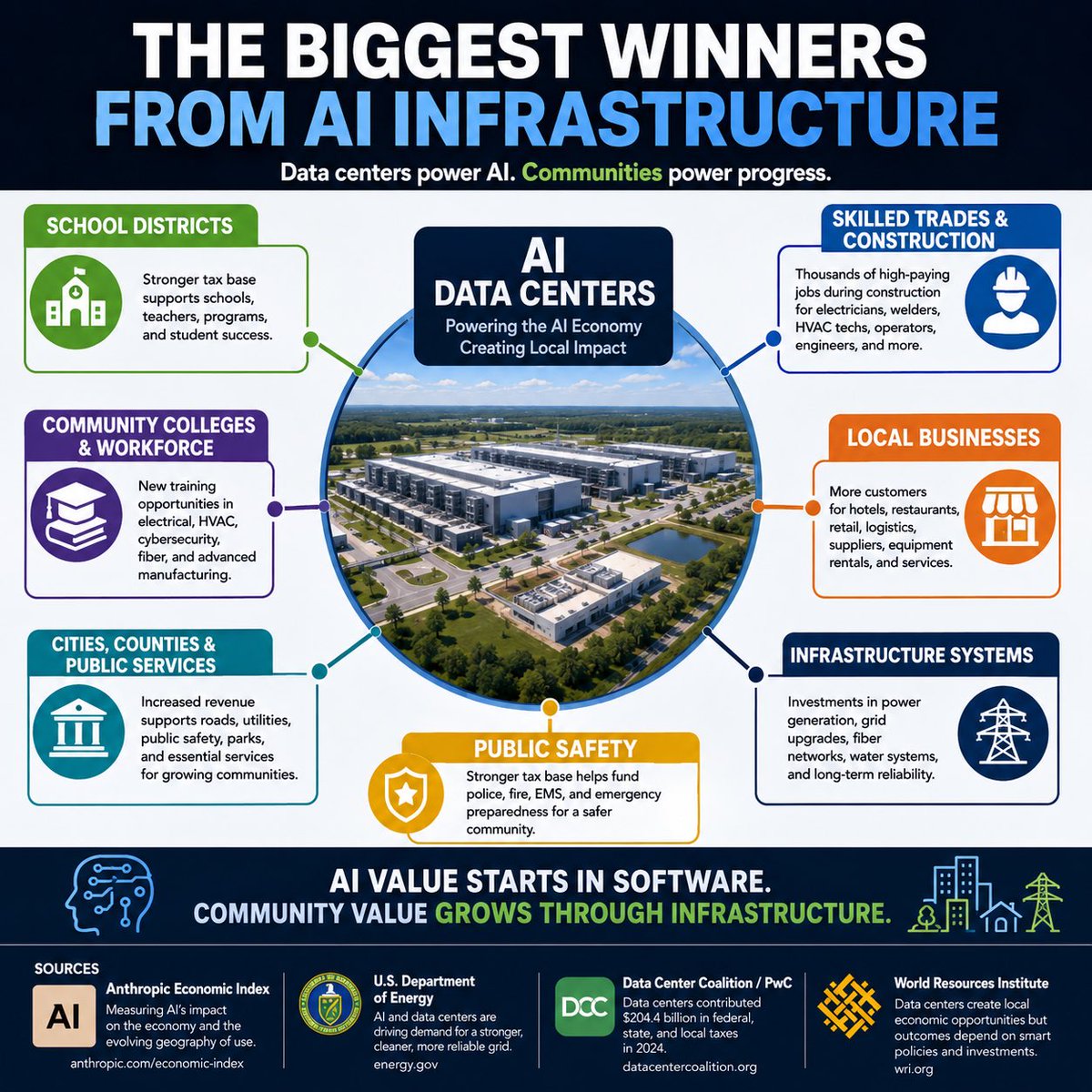
One of the most interesting findings from Anthropic's Economic Index is that AI adoption is creating winners—but not everyone is benefiting equally yet.
That's why AI infrastructure matters.
The biggest winners from data center investment are often:
🏫 School districts through expanded tax bases
👷 Electricians, welders, HVAC technicians, engineers, and construction workers through years of high-paying projects
🎓 Community colleges and workforce programs through new technical training opportunities
🏪 Local businesses serving construction crews and facility operations
🚒 Cities, counties, and public services through increased revenue for roads, utilities, public safety, and infrastructure
⚡ Power, fiber, and water systems through long-term infrastructure upgrades
AI may begin with software engineers and power users, but its economic benefits spread much wider when physical infrastructure is built.
The future of AI isn't just digital.
It's concrete, steel, fiber, power lines, and skilled trades.
Sources:
Anthropic Economic Index (2026)
U.S. Department of Energy
World Resources Institute
Data Center Coalition / PwC
#datacenters #infrastructure #communities #communitycolleges #communityinvestment
20
Jun 2
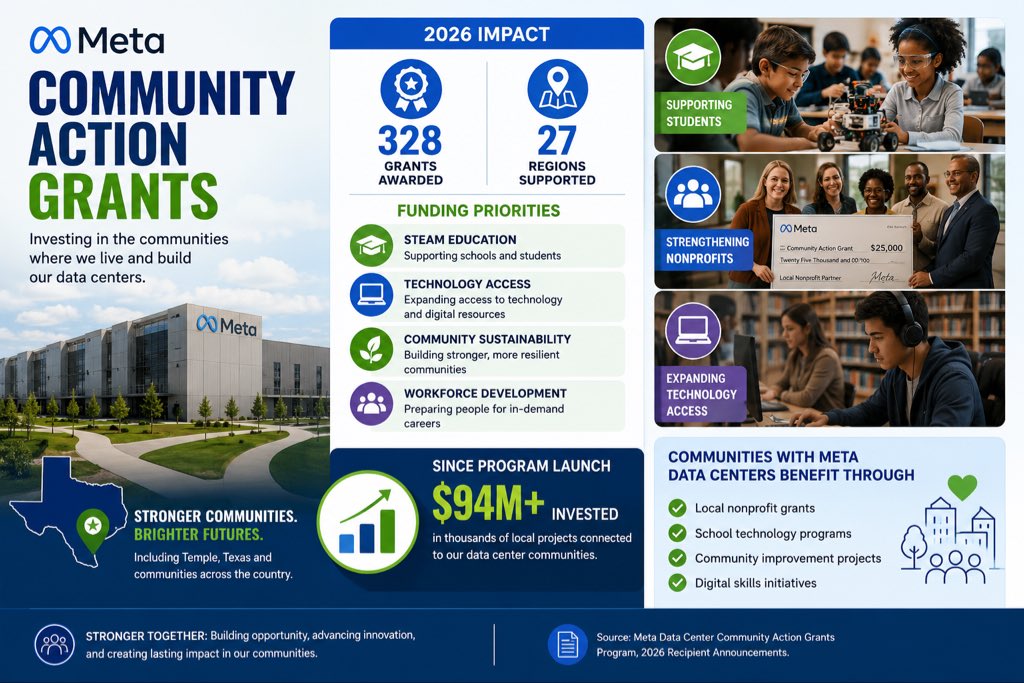
Most people don't realize how structured the Meta Data Center Community Action Grants program has become.
✅ Grants for nonprofits & public schools
✅ Focus on STEAM, technology, workforce development, and community projects
✅ Available in communities hosting Meta data centers, including Temple, Texas
✅ Administered through established grant partners and platforms
In 2026, Meta announced 328 grants across 27 regions, supporting schools, nonprofits, technology access, AI education, and local community initiatives.
Since inception, Meta reports investing more than $94 million in thousands of local projects connected to its data center communities.
When discussing data centers, it's worth looking not only at tax revenue and jobs, but also at the community investments that often accompany these facilities.
#DataCenters #EconomicDevelopment #STEM #Education #Texas #TempleTX #CommunityInvestment
23
Jun 1
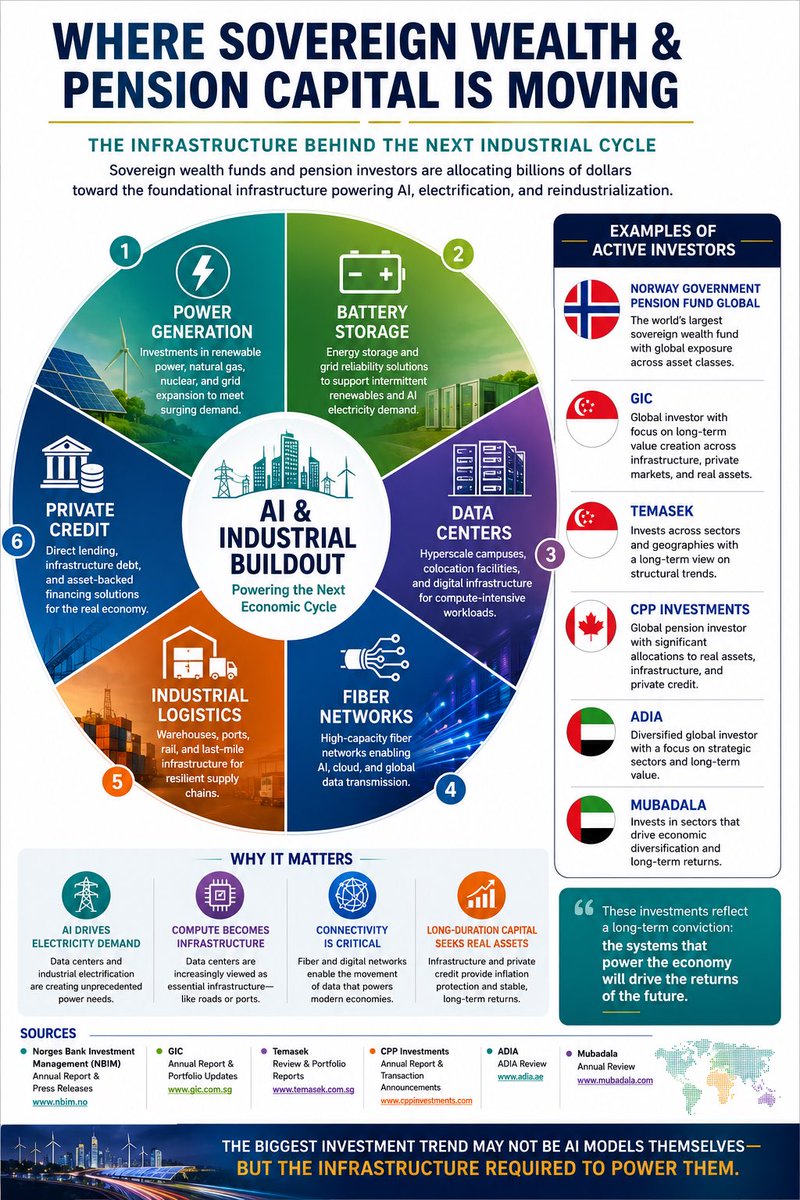
Where Sovereign Wealth & Pension Capital Is Moving
The Infrastructure Behind the Next Industrial Cycl
Recent Capital Focus
⚡ Power Generation
Grid expansion, renewable infrastructure, power assets
🔋 Battery Storage
Grid reliability and AI-driven electricity demand
🏗️ Data Centers
Hyperscale campuses, colocation, digital infrastructure
🌐 Fiber Networks
Connectivity for AI, cloud, and data transmission
🏭 Industrial Logistics
Warehouses, ports, supply-chain infrastructure
💰 Private Credit
Direct lending, infrastructure debt, asset-backed finance
⸻
Why It Matters
AI is increasing demand for:
Electricity
Compute
Data transmission
Physical infrastructure
Many of the world’s largest investors are allocating capital toward the systems that support all four.
⸻
Examples of Active Investors
🇳🇴 Norway Government Pension Fund Global
🇸🇬 GIC
🇸🇬 Temasek
🇨🇦 CPP Investments
🇦🇪 ADIA
🇦🇪 Mubadala
⸻
Sources
• Norges Bank Investment Management (NBIM) Annual Report & Press Releases
nbim.no
• GIC Annual Report & Portfolio Updates
gic.com.sg
• Temasek Review & Portfolio Reports
temasek.com.sg
• CPP Investments Annual Report & Transaction Announcements
cppinvestments.com
• ADIA Review
adia.ae
• Mubadala Annual Review
mubadala.com
Bottom Banner
“The biggest investment trend may not be AI models themselves—but the infrastructure required to power them.”
21
Jun 1
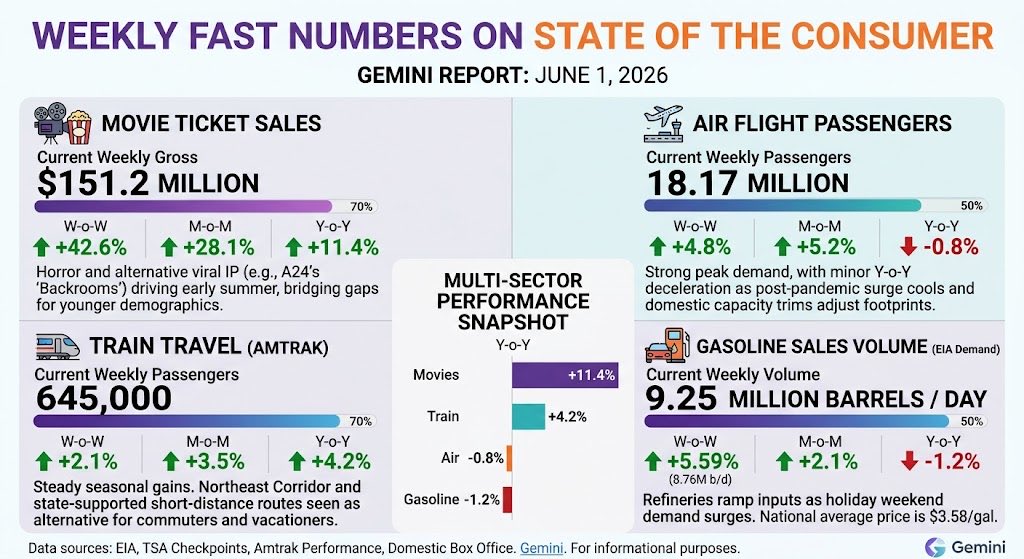
Weekly Fast Numbers on State of the Consumer 📊
The official post-Memorial Day recap confirms it: the American consumer is prioritizing experiences, local entertainment, and travel as we head into summer.
Here are the macro fast numbers from our latest report:
🎬 Movie Box Office: $151.2M top-film frame
• WoW: 📈 42.6% (Driven by A24's massive *$81.5M* debut for *Backrooms*)
• YoY: 📈 11.4%
✈️ Aviation (TSA Throughput):18.17M holiday passengers
• WoW: 📈 4.8% (Peak holiday travel surge)
• MoM: 📈 5.2%
🚆 Rail Traffic (Amtrak):645K passenger trips
• WoW: 📈 2.1%
• YoY: 📈 4.2%
⛽ Gasoline Volume Demand: 9.25M barrels/day
• WoW: 📈 5.59% (Massive holiday road-trip draw)
• YoY: 📉 -1.2%
The Takeaway: There is clear momentum in "experience-first" economic spending. Despite standard inflation discussions, heavy fuel inventory draws and a massive surge in local cinema show consumers are highly active and eager to get out.
#Economy #ConsumerTrends #MacroData #TravelTrends
32