
Sweary feminist with a low boredom threshold. Also UX/information designer; writer and editor; amateur musician. All strong opinions my own.
Joined April 2008
- Tweets 28,951
- Following 2,368
- Followers 3,069
- Likes 509,216
287 Photos and videos






Jun 13
Indeed. Why do we care more about property than people?
Jun 12

What amazes me are the rules of British ‘justice’ where convicted criminals are given 3y 8m for grievous bodily harm and 5y for criminal damage.
The criminal damage can be fixed 100%, possibly even better than before, within a matter of weeks/months.
The victim of grievous bodily harm will have to live with that for the rest of her life. Decades. She will never forget it nor feel results of that grievous harm inflicted disappear.
No justice imo. But I’m glad they were all jailed. I hope civil matters are brought to deter future terrorists like them.
1
27
Jun 13
I’m increasingly inclined to think that AI is evil.

I saw a post on Reddit that said that “The underlying purpose of AI is to allow wealth to access skill while removing from the skilled the ability to access wealth.” And I don’t think I’ve ever seen AI described so incisively.
1
56
Ms Grumpytrousers retweeted

Jun 10
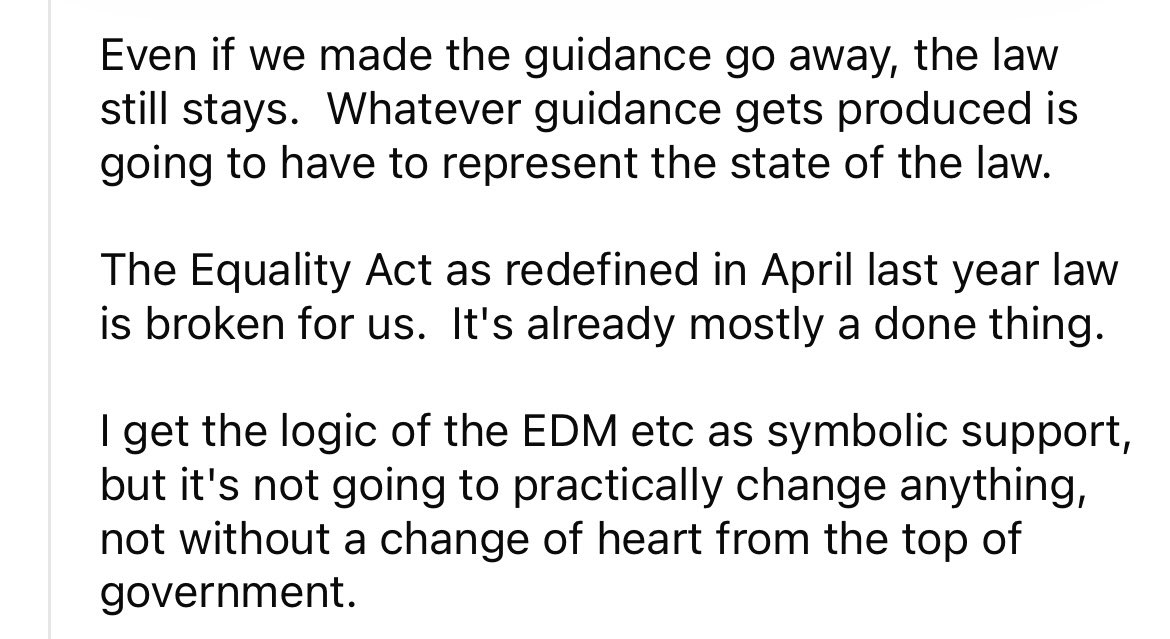
If you want to know where we’re at now … Trans Reddit now understands how legislation works better than many of our actual legislators 🤦♀️
9
44
212
5,440
Jun 10
Oh @Morrisons I'd only just discovered your glorious mango and coconut ice lollies – absolutely gorgeous: you can taste the coconut milk – and now they are gone. WHY???
The new Pistachio & Creme are as disgusting as their name implies. Ugh.
1
1
3
204
Ms Grumpytrousers retweeted

Even among students (exposed to so much propaganda and peer pressure on this issue), a decisive majority disagree with males using women's changing rooms (and vice versa).
Great to see the question asked really clearly by @HEPI_news (so often not the case in polling this topic).
Interesting given that universities' failure to uphold EA2010 seems to be driven by fear of (perceived) student opinion. Yet this polling demonstrates that most students quietly disagree with their activist/NUS peers.
I'd love to see further breakdown of the numbers, e.g. Russell Group vs other students @nickhillman
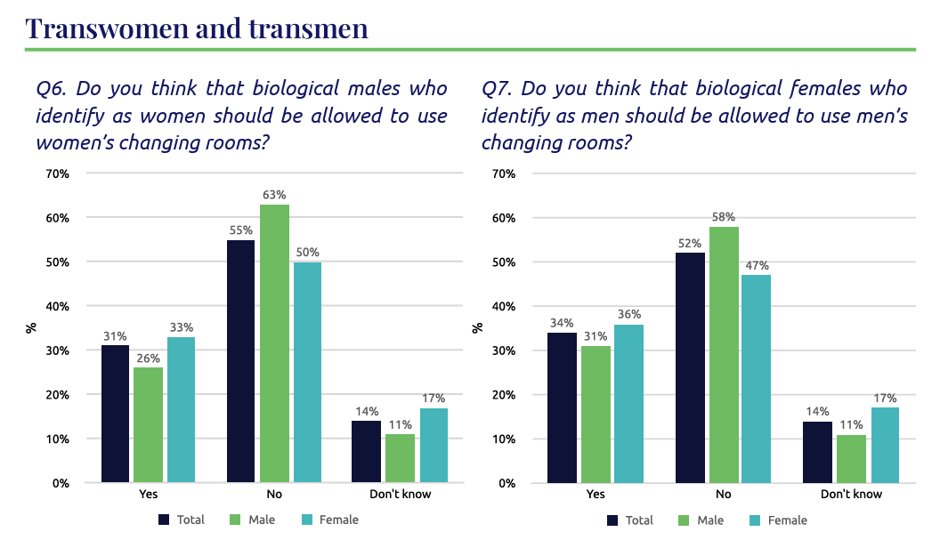

New Post: New HEPI Policy Note ‘A breed apart? What do young undergraduates think of controversial and divisive issues?’ hepi.ac.uk/2026/06/04/new-he… hepi.ac.uk/2026/06/04/new-he…
25
400
1,039
54,670
Ms Grumpytrousers retweeted

Jun 9
Men will say “she knew what she was doing” about a 14-year-old girl but “he made a mistake” about a grown man.
That’s not confusion. That’s misogyny.
88
3,971
20,900
123,173
Ms Grumpytrousers retweeted
Jun 9
FACT: Female victims who kill in SELF DEFENSE will spend an average of 15 years behind bars
Men who kill their female partners serve ,on average, between 2 and 6 years behind bars...
124
5,130
25,424
229,188
Excellent summary.

No. This is classic straw manning and intentional misunderstanding, demonstrating the necessity of my post. You are not actually arguing agains the Gender Critical or TERF position. You are arguing against your fantasy of it, because otherwise your hatred and attacks are unjustified.
Your argument depends on pretending that “female” means “currently has a full, functioning, typical reproductive system.” That is not the claim that I or any GC feminist or TERF has made. That is your straw man. You either a misunderstand, lack comprehension or afraid that an honest conversation will expose your bad faith and shallow arguments. Your own cognitive bias has brought you to your incorrect conclusions about my position, not my actual position.
You are confusing a sex category with a checklist of typical traits.
“Female” does not mean “has every typical female trait,” “has functioning ovaries,” “can get pregnant,” or “has no medical variation.” It means a human being of the sex organized around the ova-producing developmental pathway.
A woman with a hysterectomy is not an exception to being female. A menopausal woman is not an exception to being female. An infertile woman is not an exception to being female. A female person with a DSD is not an exception to being female. These are female human beings with atypical development, injury, illness, infertility, age-related change, or medical history. They are in fact proof of being female since only a female can have a hysterectomy, cease menstruation or have a disorder of female sex development.
That is not special pleading. That is how biological categories work. The existence of members in a category that are at a different developmental stage than other members of the category do not erase the category.
The people you claim are being excluded from the category “female” are not females with atypical traits. They are males. That is the relevant distinction.
And no, disagreement with gender-identity ideology is not “anti-trans.” You can believe trans-identified people should be treated humanely, protected from violence, and allowed to live ordinary lives without also believing that sex categories must be redefined around identity.
As for healthcare, people have different views. But objecting to medical transition for minors, weak evidence standards, compelled affirmation, or the removal of safeguards is not the same thing as hating trans people. Calling every boundary, definition, or safeguarding concern “anti-trans” is just a way to avoid arguing the point. It is all deflection and projection to protect fundamentally bad ideas.
You think that the position that sex is real is anti-trans. I think the position that sex can be overwritten by subjective gender identity based on sex stereotypes os anti-woman and sexist. Deal with your misogyny and leave me out of your sexism -- yours is the gender essentialist position, not mine.
As stated, the entire reason for this thread is because of constantly having the argument mischaracterized and lied about by trans activists acting in bad faith. You are simply proving my point.
7
337
Ms Grumpytrousers retweeted

Jun 8
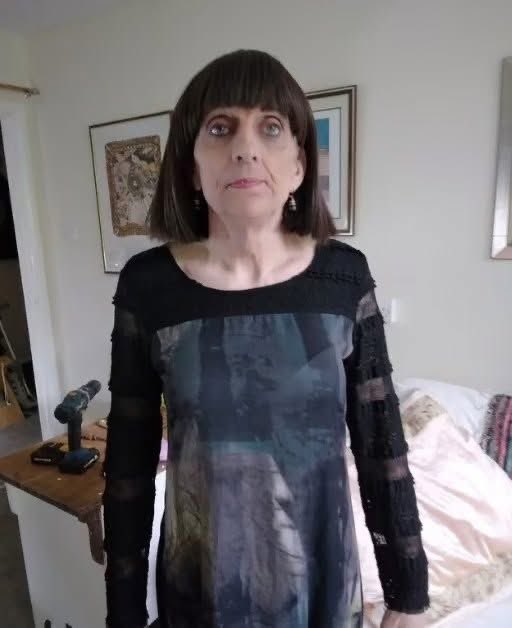
A paedophile who changed gender while in prison for sexually abusing their own daughter as a child and sending explicit photos of her to perverts online has been quietly released back into the community.
Claire Fox, 61, who was previously known as Clive Bundy, who has six kids, served just seven years of a 15-year jail sentence, before being settled into a tiny market town on the Welsh borders.
Fox, who wears a black wig and floral dresses told neighbours, who knew nothing of fox's sordid past, that fox was an electrician from Bangor as they helped get settled into fox's new surroundings and helped furnish her flat.
Fox arrived in a sheltered accommodation block for older people in a tiny town at the start of June.
Fox was given new furniture, a television, printer, washing machine and crockery by the armed forces charity SSAFA because fox had once been in the Territorial Army.
Fox’s release from prison has appalled the daughter Ceri-Lee Galvin, who bravely waived her right to anonymity, having been abused by her father for nine years from the age of eight.
Revealing her astonishment, Ceri-Lee, 24, said: ‘My father is not a woman and I refuse to recognise him as such. He changed his gender in prison to make his life there easier.
‘But now he is out and already up to his usual tricks conning everyone he meets.
‘The fact he is now dressed as a woman makes him more dangerous as young girls are his thing and he has never shown any remorse.
‘My father is a highly manipulative man who has attended no sexual offender rehabilitation programmes, shown no remorse for what he has done and openly admits finding children attractive.
‘There have been no meetings I’m aware of to tell local schools about his presence, he has no tag and no curfew. He has just been put into this community and given all he could wish for – food, furniture and a home.’
Ceri-Lee, now a student paramedic, added: ‘I am in no way transphobic and I feel incredibly sorry for people who genuinely need to transition. They face stigma and worse because of cases like this.
‘But it should just not be an option for those convicted of sexual offences against children to suddenly say that they want to be a woman.
‘This only arose at the end of 2021 when he was due to be moved to an open prison but then had a fight with a fellow prisoner that was serious enough to stop the move.
‘That is when he went for the gender change – when he was almost 60, having been a macho man all his life and having had eight children and having never mentioned gender dysphoria before.
‘Now he is being indulged by everyone. The prison service gave him make-up and women’s clothes and now a charity for the armed forces have provided him with so much stuff when all he did was a short stint in the Territorial Army in his 20s.
289
1,962
3,606
123,364
Ms Grumpytrousers retweeted

Jun 7
When I talk about fear culture at our universities, this is what I mean. A few young minds that have closed themselves off to anything they disagree with are ruining it for the majority of us students who know that such exposure is the most important of all.
Jun 7

Due to escalating disruptive protests, I have decided to cancel the remainder of these lectures. This is deeply lamentable, but the disruption has undermined the academic nature of this series. Students shouldn't face bullying or harassment when attending academic events.
60
774
3,898
95,773
Ms Grumpytrousers retweeted

There's confusion, so here's that EHRC guidance in plain Sunday Sport language:
'Lads, if you want to play dress up and have a wank, crack on. Just not in the ladies' shithouse, eh?'
74
585
4,214
137,010


Ms Grumpytrousers retweeted

An astonishing omission by @BBCNews to leave out the motivation of this man. He specifically targeted girls and he was motivated by ‘trans’ grievances.
Why sanitise the truth in this case?
In his own words 👇
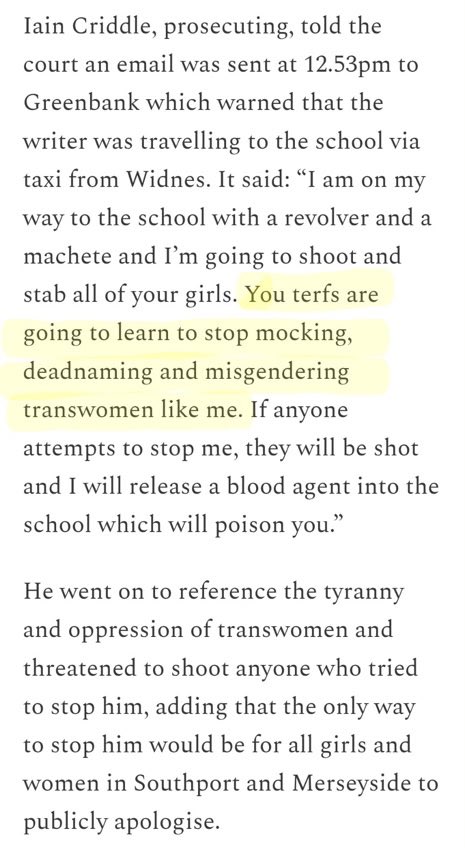

‘Darren Rigby, who sent hoax death threats to schools is jailed’
All girls’ schools were specifically targeted. Rigby ‘threatened to carry out deadly attacks supposedly in response to the treatment of ‘transwomen’’. None of this features in the coverage across outlets, despite the evidence emerging in email evidence and in court, neither does it feature in the Merseyside Police report.
‘I’m going to kill every girl and woman staff member I come across’
‘I'm going to shoot and stab all your girls’
It’s a crime of extreme misogyny in the cause of ‘fighting trans oppression’ but any mention of ‘trans’ has been erased by the police, PA and all news outlets. In addition the BBC report hides the fact that it was a crime against women and girls.
bbc.co.uk/news/articles/c0e2…
southport.thelead.uk/p/hoax-…
24
525
1,353
26,455
Ms Grumpytrousers retweeted

Jun 4
The core part of the Henry Nowak murder (the part we must not forget and must seriously engage with) is that his killer and family instinctively thought to fabricate a racism narrative because they knew it would give them an immediate advantage and invert the roles at the scene. And it worked exactly as calculated.
It has struck a raw nerve because it makes visible in the most repulsive way imaginable what many have long sensed, that accusations of racism have become a powerful, paralysing force in modern Britain eventually leading to a dying boy being sidelined while the system instinctively prioritised accusations of racism.
211
3,076
16,970
274,567
We have to stop zig-zagging from one stupid extreme to the other.
Jun 3

Bear in mind that during the inquiry into the Manchester Arena bombing, it came out that security guard Kyle Lawler had actually spotted suicide bomber Salman Abedi before.
Abedi was fidgety and sweating in a bulky jacket on a warm night, and carrying a large backpack. Lawler had a “bad feeling” and thought something was wrong, but he hesitated and failed to report it properly. His exact words:
“I did not want people to think I am stereotyping him because of his race… I was scared of being wrong and being branded a racist if I got it wrong and would have got into trouble.”
22 innocents were killed; hundreds scarred for life.
This bloodbath should have been the final wake-up call about the lethal insanity of “anti-racism” and the deranged cult that treats being called racist as the ultimate unforgivable sin.
Instead, Britain doubled down and rammed this poisonous ideology even deeper into the College of Policing’s training.
Time to scrap the race-baiting training and fire the ideologues. Or keep burying more young, innocent Brits.
26
Ms Grumpytrousers retweeted

This petition has to get to 10 000 within the next 3 weeks. We really, really, really need this research into the impact of desexed language in women's health!
Please sign and share!
petition.parliament.uk/petit…
2
31
49
2,585
Ms Grumpytrousers retweeted

11 trans people have been murdered since 2000. 3 by “clients”, 1 drug dealer, 2 family 3 partners, 1 by school students and 1 by a transwomen. All knew their killers.
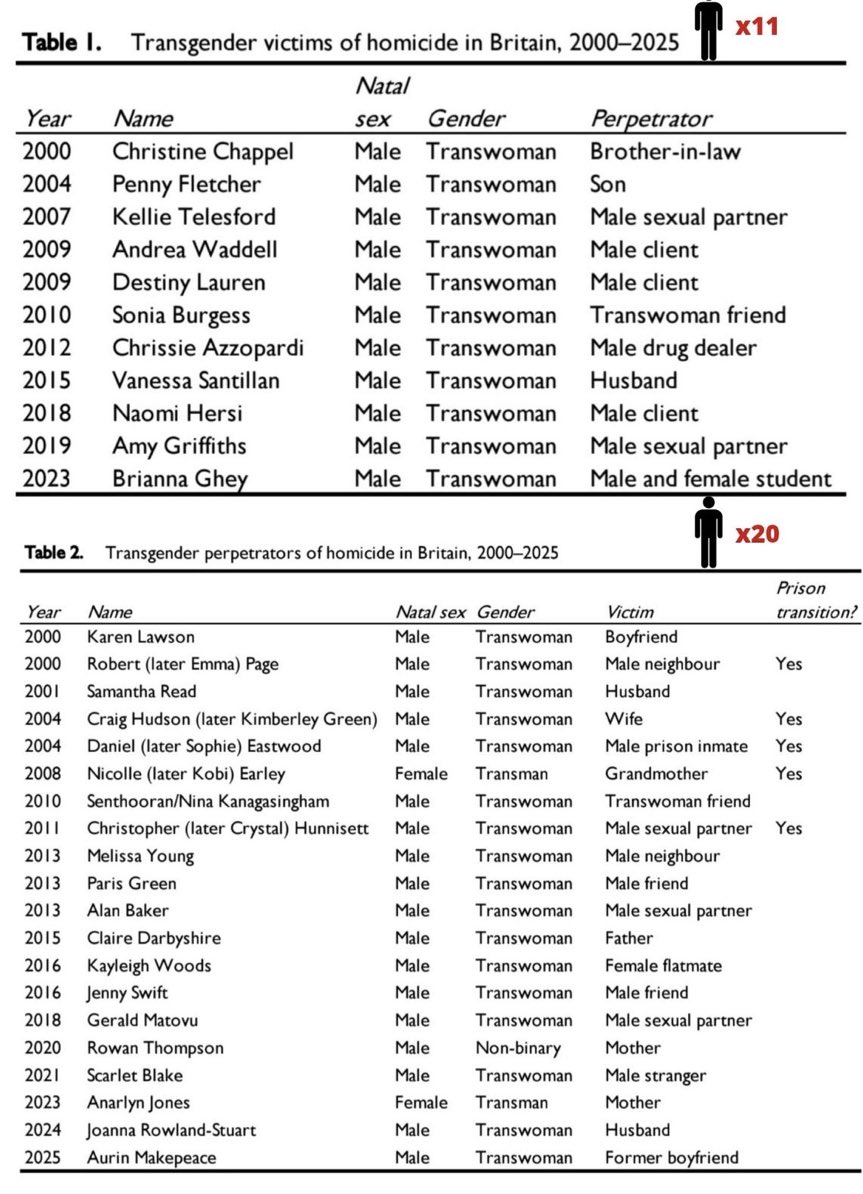

You murdered thousands of our trans sisters, brothers and siblings.
It’s because of Labour that so many of us aren’t alive this pride month.
No amount of performative rainbow capitalism will clean the blood off your hands.
We will never forget.
Community note
UK analyses of homicide cases show around 11 transgender-identified victims in Britain from 2000-2025. papers.ssrn.com/sol3/papers.cf…
fairplayforwomen.com/trans-murder-r…
61
613
2,841
79,208
Yes.
Jun 2

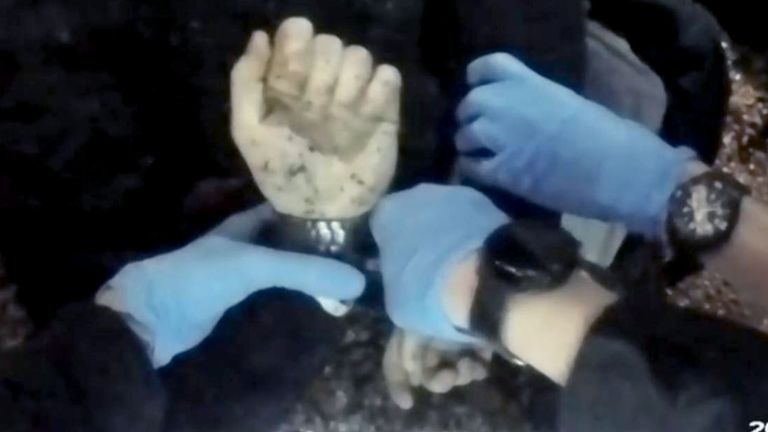
I have been posting and writing about the Henry Nowak tragedy for three weeks, and have nothing new to say. Except one thing. That box-ticking phrase from the female officer when the murderer denies having stabbed Henry.
“I know, but we have to check, don’t we?”
What we hear in those words is not just the madness of DEI, which has taught her automatically to believe the non-white assailant over the white victim. We hear, too, the obsession with procedure, the elevation of HR, the triumph of public-sector seminars over decency. A culture of compliance has displaced a culture of conscience.
31

Ms Grumpytrousers retweeted

Jun 1
An advertising executive in 1939 wrote a 48-page book explaining exactly how ideas are made. It's 5 steps. Almost everyone skips the one that actually does the work.
His name was James Webb Young, and he spent his career at one of the biggest ad agencies in America watching people wait around for inspiration to strike.
He thought that was insane. He believed producing an idea was a process you could learn, repeat, and control, the same way a factory produces cars. So he wrote down the exact method.
The whole thing rests on one claim that sounds too simple to be true.
An idea is nothing more than a new combination of old elements.
That's it.
You don't invent ideas out of nothing. You take things that already exist and connect them in a way nobody connected before. Which means the entire skill of being creative is just the skill of seeing relationships between things.
The more raw material you've stuffed into your head, the more combinations become possible.
He compared the mind to a kaleidoscope. Every turn shifts the same colored pieces into a new pattern. The more pieces inside, the more striking the patterns it can make.
You are not making new glass. You are rearranging what's already there.
Then he laid out the five steps.
Step one is gathering raw material.
Two kinds. Specific material about the exact problem in front of you, and general material about everything else under the sun. He said most people fail right here, because gathering is boring and they'd rather sit and hope inspiration shows up. He called it a chore people are constantly trying to dodge.
Step two is chewing on it.
You take the facts and turn them over in your mind, look at them from every angle, try to force pieces together. Partial ideas start showing up. So does exhaustion. You hit a wall where nothing fits and your brain feels completely used up. Most people read that wall as failure and quit.
It isn't failure. It's the signal for step three.
Step three is the one everyone rushes past.
You drop the problem completely. You walk away. You go do something that has nothing to do with the work, something that excites you. A movie, a walk, music, sleep. Young was dead serious about this. You make no direct effort at all. You hand the whole thing over to your unconscious mind and you leave it alone.
This feels like procrastination. It is the opposite. Your conscious mind has done all it can. Now a deeper part of your brain takes the pieces you fed it and keeps shuffling them while you are busy not thinking about it.
Step four is when the idea comes back.
Not while you're straining at your desk. It arrives in the shower, on a walk, the second you stop trying. That flash of insight only fires after you've released the pressure. Young watched it happen to himself again and again, and so has anyone who's ever solved a problem the moment they gave up on it.
James Clear built half his work on this idea. Brian Eno reaches for the same principle every time he gets stuck. The break is not a break from the work. The break is the work.
Step five is the part the dreamers abandon. You take the fragile new idea out into the real world and let it get criticized. You shape it, fix it, adapt it to actual conditions. Young said good ideas have a self-expanding quality. Show one to the right people and they instantly tell you how to make it better. Most idea people are too precious to listen. They lose the idea in the final stage because they won't let anyone touch it.
So the full loop is gather, chew, drop it, catch it, ship it.
The brutal part is how simple it sounds. Young warned that the formula is so easy to state that nobody believes it works, and so hard to follow that almost nobody actually does it. The believing is easy. The doing is the whole game.
Everyone wants the flash of insight in step four. Nobody wants to do the boring gathering in step one, and nobody trusts the empty waiting in step three.
But the idea was never going to come from staring harder.
It was going to come the moment you finally looked away.
15
114
431
18,725