Retired, British, Doomer, Barefoot hiking club founder. Naturist, Wild swimmer. Currently reading Physics, Cosmology, Geopolitics, Philosophy and much more.
Joined May 2008
- Tweets 3,394
- Following 373
- Followers 295
- Likes 8,223
581 Photos and videos









Apr 6
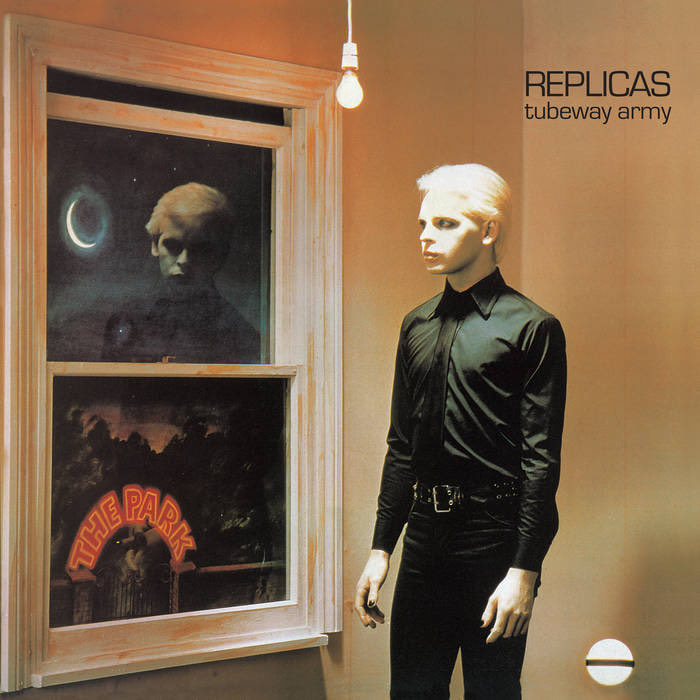
I see them on the Dark Side of the Moon

A new milestone for humankind: The crew of Artemis II are now the farthest any human has ever travelled, reaching a maximum distance of 252,752 miles from Earth.
This surpasses the previous record set by Apollo 13 in 1970 by about 4,102 miles.
138
Apr 4
Are friends electric?

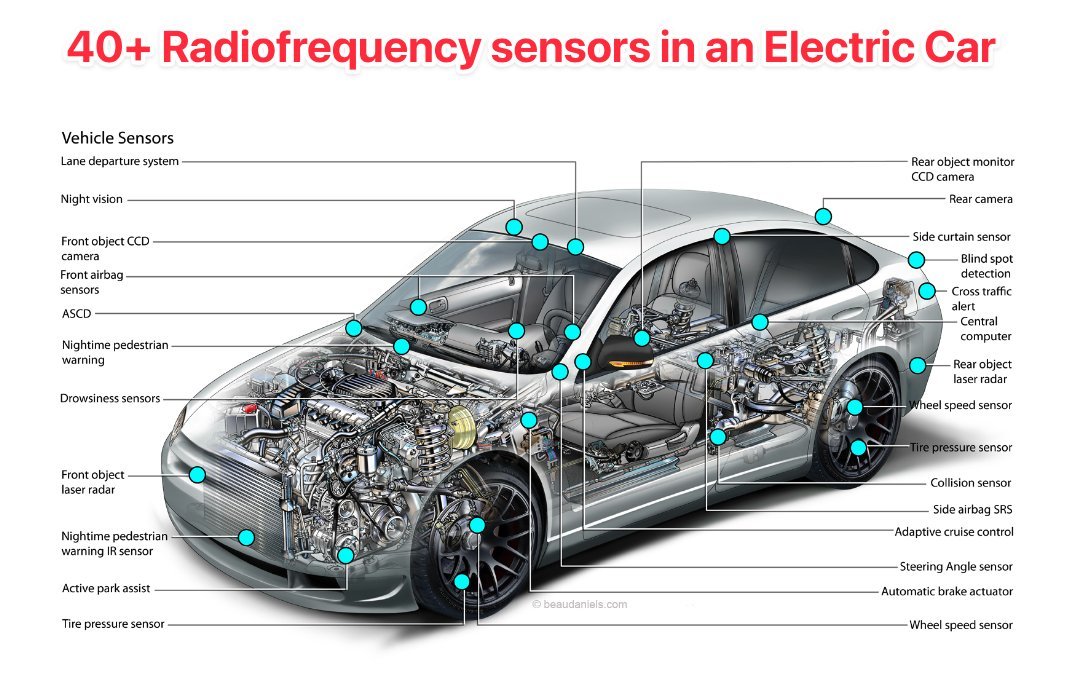
Your Tesla has a 60 GHz RADAR pointed at your face.
Not for driving or autopilot.
For "cabin monitoring"
Texas Instruments IWR6843AOP chip.
60-64 GHz millimeter wave. mounted above the rearview mirror. beaming down into the cabin.
Detecting your breathing, your heart rate, whether a child is in the back seat.
Sounds helpful until you understand what 60 GHz millimeter waves actually do to biology.
60 GHz penetrates roughly 0.4 mm into skin.
shallow enough for the industry to call "safe"
But your skin is the largest organ in your body. packed with Nerve endings, Merkel cells, melanocytes.
Soviet-era research documented non-thermal biological effects of mmWaves at low power densities.. effects the FCC has never evaluated.
and nobody has studied what happens when this signal runs continuously for 10-hour drives, week after week, year after year.
This cabin RADAR was installed in late 2021 but never activated.
Left dormant for over 3 years.
February 2025, software update 2025.2.6 quietly turned it on.
no opt-out or announcement.
just switched on.
and it doesn't turn off.
it runs while you drive. while you're parked. while you're charging. while your kids sit in the back seat on a 10-hour road trip. continuous millimeter wave exposure at close range.. 0.4 to 2 meters from your body.
That's not a cell tower 200 meters away. that's a RADAR transmitter inside a sealed metal box with you.
a Faraday cage works both ways. the metal body of the car that blocks outside signals also TRAPS the ones generated inside. every RF source in that cabin bounces off the roof, the doors, the floor.. back into you.
and the cabin RADAR is just one layer.
a Tesla Model S Plaid has 46 antennas.
— LTE cellular: 700-2600 MHz, 2x2 MIMO, always on
— WiFi: 2.4 5 GHz, dual band
— Bluetooth: 2.4 GHz, always scanning for your phone key
— UWB ultra-wideband: 6-8 GHz, phone-as-key
— GPS: 1.2-1.6 GHz
— Satellite radio: 2.3 GHz
— Cabin RADAR: 60-64 GHz
LTE, Bluetooth and cabin RADAR are essentially ALWAYS transmitting.
A 2025 study on the Tesla Model Y took 952 EMF measurements across SuperCharging, standard charging, high-speed driving, urban and idle states.
They found:
1/ Peak ELF emissions during SuperCharging, especially near center console and rear seats
2/RF hotspots from LTE, WiFi, Bluetooth in the sub-6 GHz range
3/ Body voltage INCREASED during SuperCharging and high-speed driving
4/ EMF varied dramatically depending on where you sit in the cabin
FCC safety limits are from 1996.
Based on animal studies measuring only THERMAL effects for less than 1 hour. no non-thermal biological effects considered. no study has EVER examined chronic simultaneous exposure to ELF LTE WiFi Bluetooth 60 GHz mmWave UWB in a sealed metal cabin.
NOT ONCE.
In 2021, a U.S. Court of Appeals ruled the FCC's refusal to update these limits was "arbitrary and capricious." they still haven't changed them.
Martin Pall's model calculates that VGCCs amplify EMF forces by 7.2 million times at the cellular level. that calcium flooding triggers peroxynitrite formation, PARP activation, NAD depletion.. your repair machinery eating itself.
You're sitting in a metal box with 40 antennas, a millimeter-wave RADAR pointed at your chest and AC magnetic fields from a battery pack under your seat pulling hundreds of kilowatts during charging.
and the safety standard says it's fine because your skin didn't get warm.
Diabolical.
108
Mike Berrow retweeted

Mar 29
22
113
283
105,414
Mike Berrow retweeted

Mar 22
John Taylor Gatto was named New York State Teacher of the Year. Upon receiving the award, he quit and spent the rest of his life writing devastating critiques of the educational system he had mastered.
Gatto argued that regardless of the official curriculum, schools actually teach seven hidden lessons. The first is confusion. Students learn disconnected facts across dozens of subjects with no integration or meaning. The second is class position. Students learn their place in the social hierarchy. The third is indifference. Students learn that nothing is worth finishing because the bell always rings. The fourth is emotional dependency. Students learn to surrender their will to a chain of command. The fifth is intellectual dependency. Students learn to wait for experts to tell them what to think. The sixth is provisional self-esteem. Students learn that their worth depends on expert evaluation. The seventh is that they are always being watched and have no privacy.
These lessons, Gatto argued, are the actual function of schooling. The explicit curriculum of reading, writing, and arithmetic is almost incidental. The real purpose is to produce passive, dependent, compliant citizens who wait for authorities to tell them what to do and think.
Trad schooling amounts to thirteen years of training in being passive and dependent.
I have seen this play out with hundreds of students. When I created Montessori middle schools in the San Francisco Bay Area, about half the students came up through Montessori elementary and about half came from public schools. When we opened, the Montessori kids immediately began doing their work, taking initiative, choosing what to tackle first. The public school students were lost. They would stare at their desks until we walked over and helped them plan their morning. It took at least a semester, sometimes a full year, before they could function in an environment that asked them to direct their own learning.
These were not less intelligent children. They had simply been trained differently. For years, someone else had made all the decisions about what they would do, when they would do it, and how they would do it. When that structure was removed, they did not know how to operate.
Agency is natural to children unless we train it out of them.
When I coach parents on evaluating their children's education, I tell them to ignore grades entirely. The question is whether their children are taking initiative, being responsible, and becoming empowered moral beings. If a child is getting straight A's but has no initiative and no sense of personal responsibility, that child is being damaged by their education regardless of how it looks on paper.
125
1,242
4,450
156,363
Mike Berrow retweeted

Mar 23
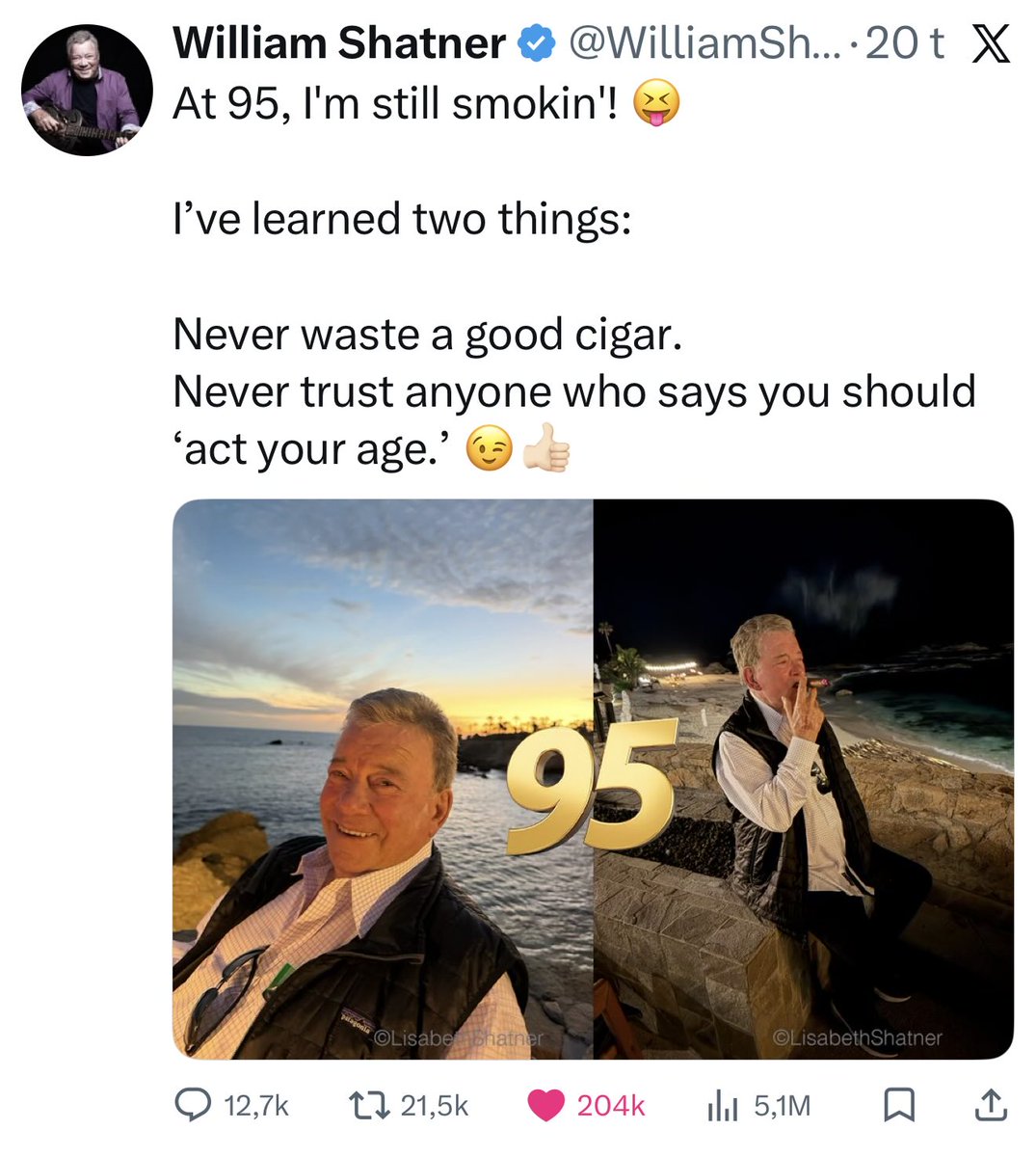
William Shatner turned 95 yesterday. He celebrated by sitting on a beach in the dark, smoking a cigar, and posting about it to 5.1 million people.
This is, when you think about it, the most William Shatner thing William Shatner has ever done.
The man has been captain of a starship, has wrestled with Klingons and network executives (often indistinguishable), has rocketed into actual space at the age of 90 aboard a Blue Origin capsule and come back down weeping about the fragility of life.
Now he is 95, on a beach somewhere warm, with a cigar, and he wants you to know two things:
1. Never waste a good cigar.
2. Never trust anyone who tells you to act your age.
There is a whole philosophy packed into those two sentences. Not a complicated philosophy, not the kind that requires footnotes or a reading list, but a philosophy nonetheless. It belongs to a particular tradition, the tradition of people who have simply refused to be told what the appropriate next step is. Churchill had it. Keith Richards has it. Your grandmother who still drives at 87 and won’t discuss it has it.
The photograph posted alongside the tweet shows him looking pleased with himself in a way that is entirely justified. The big gold “95” floats between the two images like a trophy he has just picked up for the event of still being here. He earned it. And the cigar.
Now. You are probably not 95. You have almost certainly not been to space.
But here is the thing about his two rules. They do not actually require any of that. They just require a decision. A decision to stop treating your remaining time as something to be managed carefully and apologized for. To stop shrinking yourself to fit other people’s idea of what sensible looks like at your particular age.
The cigar is optional. The attitude is not.
Gandalv / @Microinteracti1
29
146
727
19,805
Mike Berrow retweeted

Feb 22
So, so you think you can tell Heaven from Hell, blue skies from pain
Can you tell a green field from a cold steel rail?
A smile from a veil?
Do you think you can tell?
Did they get you to trade your heroes for ghosts?
Hot ashes for trees?
Hot air for a cool breeze?
Cold comfort for change?
Did you exchange
A walk-on part in the war for a lead role in a cage?
How I wish, how I wish you were here
We're just two lost souls swimming in a fishbowl, year after year
Running over the same old ground
What have we found?
The same old fears
Wish you were here
8
113
607
10,480
Feb 22
Yah, this might work with a limit of one car per household. Americans, are you in?
Yeah, … I didn’t think so 🧐
Feb 21

This is a real neighborhood in Denmark 🇩🇰
Perfect circles. Pie-shaped homes.
Shared green space in the center.
Genius design… or cult vibes? 👀
Would you live here? 👇

1
67
Feb 21
Don’t let it happen!

This video was tricky to make, But I had to tell at least some of this story because the silence is becoming dangerous. 🌳🚫
Everyone is being distracted by the "migrant story" headlines, but behind the scenes, there is a full-scale war being planned against our environment.
1
69
Feb 16
Many of these bodacious words are used only by the codgers. They need to be preserved! Do your part and use the bejeebers out of them every day!
— Society for the Preservation of Words That Make Children Laugh.
1
2
79
Mike Berrow retweeted

Feb 11
This is the best and most reasonable "anti-LLM" take I've ever read.

66
246
4,564
1,314,462
Feb 11
If you were a teen in the 70s, you'll nod along. Not just nostalgia—this explains the mental agility, toughness & social wiring from that era: default mode network activation, eustress, antifragility. Modern kids miss it. Time to reintroduce these things. youtu.be/Y7Yg_1tch5c?si=smTi…
49
Feb 11
— Something Big Is Happening —
The singularity seems near. It seems that we have the choice of riding it or getting run over by it.

195
Jan 28
Imagine there's no countries.
It isn't hard to do.
Jan 27

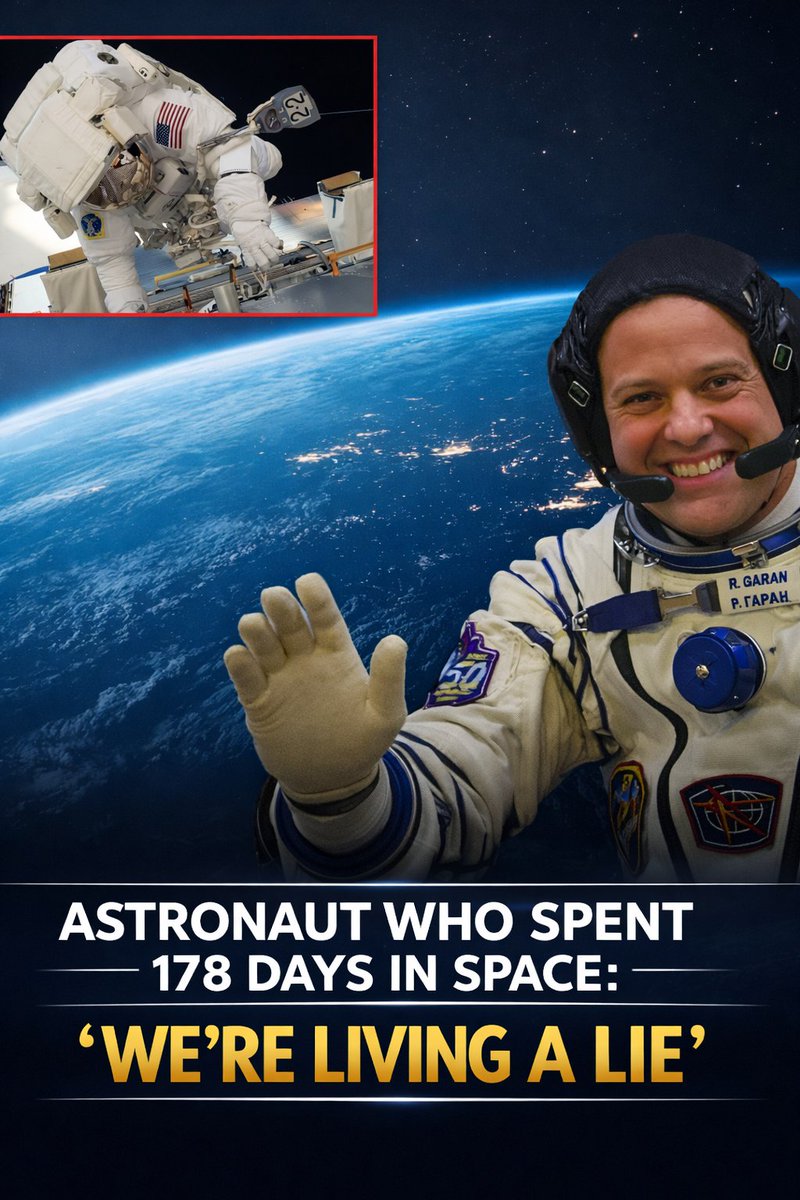
🚨: Astronaut’s Wake-Up Call from Space
After spending 178 days aboard the International Space Station, astronaut Ron Garan returned to Earth with a realization that shook him — we’re living a lie.
From orbit, he saw our planet as one glowing blue sphere — no borders, no nations, no divisions — just a single, fragile home floating in the vast darkness. Yet down here, we live as if we’re separate, fighting over lines that don’t even exist from space.
He watched lightning storms flicker like heartbeat pulses, auroras dance across the poles, and a thin blue atmosphere shielding all life — a reminder of how delicate our world truly is.
Garan says humanity’s priorities are upside down: we’ve put the economy first, when it should be Planet → Society → Economy. Because without a thriving planet, nothing else survives.
His message is clear and urgent — 🌎 Earth is our shared spaceship. We are not passengers… we are crew.
And it’s time we start acting like it.
1
64
Jan 27
When the bull leaves the china shop the crockery is still broken.
68
Mike Berrow retweeted

Top of the Pops (24th January 1980). Joe Jackson is currently at number 12 with It’s Different For Girls.
67
267
1,853
85,930
Mike Berrow retweeted

Jan 25
HAPPENING NOW 🚨: MN National Guard members have arrived at the site of the federal building, and have been ordered to distribute donuts, coffee and hot chocolate to anti-ice protestors.
They were given reflective vests so protestors don’t confuse them with federal agents.
4,902
11,504
95,816
7,535,238
Mike Berrow retweeted

Jan 24
@coldfishstix
A sad and honest reflection of what’s going on‼️ #ICETerrorism
171
2,388
6,198
80,720
Jan 21
Ouch!
“Americans live in the illusion that the US can do everything on its own, despite the fact that the US for nearly 20 years has lived beyond its means.”
Jan 21

The problem isn't Trump. The problem is the US.
When the outside world observes Trump's insane behaviour and his threats against allies, and we at the same time observe that there is no real action from the US public, Congress, the US Supreme Court, or the US media about this insanity, we will all have to conclude that the US accepts this behaviour.
The public in the US think the US is entitled to a certain position in the world where there is no room for decent behaviour and where there are no norms and rules.
That means that we all have to conclude that the US — not only Trump — has betrayed the international order that the US, with its Western partners, were the main architects of after the Second World War.
This is the conclusion that Canadian Prime Minister Mark Carney so clearly laid out in his speech at Davos yesterday. We simply cannot trust the US to play by the rules any more. Therefore, we also fundamentally have to ask ourselves — should we trust the financial and economic structure which is an integral part of the global rules-based order?
Americans live in the illusion that the US can do everything on its own, despite the fact that the US for nearly 20 years has lived beyond its means.
US private and government consumption has been funded by, among others, European central banks and pension funds. But we now have to ask ourselves — why would we trade in dollars? Why would we put our savings into US Treasury bonds?
If the US is not a rules-based society, we cannot trust the dollar to be a stable currency, and it would be insane to hold dollars. As domestic US institutions are eroded and governance structures destroyed, the US will be turned into an emerging market economy — or more accurately, a de-merging economy.
If the US threatens the territory of allies, then the US acts as an authoritarian bully nation. Nobody in their right mind would lend money to the US government. If the US doesn't live up to its international obligations and respect the sovereignty of other nations, why would we expect the US government to honour its debts?
If Trump can tariff nations that will not give up their territory, then there is certainly no reason to believe that the US will not introduce capital controls. And if that is a risk, why would you risk investing in the US?
It is not a question about Europe standing up to the US. It is a question about being prudent with our investments — about reducing risks.
Every day Trump remains in office, distrust of the US increases, and the cost for the US will go up day by day. And this is irreversible. It takes years to build trust, but you can destroy it by your actions in minutes.
Europe has now completely lost trust in the US. And so has Canada. It is up to the people of the US to demonstrate that Trump is an 'outlier', and it is up to the American people to stop him.
If you don't do that, we will have to assume that this is what the US is about — whether the name of the President is Trump or something else, whether the President is a Republican or a Democrat.
49
Jan 21
Easily the best speech so far at Davos.
Jan 20

For anyone who would like to hear Mark Carney’s outstanding Davos speech in full here it is. This is what true global leadership looks like.
Canada should be immensely proud today, because they are leading the fight back when others dare not.
🎥 TikTok - vm.tiktok.com/ZNRBDT4mB/
1
71
Jan 10
Abertillery !!


77