
aspiring brain-computer interface engineer
Joined March 2021
- Tweets 688
- Following 404
- Followers 202
- Likes 21,425
10 Photos and videos




Benjamin Fockter retweeted

Jun 11
Together with UC Berkeley we are announcing the laser phase plate - a breakthrough in atomic resolution imaging. This is the brightest continuous wave laser in the world, 100 million times the intensity of the surface of the sun.
Phase contrast plays an important role in microscopy, but it was thought close to impossible for electron microscopy, where it would require interfering with an electron beam. Holger Mueller and Robert Glaeser proposed exactly this using a standing wave laser. It has taken over 15 years to make this a reality. Biohub partnered with UC Berkeley and Mueller to support this work and to engineer and build the technology.
Contrast has been the critical barrier to achieving atomic resolution imaging of the cell. In cryo-electron tomography, a cellular imaging technology that uses electron microscopy, the low contrast makes it impossible to resolve anything but the largest proteins within their cellular context. The laser phase plate removes that barrier.
With advances in AI this breakthrough in contrast will start to open up a new frontier in structural biology, that will allow us to see the molecular machines of the cell, and how they assemble into far more complex and dynamic systems, and understand how they work.
85
527
3,685
572,614

Jun 8
I wrote mine in Python (no libs) … then I realised why it needs to be written in C …
Jun 8

I wrote my first neural networks in pure C, then in Matlab, then in NumPy, before eventually upgrading to Theano. Since then I have seen and tried pretty much every NN framework ever developed. Some are bad, some are good. The good ones understand API design principles.
158
Benjamin Fockter retweeted

Jun 7
i hate that i have friends. i get attached and there is a warm feeling in my chest and i giggle and squirm and kick my feet. i want to be alone and lonely forever. i want to leave not a footprint or memory of myself on this earth when i depart. i want to run into the mountains, just me and my flailing survival skills, but i'm weak and needy and so needy. i need society and i hate that i need society. i love and hate being intertwined in the complex machinations of the market that bring me the miracles of modernity, in the webs of social ties that love and hate each other, that tolerate each other with no escape. hell is other people; i love hell and i want to leave. all relations are invertible: i hate hell and i want to stay.
3
3
46
1,417
Jun 5
big fan of improved memory, but just the heading ‘Family Life’ looks so dystopic going forwards … I can see Chat synthesising some very intricate family dynamics :/

With the new memory system, you can review and steer what ChatGPT remembers through a memory summary, with more visibility and control over how context is used.
56
Benjamin Fockter retweeted

Jun 3
Anyone who confidently states that AI either is or is not conscious, is safe to ignore.
There are plausible theories that predict either but none have been actually tested.
84
21
363
82,527
Jun 4
I just had to explicitly search SO and random GH because Opus 4.6 (High) and Gemini Flash (Standard) couldn’t figure out why Ctrl r was not doing reverse search in tmux
2
71
Jun 4
export EDITOR=vim does not affect the ZLE behaviour of the current shell, but puts all the nested shells (including tmux sessions) into “vi insert mode”
1
25
Benjamin Fockter retweeted

Neuropixels Opto is out! 🎉🥳🍾🚨 Congratulations to a fantastic team!
nature.com/articles/s41592-0…
65
221
14,415
Benjamin Fockter retweeted

Jun 2
Today a crazy quantum story just got wilder.
On March 31, the Google Quantum AI team published a landmark result on Shor's algorithm for elliptic curve cryptography. Technically, the paper was a bombshell: a dramatic 10x improvement over the state-of-the-art. As a stunt and wakeup call to the blockchain space, those optimisations were illustrated on secp256k1, the elliptic curve underlying Bitcoin and Ethereum signatures.
But perhaps the most striking part of the paper was sociological, not technical. Instead of following standard academic process, the optimisations were kept secret, hidden behind a zero-knowledge (ZK) proof. Google's accompanying blog post mentions they "engaged with the U.S. government". The ZK proof demonstrates the existence of algorithmic improvements without leaking details. Academic censorship with ZK, a historic first!
As a co-author of the Google paper I witnessed some of the context surrounding this censorship. To be honest, multiple aspects of that context don't sit well with me. As much as I believe the general public ought to know more, I am limited in my ability to whistleblow. Though let me be clear about one thing: the Google team's professionalism has been absolutely exemplary, and they deserve nothing but praise.
Censorship has a way of backfiring. The Streisand effect, where an attempt to bury something only draws more attention to it, is exactly what's unfolding today. First, Google's key optimisation has been rediscovered by the French. And in a thrilling turn of events, a collaborative Shor-at-home challenge just launched. The initiative, available at ecdsa[.]fail, breached a new Shor world record in a matter of hours.
Let's start with the rediscovery. Just two months after Google's paper, French quantum expert André Schrottenloher cracks the main secret optimisation. His paper, titled "Optimized Point Addition Circuits for Elliptic Curve Discrete Logarithms", landed on the arXiv today. Big congrats to André, who beat several other nerdsnipped experts to it. In a blog post also published today, Craig Gidney, the world expert on Shor optimisations, revealed that he'd been sitting on this very optimisation for a whole year under censorship pressure.
Interestingly, André missed a handful of minor optimisations, both from Google's original publication and from improvements found since. It's plausible there's still plenty of juice left to squeeze out of Shor, and this is exactly what the ecdsa[.]fail challenge is about. The verifier program developed for the ZK proof does double duty, automatically filtering for valid submissions. Dozens of compounding small and micro improvements are rolling in. As of the time of writing there's an 8.4% improvement to Google's circuit, as measured by the product of logical qubit count and Toffoli gate count. Nice!
The nerdsnipping ran deeper than anyone expected. Over the last few weeks it became clear it extended well beyond André and other quantum experts. Behind the scenes, a small army of amateurs quietly got to work. Inspired by Karpathy-style autoresearch, they turned AI on Shor. Ironically, the verifier program for the ZK proof makes an ideal reward function for AIs. The barrier to entry for this modern style of research is refreshingly low, with several non-experts, even a teenager, finding nice optimisations. Get in touch if you'd like to join a Telegram group with fellow autoresearchers :)
Part 2: neutral atoms and qday
The story doesn't end with Google. On the same day Google went public, a stealthy startup called Oratomic published its own Shor paper in a coordinated release. It made a splash, ultimately becoming the most upvoted paper on scirate[.]com, a website ranking arXiv papers.
Oratomic's claim was wild. By building on Google's logical optimisations and applying custom physical optimisations for neutral atoms, they claimed just 10K physical qubits were sufficient to run Shor's algorithm on secp256k1. That number is mind-bogglingly low.
Knowing essentially nothing about neutral atoms when Oratomic's paper landed, I was intrigued and decided to learn more about the tech. I fell straight down the rabbit hole and spent a couple hundred hours on the topic. I got a little obsessed and watched every YouTube video I could find and spoke to a bunch of experts.
My conclusion? The tech is real, very real. Even Google recently decided to start a neutral atom lab, a notable pivot from their sole focus on superconducting qubits. If you care about qday, i.e. the day a quantum computer will break the first piece of cryptography in production, neutral atoms demand your attention. I shared some of my learnings on Shor and neutral atoms in a 30min talk at the ZKProof cryptography conference. You can find it on YouTube by searching "zkproof neutral atom".
Here's an interesting observation about this duo of breakthrough papers: neither Google nor Oratomic say a word about what their results mean for qday. No timelines. Zero. Nada. That is especially baffling given that the whole point of whitehat quantum cryptanalysis is to inform qday estimations and help the general public make good decisions.
So let me attempt to partially fill the silence, similarly to what Scott Aaronson did in his April 29 post. Given everything I know, including scary non-public information, I now put the odds of qday by 2032 at 50%. 10% by 2030.
Anecdotally, the US government has its own date: 2035. Originating at the NSA and later adopted by NIST, it's when branches of the US government will be disallowed from using quantum-vulnerable cryptography. In plain language: with hindsight, that date is a joke and should be discounted entirely. I don't see how NIST avoids being forced to pull it forward by years.
Part 3: post-quantum cryptography
There are good reasons to sound the alarm today, but please do not panic. Rushing carelessly towards immature post-quantum cryptography is a recipe for disaster. IMO a good target date for migration is 2029, roughly 3.5 years out. 2029 happens to be the date selected by Google, Cloudflare, and the Ethereum Foundation.
These days most of my time goes to safely migrating Ethereum towards post-quantum cryptography as part of the broader lean Ethereum effort. There's a lot to do. We need to rip out and replace BLS signatures at the consensus layer, KZG commitments at the data layer, and ECDSA signatures at the execution layer.
The plan to get there is compelling, and is based on hash-based cryptography. Within the Ethereum Foundation we've developed a Swiss army knife called leanVM (github[.]com/leanEthereum/leanVM) powered by the magic of hash-based SNARKs. Thanks to truly exceptional work by Emile, Thomas, and others, its performance is derisked. Regarding security, leanVM is a jewel, a minimal zkVM crafted for end-to-end formal verification and maximum security.
Want to help? There are two $1M initiatives. First, the Proximity Prize (proximityprize[.]org). Solve a long-standing mathematical conjecture in coding theory, improve hash-based SNARKs, and go home a millionaire. Second, the Poseidon Initiative (poseidon-initiative[.]info), offers $1M for breaking Poseidon, the SNARK-friendly hash function.
408
1,128
6,241
3,699,815
Jun 2
insanely cool. I feel there is still a lot of hidden structure that makes neurons more efficient than current analogs, and details that don’t get captured in traditional math models (e.g. LIF/IF, etc)

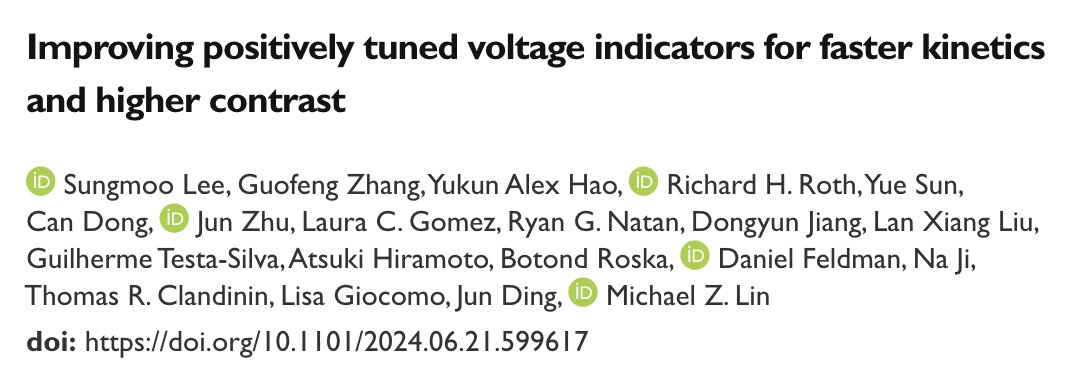
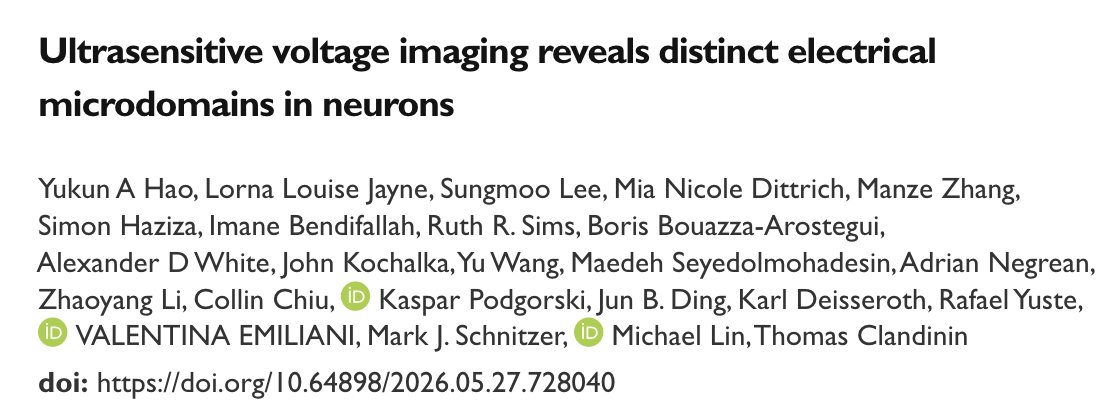
Excited to announce a powerful new one-two punch for voltage imaging from our lab and collaborators! In two new preprints, we introduce ASAP6c for high-throughput population spike-recording, and ASAP7yfor deep, subthreshold 2P imaging.
🧵 1/14
2
44
Benjamin Fockter retweeted

May 31
It was the best of times, it was the worst of times.
May 31

This has quietly been a miracle month in medicine.
In the last 5 weeks we’ve got news on:
- retatrutide, the triple agonist GLP-1 from Lilly, basically melting fat and body-wide inflammation at record levels
- RevMed’s new pancreatic cancer drug showing unprecedented abilities to extend life
- small trial of a one-and-done PCSK9 gene editing therapy for slashing LDL cholesterol
- Mayo’s AI-assisted radiology showing vastly improved cancer detection
- this new therapy for metastatic solid tumors
This stuff is at varying levels of evidence. Retatrutide is ~100% on its way, other stuff needs more clinical trial data. But put it together and we’re maybe on the verge of majorly reducing the mortality of heart disease and cancer, the two leading causes of death in America.
37
34
950
425,210
Benjamin Fockter retweeted

May 31
With Codex at 5 million users, they’ve hit about 0.6% of ChatGPT’s roughly 900 million users. We are so, so early. The vast majority of people have no idea what’s already possible to do with AI, while a tiny minority is automating their personal lives and work.
91
172
2,485
495,895
Benjamin Fockter retweeted

Rice and Baylor College of Medicine are joining the @BrainGateTeam consortium to develop brain-controlled robotic assistive devices that could help people with tetraplegia eat and drink independently. #BCI #Neurotech
Find out more: news.rice.edu/news/2026/clin…
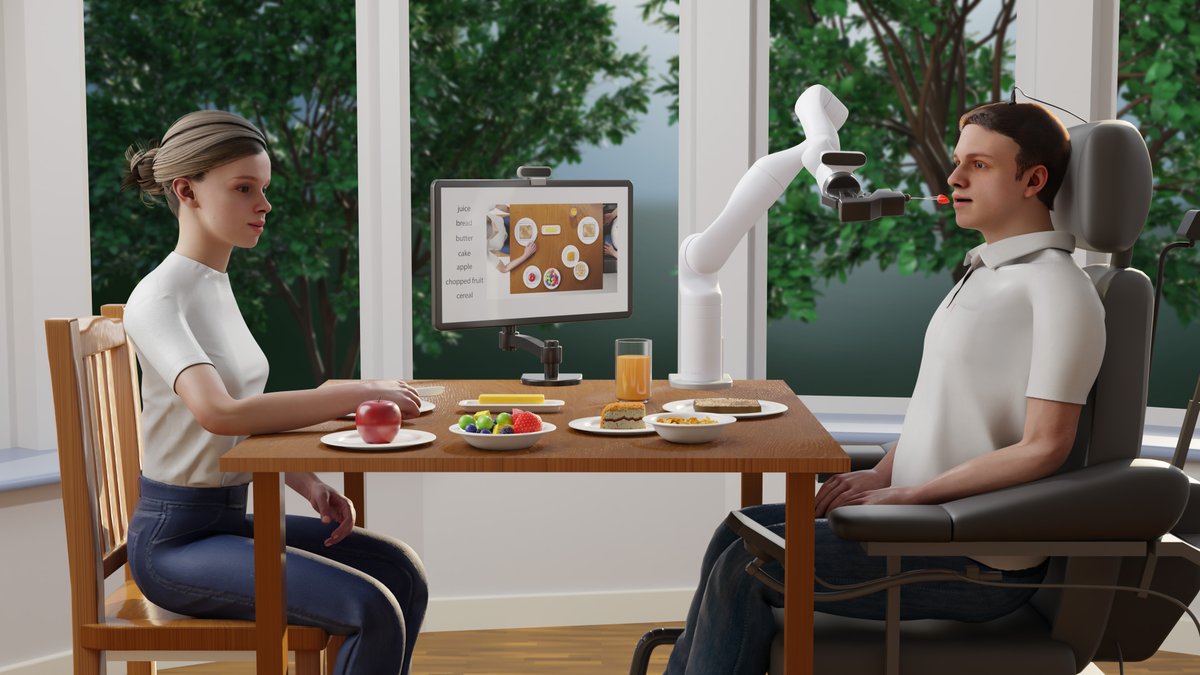
ALT AI-generated image of man seated at table and eating assisted by robotic arm controlled via brain-computer interface technology, with a woman caregiver observing
5
13
3,793
May 28
I know this is not going to happen, or probably super simple to ask CC to add. But I wish there was a /speed setting, so I can slow down agents. esp. on Agent Teams with @claudeai (the terminals is just matrix). Then work my way up. same way I now watch 3x YT vids but started with 1.25x etc.
1
44