
🍞 🍖 🧀 🍅 🥬 🥒 🫙 🍞
Joined March 2012
- Tweets 216
- Following 2,677
- Followers 88
- Likes 143
3 Photos and videos




19 May 2025
gm! Going to retire in 2025 with @cabbagedotapp’s AI opportunity feed to spot the next $aixbt or $GOAT early!! #CabbageAlpha @cabbagedotapp
Join me to get early access at cabbage.app?ref=fe2dru2j
2
111
芝士汉堡 retweeted

10 Jan 2025
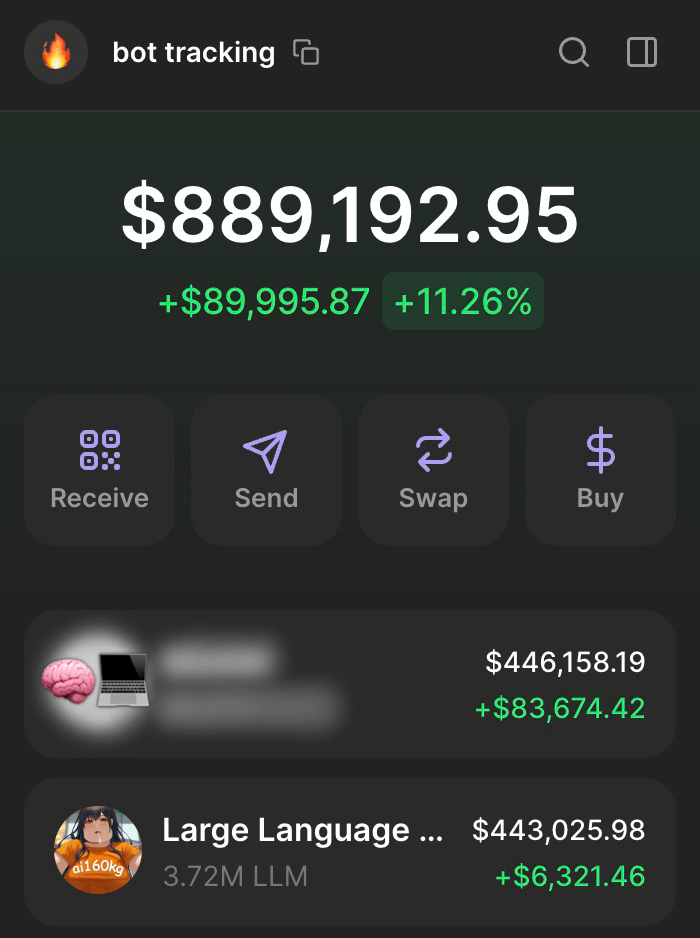
Just now, the bot is tracking the next 100x AI agent.
Previously, the bot tracked #ai16z and shared it long before the Binance listing. Later, it was also $LLM
The next runner is 200M , and I’m ready to share it.
Want the CA? Like, Retweet, and Comment "LFG". I’m only sharing it with my followers.
9 Jan 2025

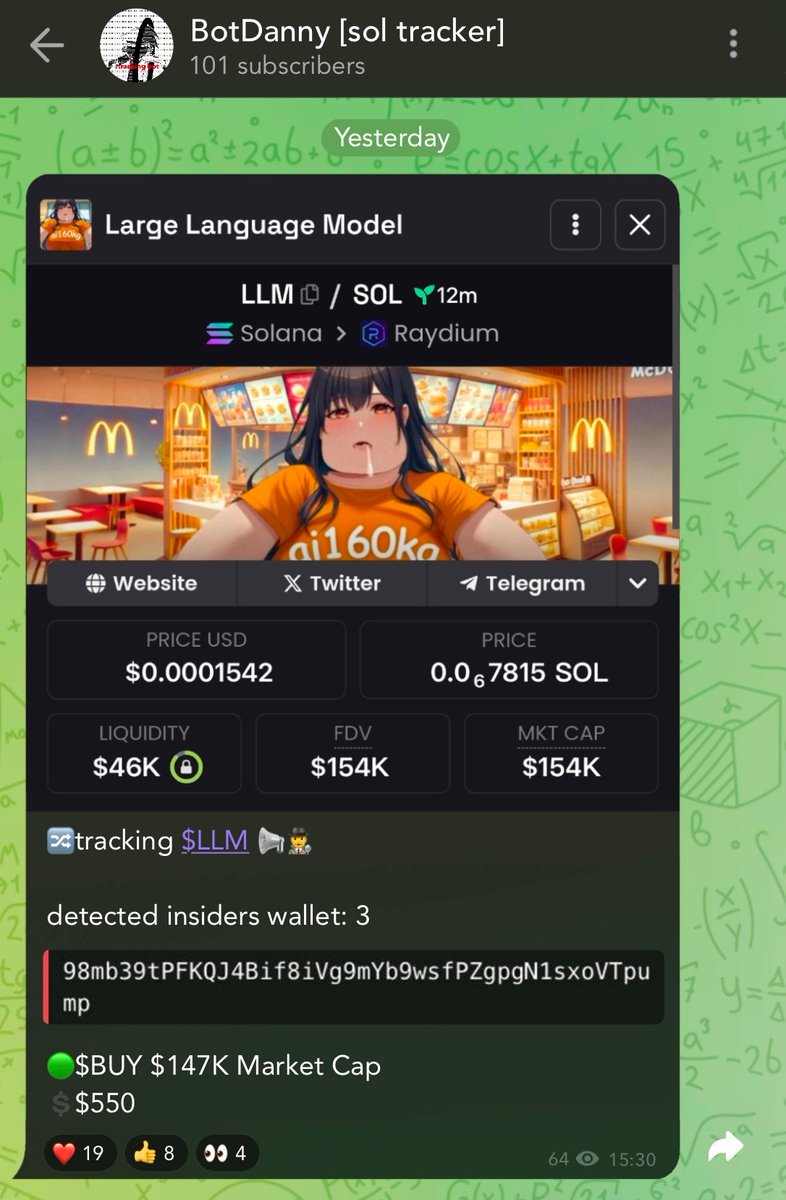
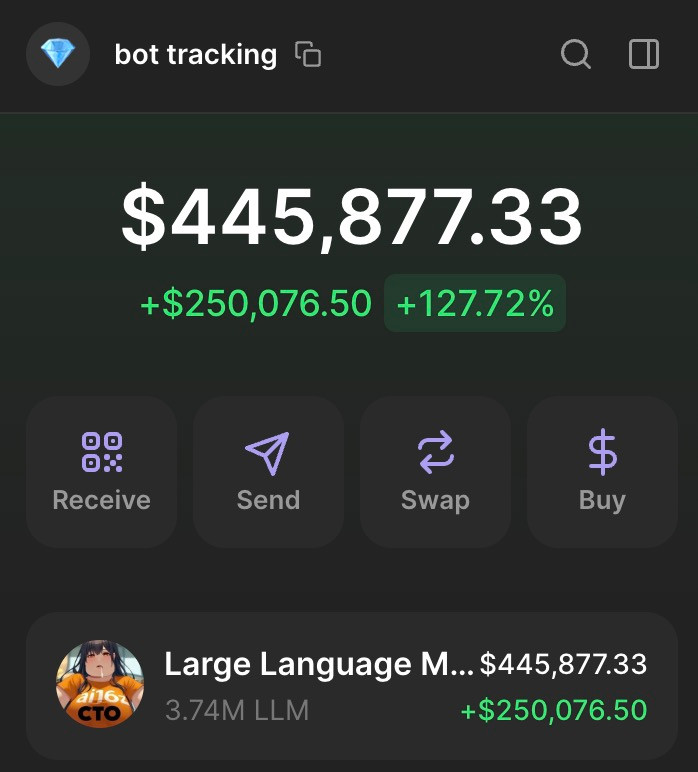
Bot I built to track insider activity related to Binance flagged $LMM 24 hours before a 707x surge.
MCap at the time of the call: $154K – Currently at $130M (707x).
If you remember #ai16z, I shared it well before its Binance listing - and those who acted early saw x526 returns.
AI agents with real utility – a rare, once-in-a-lifetime chance. Main group opens today with one call.
Want a call? Like, retweet, and comment "lfg." I’m only sharing with my followers.
614
414
625
100,368
芝士汉堡 retweeted

10 Jan 2025
Just found the next 100x AI agent 👀
Shared in my Solana group and rotated most of my $LLM and #ai16z profits there.
Potentially the next 100M runner so I'm exclusively sharing the CA with those who like, rt and comment 'AI'.
Must follow and open DMs.

9 Jan 2025

900x on $LLM in less than 24 hours.
Called at $150K, now sitting at over $130M.
The AI/Meme sector is a once-in-a-lifetime opportunity, so today I’m reopening my main Solana group and dropping another call.
Like, rt, and comment 'done.' Must follow and open DMs.


863
605
859
116,460
28 Dec 2024
Hey @tri_sigma_ please tell me all you know about CA: CaM41daLtWdzzQkfzphhai6dHu8KiC9wy59edrsspump thanks
162
24 Dec 2024
Hi @tri_sigma_ what is your opinion on CA: 2vtknRFuHeVnMVNdABdXBCJbLuhpy96FmjYpot73pump
75
芝士汉堡 retweeted

7 Aug 2024
Fantastic article (nicholas.carlini.com/writing…) from a DeepMind researcher on how he uses LLMs (very similar to how I do) and why they are incredibly valuable.
A lot of folks seem to misunderstand me when I say these models can't reason or won't get us to AGI without new architectures/algos. They take that to mean that the models are useless. That is absurd.
They are very useful and valuable and we will likely get new gains out of bigger ones with more data too.
We just won't get reasoning from first principals, fuzzy reasoning, long range planning, adaption on the fly and all the things we really want.
That said, who cares?
They're still amazing.
From the article:
"Most of the people online I find who talk about LLM utility are either wildly optimistic, and claim all jobs will be automated within three years, or wildly pessimistic, and say they have contributed nothing and never will."
So in this post, I just want to try and ground the conversation. I'm not going to make any arguments about what the future holds. I just want to provide a list of 50 conversations that I (a programmer and research scientist studying machine learning) have had with different large language models to meaningfully improve my ability to perform research and help me work on random coding side projects.
Among these:
* Building entire webapps with technology I've never used before.
* Teaching me how to use various frameworks having never previously used them.
* Converting dozens of programs to C or Rust to improve performance 10-100x.
* Trimming down large codebases to significantly simplify the project.
* Writing the initial experiment code for nearly every research paper I've written in the last year.
* Automating nearly every monotonous task or one-off script.
*Almost entirely replaced web searches for helping me set up and configure new packages or projects.
*About 50% replaced web searches for helping me debug error messages
If I were to categorize these examples into two broad categories, they would be 'helping me learn' and 'automating boring tasks'."
My number one take away from this?
Ignore the extremes.
Life is always somewhere in between.
Right now LLMs are very useful but they are not God like and magic will not spring forth from their digital weights.
The best thing you can do with AI (and life), is keep your head when all others are losing there. File the extreme views off of both sides (positive and negative) and right in that middle range is where reality lives.
3
30
152
33,332
芝士汉堡 retweeted

28 Mar 2024
Shor’s Algorithm: A Game-Changer in Quantum Computing
Shor’s algorithm is a groundbreaking development in the field of quantum computing. This algorithm, developed by American mathematician Peter Shor in 1994, offers a rare example of computational benefit in quantum computing. It addresses the challenge of factoring huge numbers, a task that has proven to be difficult and time-consuming for classical computers.
How Shor’s Algorithm Works
Shor’s algorithm is a quantum algorithm that revolutionized the field of quantum computing by providing a solution to the challenging problem of factoring large numbers. This explains the step-by-step process of how Shor’s algorithm works.
Selecting a random integer for factoring
The algorithm begins by selecting a random integer that is less than the number to be factored. This random integer serves as a starting point for the factoring process.
Calculating the greatest common divisor
The next step involves calculating the greatest common divisor between the random integer and the target number. This is done using classical computation.
Determining if the target number was mistakenly factored
By comparing the greatest common divisor to the target number, it can be determined if the target number was mistakenly factored. For smaller numbers, this can be an option, but for larger numbers, a supercomputer or quantum computer is required.
Using a quantum computer to calculate the period of the number
If the target number was not mistakenly factored, a quantum computer is used to calculate the period of the number. This step is crucial in the factoring process and takes advantage of the unique properties of quantum computation.
Completion of factoring the target integer
Once the period of the number has been calculated, the algorithm determines if a fresh random integer should be examined or if the desired factors have been discovered. If the factors have been found, the factoring of the target integer is complete.
Although this high-level explanation of Shor’s algorithm may seem straightforward, implementing the factorization method is complex and requires in-depth study. However, Shor’s algorithm has the potential to break public key cryptography schemes, making it a game-changer in the field of quantum computing.
Benefit of Breaking Encryption in Quantum Computing
Shor’s algorithm has the potential to break encryption, which is a significant benefit in the field of quantum computing. Let’s discuss the potential of breaking encryption using Shor’s algorithm and why quantum computers are necessary for this task.
Explaining the potential of breaking encryption using Shor’s algorithm
Shor’s algorithm is a game-changer in the field of quantum computing because it can factorize large numbers in polynomial time, which is much faster than the best-known classical algorithms. This ability to factorize large numbers quickly has significant implications for breaking encryption.
Understanding the need for quantum computers in breaking cryptographically secure numbers
While classical computers can perform superhuman calculations, they are not efficient in factoring large numbers. Breaking cryptographically secure numbers requires the computational power of quantum computers, which can leverage the unique properties of quantum computation to calculate the period of the number.
The role of quantum computers in calculating the period of the number
Once the greatest common divisor of the random integer and the target number have been calculated classically, a quantum computer is used to calculate the period of the number. This step is crucial in the factoring process and can only be efficiently performed by a quantum computer.
Completion of Shor’s algorithm after factoring the target integer
After the period of the number has been calculated, the algorithm determines if a fresh random integer should be examined or if the desired factors have been discovered. If the factors have been found, the factoring of the target integer is complete, and encryption can be broken.
Although the practical implementation of Shor’s algorithm is still challenging due to the high error rates of current quantum computers, its potential to break encryption has led to the development of post-quantum cryptographic standards that aim to protect digital systems from the future threat of quantum computers.
Challenges and Limitations of Shor’s Algorithm
While Shor’s algorithm is a groundbreaking development in the field of quantum computing, it also has its challenges and limitations. Some of these challenges and limitations, include a comparison with classical algorithms, the theoretical speed advantage of Shor’s algorithm, consideration of error rates in contemporary quantum computers, the importance of quantum error correction, and the practicality of using Shor’s algorithm to break RSA encryption.
The Impact of Shor’s Algorithm on the Development of New Cryptographic Systems
Shor’s algorithm, which we discussed earlier in this blog, has had a significant impact on the development of new cryptographic systems. This algorithm demonstrated the potential of quantum computers to break traditional cryptographic schemes, such as RSA encryption. The development of post-quantum cryptographic algorithms is a direct response to the threat posed by Shor’s algorithm. These new algorithms aim to provide security in a post-quantum world, ensuring that digital systems remain protected.
3
5
380
芝士汉堡 retweeted

29 Jun 2024
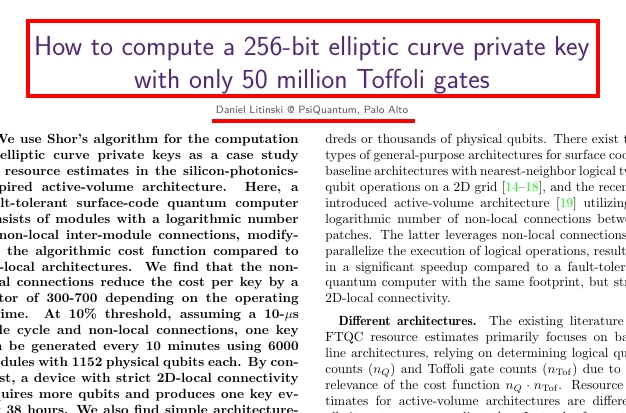
🚨How to compute a 256-bit elliptic curve private key with only 50 million Toffoli gates was published by PsiQuantum's Dr. Daniel Litinski in 2023.#Bitcoin
How should Bitcoin respond to the imminent quantum threat?
#Whistleblower #Crypto #Quantum #Crisis arxiv.org/pdf/2306.08585
1
5
10
322
芝士汉堡 retweeted

10 May 2024
Announcing Venice
Today, we launch private, permissionless AI for the purpose of unfettered civilizational advancement: Venice.ai
Full announcement:
moneyandstate.com/blog/the-s…
@TryVenice
A thread...
1/17
626
860
3,916
972,514

27 Dec 2023
Requesting $OSMO funds from the #Stakely Faucet on the Osmosis blockchain. Request ID: BLC641HM #privacy stakely.io/en/faucet/osmosis…
1
8
58
芝士汉堡 retweeted

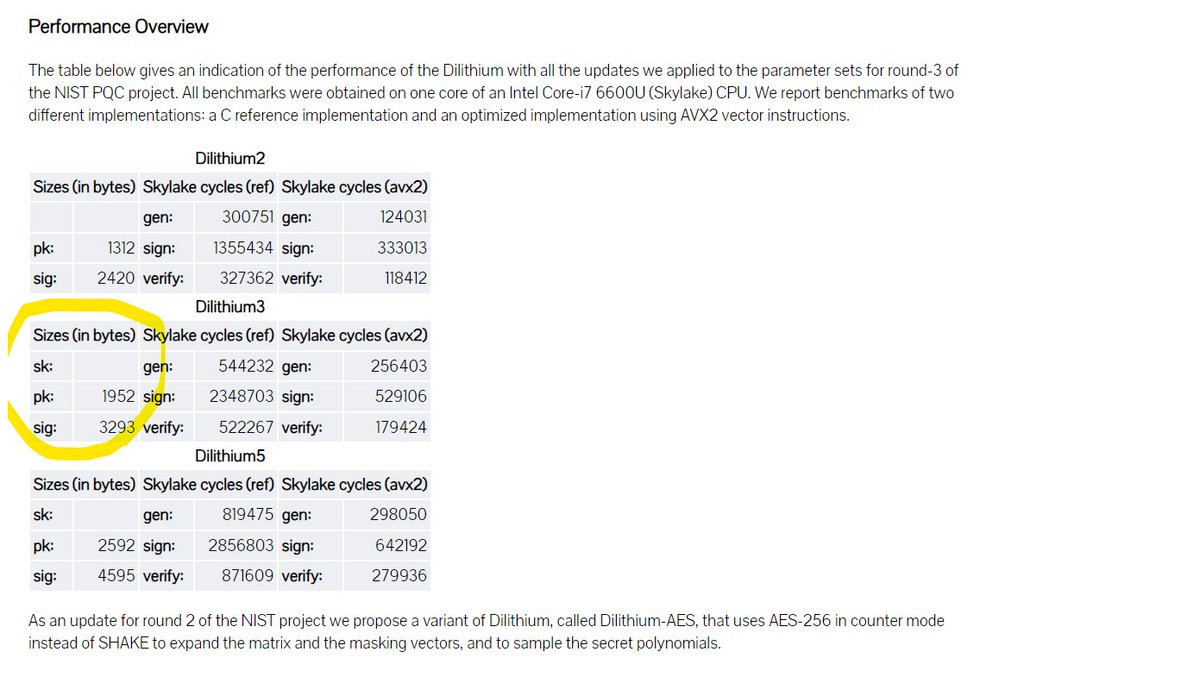
2 teams, from Shenzhen, and probably Bucharest, are preparing fork bitcoin by quantum resistant CRYSTAL-Dilithium lattice-based digital signature. Udi,Once if you want to upgrade bitcoin by Dilithium too, SL3 could be the best before its standard of 2024.
pq-crystals.org/dilithium/in…
3
4
185



芝士汉堡 retweeted

2 Nov 2023
Hot on the heels of #ChatControl and in the name of “identity” and “consumer choice” the EU seeks the ability to undetectably spy on HTTPS communication; 300 experts say “no” to #Article45 of #eIDAS #QWAC alecmuffett.com/article/1081…
9
151
322
422,613

芝士汉堡 retweeted

10 Aug 2023
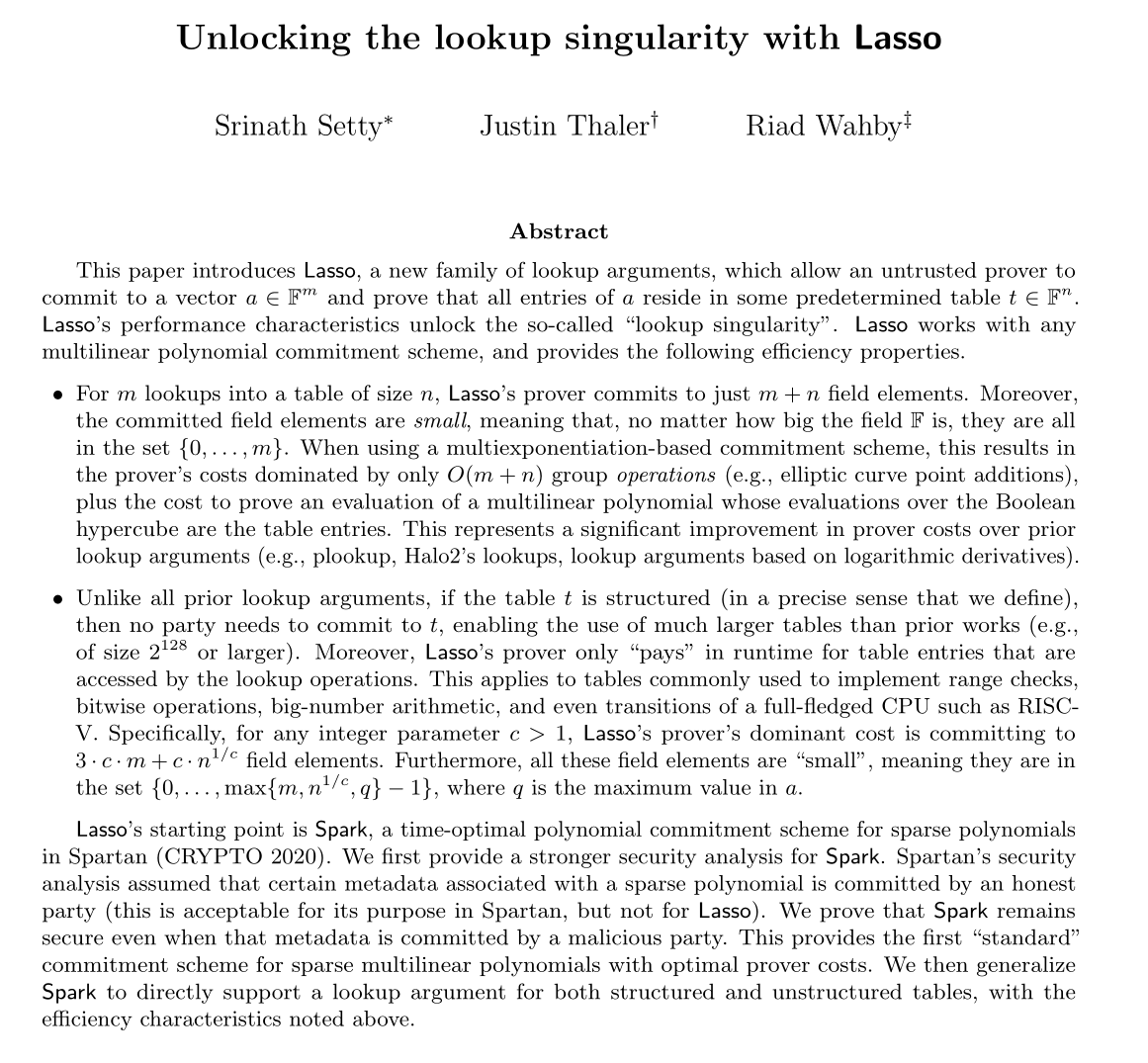
Introducing Lasso, a new lookup argument that unlocks "lookup singularity" by building on Spartan's sparse polynomial commitment ("Spark"). Appearing on eprint shortly! Joint work with @SuccinctJT and Riad Wahby.
5
42
213
36,856
芝士汉堡 retweeted
11 Aug 2023
The Lasso paper is now on eprint: eprint.iacr.org/2023/1216.pd…. The main result is that a natural generalization of the Spark sparse polynomial commitment scheme in Spartan (from the 2019 universal SNARK summer/fall!!!) directly provides lookup argument that unlocks lookup singularity
10 Aug 2023

Introducing Lasso, a new lookup argument that unlocks "lookup singularity" by building on Spartan's sparse polynomial commitment ("Spark"). Appearing on eprint shortly! Joint work with @SuccinctJT and Riad Wahby.
1
13
73
17,067