
Joined October 2017
- Tweets 3,536
- Following 2,759
- Followers 2,530
- Likes 6,572
549 Photos and videos















Web³ Jefe retweeted

Jun 9
Consistently fast data propagation is how we optimize Ethereum's block supply chain. @sajidazouarhi
37
18
168
6,163
Web³ Jefe retweeted

Jun 9
Hello, do you have a moment to talk about optimizing your staking yield?
30
11
125
2,554
Web³ Jefe retweeted
Jun 8
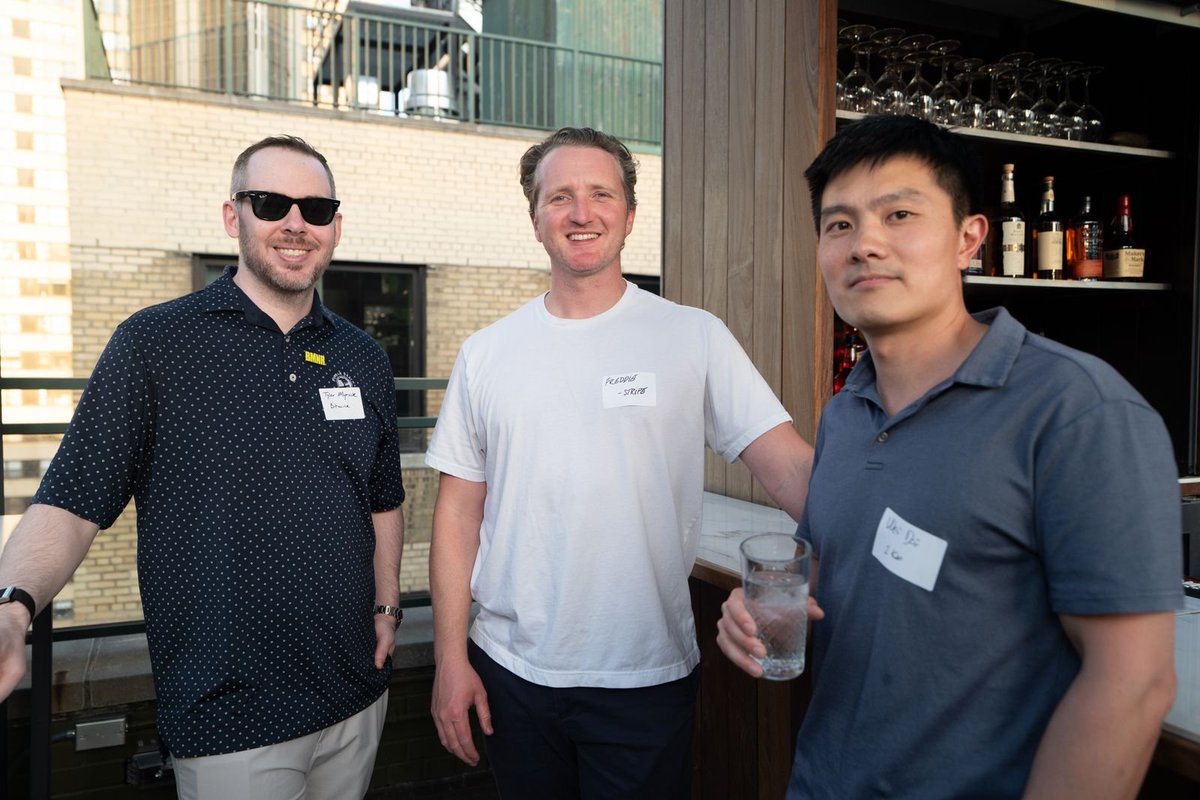
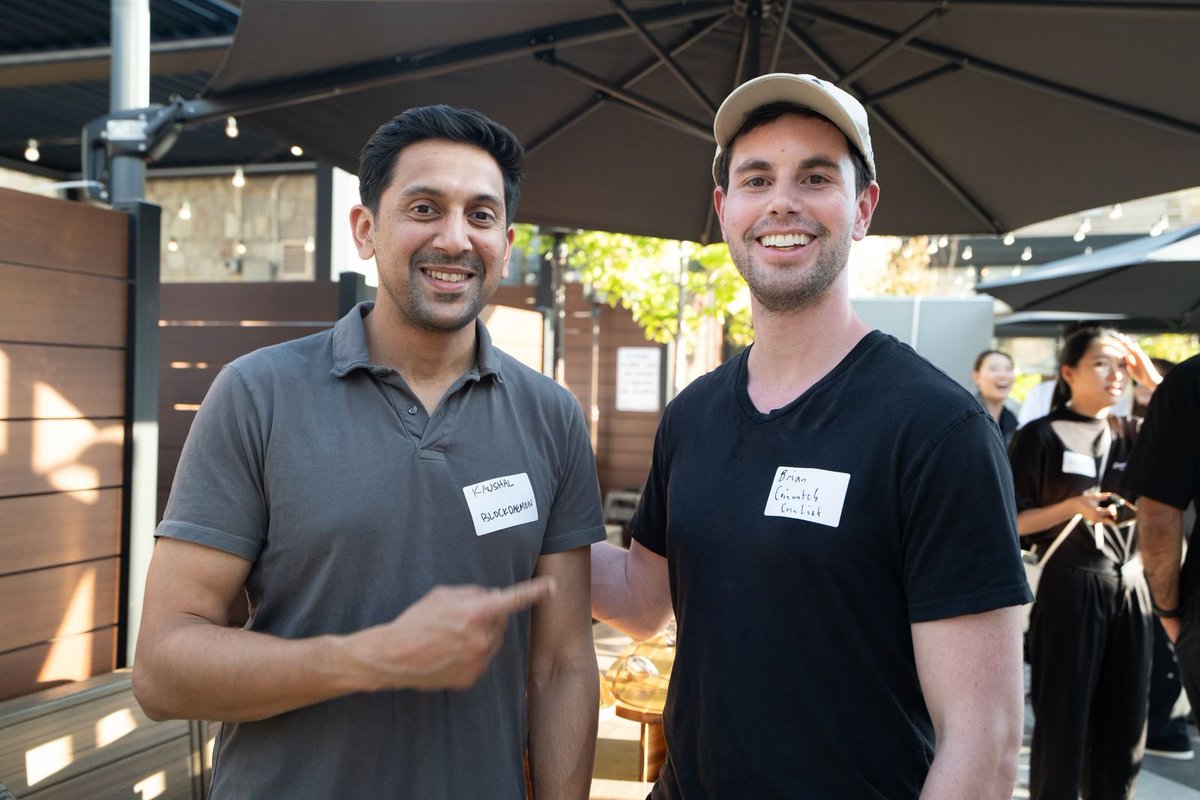
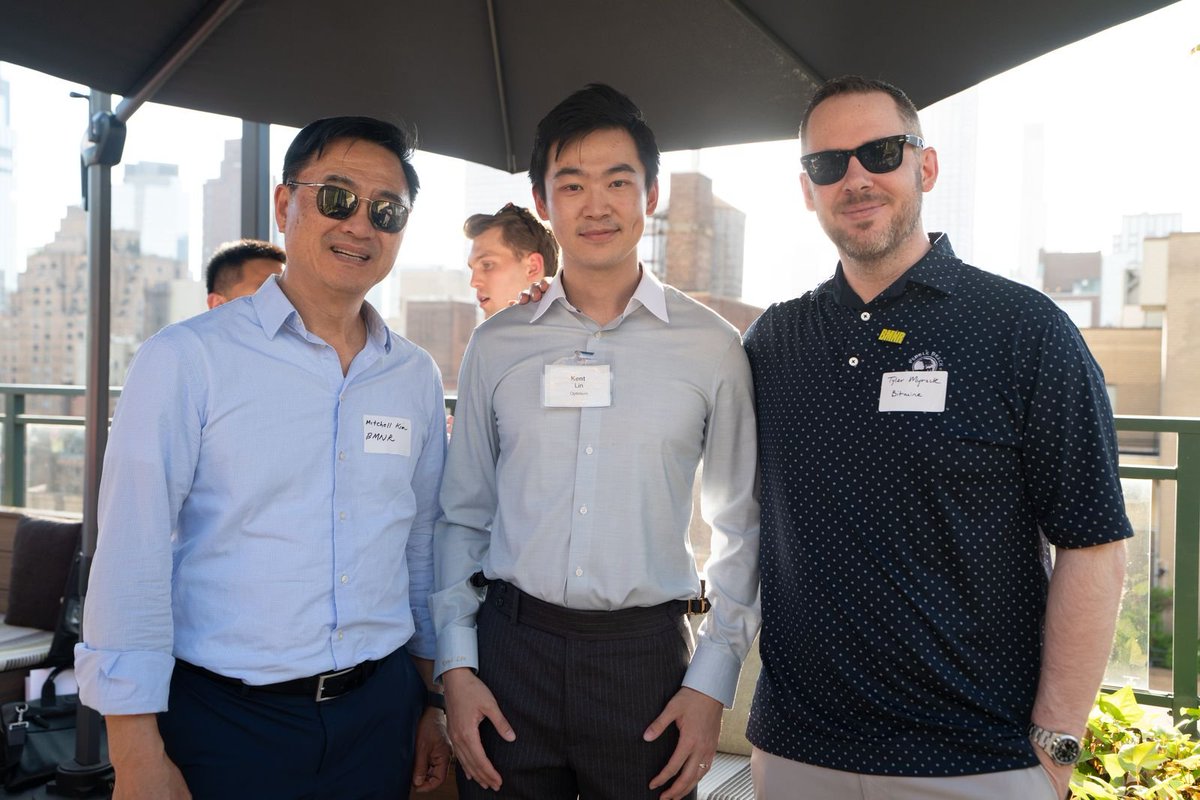
Wonderful night in NYC🗽 with our institutional friends. Welcome to the new Wall Street!
Jun 5

The TAM is the entire global financial system & the ticker is $ETH.
Cheers from the Optimum team, @BitMNR, @1kxnetwork, @BlockdaemonHQ and @Auros_global here at last night's Top of the Block event we hosted in NYC. 🥂
Catch us next week at @ethconf!

2
23
450
Web³ Jefe retweeted
Jun 2
"𝘼𝙨𝙨𝙪𝙢𝙚 𝙚𝙫𝙚𝙧𝙮𝙩𝙝𝙞𝙣𝙜 𝙊𝙥𝙩𝙞𝙢𝙪𝙢'𝙨 𝙙𝙤𝙞𝙣𝙜 𝙞𝙨 𝙨𝙪𝙥𝙚𝙧 𝙨𝙪𝙘𝙘𝙚𝙨𝙨𝙛𝙪𝙡"
@tarunchitra sees our Latency Marketplace giving rise to blockspace futures markets, in turn tightening the spread for TradFi assets trading onchain.
51
38
213
9,675

Web³ Jefe retweeted
May 19
Find something you believe in and go all in on building it.
@kentlinyy talks about dropping out of HBS to co-found Optimum.👇
38
27
202
6,627
Web³ Jefe retweeted

May 18
Many people talk about quantum (PQ) computing like it's mystical. It isn't. It's math. The way we will secure data against it is also math, specifically, coding theory. Let me explain what that means, because much of the current PQ conversation is missing some important context.
Quantum computers work on qubits rather than bits. A bit is 0 or 1. A qubit can be described as something that can be 0, 1, or a distribution between them. That extra room is where the power comes from: a quantum computer is probabilistic, not deterministic, and it can solve specific problems that today's machines cannot.
The challenge is that as you compute, the qubits degrade. The state doesn't stay constant. Without robust, efficient error correction, a quantum computer can't scale. Error correction is a coding problem. So coding is one of the largest open obstacles to making quantum computing real at all, which is why so much of the heavy investment in this space is, at its core, an investment in better codes.
That same math is what protects us on the other side. To see why, the analogy I keep coming back to is a door and a lock. Every cryptosystem you use today protects a large surface (say a megabit of data) with a tiny key, say 128 or 256 bits. The lock is a small fraction of the door. That arrangement works against a classical attacker because they have to break the lock; there's no other way in.
A quantum attacker doesn't have that constraint. They can probe non-deterministically; they don't need to break the lock at all. They can look for a weak point anywhere on the surface of the door and punch a hole through it. You may not even know which part of your data they saw, maybe nothing important, maybe exactly what you wanted to hide.
Almost the entire PQ conversation today is about reinforcing the lock. Replace ECDSA, replace the key-exchange primitive, swap in a lattice-based KEM. That work matters and it should continue. But it is still a small reinforced patch on a very large door.
The real question is how you reinforce the whole door. The math for that has existed since the 1970s: the McEliece cryptosystem, the granddaddy of post-quantum schemes, and the main one I personally trust. It has withstood half a century of attacks by cryptographers without a fundamental break—a track record little else in this space comes close to.
The problem with McEliece is not security. It is pain. Applying it to a full payload is, if you forgive the grim comparison, like chemo: it kills the tumor and almost kills the patient. That is why nobody deploys it broadly. The lock is small enough to absorb the cost; the door is not.
This is where coding solves the second half of the problem. The construction my collaborators and I developed, HUNCC (Hybrid Universal Network Coding Cryptosystem), splits the data into coded pieces and applies the expensive PQ encryption to only a small fraction of them, maybe a few percent, or less. An attacker who breaks in sees a system of equations with one unknown they cannot recover. One unknown in a coded system is a hyper-strong key, and the protection lives everywhere on the data, not just at the lock.
The point is not that this replaces ML-KEM or any other PQ KEM. It doesn't, and I wouldn't claim it does. The point is that coding is what makes post-quantum security something you can actually deploy at speed, across the whole door, without paying the chemo cost everywhere.
Coding is what is currently blocking quantum computing from becoming real, and coding is what will make quantum safety real. The math has been here for fifty years. What we have been missing is the path from correct-but-unusable to correct-and-fast.
More to come.
35
22
150
21,779
Web³ Jefe retweeted
May 11
Gmum and thank you to everyone who helped us spread the word of giving back in the spirit of Mother's Day!
We hope we've inspired others to give back as well, and look forward to doing more charity drives like this in the future. ❤️
- The Optimum Team

May 8
Happy MUM's Day Weekend!
In honor of mothers everywhere we'll be donating $1,000 to @UNICEF, but first we need you to help us blow this post up and encourage others to donate too.
Time to make the world's longest GMUM chain in the replies! Once we hit 100 we donate. 🤝

78
50
239
5,348

Web3 is increasingly becoming more about data flow than computation.
Networks can handle thousands of transactions, but the real challenge is how quickly and reliably information moves through them. Blockchain data flows are more like waves:
they spread, collide, become distorted, and sometimes become distorted along the way.
------------------------------------------------
@get_optimum doesnt try to push more data through congested channels, Optimum rethinks the transmission dynamics itself.
The flow becomes more uniform, predictable, and resilient to congestion. This reduces latency not only on average but also, more importantly, reduces its variability, making the network stable under real world load.
This directly impacts
〰️How quickly nodes reach consensus
〰️How efficiently validators use their time
〰️How predictably the entire system operates.
Web3 is moving forward not only due to its capacity, but also due to the quality of its data transfer.
And this is where @get_optimum plays a key role.

TREASURE HUNT IS OVER!♾
Four shards. Four phases.
What looked like a game turned into something much deeper a live demonstration of how latency shapes outcomes. How fast you react, how well you adapt, and how efficiently you move through fragmented information.
🔻 🔻
It reflects the same principles @get_optimum works on ensuring data reaches the right place faster, with fewer delays and less duplication.
That why this hunt felt different. It wasnt abstract.
The ones who reached the end didnt just follow clues they operated at the edge of coordination and speed.
🔺 🔺
This Thursday,
in the Community Call together with @blockchainjeff those who collected all 4 shards will come together.
Not just to receive rewards, but to be recognized as the ones who truly understood the mechanics behind it all.
Because in the end, controlling latency isnt just a skill in a game its an advantage in the networks of the future♾
34
1
117
3,154
Web³ Jefe retweeted
May 3
Literally flying across the globe for this. I'm coming at you baby - Consensus Miami.
Node operators, institutional ETH holders, traders - if you want faster speed & higher yield, DM me for meetings!
📍Posting from 11585m altitude, in the middle of The Atlantic.
May 1
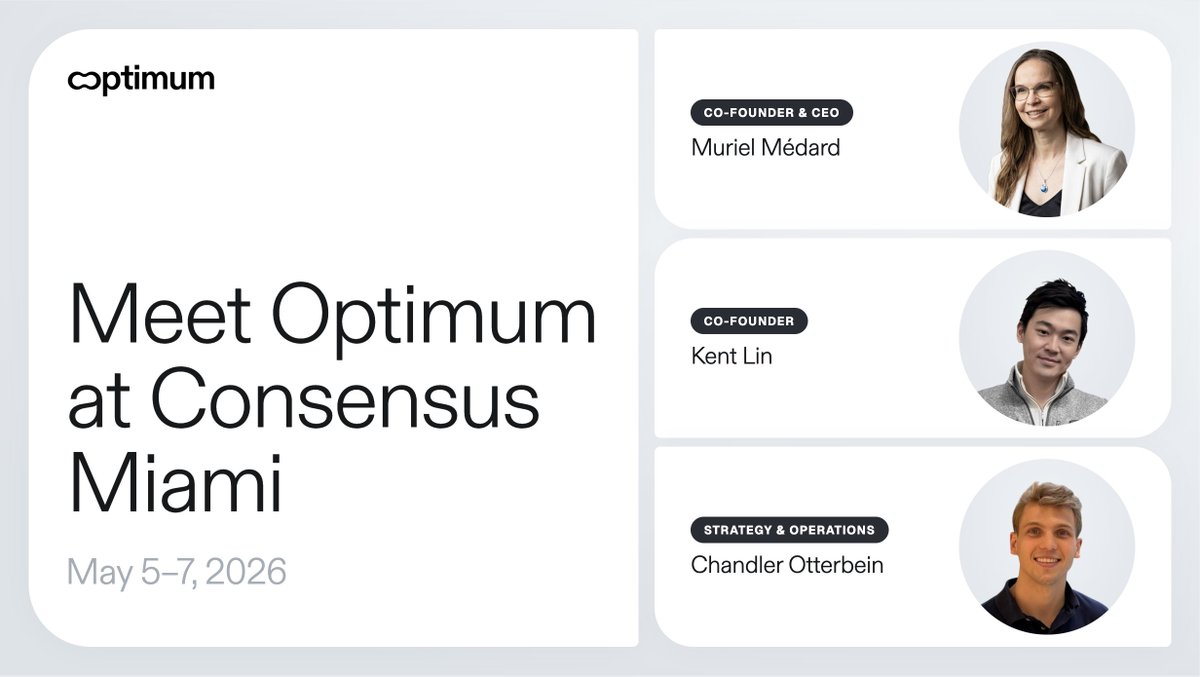
We're coming to @consensus2026 next week! 🌴
@kentlinyy @MurielMedard and @ChandlerOtterbe will be on the ground in Miami. Get in touch if you'd like to meet up with the team. 🤝
2
1
27
1,152
Web³ Jefe retweeted
Mar 26
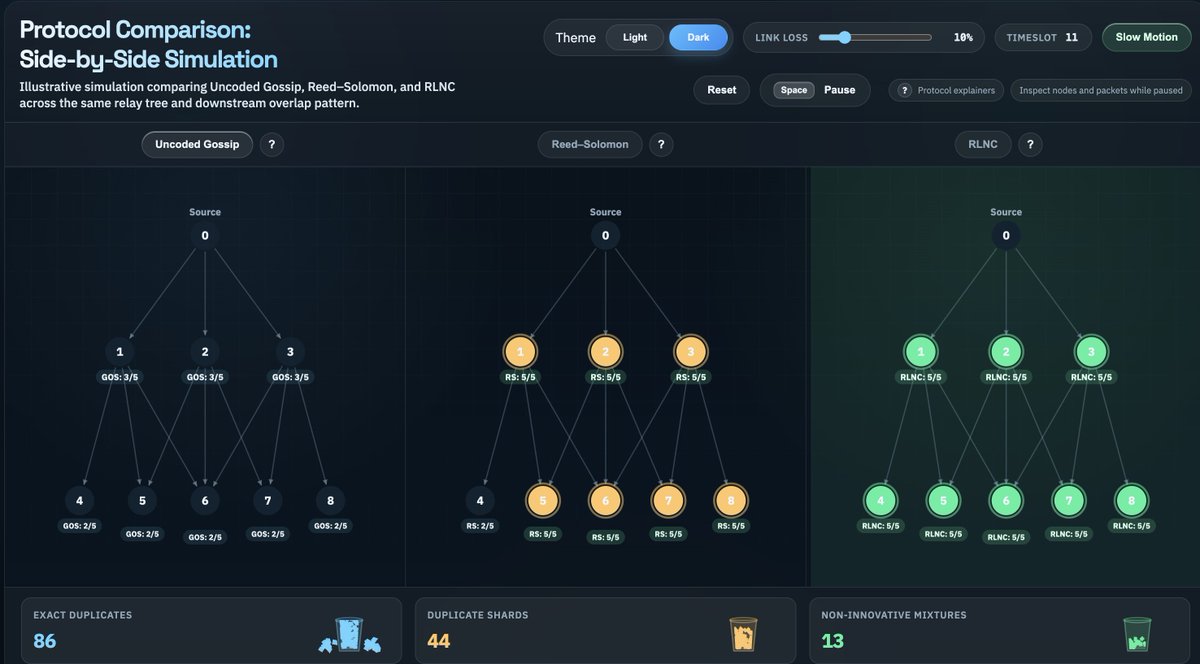
The Power of RLNC Visualized 🌐
To illustrate the speed and efficiency of different data propagation schemes we created a simulation comparing message delivery times across the same network.
Run it yourself at: gmum.cc/simulation/
52
37
199
15,411
Web³ Jefe retweeted
Mar 25
Congrats on launching MAVAN — world's largest single-entity staking op is huge for institutional ETH adoption! 🔥
For even better performance on your validator network (lower latency, faster propagation), you guys should try @get_optimum — the MIT-born data acceleration network is built exactly for infra like this. Could be a game-changer for uptime & rewards.
What do you think? $BMNR $ETH @fundstrat @BitMNR
Mar 25

MAVAN is live ‼️
We are open for business and will be the world’s largest single entity staking operation.
PS: you can stake your ethereum and other crypto with us.
$BMNR
@fundstrat
prnewswire.com/news-releases…
4
2
31
1,245
Web³ Jefe retweeted
Mar 25
Gm @fundstrat, in case you didn't catch the @therollupco stream earlier:
We would love to help the new world's largest staking operation enhance their validator performance and APYs 🤝
Mar 25
MAVAN is live ‼️
We are open for business and will be the world’s largest single entity staking operation.
PS: you can stake your ethereum and other crypto with us.
$BMNR
@fundstrat
prnewswire.com/news-releases…
26
18
128
4,409
Web³ Jefe retweeted
Mar 20
Come and meet us at EthCC in Cannes!
Mar 18

Grateful to welcome @get_optimum as a sponsor for @blockspaceforum Cannes. We are excited for their insights and contributions as we look to make block and transaction propagation faster!
RSVP -> luma.com/blockspaceforum

7
1
30
804
Web³ Jefe retweeted
Mar 19
This exchange between @raulvk and @TobiasKlenze raises an important question:
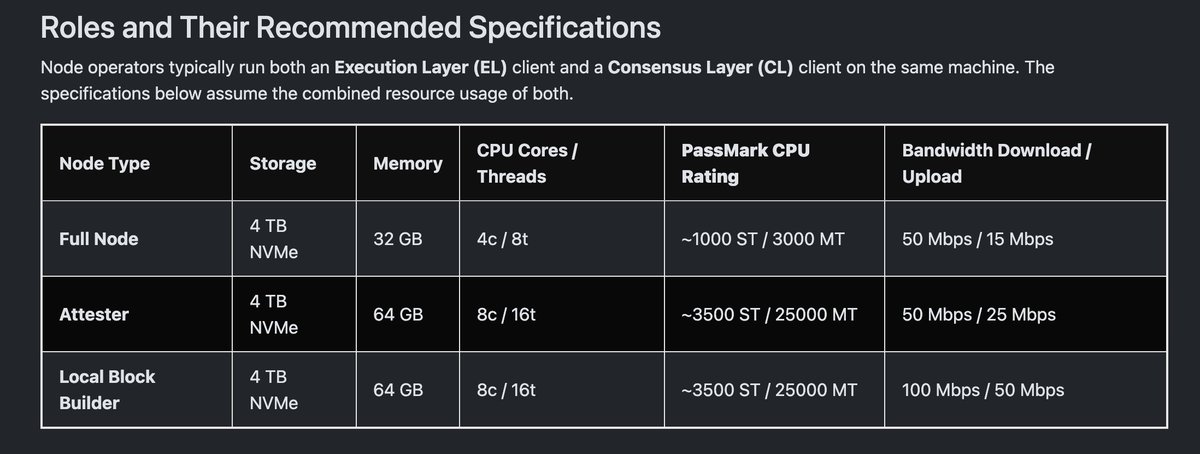
How do you optimize for low latency across a truly permissionless, decentralized network?
Or put another way — how do you deliver the core promise of blockchains at high performance and scale?

this is not using gossip, it's erasure-coded broadcast.
- Monad and Solana have deterministic topologies
- this involves permissioning the validator network plane and publicly listing endpoints
- Ethereum's network is permissionless, we cannot route deterministically
- Monad requires 300Mbps bandwidth, Solana more.
- Here are Ethereum's requirements, keeps the network universally accessible and decentralized
11
14
84
3,639
Web³ Jefe retweeted

Mar 12
Staying up late the rest of the week to crack the game.gmum.cc top #100. Game on, @get_optimum 🎯

Mar 5
Are you faster than mump2p?
Our cracked growth manager @abbas_tfu made an aim trainer that generates targets at the same speed mump2p delivers blocks across Ethereum 🎯
Come earn your spot on the leaderboard game.gmum.cc
4
1
26
799

Mar 10
🤔

Someone set loose two AI agents with $1,000 each and 48 hours to trade on Polymarket.
Claude: 1,322% to $14,216
OpenClaw: liquidated to zero in under 48h.
5
33
1,021
Web³ Jefe retweeted

Mar 10
Alright, I officially surrender! 🏳️. GG @abbas_tfu
My hands have literally stopped responding after trying to keep up with the mump2p speed from @get_optimum. It’s just moving on a different level. ⚡️💨
If you think you're fast, try racing against mump2p.🤯🚀
game.gmum.cc

Mar 5
Are you faster than mump2p?
Our cracked growth manager @abbas_tfu made an aim trainer that generates targets at the same speed mump2p delivers blocks across Ethereum 🎯
Come earn your spot on the leaderboard game.gmum.cc
4
1
36
764