
Joined July 2008
- Tweets 28,186
- Following 1,782
- Followers 38,381
- Likes 15,885
1,656 Photos and videos


22 May 2025
New House GOP text has faster phaseout for IRA clean electricity credits—you gotta start building 60 days after the law passes and put it in service by the end of 2028, or no credit.
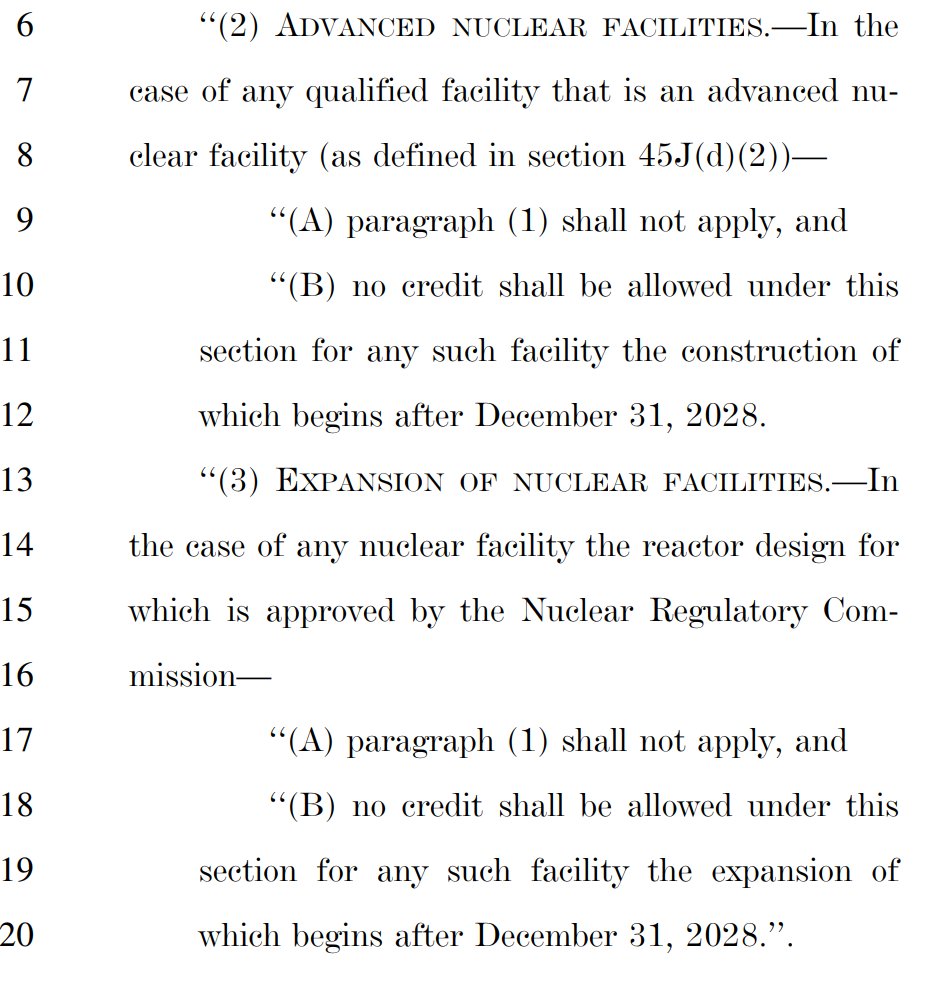
There's an exception for nuclear—you can claim the credit if you start construction by end 2028.
22 May 2025

HERE IS THE MANAGER'S AMENDMENT
punchbowl.news/managers-amen…
8
7
21
11,547
22 May 2025
More detail here on why this is a potentially pretty significant tweak for new nuclear projects.
(Though not as much of a boost as the original IRA, which would keep tax credits for new reactors until at least 2032—and probably longer.) x.com/Dr_A_Stein/status/1925…
22 May 2025

The manager's amendment to the reconciliation bill keeps the tax credits for advanced nuclear and expanding existing plants if construction starts by the end of 2028. A lot of projects could meet this deadline if they apply to the NRC soon and seek a LWA, or buy long lead items
2
2,819
12 May 2025
Looking at IRA:
—phase down of tech-neutral clean electricity credits after 2028, to zero by 2031
—termination of EV tax credits after end 2026
—termination of hydrogen tax credits after end 2025
—new restrictions on foreign entity of concern for domestic manufacturing credits
12 May 2025

BREAKING NEWS: House Republicans are out with their tax bill extending the 2017 tax cuts, granting Trump’s campaign priorities & more
UPDATED TIME - Markup kicks off 2:30 p.m. tomorrow
The bill is 389 pages !!
READ IT HERE: punchbowl.news/smitmo_017_xm…
3
14
68
45,365
12 May 2025
Oh wait, sorry. The full tech-neutral clean electricity credits will only apply to plants that are "in service" by 2028, which is a major restriction — this is a MUCH faster phase out than it first looked.
4
2
36
22,339
15 Feb 2025
More than 300 workers at the National Nuclear Security Administration were told they were fired on Thursday.
Now at least some of them are getting contacted and told to please come back to their jobs: nytimes.com/2025/02/14/us/po…
30
67
129
137,358
11 Feb 2025
NYT has openings for two climate reporter positions — descriptions/how to apply at the links:
1) Climate policy reporter: nytimes.wd5.myworkdayjobs.co…
2) Climate adaptation reporter: nytimes.wd5.myworkdayjobs.co…
1
10
23
4,310
22 Jan 2025
The big VC Summer nuclear project in South Carolina come back from the dead. Santee Cooper is looking to sell the unfinished plant to buyers who might be interested in building two AP-1000s: wsj.com/business/energy-oil/…
1
5
16
1,305
22 Jan 2025
Nuclear folks talk a lot about the skilled workforce built up and lessons learned from Vogtle in Georgia, arguing that the next AP-1000s could be built more efficiently, with fewer overruns.
TBD whether anyone wants to test that out — and what kind of federal backing they'd need
7
930
22 Jan 2025
Desalination for drinking water is surprisingly affordable. Desalination for agriculture probably doesn't make a ton of economic sense apart from some high-value crops.
Really interesting post by @_HannahRitchie sustainabilitybynumbers.com/…
2
5
20
1,542
brad plumer retweeted

15 Jan 2025
More Americans Than Ever Are Living in Wildfire Areas. L.A. Is No Exception. nytimes.com/interactive/2025…
This is a great article from @rjnskl and @bradplumer at @nytimes.
Some important nuggets:
"Between 1990 and 2020, the number of homes in fire-prone parts of California grew by 40 percent, according to research led by Volker Radeloff, a professor of forest ecology at the University of Wisconsin-Madison."
"In California, many cities have restricted development in downtown areas, pushing people to the fringes. Mobile homes and low-income housing are prevalent in fire-prone areas."
"The growth of housing in flammable areas is a big reason that wildfires are becoming more destructive. Not only are there more homes in the path of fires, but with more people living near forests and grasslands, there’s a greater chance fires will start in the first place."
"Many of the homes in Pacific Palisades were 40 to 100 years old, and had avoided damage for many years in a region that burns frequently, said Crystal Kolden, director of the Fire Resilience Center at the University of California, Merced. But this time, there was more fuel and stronger winds. Much of the surrounding area used to be ranch land, and cattle grazing kept the buildup of flammable shrubs and grasses in check. Some of that land has since been converted into a park and a conservation area, allowing more vegetation to grow."
"After the Camp Fire, one analysis found that about 51 percent of the 350 single-family homes in Paradise built to the new codes escaped damage, compared with just 18 percent of the 12,100 homes built before the standards."
"In many cases, homeowners, state agencies and the federal government will have to do more to prevent vegetation buildup around high-risk areas, experts say."
"“There are lots of disasters we have limited control over,” said Dr. Kolden. “But fire is one we do have control over. We can control the fuel. We can control what our structures look like.”"
1
7
9
2,054
14 Jan 2025
Pretty big setback for early efforts to make low-carbon steel in the U.S. (Also raises the question of whether that $500 million will be repurposed by Trump's DOE or just go unspent.) canarymedia.com/articles/gre… by @mariagallucci
1
1
7
1,730
7 Jan 2025
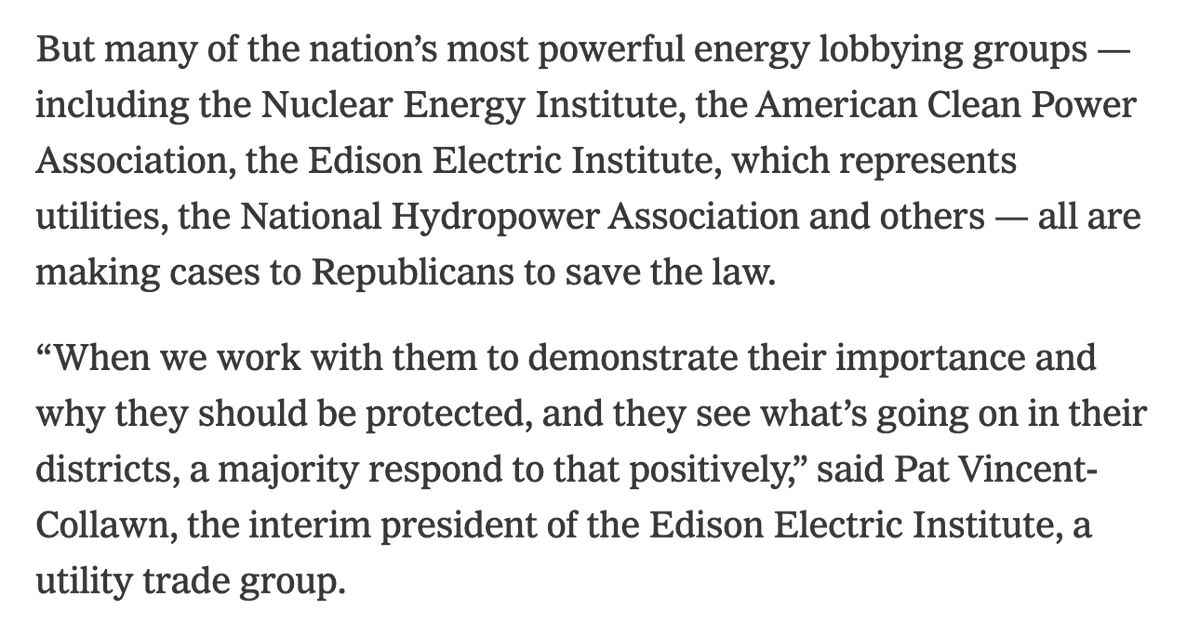
Arguably the biggest policy in the IRA — the technology-neutral clean electricity tax credits — were designed to attract support from so many different industries that they'd be hard to kill.
Now that theory is about to be tested. Story w/ @LFFriedman: nytimes.com/2025/01/07/clima…
2
5
9
4,472
7 Jan 2025
One notable dynamic—you used to see individual energy trade groups lobbying to save their own narrow tax credits. Wind industry for the PTC, solar for the ITC, etc.
But the broader tech focus of the IRA means the big trade groups are now banding together.
4
939
4 Jan 2025
Wild story: A TVA dam was famously halted in the 1970s over fears that it'd threaten a rare endangered fish known as the snail darter. (Congress later approved the dam anyway.)
Now, genetic evidence suggests the snail darter was never even a real species: nytimes.com/2025/01/03/scien…
1
1
5
1,181
3 Jan 2025
Interesting take on the hydrogen rules by Mathias Zacarias of CSIS — if the AI data center boom is as big as hyped, there'll be a scramble for 24/7 clean power, and hydrogen producers using electrolysis may struggle to win out, even with hefty subsidies: linkedin.com/posts/mathias-z…
3
4
27
3,719
3 Jan 2025
After many months, Treasury finished its guidance for the 45V hydrogen tax credit—kicking off billions in subsidies for green hydrogen.
Early reactions suggest industry and enviros seem fairly happy with the end result? But it's 400 pages long, so… nytimes.com/2025/01/03/clima…
22
20
75
159,228
3 Jan 2025
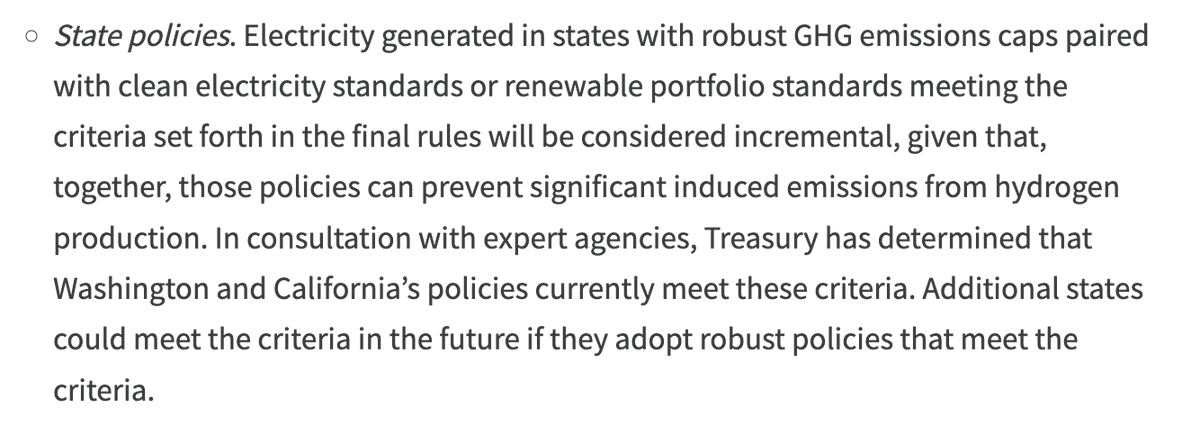
One curious twist in the rules — if states have hard emissions caps or clean electricity standards, then hydrogen developers don't need to fret about additionality when procuring power.
Seems like a (small) federal incentive for states to ratchet up their climate policies, no?
1
1
2
1,057
2 Jan 2025
In 2024, hot weather might’ve pushed up US electricity demand more than AI did?
Per EIA, overall electricity use rose 1.8%, but it was mostly residential. Commercial use (includes data centers) barely went up.
And the number of cooling degree days rose ~10% compared to 2023.
2
4
35
5,087
2 Jan 2025
Overall electricity demand stats, from the most recent STEO: eia.gov/outlooks/steo/tables…
Heating/cooling degree days: eia.gov/outlooks/steo/tables…
1
2
762
2 Jan 2025
Obviously it’s still early days for AI — no one expects a huge data center surge to materialize all in one year. But interesting.
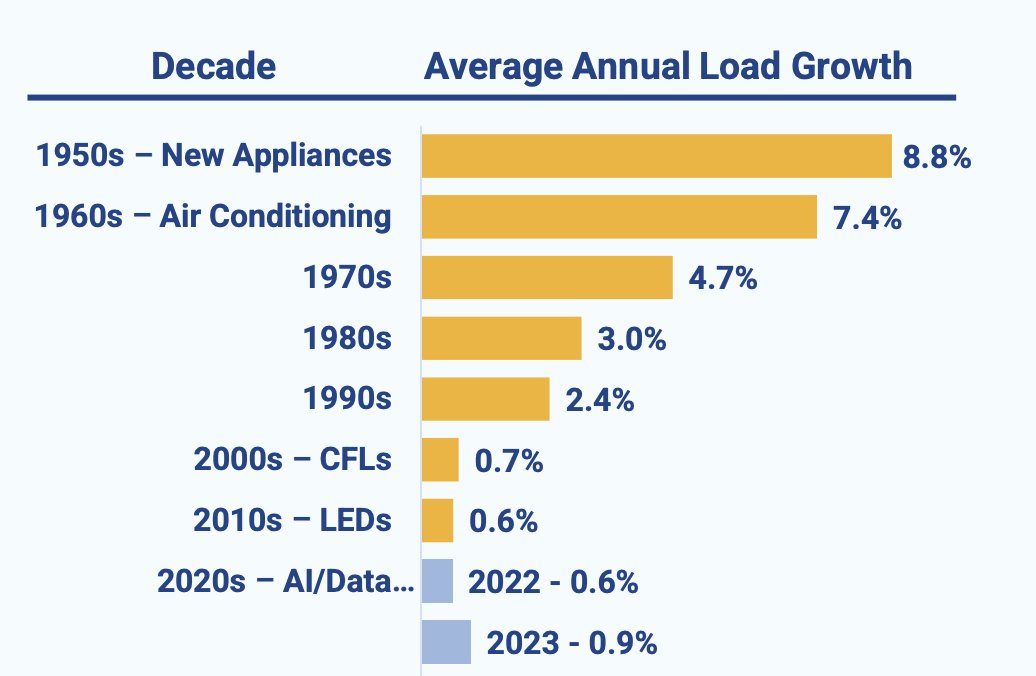
Also, a 1.8% increase in demand sounds small, but the U.S. hasn’t seen sustained load growth at that rate since the 1990s: gridstrategiesllc.com/wp-con…
1
3
880