
Co-founder and CTO @paretocredit (fka @idlefinance) | Ethereum developer
Joined August 2011
- Tweets 574
- Following 2,582
- Followers 849
- Likes 6,111
28 Photos and videos










Pinned Tweet

6 Nov 2024
1️⃣
🎉 Celebrating 5 incredible years of @idlefinance! What a journey it's been, and we're just getting started 🚀 Dive into our story below.
11
2
52
3,417
Just wrapped an audit of @paretocredit’s new Revolving Credit Vaults with @sherlockdefi and @IAm0x52
Appreciated the deep technical knowledge and a professional approach that resulted in meaningful and actionable findings
Zero high-severity issues. All other already addressed
Jun 10

Revolving Credit Vaults are coming to Pareto - but security first.
Before the launch, we put our new contracts through a full security audit by @sherlockdefi and @IAm0x52
The review covered:
- How borrowers draw and repay funds
- The liquidity buffer backing each vault
- Deposit and withdrawal mechanics
- Fee calculation and accrual
- Default handling and multi-vault management
Result: zero high-severity issues. Every finding was resolved before the final commit.
More on Revolving Credit Vaults soon - stay tuned!

3
9
973
William | bugduino.eth retweeted

Jun 10
Private Credit is becoming a new DeFi Lego.
Over the past two years, most RWA growth has been driven by tokenized Treasury products.
The idea is simple: USDC → Treasury Bills → 4–5% yield.
Investors can earn government bond yields while keeping liquidity and onchain composability.
This model has clearly found strong product-market fit.
However, most Treasury-backed RWAs today share one common feature:
They are mostly passive yield assets.
Users deposit capital, earn yield, and hold the asset. The value creation largely stops there.
@paretocredit is taking a very different approach.
Instead of tokenizing government debt, Pareto focuses on institutional credit.
Through its Credit Facilities, onchain capital is allocated to firms such as FalconX, Bastion, Fasanara Digital, Adaptive Frontier, and RockawayX.
These firms operate in areas like:
• Prime brokerage
• Market making
• Digital asset financing
• Quant trading
• Institutional liquidity
In other words, the yield does not come from government bonds.
It comes from real business activity within the crypto economy.
This creates a completely different asset class, giving investors exposure to institutional credit in digital assets.
The interesting part is that this credit can be programmed onchain.
In traditional finance, private credit usually follows a simple model: Private Credit → Fund Investors → Yield
Capital is raised. Returns are distributed. The assets remain locked inside the fund structure.
Pareto is changing that through Credit Vaults.
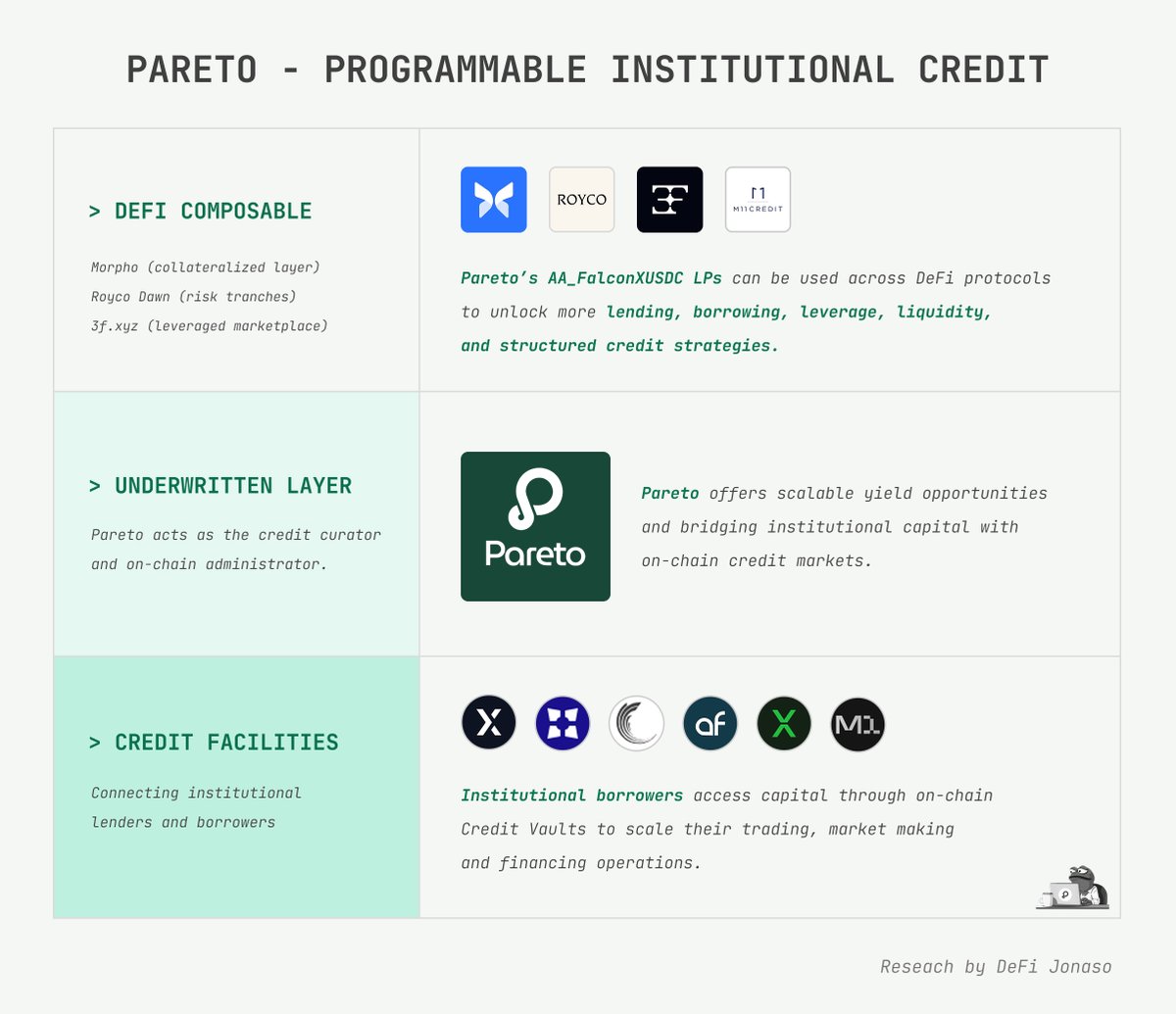
Institutional credit positions are tokenized into LP assets that can interact with the DeFi ecosystem.
Most notably, @FalconXGlobal LPs are already appearing across leading DeFi protocols, creating a new model:
Institutional Credit → Tokenized LP → DeFi Composability
These LPs are no longer just yield-generating positions.
They can be:
• Used as collateral on @Morpho
• Leveraged on @3f_xyz
• Integrated into structured credit strategies through @roycoprotocol
This is a key difference between FalconX LPs and most Treasury-backed tokens today.
• Treasury tokens provide exposure to low-risk government debt and its yield.
• FalconX LPs provide exposure to real credit demand from the crypto economy and the financial activity of digital asset institutions.
Looking at the bigger picture, Pareto may represent the next stage of RWA evolution.
Turning institutional credit into assets that can be reused, combined, and programmed across DeFi.
Private Credit is not only being tokenized.
Private Credit is becoming composable.
Jun 9
$2.5m secured in under one week on @roycoprotocol
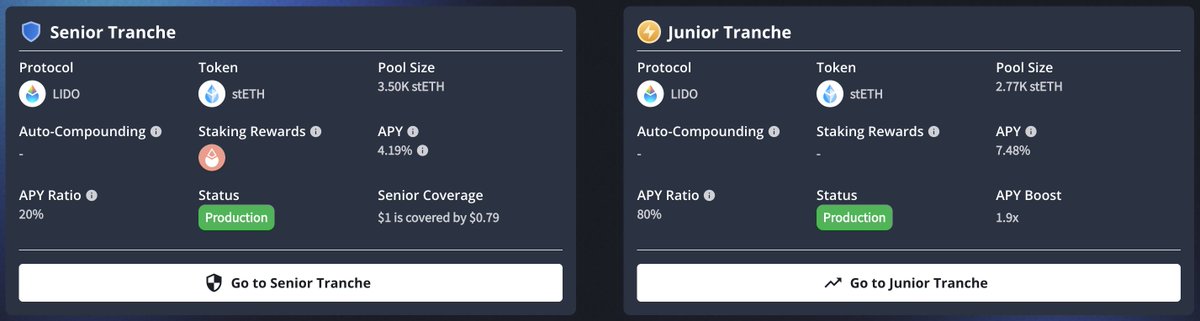
Royco offers tranched exposure to the @FalconXGlobal Credit Vault on Pareto: senior tranche gets first-loss coverage, junior takes the risk in exchange for higher yield.
43
5
65
3,824
Composability is one of the building blocks of true institutional adoption.
Levered strategies add another layer of capital efficiency (but as everything, also come with certain risks, so DYOR).
Great collab between @3f_xyz @paretocredit @FalconXGlobal and @M11Credit!
Jun 3
New, customizable looping strategy for FalconX Credit Vault is now live on @3f_xyz!
The usual flow:
- Deposit USDC into 3F's strategy
- 3F deploys USDC into the @FalconXGlobal Credit Vault on Pareto, curated by @M11Credit, receiving AA_FalconXUSDC tokens
- Those tokens are posted as collateral on @Morpho to borrow more USDC
- Borrowed USDC loops back in, amplifying credit exposure
- You choose the target leverage - 3F manages the collateral, borrowing, and rebalancing
What previously required manually compounding through multiple redemption cycles is now a single deposit with leverage up to 6.5x!
→ app.3f.xyz/asset/pareto-falc…

1
1
12
603
135M in the FalconX Credit Vault, AA_FalconXUSDC as real collateral on @Morpho, automated looping strategies enabled by @gauntlet_xyz, expansion to @monad... That's a real product-market fit.
Proud of what we built with @FalconXGlobal and @M11Credit
May 27

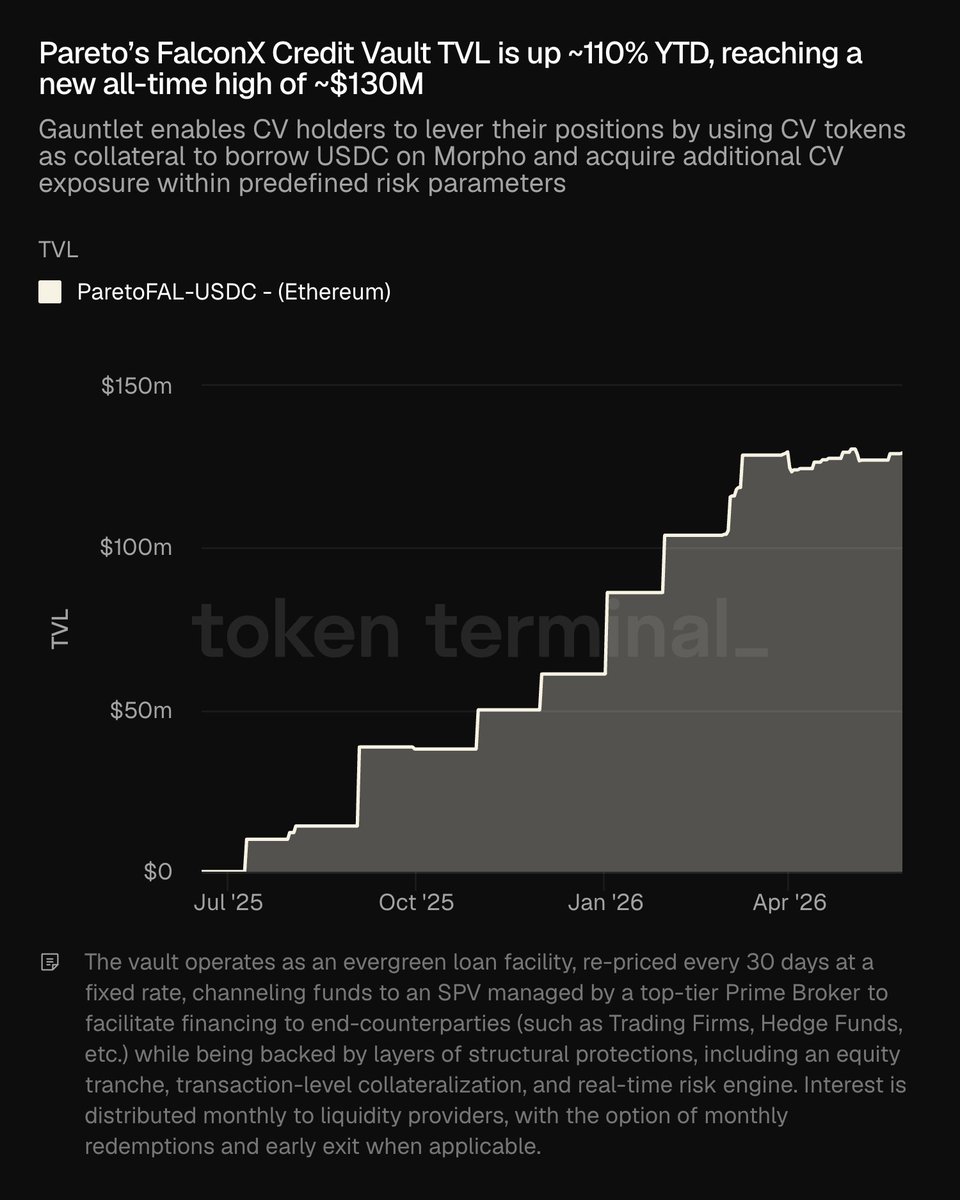
🏦⛓️ @paretocredit's FalconX Credit Vault TVL is up ~110% YTD, reaching a new ATH of ~$130M.
@gauntlet_xyz enables CV holders to lever their positions by using CV tokens as collateral to borrow USDC on @Morpho & acquire additional CV exposure within predefined risk parameters.
3
6
16
2,469
1/ We spent the last few days integrating Centaur github.com/paradigmxyz/centa… into Pareto Credit as an internal AI teammate.
This is one of the first AI infra projects that actually made me think: “ok, this is how company agents should work.”
cc @gakonst @arjunblj @paradigm @tempo
2
3
24
5,767
5/ The daily brief is the part I’m most excited about.
Every weekday morning Centaur summarizes what changed across repos/docs.
Company context stops being static memory and becomes something that stays fresh by default
1
2
168
6/ Still early, but this feels very close to the shape of useful company AI:
self-hosted, shared by the team, connected to real tools, aware of company context, and able to become operational over time
2
129
Hard to believe that we’ve been building in the space for over 7 years... Great to see @serotonin_hq @Solofunk deep dive into the @paretocredit protocol and our recent developments.
Take a read:

3
1
13
1,235
Repurchase agreements became essential because they gave markets a reliable way to turn collateral into liquidity.
That is part of what we’re exploring with the @FalconXGlobal Credit Vault, where AA_FalconXUSDC tokens can be used as collateral on @Morpho to borrow USDC
4
1
12
226
Proud to see this live! A lot of work went into building the infrastructure behind it on our side. Big credit to our partners @FalconXGlobal @monad @M11Credit @Morpho @SteakhouseFi for making it happen together 🤝
2
2
14
408
May 5

FalconX and Sygnum partner to launch tokenized credit offering for institutional clients theblock.co/post/399947/falc…
3
7
137
William | bugduino.eth retweeted

May 6
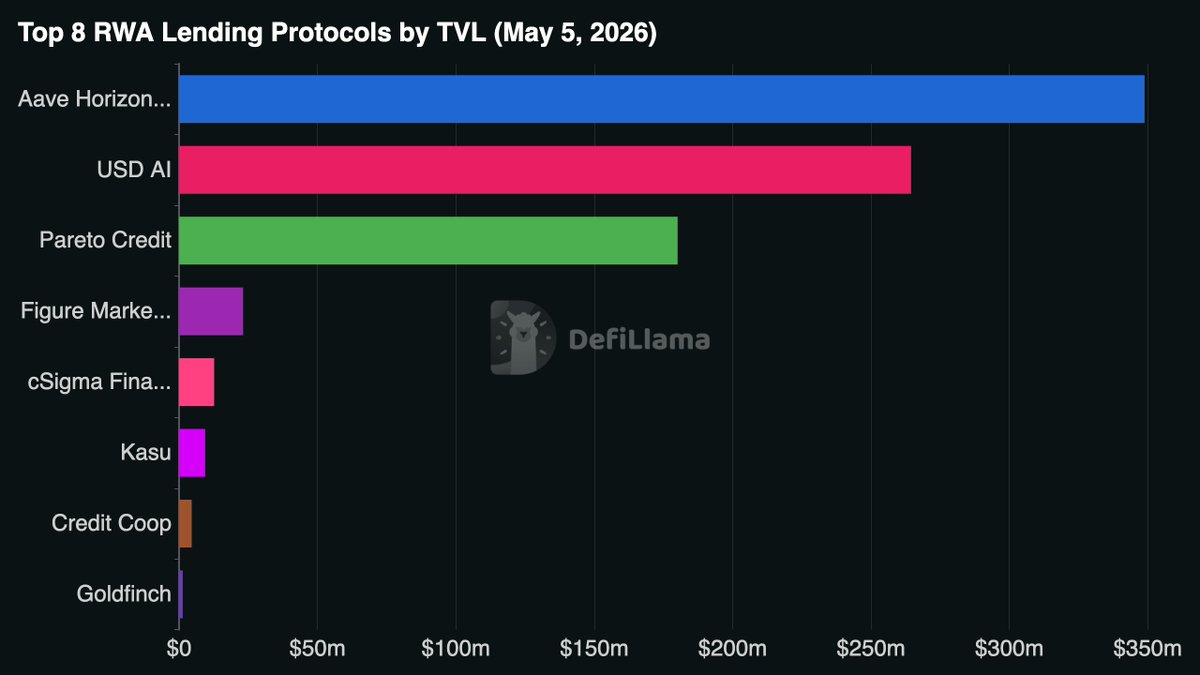
Pareto ranked 3rd by @DefiLlama across top RWA lending protocols.
While the sector retraced 41.5% in April, Pareto's TVL held at ~$180m.
1
5
15
865
.@paretocredit has just expanded into the banking sector with its whitelabel Credit Vault infrastructure.
Proud of the role Pareto plays here!
Banks, fintechs, payment networks, and BNPLs can use this setup to bring credit products onchain and easily open new revenue lines.
1
2
9
415
Why tokenized private credit becomes one of the most important RWA use cases in 2026
Private credit is a massive market, currently valued at $2T , but its legacy infrastructure still depends on fragmented records, delayed reporting, and manual coordination
👇
3
4
11
695
Tokenization solves that and takes the market to the next level:
- Settlements done in hours instead of days
- Better visibility into loan positions
- More competitive APYs
This is the difference that actually matters
1
8
74
If you’re wondering why legacy private credit - one of the largest markets in finance - is still stuck in the past, give it a read: x.com/paretocredit/status/20…
6
80
William | bugduino.eth retweeted
Apr 22
3
5
17
3,435