
Math & code enthusiast obsessed with problem-solving. Runner🏃.
Joined October 2013
- Tweets 6,886
- Following 944
- Followers 1,229
- Likes 1,353
229 Photos and videos



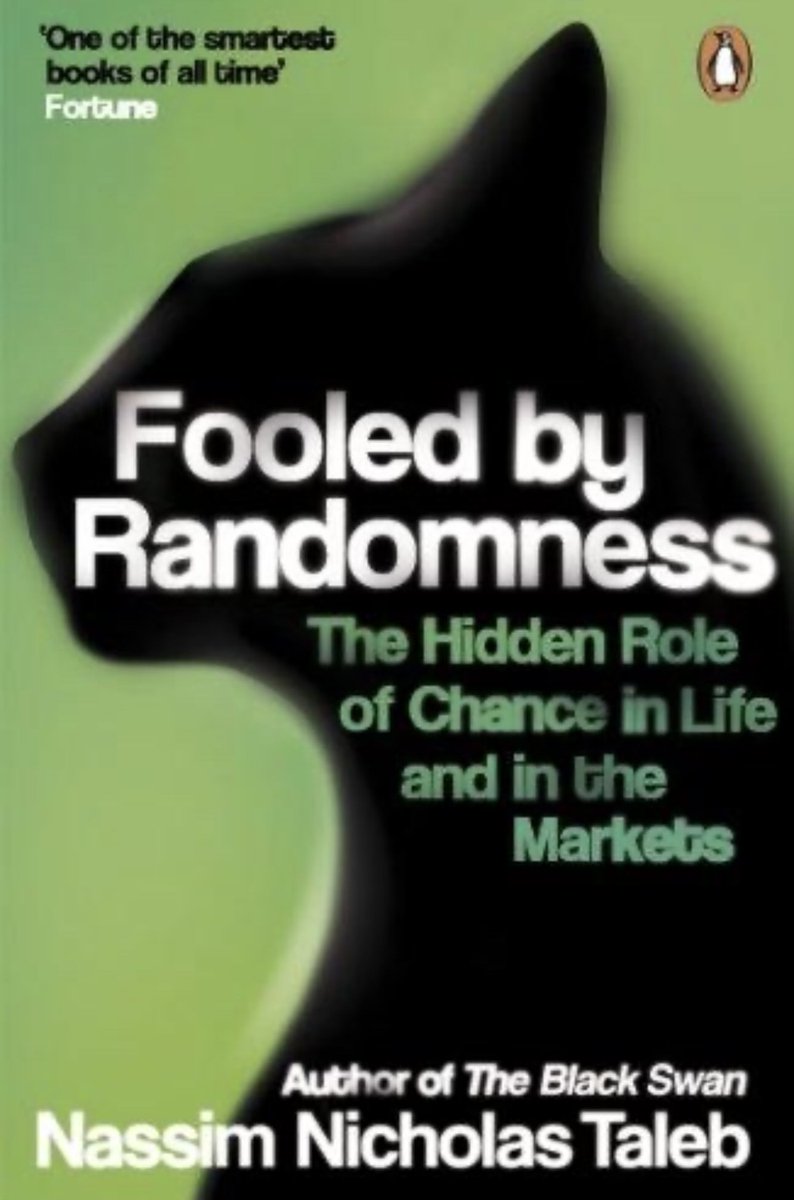

欧姆剃刀,熵增定律
Jun 14

世界公认十大顶级思维
1. 第一性原理:回归本质,拆解到最基础原理
2. 复利思维:做时间的朋友,抵御短期诱惑
3. 奥卡姆剃刀:如无必要,勿增实体,极简是最高效的
4. 贝叶斯思维:根据新信息不断修正你的根概率
5. 遍历性:只要有一次出局,基础概率就毫无意义
6. 幸存者偏差:不要只看成功者,死人不会说话
7. 熵增定律:系统不主动输入能量,必将走向混乱,自律的物理本质
8. 二八法则:死磕那20%的核心高价值区
9. 逆向思维:反过来想,查理芒格的最爱
10. 反脆弱:从不确定性和波动中获益
24
Bugjay retweeted

Jun 14
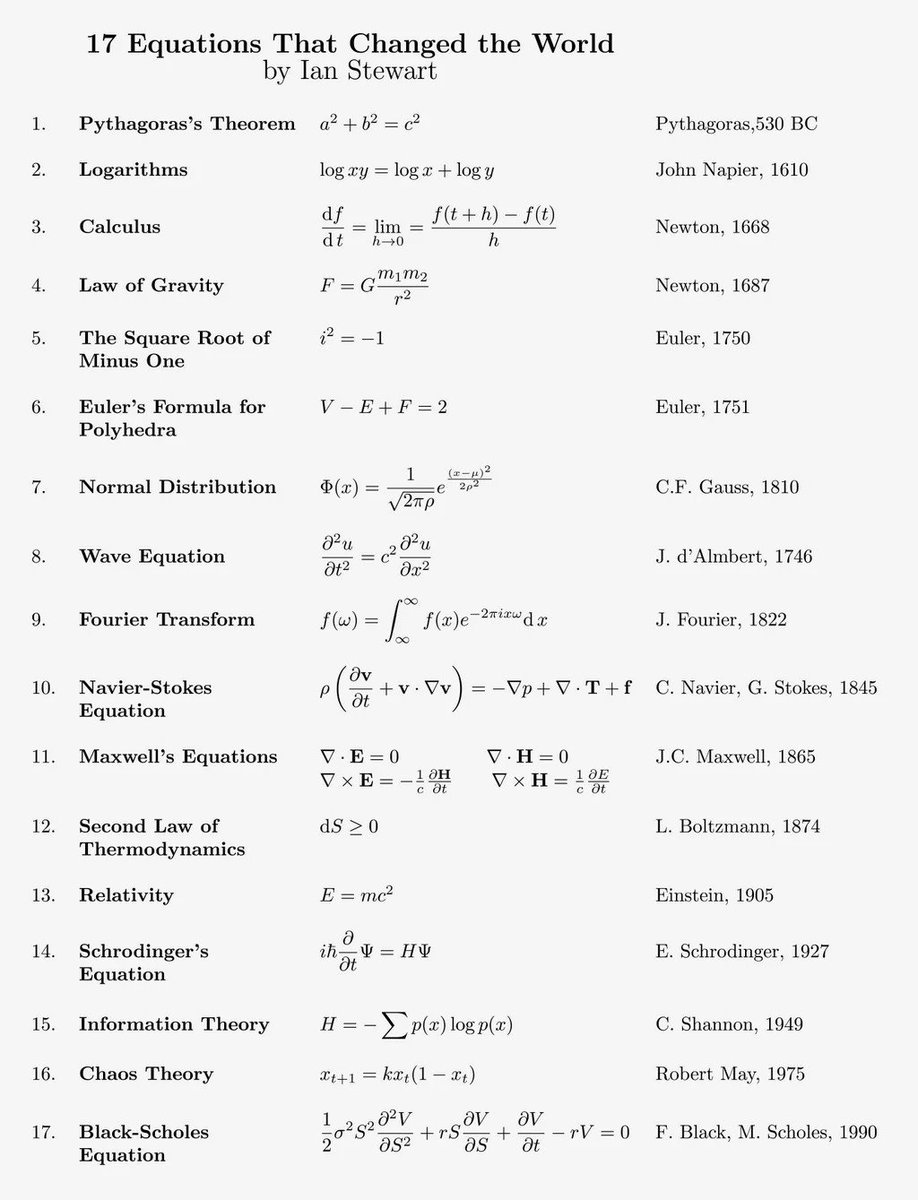
17 equations that changed the world by Ian Stewart
24
300
1,729
57,117
The decision tree algorithm has been using this metric.
Jun 13

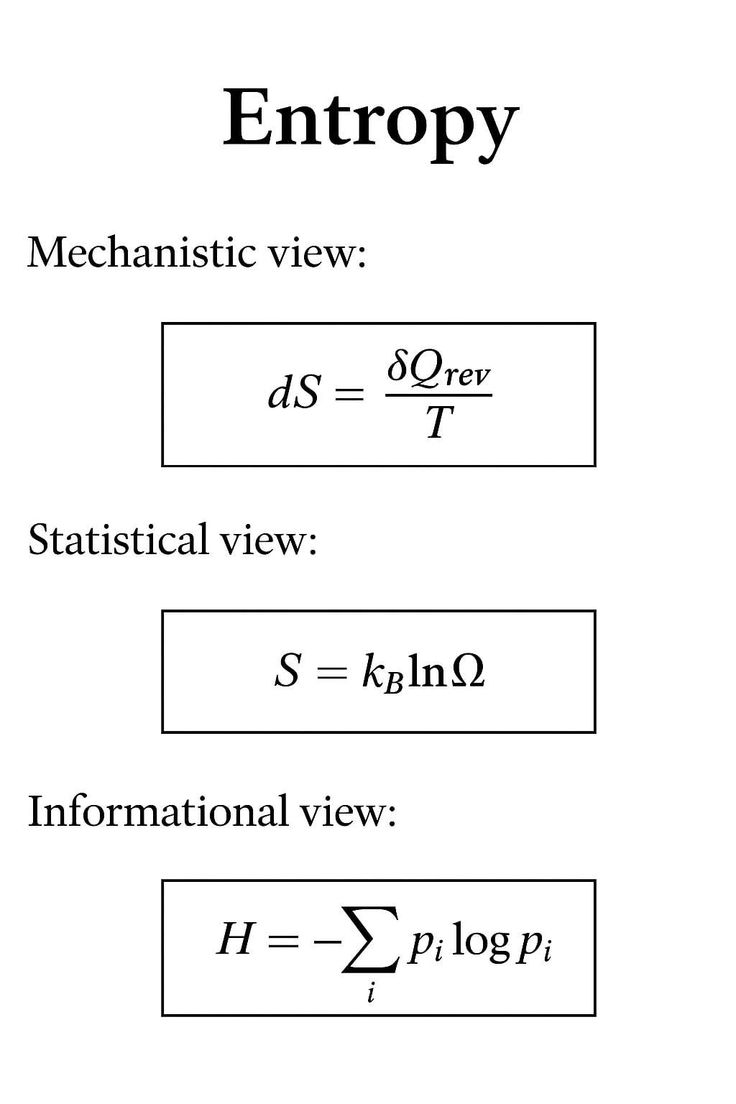
Entropy shows up in engines, molecules, and your phone’s data. This graphic lays out three perspectives.
Mechanistic: dS = δQ_rev / T for reversible processes. Statistical: S = k_B ln Ω linking to microstate count. Informational: H = −∑_i p_i log p_i for probability-based uncertainty.
These concepts power real-world tech like high-efficiency turbines in power plants, explain why cream mixes into coffee irreversibly, enable JPEG and MP3 compression to shrink files, and help train AI by measuring how much new info each prediction adds.
1
9
Bugjay retweeted

Jun 14
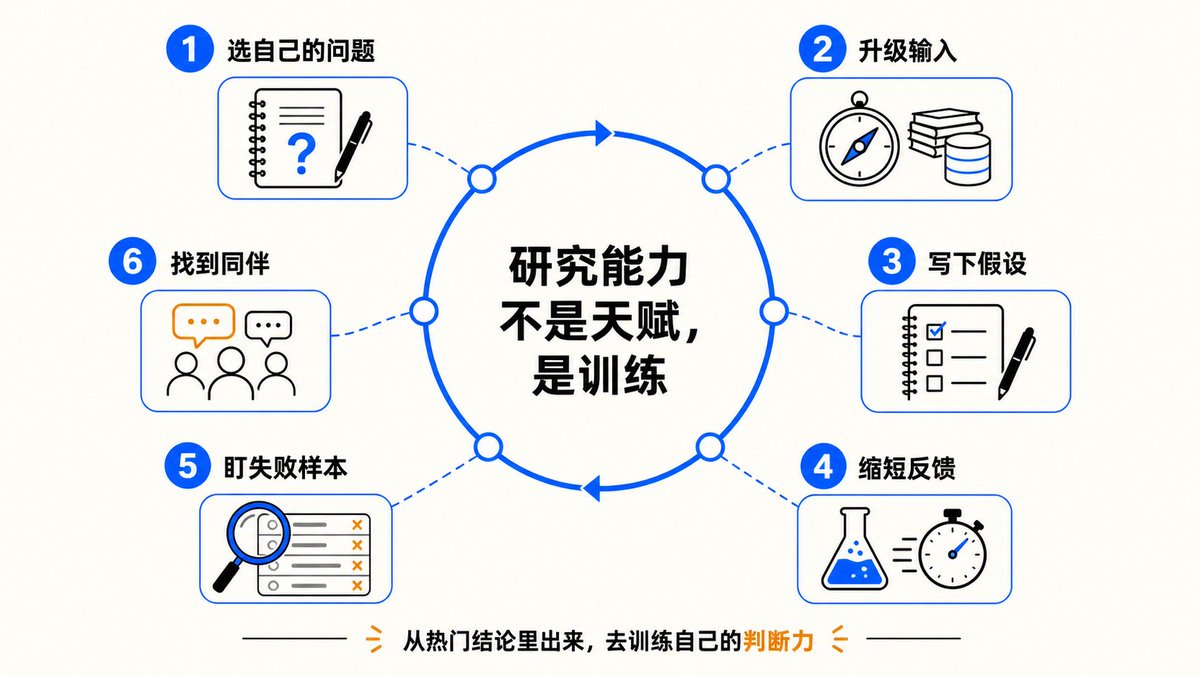
这篇 how to be good at research,我觉得挺好了,翻译了读了一次,我估计大家都不喜欢看文章,所以做了一下总结:
它讲的不是「怎么读论文」,而是一个更底层的事:
研究能力不是天赋,是一套可以训练的判断系统。
原文大概可以归纳成 6 个动作:
第一,选自己的问题。
别让导师、大厂发布会、热门论文、X 时间线替你选问题。别人已经冲进去的热门方向,通常意味着你比他们晚、算力比他们少、上下文也比他们薄。
真正好的问题,往往来自你想要一个结果,然后倒推:为了让这个结果成立,我需要验证什么?
第二,升级输入。
只看 arXiv 热榜、群聊转发、爆款 thread,最后会得到和所有人一样的想法。
原文说得很狠:共享阅读列表会制造共享观点。
更好的输入是旧论文、appendix、失败案例、原始数据、被忽略的限制条件。很多新东西,其实是旧东西换了名字重新跑一遍。
第三,把想法写下来。
脑子里的想法很会骗人,写出来才知道哪里断了。
最简单的研究日志就 5 行:
我假设什么?
我怎么测?
我预期会发生什么?
真实结果是什么?
我现在改信什么?
好记性不如烂笔头,只有自己写出来的,才是自己的上下文.
第四,缩短反馈回路。
研究速度不是「我读了多少」,而是「我多快发现自己错了」。
Karpathy 训练神经网络前会先 overfit 一个小 batch,先把问题缩到便宜、可控、能看见错误,再花大算力。
做 AI 产品、AI 副业也一样。
别一上来做完整系统。先做一个丑 demo、一个手动流程、一个飞书表、一个能跑通的 n8n 自动化。
先做,不要怕,AI时代重构的成本大大降低!
第五,盯输出,尤其盯失败输出。
内容发了,有几个赞,也不代表你理解用户。
你真正该看的,是没人点的笔记、没人回复的私信、客户卡住的步骤、AI 每次都写错的地方。
Andrew Ng 那个老办法很朴素:拉 100 个失败案例,手动读,分堆,先解决最大的一堆。
比如说,我知道翻译的x的文章几乎没人看,但是我还是想分享坐下记录,那就发长推.
第六,找到能一起打磨问题的人。
原文讲 Hamming 的「开门」逻辑:关门的人一年内做得更多,开门的人更容易做出重要的东西,因为打断里有真实世界的信息。
这句话放到今天,就是别只闭门造 prompt。
把半成品想法放出去,找人复现,找人骂,找人指出哪里不成立。
一个人可以走的很快,一群人才能走得更远.
我的看法是:
AI 时代工具会越来越多,教程会越来越便宜,模型能力也会持续下沉。
最后拉开差距的,是谁能更快形成判断,谁能更便宜地验证判断,谁能从失败里捡到下一步,而这,需要大量的积累.

30
15
71
11,122
Bugjay retweeted

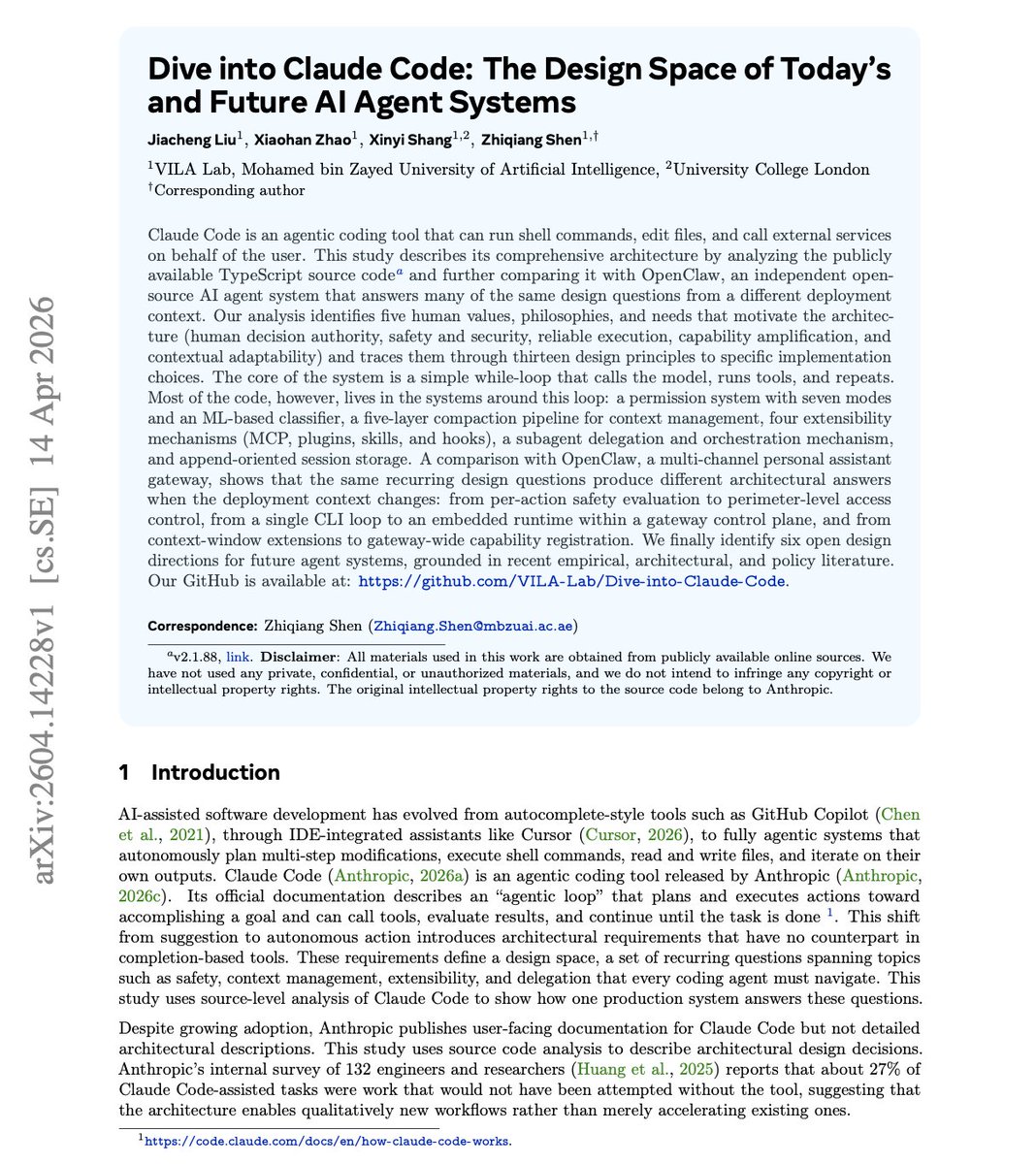
Claude Code fully dissected!
Researchers from UCL reverse-engineered the leaked Claude source. What they found changes how you should think about agent design.
Only 1.6% of the codebase is AI decision logic.
The other 98.4% is operational infrastructure. Permission gates, tool routing, context compaction, recovery logic, session persistence. The model reasons. The harness does everything else.
This is the opposite of what most agent frameworks do today.
LangGraph routes model outputs through explicit state machines. Devin bolts heavy planners onto operational scaffolding. Claude Code gives the model maximum decision latitude inside a rich deterministic harness, and invests all its engineering effort in that harness.
The core loop is a simple while-true. Call model, run tools, repeat.
But the systems around that loop are where the real design lives:
A permission system with 7 modes and an ML classifier. Users approve 93% of prompts anyway, so the architecture compensates with automated layers instead of adding more warnings.
A 5-layer context compaction pipeline. Each layer runs only when cheaper ones fail. Budget reduction, snip, microcompact, context collapse, auto-compact.
Four extension mechanisms ordered by context cost. Hooks (zero), skills (low), plugins (medium), MCP (high). Each answers a different integration problem.
Subagents return only summary text to the parent. Their full transcripts live in sidechain files. Agent teams still cost roughly 7x the tokens of a standard session.
Resume does not restore session-scoped permissions. Trust is re-established every session. That friction is the point.
The bet behind all of this is simple. As frontier models converge on raw coding ability, the quality of the harness becomes the differentiator, not the model.
Paper: Dive into Claude Code (arXiv:2604.14228)
We've shared an article on Agent Harness and what every big company is building.
Read it below.

51
299
1,771
217,215
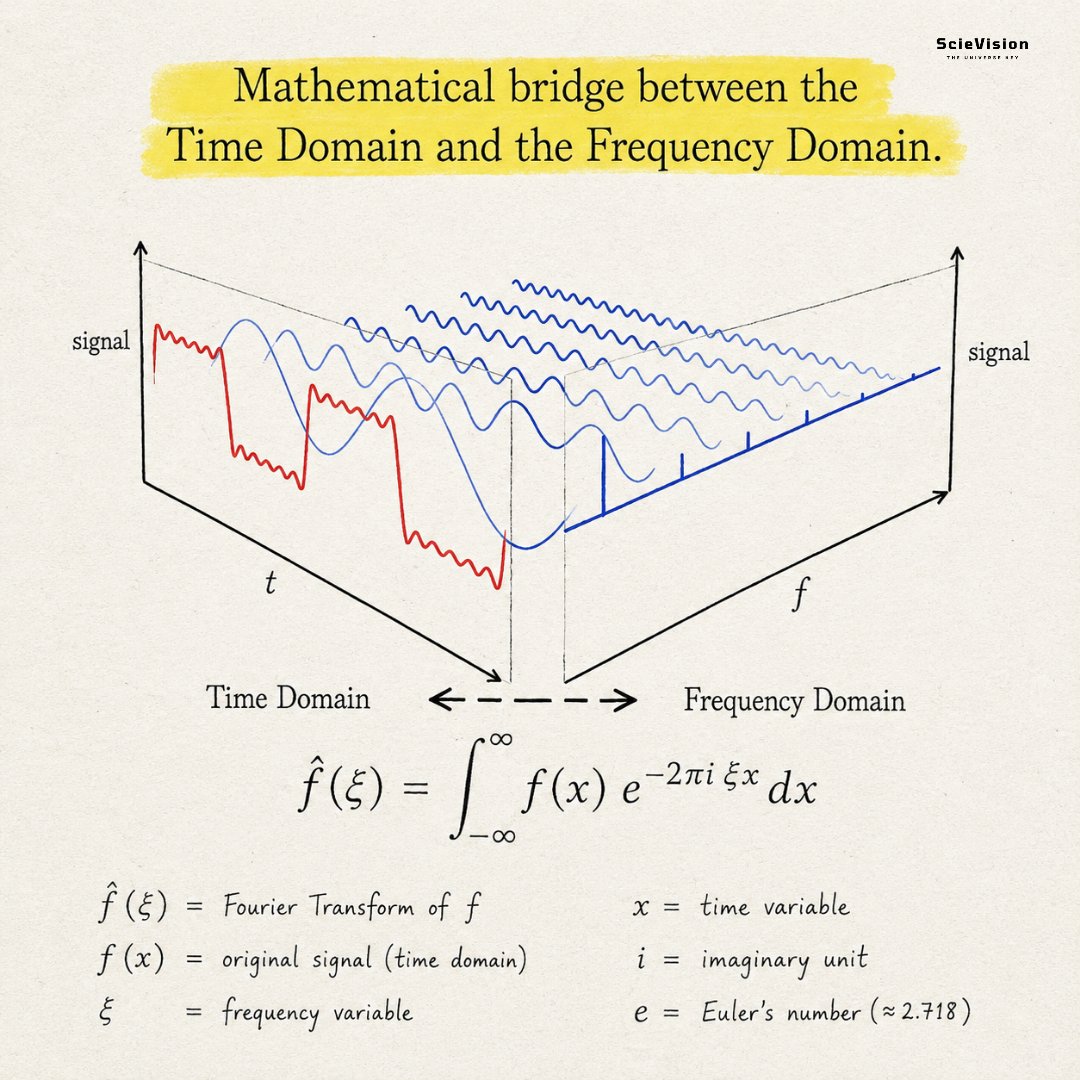
I am particularly fascinated by the Fourier Transform.
Any signal, no matter how complex, can be perfectly rebuilt from enough simple waves.
Jun 13

Mathematical bridge between the Time Domain and the Frequency Domain ✍️
The Fourier Transform answers a simple question: "what's inside this signal?".... Think about a musical chord. When you press three keys on a piano at the same time, you hear one combined sound. A trained musician can listen closely and identify each individual note hidden within that chord. That's what the Fourier Transform does, mathematically. It takes any complicated signal and identifies the simple, pure waves inside it, along with their amounts. The diagram illustrates this well. The red, messy wave on the left represents your real-world signal it could be a voice, a heartbeat, or a musical note. The clean blue waves spreading out are the simple components hidden within that signal. The spikes on the right act as a scoreboard a tall spike means that component is a significant part of the signal, while no spike indicates it's absent. The most amazing part is this: "any signal, no matter how rough or complex, can be perfectly reconstructed by adding enough simple smooth waves." A human voice, a stock market chart, or even a picture they are all made of simple ripples layered on top of one another. You can think of it like a prism splitting white light into a rainbow. White light appears as one simple thing, but the prism shows it is made up of many colors mixed together. The Fourier Transform serves as that prism for sound, images, radio signals, or anything else. It uncovers the hidden components that have always been there.
18
写作就是在做减法。
好书推荐,是一本值得反复阅读的书,《On Writing Well》
Jun 13

William Zinsser taught writing at Yale, then wrote the book that has fixed more bad writing than every English class combined.
Here are 10 cuts from "On Writing Well" that instantly make your writing twice as strong.
1) Delete every word doing no work

19
Bugjay retweeted

Jun 13
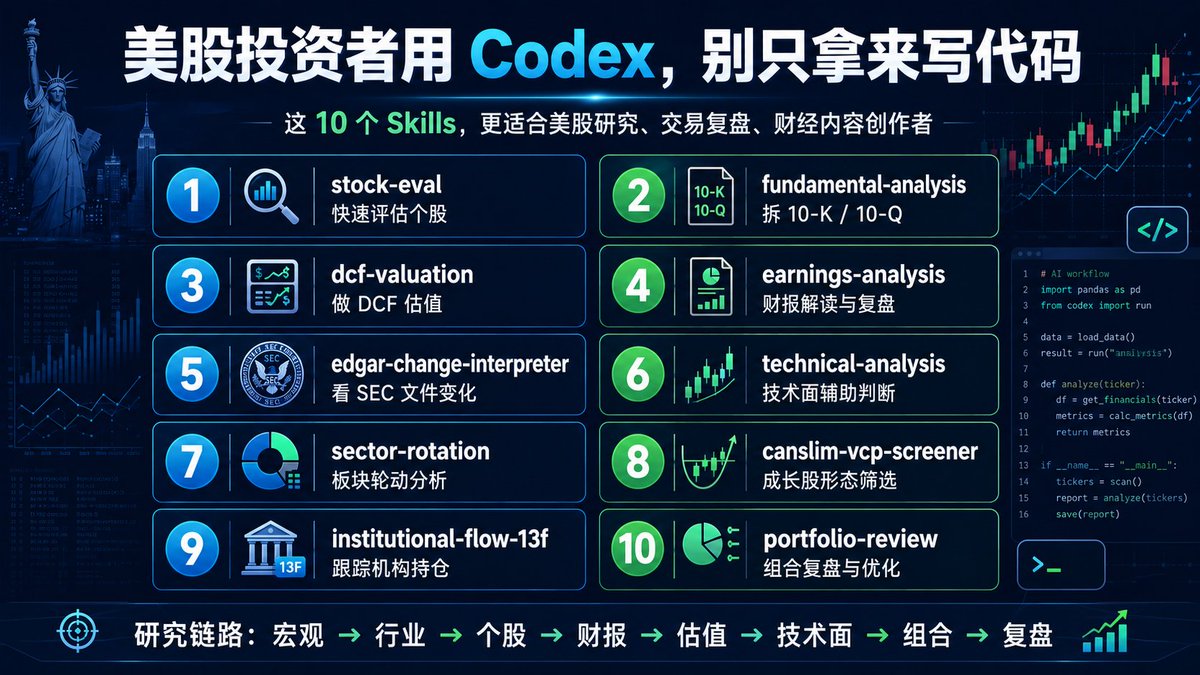
美股投资者用 Codex,别只拿来写代码。
这 10 个 Skills 更适合美股研究、交易复盘、财经内容创作者:
1、stock-eval
快速评估一只美股:质量、ROIC、Piotroski、估值、买/看/放弃信号
GitHub:
github.com/yennanliu/InvestS…
2、fundamental-analysis
拆 10-K / 10-Q:收入、利润率、现金流、资产负债表、会计质量
GitHub:
github.com/yennanliu/InvestS…
3、dcf-valuation
DCF 估值:WACC、终值、熊/基/牛三种情景、敏感性分析
GitHub:
github.com/yennanliu/InvestS…
4、earnings-analysis
财报季必备:业绩 beat/miss、guidance 变化、管理层口径、Q&A 风险点
GitHub:
github.com/HHFinAi/claude-eq…
5、edgar-change-interpreter
读 SEC 文件别只看总结,要看“变了什么”和“少说了什么”:10-K、10-Q、8-K 风险变化、披露陷阱
GitHub:
github.com/cmdrvl/edgar-chan…
6、technical-analysis
技术面辅助:MA、RSI、MACD、支撑阻力、周线结构、趋势确认
GitHub:
github.com/tradermonty/claud…
7、sector-rotation
看板块轮动:科技、金融、医疗、能源、消费谁在走强,市场处在什么阶段
GitHub:
github.com/tradermonty/claud…
8、canslim-vcp-screener
成长股筛选:CANSLIM、VCP、突破形态、成交量确认
GitHub:
github.com/tradermonty/claud…
9、institutional-flow-13f
看机构持仓:13F 变化、聪明钱流向、增持/减持、集中度变化
GitHub:
github.com/yennanliu/InvestS…
10、portfolio-review
组合复盘:仓位集中度、行业暴露、风险指标、再平衡建议、持仓 thesis 是否失效
GitHub:
github.com/tradermonty/claud…
美股研究链路就是:
宏观 → 行业 → 个股 → 财报 → 估值 → 技术面 → 组合 → 复盘
不要一次全装。
长期投资者先装:fundamental-analysis、dcf-valuation、earnings-analysis、edgar-change-interpreter。
交易型选手先装:technical-analysis、sector-rotation、canslim-vcp-screener、position-sizer。
财经内容创作者先装:stock-eval、earnings-analysis、portfolio-review、fact-check。
重点不是让 AI 替你荐股,而是把重复的投研动作变成标准流程。
#Codex #美股 #AI投研 #投资研究
15
113
348
23,790
自从 Word 可以直接使用 Claude 插件后,我已经彻底用它替代了 Ulysses。
原因很简单。
第一,写作已经离不开 AI。无论是构思、润色还是查漏补缺,AI 都成为了写作流程的一部分。
第二,我的日常工作需要大量审核和校对文稿,而 Claude 能显著提升这部分工作的效率。
更重要的是,写作不再是一个人的独白,当然大部分时间是一个人在苦思冥想。但是在写作过程中,我可以随时与 AI 讨论观点、推敲逻辑、碰撞想法,让思考不断向前推进。
今天在 word 上使用 claude,很感慨。
10 年前第一次使用 Ulysses 时,我觉得它惊艳无比:界面优雅、体验流畅,让写作变成了一件享受的事情。
但 AI 时代到来后,评价一款写作工具的标准已经改变了。仅仅“写得舒服”已经不够,能否与 AI 深度协作,正在成为新的核心竞争力。
曾经惊艳的 Ulysses,如今依然优秀,却已经不再是我写作工作流的中心。
2
39
如雷贯顶!这篇文章很好地讲述研究的意义和目的,让我理解研究的本质。
人人都在研究,但是研究的方法各有不同,带来的收益也不同。

1
3
388
言行一致就是最好的育儿方法
Jun 12

Someone asked me to recommend a good book on parenting. I would guess that most books about parenting are tedious. So my recommendation is to read autobiographies, the early parts of which are usually implicitly about parenting.
32
不要让 Agent 独自设计系统;人要负责目标、边界、接口和验收标准,Agent 负责低风险实现。
Jun 12

🛠️🧭 Principles for AI Coding → How to Build Production AI Agents with Claude.
𝗠𝘆 𝟳-𝗦𝘁𝗲𝗽 𝗿𝗼𝗮𝗱𝗺𝗮𝗽 𝗳𝗼𝗿 𝗯𝘂𝗶𝗹𝗱𝗶𝗻𝗴 𝘁𝗲𝘀𝘁𝗮𝗯𝗹𝗲, 𝗺𝗼𝗱𝘂𝗹𝗮𝗿, 𝗮𝗻𝗱 𝘀𝗮𝗳𝗲-𝘁𝗼-𝗰𝗵𝗮𝗻𝗴𝗲 𝗔𝗜-𝗴𝗲𝗻𝗲𝗿𝗮𝘁𝗲𝗱 𝗰𝗼𝗱𝗲.
Most AI engineers are hearing:
“Code is cheap.”
I think this is dangerously wrong.
Bad code is now more expensive because AI can multiply it faster.
My 7-Step roadmap for using AI coding agents like a pro:
》𝗦𝘁𝗲𝗽 𝟭: Turn the Prompt into a Design Mission
✸ Define the goal, constraints, risk, and acceptance criteria.
✸ Tell the agent what “done” means before it starts.
✸ Do not start from a vague request.
→ Example: “Interview me first. Find the failure paths.”
》𝗦𝘁𝗲𝗽 𝟮: Build a Shared Design Concept
✸ Make the agent ask questions before planning.
✸ Resolve unclear decisions early.
✸ Do not confuse a generated plan with understanding.
→ Example: “What can break before we write the PRD?”
》𝗦𝘁𝗲𝗽 𝟯: Create a Shared Language
✸ Define domain terms, modules, actions, and data names.
✸ Use the same words in prompts, code, tests, and docs.
✸ Do not let the agent rename concepts every sprint.
→ Example: “PatientRiskScore” means one thing everywhere.
》𝗦𝘁𝗲𝗽 𝟰: Give the Agent a Module Map
✸ Show where the change belongs.
✸ Name the module, interface, dependencies, and boundaries.
✸ Do not let the agent wander through the repo.
→ Example: Retry logic belongs behind PaymentGateway.
》𝗦𝘁𝗲𝗽 𝟱: Force Small Feedback Loops
✸ Use tests, types, linting, logs, and browser checks.
✸ Make the agent check after small changes.
✸ Do not let it write 800 lines before testing.
→ Example: Red test, code, type check, green test, refactor.
》𝗦𝘁𝗲𝗽 𝟲: Design Deep Modules
✸ Hide complexity behind simple interfaces.
✸ Build fewer, stronger boundaries.
✸ Do not create 40 tiny helper files.
→ Example: One ingestion service hides parsing, chunking, storage, and errors.
》𝗦𝘁𝗲𝗽 𝟳: Own the Interface, Verify the Code
✸ You design contracts, schemas, methods, and review points.
✸ Let the agent implement low-risk internals.
✸ Check tests, logs, affected modules, and regression risk.
→ Example: Approve the tool schema before Claude writes the handler.
𝗣𝗹𝗲𝗮𝘀𝗲 𝗥𝗲𝗺𝗲𝗺𝗯𝗲𝗿:
Let Claude write the code, but do not let it design the system alone.
Before you ship, check the interface, the tests, the failure paths, and the modules it touched.
That is where AI engineers stand out now.
--
📥 Skip the trial-and-error of building production AI agents.
Watch my free 30-min training get 88 pages of production guides.
Join 46,000 AI engineers, architects, and directors.
👉 maryammiradi.com/free-ai-age…
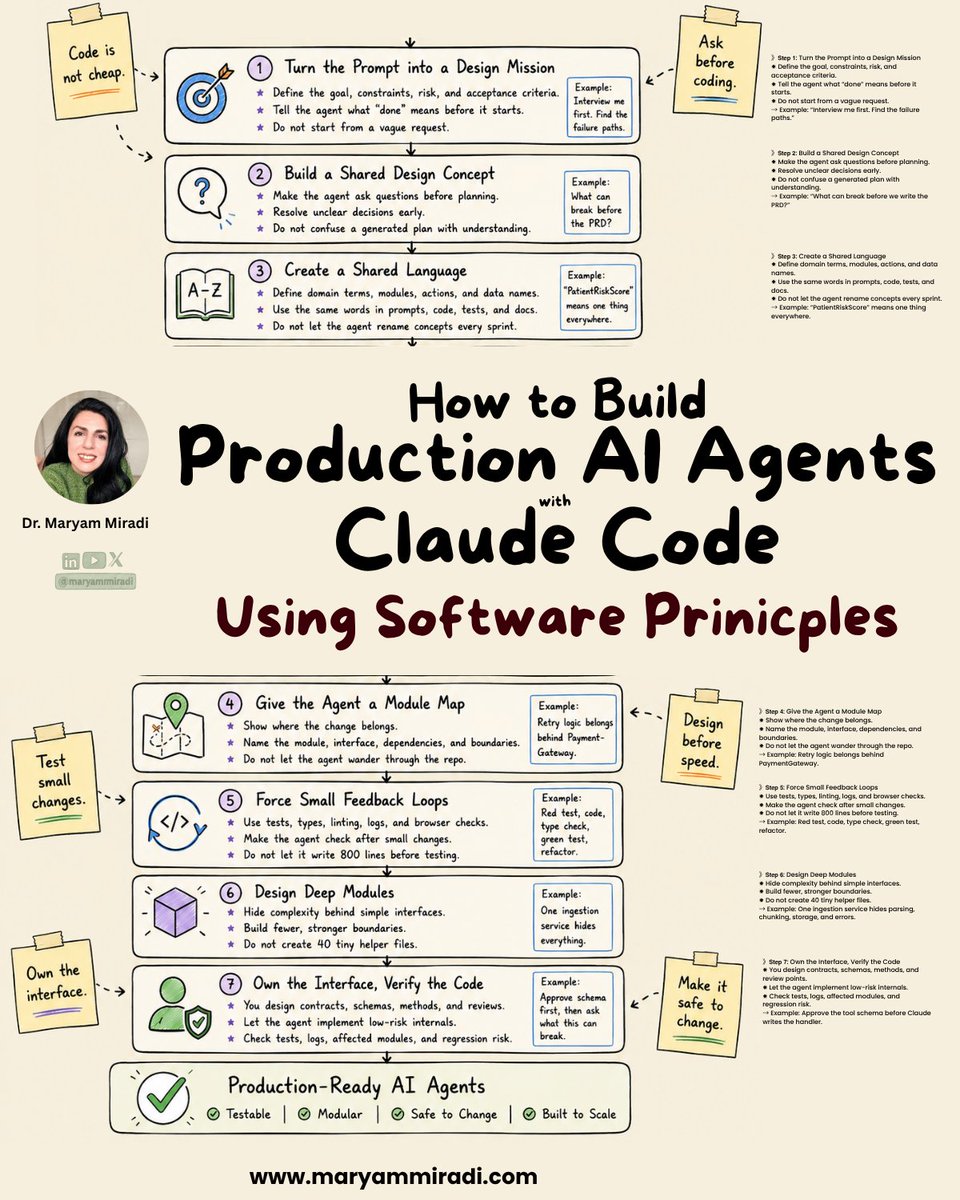
ALT Infographic titled “How to Build Production AI Agents with Claude Code Using Software Principles” by Dr. Maryam Miradi. The visual presents a 7-step framework for building production-ready AI agents: turn the prompt into a design mission, build a shared design concept, create a shared language, give the agent a module map, force small feedback loops, design deep modules, and own the interface while verifying the code. The roadmap emphasizes planning before coding, shared understanding, modular architecture, frequent testing, clear interfaces, and safe change management. The outcome is AI-generated software that is testable, modular, safe to change, and built to scale.
22
这张图可以吹一辈子
Jun 12

Next time you think of giving up, remember this photo of Elon in 2008.

1
23
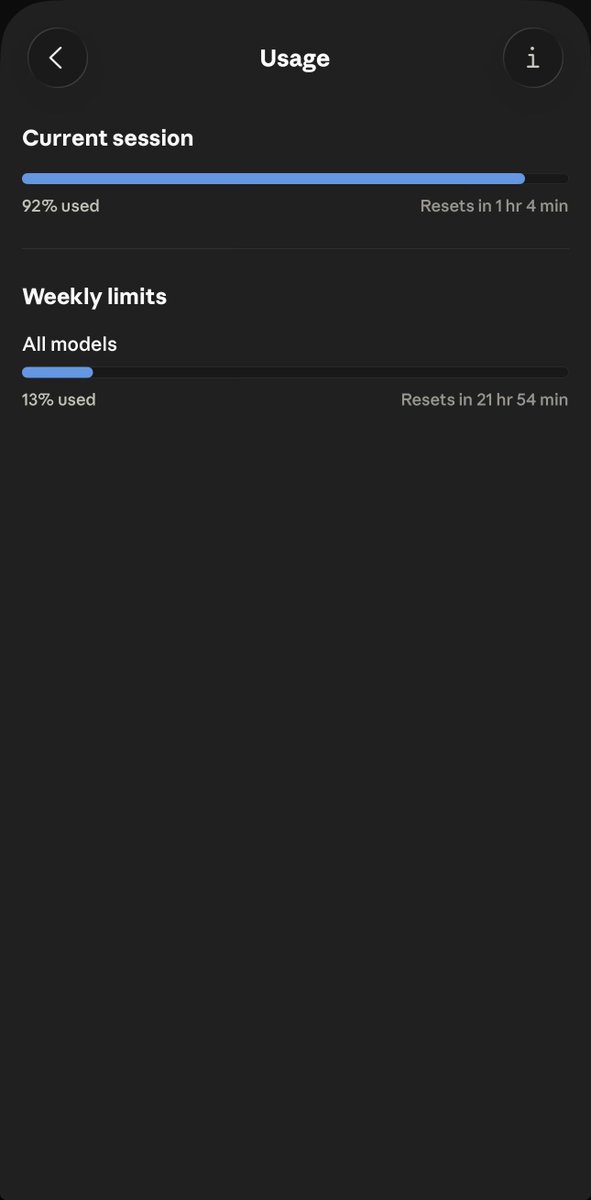
这个要感谢codex,claude也开始重置
Jun 13

We've reset 5-hour and weekly rate limits for all users.
25